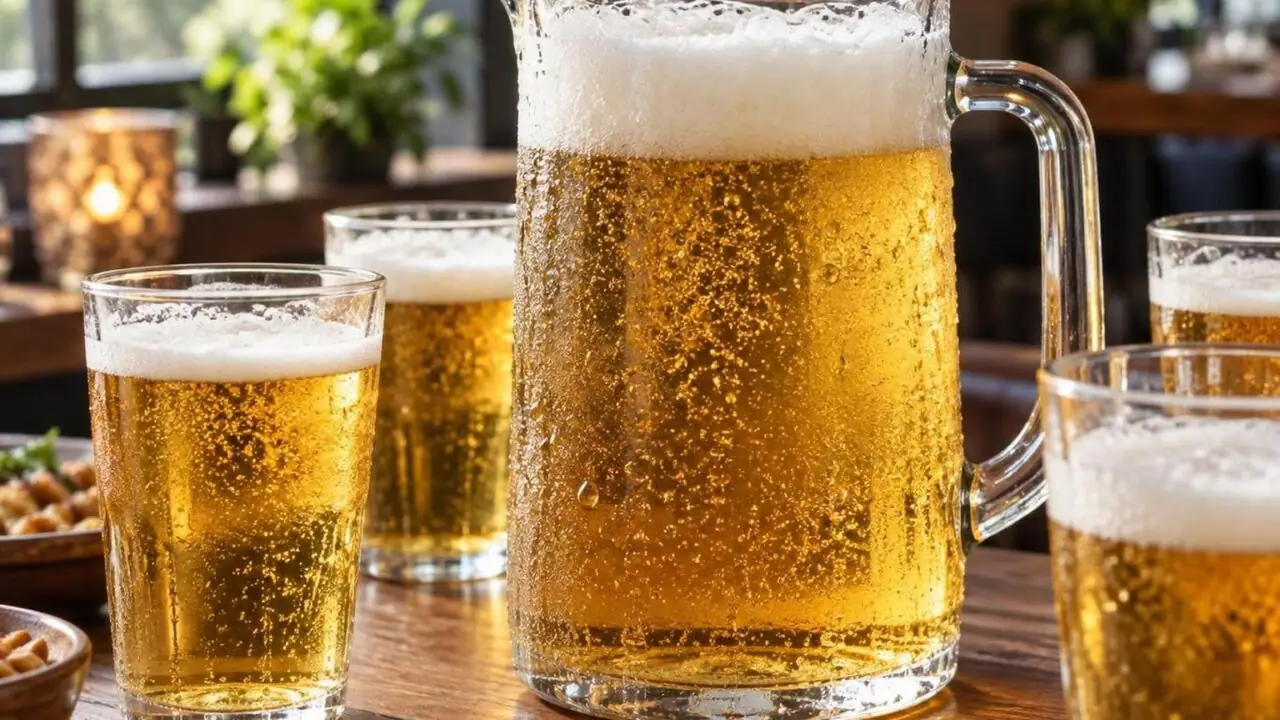
How Many 12 Oz Beers in a Pitcher? is 5 12 oz beers in a standard 60 oz pitcher. Many U.S. bars use 60 oz pitchers, though 48 oz and 64 oz pitchers are also common, changing the count to 4 or about 5.3 beers.
The useful rule is simple: divide the pitcher’s fluid ounces by 12.
This article breaks down common pitcher sizes, beer counts, serving expectations, and why foam, glass size, and house pours can make the real table count slightly lower than the math.
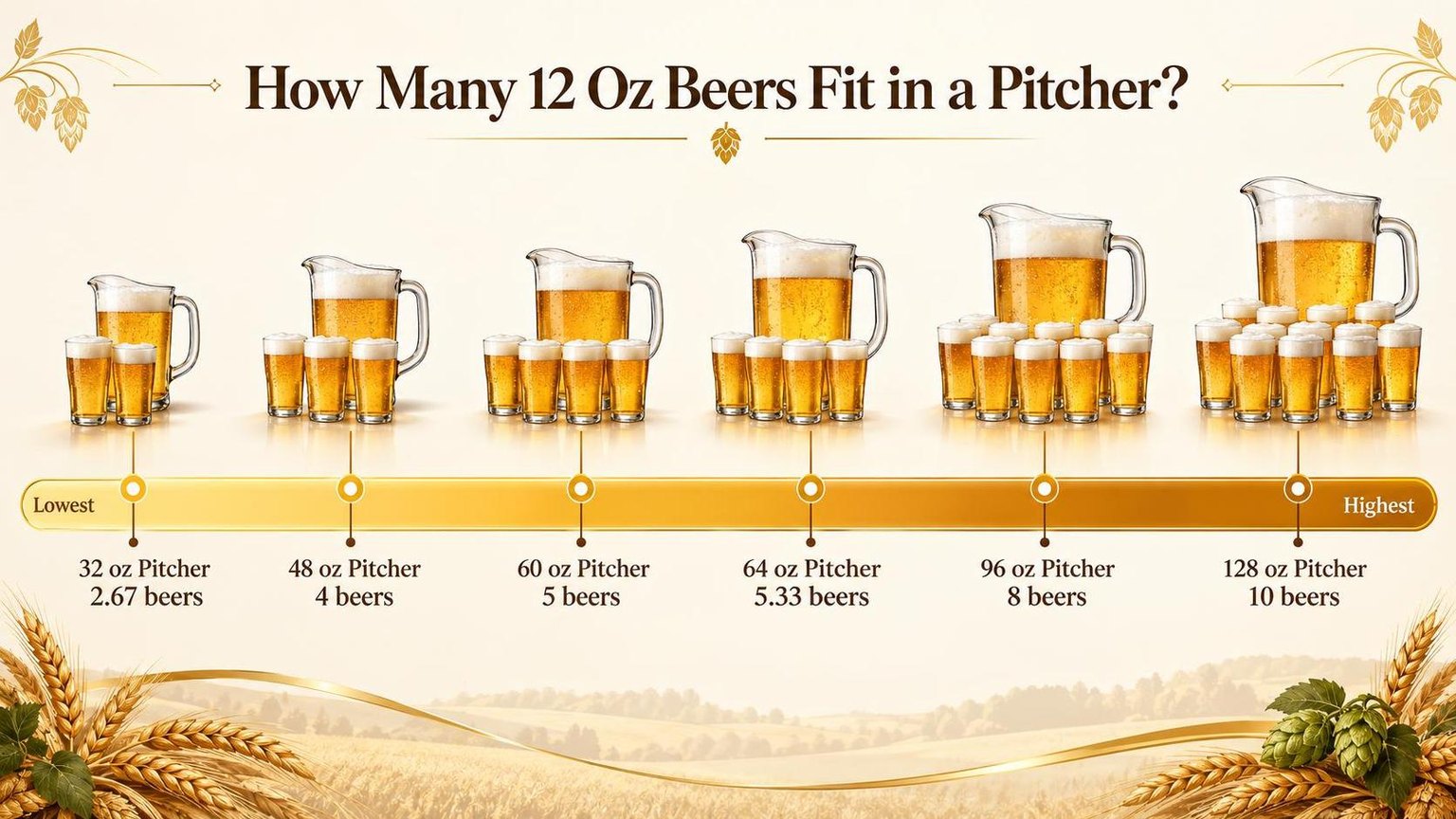
Standard Pitcher Sizes in Ounces
Beer pitchers in the United States come in two dominant sizes: 48 oz and 60 oz. Knowing the exact capacity matters because it directly determines how many 12 oz pours you get and how much you’re paying per beer.
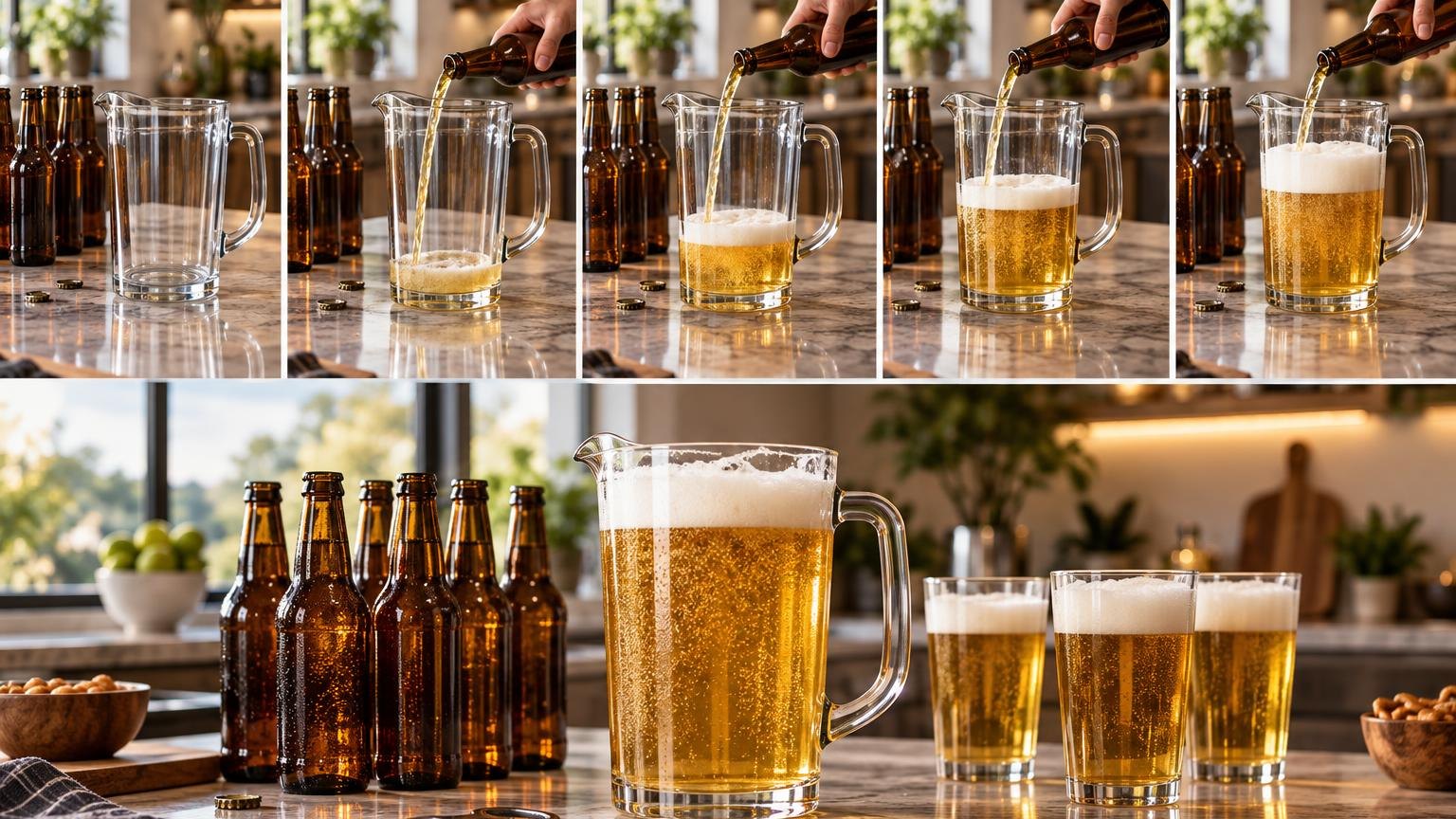
The Two Standard Sizes
The 48 oz pitcher is the smaller standard, holding exactly 4 beers at 12 oz each. The 60 oz pitcher is the most common size served at American bars and restaurants, yielding 5 full 12 oz pours.
| Pitcher Size | Ounces | 12 Oz Beers | 16 Oz Pints |
| Small | 32 oz | 2.67 | 2 |
| Medium | 48 oz | 4 | 3 |
| Standard/Large | 60 oz | 5 | 3.75 |
| Extra Large | 64 oz (half gallon) | 5.33 | 4 |
Why 60 Oz Dominates
The 60 oz pitcher became the American bar standard because it divides evenly into 12 oz servings. Five clean pours with no leftover beer means efficient service and straightforward pricing for establishments.
Most major restaurant supply brands — Carlisle, Winco, Cambro — manufacture their primary beer pitchers at 60 oz capacity. This reinforces the size as the default across chains and independent bars alike.
The 32 Oz and 64 Oz Outliers
Some brewpubs and casual dining spots use 32 oz pitchers, essentially personal-sized vessels holding roughly 2⅔ standard beers. These work well for tables of two or for sampling craft offerings.
The 64 oz pitcher equals exactly half a gallon. It appears less frequently at bars but is common in retail plastic pitchers sold at stores like Target and Walmart for home use.
Regional and Venue Variations
Not every pitcher is labeled by the ounce. Some venues advertise by liters instead. A 1.5-liter pitcher holds approximately 50.7 oz — between the 48 oz and 60 oz American standards.
- Sports bars: typically stock 60 oz pitchers, occasionally offering 48 oz as a “small” option
- Brewpubs: often use 32 oz or 48 oz pitchers to encourage sampling multiple styles
- Pizza chains: most default to 60 oz pitchers — Shakey’s, Round Table, and similar concepts
- German-style beer halls: may serve 1-liter (33.8 oz) or 2-liter (67.6 oz) pitchers
Always confirm the pitcher size before ordering. A 48 oz pitcher priced identically to a competitor’s 60 oz version costs you 25% more per beer — a significant difference over a night out.
How Many 12 Oz Beers Fit
A standard U.S. bar pitcher usually holds enough beer for about five 12-ounce servings. The exact count depends on the pitcher’s stated capacity, the amount of foam, ice-free volume, and whether staff pour to the rim or leave headspace.
The most common pitcher capacities are 60 and 64 fluid ounces. A 60-ounce pitcher equals five full 12-ounce beers; a 64-ounce pitcher provides five full servings plus four ounces remaining.
| Pitcher capacity | Equivalent 12-ounce beers | Beer remaining after full servings |
| 48 fluid ounces | 4 full beers | 0 fluid ounces |
| 60 fluid ounces | 5 full beers | 0 fluid ounces |
| 64 fluid ounces | 5 full beers | 4 fluid ounces |
| 72 fluid ounces | 6 full beers | 0 fluid ounces |
| 96 fluid ounces | 8 full beers | 0 fluid ounces |
| 128 fluid ounces | 10 full beers | 8 fluid ounces |
Why a Poured Pitcher May Serve Less
Capacity markings describe total liquid volume, not necessarily the usable beer volume delivered at the table. Draft beer requires a foam head, and a pitcher commonly arrives below its rim to reduce spills during service.
A properly poured draft beer has a foam collar, often called a head. Foam is not wasted beer: it releases carbonation, carries aroma, and slows rapid carbon-dioxide loss. Still, foam occupies pitcher space before it settles.
| Nominal pitcher capacity | Example beer volume after allowing headspace | Approximate 12-ounce servings |
| 60 fluid ounces | 54 fluid ounces | 4.5 servings |
| 64 fluid ounces | 58 fluid ounces | 4.8 servings |
| 72 fluid ounces | 65 fluid ounces | 5.4 servings |
These examples use a ten-percent allowance for headspace and foam. Actual yield changes with beer style, faucet setup, glassware, temperature, and pour technique; highly carbonated beers can create more foam than low-carbonation ales.
Check the Menu Description
“Pitcher” is not a regulated serving-size term. A restaurant can use a smaller glass vessel, a plastic pitcher, or a large-format carafe, so the menu’s listed fluid-ounce capacity is the reliable measure.
Ask whether the stated volume is the vessel’s maximum capacity or the amount of beer served. That distinction matters when splitting a pitcher among a group, especially when each person expects a full 12-ounce equivalent.
- A 60-ounce pitcher divides evenly among five people at 12 ounces each.
- A 64-ounce pitcher gives five people 12 ounces each, with four ounces left.
- A 48-ounce pitcher serves four full 12-ounce portions.
- Ordering by stated ounces prevents assuming every pitcher equals five beers.
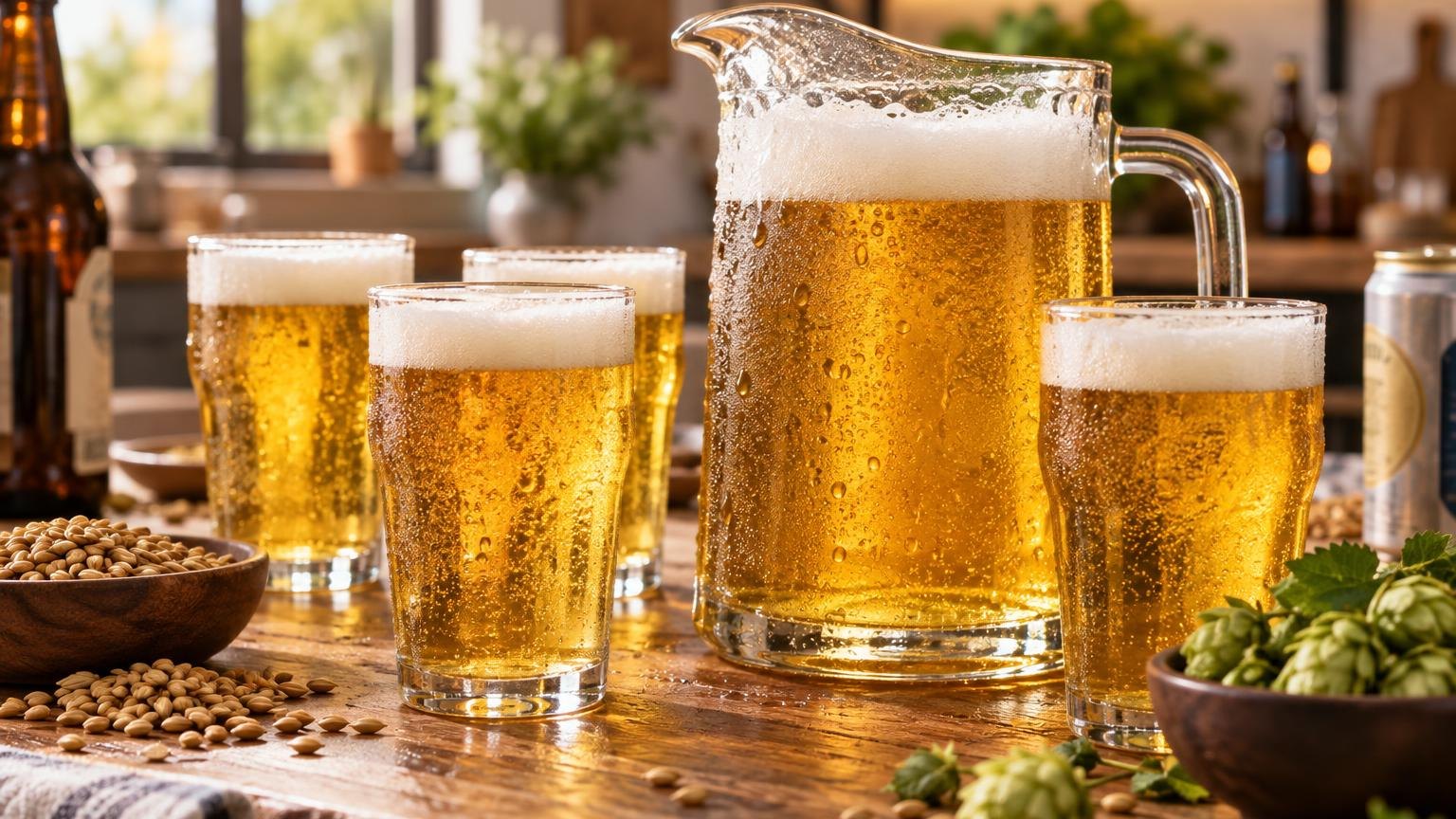
US Pitcher Sizes by Venue
Not every pitcher holds the same volume. US establishments serve pitchers ranging from 32 oz to 64 oz depending on venue type, state regulations, and business model. Knowing the standard at each venue type prevents ordering surprises.
Standard Pitcher Volumes by Venue Type
| Venue Type | Common Pitcher Size | 12 oz Beers per Pitcher |
| Sports bars | 60 oz | 5 |
| Casual dining chains (Applebee’s, Chili’s, Buffalo Wild Wings) | 60 oz | 5 |
| Craft breweries / brewpubs | 32–48 oz | 2.7–4 |
| College-town bars | 48–60 oz | 4–5 |
| Dive bars | 60 oz | 5 |
| German beer halls | 64 oz (half-gallon) | 5.3 |
| Pizza restaurants | 48–60 oz | 4–5 |
Why Sizes Vary
Craft breweries favor smaller 32 oz or 48 oz pitchers because their beers carry higher ABV levels, often 6–10%. Serving smaller volumes limits over-consumption per round and preserves flavor before the beer warms.
Sports bars and casual dining chains default to 60 oz pitchers. This size splits evenly into five 12 oz pours, simplifying service and pricing across large-format draft menus.
Some German-style beer halls in cities like Denver, Milwaukee, and Cincinnati use 64 oz pitchers—a true half-gallon. That yields roughly 5.3 standard 12 oz pours per pitcher.
State and Local Regulations
Certain jurisdictions cap individual pitcher size. Utah limits beer pitchers to patrons in groups of two or more. Some Oklahoma municipalities historically restricted pitcher service entirely at bars without food service.
In states with stricter alcohol control boards, like Pennsylvania and Massachusetts, establishments may serve only 48 oz pitchers to comply with responsible-service guidelines tied to their liquor license category.
Quick Reference: Pours per Pitcher
- 32 oz pitcher: 2 full 12 oz beers + 8 oz remaining (roughly 2⅔ pours)
- 48 oz pitcher: 4 full 12 oz beers
- 60 oz pitcher: 5 full 12 oz beers
- 64 oz pitcher: 5 full 12 oz beers + 4 oz remaining (5⅓ pours)
Always confirm pitcher size with your server before ordering. A $16 pitcher priced on 60 oz yields $3.20 per beer—but the same price on a 48 oz pitcher raises your per-beer cost to $4.00.
Draft Beer Foam Changes the Count
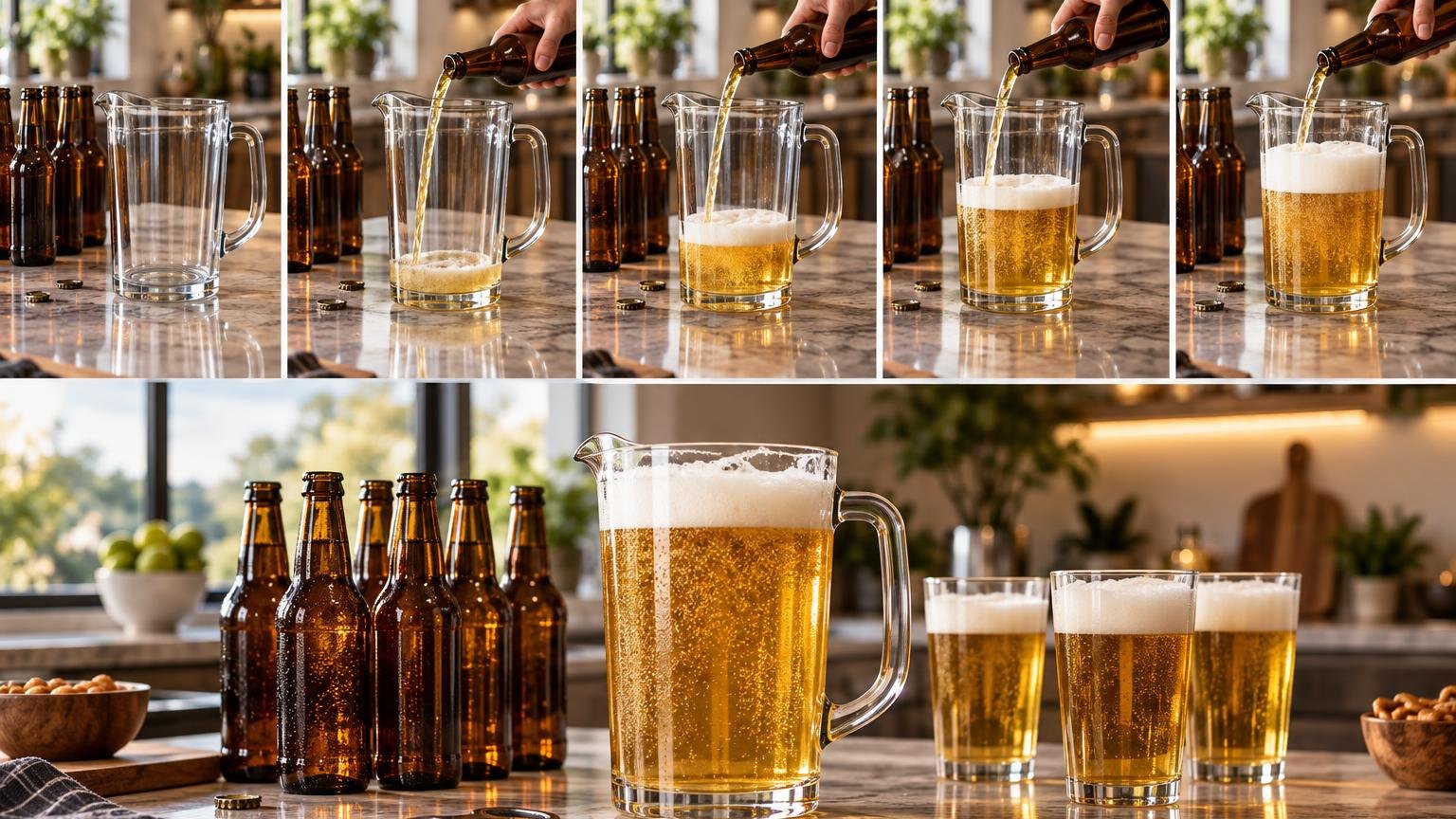
A standard 60 oz pitcher theoretically holds five 12 oz beers, but draft beer foam (called “head”) steals real liquid volume.
Bartenders pouring from a tap routinely lose 10–25% of pitcher capacity to foam, dropping the actual beer count significantly.
How Foam Reduces Liquid Volume
Beer foam is approximately 25% liquid and 75% gas (CO₂). A one-inch head on a standard pint glass displaces roughly 1.5–2 oz of liquid beer. In a pitcher, foam accumulates faster due to the wider pour surface and greater turbulence.
An inexperienced pour can produce 2–3 inches of foam in a pitcher, consuming 10–15 oz of total volume. That transforms a 60 oz pitcher into just 45–50 oz of drinkable beer.
Actual Beer Count by Foam Level
| Foam Level | Liquid Beer in 60 oz Pitcher | 12 oz Beers |
| No foam (perfect pour) | 60 oz | 5.0 |
| ½-inch head | 55–57 oz | 4.6–4.75 |
| 1-inch head | 50–53 oz | 4.2–4.4 |
| 2-inch head (poor pour) | 45–48 oz | 3.75–4.0 |
| 3-inch head (very poor pour) | 40–43 oz | 3.3–3.6 |
Factors That Increase Foam
- Warm glassware: A pitcher at room temperature produces 20–30% more foam than a chilled one held at 34–38 °F.
- Dirty lines: Beer lines cleaned less than every two weeks build biofilm that nucleates excess CO₂ release.
- Over-carbonated kegs: CO₂ pressure set above 12–14 PSI at 38 °F forces more gas into solution, creating explosive foam on pour.
- High-protein styles: Wheat beers and IPAs produce denser, longer-lasting heads than lagers, reducing pourable liquid by an extra 5–8%.
- Pouring angle: A straight vertical pour generates roughly twice the foam of a 45-degree tilt pour.
What This Means at the Table
Realistically, a well-poured 60 oz draft pitcher delivers 4 to 4.5 full 12 oz glasses—not five. Experienced bartenders target a ½-inch collar of foam, balancing flavor release with maximum liquid yield.
If your group needs exactly five full 12 oz servings, order a 64 oz pitcher instead. That extra 4 oz provides a buffer against normal foam loss during a proper tap pour.
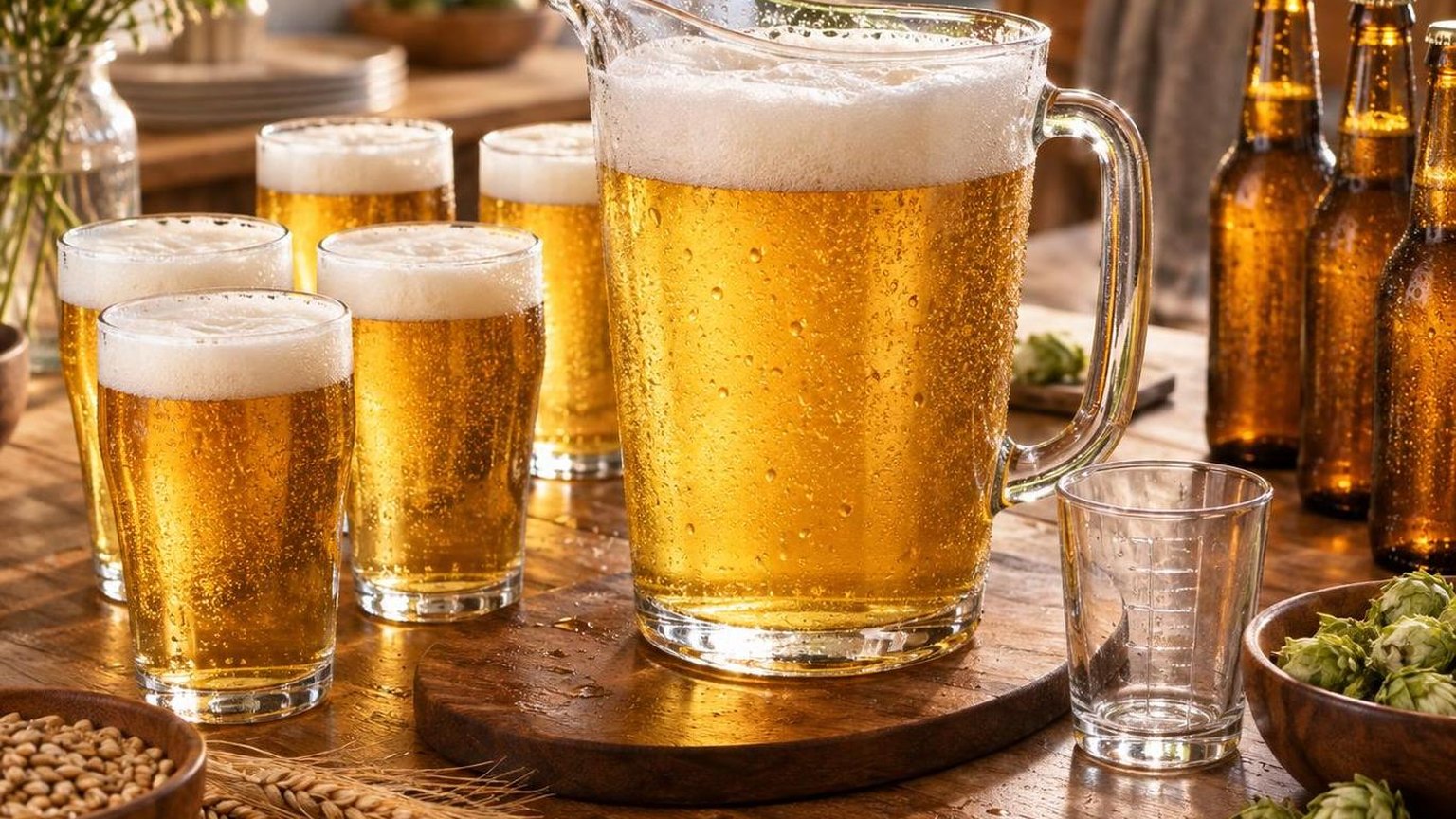
Quick Formula for Any Pitcher
The formula is straightforward: divide the pitcher’s total fluid ounces by 12. This gives you the exact number of standard 12 oz beer servings. Memorize this single calculation and you’ll never over-order or under-order again.
The Core Equation
Number of beers = Pitcher volume (oz) ÷ 12
A standard US pitcher holds 60 oz. Dividing 60 by 12 yields exactly 5 beers. That clean number is why the 60 oz size became the industry default.
Common Pitcher Sizes Calculated
| Pitcher Size | Fluid Ounces | ÷ 12 | 12 oz Beers |
| Small / Half Pitcher | 32 oz | 32 ÷ 12 | 2.67 (about 2⅔) |
| Medium | 48 oz | 48 ÷ 12 | 4.00 (exactly 4) |
| Standard | 60 oz | 60 ÷ 12 | 5.00 (exactly 5) |
| Large | 64 oz | 64 ÷ 12 | 5.33 (about 5⅓) |
Adjusting for Different Glass Sizes
Not everyone drinks from a 12 oz glass. Swap the divisor for whatever serving size your group prefers.
| Glass Size | Beers from 60 oz Pitcher |
| 10 oz (small tumbler) | 6.0 servings |
| 12 oz (standard) | 5.0 servings |
| 16 oz (US pint) | 3.75 servings |
| 20 oz (Imperial pint) | 3.0 servings |
Account for Foam and Pour Loss
In practice, you lose roughly 5–10% of a pitcher’s volume to foam head and residual liquid left behind. Factor this into your math for realistic counts.
- Generous foam: Subtract about 10%, turning a 60 oz pitcher into ~54 usable ounces (4.5 beers instead of 5).
- Controlled pour: Subtract about 5%, yielding ~57 usable ounces (4.75 beers).
- Tip: Tilt each glass at 45 degrees and pour slowly down the side to minimize foam loss.
Quick Mental Shortcut
If you don’t know the pitcher’s exact ounce capacity, most bars use the 60 oz standard. Ask your server to confirm — sizes vary by establishment, especially between casual chains and craft breweries.
For group planning, round down after dividing. A 64 oz pitcher mathematically gives 5.33 beers, but after foam loss you’ll realistically pour 5 full glasses. Rounding down prevents the awkward half-empty final pour that nobody wants.
Ordering Pitchers for a Group
Ordering pitchers instead of individual pints saves 15–25% at most bars and restaurants. A standard 60 oz pitcher holds five 12 oz servings, making group math straightforward once you know your party size and drinking pace.
Pitchers Needed by Group Size
Use this table assuming each person drinks two to three 12 oz beers over a two-hour period.
| Group Size | Beers Needed (2 each) | Beers Needed (3 each) | Pitchers (60 oz) at 2 each | Pitchers (60 oz) at 3 each |
| 4 people | 8 | 12 | 2 | 3 |
| 6 people | 12 | 18 | 3 | 4 |
| 8 people | 16 | 24 | 4 | 5 |
| 10 people | 20 | 30 | 4 | 6 |
| 12 people | 24 | 36 | 5 | 8 |
Round up to the next whole pitcher. Leftover beer beats running short mid-conversation.
Cost Comparison: Pitchers vs. Individual Beers
Average US bar prices illustrate the savings clearly.
| Order Method | Typical Price | Cost per 12 oz Serving |
| Individual pint (16 oz) | $6–$8 | $4.50–$6.00 |
| 60 oz pitcher | $15–$22 | $3.00–$4.40 |
| 48 oz pitcher | $12–$18 | $3.00–$4.50 |
A group of six ordering three pitchers at $18 each pays $54 total—roughly $9 per person for three beers. Ordering individually at $7 per pint would cost $126.
Practical Tips for Group Orders
- Confirm pitcher size first. Bars use 48 oz, 60 oz, or 64 oz pitchers. Ask your server which size they pour.
- Order one pitcher per 4–5 people as a starting round, then reassess after 30 minutes.
- Request extra glasses. Pitchers arrive with 4 glasses by default at most establishments.
- Account for non-drinkers. Subtract them before calculating—wasted beer erases your savings.
- Stick to one style per pitcher. Splitting a pitcher across different beers isn’t possible, so pick a crowd-pleaser like a lager or pale ale.
- Watch temperature. Beer warms noticeably after 15–20 minutes. Order smaller rounds more frequently in warm weather rather than one oversized order.
Pitcher service works best for groups of 4–12. Beyond 12 people, many bars recommend kegs or bucket deals, which drop per-serving costs below $2.50.
Questions Readers Ask
How many 12 oz beers fit in a standard 60 oz pitcher?
A standard 60 oz pitcher holds exactly 5 full 12 oz beers. This is the most common pitcher size served in American bars and restaurants, making it an economical choice for groups of 4–5 people.
How many 12 oz beers are in a 48 oz pitcher?
A 48 oz pitcher yields 4 full 12 oz pours. This smaller pitcher format is frequently used in brewpubs and casual dining chains where tables seat 2–3 guests, and it typically costs $2–$4 less than a 60 oz pitcher.
Does foam reduce the number of 12 oz beers you get from a pitcher?
Yes. A typical pour produces about 0.5–1 inch of foam head, which means a 60 oz pitcher realistically delivers closer to 4 full 12 oz beers plus one partial glass of around 8–10 oz.
Bartenders who pour with excessive foam can reduce your usable volume by 10–15%.
Is it cheaper to order a pitcher instead of individual 12 oz beers?
In most US bars, a 60 oz pitcher costs $15–$22 for domestic beers, while five individual 12 oz drafts run $25–$35 at $5–$7 each. That puts savings at roughly 30–40% per ounce when ordering by the pitcher.
How many 12 oz beers are in a 32 oz mini pitcher?
A 32 oz mini pitcher holds 2 full 12 oz beers with about 8 oz left over—enough for a generous two-thirds of a third glass.
These smaller pitchers are common at sports bars for couples or solo drinkers who want draft beer at a slight volume discount.
How many pitchers of 12 oz beers equal a half-barrel keg?
A US half-barrel keg contains 1,984 oz, which equals approximately 33 full 60 oz pitchers or about 165 individual 12 oz beers.
For large events, knowing this conversion helps estimate whether buying a keg is more cost-effective than ordering pitchers at a venue.
Related Reading
- How To Take Labels Off Wine Bottles?
- How Many Cups Is 6 Tablespoons? – 2026
- How Many Pounds Is 13 Stone?
- What Wine Is Sweet And Fruity?
- How Many Ml In 15 Oz?
- How Many Gallons Is 10 L?
- How Many Bottles In A Case Of Wine?
- All Blog Guides
- National Institute on Alcohol Abuse and Alcoholism (2023)
- Centers for Disease Control and Prevention (2024)
- U.S. National Library of Medicine / MedlinePlus (2022)
- Dietary Guidelines for Americans – USDA & HHS (2020)
- National Institute of Standards and Technology – Units of Measurement (2023)
- University of Notre Dame – Standard Drink Equivalents (2023)
- Brewers Association (2024)
- Cornell University – Alcohol Policy Information System Resource (2023)