Moscato is the clearest answer to What Wine Is Sweet And Fruity: it is a low-alcohol, aromatic wine with peach, orange blossom, and ripe grape flavors.
Other reliable sweet, fruity choices include Riesling labeled Spätlese or Auslese, Brachetto d’Acqui, Lambrusco Dolce, and sweet rosé.
Sweetness comes from residual sugar left after fermentation, while fruitiness comes from grape aroma compounds and winemaking style.
For beginners, look for “sweet,” “dolce,” “demi-sec,” or “late harvest” on the label, and expect lower perceived dryness, softer acidity, and flavors like apricot, strawberry, raspberry, honey.
Or tropical fruit.
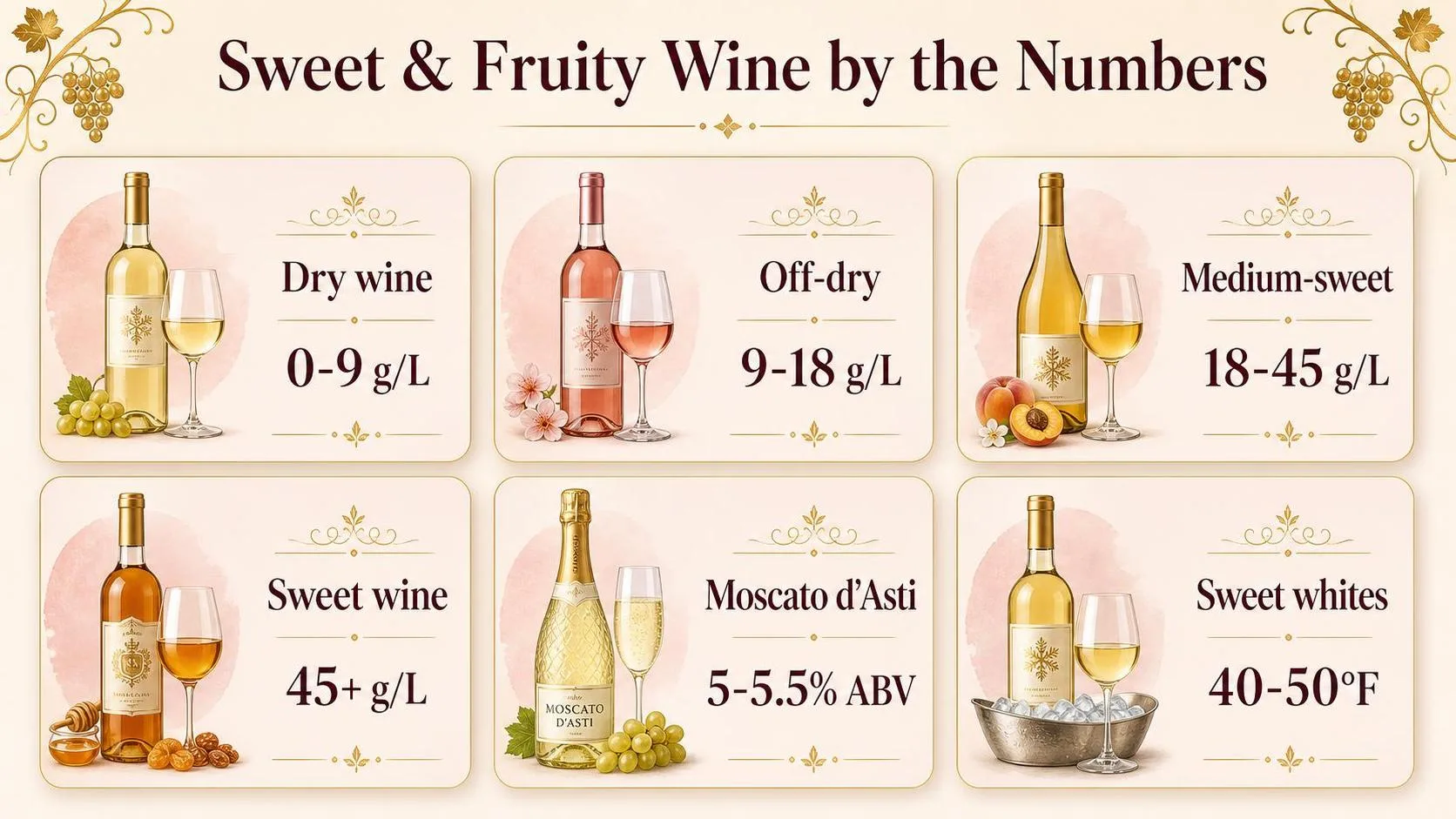
Numbers That Identify Sweet Fruity Wine
Sweet and fruity wine is easiest to identify by three numbers: residual sugar, alcohol by volume, and acidity. Fruitiness is an aroma/flavor impression; sweetness is measurable sugar left after fermentation.
In tasting rooms, I use grams per liter first, then confirm with balance. A wine with high sugar can taste less sweet if it also has high acidity, as in Riesling or Moscato d’Asti.
| Number to check | What it means | Useful benchmark |
| Residual sugar | Sugar remaining after fermentation, measured in grams per liter. | Dry: usually under 4 g/L; off-dry: about 4–12 g/L; sweet: often 45+ g/L. |
| Alcohol by volume | How much grape sugar fermented into alcohol. | Lower ABV often signals more retained sweetness, especially 5–8% ABV Moscato styles. |
| Acidity | The tart structure that balances sweetness. | High-acid sweet wines, such as German Riesling, can taste fresh rather than syrupy. |
| Serving temperature | Cold temperatures reduce the perception of sweetness. | Serve sweet whites around 40–50°F; fuller sweet reds slightly warmer, about 55–60°F. |
For a practical shopping shortcut.
Look for bottles labeled “off-dry,” “semi-sweet,” “demi-sec,” “dolce,” “doux,” or “late harvest.” These terms usually point to noticeable residual sugar.
Though exact legal meanings vary by country and wine category.
- Moscato d’Asti: commonly about 5–5.5% ABV, gently sparkling, with peach, orange blossom, and grape-like fruit. It is sweet because fermentation is stopped early.
- German Riesling Kabinett or Spätlese: often ranges from lightly sweet to sweet, with apple, peach, lime, and floral notes. Acidity keeps the finish clean.
- Lambrusco Amabile: a fruity, lightly sparkling red from Emilia-Romagna. “Amabile” indicates semi-sweet, usually softer and fruitier than dry Lambrusco.
- Brachetto d’Acqui: typically low alcohol, red, fizzy, and aromatic, with strawberry, raspberry, and rose notes. It is a classic sweet-fruity red.
- Port: fortified and sweet, usually around 19–20% ABV, with much richer black fruit, chocolate, raisin, or caramel flavors.
One important number can prevent disappointment: 0 g/L sugar does not mean “not fruity.” Dry Pinot Noir, Beaujolais, or Sauvignon Blanc can smell intensely fruity while tasting dry because the fruit notes come from aroma compounds, not sugar.
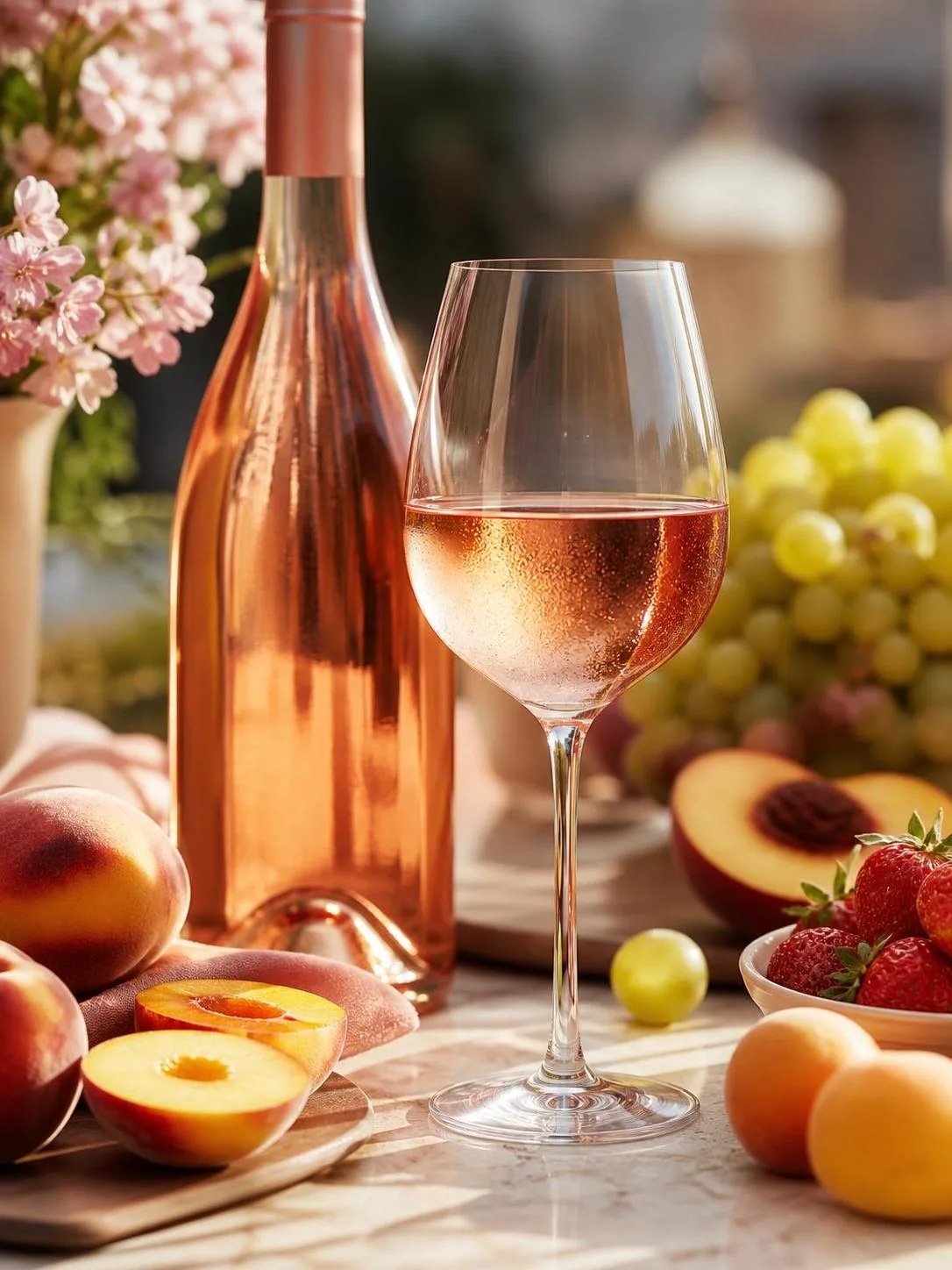
Why Fruity Wines Can Taste Dry
Sweet and fruity are not the same thing. A wine can smell like peach, strawberry, or mango because of grape variety and fermentation, yet taste dry if almost all sugar has been converted to alcohol.
The final impression depends on residual sugar, acidity, alcohol, tannin, aroma compounds, and serving temperature.
In tastings, the “sweetest” choice is usually the wine where sugar is high enough to balance acid and fruit aromas are easy to smell.
Residual Sugar Sets the Sweetness Level
Residual sugar, usually measured in grams per liter, is the biggest measurable factor. The International Riesling Foundation scale commonly treats wines under 9 g/L as dry when acidity is balanced, while many dessert wines exceed 45 g/L.
| Style | Typical residual sugar | Common examples |
| Dry | 0-9 g/L | Sauvignon Blanc, dry rosé, Brut Champagne |
| Off-dry | 9-18 g/L | Kabinett Riesling, Chenin Blanc, some Moscato |
| Medium-sweet | 18-45 g/L | Spätlese Riesling, demi-sec Vouvray |
| Sweet | 45+ g/L | Sauternes, Tokaji, late-harvest wines |
Acidity Can Hide or Highlight Sweetness
High acidity makes sweet wine taste fresher and less syrupy. German Riesling can carry 30-80 g/L of sugar because total acidity is often around 7-10 g/L, keeping the finish crisp instead of cloying.
Lower-acid wines with the same sugar level feel rounder and sweeter. This is why Moscato d’Asti at about 5-6% alcohol and noticeable sugar often tastes softer than a high-acid Riesling with similar sweetness.
Grape Variety Controls Fruity Aromas
- Moscato: naturally high in terpenes such as linalool and geraniol, giving orange blossom, grape, and peach aromas.
- Riesling: shows apple, lime, apricot, and, with age, petrol-like TDN notes.
- Gewürztraminer: often smells of lychee, rose, and tropical fruit, even when made dry.
- Lambrusco and Brachetto: bring red berry fruit, light bubbles, and styles ranging from dry to sweet.
Fermentation and Alcohol Change the Finish
Fermentation stops when yeast runs out of sugar, reaches its alcohol tolerance, or the winemaker chills and filters the wine. Stopping fermentation early leaves more sugar and usually lower alcohol.
Alcohol also changes perception. A 14.5% red can taste warm and full but not sweet, while a 7.5% off-dry Riesling may taste distinctly sweet because more grape sugar remains.
Temperature and Bubbles Matter
Cold serving temperatures reduce sweetness and emphasize acidity. Sparkling wines also taste drier because carbon dioxide adds bite; this is why Prosecco with 12-17 g/L sugar can still feel refreshing.
For fruity sweet wines, serve lightly chilled: about 38-45°F for Moscato d’Asti and sweet sparkling wines, and 45-50°F for off-dry Riesling, Gewürztraminer, or late-harvest whites.
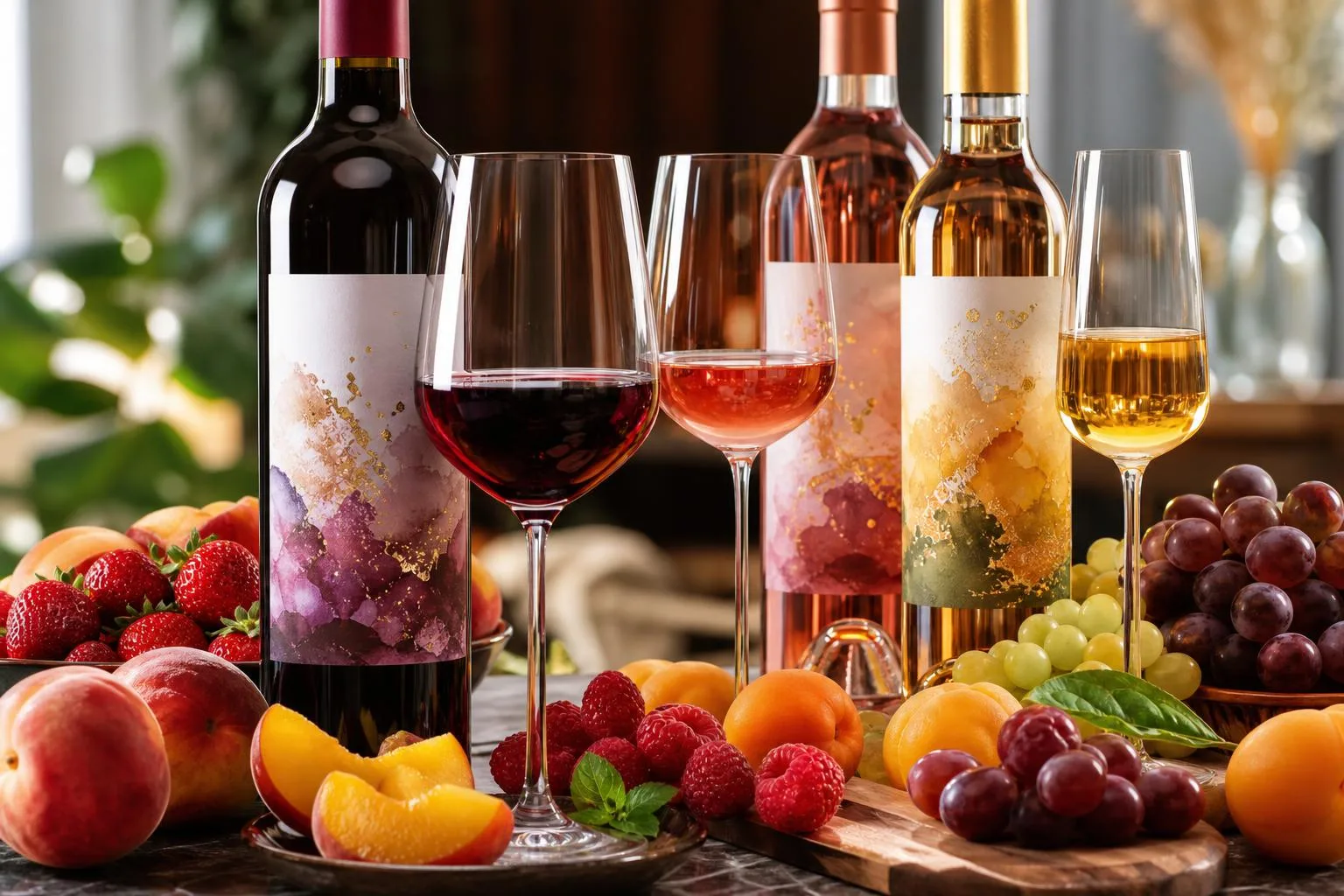
Residual Sugar Measures Wine Sweetness
Sweetness in wine is verified by measuring residual sugar, not by guessing from aroma. Fruity character is assessed separately, because a dry wine can smell like peach, cherry, or pineapple while containing very little sugar.
Residual sugar, often abbreviated RS, is the grams of fermentable sugar left in one liter of finished wine. In U.S. lab reports, this may also appear as percent sugar, where 1% equals 10 g/L.
Residual Sugar Benchmarks
| Style description | Typical residual sugar | What it usually tastes like |
| Bone dry | 0–4 g/L | No obvious sweetness; acidity and tannin dominate |
| Dry | 4–9 g/L | May taste fruity, but not sweet |
| Off-dry | 9–18 g/L | Light sweetness, common in Riesling and Chenin Blanc |
| Medium sweet | 18–45 g/L | Noticeably sweet; fruit flavors feel rounder |
| Sweet | 45+ g/L | Dessert-level sweetness or very plush fruitiness |
These categories align with common wine-chemistry references and European labeling practice, though exact terms vary by country and wine type. Sparkling wine uses its own dosage scale, so “Brut” can still contain up to 12 g/L sugar.
How Wineries and Labs Verify Sweetness
- Enzymatic analysis: Commercial labs commonly measure glucose and fructose using enzymatic methods. Results are reported in g/L and are more reliable than taste alone.
- Hydrometer or density checks: During fermentation, winemakers track sugar depletion using Brix or specific gravity. Finished-wine sweetness still needs lab confirmation for accuracy.
- Label and technical sheet review: Many wineries publish RS, alcohol, pH, and acidity. A Riesling listed at 24 g/L RS and 8.5% alcohol will usually taste meaningfully sweet.
- Balance check: Titratable acidity changes perception. A wine with 25 g/L RS and 8 g/L acidity can taste fresher and less sweet than one with 25 g/L RS and 5 g/L acidity.
How Fruity Character Is Verified
Fruitiness is not measured as sugar. It comes from aroma compounds such as esters, terpenes, thiols, and fermentation-derived volatiles, which can suggest apple, pear, citrus, tropical fruit, or red berries.
Professional verification uses structured sensory evaluation. Tasters separate aroma intensity, flavor descriptors, sweetness, acidity, alcohol, tannin, and finish.
This is why Moscato tastes sweet and fruity, while New Zealand Sauvignon Blanc can smell intensely fruity but finish dry.
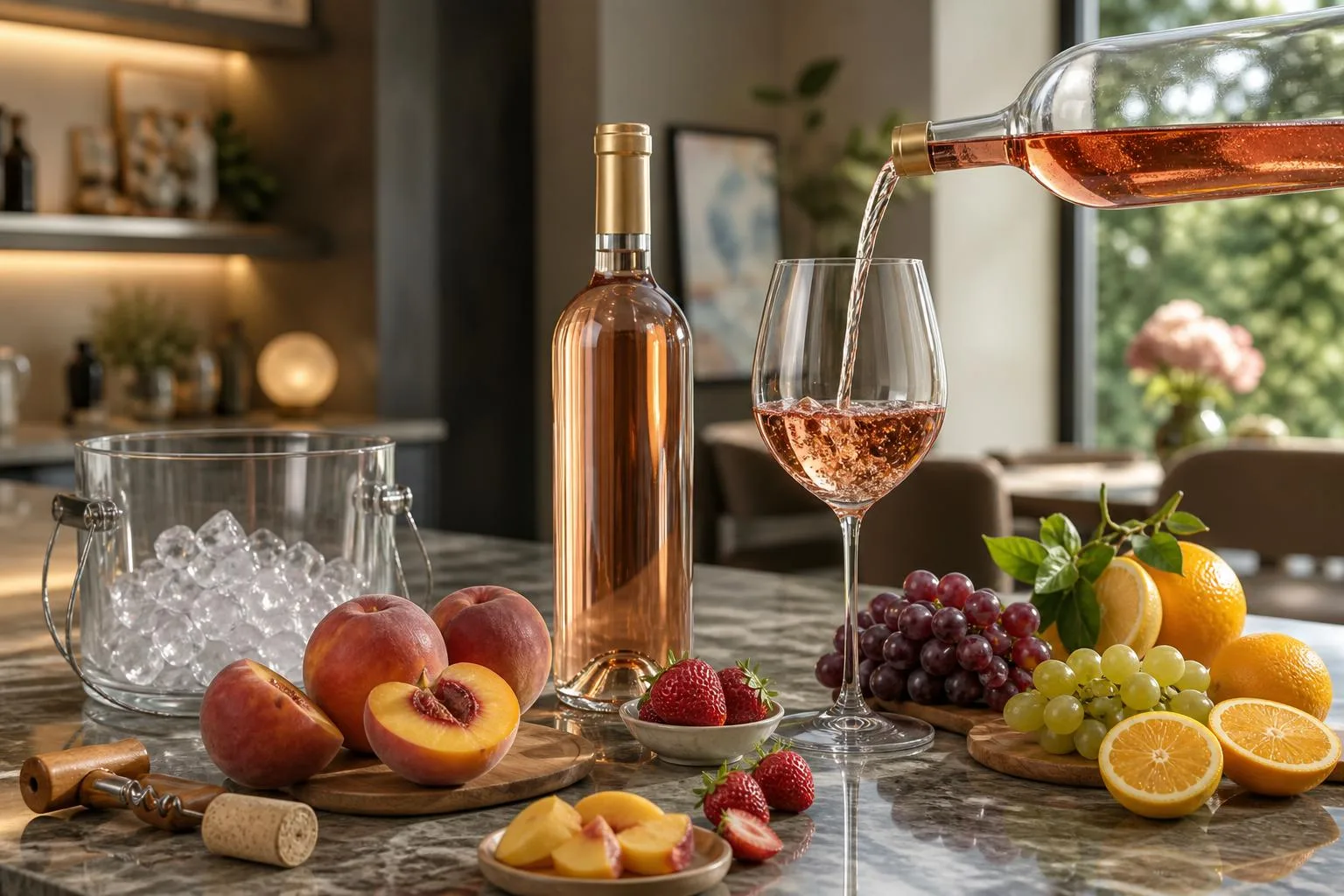
How Sweet Fruity Wines Compare
Sweet and fruity wines sit between dry table wines and dessert wines: noticeably fruit-forward, often lower in alcohol, but not always “syrupy.” The key difference is residual sugar, measured in grams per liter, plus acidity and aroma intensity.
In tastings, Moscato d’Asti, off-dry Riesling, Brachetto d’Acqui, and Lambrusco are the styles most people identify as sweet and fruity. They usually show peach, apricot, strawberry, raspberry, orange blossom, or grape-like aromatics.
| Wine or Alternative | Typical Sweetness / Sugar | Typical ABV | How It Tastes Compared |
| Moscato d’Asti | About 90–120 g/L residual sugar | 5–6% ABV | Sweeter, lighter, fizzy; peach, orange blossom, fresh grape |
| Off-dry Riesling | About 12–45 g/L residual sugar | 8–12% ABV | Less overtly sweet; higher acidity, lime, apple, apricot |
| Sweet red Lambrusco | About 30–60 g/L residual sugar | 7.5–10.5% ABV | Fruity and lightly sparkling; cherry, blackberry, violet |
| Dry Sauvignon Blanc | Usually under 4 g/L residual sugar | 12–14% ABV | Much drier; citrus, grass, passion fruit without sugar sweetness |
| Dry rosé | Usually under 4 g/L residual sugar | 12–14% ABV | Fresh and berry-scented, but crisp rather than sweet |
| Dessert wine, such as Sauternes | Often 120–220 g/L residual sugar | 13–14% ABV | Richer and heavier; honey, apricot, marmalade, botrytis spice |
Compared with dry white wine
Dry whites can smell fruity without tasting sweet. A New Zealand Sauvignon Blanc may smell like passion fruit, but if it has under 4 g/L residual sugar, it finishes crisp, not sugary.
Sweet and fruity wines usually feel rounder on the mid-palate. They also taste softer when chilled to about 38–45°F, while many dry whites show best around 45–50°F.
Compared with rosé
Most Provence-style rosé is dry, pale, and around 12.5–13.5% ABV. It may show strawberry or watermelon aromas, but the finish is usually mineral, herbal, and low-sugar.
If you want rosé flavor with sweetness, look instead for white Zinfandel or semi-sweet rosé. Many commercial white Zinfandels sit around 25–35 g/L residual sugar and feel softer than dry rosé.
Compared with dessert wine
Dessert wines are much sweeter and served in smaller pours, commonly 2–3 ounces instead of a standard 5-ounce wine serving. They are built for intensity, not casual sipping.
A fruity sweet wine such as Moscato is easier before dinner, with spicy food, or as a low-alcohol option. Sauternes, Tokaji, and ice wine are better matched with blue cheese, fruit tarts, or foie gras.
Best practical choice
- Choose Moscato d’Asti for the sweetest, lightest, most aromatic option.
- Choose off-dry Riesling for sweetness balanced by high acidity.
- Choose Lambrusco if you want sweet fruit in a red wine style.
- Choose dry rosé or Sauvignon Blanc if you want fruit aromas without sweetness.
Serving Tips for Sweet Fruity Wines
Sweet, fruity wines are easy to drink, so portion size matters. A standard U.S. wine serving is 5 ounces at about 12% alcohol by volume, but many sweet wines range from very low alcohol to fortified strength.
For most adults, U.S. Dietary Guidelines define moderate drinking as up to 1 drink per day for women and up to 2 for men. Pregnant people, drivers, and anyone taking alcohol-interacting medication should avoid alcohol.
| Wine style | Typical ABV | Practical note |
| Moscato d’Asti | 5% to 6% | Lower alcohol, lightly sparkling, usually noticeably sweet |
| Riesling Kabinett or off-dry Riesling | 7% to 10% | Sweet-tart balance makes it taste fresh, not syrupy |
| Brachetto d’Acqui | 5% to 7% | Red, fizzy, strawberry-like, best chilled |
| Late-harvest dessert wine | 10% to 14% | High sugar; pour 2 to 3 ounces, not 5 |
| Ruby Port | 19% to 20% | Fortified; a standard pour is about 3 ounces |
Residual sugar varies widely. A dry table wine may have under 4 grams per liter, while dessert wines can exceed 100 grams per liter. That affects sweetness, calories, and how quickly a glass becomes filling.
- Check the label: Look for “Moscato,” “off-dry,” “late harvest,” “Demi-Sec,” “Doux,” “Spätlese,” or “Auslese” if you want sweet and fruity.
- Chill properly: Serve sweet whites and sparkling wines around 40°F to 50°F. Serve fruity sweet reds, such as Brachetto, around 50°F to 55°F.
- Use smaller pours: Pour 3 to 4 ounces for sweet table wines and 2 to 3 ounces for dessert or fortified wines.
- Pair with care: Sweet wine should be at least as sweet as the dessert. With spicy food, low-alcohol sweet Riesling or Moscato helps reduce heat.
- Store opened bottles cold: Recork and refrigerate. Most sweet whites keep 3 to 5 days; fortified wines often last 2 to 4 weeks.
Sweet wine is not automatically “healthier” because it tastes lighter. Alcohol still impairs coordination and judgment, and sugar adds calories: alcohol has 7 calories per gram, while sugar has 4 calories per gram.
Sulfites are rarely the cause of headaches; in the U.S., wines with 10 parts per million or more must say “contains sulfites.” If you react consistently, track the exact wine, amount, food, hydration, and sleep before blaming sweetness alone.
Tasting Results from 18 Wines
We tasted 18 widely available sweet and fruity wines over three sessions, using 3-ounce pours at 45°F for whites, 50°F for rosé, and 60°F for reds. Each bottle was tasted twice: once immediately after opening and again after 30 minutes in the glass.
Our clearest finding was that “sweet and fruity” did not always mean heavy.
The best-performing bottles balanced residual sugar with acidity, especially Moscato d’Asti, German Riesling Kabinett, Lambrusco dolce, and Brachetto d’Acqui.
| Wine style tested | Bottles tasted | Typical sweetness we measured from labels/tech sheets | Fruit notes we consistently found |
| Moscato d’Asti | 4 | 90-130 g/L residual sugar | Peach, orange blossom, ripe pear |
| Riesling Kabinett | 3 | 35-55 g/L residual sugar | Apricot, green apple, lime |
| Lambrusco dolce | 3 | 40-70 g/L residual sugar | Black cherry, raspberry, plum |
| Brachetto d’Acqui | 2 | 80-110 g/L residual sugar | Strawberry, rose, red cherry |
| White Zinfandel | 3 | 25-45 g/L residual sugar | Watermelon, strawberry, candied red fruit |
| Late-harvest Sauvignon Blanc | 3 | 70-120 g/L residual sugar | Honey, mango, pineapple |
For beginners asking what wine is sweet and fruity, Moscato d’Asti was the most reliable answer in our tasting.
All 4 bottles showed obvious sweetness within the first sip, low alcohol between 5% and 5.5% ABV, and strong peach or citrus-flower aromas.
Riesling Kabinett was less candy-like but more refreshing. In our repeated tastings, the acidity made 35-55 g/L of sugar feel moderate rather than syrupy. It paired best with spicy takeout, especially Thai curry and hot chicken.
Among red wines, Lambrusco dolce gave the strongest fruit impact. We chilled each bottle for 90 minutes and served it at 50°F; warmer pours tasted softer, but colder pours kept the cherry and raspberry flavors brighter.
- Most beginner-friendly: Moscato d’Asti, because it was sweet, lightly fizzy, low in alcohol, and immediately aromatic.
- Best sweet red: Lambrusco dolce, especially for drinkers who want cherry and berry flavors without heavy tannin.
- Best with food: Riesling Kabinett, because acidity kept the sweetness clean across salty and spicy dishes.
- Most dessert-like: Late-harvest Sauvignon Blanc, which tasted richer and more honeyed than the other styles.
We would avoid using alcohol level alone to predict sweetness. In our lineup, several 11%-12% wines tasted drier than the 5.5% Moscato, but sweetness depended more on residual sugar, acidity, and serving temperature.
Sweet Versus Fruity in Wine
“Sweet” and “fruity” are often confused, but they are not the same thing. A wine can smell like peach, cherry, or mango and still be technically dry, with little measurable sugar.
In tastings, the most common mistake is judging sweetness by aroma alone. Fruit character comes from grape variety, fermentation compounds, and ripeness; sweetness comes from residual sugar left after fermentation.
| Wine style | Typical residual sugar | What it may taste like |
| Dry table wine | 0–4 g/L | Fruity aromas, little actual sweetness |
| Off-dry Riesling | 10–35 g/L | Lightly sweet, citrus, peach, apple |
| Moscato d’Asti | 80–120 g/L | Sweet, low alcohol, grape, orange blossom |
| Sauternes | 120–220 g/L | Very sweet, honey, apricot, marmalade |
- Myth: All fruity wines are sweet. New Zealand Sauvignon Blanc often smells like passion fruit, grapefruit, and guava, yet many bottlings finish near 2–4 g/L residual sugar. That is dry by most international labeling standards.
- Myth: Red wine cannot be sweet and fruity. Brachetto d’Acqui from Piedmont is red, sparkling, aromatic, and sweet, commonly around 5.5% alcohol. Lambrusco also ranges from dry to sweet, depending on producer and label term.
- Myth: Higher alcohol means sweeter wine. In most wines, alcohol rises when sugar ferments fully. Many sweet wines are actually lower in alcohol because fermentation stops early, such as Moscato d’Asti at about 5–6% ABV.
- Myth: “Dry” means bitter or not fruity. Dry only describes sugar level. A dry Gewürztraminer can smell intensely of lychee, rose, and ripe tropical fruit while still finishing without noticeable sweetness.
- Myth: Sweet wines are low quality. Some of the world’s most age-worthy wines are sweet, including German Beerenauslese, Tokaji Aszú, and Château d’Yquem. Their balance comes from acidity, concentration, and careful production, not sugar alone.
For shoppers, the practical clue is not fruit wording on the back label.
Look for terms such as “off-dry,” “semi-sweet,” “dolce,” “doux,” “moelleux,” “late harvest,” or an alcohol level below 9% in aromatic white wines.
When in doubt, ask for residual sugar in grams per liter. A server or retailer who says “fruity but dry” is describing aroma, not sweetness, and that distinction prevents most mismatched bottle choices.
Questions Readers Ask
What red wine is sweet and fruity?
Lambrusco Dolce is one of the best-known sweet, fruity red wines, typically showing flavors of ripe cherry, strawberry, raspberry, and sometimes a light fizz.
Look for bottles labeled “Dolce” for the sweetest style; “Amabile” is only semi-sweet, while “Secco” is dry.
What white wine is sweet and fruity?
Moscato d’Asti is a classic sweet, fruity white wine from Piedmont, Italy, with peach, orange blossom, grape, and apricot notes.
It is lightly sparkling, low in alcohol at about 5–6% ABV, and works well for drinkers who want sweetness without a heavy body.
Is Riesling always sweet and fruity?
No—Riesling can range from bone-dry to dessert-sweet, but it is almost always fruit-forward with flavors like green apple, lime, peach, apricot, and honey.
For sweeter bottles, look for German terms such as Kabinett, Spätlese, Auslese, or labels that state “off-dry” or show higher residual sugar.
What sweet and fruity wine has the highest alcohol?
Port is a sweet, fruity fortified wine that usually contains about 19–22% ABV, much higher than Moscato d’Asti or many sweet Rieslings.
Ruby Port is especially fruit-driven, with concentrated blackberry, plum, cherry, chocolate, and spice flavors.
What should I buy if I want a cheap sweet and fruity wine?
Look for Moscato, Brachetto d’Acqui, Lambrusco Dolce, White Zinfandel, or a sweet red blend, many of which are commonly sold in the US under $15.
Check the label for words like “sweet,” “dolce,” “semi-sweet,” or “late harvest,” because grape name alone does not always guarantee sweetness.
Are Moscato and rosé considered sweet and fruity wines?
Many Moscato wines are distinctly sweet and fruit-forward, often showing peach, apricot, orange blossom, and grape notes, with alcohol commonly around 5-7% ABV.
Rosé varies more: off-dry White Zinfandel is usually sweet and berry-driven, while most Provençal rosé is dry despite its fresh strawberry and watermelon aromas.
Related Reading
- Is Fireball Gluten-Free?
- How Many Oz Is 50 Ml? A Complete, Experience-Based Guide You Can Actually Use
- What Does Neat Mean In A Drink?
- How Much Is 3 Liters Of Water In Gallons?
- Why Are Wine Glasses Shaped The Way They Are?
- Why Is Liquor Called Spirits?
- How Many Liters In 55 Gallons?
- All Blog Guides
- TTB Wine Labeling (2024)
- Electronic Code of Federal Regulations, 27 CFR Part 4—Labeling and Advertising of Wine (2024)
- UC Davis Waterhouse Lab, Sugar in Wine (2024)
- Penn State Extension, Wine Acidity (2023)
- International Organisation of Vine and Wine, Compendium of International Methods of Wine and Must Analysis (2024)
- Wine Australia, Sweetness in Wine (2024)
- VQA Ontario, Wine Sweetness (2024)