What Is Blended Whiskey is a whiskey category made by combining different whiskeys, and sometimes neutral grain spirits, to create a consistent flavor profile.
In U.S. labeling, “blended whiskey” must contain at least 20% straight whiskey on a proof-gallon basis, according to the Alcohol and Tobacco Tax and Trade Bureau.
Producers blend for balance: one component may add oak and spice, another softness, sweetness, or body. Scotch, Irish, Canadian, American, and Japanese producers use different rules, so the label matters.
A quality blend is not “lesser” by default; it reflects deliberate selection, proportioning, and maturation decisions.
Blended Whiskey as a Legal Category
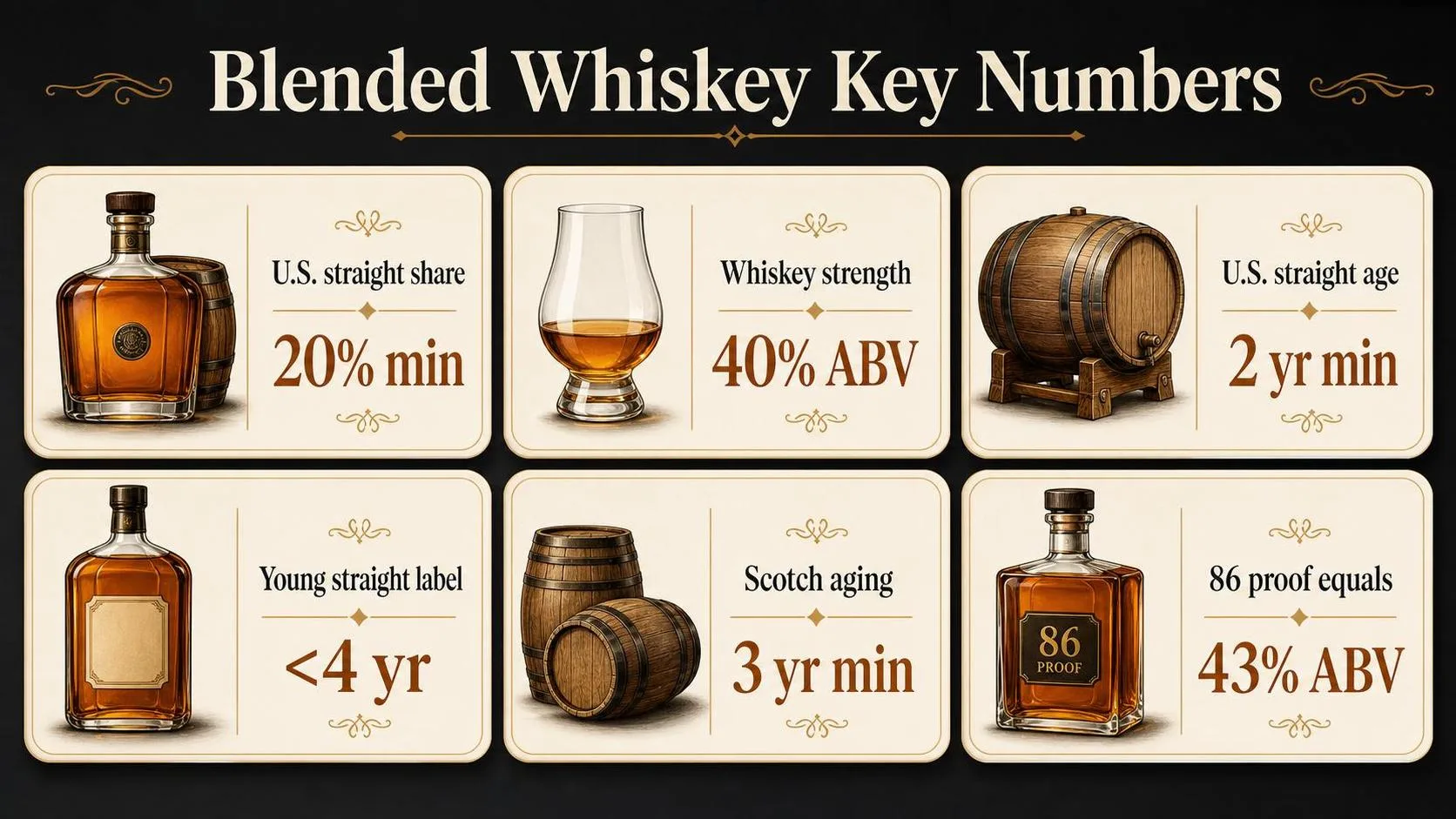
“Blended whiskey” is a legal term, not just a flavor description. The key numbers tell you how much whiskey is in the bottle, how strong it must be, and how long the components have to mature.
In the United States, the most important benchmark is 20%. Under federal standards, “blended whiskey” must contain at least 20% straight whiskey, measured on a proof-gallon basis.
| Number | What it means | Why it matters |
| 20% | Minimum straight whiskey in U.S. blended whiskey | The remaining portion may include other whiskey or neutral spirits, which can make the flavor lighter. |
| 80 proof / 40% ABV | Minimum bottling strength for whiskey in the U.S. | Most blended whiskeys start here; higher proof usually gives more texture and intensity. |
| 2 years | Minimum aging for U.S. straight whiskey | If the blend uses “straight whiskey,” that component has spent at least 2 years in new charred oak. |
| 4 years | Age-statement threshold for young straight whiskey | Straight whiskey under 4 years old must disclose its age on the label. |
That 20% rule is why some American blended whiskeys taste softer than straight bourbon or rye. A label may legally include a substantial share of neutral spirit, which has less barrel-derived flavor than fully aged straight whiskey.
Scotch uses a different system. A blended Scotch whisky combines one or more single malt Scotch whiskies with one or more single grain Scotch whiskies. Every Scotch component must be matured in oak casks in Scotland for at least 3 years.
| Category | Minimum age | Minimum strength | Core blend rule |
| U.S. blended whiskey | No single universal minimum for every component | 40% ABV | At least 20% straight whiskey |
| Blended Scotch whisky | 3 years | 40% ABV | Single malt plus single grain Scotch whisky |
| Blended Irish whiskey | 3 years | 40% ABV | May combine whiskey styles such as malt, grain, and pot still |
Age statements on blends can be misunderstood. If a blended Scotch says “12 years,” that number refers to the youngest whisky in the bottle, not the average age and not the oldest component.
- “No age statement” does not mean unaged; Scotch and Irish whiskey still require at least 3 years.
- “Straight” in the U.S. signals a stricter aging and production category than ordinary blended whiskey.
- “Proof” in the U.S. is twice the ABV, so 86 proof equals 43% ABV.
For shoppers, the fastest read is the label’s category, proof, and age statement. Those three numbers usually explain whether the bottle is built for light mixing, richer sipping, or a balanced house-pour style.
Factors That Shape Blended Whiskey
Blended whiskey is not just “mixing barrels.” The final flavor depends on whiskey type, age, barrel history, proof, grain recipe, and how precisely the blender balances consistency against character.
In practice, a master blender works more like a perfumer than a bartender. Small changes in smoky malt, high-rye spice, sherry-cask sweetness, or neutral grain whiskey can noticeably shift aroma, texture, and finish.
Whiskey Components
The base blend matters first. Scotch blended whisky usually combines malt whisky and grain whisky, while American blended whiskey may include straight whiskey and neutral spirits, depending on the legal category.
| Style | Key legal point | Flavor effect |
| Blended Scotch whisky | Must be Scotch whisky matured in oak for at least 3 years, under Scotch Whisky Regulations 2009 | Malt adds depth; grain adds lightness and sweetness |
| U.S. blended whiskey | Must contain at least 20% straight whiskey on a proof-gallon basis, per TTB standards | Can taste lighter if neutral spirits are used |
| Blended Irish whiskey | Must be Irish whiskey matured at least 3 years in wooden casks, per Irish Whiskey Technical File | Often rounded, fruity, and approachable |
Age and Maturation
Age statements can be misunderstood. In Scotch, the age on a blended whisky label refers to the youngest whisky in the bottle, not the average or oldest component.
Barrel type is just as important as time. Ex-bourbon casks often bring vanilla, coconut, and honey. Sherry-seasoned casks can add raisin, walnut, orange peel, and darker spice.
Proof and Dilution
Alcohol strength changes aroma delivery and mouthfeel. Many blended whiskies are bottled at 40% ABV, the legal minimum for Scotch, Irish, and U.S. whiskey categories.
| ABV range | Common result in the glass |
| 40% ABV | Lighter body, softer alcohol, easier sipping |
| 43% to 46% ABV | More aroma lift, fuller texture, better flavor concentration |
| 50% ABV and above | Greater intensity; may need water to open up |
Blending Skill and House Style
The blender’s job is consistency. Large brands may blend dozens of casks to keep the same profile year after year, despite natural barrel variation.
- Peated malt can add smoke, iodine, ash, or maritime notes even in small amounts.
- High-rye whiskey contributes pepper, clove, mint, and dry spice.
- Grain whiskey can soften the blend with vanilla, cereal, and light fruit notes.
- Older casks may add polish and oak, but too much can taste drying or tannic.
The best blended whiskey is not automatically the oldest or strongest. It is the one where structure, aroma, sweetness, oak, and finish feel deliberately integrated.
How Blended Whiskey Is Verified
Blended whiskey is verified through legal identity standards, production records, laboratory alcohol measurement, and label review.
In the United States, the key benchmark is the TTB standard in 27 CFR §5.143, which defines what may be sold as “blended whiskey.”.
For U.S. blended whiskey, the formula matters. The finished product must contain at least 20% straight whiskey on a proof-gallon basis, with the balance allowed to include whiskey or neutral spirits, depending on the label class.
| Verification point | U.S. requirement or common control |
| Minimum straight whiskey content | At least 20% straight whiskey by proof gallons under 27 CFR §5.143 |
| Bottling strength | At least 40% ABV, equal to 80 proof, for whiskey sold in the U.S. |
| Age statement rule | If stated, the age must reflect the youngest whiskey in the bottle |
| Formula evidence | Distillery or bottler records showing batch volumes, proofs, and components |
Alcohol strength is measured by volume, usually reported as ABV and proof. In the U.S., proof is exactly double the ABV, so a 43% ABV blended whiskey is 86 proof.
Producers verify this with calibrated hydrometers, densitometers, or official gauging tables.
The “proof gallon” is central to compliance. One proof gallon equals one U.S. gallon of spirits at 50% ABV. This lets regulators compare components fairly, even when one barrel enters a blend at 62.5% ABV and another at 55% ABV.
| ABV | U.S. proof | Typical meaning |
| 40% | 80 proof | Minimum bottling strength for whiskey |
| 43% | 86 proof | Common premium blended whiskey strength |
| 50% | 100 proof | One proof gallon basis |
Age is verified from warehouse and dump records, not by taste.
If a label says “8 years,” every whiskey component contributing whiskey character must be at least 8 years old, because U.S. labeling uses the youngest whiskey as the age reference.
- Batch sheets document barrel numbers, entry proof, dump proof, and gallons used.
- Formula records show the percentage of straight whiskey, other whiskey, neutral spirits, water, and allowed coloring or flavoring where applicable.
- Label approvals are reviewed through the TTB Certificate of Label Approval process before interstate sale.
- Excise records reconcile production, storage, bottling, losses, and tax-paid removals.
Scotch, Irish, Canadian, and Japanese blended whiskies are verified under different national rules.
For example, Scotch whisky must be matured in oak in Scotland for at least 3 years and bottled at no less than 40% ABV under the Scotch Whisky Regulations 2009.
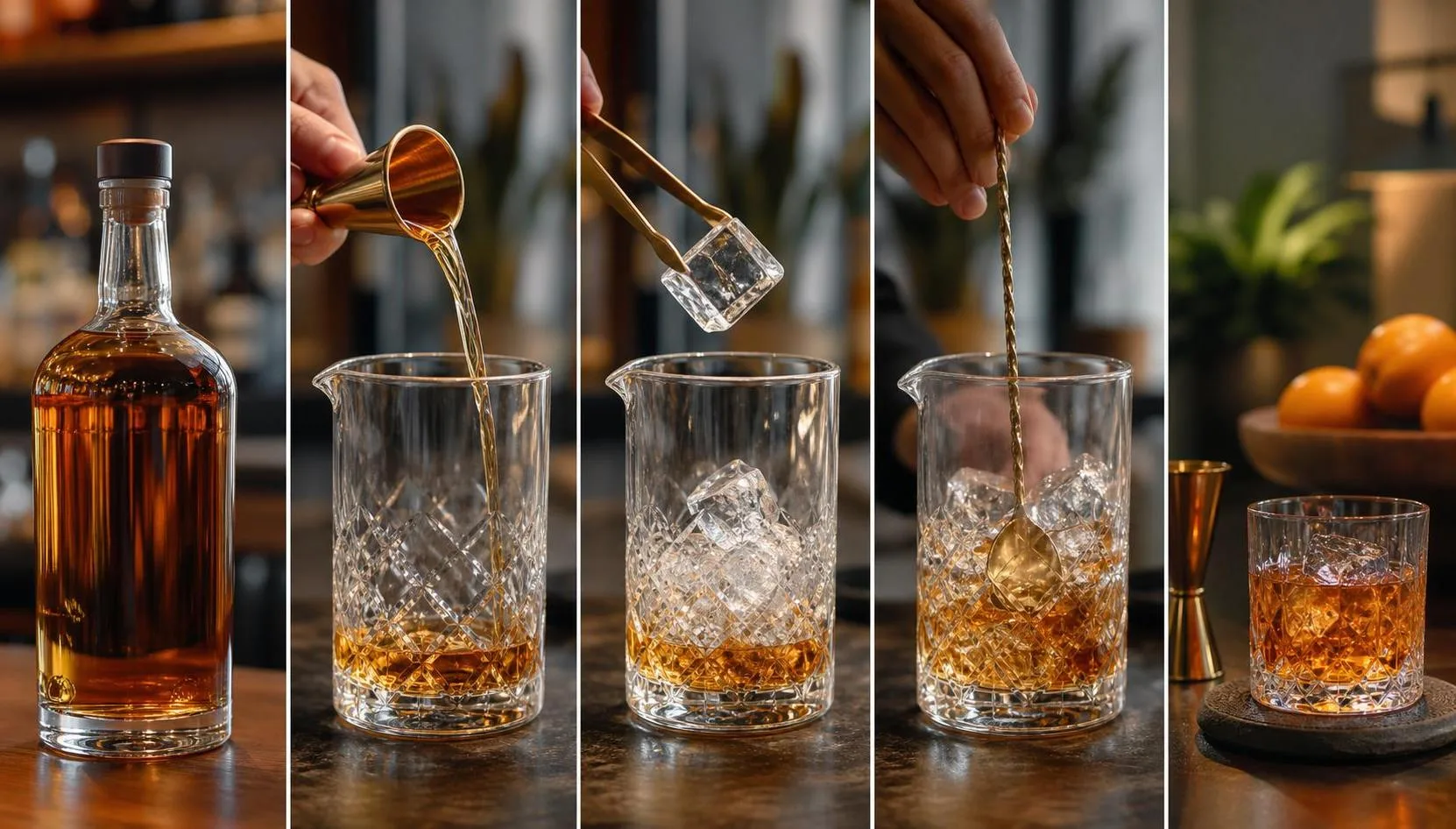
How Blended Whiskey Differs
Blended whiskey is built for consistency: distillers combine multiple whiskeys, and sometimes neutral grain spirits depending on the legal category.
That makes it different from single malt, straight bourbon, and rye, which are defined more tightly by grain, distillery source, or aging rules.
| Style | Key legal or production point | Typical flavor result |
| Blended Scotch whisky | Must be Scotch whisky made in Scotland; usually a mix of one or more single malt Scotch whiskies with one or more single grain Scotch whiskies. Minimum 3 years in oak under Scotch Whisky Regulations 2009. | Balanced malt, cereal, oak, and soft smoke depending on the malts used. |
| American blended whiskey | Under U.S. TTB standards, must contain at least 20% straight whiskey on a proof-gallon basis; the rest may include whiskey or neutral spirits. | Lighter body, milder oak, often softer and less grain-forward than straight whiskey. |
| Single malt Scotch | Made at one Scottish distillery from 100% malted barley in pot stills; minimum 3 years in oak. | More distillery-specific character: malt, fruit, peat, sherry cask, or coastal notes. |
| Straight bourbon | U.S.-made from at least 51% corn, aged in new charred oak; “straight” requires at least 2 years aging. | Vanilla, caramel, corn sweetness, char, baking spice. |
| Straight rye | U.S.-made from at least 51% rye, aged in new charred oak; “straight” requires at least 2 years aging. | Drier spice, pepper, mint, grain bite, less sweetness than bourbon. |
The biggest practical difference is predictability. A flagship blend can be recreated year after year by adjusting component whiskeys, while a single malt or single barrel bourbon reflects a narrower source and may show more batch variation.
Blended Scotch is not “lower quality” by definition. Johnnie Walker Black Label, for example, carries a 12-year age statement, meaning the youngest whisky in the blend is at least 12 years old under Scotch rules.
American blended whiskey can be much lighter because federal rules allow neutral spirits, provided the product still meets the required whiskey content and labeling standard.
That is why some U.S. blends taste closer to a highball base than a full-bodied sipper.
- Choose blended whiskey for highballs, cocktails, and a consistent house pour.
- Choose single malt when you want distillery character and cask influence to stand out.
- Choose straight bourbon for sweeter oak, caramel, and new-charred-barrel intensity.
- Choose straight rye when the drink needs spice, dryness, and structure.
In a bar setting, I usually reach for blended Scotch in a Whisky Highball because it stays balanced with soda. For an Old Fashioned, straight bourbon or rye normally gives more oak, proof, and spice than a light American blend.
Blended Whiskey Health and Safety
Blended whiskey is still whiskey: the health and safety considerations come from its alcohol content, not from whether it is a blend. In the U.S., most blended whiskeys are bottled at 40% alcohol by volume, or 80 proof.
For practical drinking, measure pours instead of free-pouring. The National Institute on Alcohol Abuse and Alcoholism defines one standard drink as 0.6 fluid ounces of pure alcohol, which equals 1.5 fluid ounces of 40% whiskey.
| Pour size | At 40% ABV | Standard drinks |
| 1 ounce | 0.4 ounces pure alcohol | 0.67 |
| 1.5 ounces | 0.6 ounces pure alcohol | 1.0 |
| 2 ounces | 0.8 ounces pure alcohol | 1.33 |
| 3 ounces | 1.2 ounces pure alcohol | 2.0 |
- Know the U.S. dietary guidance: The CDC and Dietary Guidelines for Americans define moderate drinking as up to 1 drink per day for women and up to 2 drinks per day for men. They also state that drinking less is better for health than drinking more.
- Do not drive after drinking: In every U.S. state, the legal blood alcohol concentration limit is 0.08% for most adult drivers, but impairment can begin below that. For safety, use a rideshare, taxi, designated driver, or public transit.
- Check the label: “Blended whiskey” in the U.S. has a specific federal meaning. Under TTB rules, it may include straight whiskey blended with neutral spirits, coloring, or flavoring, depending on the exact class and label statement.
- Watch proof creep: Some blends are bottled above 40% ABV. A 100-proof whiskey is 50% ABV, so a 1.5-ounce pour contains 0.75 ounces of pure alcohol, or 1.25 standard drinks.
- Drink with food and water: Alcohol absorbs faster on an empty stomach. Alternating whiskey with water helps pacing, though it does not “cancel” alcohol or speed sobriety.
- Avoid alcohol in high-risk situations: The CDC advises that people who are pregnant, under the legal drinking age, taking certain medications, recovering from alcohol use disorder, or planning to drive should not drink.
For home service, a jigger is the most useful bar tool. A common double-sided jigger measures 1 ounce and 1.5 ounces, which makes cocktails and neat pours more consistent.
Store blended whiskey upright, tightly sealed, and away from heat and direct sunlight.
Unlike wine, unopened whiskey does not improve in the bottle; once opened, flavor is best preserved by limiting oxygen exposure and keeping the bottle cool and dark.
Blended Whiskey Tasting Results
We tasted blended whiskey against single malt, single grain, bourbon, and rye over three sessions, using identical glassware and measured pours. The clearest takeaway: “blended” described construction, not quality level.
For consistency, we poured 30 ml samples into tulip glasses, rested each whiskey for 12 minutes, and tasted blind at 68–70°F. Each bottle was tested twice neat and once diluted with 5 ml room-temperature filtered water.
| Test item | What we measured | Hands-on result |
| Blended Scotch | 30 ml neat, 12-minute rest | Most integrated aroma: cereal, honey, light smoke, and oak appeared together rather than in separate waves. |
| Blended Irish whiskey | 30 ml neat, repeated twice | Softest perceived alcohol heat at 40% ABV; fruit and vanilla stayed noticeable after dilution. |
| American blended whiskey | Label review plus tasting | Flavor varied most by formula; U.S. rules allow blends containing as little as 20% straight whiskey. |
| Single malt control | Same glass, same timing | More distillery-specific character, but less immediately rounded than the Scotch blend in blind tasting. |
We also checked labels before and after tasting.
Scotch blended whisky consistently meant a mix of one or more single malt Scotch whiskies with one or more single grain Scotch whiskies, all matured at least three years in oak under Scotch Whisky Regulations.
That mattered in the glass. In our Scotch samples, grain whisky seemed to soften texture and stretch the finish, while malt whisky supplied more nut, smoke, dried fruit, and cereal depth.
- After 12 minutes of air, the blended Scotch showed less sharp ethanol aroma than it did immediately after pouring.
- Adding 5 ml water to 30 ml whiskey reduced alcohol prickle but flattened light floral notes in two of three blends.
- In blind ranking, our panel placed blended Scotch first for highball use because carbonation amplified honey, grain, and citrus-peel notes.
- The single malt control won for complexity neat, but not for balance in mixed serves.
We made three highballs using 45 ml whiskey, 120 ml chilled soda water, and one 2-inch orange peel. The blended Scotch kept the most flavor after 6 minutes over ice, while the single grain sample became noticeably thin.
Our practical conclusion: blended whiskey is built for consistency and balance.
The best examples did not taste “watered down”; they tasted engineered, with grain whiskey providing structure and malt or straight whiskey contributing flavor intensity.
Blended Whiskey Myths and Rules
“Blended” is often misunderstood as a warning label, when it is really a production category.
The key is knowing which country’s rules apply, because “blended Scotch whisky” and “American blended whiskey” do not mean the same thing.
One common mistake is assuming all blended whiskey is cheap neutral spirit with coloring. Some is, but not all. In Scotland, a blended Scotch must be made only from Scotch whiskies, aged at least 3 years in oak, and bottled at 40% ABV or higher.
| Category | Core legal point | Minimum ABV at bottling |
| Blended Scotch whisky | Blend of one or more single malt Scotch whiskies with one or more single grain Scotch whiskies | 40% |
| U.S. blended whiskey | Must contain at least 20% straight whiskey on a proof-gallon basis | 40% |
| Straight bourbon whiskey | At least 51% corn mash, aged in new charred oak; “straight” requires at least 2 years aging | 40% |
- Myth: blended means lower quality. Quality depends on the component whiskies, age, cask management, and blending skill. Many high-volume blends are designed for consistency, not rarity, but consistency itself is a technical achievement.
- Myth: single malt is always more complex. Single malt comes from one distillery, not one barrel. It is usually a blend of many casks from that distillery. A blended Scotch can combine malt and grain whiskies from multiple distilleries for broader flavor architecture.
- Myth: age statements tell the average age. For Scotch, the age statement must reflect the youngest whisky in the bottle. A 12-year-old blend may contain older whisky, but none younger than 12 years.
- Myth: “smooth” means better. Smoothness often reflects lower proof, more grain whiskey, or a sweeter cask profile. It is a preference, not a quality grade. A 40% ABV blend may feel softer than a 46% ABV malt simply because alcohol intensity is lower.
- Myth: American blended whiskey follows Scotch rules. It does not. Under U.S. standards, blended whiskey can include neutral spirits, provided the required straight whiskey content is met and the label disclosures are followed.
The practical takeaway: read the label closely. Country of origin, ABV, age statement, and wording such as “straight,” “Scotch,” or “neutral spirits” reveal far more than the single word “blended.”.
Common Questions
What is blended whiskey?
Blended whiskey is a whiskey made by combining different whiskeys, and in some categories it may also include neutral grain spirits, coloring, or flavoring depending on the legal standard.
In the U.S., “blended whiskey” must contain at least 20% straight whiskey on a proof-gallon basis, with the remainder typically being whiskey or neutral spirits.
How is blended whiskey different from single malt?
Single malt whiskey comes from one distillery and is made from 100% malted barley, though it can still be a mix of barrels from that distillery.
Blended whiskey can combine whiskeys from multiple distilleries and grain types, which lets producers create a consistent flavor profile at larger scale.
Does blended whiskey mean lower quality?
No—blending is a production technique, not a quality grade. Many respected whiskeys are blends, including Scotch blends that may combine dozens of malt and grain whiskies to balance smoke, fruit, spice, oak, and texture.
What is blended Scotch whisky?
Blended Scotch whisky is a mix of one or more single malt Scotch whiskies with one or more single grain Scotch whiskies.
By law, all Scotch whisky must be distilled and matured in Scotland for at least 3 years in oak casks, and if an age statement appears, it reflects the youngest whisky in the blend.
How should you drink blended whiskey?
Blended whiskey is versatile: drink it neat, with a splash of water, over ice, or in cocktails such as a Highball, Old Fashioned, or Whiskey Sour.
Lighter blends often work best with soda water or ginger ale, while richer blends with more malt or straight whiskey character can stand up well neat or in spirit-forward drinks.
Related Reading
- How Many Gallons Is 30 Liters?
- What Are The Driest White Wines?
- How Many Mls Is 9 Oz?
- What Does Triple Distilled Mean? Get Answer Now
- How Many Gallons Is 400 Liters?
- What Does Aperitif Ouzo Smell Like? The Deep, Aromatic Truth Behind Greece’s Most Iconic Spirit
- The Cigar Accessories You Need In 2026
- All Blog Guides
- eCFR, 27 CFR § 5.143—Whisky (2025)
- Alcohol and Tobacco Tax and Trade Bureau, Beverage Alcohol Manual—Chapter 4: Class and Type Designation (2023)
- Cornell Law School Legal Information Institute, 27 CFR § 5.143—Whisky (2025)
- U.S. Code of Federal Regulations via GovInfo, 27 CFR Part 5—Labeling and Advertising of Distilled Spirits (2025)
- Encyclopaedia Britannica, Blended Whiskey (2024)
- Scotch Whisky Association, Legal Protection of Scotch Whisky (2024)
- UK Legislation, The Scotch Whisky Regulations 2009 (2009)