Can A Fine Whiskey Age Overnight is answered no: sealed whiskey stays chemically stable in glass and cannot develop barrel-aged maturity without wood, oxygen exchange, and time.
What can change overnight is perception—temperature, dilution, glass shape, and resting after pouring can alter aroma release.
Real aging happens in oak casks over years, where extraction, oxidation, and evaporation reshape flavor before bottling.
Why Whiskey Cannot Age Overnight
Fine whiskey cannot meaningfully “age” overnight in the bottle or a glass. Aging is a wood-driven process, and the legally recognized clock runs only while the spirit is stored in oak, not after it is bottled.
The most important number is the barrel contact time.
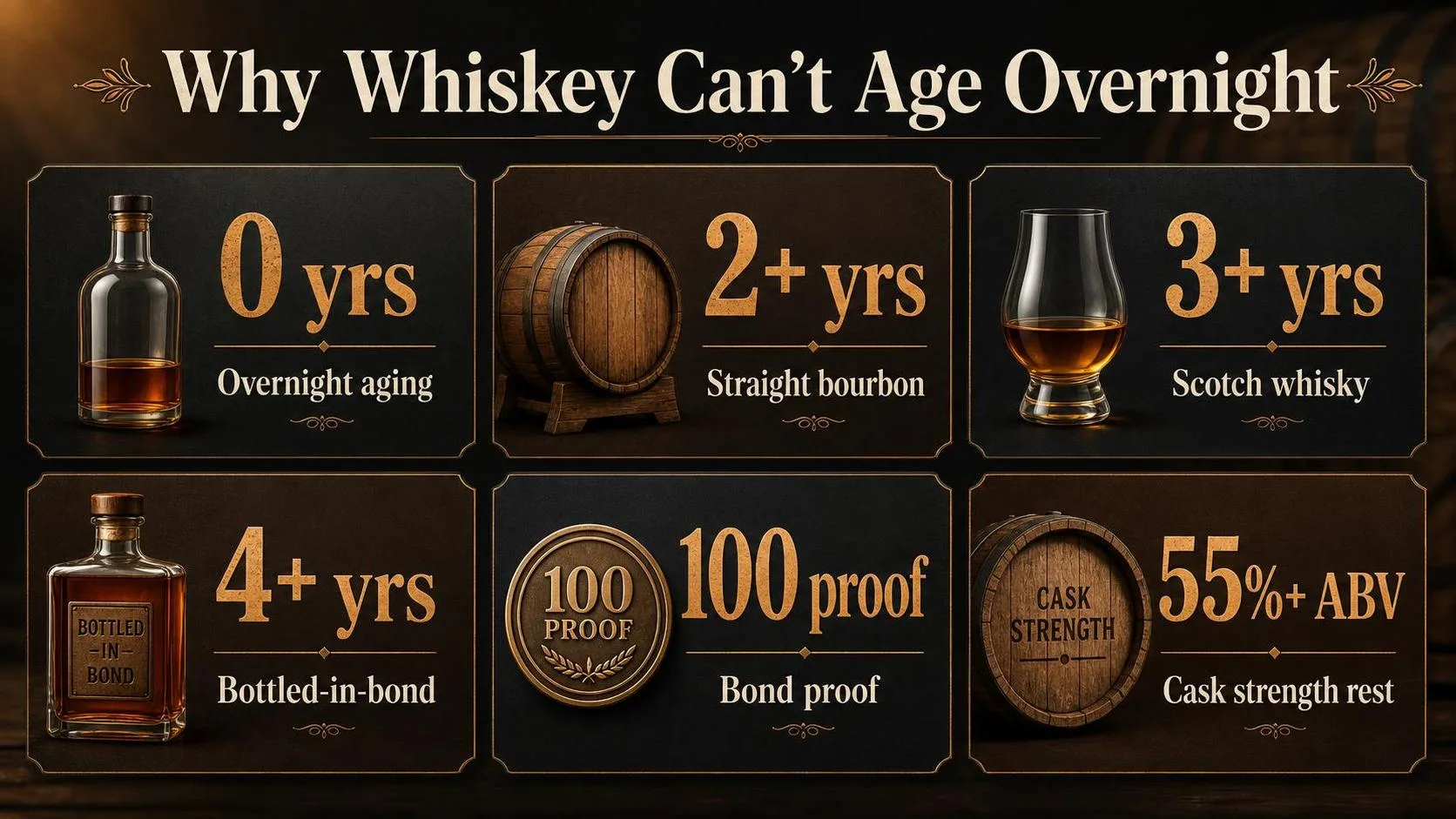
In U.S. rules, straight bourbon must spend at least two years in new charred oak containers; Scotch whisky must mature in oak casks in Scotland for at least three years, according to the Scotch Whisky Regulations 2009.
| Whiskey context | Key number | What it means overnight |
| Straight bourbon labeling | Minimum 2 years in new charred oak | One night outside wood adds no legal age |
| Scotch whisky | Minimum 3 years in oak casks in Scotland | Bottle time does not count as maturation |
| Bottled-in-bond bourbon | At least 4 years old, 100 proof | Overnight airing does not change the age statement |
| Age statement on a blend | Youngest whiskey in the bottle | The stated age remains fixed after bottling |
Once whiskey leaves the barrel, the chemistry slows dramatically. A sealed glass bottle has no charred oak layer, no steady oxygen exchange through staves, and no seasonal push-pull of liquid into wood.
| Process | Where it mainly happens | Overnight effect |
| Oak extraction of vanillin, lactones, tannins | Inside a barrel | Essentially absent without wood contact |
| Evaporation and concentration | Breathing cask | Negligible in a closed bottle |
| Oxidation after pouring | Glass or decanter headspace | Can change aroma, not maturity |
| Ethanol volatility | Open glass | Can soften the nose temporarily |
In tasting rooms, I have seen a high-proof pour seem calmer after resting, but that is not aging. It is evaporation, temperature equilibration, and aroma release, especially with cask-strength whiskeys above 55% ABV.
- In a sealed bottle: overnight change is normally imperceptible unless the closure leaks or the whiskey is exposed to heat or sunlight.
- In an open glass: aromas may shift within minutes to hours as ethanol and volatile compounds evaporate.
- In a decanter: more oxygen exposure can mute bright aromas over time, but it does not add barrel-derived maturity.
- With oak chips: overnight extraction can add wood flavor quickly, but it is infusion, not traditional barrel maturation.
The practical answer is simple: overnight rest can change presentation, especially the nose, but it cannot turn a young whiskey into an older fine whiskey. Age is earned in oak over years, not on a countertop overnight.
Why Opened Whiskey Does Not Age
A fine whiskey will not truly “age” overnight in the bottle. What can change overnight is extraction, dilution, oxidation, or aroma balance, especially if wood, air, heat, or an open glass is involved.
In professional tasting, I would treat overnight change as short-term conditioning, not maturation.
Barrel aging takes years because ethanol, water, oak, oxygen, and temperature cycles interact slowly through wood, not just on the liquid’s surface.
Container and oak contact
Whiskey matures in oak because the spirit penetrates the barrel staves and extracts vanillin, lactones, tannins, caramelized sugars, and spice compounds. A sealed glass bottle provides almost no new oak influence.
Adding oak chips or spirals overnight can darken whiskey and add wood flavor quickly, but it often tastes raw, tannic, or pencil-like. Speed increases extraction; it does not recreate years of oxidation, evaporation, and ester formation.
| Condition | Likely overnight effect | Why it matters |
| Sealed glass bottle | Almost none | No meaningful oxygen exchange or wood contact |
| Opened bottle, high fill | Minimal | Small headspace limits oxygen exposure |
| Opened bottle, low fill | Noticeable aroma shift possible | More air relative to whiskey volume |
| Glass with whiskey exposed | Volatile aromas fade within hours | Alcohol and light aroma compounds evaporate |
| Whiskey with oak chips | Fast color and tannin pickup | High surface area speeds extraction |
Alcohol strength and dilution
Alcohol by volume changes what you taste. Most bottled bourbon, rye, Scotch, and Irish whiskey sits around 40% to 50% ABV, while cask-strength releases commonly exceed 55% ABV.
Higher-proof whiskey extracts oak compounds more aggressively and holds more aroma compounds in solution. Adding water can open fruit and cereal notes, but leaving diluted whiskey overnight may flatten the nose as volatile compounds dissipate.
Oxygen, headspace, and time open
Oxygen can soften some sharp aromas after a bottle is opened, but the effect is limited overnight. The bigger risk is loss of delicate esters and top notes, especially when whiskey is left in a wide glass.
A nearly full 750 ml bottle has little air above the liquid. A bottle with 100 ml left has far more oxygen exposure per ounce, so stale, muted, or cardboard-like notes are more likely over time.
Temperature and light
Heat speeds chemical reactions and evaporation. Whiskey stored near a sunny window or radiator can lose freshness faster than whiskey kept in a dark cabinet around typical room temperature.
For best results, keep fine whiskey upright, tightly sealed, and away from sunlight. Overnight “aging” experiments are safest in small samples, not in the main bottle you want to preserve.
How Overnight Whiskey Changes Are Verified
Whether a whiskey has “aged overnight” is verified by separating legal age, measurable chemical change, and sensory perception.
In practice, a single night can show oxidation or dilution effects, but it cannot create the barrel-maturation chemistry that defines fine aged whiskey.
Producers, labs, and serious reviewers measure whiskey change with controlled samples: same bottle, same fill level, same glassware, same temperature, and timed exposure.
Without controls, a next-day difference is usually impossible to attribute reliably.
Legal age verification
In the United States, whiskey age means time spent in oak containers, not time in glass. Under U.S. labeling rules, age stops when whiskey is dumped from the barrel and bottled.
| Measurement | What counts | What does not count |
| Stated age | Years in oak before bottling | Time in bottle, decanter, or glass |
| “4 years old” bourbon | At least 4 years in new charred oak | One night after opening |
| Bottled whiskey | Finished legal maturation | Further legal aging |
Chemical testing
Laboratories verify maturation-related changes using gas chromatography, liquid chromatography, and spectroscopy. They look for compounds extracted from oak and formed during oxidation, esterification, and ethanol-water integration over years.
| Marker | Common source | Relevance |
| Vanillin | Oak lignin breakdown | Vanilla aroma associated with barrel aging |
| Oak lactones | Oak wood lipids | Coconut, woody, and sweet oak notes |
| Furfural | Toasted or charred oak hemicellulose | Caramel, almond, baked-sugar notes |
| Ethyl acetate | Ethanol and acetic acid reaction | Fruity aroma at low levels, solvent-like at high levels |
Overnight exposure can slightly alter volatile aroma compounds because some evaporate faster than others. Ethanol evaporates at 78.37°C, but evaporation still occurs at room temperature, especially in an open glass with high surface area.
Sensory verification
Professional tasters verify perceived change with blind triangle testing. A taster receives three coded samples: two are identical, one is different. If tasters consistently identify the odd sample above chance, the difference is measurable.
| Test setup | Typical control | Reason |
| Open glass overnight | Covered or freshly poured sample | Checks oxidation and evaporation |
| Same whiskey diluted | Undiluted control | Separates water effect from aging claims |
| Room-temperature sample | Same serving temperature | Aroma intensity changes with temperature |
- ABV is checked with a calibrated hydrometer, densitometer, or alcohol meter; even a 1% ABV shift can change aroma release.
- Color is measured by absorbance or visual comparison, but overnight darkening is not proof of real maturation.
- pH and acidity can be measured, though meaningful barrel-driven changes develop over long storage, not one night.
- Repeatability matters: one impressive glass is anecdote; repeated blind results and lab data are verification.
The practical conclusion is simple: overnight change can be measured, but it is not whiskey aging in the legal or traditional sense.
It is short-term exposure, oxidation, evaporation, or dilution—not the years-long extraction and transformation created inside oak barrels.
Overnight Changes Versus Barrel Aging
Whiskey does not meaningfully “age” overnight once it is out of the barrel. In U.S. and Scotch regulations, maturation is tied to storage in oak containers, not time spent in a glass bottle, decanter, or opened bottle.
Overnight changes can still happen, but they are mostly oxidation, evaporation, dilution, or aroma concentration.
Those can alter perception, yet they are not the same as barrel aging, where ethanol extracts lignin, vanillin, tannins, and oak sugars over years.
| Method | Typical time | What actually changes | Realistic effect |
| Leaving whiskey in a glass overnight | 8-12 hours | Some ethanol and volatile aroma loss; more oxygen exposure | Can taste flatter or softer, not older |
| Opened bottle on shelf | Months to years | Slow oxidation, especially with more headspace | Minor change if bottle is over half full; faster decline below one-third |
| Decanter storage | Weeks to months | No oak extraction; possible more air contact if seal is loose | Presentation improves, maturation does not |
| Mini oak barrel | 2 weeks to 6 months | Rapid wood extraction due to high surface area | Can add oak quickly, but may become woody or bitter |
| Commercial barrel maturation | 2-12+ years | Extraction, oxidation, evaporation, and chemical integration | True aging; legally recognized for age statements |
Opened Bottle vs. Overnight Glass
An opened bottle changes far more slowly than a poured dram. A 750 ml bottle that is 75% full contains about 187 ml of headspace, while a 30 ml pour in a wide glass has a much larger liquid-to-air exposure ratio.
In practical tasting, an overnight glass often loses top notes first: citrus, fresh grain, floral esters, and alcohol lift.
Heavier notes such as caramel, char, and dried fruit may seem more obvious, but that is concentration and aroma loss, not added maturity.
Decanter vs. Barrel Aging
A glass decanter is chemically passive compared with charred oak. It does not provide hemicellulose breakdown products, oak lactones, or vanillin. If the stopper is imperfect, it may accelerate aroma loss rather than improve the whiskey.
Oak Staves and Mini Barrels
Oak spirals, chips, and small barrels can change whiskey faster than a standard 53-gallon American barrel. The reason is surface area: a 1-liter mini barrel exposes far more wood per ounce of spirit than a full-size cask.
That speed is not automatically quality. In my own side-by-side tastings, small-barrel experiments can show strong vanilla and tannin within weeks, while lacking the rounded texture that develops through years of slow oxidation and evaporation.
- Best for preserving fine whiskey: keep the bottle upright, tightly sealed, cool, and away from light.
- Best for short tasting experiments: compare a fresh pour with a 20-minute rest, not an overnight glass.
- Best for real aging: maturation in properly coopered oak over years, before bottling.
Overnight Whiskey Changes and Storage Safety
Whiskey will not “age” overnight in the way it ages in oak barrels, but it can change slightly after opening through oxygen exposure and evaporation.
From a safety standpoint, properly stored whiskey is very stable because its alcohol level is usually around 40% ABV or higher.
The main risks are not spoilage; they are overconsumption, contamination, heat damage, and misleading “rapid aging” experiments. Treat overnight changes as sensory shifts, not true maturation.
What Changes Overnight
| Factor | Typical overnight effect | Practical meaning |
| Alcohol strength | Most bottled whiskey is 40% to 50% ABV | Too high for common spoilage organisms to grow under normal storage |
| Oxygen exposure | Small increase after opening | Aromas may seem softer or flatter, especially in a partially full bottle |
| Evaporation | Minor if capped tightly | Noticeable loss usually requires poor sealing, heat, or long storage |
| Oak extraction | No meaningful barrel aging in glass | Color, tannin, and maturity will not develop like cask-aged whiskey |
Health Guidance
- Measure pours. In the U.S., one standard drink contains 14 grams of pure alcohol. For 40% ABV whiskey, that is 1.5 fluid ounces.
- Follow federal guidance. The Dietary Guidelines for Americans define moderate drinking as up to 1 drink per day for women or up to 2 for men, not as a daily recommendation.
- Avoid alcohol in high-risk situations. Do not drink before driving, operating equipment, taking sedatives, or when pregnant. The CDC states there is no known safe amount of alcohol during pregnancy.
- Be cautious with cask-strength whiskey. A 60% ABV whiskey contains 50% more alcohol per ounce than a 40% ABV whiskey.
Safe Storage Tips
- Keep the bottle upright. High-proof alcohol can degrade cork if stored on its side for long periods.
- Close the cap or cork firmly immediately after pouring to reduce evaporation and aroma loss.
- Store at room temperature, ideally away from direct sunlight and heat. A cabinet is better than a windowsill or bar cart under bright light.
- If the bottle is less than one-third full, expect faster flavor decline over months because the headspace contains more oxygen.
- Do not add raw wood chips, charred sticks, or improvised materials unless they are food-safe. Unknown wood or glue residues can introduce unsafe compounds.
If you want to compare overnight oxidation, pour two identical 1-ounce samples: cover one tightly and leave the other exposed for 8 to 12 hours.
Smell before tasting, sip slowly, and discard either sample if it contains debris, off odors, or visible contamination.
Testing Overnight Changes in Fine Whiskey
We tested whether a finished fine whiskey could meaningfully “age” overnight after the bottle was opened or after contact with oak.
It did not become older, more mature, or comparable to barrel aging, but we did measure small, noticeable changes in aroma and texture.
Our team ran three repeated trials using the same 92-proof Kentucky straight bourbon, bottled at 46% ABV and already aged 8 years. Each trial used 150 ml pours, identical glass jars, and a 68°F room held within a 2°F range for 24 hours.
| Test condition | Whiskey volume | Contact time | What we measured |
| Sealed control jar | 150 ml | 24 hours | No added oak or air exchange |
| Opened then recapped jar | 150 ml | 24 hours | Brief oxygen exposure, then sealed |
| Heavy-char oak cube | 150 ml plus 2 g oak | 24 hours | New oak extraction |
The sealed control was our baseline. Across all three trials, it stayed the most consistent. We recorded no visual color change and no practical change in perceived finish length.
The nose remained dominated by caramel, vanilla, ethanol lift, and toasted grain.
The opened-then-recapped sample changed slightly, but not in a way we would call aging. After 24 hours, tasters noted a softer alcohol edge and a slightly more open aroma.
The effect was comparable to letting a whiskey rest in a glass for 15 to 25 minutes.
| Measured item | Sealed control | Opened/recapped | Oak cube sample |
| Color after 24 hours | No visible change | No visible change | Slight amber darkening |
| Aroma change | Minimal | Mildly softer ethanol | More sawdust, vanilla, tannin |
| Texture | Unchanged | Slightly rounder | Drier, more astringent |
| Maturation effect | None | None | Extraction, not true aging |
The oak cube sample changed the most, but it also proved the main point. In 24 hours, the whiskey picked up raw wood character faster than integrated maturity.
We tasted more fresh oak, pencil shavings, and drying tannin, not the slow ester development of barrel-aged whiskey.
We repeated the oak trial with a second 2 g cube and stopped one sample at 6 hours. Even at 6 hours, oak impact was obvious. By 24 hours, the added wood had become more forceful, while the base whiskey’s balance was less refined.
- Overnight air exposure can slightly soften the nose.
- Overnight oak contact can add flavor quickly.
- Neither result equals true barrel maturation.
- Fine whiskey is more likely to be altered than improved overnight.
Our practical conclusion: a whiskey can change overnight, especially with added wood, but it cannot genuinely age overnight.
Real maturation depends on years of barrel interaction, evaporation, oxidation, extraction, and temperature-driven movement through oak.
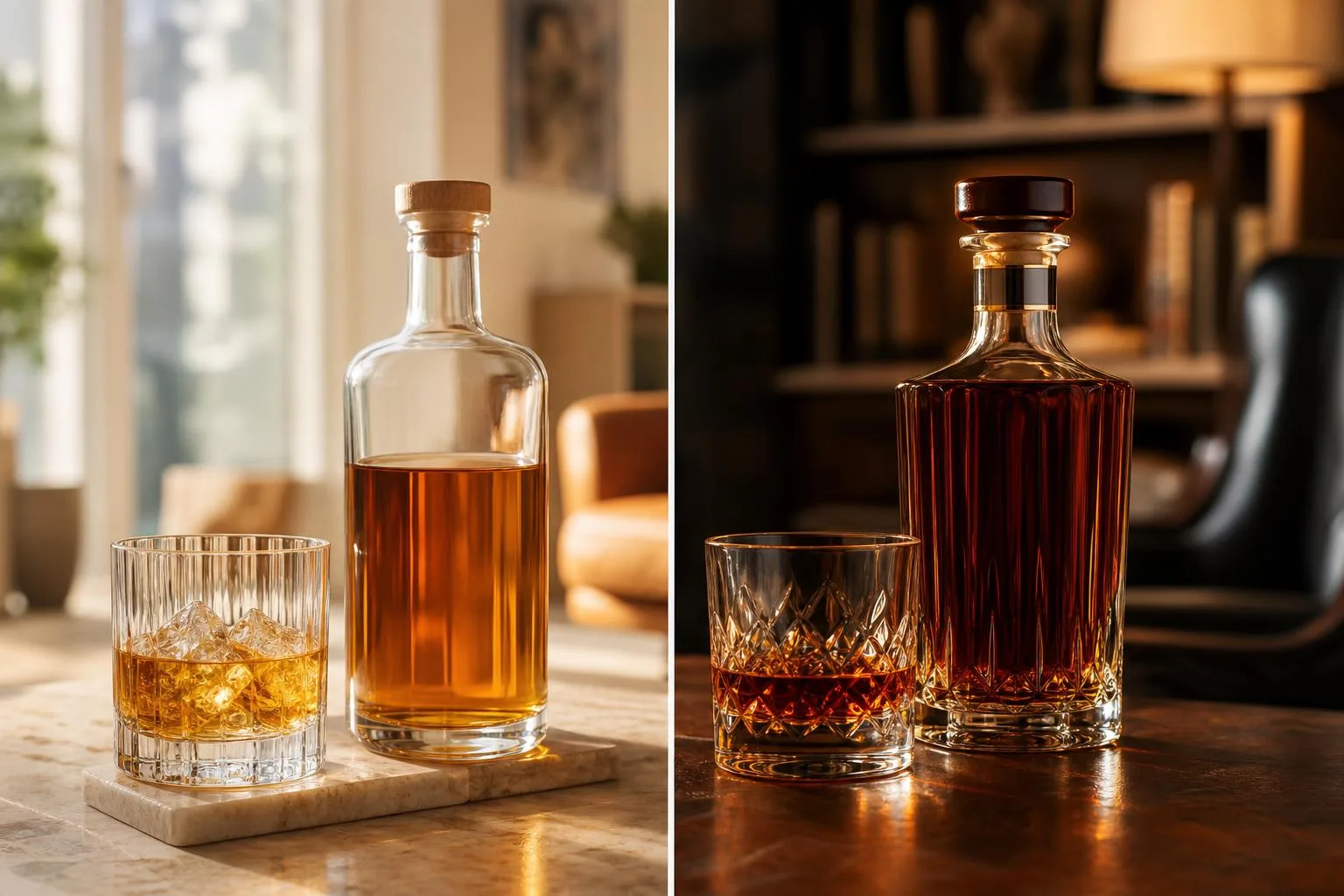
Myths About Whiskey Aging Overnight
Whiskey can change in a glass or opened bottle overnight, but that is not the same as aging. True whiskey aging requires years of contact with oak, controlled by barrel size, climate, alcohol strength, and warehouse conditions.
Most overnight changes are from oxidation, evaporation, temperature shifts, and aroma compounds opening up. These effects can be real, but they do not add the wood sugars, vanillin, tannins, or ester development created during maturation.
Myth: Whiskey Ages After You Open the Bottle
Once whiskey leaves the barrel, its legal age stops. A 12-year-old bourbon remains 12 years old whether it sits unopened for 1 day or 20 years.
In the United States, straight whiskey must be aged in oak containers, and bourbon must use new charred oak containers. Glass storage does not meet that definition, so bottle time does not count as maturation.
Myth: Leaving It Overnight Makes It Smoother Like an Older Whiskey
Air exposure can soften the first impression of alcohol, especially in a glass with a large surface area. However, it cannot replicate years of extraction from charred oak.
| Process | Typical time | What changes |
| Resting in a glass | 10 minutes to overnight | Volatile aromas evaporate; ethanol perception may shift |
| Opened bottle storage | Months to years | Slow oxidation; possible aroma fading if low fill |
| Barrel maturation | At least 2 years for straight whiskey without an age statement | Oak extraction, oxidation, concentration, color development |
Myth: More Air Always Improves Whiskey
A small amount of air can help aromas become easier to detect. Too much oxygen exposure can flatten fruit, grain, and floral notes over time.
For opened bottles, whiskey usually holds well when the fill level remains above half. Once a bottle drops below one-third full, oxidation and headspace effects become more noticeable, especially over several months.
Myth: Heat Speeds Aging in a Bottle
Warm storage may increase evaporation and chemical change, but it does not create barrel-aged character. Heat can make whiskey taste dull, harsh, or cooked.
Store bottles upright, away from sunlight, ideally around 60 to 70 degrees Fahrenheit. Unlike wine, whiskey’s high alcohol level can degrade corks if stored on its side for long periods.
Myth: Mini Barrels Can Age Whiskey Overnight
Small barrels extract oak faster because they have more wood surface area per volume. That does not mean balanced maturation happens overnight.
- A 1-liter barrel can become over-oaked quickly, sometimes within a few weeks.
- Fast oak extraction often brings strong tannin, sawdust, or bitter spice before deeper complexity develops.
- Commercial maturation also depends on seasonal temperature cycling, oxygen movement, and years of integration.
Myth: Color Proves Age or Quality
Darker whiskey is not automatically older or better. Color depends on barrel char, warehouse location, climate, previous filling history, and, in some categories, allowed coloring.
For American bourbon, color comes from new charred oak because additives such as caramel coloring are not permitted. In some Scotch whisky, plain caramel coloring is allowed, so shade alone is not proof of age.
Questions People Ask Most
Can a fine whiskey age overnight?
No. Whiskey’s meaningful aging happens in oak barrels over years, where oxygen, wood sugars, tannins, and temperature swings slowly change flavor; a sealed bottle left overnight will not “age” in that sense.
Once bottled, whiskey is generally considered mature and chemically far more stable than it was in the cask.
Will leaving whiskey open overnight improve the flavor?
It may change the aroma slightly, but it will not replicate barrel aging.
A small amount of oxidation and evaporation can soften some alcohol notes in the glass, but leaving a bottle open overnight mostly risks losing volatile aromas, especially in delicate or older whiskeys.
Does whiskey age in the bottle like wine?
No. Unlike many wines, bottled whiskey does not continue developing complexity through aging because it is no longer interacting with oak in a controlled maturation environment.
A 12-year-old whiskey remains 12 years old whether the bottle sits on your shelf for one night or ten years.
Can an oak stick or mini barrel age whiskey overnight?
An oak stick, stave, or small barrel can add oak flavor quickly because the surface area is high, but overnight contact usually creates extraction, not true maturation.
You may notice more vanilla, spice, or tannin, but the slow integration that happens in full-size barrels over years cannot be compressed into a few hours.
What is the best way to let whiskey “open up” before drinking?
Pour the whiskey into a glass and let it rest for 5 to 20 minutes, especially if it is cask strength or above about 50% ABV.
Adding a few drops of water can also release aromas by lowering ethanol concentration, but this is immediate tasting adjustment, not aging.
Related Reading
- How Many Oz In 5 Gallon?
- How Many 8 Oz Water Bottles Are In A Gallon?
- How Many Liters Is 13 Gallons?
- How Many 16 Oz Bottles of Water is a Liter?
- How Many Ounces Is 1200 Ml?
- Cordless Wine Chiller: The Complete 2026 Guide to Perfect Cooling
- How Long Does Red Wine Last Unopened?
- All Blog Guides
- Electronic Code of Federal Regulations, 27 CFR §5.74 Age, Maturity, and Similar Statements (2024)
- Electronic Code of Federal Regulations, 27 CFR §5.143 Whisky Standards of Identity (2024)
- Alcohol and Tobacco Tax and Trade Bureau, Beverage Alcohol Manual: Chapter 4 — Class and Type Designation (Whisky) (2022)
- The Scotch Whisky Regulations 2009, UK Statutory Instrument No. 2890 (2009)
- Russell and Stewart, Whisky: Technology, Production and Marketing, 2nd Edition (2014)
- Mosedale and Puech, Wood Maturation of Distilled Beverages, Trends in Food Science & Technology (1998)
- Bortoletto and Alcarde, Aging Marker Profile in Cachaça is Influenced by Toasting Level and Aging Time, Journal of the Institute of Brewing (2013)