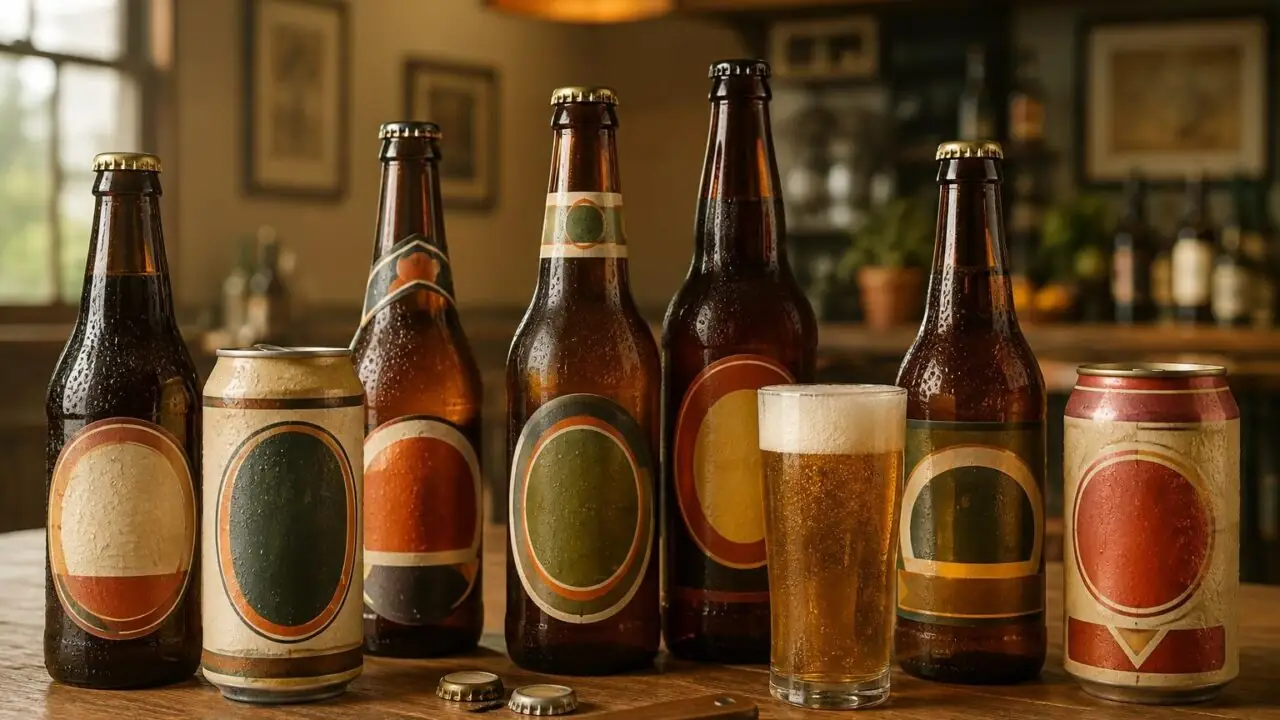
beers of the 1970s are mass-market lagers, regional holdouts, early light beers, and the first modern American craft revivals that reshaped U.S. drinking after decades of brewery consolidation.
Budweiser, Schlitz, Coors Banquet, Miller High Life, Pabst Blue Ribbon, and Michelob dominated shelves, while Miller Lite’s 1975 national launch made “less filling” a mainstream selling point.
The decade also planted craft beer’s roots: Anchor Brewing revived steam beer in San Francisco, New Albion opened in 1976, and homebrewing legalization in 1978 gave drinkers tools to recreate porters, pale ales, and fuller-flavored styles.
American Lager Dominance in the 1970s
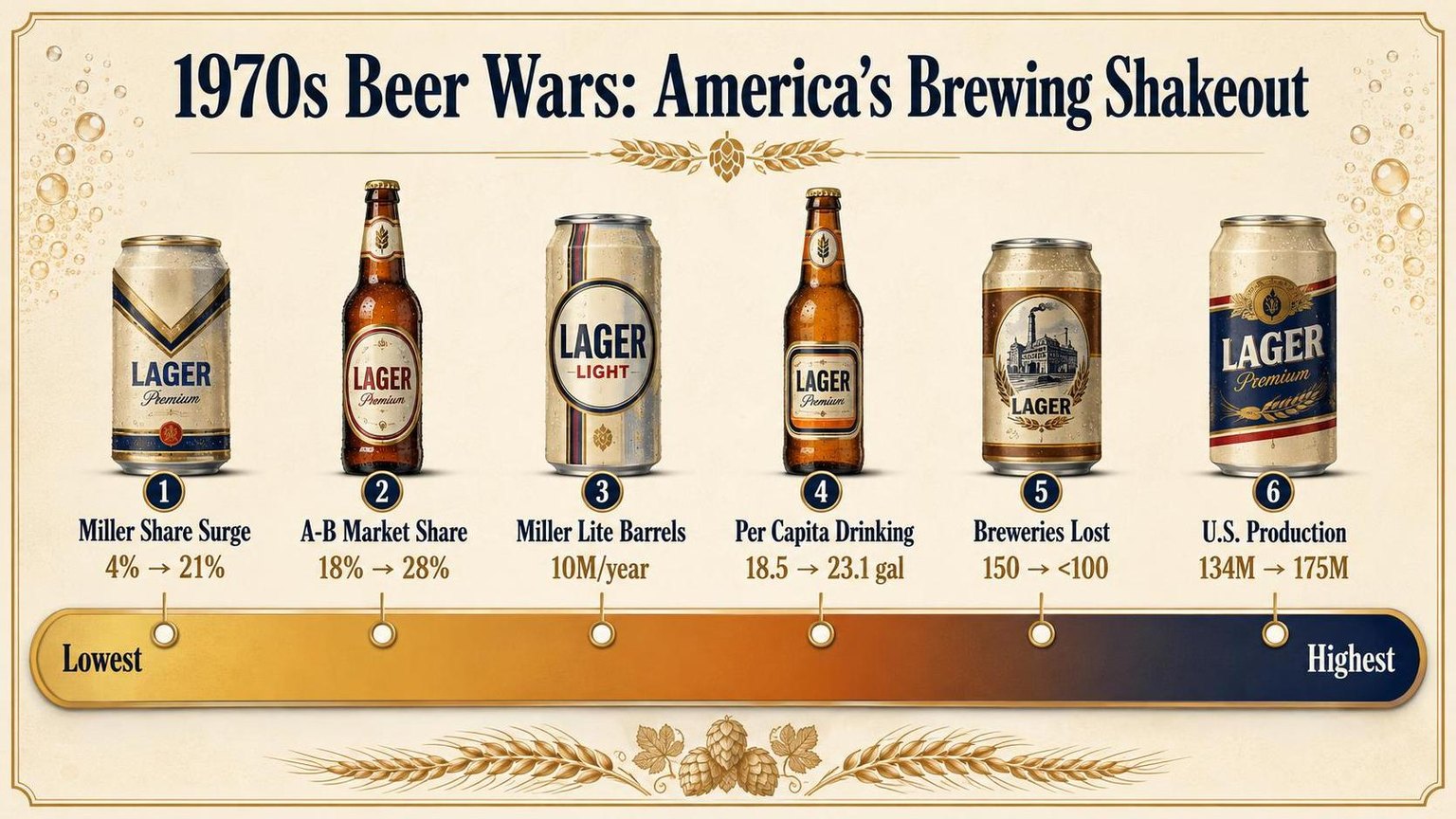
By 1970, light American lagers had captured over 90% of the U.S. beer market.
A handful of national breweries consolidated power throughout the decade, reducing the total number of U.S. brewing companies from roughly 150 in 1970 to fewer than 100 by 1979.
Anheuser-Busch, Miller, and Schlitz battled for supremacy. Their combined market share grew dramatically across the decade as regional breweries folded or were acquired.
| Brewery | 1970 Market Share | 1978 Market Share |
| Anheuser-Busch | 18% | 25.4% |
| Miller Brewing | 4.2% | 15.4% |
| Schlitz | 12.4% | 11.8% |
| Pabst | 8.6% | 8.7% |
| Coors | 3.4% | 7.6% |
Miller Lite and the Light Beer Revolution
Miller Lite launched nationally in 1975, producing 12.8 million barrels by 1978. It contained 96 calories per 12-ounce serving compared to roughly 150 in standard lagers. This single product reshaped the entire industry.
The “Tastes great, less filling” campaign became one of advertising’s most recognized slogans. Miller’s total production surged from 5.4 million barrels in 1970 to 31.3 million barrels by 1978.
Regional Casualties
National advertising budgets crushed smaller operations. Breweries that closed or were absorbed during the 1970s included notable names across every region.
- Rheingold — closed its Brooklyn facility in 1976 after 121 years
- Schaefer — lost its independent status, merged with Stroh’s by decade’s end
- Falstaff — dropped from 7 million barrels in 1965 to under 3 million by 1975
- Lucky Lager — sold to General Brewing, then declined sharply
Production Scale
Total U.S. beer production reached approximately 175 million barrels by 1979, up from 134 million in 1970. Per capita consumption rose from 18.5 gallons annually to 23.1 gallons during the same period.
Adjunct-heavy recipes using corn and rice kept costs low and flavor neutral.
This uniformity drove consumer loyalty toward brand identity rather than taste differentiation — a pattern that persisted until craft brewing’s emergence in the 1980s.
Big Brewers and National Brands
The 1970s witnessed unprecedented consolidation in American brewing. In 1970, the top five brewers controlled roughly 49% of the U.S. beer market; by 1980, that share exceeded 75%.
Regional breweries collapsed as national brands dominated television advertising and distribution networks.
Anheuser-Busch seized the decade’s crown. Budweiser overtook Schlitz as America’s best-selling beer in 1977, a position it has never relinquished.
| Brewery | 1970 Market Share | 1980 Market Share |
| Anheuser-Busch | 18% | 28% |
| Miller Brewing | 4% | 21% |
| Schlitz | 12% | 8% |
| Pabst | 8% | 6% |
| Coors | 6% | 8% |
Miller Brewing’s transformation was the decade’s most dramatic story. Philip Morris acquired Miller in 1970 for $227 million and applied cigarette-marketing tactics to beer.
Miller Lite, launched nationally in 1975, created the light beer category almost single-handedly.
By 1978, Miller Lite sold 10 million barrels annually, fueled by the iconic “Tastes Great, Less Filling” campaign featuring retired athletes.
The Fall of Schlitz
Schlitz entered the 1970s as America’s second-largest brewer. Management cut costs by shortening the brewing cycle and substituting corn syrup and hop pellets for traditional ingredients.
The consequences were severe. A 1976 reformulation caused visible flakes to form in bottles, triggering a massive recall. Sales plummeted from 24 million barrels in 1976 to under 15 million by 1980.
Coors: The Regional Mystique
Adolph Coors Company distributed to only 11 western states throughout the 1970s. This scarcity created cult-like demand — bootleg Coors shipments to eastern states became a cultural phenomenon referenced in the 1977 film Smokey and the Bandit.
- Coors brewed exclusively in Golden, Colorado, using Rocky Mountain spring water and no pasteurization
- The company required refrigerated shipping and storage, adding significant distribution costs
- Annual production reached 13.7 million barrels by 1977 from a single brewery — the world’s largest
The total number of U.S. breweries bottomed out near 80 by the late 1970s, down from 750 in 1940. National brands had reshaped American beer into a homogeneous, light-lager landscape that would persist until the craft revolution of the 1980s.
Light Beer Becomes a Category
Miller Lite, launched nationally in 1975, transformed light beer from a failed experiment into America’s fastest-growing beer segment.
By 1978, it ranked as the second-best-selling beer in the United States, fundamentally reshaping the industry’s competitive landscape.
The Road to Miller Lite
Rheingold Breweries first introduced Gablinger’s Diet Beer in 1967, developed by biochemist Joseph Owades. The beer used an enzyme process to break down starch, reducing calories.
It flopped commercially—consumers associated “diet” with feminine branding.
Owades shared his formula with Peter Hand Brewing Company in Chicago, which released Meister Bräu Lite in 1967. That brand also struggled. When Meister Bräu went bankrupt in 1972, Miller Brewing acquired the Lite trademark and recipe.
Miller’s Marketing Revolution
Miller repositioned the product entirely. Rather than marketing to dieters, they hired retired athletes—Dick Butkus, Bob Uecker, Mickey Spillane—to argue whether Lite tasted great or was less filling.
The campaign debuted in 1973 in test markets.
The national rollout in 1975 produced explosive growth. Miller Lite sales climbed from 5 million barrels in 1975 to over 24 million barrels by 1980, making it the era’s most successful new product launch in any consumer category.
Competitors Rush In
Every major brewer scrambled to release a light counterpart. The following table shows launch years for key light beers of the decade:
| Brand | Brewery | Year Launched | Calories (12 oz) |
| Miller Lite | Miller Brewing | 1975 (national) | 96 |
| Natural Light | Anheuser-Busch | 1977 | 95 |
| Coors Light | Coors Brewing | 1978 | 102 |
| Bud Light | Anheuser-Busch | 1982 | 110 |
By 1979, light beers accounted for roughly 10% of total U.S. beer volume—up from virtually zero five years earlier. The segment would reach 30% market share by the late 1980s.
- Calorie reduction method: Amyloglucosidase enzyme converts residual dextrins into fermentable sugars, yielding a drier, lower-calorie beer.
- Key insight: Miller spent an estimated $6 million on Lite advertising in 1975 alone—unprecedented for a single brand launch.
- Cultural shift: Light beer made low-calorie drinking acceptable for male consumers, breaking the “diet” stigma that sank earlier attempts.
Imports on 1970s Store Shelves
Imported beer volume in the United States surged from 1.2 million barrels in 1970 to over 3.5 million barrels by 1979, nearly tripling in a single decade.
Much of that growth came from European and Mexican brands capitalizing on American curiosity beyond domestic lagers.
Heineken dominated the import category throughout the decade, holding roughly 40% of total U.S. import market share by 1975.
| Brand | Country | Approx. U.S. Import Rank (mid-1970s) |
| Heineken | Netherlands | 1 |
| Molson | Canada | 2 |
| Beck’s | West Germany | 3 |
| Labatt | Canada | 4 |
| Dos Equis | Mexico | 5 |
| Bass Ale | England | 6 |
| Foster’s Lager | Australia | 7 |
| St. Pauli Girl | West Germany | 8 |
Canadian brands benefited from geographic proximity and lower shipping costs. Molson Golden and Labatt Blue each moved over 200,000 barrels annually into the U.S. by 1978.
Mexican imports were still modest but growing. Dos Equis entered more U.S. states during the decade, and Corona began limited distribution in border states by 1979, years before its 1980s boom.
- Price premium: Imports typically cost $1.50–$2.50 per six-pack versus $1.00–$1.50 for domestic brands like Budweiser or Miller High Life.
- Package format: Most imports arrived in green or brown glass bottles; canned imports were rare before 1980.
- Distribution: Import availability concentrated in major metro areas — New York, Chicago, Los Angeles, and San Francisco accounted for a disproportionate share of sales.
- Retail placement: Liquor stores and specialty delis carried the widest selections; supermarket import sections rarely exceeded five or six brands.
Heineken’s U.S. importer, Van Munching & Company, spent an estimated $4 million on advertising in 1976 alone, an unprecedented figure for an import brand at the time.
The 1970s import wave planted seeds for broader American palate expansion. Consumers who reached for a Heineken or Beck’s in 1975 were the same demographic that later embraced craft brewing in the late 1980s and 1990s.
Homebrewing Before Legalization Changed Everything
Homebrewing beer remained a federal crime in the United States from Prohibition’s repeal in 1933 until February 1, 1979.
For 46 years, thousands of Americans brewed illegally in basements and garages, quietly preserving techniques the commercial market abandoned.
The oversight was legislative. When Congress repealed Prohibition via the Twenty-first Amendment, it legalized homemade wine but accidentally omitted beer from the statute.
Senator Alan Cranston of California introduced S. 3191 in 1978. President Jimmy Carter signed H.R. 1337 into law on October 14, 1978, effective February 1, 1979.
The law permitted adults to brew up to 100 gallons per individual or 200 gallons per household annually without federal tax.
| Detail | Before Legalization (Pre-1979) | After Legalization (1979+) |
| Federal legal status | Illegal (Title 26 USC) | Legal up to 200 gal/household/year |
| Homebrew supply shops (est.) | Fewer than 20 nationwide | Over 300 by mid-1980s |
| American Homebrewers Association members | Did not exist | Founded 1978; 1,500+ members by 1980 |
| Homebrew competitions sanctioned | None | First AHA National Competition, 1979 |
Charlie Papazian founded the American Homebrewers Association in Boulder, Colorado, in 1978. His 1984 book The Complete Joy of Homebrewing sold over one million copies and became the movement’s essential text.
Throughout the 1970s, underground brewers relied on rudimentary ingredients. Blue Ribbon malt extract and bread yeast dominated, producing inconsistent results far from today’s craft standards.
- Malt extract kits cost roughly $8–$12 in the mid-1970s (approximately $45–$65 adjusted for inflation)
- Dedicated brewing yeast strains were nearly impossible to source domestically before 1979
- Most homebrewers fermented in repurposed 5-gallon glass carboys or plastic buckets
- Temperature control was nonexistent—seasonal brewing dictated quality
State-level legalization lagged behind the federal change. Mississippi and Alabama did not legalize homebrewing until 2013, making them the final two states to permit the practice.
The 1979 legalization directly seeded the American craft beer revolution. Ken Grossman (Sierra Nevada), Charlie McElevey, and dozens of future craft brewery founders started as homebrewers during or immediately after this pivotal legal shift.
Craft Brewing’s First 1970s Pioneers
American craft brewing emerged through a handful of small, equipment-poor operations rather than a coordinated movement. Their fuller-flavored ales challenged a market dominated by light adjunct lager.
Several experiments failed commercially, but their methods, recipes, and alumni shaped the next generation.
Anchor Brewing and Liberty Ale
Fritz Maytag had rescued San Francisco’s Anchor Brewing before the decade began, then rebuilt its production standards during the seventies.
Anchor preserved steam beer, a distinctly Californian lager fermented at unusually warm temperatures, while introducing beers that departed sharply from national brands.
Liberty Ale became the pivotal release. Brewed to commemorate Paul Revere’s ride, it featured Cascade hops, open fermentation, and dry hopping.
The Brewers Association and beer historians frequently identify it as a prototype for the citrus-forward American pale ales and India pale ales that followed.
New Albion’s Microbrewery Model
Former Navy engineer Jack McAuliffe founded New Albion Brewing Company in Sonoma, California. Inspired by British ales he encountered overseas, McAuliffe assembled a compact brewhouse from salvaged dairy and industrial equipment.
New Albion made pale ale, porter, and stout rather than imitating mass-market lager.
Distribution remained local, capacity was tiny, and insufficient capital forced the brewery to close.
Its larger importance was demonstrative: a brewer could build an independent plant, package assertive ales, and sell them directly into a regional market.
A Decade of Foundation Events
| Year | Event | Significance |
| 1975 | Anchor released Liberty Ale for the bicentennial of Paul Revere’s 1775 ride. | Its Cascade-hop character and dry hopping anticipated modern American pale ale. |
| 1976 | Jack McAuliffe founded New Albion. | It became the first widely recognized new American microbrewery after Prohibition. |
| 1978 | President Jimmy Carter signed federal homebrewing legislation. | Federal law allowed 100 gallons per adult annually, capped at 200 gallons per household, subject to state law. |
| 1979 | Boulder Beer Company began in Colorado. | Founded by homebrewers, it became an early enduring example of the small regional brewery. |
Federal homebrewing legalization widened the pool of technically experienced amateurs.
Brewers who practiced recipe formulation, yeast handling, sanitation, and hop selection at home soon founded commercial operations, including Sierra Nevada, which opened immediately after the decade ended.
These pioneers established the essential craft-brewing proposition: small scale could support distinctive flavor.
Their influence came less from production volume than from proving that drinkers would seek locally made pale ales, porters, stouts, and historically rooted beer styles.
Beer Advertising and Bar Culture
The 1970s transformed beer marketing from regional print campaigns into national television spectacles.
Brewing companies collectively spent over $200 million annually on advertising by 1979, up from roughly $100 million at the decade’s start, making beer one of TV’s largest ad categories.
Landmark Campaigns That Defined the Decade
Miller Lite’s 1973 launch introduced the “Tastes Great, Less Filling” campaign featuring retired athletes like Dick Butkus and Bob Uecker.
The campaign ran for nearly two decades and propelled Miller Lite to 24 million barrels by 1978.
Schlitz aired its controversial “Drink Schlitz or I’ll Kill You” ads in 1977, featuring boxer James Coburn.
The aggressive tone backfired, accelerating Schlitz’s decline from America’s second-largest brewer to near-irrelevance by decade’s end.
| Brand | Slogan | Year Launched | Estimated Annual Ad Spend (late 1970s) |
| Budweiser | “This Bud’s for You” | 1979 | $45 million |
| Miller Lite | “Tastes Great, Less Filling” | 1973 | $38 million |
| Schlitz | “Go for the Gusto” | 1971 | $30 million |
| Coors | “Taste the High Country” | 1975 | $18 million |
Bar Culture Shifts
The neighborhood tavern remained central to American social life. The U.S. had approximately 65,000 bars and taverns in 1975, many serving as community hubs in working-class neighborhoods across the Midwest and Northeast.
Draft beer dominated bar sales, accounting for roughly 20% of total beer volume nationally. Bars typically offered three to five taps—almost exclusively mainstream American lagers from Anheuser-Busch, Miller, Schlitz, or Pabst.
- Happy hour became a widespread practice in the 1970s, with bars offering discounted pitchers for $1.50–$2.50 during afternoon hours
- Fern bars—upscale, plant-decorated establishments—emerged mid-decade, attracting young professionals and women in larger numbers
- The legal drinking age varied by state, ranging from 18 to 21, creating border-crossing “blood alley” highways between states
- Coin-operated pool tables and early arcade games like Pong (1972) became standard bar fixtures
The fern bar trend signaled a cultural shift. Establishments like T.G.I.
Friday’s, founded in 1965 but rapidly expanding through the 1970s, blurred the line between restaurant and bar, broadening beer’s demographic reach beyond the traditional blue-collar male drinker.
Frequently Asked Questions
What were the best-selling beer brands in the United States during the 1970s?
Budweiser overtook Schlitz as the top-selling U.S. beer in 1977, ending Schlitz’s decades-long reign.
Miller High Life surged from 7th place in 1970 to 2nd by 1977 after Philip Morris acquired Miller Brewing in 1969 and launched aggressive “Miller Time” marketing campaigns.
Pabst Blue Ribbon, Coors Banquet, and Schlitz rounded out the top five for most of the decade.
How did Miller Lite reshape the beer industry after its 1975 national launch?
Miller Lite debuted nationally in 1975 with 96 calories per 12-oz serving—roughly one-third fewer than standard American lagers—and created the light beer category almost overnight.
By 1978 Miller Lite sold over 10 million barrels annually, prompting Anheuser-Busch to release Natural Light (1977) and Bud Light (test-marketed in 1981).
The “Tastes great, less filling” campaign featuring retired athletes became one of the most recognized ad slogans in American television history.
Why did Schlitz lose its dominant market position during the 1970s?
Schlitz implemented a cost-cutting reformulation in the early 1970s, replacing traditional brewing ingredients with corn syrup and hop pellets while shortening the fermentation cycle.
The changes caused visible haze and flocculation problems in bottles, triggering consumer complaints and a damaging 10-million-can recall in 1976.
Sales collapsed from roughly 17.8 million barrels in 1974 to under 8 million by 1980, and the company was eventually sold to Stroh Brewery in 1982.
What role did the 1970s play in the rise of American craft brewing?
The number of U.S. breweries had shrunk to fewer than 50 by the mid-1970s, the lowest count since Prohibition.
Jack McAuliffe founded New Albion Brewing in Sonoma, California, in 1976—widely recognized as the first American microbrewery of the modern era. President Jimmy Carter signed H.R.
1337 in October 1978, legalizing home brewing of up to 200 gallons per household annually, which directly fueled the homebrewer-to-professional pipeline that built the craft beer movement of the 1980s and beyond.
Which imported beers gained popularity in the U.S. during the 1970s?
Heineken dominated the U.S. import market throughout the 1970s, holding roughly 40% of import volume by decade’s end. Molson Canadian and Labatt Blue benefited from proximity and cross-border tourism, while Beck’s and St.
Pauli Girl introduced Americans to German-style pilsners.
Corona, Dos Equis, and Foster’s Lager began appearing on U.S. shelves late in the decade, setting the stage for the import boom of the 1980s when imported beer’s market share tripled.
Further Reading
- What Is The Oldest Whiskey In The World?
- What Is The Smoothest Tequila?
- How Many 8 Oz In 1 Liter?
- How Many Twisted Teas To Get Drunk?
- How Many Ounces Is 12 Ml? A Clear, Practical Guide Based on Real-Life Use
- Is Fireball Gluten-Free?
- Does Hpnotiq Need To Be Refrigerated?
- How Long Is Maker’S Mark Bourbon Aged?
- All Blog Guides
- Brewing Industry Research Foundation – Journal of the Institute of Brewing (1975)
- U.S. Alcohol and Tobacco Tax and Trade Bureau – Historical Tax Rates (1970s)
- National Institute on Alcohol Abuse and Alcoholism – Alcohol Epidemiologic Data Directory (1978)
- USDA Economic Research Service – U.S. Beer Industry Data (1979)
- Brewers Association of America Records, 1942–1986 – Smithsonian National Museum of American History Archives Center (1976)
- Kenneth Elzinga, "The Beer Industry" – University of Virginia Department of Economics (1973)
- PubMed – "Beer Composition and Nutritive Value" Journal of the American Society of Brewing Chemists (1977)