
How Long After Taking Theraflu Can I Drink Alcohol? Wait at least 24 hours after your last dose, and longer if the product contains acetaminophen, dextromethorphan, doxylamine, or phenylephrine.
Alcohol can raise liver-risk with acetaminophen and intensify drowsiness, dizziness, impaired coordination, and poor judgment.
Theraflu formulas vary, so the safe window depends on the exact active ingredients, your liver health, dose timing, and how much alcohol you plan to drink.
This guide explains the interaction risks, label warnings, and when to ask a pharmacist or clinician before drinking.
Theraflu Ingredients That Interact With Alcohol
Theraflu products contain a combination of active ingredients, each carrying distinct risks when mixed with alcohol.
Understanding these specific compounds and their interaction mechanisms is essential before consuming any alcoholic beverage during or after Theraflu use.
Acetaminophen (APAP)
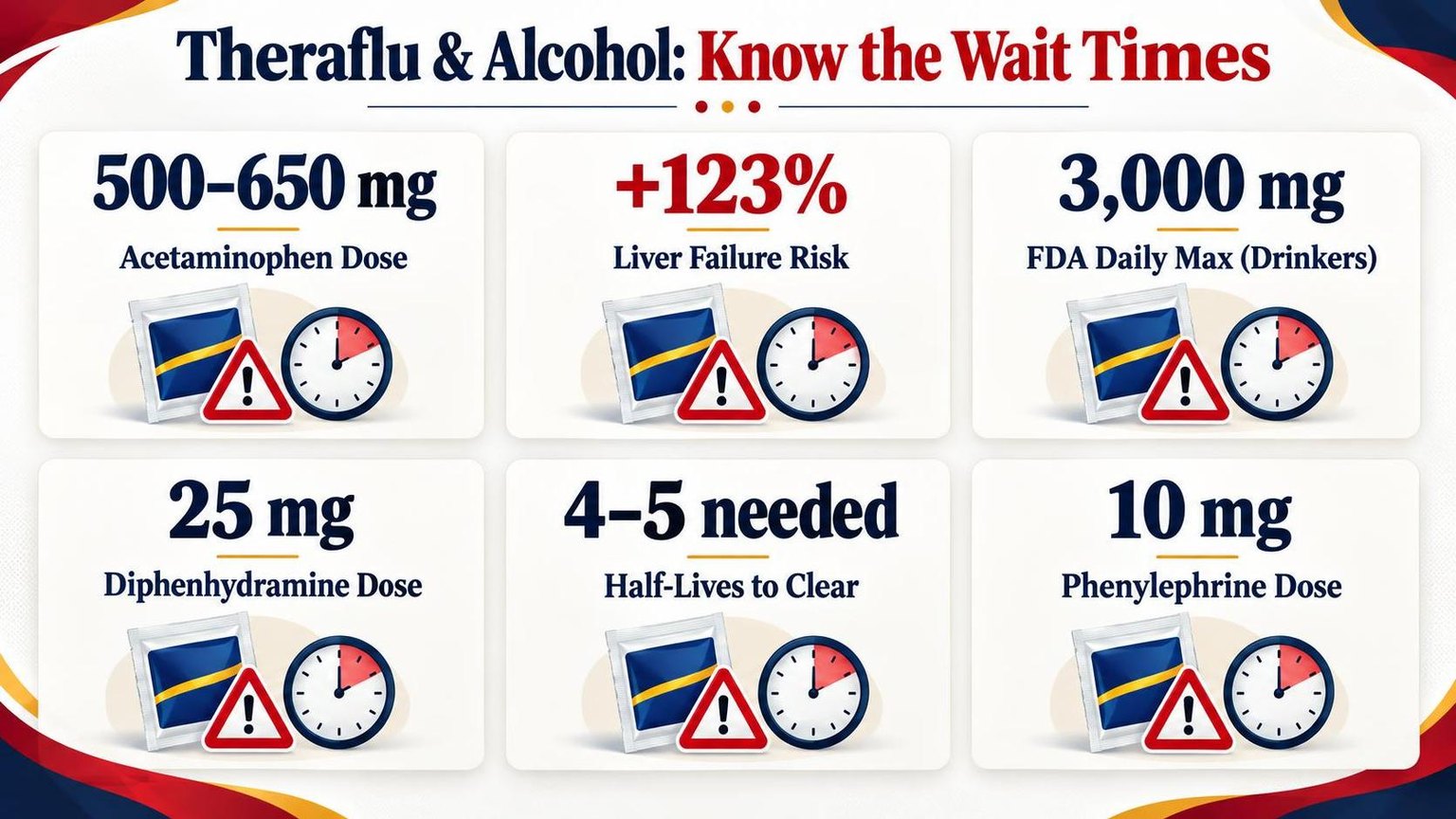
Every Theraflu formulation contains acetaminophen at doses of 500–650 mg per packet. The FDA maximum daily limit is 3,000 mg for adults who consume alcohol. Exceeding this threshold dramatically increases hepatotoxicity risk.
Acetaminophen is metabolized in the liver by the CYP2E1 enzyme. Alcohol upregulates this same enzyme, increasing production of the toxic metabolite NAPQI (N-acetyl-p-benzoquinone imine). NAPQI depletes glutathione stores and causes liver cell death.
A 2011 study in Pharmacoepidemiology and Drug Safety found that concurrent acetaminophen-alcohol use increased the risk of acute liver failure by approximately 123% compared to acetaminophen alone.
Diphenhydramine (Antihistamine)
Theraflu Nighttime formulations contain 25 mg of diphenhydramine per dose. This first-generation antihistamine crosses the blood-brain barrier and causes significant sedation through H1 receptor antagonism.
Alcohol potentiates diphenhydramine’s central nervous system depression. Combined use can cause extreme drowsiness, impaired motor coordination, slowed breathing, and loss of consciousness.
The National Institute on Alcohol Abuse and Alcoholism classifies this as a dangerous combination.
Phenylephrine
Several Theraflu products contain 10 mg of phenylephrine per packet. This sympathomimetic decongestant raises blood pressure by constricting blood vessels. Alcohol initially causes vasodilation, then rebound vasoconstriction.
The opposing cardiovascular effects create unpredictable blood pressure fluctuations. Individuals with hypertension face elevated stroke and cardiac event risk from this combination.
Dextromethorphan (DXM)
Theraflu Cough Relief contains 20 mg of dextromethorphan per dose. DXM acts on NMDA receptors and sigma-1 receptors in the brain. Alcohol amplifies its dissociative and sedative properties.
Combining DXM with alcohol increases the risk of serotonin syndrome, respiratory depression, and severe dizziness. The FDA has flagged this interaction as clinically significant.
Interaction Severity Summary
| Ingredient | Typical Dose per Packet | Primary Interaction With Alcohol | Severity |
| Acetaminophen | 500–650 mg | Liver toxicity (increased NAPQI) | High |
| Diphenhydramine | 25 mg | Excessive CNS depression | High |
| Phenylephrine | 10 mg | Blood pressure instability | Moderate |
| Dextromethorphan | 20 mg | Respiratory depression, serotonin risk | Moderate–High |
Not every Theraflu product contains all four ingredients. Check your specific product’s Drug Facts label to identify which active compounds are present before assessing your alcohol interaction risk.

Minimum Wait Time After Theraflu
The minimum safe wait time after taking Theraflu depends on which active ingredient takes longest to clear your system.
Acetaminophen, the primary component at 650 mg per dose, dictates the timeline because it poses the greatest liver-interaction risk with alcohol.
Elimination Half-Lives of Theraflu Ingredients
Each active ingredient in Theraflu Multi-Symptom Severe Cold has a different plasma half-life. Full clearance requires approximately 4–5 half-lives.
| Active Ingredient | Dose per Packet | Half-Life | Time to ~97% Clearance (5 half-lives) |
| Acetaminophen | 650 mg | 2–3 hours | 10–15 hours |
| Dextromethorphan HBr | 20 mg | 3–6 hours | 15–30 hours |
| Phenylephrine HCl | 10 mg | 2.5–3 hours | 12.5–15 hours |
The Practical Recommendation
Wait at least 24 hours after your last Theraflu dose before consuming any alcohol. This buffer exceeds the clearance window for all three ingredients and accounts for individual metabolic variation.
The FDA warns against combining acetaminophen with alcohol because both substances are metabolized by the CYP2E1 enzyme in the liver. Concurrent use increases production of the toxic metabolite NAPQI, which causes hepatocellular damage.
Chronic alcohol users—defined by the FDA as three or more drinks per day—face elevated risk even beyond the standard wait period.
The agency recommends these individuals consult a physician before taking any acetaminophen-containing product.
Why 24 Hours, Not Just 15
Pharmacokinetic clearance does not equal metabolic safety. Several factors extend the real-world risk window beyond the calculated elimination time:
- Liver enzyme induction: Acetaminophen’s effect on CYP2E1 activity persists after the drug itself has cleared plasma, keeping NAPQI production elevated.
- Dextromethorphan variability: Approximately 5–10% of the population are CYP2D6 poor metabolizers, extending DXM’s half-life to 24 hours or longer.
- Cumulative dosing: Theraflu allows up to 3 packets in 24 hours (1,950 mg acetaminophen total), approaching the 3,000 mg daily ceiling the FDA recommends for people who drink alcohol.
- Dehydration during illness: Fever and reduced fluid intake slow renal clearance and concentrate drug metabolites in the liver.
Adjusting for Multiple Doses
Start the 24-hour clock from your final dose, not your first. If you took Theraflu at 10 PM, avoid alcohol until at least 10 PM the following day.
If you used Theraflu for multiple consecutive days, consider extending the wait to 36–48 hours. Repeated acetaminophen dosing upregulates CYP2E1 expression, amplifying alcohol’s hepatotoxic potential even after drug clearance.
When in doubt, consult your pharmacist or physician—particularly if you take other medications metabolized by the liver or have any pre-existing hepatic condition.
Why Acetaminophen Raises Alcohol Risk
Theraflu’s active ingredient acetaminophen is processed through the same liver enzyme pathway that metabolizes ethanol.
Combining them forces the liver into a metabolic conflict that generates a toxic byproduct capable of destroying liver cells. This interaction is dose-dependent and well-documented in clinical literature.
The CYP2E1 Enzyme Problem
Acetaminophen is primarily metabolized by glucuronidation and sulfation—safe pathways that handle roughly 90% of a therapeutic dose. The remaining 5–10% is oxidized by the cytochrome P450 enzyme CYP2E1.
CYP2E1 converts that fraction into N-acetyl-p-benzoquinone imine (NAPQI), a highly reactive and hepatotoxic metabolite. Under normal conditions, glutathione neutralizes NAPQI before it causes damage.
Chronic alcohol consumption upregulates CYP2E1 activity by as much as 5- to 10-fold, according to research published in Pharmacological Reviews. This means more acetaminophen gets shunted into the NAPQI-producing pathway.
Glutathione Depletion
Alcohol independently depletes hepatic glutathione stores. Studies show chronic drinkers may have glutathione levels reduced by 40–50% compared to non-drinkers.
The result is a two-hit mechanism: more NAPQI is generated while less glutathione is available to detoxify it. Unbound NAPQI binds covalently to liver cell proteins, triggering hepatocyte necrosis.
Risk Thresholds: Key Numbers
| Factor | Detail |
| Maximum recommended acetaminophen dose | 3,000 mg/day (FDA guideline for general consumers) |
| Theraflu acetaminophen per dose | 500–650 mg depending on formulation |
| Acetaminophen doses linked to liver injury with alcohol | As low as 2,000–3,000 mg/day in regular drinkers |
| Alcohol threshold increasing risk | 3 or more drinks per day (FDA warning threshold) |
| Acetaminophen-related acute liver failure cases annually (US) | ~29,000 hospitalizations; roughly 500 deaths per year |
What Happens at the Cellular Level
- NAPQI binds to mitochondrial proteins within hepatocytes, disrupting ATP production and cellular energy metabolism.
- Oxidative stress cascades, causing lipid peroxidation of cell membranes.
- Kupffer cells release pro-inflammatory cytokines (TNF-α, IL-1β), amplifying tissue injury beyond the initial toxic insult.
- In severe cases, centrilobular necrosis—death of liver cells surrounding the central vein—develops within 24–72 hours.
The FDA’s Explicit Warning
Since 2011, the FDA has required all acetaminophen-containing products to carry a liver warning. The label specifically states that users who consume three or more alcoholic drinks daily should consult a physician before use.
This warning applies directly to every Theraflu formulation containing acetaminophen.
The combination does not require heavy drinking to become dangerous—moderate alcohol intake alongside repeated therapeutic doses can push NAPQI production past the liver’s detoxification capacity.
Individuals with pre-existing liver conditions, malnourishment, or fasting states face even greater risk because these conditions further reduce baseline glutathione reserves.
When Drinking Requires Medical Advice
Certain medical conditions and medication combinations transform even moderate alcohol use during Theraflu treatment into a genuine emergency risk.
Recognizing these scenarios prevents liver failure, respiratory depression, and dangerous drug interactions that send thousands to emergency rooms annually.
Pre-Existing Conditions That Demand Physician Guidance
Acetaminophen-alcohol interactions intensify dramatically when underlying health conditions are present. The FDA warns that people with liver disease face hepatotoxicity at doses well below the standard 3,000 mg daily ceiling.
| Condition | Risk With Alcohol + Theraflu | Action Required |
| Chronic liver disease | Hepatotoxicity at doses as low as 2,000 mg/day | Consult physician before any use |
| Alcohol use disorder | CYP2E1 enzyme upregulation increases toxic NAPQI metabolite production by 2–3× | Avoid acetaminophen entirely or use under strict supervision |
| Kidney disease (Stage 3+) | Impaired drug clearance extends half-life beyond normal 2–3 hours | Dose adjustment and medical monitoring |
| Hepatitis B or C | Compounded liver inflammation; ALT/AST elevation risk | Physician must approve acetaminophen use |
| Current use of warfarin | Acetaminophen increases INR by 1.0–1.5 points; alcohol amplifies bleeding risk | INR monitoring required |
Concurrent Medications That Require Immediate Medical Input
Theraflu’s phenylephrine and dextromethorphan components create additional interaction layers beyond acetaminophen. Adding alcohol to these combinations multiplies central nervous system depression.
- Benzodiazepines (alprazolam, lorazepam): Triple CNS depressant effect with alcohol and dextromethorphan — respiratory rate can drop below 12 breaths per minute
- Opioid pain medications: The CDC reports opioid-alcohol-acetaminophen combinations contribute to over 22% of acetaminophen-related acute liver failure cases
- SSRIs/SNRIs: Combined with dextromethorphan and alcohol, serotonin syndrome risk increases — symptoms include hyperthermia above 38.5°C and muscle rigidity
- MAO inhibitors: Theraflu labels explicitly contraindicate use within 14 days of MAOIs; alcohol further destabilizes blood pressure regulation
- Metformin: Alcohol inhibits gluconeogenesis; combined with cold-symptom fasting, hypoglycemia below 70 mg/dL becomes likely
Emergency Warning Signs After Combining
Call 911 or Poison Control (1-800-222-1222) immediately if these symptoms appear after mixing Theraflu with alcohol.
- Upper right abdominal pain persisting more than 30 minutes — signals possible hepatic injury
- Yellowing of skin or eyes within 24–72 hours
- Vomiting blood or dark “coffee ground” emesis
- Respiratory rate dropping below 10 breaths per minute
- Confusion, slurred speech, or loss of consciousness
N-acetylcysteine (NAC), the antidote for acetaminophen overdose, is most effective within 8 hours of ingestion. Delayed treatment beyond 24 hours reduces survival rates in acute liver failure cases significantly.
Any person consuming more than 3 alcoholic drinks daily should consult a physician before taking any acetaminophen-containing product, per FDA labeling requirements established in 2011.

Safer Choices While Taking Theraflu
Managing cold and flu symptoms without risking alcohol-drug interactions requires deliberate planning.
Several evidence-based strategies help you recover faster while keeping your liver, central nervous system, and overall health protected throughout your illness.
Hydration Alternatives That Support Recovery
Dehydration worsens cold symptoms and strains the liver. Alcohol acts as a diuretic, increasing urine output by up to 160% compared to equivalent water intake. Choose beverages that actively support healing instead.
- Water: Aim for 2.7–3.7 liters daily (per the National Academies of Sciences), increasing intake during fever
- Electrolyte drinks: Replace sodium, potassium, and chloride lost through sweating and fever
- Warm broths: Chicken broth provides roughly 900 mg sodium per cup, aiding fluid retention
- Herbal teas (caffeine-free): Chamomile and ginger teas soothe throat irritation without interfering with acetaminophen metabolism
- Coconut water: Contains approximately 600 mg potassium per cup, supporting rehydration
Theraflu Formulations and Their Active Ingredients
Not all Theraflu products carry identical risks. Understanding each formulation’s active ingredients helps you gauge the specific dangers of combining them with alcohol.
| Product | Acetaminophen | Phenylephrine | Dextromethorphan | Diphenhydramine |
| Theraflu Daytime Severe Cold | 650 mg | 10 mg | 20 mg | — |
| Theraflu Nighttime Severe Cold | 650 mg | 10 mg | 20 mg | 25 mg |
| Theraflu ExpressMax Daytime | 325 mg per caplet | 5 mg | 10 mg | — |
| Theraflu Nighttime Flu Relief Max | 650 mg | 10 mg | 20 mg | 25 mg |
Nighttime formulations containing diphenhydramine pose the greatest sedation risk when combined with alcohol. The 25 mg dose alone can impair reaction time by 30–40%.
Practical Steps to Stay Safe
The FDA recommends avoiding alcohol entirely while taking any acetaminophen-containing medication. Follow these guidelines to minimize risk during your recovery period.
- Wait at least 24 hours after your final Theraflu dose before consuming any alcohol
- Track total acetaminophen intake — never exceed 3,000 mg daily from all sources combined
- Read all medication labels — over 600 OTC products contain acetaminophen, creating hidden overlap
- Avoid “hair of the dog” thinking — alcohol suppresses immune function by reducing white blood cell production for up to 24 hours after consumption
- Consult your pharmacist if you consume more than 3 alcoholic drinks daily, as chronic use lowers the liver’s acetaminophen toxicity threshold significantly
When to Seek Medical Attention
Contact a healthcare provider immediately if you experience nausea, upper abdominal pain, dark urine, or yellowing skin after mixing Theraflu with alcohol.
Acetaminophen-induced liver injury can progress silently for 24–72 hours before symptoms become obvious.
Prioritizing rest, hydration, and proper nutrition accelerates recovery far more effectively than any alcoholic beverage.
Your liver processes both acetaminophen and alcohol through the same CYP2E1 enzyme pathway — forcing it to handle both simultaneously creates unnecessary toxicity risk.
Frequently Asked Questions
How long after taking Theraflu should I wait before drinking alcohol?
Wait at least 24 hours after your last dose of Theraflu before consuming any alcohol.
Theraflu contains acetaminophen (650 mg per dose in most formulations), which is processed by the liver through the same enzymatic pathway (CYP2E1) as alcohol, and combining them significantly increases the risk of acute liver damage.
What specific ingredient in Theraflu makes it dangerous to mix with alcohol?
Acetaminophen is the primary concern. The FDA warns that taking more than 3,000 mg of acetaminophen per day while consuming alcohol can cause severe hepatotoxicity.
Many Theraflu products also contain dextromethorphan or phenylephrine, both of which have their own dangerous interactions with alcohol, including excessive drowsiness and cardiovascular stress.
Can I have just one beer or glass of wine while taking Theraflu?
No. Even one standard drink (14 g of pure alcohol) activates CYP2E1 in the liver, increasing the conversion of acetaminophen into its toxic metabolite NAPQI.
The FDA labeling on all acetaminophen-containing products explicitly states to avoid alcohol entirely while using the medication, regardless of the amount consumed.
Does Theraflu Nighttime carry a higher risk when combined with alcohol than the Daytime formula?
Yes. Theraflu Nighttime formulations contain diphenhydramine or chlorpheniramine, which are sedating antihistamines.
Alcohol amplifies their central nervous system depressant effects, potentially causing dangerous levels of sedation, respiratory depression, and impaired motor function beyond what either substance produces alone.
What symptoms indicate a dangerous reaction between Theraflu and alcohol?
Warning signs include upper abdominal pain, nausea, vomiting, yellowing of the skin or eyes (jaundice), dark urine, and extreme fatigue—all indicators of liver distress.
In severe cases, acetaminophen-alcohol liver injury can progress to acute liver failure within 24–72 hours. Seek emergency medical attention immediately if any of these symptoms appear.
Does chronic or heavy drinking change how long I should wait after taking Theraflu?
Yes. Chronic alcohol use (defined as 3 or more drinks per day) upregulates CYP2E1 enzyme activity, meaning your liver produces more of the toxic metabolite NAPQI from acetaminophen even at standard doses.
The FDA recommends that heavy drinkers consult a physician before taking any acetaminophen-containing product, and waiting longer than 24 hours—ideally 48 to 72 hours—is a prudent precaution.
Is it safer to substitute Theraflu with an alcohol-compatible cold remedy?
No over-the-counter cold medication is truly “safe” to combine with alcohol, but products without acetaminophen eliminate the most acute liver risk.
Ibuprofen-based alternatives still carry gastrointestinal bleeding risks when mixed with alcohol.
The safest approach is to abstain from alcohol entirely while treating cold or flu symptoms with any medication, and to discuss options with a pharmacist if you anticipate drinking within 24 hours.
- How Many Oz In A Pint Of Beer?
- Mango Chili Truly Review – What You Need to Know
- What Is Agave Used For?
- What Does an Apricot Taste Like? A Complete Guide to Flavor, Texture, and Culinary Experience
- How Much Caffeine In Starbucks Frappuccino Bottle? Get the Answer
- How To Open A Wine Bottle Without A Bottle Opener?
- All Blog Guides
- U.S. Food & Drug Administration – Acetaminophen Information (2023)
- National Institute on Alcohol Abuse and Alcoholism – Harmful Interactions: Mixing Alcohol with Medicines (2014)
- National Library of Medicine / MedlinePlus – Acetaminophen (2024)
- PubMed Central – Acetaminophen Hepatotoxicity and Alcohol (2007)
- Cleveland Clinic – Can You Drink Alcohol While Taking Acetaminophen? (2023)
- Mayo Clinic – Acetaminophen and Alcohol: Safety Concerns (2023)
- Drugs.com – Theraflu and Alcohol / Food Interactions (2024)
- Harvard Health Publishing – Overdoing Acetaminophen (2023)
- MedlinePlus – Dextromethorphan (2024)