What Makes Wine Expensive? is scarce vineyard land, low yields, costly labor, oak aging, long storage, brand reputation, and market demand concentrated in a bottle.
Grand cru Burgundy, Napa cult Cabernet, and first-growth Bordeaux often cost more because production is limited while collectors compete globally.
Price also reflects risk before release: hand harvesting, grape sorting, barrel purchases, cellar losses, financing years of inventory, and strict appellation rules.
Expensive wine is not automatically better, but its cost usually traces to scarcity, production choices, provenance, critical attention, and resale confidence.
Land Costs Behind Bottle Prices
Land is one of the biggest fixed costs in fine wine. A vineyard in a famous region can cost tens or hundreds of times more per acre than productive farmland nearby, and that capital cost gets pushed into every bottle.
Prestige regions charge a scarcity premium because plantable, legally protected vineyard land is limited. In Napa Valley, that premium is especially visible.
| Region or land type | Typical value |
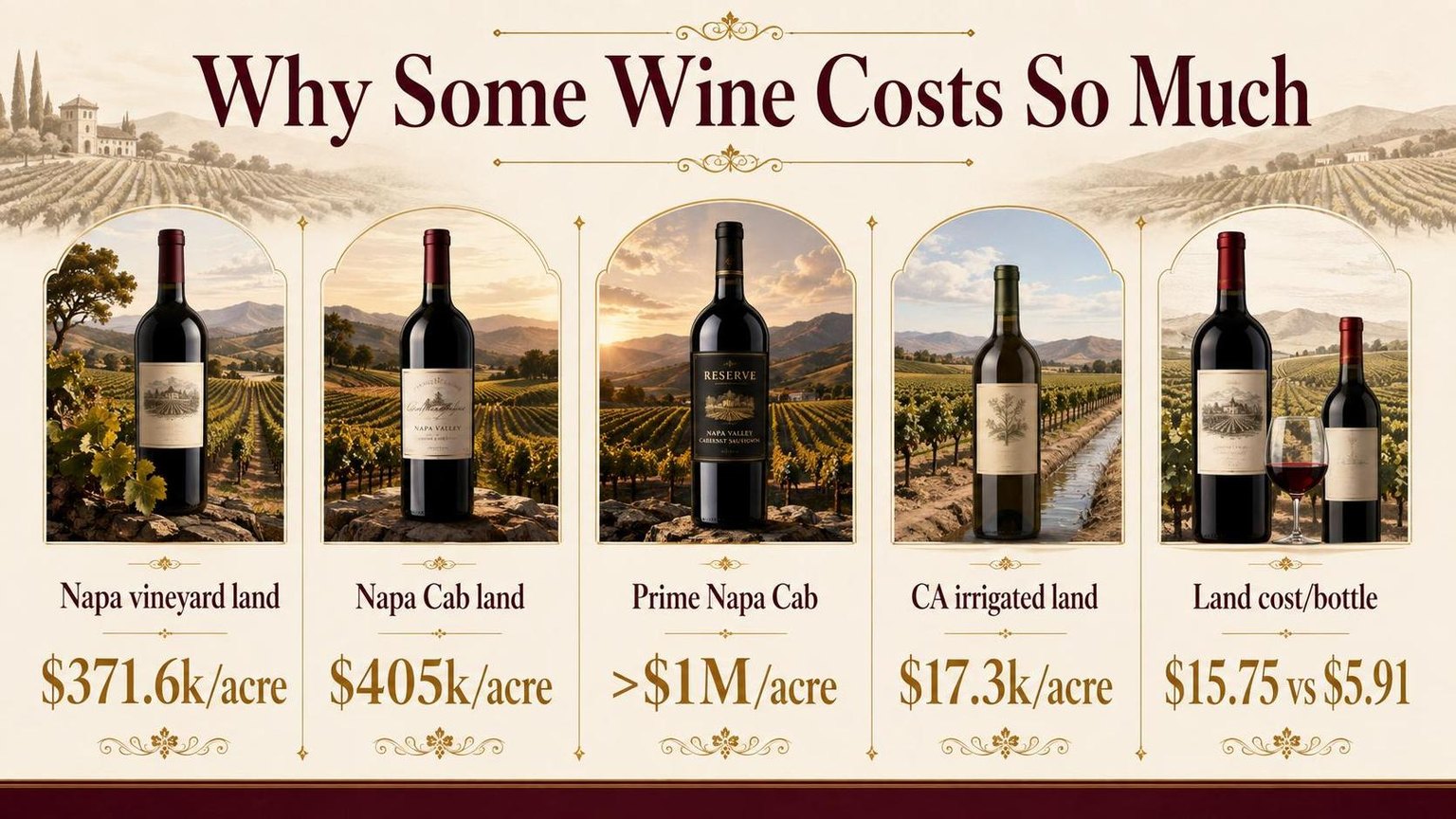
| Napa Valley vineyard land, average per acre in 2023 | $371,600 |
| Napa Valley Cabernet Sauvignon vineyard land, average per acre in 2023 | $405,000 |
| Prime Napa Valley Cabernet Sauvignon vineyard land, top sites | More than $1,000,000 per acre |
| California irrigated cropland, statewide average in 2023 | $17,300 per acre |
These numbers show the gap. Average Napa vineyard land was about 21 times the value of average California irrigated cropland in 2023. Prime Napa Cabernet sites could exceed 58 times that cropland benchmark.
That purchase price becomes a carrying cost. If a buyer finances a $400,000 acre at 7% interest, interest alone is $28,000 per acre per year before taxes, farming, water, labor, barrels, or winemaking overhead.
Yield determines how much land cost each bottle must absorb. Premium Napa Cabernet is often farmed for quality at roughly 3 to 4 tons per acre, far below high-yield interior regions.
| Assumption | Low-yield case | Higher-yield case |
| Land value per acre | $405,000 | $405,000 |
| Annual carrying cost at 7% | $28,350 | $28,350 |
| Yield | 3 tons per acre | 8 tons per acre |
| Approximate 750 mL bottles per acre | About 1,800 | About 4,800 |
| Land carrying cost per bottle | About $15.75 | About $5.91 |
The bottle count uses a standard rule of thumb: one ton of grapes produces about 150 gallons of wine, or roughly 757 standard bottles. Lower yields improve concentration, but they also raise land cost per bottle sharply.
- Expensive appellations have limited supply of plantable land.
- Luxury regions often use lower yields, spreading fixed land costs across fewer bottles.
- Top vineyard addresses also raise taxes, insurance, and development costs.
- Buyers often pay for reputation as much as raw agricultural output.
Land does not guarantee quality, but it strongly shapes price. When the dirt under the vines costs six or seven figures per acre, the bottle cannot be cheap.
Grape Yields and Vineyard Labor
Low yields and high labor costs are two of the clearest reasons some wines cost far more than others. Expensive bottles often start in vineyards that produce fewer grapes per acre and require more hand work per vine.
Yield matters because a vineyard has nearly the same fixed costs whether it crops heavily or lightly. When a grower limits tonnage, the land, pruning, canopy work, and harvest costs are spread across fewer bottles.
| Vineyard scenario | Typical yield | Approximate 750 mL bottles per acre |
| High-yield commercial vineyard | 8 to 12 tons per acre | about 4,000 to 6,000 bottles |
| Quality-focused premium vineyard | 3 to 5 tons per acre | about 1,500 to 2,500 bottles |
| Very low-yield fine wine site | 1 to 3 tons per acre | about 500 to 1,500 bottles |
A rough conversion helps explain the economics. One ton of grapes yields about 150 gallons of wine, or about 750 standard bottles after fermentation losses and cellar handling.
Low yields can come from poor soils, old vines, steep slopes, cool climates, or intentional crop thinning. In regions focused on concentration and structure, growers may drop fruit midseason so the vine ripens fewer clusters more evenly.
That practice is expensive because discarded fruit earns nothing. A vineyard that cuts production from 5 tons per acre to 2.5 tons per acre may lose roughly 1,875 bottles of potential volume from that acre alone.
Labor is the second major driver. Fine-wine vineyards often rely on hand pruning, shoot positioning, leaf pulling, green harvesting, selective picking, and multiple passes through the same rows.
| Task | Mechanized or hand | Cost effect |
| Winter pruning | Usually hand | Skilled seasonal labor on every vine |
| Canopy management | Often hand | Several passes during the growing season |
| Harvest on steep or prestigious sites | Often hand | Slower picking and tighter fruit selection |
Hand harvesting commonly costs several times more than machine harvesting in the United States. It also limits speed, especially on hillsides where tractors and mechanical harvesters cannot operate safely.
- Steep vineyards increase labor hours and reduce mechanization.
- Old, low-vigor vines often produce less fruit per worker hour.
- Selective hand picking improves quality but raises per-bottle cost.
The result is simple economics. When vineyards yield less and require more labor, each bottle carries a larger share of land, farming, and harvest expense before the wine even reaches the cellar.
Oak Aging and Cellar Expenses
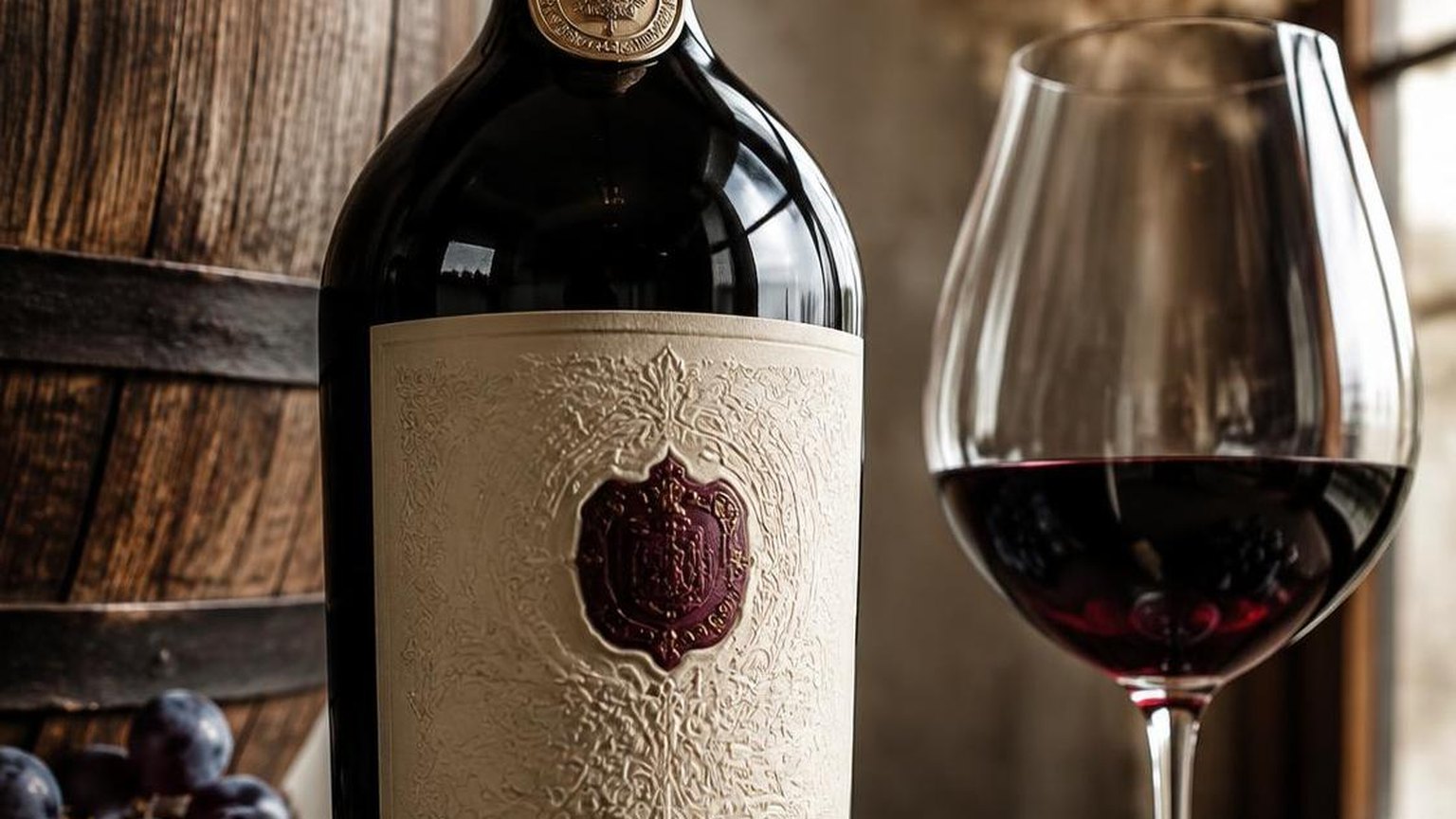
Oak aging raises wine cost because the producer buys expensive barrels, loses wine to evaporation, and waits longer to sell the finished bottles. The cellar then becomes both a flavor tool and a storage bill.
A standard barrique holds 225 liters, or about 300 standard 750 mL bottles. New French oak commonly costs far more than American oak, and premium coopers can charge well above entry-level prices.
| Item | Typical figure |
| French oak barrel, 225 L | $1,000-$2,000 each |
| American oak barrel, 225 L | $400-$900 each |
| Bottles per 225 L barrel | About 300 |
| Common barrel aging period for premium reds | 12-24 months |
| Annual evaporation in barrel cellar | About 2%-5% |
If a winery uses one new $1,500 French barrel for 300 bottles, the barrel alone adds about $5 per bottle before labor, rent, financing, and packaging. Producers often use a mix of new and neutral barrels, but top wines may lean heavily on new oak.
Barrels are not one-time flavor assets forever. The strongest oak impact usually comes in the first fill, then declines over the next few vintages.
Many estates replace a meaningful share of their barrel inventory each year to keep a consistent house style.
Cellar time is another cost. A wine aged 18 months in barrel and 6 months in bottle may sit for two years before release.
During that period, the winery has already paid for grapes, fermentation, barrels, glass, corks, and storage, but has not yet collected revenue.
Evaporation also matters. The “angel’s share” in a barrel room can remove roughly 2% to 5% of wine per year, depending on humidity and temperature. Lost volume means fewer saleable bottles from the same harvest.
- Temperature-controlled barrel rooms increase electricity and maintenance costs.
- Barrels require topping up, cleaning, sulfur management, and sensory monitoring.
- Racking and moving barrels add labor and equipment expense.
- Long aging ties up warehouse space that could hold finished, sellable inventory.
Oak aging can improve texture, stability, and complexity, but it is never free. Expensive wine often reflects not only better fruit, but also the capital, time, and loss built into every month in barrel.
Vintage Scarcity and Critic Scores
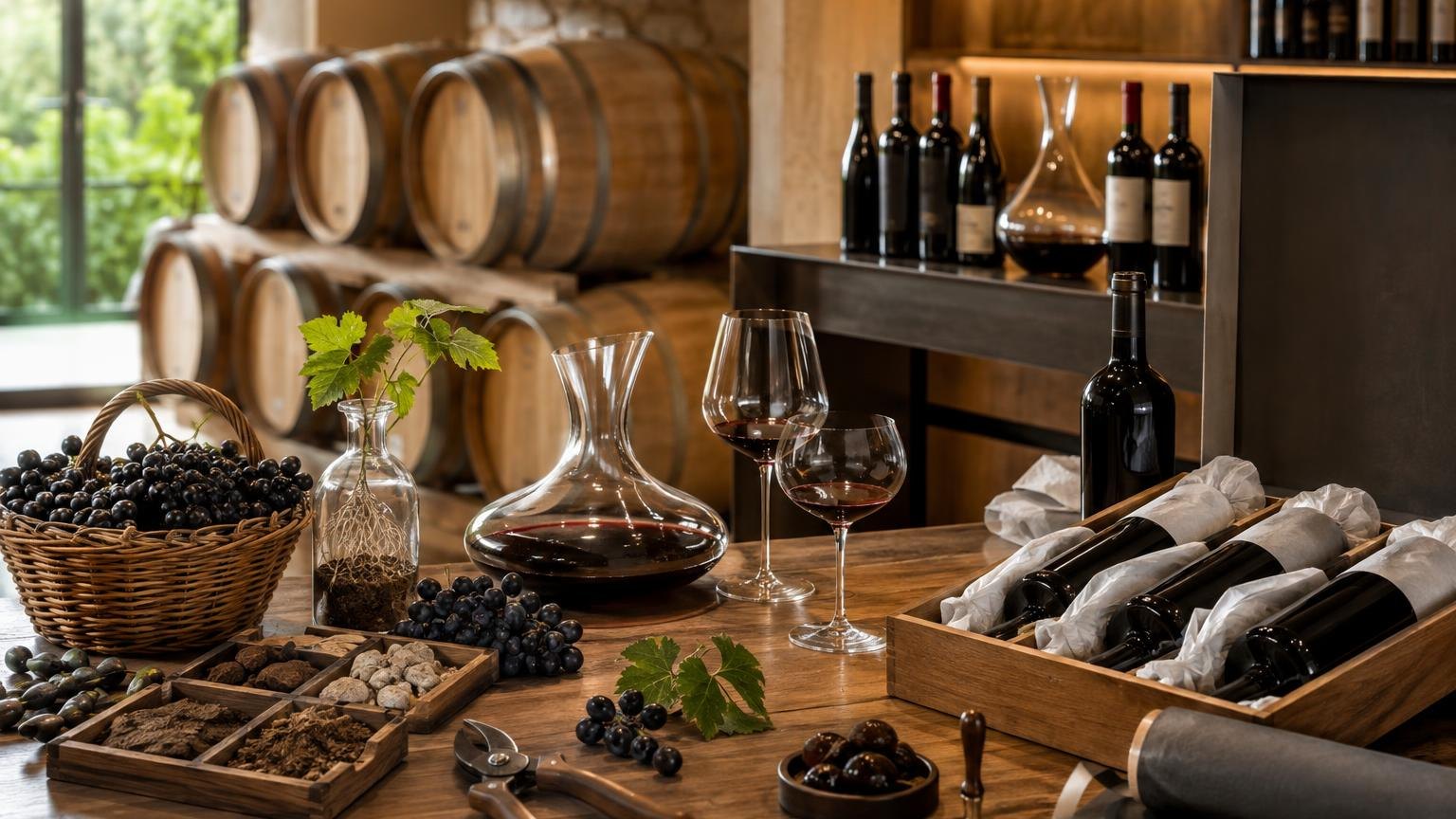
Vintage scarcity raises price when a year produces less usable fruit, fewer bottles, or both. Critic scores then sharpen that effect by directing global demand toward a small set of wines from that already-limited supply.
A great score does not create rarity. It magnifies it. When production is fixed and collectors compete for top-rated bottles, release prices and resale prices usually move faster than for similar wines from larger harvests or lower-rated years.
Scarcity often starts in the vineyard. Frost, hail, drought, heat spikes, and rot can cut yields sharply. In France, appellation rules also cap yields, so producers cannot fully replace lost volume by cropping more heavily.
Bordeaux shows the mechanism clearly. The 2017 vintage was hit by severe spring frost in parts of the region.
FranceAgriMer reported French wine production at about 36.7 million hectoliters in 2017, roughly 18% below 2016, making it one of the country’s smallest harvests in decades.
Small harvests do not automatically make wines expensive. Price usually jumps when scarcity overlaps with strong quality assessments.
That is why top vintages in Burgundy, Bordeaux, Napa Valley, and Champagne can separate so sharply from neighboring years.
| Factor | What changes | Typical price effect |
| Frost or hail | Fewer bottles released | Higher primary and secondary-market prices if demand holds |
| High critic score | More buyer attention | Faster sell-through and stronger auction demand |
| Low score in abundant year | More supply than urgency | Weaker pricing power |
Critic scores matter because many buyers use them as a shortcut. Robert Parker’s 100-point scale became especially influential in the fine-wine trade.
A move from 94 to 100 can change a wine from “excellent” to “must-own” for collectors and merchants.
That effect is visible in Liv-ex trading. First Growth Bordeaux and cult Napa wines often see stronger demand after 98-100 point reviews from major critics such as The Wine Advocate, Vinous, or Wine Spectator.
The score increases confidence, not supply.
| Score band | Common market reading | Demand impact |
| 90-93 | Very good to outstanding | Broad interest, limited frenzy |
| 94-97 | Collectible quality | Higher merchant and cellar demand |
| 98-100 | Trophy-wine territory | Strongest competition for scarce bottles |
The most expensive wines usually combine both forces: a short crop and elite reviews. Domaine de la Romanée-Conti is the textbook case.
Grand Cru land is tiny, production is inherently low, and high critical acclaim pushes a microscopic supply into a global luxury market.
- Scarcity matters most when bottle counts are genuinely low.
- Scores matter most when buyers trust the critic and the producer already has status.
- Prices rise highest when rarity, reputation, and top reviews arrive in the same vintage.
Brand Prestige and Provenance Records
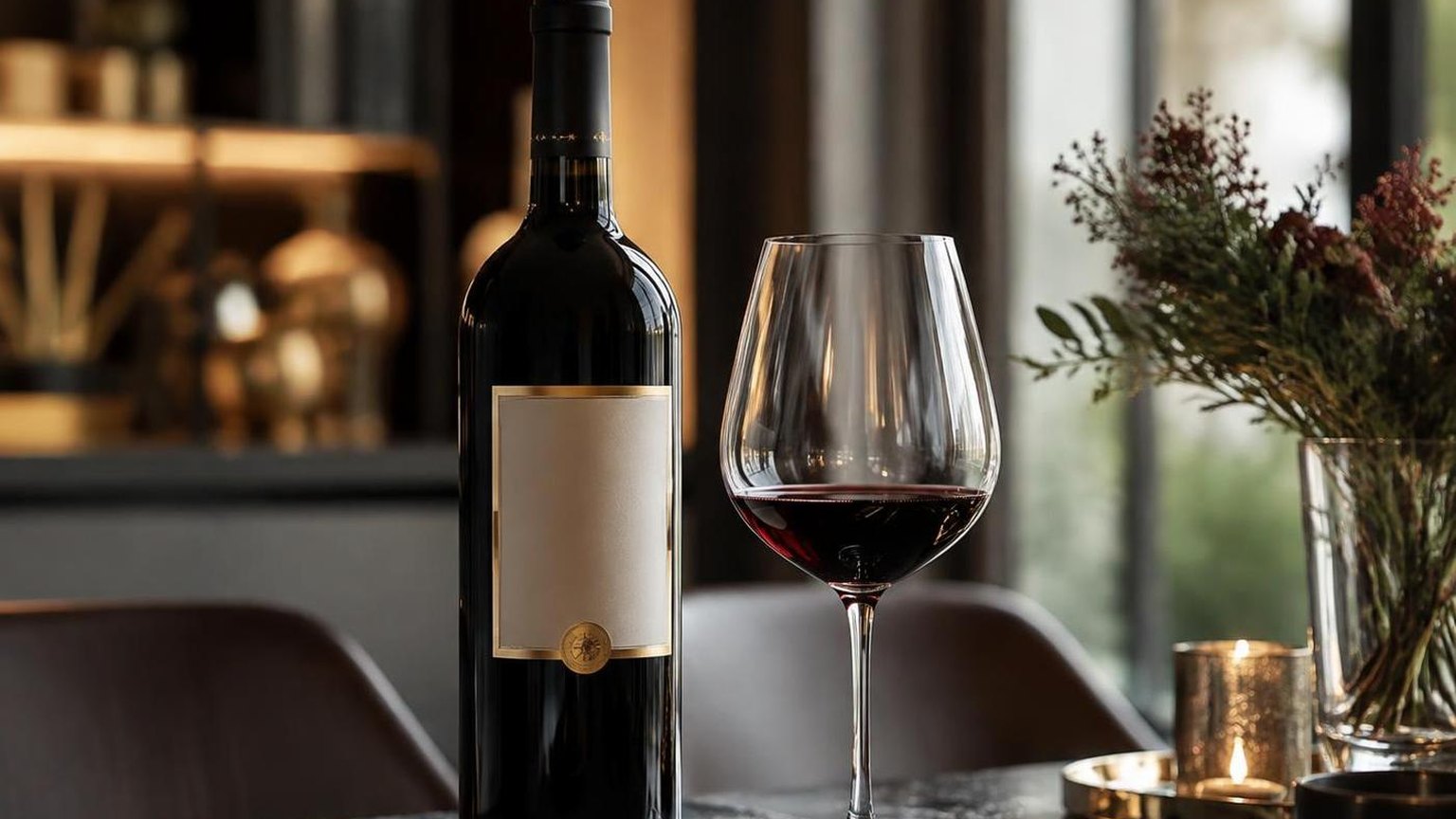
Brand prestige raises wine prices because buyers pay for a producer’s long record of quality, scarcity, and recognition. Provenance records raise them again because documented storage and ownership reduce fraud risk and preserve resale value.
In fine wine, the name on the label can function like a luxury trademark. First Growth Bordeaux, Domaine de la Romanée-Conti, and top Champagne houses command premiums that exceed their farming and production costs by a wide margin.
That premium is measurable in secondary markets. Wines with deep critic history, low production, and global demand often trade repeatedly after release, and each documented transaction strengthens price confidence for the next buyer.
| Producer or category | Prestige signal | Why it affects price |
| Bordeaux First Growths | 1855 Classification | A 170-year reputation creates durable global demand |
| Domaine de la Romanée-Conti | Tiny production from elite vineyards | Extreme scarcity plus status pushes bottle prices into the thousands |
| Top Champagne houses | Long luxury branding and vintage library | Collectors pay more for consistency, ageability, and house reputation |
Provenance matters most once prices become high enough to attract counterfeiting.
Auction houses, merchants, and collectors pay materially more for bottles with original wooden cases, import labels, release receipts, and documented professional storage.
Auction history shows how severe the fraud risk became. In 2013, collector Rudy Kurniawan was convicted in federal court for selling counterfeit rare wines, exposing how easily undocumented bottles could infiltrate elite cellars and distort pricing.
After that scandal, provenance standards hardened. Major auction firms now emphasize fill level, capsule condition, label inspection, storage history, and chain of custody, especially for Burgundy and Bordeaux from the 1940s through the 1990s.
| Provenance factor | What buyers look for | Pricing effect |
| Storage history | Consistent cellar temperature near 55°F and high humidity | Reduces spoilage risk and supports top estimates |
| Original packaging | OWC, tissue, bands, and release materials | Improves confidence and resale appeal |
| Ownership trail | Invoices, auction records, and merchant receipts | Lowers authenticity risk and narrows buyer discount |
Prestige and provenance reinforce each other. A famous label without records can be heavily discounted, while a less famous wine with impeccable documentation rarely reaches luxury-tier pricing. The most expensive bottles usually have both.
- Prestige creates demand before the bottle is opened.
- Provenance protects value after the bottle changes hands.
- Together, they turn wine from a beverage into a collectible asset.
Taxes Tariffs and Distribution Markups
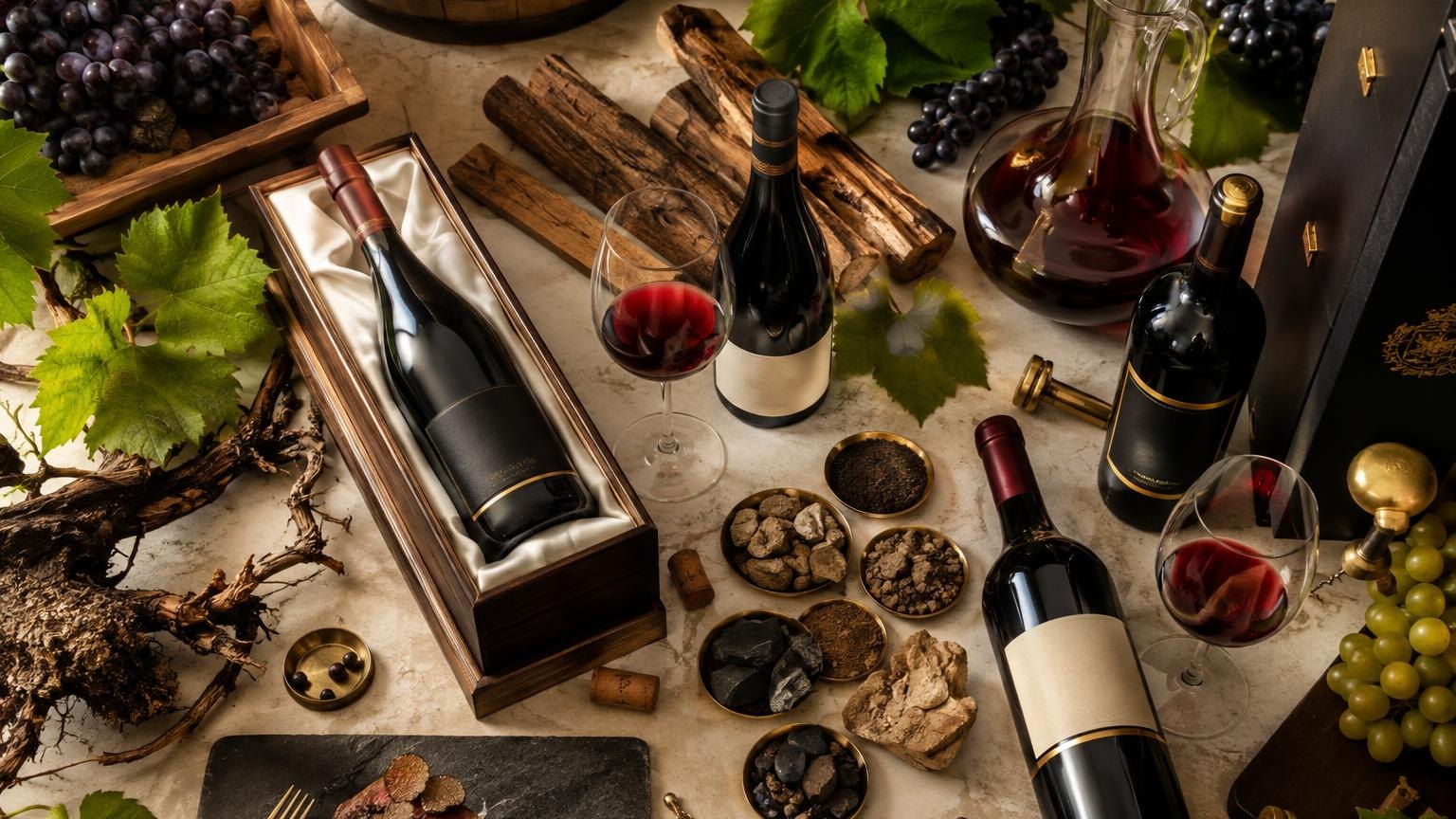
Wine gets expensive before the cork is pulled. In the U.S., price builds through taxes, tariffs, and the three-tier system, where importers, distributors, and retailers each add cost.
Small percentages compound fast on a bottle that already has shipping, glass, labor, and brand overhead.
Federal excise tax is the first fixed layer. For still wine up to 16% alcohol, the standard federal rate is $1.07 per gallon, or about $0.21 on a 750 mL bottle. Sparkling wine is taxed much harder at $3.40 per gallon, about $0.67 per 750 mL bottle.
| U.S. tax or charge | Rate | Approx. per 750 mL bottle |
| Federal excise tax, still wine up to 16% ABV | $1.07 per gallon | $0.21 |
| Federal excise tax, sparkling wine | $3.40 per gallon | $0.67 |
| Import duty, still wine in containers over 1 liter not over 4 liters | $0.14 per liter | Not a 750 mL format |
| Import duty, still wine in containers not over 1 liter | $0.063 per liter | About $0.05 |
State taxes stack on top. California charges $0.20 per gallon on still wine and $0.30 on sparkling. Kentucky charges $0.50 per gallon.
Control states and local jurisdictions can add separate fees, bottle deposits, or ad valorem taxes, making the same SKU cost different amounts in different markets.
Tariffs are the volatile layer. In October 2019, the U.S. imposed a 25% tariff on many still wines under 14% ABV from France, Spain, Germany, and the UK as part of the Airbus dispute.
That surcharge was suspended in March 2021, but it showed how a political decision can raise shelf prices almost overnight.
Distribution markups usually move the final number more than taxes do. Under the U.S. three-tier system, an imported bottle may pass from foreign producer to importer, then distributor, then retailer or restaurant.
Each tier needs margin, and each margin is taken on top of the prior cost.
| Stage | Example bottle cost | Illustrative markup |
| Landed importer cost | $10.00 | Base cost |
| Sold to distributor | $13.00 | 30% |
| Sold to retailer | $17.55 | 35% |
| Retail shelf price | $24.57 | 40% |
Restaurants add the steepest final markup. A bottle that retails for $25 commonly appears on wine lists at $50 to $75.
The reason is simple: storage, breakage, trained staff, stemware, and slower inventory turns all have to be paid for from the bottle price.
When Expensive Wine Tastes Better
Expensive wine can taste better when money pays for measurably harder farming, lower yields, stricter sorting, and longer aging.
It can also taste better when the wine is built to improve for years, because complexity, texture, and finish often increase with time.
Price alone does not guarantee quality. In blind tastings, context and expectation matter, but certain cost drivers consistently produce wines with greater concentration, balance, and age-worthiness.
One clear factor is yield. Top estates often crop far below bulk-wine levels, reducing juice volume per acre and increasing flavor concentration.
| Production factor | Typical inexpensive wine | Typical expensive wine |
| Yield | 8 to 12 tons per acre | 2 to 4 tons per acre |
| Hand harvesting | Rare | Common |
| Sorting | Minimal | Hand sorting, sometimes twice |
| New French oak barrel | Usually none | About $1,000 to $1,500 each |
| Barrel aging | 0 to 6 months | 12 to 24 months |
Those choices cost money and can improve taste. Hand harvesting protects intact clusters, selective sorting removes underripe or damaged fruit, and careful oak aging adds structure, spice, and texture rather than raw wood flavor.
Site also matters. Grand Cru Burgundy covers small, highly sought parcels, and famous Napa vineyards trade fruit at prices that can exceed several thousand dollars per ton.
Scarce land with a long record of quality often delivers more consistent ripeness and complexity.
Age-worthiness is another reason expensive wine may show better. Fine Barolo, Bordeaux, and top Riesling can taste tight in youth, then open after 10, 15, or 20 years as tannins soften and tertiary aromas develop.
- Primary aromas: fresh fruit, flowers, herbs.
- Secondary aromas: bread, vanilla, toast from fermentation and oak.
- Tertiary aromas: leather, mushroom, tobacco, truffle from bottle age.
Expensive sparkling wine shows the same pattern. Champagne must age at least 15 months on lees by law for non-vintage and 36 months for vintage; prestige cuvées often rest far longer, building finer mousse and brioche-like depth.
The best case for expensive wine is precision, not luxury. When high cost reflects exceptional vineyard work, low yields, long élevage, and proven aging potential, the glass often shows more length, detail, and persistence than cheaper bottles.
Frequently Asked Questions
Why do some wines cost hundreds or thousands of dollars?
Price rises when supply stays small and demand stays global.
Top estates in places like Burgundy or Napa may produce limited cases from prized vineyard sites, then add decades of reputation, critic scores, and collector demand, which pushes prices far beyond farming cost alone.
Does expensive wine come from better grapes?
Often, yes, because top producers farm lower-yield vineyards and sort fruit aggressively.
A quality-focused vineyard might crop at 2 to 4 tons per acre instead of 8 to 12, which concentrates flavor but reduces total production and raises the cost per bottle.
How much does land price affect wine cost?
Land cost is one of the biggest drivers in famous regions. Vineyard land in elite appellations can reach hundreds of thousands or even millions of dollars per acre, so producers must spread that investment across every bottle they sell.
Why are wines from places like Burgundy, Champagne, and Napa so expensive?
These regions combine strict production limits, high land values, and strong brand recognition.
Champagne also requires labor-intensive traditional-method sparkling production and extended aging, while Burgundy’s tiny vineyard parcels create very small quantities that collectors compete to buy.
Do oak barrels and aging make wine more expensive?
Yes, because new French oak barrels are costly and cellar aging ties up inventory for years.
A single barrel can cost roughly $1,000 or more, and wineries may hold premium reds for 12 to 24 months before release, adding storage, financing, and evaporation loss.
Yes, especially where vineyards are steep, hand-harvested, or densely planted.
Manual pruning, canopy work, selective picking, and hand sorting require far more labor than machine-harvested, high-volume wine, and labor is one of the largest recurring costs in fine wine production.
Do scores, awards, and critics increase wine prices?
They often do because high ratings can sharply increase demand without increasing supply.
A 95-point or higher score from a major critic can move a wine from restaurant-list staple to allocation-only bottle, allowing wineries and retailers to raise prices.
Is expensive wine always better than cheap wine?
No, because price reflects scarcity, region, prestige, and aging potential as much as sensory quality.
In blind tastings, many drinkers prefer well-made bottles in the $15 to $40 range, while the biggest gains above that often come from complexity, collectibility, and reputation rather than simple drinkability.
Related Reading
- Does Walgreens Sell Liquor Like Wine? Get Answer Now
- How To Store Wine At Home? 8 Tips for Storing Wine
- How Many Calories In A Glass Of Chardonnay Wine?
- What Is the Alcohol Content of Black Box Wine?
- Beer Cave Wine and Spirits Store Near You
- How Long Can You Keep Wine Unopened?
- How Many Milliliters in a Glass of Wine?
- What Is Moscato Wine? – 2026
- All Alcohol Guides
- American Association of Wine Economists (2011)
- University of California, Davis (n.d.)
- Penn State Extension (2023)
- Alcohol and Tobacco Tax and Trade Bureau (n.d.)
- U.S. Department of Agriculture Economic Research Service (2023)
- National Library of Medicine – PubMed (2019)
- Liv-ex (2024)
- Sotheby's (2023)