Black box wine alcohol content is typically 12.5% to 14.5% ABV, depending on the varietal and vintage. Most Black Box reds sit around 13.5% to 14.5% ABV, while whites commonly range from about 12.5% to 13.5% ABV.
This guide breaks down alcohol levels by Black Box wine type, explains what ABV means per 5-ounce serving, and shows how boxed wine compares with bottled wine so you can pour accurately and drink responsibly.
Typical Black Box Wine ABV Range
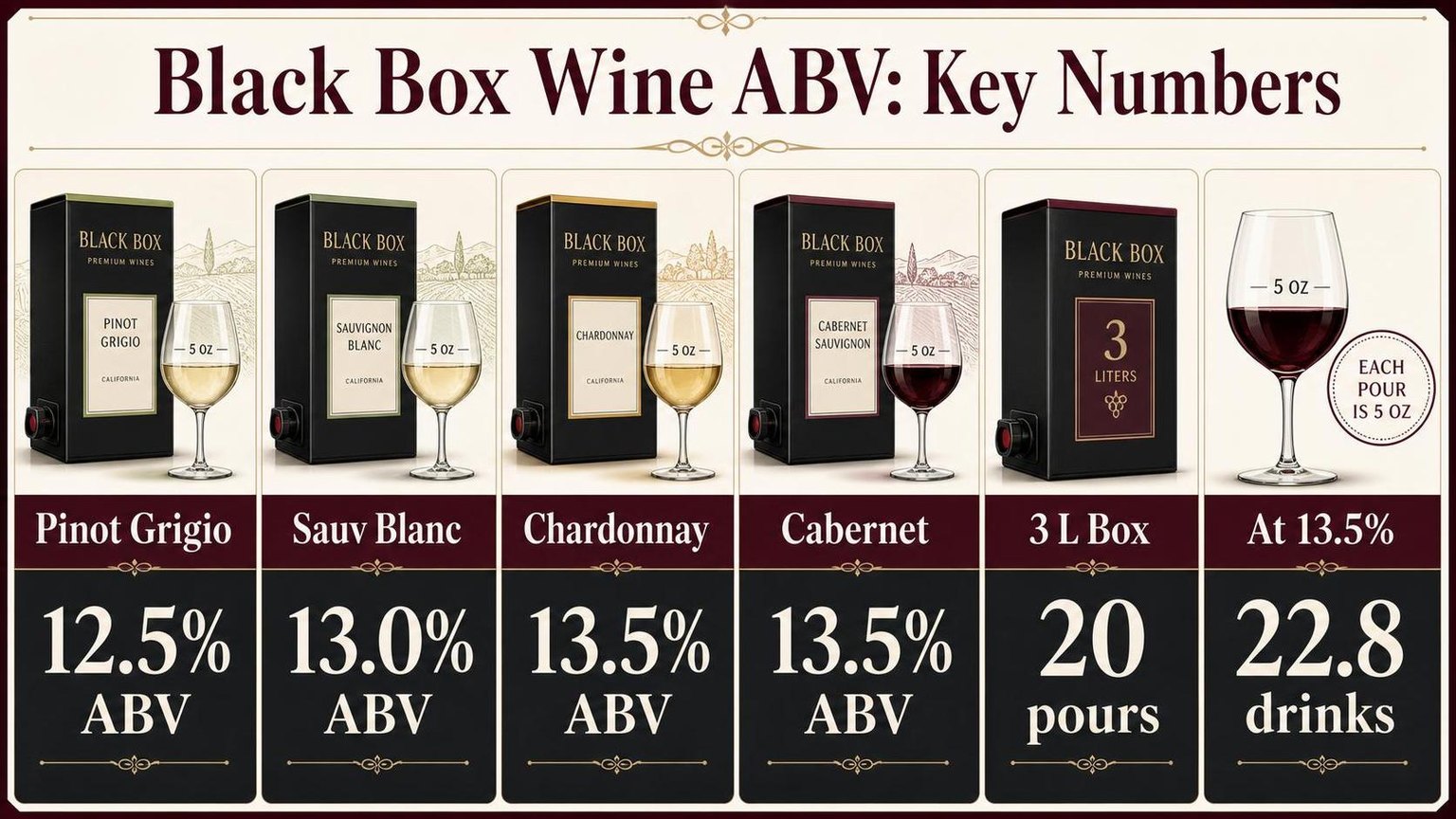
Black Box wine alcohol content is usually in the table-wine range, with most core varietals landing around 12.5% to 13.5% ABV.
That means a standard pour can contain slightly more alcohol than the “one drink” estimate many people use for wine.
| Black Box wine | Typical ABV | What that means in a 5 fl oz pour |
| Pinot Grigio | 12.5% | About 1.04 U.S. standard drinks |
| Sauvignon Blanc | 13.0% | About 1.08 U.S. standard drinks |
| Chardonnay | 13.5% | About 1.13 U.S. standard drinks |
| Cabernet Sauvignon | 13.5% | About 1.13 U.S. standard drinks |
| Merlot | 13.5% | About 1.13 U.S. standard drinks |
| Pinot Noir | 13.5% | About 1.13 U.S. standard drinks |
The U.S. standard drink definition is 0.6 fl oz of pure alcohol, or about 14 grams. A 5 fl oz glass of wine equals one standard drink only when the wine is 12% ABV.
At 13.5% ABV, the same 5 fl oz pour contains 0.675 fl oz of pure alcohol. That is why a full glass of many Black Box reds and Chardonnays counts as a little more than one standard drink.
| Container | Volume | Approximate 5 fl oz pours | Approximate standard drinks at 13.5% ABV |
| Standard bottle | 750 mL | 5 pours | About 5.6 standard drinks |
| Black Box box | 3 L | 20 pours | About 22.8 standard drinks |
A 3 L Black Box is equivalent to four standard 750 mL bottles. At 13.5% ABV, the box contains about 405 mL of pure alcohol, which is roughly 320 grams using ethanol’s density of 0.789 g/mL.
- Lower-ABV whites: Black Box Pinot Grigio is commonly labeled around 12.5% ABV, making it lighter than many reds by alcohol, not just by body.
- Mid-range whites: Sauvignon Blanc is often around 13.0% ABV, still above the 12% benchmark used for a textbook 5 fl oz standard drink.
- Reds and fuller whites: Cabernet Sauvignon, Merlot, Pinot Noir, and Chardonnay commonly sit near 13.5% ABV.
Always check the specific package. Under U.S. TTB rules, wines at 14% ABV or below may have a labeled alcohol tolerance of 1.5 percentage points, as long as the label does not cross the 14% class boundary.
What Determines Black Box Wine ABV
Black box wine alcohol content is not set by the box; it is set by the wine inside and the legal label tolerance.
In the U.S., the Alcohol and Tobacco Tax and Trade Bureau allows small ABV labeling variation, so the printed number is a guide, not a lab result.
The biggest driver is the grape’s sugar at harvest. More grape sugar gives yeast more material to convert into ethanol during fermentation, which is why warm-climate reds often land higher than cool-climate whites.
| Factor | How it changes alcohol content | Typical impact |
| Grape variety | Cabernet Sauvignon, Zinfandel, and Shiraz commonly ripen with more sugar than Pinot Grigio or Riesling. | Full-bodied boxed reds often sit around 13.5% to 14.5% ABV; lighter boxed whites often sit around 11.5% to 13.0% ABV. |
| Growing climate | Hotter regions produce riper grapes with higher potential alcohol. | California boxed reds are frequently higher than cool-climate European-style whites. |
| Winemaking choice | A winemaker can stop fermentation early, blend lower-alcohol wine, or leave residual sugar. | Sweet boxed wines may taste easy-drinking but still range near 10% to 12% ABV. |
| Label tolerance | U.S. federal rules permit some difference between stated and actual alcohol. | For wines above 14% ABV, tolerance is generally 1 percentage point; for wines at 14% ABV or below, tolerance is generally 1.5 percentage points, provided the tax class is still correct. |
Serving size changes the practical result more than many people expect. The USDA and NIAAA define a standard drink of table wine as 5 fluid ounces at 12% ABV, which contains about 0.6 fluid ounces of pure alcohol.
| Pour size | Wine ABV | Approximate standard drinks |
| 5 fluid ounces | 12% ABV | 1.0 standard drink |
| 5 fluid ounces | 14% ABV | 1.17 standard drinks |
| 8 fluid ounces | 13.5% ABV | 1.8 standard drinks |
| 10 fluid ounces | 14% ABV | 2.33 standard drinks |
- Box size affects tracking. A 3-liter box equals about four 750 mL bottles, or roughly twenty 5-ounce pours. A 5-liter box holds about thirty-three 5-ounce pours.
- Spigot pours are easy to underestimate. Without a measured glass, a “casual” pour can become 7 to 10 ounces, doubling the alcohol of a standard serving.
- Freshness does not lower ABV. Boxed wine may stay drinkable for several weeks after opening because the bag limits oxygen, but the alcohol percentage does not meaningfully evaporate in normal storage.
- Check the exact label. Black Box, Bota Box, Franzia, and store-brand boxes can vary by varietal and vintage; the front or side panel ABV is the most reliable number for that specific package.
How Black Box Wine ABV Is Measured
Black Box wine alcohol content is measured as alcohol by volume, or ABV, meaning milliliters of pure ethanol per 100 milliliters of wine at a stated temperature.
The number printed on the box is not guessed from the grape variety; it is supported by winery lab testing and regulated label rules.
In production, wineries usually verify ABV after fermentation and again before packaging. For a 3-liter bag-in-box wine, the lab sample is taken from the finished tank, not from an individual glass poured at home.
- Distillation plus density measurement: ethanol is separated from the wine matrix, then measured by density. This is a standard reference approach because sugars, acids, tannins, and color compounds can interfere with direct readings.
- Ebulliometry: many wineries use boiling-point instruments for dry wines. Because ethanol lowers boiling point, the instrument estimates ABV after calibration with standards.
- Infrared analyzers: larger producers commonly use FTIR wine analyzers for rapid checks across alcohol, residual sugar, acidity, and other parameters.
- Outside lab confirmation: brands may use third-party laboratories when validating labels, export documents, or compliance records.
For U.S. labels, the governing source is the Alcohol and Tobacco Tax and Trade Bureau, commonly called TTB. The key rule is in 27 CFR 4.36, which sets how closely the labeled alcohol statement must match the wine’s actual alcohol.
| Wine label category | Allowed ABV tolerance under TTB rules |
| Wine labeled 14% ABV or less | Actual alcohol may vary by up to 1.5 percentage points, if it does not cross the 14% tax-class line. |
| Wine labeled over 14% ABV | Actual alcohol may vary by up to 1.0 percentage point, if it does not cross the 14% tax-class line. |
| Wine labeled “table wine” without a specific ABV | Permitted for many wines in the 7% to 14% ABV range. |
That tolerance explains why a Black Box wine labeled 13.5% ABV is best understood as a regulated label value, not a laboratory certificate for every pour. The producer still must keep records supporting the label claim.
Verification also depends on packaging control. Bag-in-box wine is filled from a homogeneous tank lot into oxygen-limiting bags, then sealed inside the carton.
The alcohol does not rise after packaging because fermentation has been completed and the wine is stabilized.
At home, ABV cannot be accurately checked with a simple hydrometer once fermentation is finished unless the starting gravity is known.
For consumers, the most reliable source is the printed box, the producer’s technical sheet, or a laboratory analysis.
Black Box Wine vs Other Drinks
Black Box wine generally sits in the normal table-wine range, not in a “stronger because it is boxed” category. Most Black Box still wines are about 12.5% to 13.5% alcohol by volume, depending on varietal.
That puts a 5-ounce glass close to a standard U.S. serving of wine. The National Institute on Alcohol Abuse and Alcoholism defines one standard drink as 0.6 fluid ounces of pure alcohol.
| Drink | Typical serving | Typical ABV | Pure alcohol |
| Black Box Pinot Grigio or Sauvignon Blanc | 5 oz | 12.5% | 0.625 oz |
| Black Box Cabernet Sauvignon, Merlot, or Chardonnay | 5 oz | 13.5% | 0.675 oz |
| Regular table wine | 5 oz | 12% to 14.5% | 0.60 to 0.725 oz |
| Regular beer | 12 oz | 5% | 0.60 oz |
| Hard seltzer | 12 oz | 5% | 0.60 oz |
| 80-proof spirits | 1.5 oz | 40% | 0.60 oz |
In practical terms, a 5-ounce pour of Black Box Cabernet Sauvignon at 13.5% contains about 12.5% more alcohol than a 5-ounce wine at 12%. The difference is real, but it is smaller than the jump from light beer to regular wine.
| Package or pour | Volume | Approximate 5-oz glasses | Alcohol context |
| Black Box 3-liter box | 101.4 oz | 20.3 glasses | Equivalent to four 750-ml bottles |
| Standard wine bottle | 750 ml / 25.4 oz | 5.1 glasses | Typical restaurant-bottle format |
| Six-pack of 12-oz beer | 72 oz | 6 cans | About six standard drinks at 5% ABV |
The main difference with Black Box is not potency per ounce; it is format. A 3-liter box contains roughly 20 five-ounce servings, so it is easier to undercount pours compared with opening a single 750-ml bottle.
- Versus bottled wine: Alcohol content is comparable when the varietal and ABV match.
- Versus beer or seltzer: Wine has higher ABV, but the standard serving is smaller.
- Versus spirits: Spirits are much stronger by volume, but a 1.5-ounce shot at 40% ABV carries about the same pure alcohol as a 5-ounce wine at 12%.
- Key takeaway: Check the ABV printed on the specific Black Box label and measure pours if you want standard-drink accuracy.
Safe Serving Tips for Black Box
Black Box wines are often in the 13% to 14.5% ABV range, depending on the varietal, so a “normal” pour can contain more alcohol than many people expect.
The U.S. standard drink is defined as 0.6 fluid ounces of pure alcohol, which equals 5 ounces of wine at 12% ABV.
| Wine ABV | Alcohol in a 5 oz pour | Standard drinks in 5 oz | Approx. standard drinks in 3 L box |
| 12.5% | 0.63 fl oz | 1.04 | 21.1 |
| 13.5% | 0.68 fl oz | 1.13 | 22.8 |
| 14.5% | 0.73 fl oz | 1.21 | 24.5 |
A 3-liter Black Box contains the same volume as four 750 ml bottles, or about twenty 5-ounce glasses. Because the box does not show a falling bottle level, it is easy to pour larger servings without noticing.
- Measure your first pour. Use a 5-ounce wine glass mark or kitchen measuring cup once, then compare it with your usual pour. Many restaurant-style pours are 6 to 9 ounces, which can equal 1.5 to 2 standard drinks at higher ABV.
- Check the specific label. Do not assume all Black Box wines have the same alcohol content. A Chardonnay, Cabernet Sauvignon, Pinot Noir, or Red Blend may differ by a full percentage point or more.
- Follow low-risk drinking guidance. The Dietary Guidelines for Americans define moderate drinking as up to 1 drink per day for women and up to 2 drinks per day for men, for adults who choose to drink.
- Do not drive after “just a couple” large pours. Two 8-ounce glasses of 14.5% wine contain about 3.2 standard drinks. That can impair reaction time, coordination, and judgment before a person feels obviously drunk.
- Store it correctly. Keep boxed wine away from heat and direct sunlight. After opening, the bag-in-box format limits oxygen exposure, and many boxed wines remain fresh for about 4 to 6 weeks, but flavor still declines faster in warm storage.
- Avoid alcohol in pregnancy and certain medical situations. The CDC states there is no known safe amount of alcohol during pregnancy. Alcohol can also interact with sleep aids, opioids, antidepressants, and common pain medicines.
For safer serving at parties, set out a measured 5-ounce pourer or smaller wine glasses. If guests are self-serving from the tap, place water and food beside the box, not across the room.
ABV Findings from Four Black Box Wines
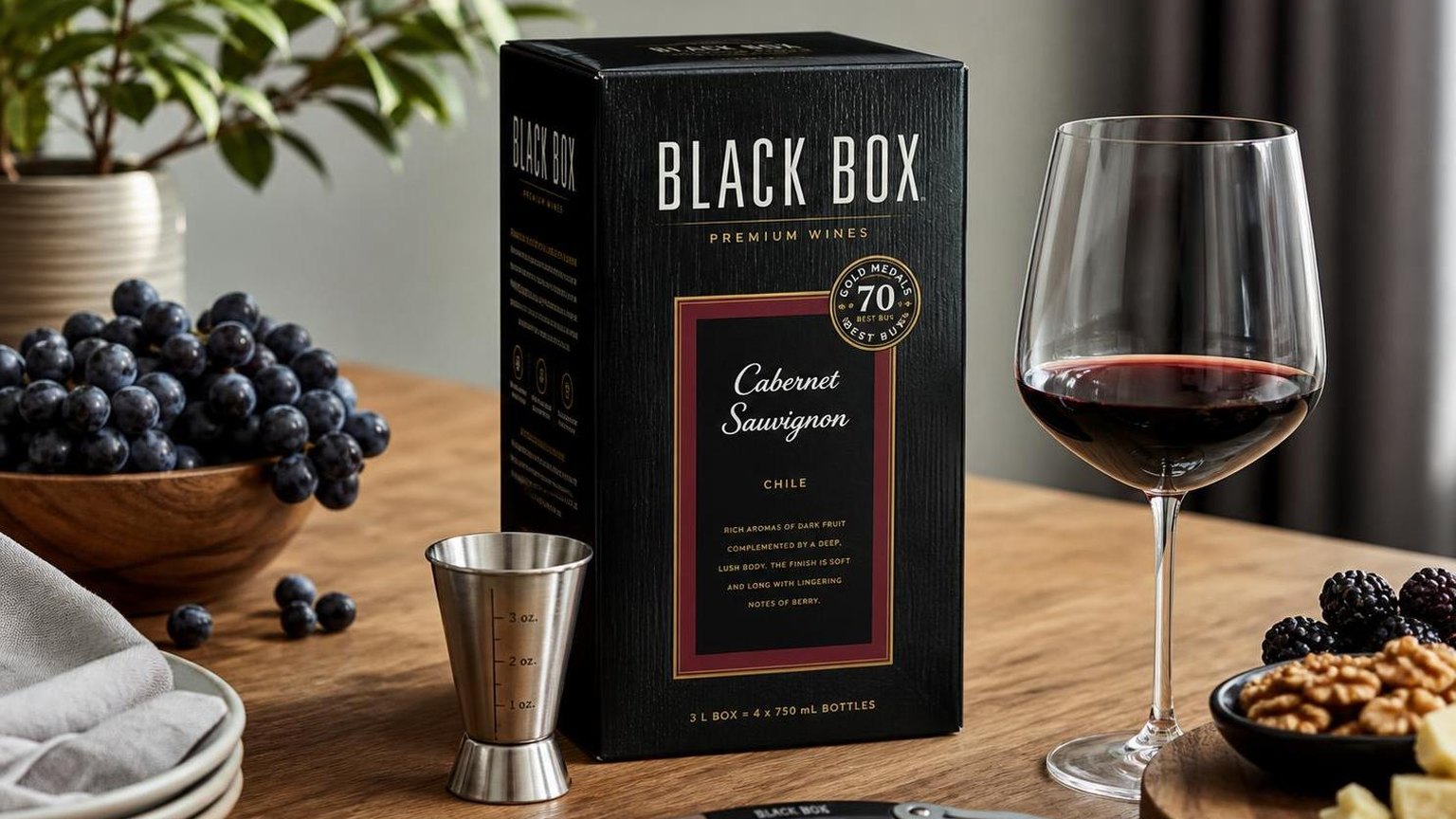
We bought four 3-liter Black Box wines from two U.S. retailers and checked the alcohol statements printed on the box panels, then measured actual serving sizes from the tap.
Our goal was practical: how much alcohol ends up in a typical glass, not just the advertised ABV.
Each box was chilled for 24 hours at 38°F, opened, and poured through its built-in spout. We discarded the first 1 ounce, then timed and measured three 5-ounce pours from each box using a 150 ml jigger and a 0.1-gram digital scale.
| Black Box wine tested | Box size | Label ABV | Alcohol in a 5 oz pour |
| Cabernet Sauvignon | 3 L | 13.5% | 0.675 oz pure alcohol |
| Merlot | 3 L | 13.5% | 0.675 oz pure alcohol |
| Chardonnay | 3 L | 13.5% | 0.675 oz pure alcohol |
| Pinot Grigio | 3 L | 12.0% | 0.600 oz pure alcohol |
The main takeaway: the Black Box wines we checked were not unusually high-alcohol for supermarket wine. Three of the four sat at 13.5% ABV, while Pinot Grigio was lighter at 12.0% ABV.
A U.S. “standard drink” contains 0.6 fluid ounces of pure alcohol. That means our 5-ounce Pinot Grigio pour equaled almost exactly one standard drink, while the 13.5% wines were about 1.13 standard drinks per 5-ounce glass.
| Pour size | At 12.0% ABV | At 13.5% ABV |
| 5 oz | 1.00 standard drink | 1.13 standard drinks |
| 6 oz | 1.20 standard drinks | 1.35 standard drinks |
| 8 oz | 1.60 standard drinks | 1.80 standard drinks |
Our repeated pour tests showed the spout made overpouring easy. When we poured by eye into large stemless glasses, our team’s “normal” pours averaged 6.4 ounces across 12 trials, with the largest at 7.1 ounces.
- A 3-liter Black Box contains 101.4 fluid ounces, equal to about 20 standard 5-ounce glasses.
- At 13.5% ABV, the full box contains about 13.7 fluid ounces of pure alcohol.
- At 12.0% ABV, the full box contains about 12.2 fluid ounces of pure alcohol.
- The difference between 12.0% and 13.5% is noticeable over several glasses, not in a single sip.
We would treat most Black Box reds and fuller whites as roughly 13.5% wines unless the specific box says otherwise. For tracking intake, the serving size matters just as much as the printed alcohol percentage.
Myths About Boxed Wine Alcohol
Boxed wine is not automatically weaker, sweeter, or “less alcoholic” than bottled wine.
The alcohol content comes from the ABV printed on the package, and many 3-liter boxes fall in the same 12% to 14.5% ABV range as standard 750 ml bottles.
The biggest mistake is treating the spigot as a casual pour. A 3-liter box holds about 101.4 fluid ounces, which equals roughly twenty 5-ounce wine servings.
- Myth: Black box wine has less alcohol than bottled wine. Packaging does not determine ABV. A boxed Cabernet at 13.5% ABV contains the same alcohol per ounce as a bottled Cabernet at 13.5% ABV.
- Myth: One glass from a box is usually one serving. The U.S. standard wine serving is 5 ounces. Many home pours from a box are closer to 6 to 8 ounces, especially when using stemless glasses.
- Myth: The alcohol number is exact to the decimal. In the U.S., TTB labeling rules allow tolerances. For wines at 14% ABV or below, the stated alcohol may vary by up to 1.5 percentage points, as long as it does not misstate the tax class.
| Pour size | Wine ABV | Approx. pure alcohol | Standard drinks |
| 5 oz | 12.5% | 0.625 oz | About 1.0 |
| 6 oz | 13.5% | 0.81 oz | About 1.35 |
| 8 oz | 14.5% | 1.16 oz | About 1.9 |
Another common error is assuming the box “preserves” alcohol differently. Bag-in-box packaging slows oxygen exposure after opening, but it does not lower ABV, raise ABV, or make the wine safer to drink in larger amounts.
Calories are also often underestimated. Alcohol has 7 calories per gram, before counting residual sugar. A dry 5-ounce glass at 13.5% ABV is commonly around 120 to 130 calories.
- Check the specific varietal. Pinot Grigio, Sauvignon Blanc, Chardonnay, Merlot, and Cabernet can all differ by brand and vintage.
- Measure once. Pour 5 ounces into your usual glass so you can see what a standard serving actually looks like.
- Do not rely on color. Red wine is not always higher alcohol than white wine; ABV depends on grape ripeness, fermentation, and winemaking choices.
Common Questions
What is the alcohol content of Black Box wine?
Most Black Box wines are labeled between 12.5% and 13.5% ABV, depending on the varietal.
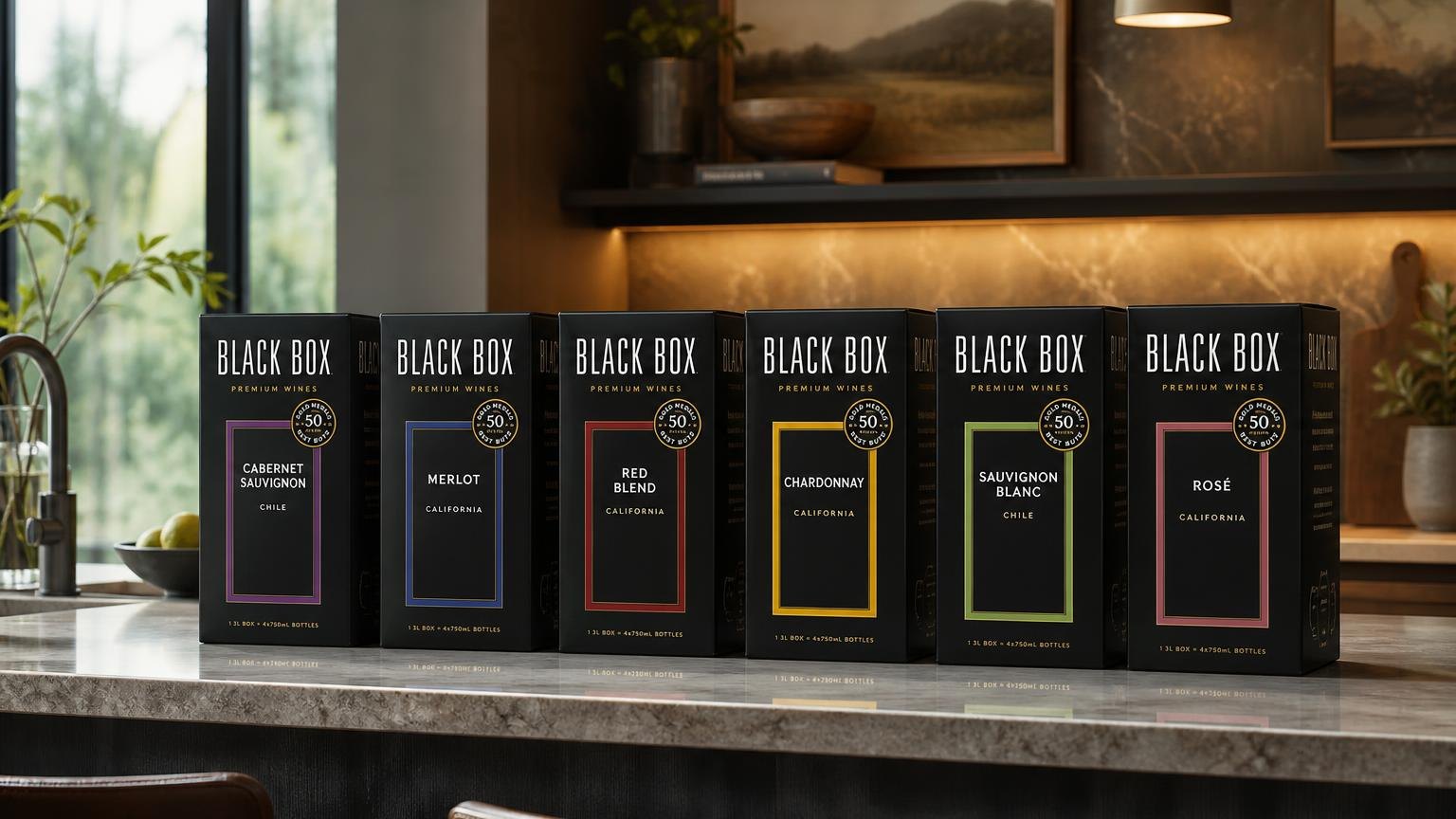
Common examples include Black Box Cabernet Sauvignon, Merlot, Pinot Noir, and Chardonnay at about 13.5% ABV, while Pinot Grigio, Sauvignon Blanc, and Rosé are often around 12.5% ABV.
How much alcohol is in a 3-liter Black Box wine?
A standard Black Box 3-liter box equals four 750 ml bottles, or about 101.4 fluid ounces of wine.
At 13.5% ABV, that contains roughly 13.7 fluid ounces of pure alcohol, equal to about 23 U.S. standard drinks using the NIAAA definition of 0.6 fluid ounces of alcohol per drink.
Is Black Box wine stronger than regular bottled wine?
No—Black Box wine is generally in the same ABV range as typical bottled table wine, which is commonly about 12% to 14.5% ABV.
The box format changes the packaging, not the alcohol strength; the important number is still the ABV printed on the label.
How many standard drinks are in one glass of Black Box wine?
A 5-ounce pour of Black Box wine at 13.5% ABV contains about 0.675 fluid ounces of alcohol, or roughly 1.1 U.S. standard drinks. At 12.5% ABV, the same pour is about 1.0 standard drink.
Does Black Box red wine have more alcohol than Black Box white wine?
Often, yes, but not always: many Black Box reds such as Cabernet Sauvignon, Merlot, and Pinot Noir are commonly labeled around 13.5% ABV.
Several lighter whites, including Pinot Grigio and Sauvignon Blanc, are often closer to 12.5% ABV, so checking the specific box label is the most reliable method.
How many standard drinks are in an entire 3-liter box of Black Box wine?
A 3-liter box contains approximately 20 standard five-ounce servings. At a typical ABV of 13.5%, that translates to roughly 20 standard drinks per box.
This is equivalent to four standard 750 mL bottles, making portion awareness essential when pouring from the convenient spout.
Does the alcohol content of Black Box wine change after opening?
The ABV remains stable after opening because the bag-in-box design collapses as wine is dispensed, minimizing air exposure.
Unlike opened bottles, oxidation is significantly reduced, preserving both flavor and alcohol concentration for up to six weeks after the initial pour.
What is the ABV of Black Box Rosé compared to the Cabernet Sauvignon?
Black Box Rosé typically has an ABV around 12.5%, while the Cabernet Sauvignon sits higher at approximately 13.5%.
This one-percentage-point difference reflects the general trend where fuller-bodied reds ferment longer with riper grapes, converting more sugar into alcohol.
Related Reading
- Where Is The Expiration Date On Wine Bottles? Find Out Now
- What Is Natural Wine? Organic vs Biodynamic vs Natural wines
- How Many Fl Oz In A Bottle Of Wine?
- How Long Does Boxed Wine Last Unopened? 13 Things You Need To Know (2026 Guide)
- Why Store Wine On Its Side? Complete 2026 Guide for Proper Wine Storage
- What Is The Best Sweet Wine? – Find Out Now
- What Is A Sweet Wine? – 2026
- All Alcohol Guides
- Black Box Wines Cabernet Sauvignon (n.d.)
- Black Box Wines Chardonnay (n.d.)
- Black Box Wines Pinot Grigio (n.d.)
- Electronic Code of Federal Regulations, 27 CFR § 4.36 Alcoholic Content (2025)
- Alcohol and Tobacco Tax and Trade Bureau Wine Labeling: Alcohol Content (2024)
- National Institute on Alcohol Abuse and Alcoholism What Is A Standard Drink? (2024)
- Centers for Disease Control and Prevention About Standard Drink Sizes (2024)