calories in moscato wine are about 127 calories per 5-ounce glass, based on a typical sweet Moscato at roughly 8% ABV with residual sugar.
A 750-mL bottle contains about five glasses, so the bottle usually lands near 635 calories before accounting for brand variation.
Moscato’s calorie count comes from alcohol and sugar, not fat. Sweeter, lower-alcohol bottles can still add calories quickly because residual sugar remains after fermentation.
Check the label’s ABV, serving size, and grams of sugar when available; those numbers explain why one Moscato pours lighter than another.
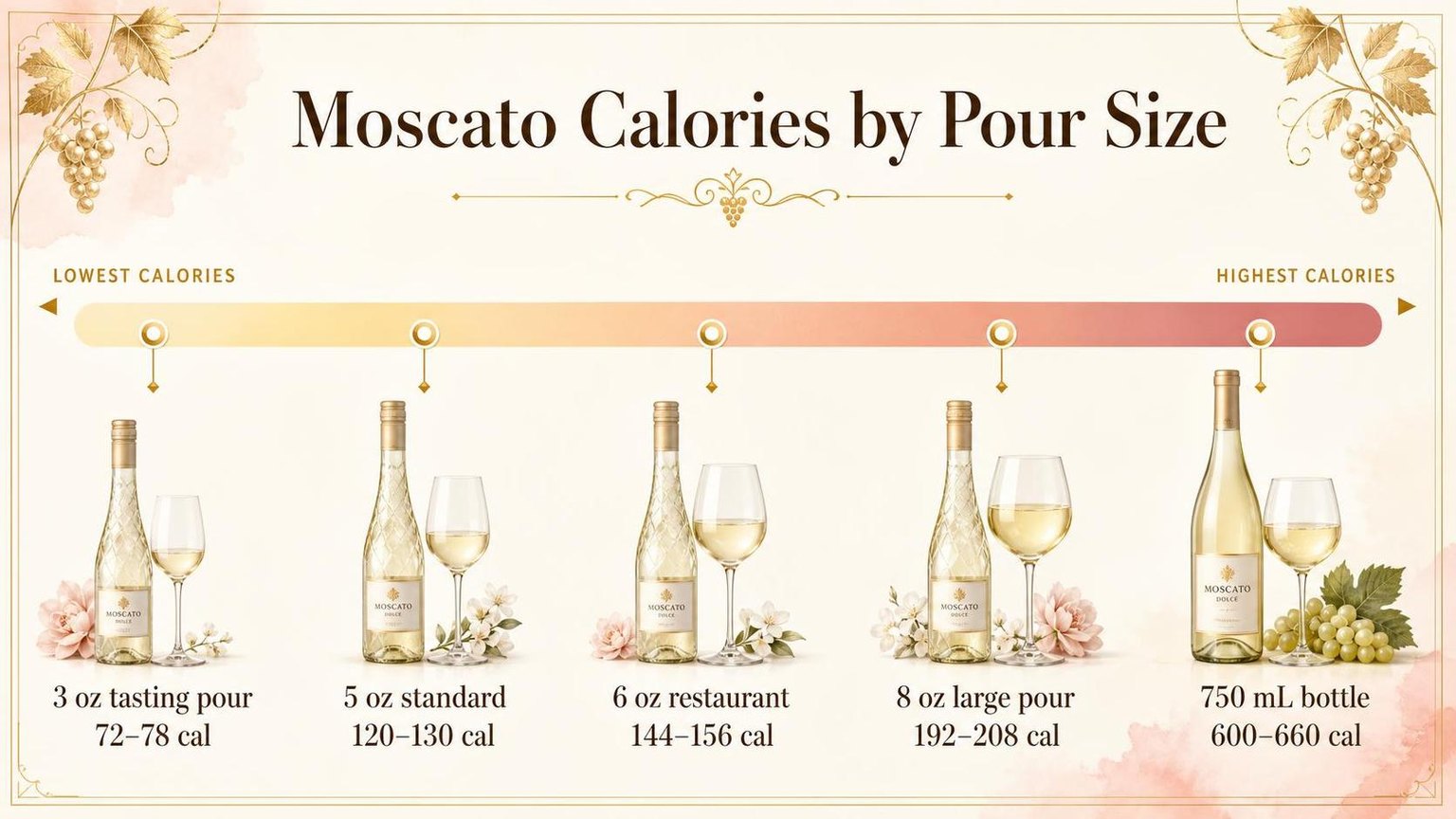
Calories in Moscato by Serving Size
Moscato is usually moderate in alcohol but higher in residual sugar than many dry white wines, so calories add up quickly as pours get larger.
A standard 5-ounce glass typically lands around 120 to 130 calories, with most of those calories coming from alcohol and remaining grape sugar.
The exact number changes by producer, sweetness level, and alcohol by volume. Moscato d’Asti is often around 5% to 6% ABV and can be lighter, while fuller sweet Moscato bottlings closer to 7% to 9% ABV often sit at the higher end.
| Serving size | Approximate calories | What it means in practice |
| 3 oz | 72 to 78 | Small tasting pour or half-glass |
| 5 oz | 120 to 130 | Standard U.S. wine serving |
| 6 oz | 144 to 156 | Generous restaurant pour |
| 8 oz | 192 to 208 | Large home pour |
| 375 mL half-bottle | 300 to 330 | About 2.5 standard glasses |
| 750 mL bottle | 600 to 660 | About 5 standard glasses |
Those numbers track with standard wine-calorie references and typical Moscato nutrition ranges.
For comparison, one fluid ounce of wine at 24 to 26 calories is common for sweet Moscato, which is why a 5-ounce glass usually falls near 120 to 130 calories.
Alcohol supplies 7 calories per gram, and sugar supplies 4 calories per gram. Moscato often has less alcohol than dry table wine, but the sweeter style can offset that reduction because residual sugar raises the total calorie count.
If you want the lightest pour, focus on Moscato d’Asti or lightly sparkling Moscato with lower ABV and serve a true 5 ounces. If you fill a large goblet to 8 ounces, you are closer to 200 calories than 120.
| Pour pattern | Total Moscato | Approximate calories |
| One standard glass | 5 oz | 120 to 130 |
| Two standard glasses | 10 oz | 240 to 260 |
| Three tasting pours | 9 oz | 216 to 234 |
| One full bottle shared equally by two people | 12.5 oz each | 300 to 330 each |
Portion size matters more than most drinkers expect. Measure the pour, check the ABV, and assume sweeter Moscato will sit slightly above dry white wine on calories per glass.
Why Moscato Calories Vary
Moscato calories change because the wine’s sugar level, alcohol content, and serving style change. A 5-ounce glass can land near 110 calories or push past 160, even before larger pours raise the total.
The biggest driver is residual sugar. Moscato is usually made from Muscat grapes and often bottled with noticeable sweetness, so more unfermented grape sugar remains in the finished wine than in dry table wines.
Alcohol matters too. Alcohol supplies about 7 calories per gram, while sugar supplies about 4. A lightly fizzy Moscato d’Asti at 5% to 6% ABV usually has fewer alcohol calories than a still Moscato around 9% to 11% ABV.
| Factor | Typical range | Why calories change |
| Residual sugar | About 20 to 120 grams per liter | More leftover sugar adds calories directly and raises total sweetness |
| Alcohol by volume | About 5% to 11% ABV | Higher alcohol increases calories even if sweetness stays similar |
| Serving size | 5 ounces vs. 8 ounces | A larger pour can raise calories by about 60% |
| Style | Frizzante, sparkling, still, pink, dessert | Different styles are fermented and sweetened to different endpoints |
Residual sugar explains why two Moscatos with similar ABV can still differ sharply.
If one wine carries 30 grams per liter of sugar and another carries 90 grams per liter, the sweeter bottle adds roughly 12 more calories per 5-ounce glass from sugar alone.
Serving size changes the math fast. A standard wine serving is 5 ounces, but many restaurant pours are 6 to 8 ounces. If a Moscato contains 125 calories per 5 ounces, an 8-ounce pour delivers about 200 calories.
Production choices also matter. Moscato d’Asti is commonly lower in alcohol because fermentation stops early, while some still Moscatos ferment further or start with riper fruit, changing both sugar concentration and alcohol level.
| Moscato style | Typical 5-ounce calories | Main reason |
| Moscato d’Asti | About 110 to 130 | Lower ABV, moderate sweetness |
| Still Moscato | About 120 to 150 | Higher ABV and moderate to high sugar |
| Sweet dessert-style Moscato | About 140 to 165 | Very high residual sugar |
Read the label when possible. If the producer lists ABV, sweetness cues, or serving size, those details give the clearest estimate of where that glass of Moscato will fall on the calorie range.
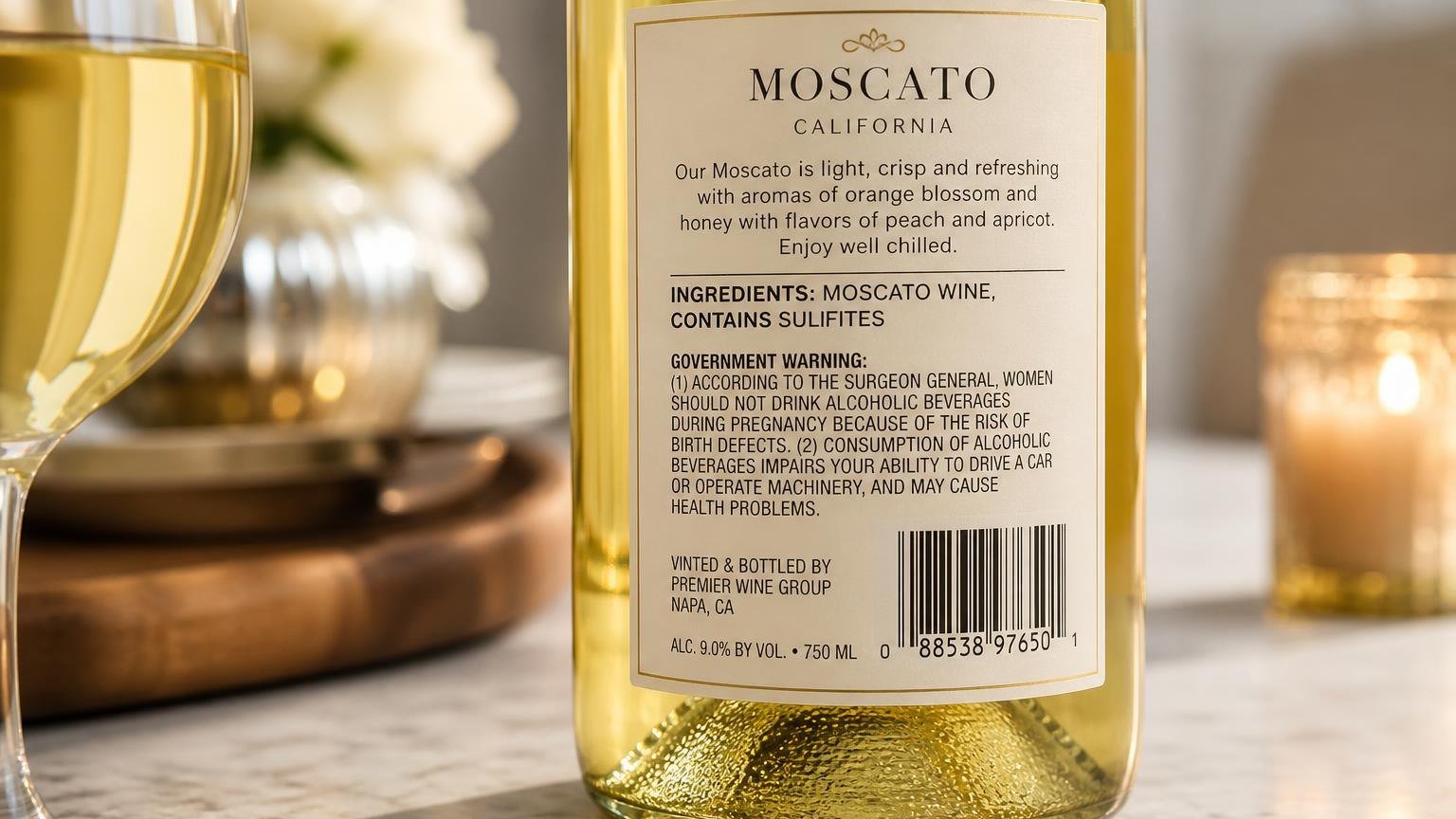
Sugar and Alcohol Calorie Breakdown
Moscato calories come from two sources: alcohol and residual sugar. Alcohol supplies 7 calories per gram, while sugar supplies 4 calories per gram, so sweetness matters, but alcohol still drives a large share of the total.
Most Moscato is low in alcohol and noticeably sweet. A typical 5-ounce serving lands around 110 to 130 calories because it combines modest alcohol with more leftover sugar than a dry white wine.
| Component | Calories per gram | Role in Moscato |
| Alcohol | 7 | Main calorie source in every wine |
| Sugar | 4 | Raises calories as sweetness increases |
Alcohol calories are tied directly to ABV. Moscato commonly ranges from about 5% to 9% ABV for lightly sparkling styles, while some still Moscatos reach 10% to 12% ABV, increasing calories even if sweetness stays similar.
| 5-ounce serving | Approx. alcohol grams | Approx. alcohol calories |
| 5% ABV Moscato | 5.9 g | 41 |
| 7% ABV Moscato | 8.3 g | 58 |
| 9% ABV Moscato | 10.6 g | 74 |
Sugar varies more than alcohol because Moscato styles differ widely. A 5-ounce pour can contain roughly 10 to 18 grams of sugar in many commercial bottles, though sweeter dessert-style versions can exceed that range.
| 5-ounce serving | Sugar grams | Sugar calories |
| Lightly sweet Moscato | 10 g | 40 |
| Moderately sweet Moscato | 14 g | 56 |
| Sweet Moscato | 18 g | 72 |
Put together, a 7% ABV Moscato with 14 grams of sugar delivers about 114 calories in 5 ounces. About 58 calories come from alcohol and 56 from sugar, which shows why Moscato can rival or exceed some drier wines despite lower ABV.
This also explains why two Moscatos with the same alcohol level can have different calorie counts. The sweeter bottle carries more residual sugar, so the label may taste only slightly richer while adding 10 to 30 more calories per glass.
- Lower-ABV Moscato is not automatically low-calorie.
- Sugar can account for roughly one-third to one-half of total calories.
- Serving size matters: 8 ounces instead of 5 increases calories by about 60%.
- Frizzante and Asti styles often stay lower in alcohol, but sweetness still adds up.
Moscato Compared With Other Wines
Moscato usually lands on the higher end of the calorie range for wine because it combines moderate alcohol with noticeable residual sugar.
In a standard 5-ounce glass, most Moscato wines deliver about 120 to 130 calories, which puts them above many dry sparkling wines and close to several fuller-bodied table wines.
The key difference is sweetness. Dry wines get more of their calories from alcohol, while Moscato gets calories from both alcohol and unfermented grape sugar.
| Wine style | Typical serving | Calories | Why it differs |
| Moscato | 5 oz | 120-130 | Moderate alcohol, higher residual sugar |
| Riesling, off-dry | 5 oz | 118-130 | Similar sweetness can push calories up |
| Pinot Grigio | 5 oz | 120-122 | Drier style, fewer sugar calories |
| Sauvignon Blanc | 5 oz | 119-121 | Usually dry, moderate alcohol |
| Chardonnay | 5 oz | 123-124 | Higher alcohol often offsets lower sugar |
| Rosé | 5 oz | 120-125 | Depends on dryness and alcohol level |
| Cabernet Sauvignon | 5 oz | 122-124 | Drier, but often higher ABV |
| Pinot Noir | 5 oz | 121-123 | Dry, moderate alcohol |
| Prosecco, Brut | 5 oz | 95-105 | Lower sugar and smaller bubbles-driven pours |
| Champagne, Brut | 5 oz | 95-100 | Very low residual sugar |
Moscato often surprises drinkers because its alcohol is usually lower than many reds and Chardonnays, often around 5.5% to 7% ABV for Asti-style versions and around 7% to 10% for still Moscato.
Even so, sweetness can keep the calorie total near or above drier wines.
That explains why a sweet Moscato can match a glass of Cabernet Sauvignon in calories despite much lower alcohol. Sugar adds up fast, especially in dessert-leaning bottles or generous pours.
- Choose Moscato d’Asti or lightly sparkling Moscato for smaller, lower-ABV servings.
- Check the label or producer notes for ABV; lower alcohol often means fewer calories, but sweetness still matters.
- Compare by serving size. A 6-ounce pour raises a 125-calorie glass to about 150 calories.
- If calorie control matters most, Brut sparkling wines are usually leaner than sweet Moscato.
In practice, Moscato is not the highest-calorie wine on the shelf, but it is rarely the lightest. It sits in the middle-to-upper range because sweetness narrows the gap between low-alcohol Moscato and stronger dry wines.
Lower Calorie Moscato Serving Strategies
Moscato is usually lower in alcohol than many table wines, but its residual sugar still adds calories. A practical target is keeping a pour at 3 to 5 ounces, because serving size changes calorie intake faster than switching brands.
A standard sweet Moscato often lands near 120 to 130 calories per 5-ounce serving. Cut the pour, dilute with zero-calorie bubbles, or choose a lower-alcohol bottle to reduce total intake without abandoning the style.
| Serving strategy | Typical portion | Estimated calories | Why it works |
| Full glass sweet Moscato | 5 oz | 120-130 | Baseline portion used on nutrition labels and wine tracking apps |
| Smaller pour | 3 oz | 72-78 | Reduces calories by about 40% versus 5 oz |
| Wine spritzer | 2.5 oz Moscato + 2.5 oz sparkling water | 60-65 | Keeps volume at 5 oz while halving wine calories |
| Extra-light tasting pour | 2 oz | 48-52 | Fits dessert pairings and slows total intake |
Measure the first pour. Many home wine glasses hold 12 to 16 ounces, and people often free-pour 6 to 9 ounces. That turns one 125-calorie serving into roughly 150 to 225 calories before a refill.
Use sparkling water, not juice or tonic, for a spritzer. Moscato already carries sweetness from residual sugar, so extra mixers usually raise calories without improving balance.
Check alcohol by volume on the label. Moscato commonly sits around 5% to 9% ABV, while many dry whites reach 12% to 14%. Lower ABV often means fewer calories from alcohol, though sweetness can offset some of that advantage.
- Serve well chilled, around 45 to 50 degrees Fahrenheit. Colder wine tastes brighter and slightly less sweet, which helps smaller pours feel satisfying.
- Choose a narrower white-wine glass. Smaller bowls make a 3- to 4-ounce pour look proportionate and reduce accidental overpouring.
- Pair with fresh fruit, not cheesecake or tiramisu. A lighter pairing prevents dessert calories from exceeding the wine itself.
- Track total glasses, not bottles opened. Two 5-ounce pours can add about 240 to 260 calories.
If calories are the priority, the most reliable strategy is simple: pour 3 ounces, top with sparkling water, and stop measuring by the rim of the glass.
Reading Moscato Labels for Calories
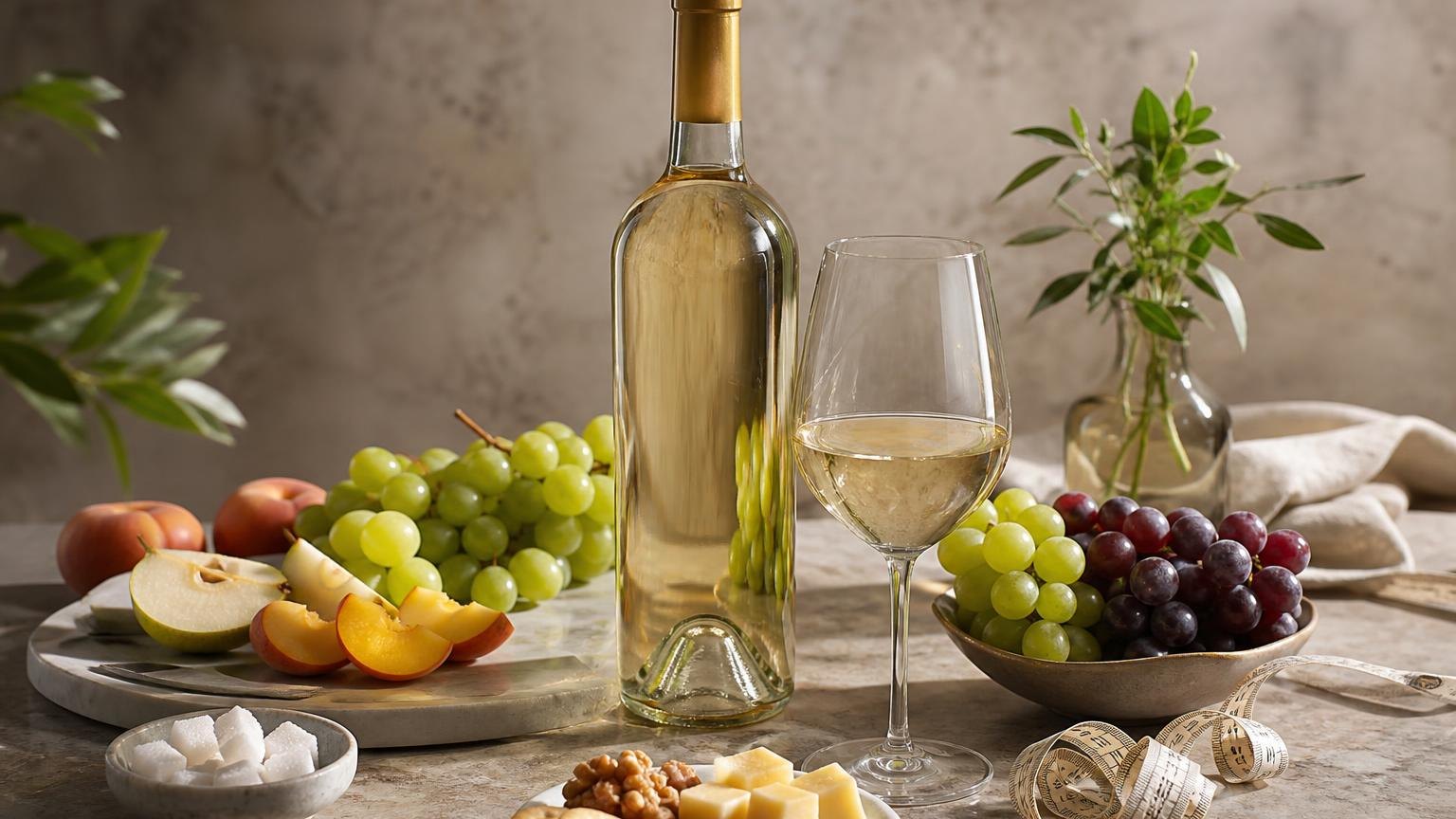
Moscato labels rarely print calories on the front. You usually have to estimate from the alcohol by volume, sweetness level, and serving size. The key is to read the bottle like a nutrition panel, even when it is not labeled as one.

Start with the serving size. In the U.S., a standard wine serving is 5 fluid ounces, or about 148 mL. Most calorie estimates for Moscato use that pour, not a full glass filled to the rim.
Alcohol drives most wine calories. Pure alcohol provides about 7 calories per gram, while sugar provides 4 calories per gram. Moscato often has fewer alcohol calories than dry table wine, but more sugar calories because it is usually sweet.
| Label detail | What to look for | Why it matters for calories |
| Serving size | 5 oz / 148 mL | Calories are usually estimated per standard pour |
| ABV | Often 5% to 9% for sweeter Moscato; some still versions 10% to 12% | Higher ABV usually means more calories from alcohol |
| Style | Still, frizzante, or sparkling | Style affects sweetness and typical pour size |
| Sweetness cues | “Sweet,” “dessert,” “d’Asti,” “spumante” | Sweeter styles usually carry more residual sugar |
A 5-ounce glass of Moscato commonly lands around 110 to 130 calories. Moscato d’Asti is often near the lower end because it is lightly sparkling and usually around 5.5% ABV, though sweetness still contributes meaningful calories.
| Moscato type | Typical ABV | Estimated calories per 5 oz |
| Moscato d’Asti | 5% to 6% | 110 to 120 |
| Still sweet Moscato | 7% to 9% | 120 to 130 |
| Higher-alcohol Moscato | 10% to 12% | 125 to 140 |
If the bottle has a government warning and alcohol percentage but no nutrition panel, use ABV first.
Then use style words as your sugar clue. “Sweet” and “dessert” usually signal more residual sugar than a lightly sweet sparkling Moscato.
Watch bottle size and pour size. A 750 mL bottle holds about five 5-ounce servings. At 120 calories per serving, that bottle delivers about 600 calories total if you finish it.
- Check ABV before brand claims like “light” or “refreshing.”
- Use 5 ounces as the baseline for comparison.
- Assume sweeter wording means more sugar calories.
- Count the whole bottle, not only one pour, if you are tracking intake.
Frequently Asked Questions
How many calories are in a 5-ounce glass of Moscato wine?
A 5-ounce glass of Moscato usually contains about 120 to 140 calories. The exact number depends on alcohol level and residual sugar, with sweeter, lower-alcohol Moscato often landing near the middle of that range.
Why does Moscato usually have more calories than dry white wine?
Moscato keeps more residual sugar than dry whites such as Sauvignon Blanc or Pinot Grigio, and that sugar adds calories.
Many dry white wines fall around 120 calories per 5 ounces, while sweeter Moscato can edge higher because it combines alcohol calories with leftover grape sugar.
How many calories are in a bottle of Moscato?
A standard 750 mL bottle holds about five 5-ounce servings, so a full bottle of Moscato usually contains roughly 600 to 700 calories. If the wine is especially sweet or poured in larger servings, the total can climb above that range.
Does pink Moscato have more calories than white Moscato?
Pink Moscato and white Moscato are often close in calories, usually around 120 to 140 per 5-ounce glass. Pink versions can run slightly higher if the producer leaves more sugar in the wine or blends in a sweeter red component.
How can you estimate calories in Moscato if the label does not list them?
Check the alcohol by volume and the sweetness style, because both affect the final calorie count.
As a practical rule, a lightly sweet Moscato around 5% to 7% ABV may be near 110 to 130 calories per 5 ounces, while richer styles around 8% to 10% ABV often reach 130 to 150.
Does Moscato have more calories than red wine?
A 5-ounce glass of Moscato typically contains 120–130 calories, while a comparable pour of dry red wine like Cabernet Sauvignon averages 122–125 calories.
Despite its lower alcohol content (5–7% ABV), Moscato's higher residual sugar—often 100–120 g/L—largely offsets that caloric difference.
How many calories does a single fluid ounce of Moscato contain?
One fluid ounce of Moscato contains approximately 24–26 calories. This figure derives from its typical 5–7% ABV contributing around 14–16 calories per ounce from alcohol, with the remaining 8–10 calories coming from its elevated residual sugar content.
Related Reading
- How to Make Homemade Wine from Grapes? (Beginner-Friendly Method, Real Fermentation Experience & Proven Tips)
- How Many Carbs In A Glass Of Pinot Grigio? Answer By Expert
- Beer Cave Wine and Spirits Store Near You
- How Many Grapes Are in a Bottle of Wine?
- How Did They Make Wine in Biblical Times?
- What Does Wine Taste Like? – 2026
- Aperol vs Campari
- All Alcohol Guides