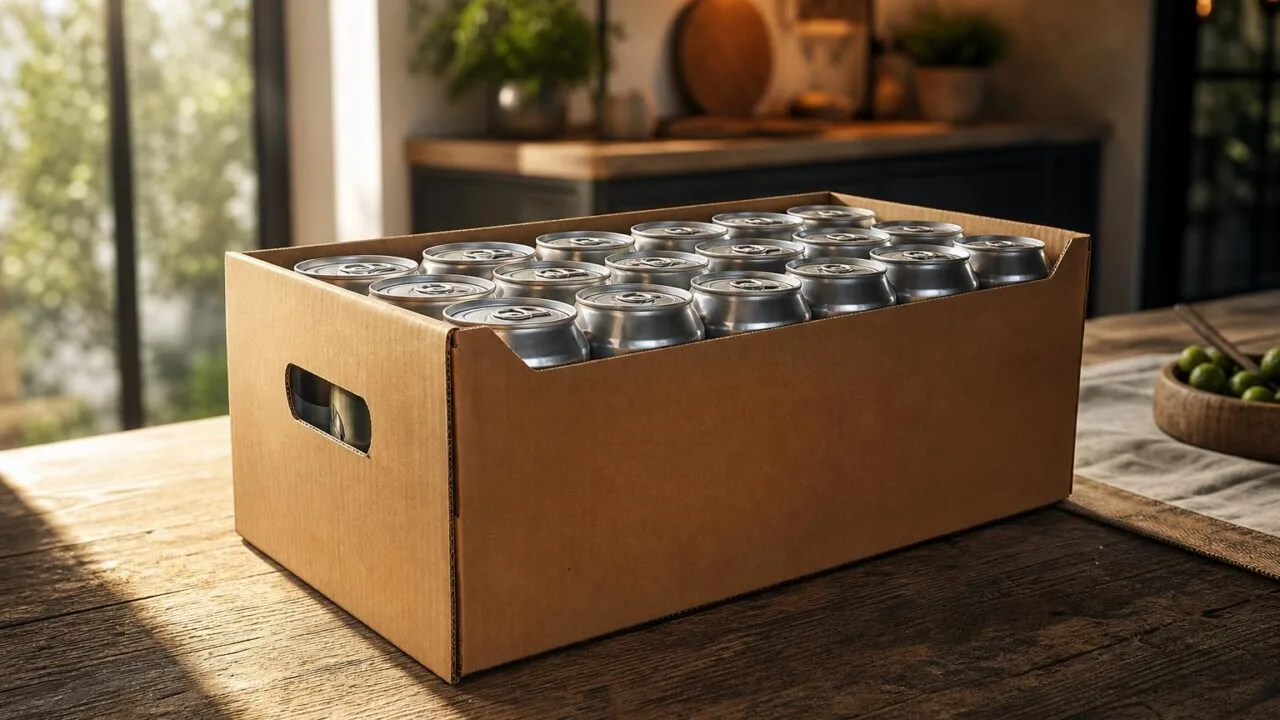
How Much Does A Case Of Beer Weigh is about 20 pounds for a standard 24-pack of 12-ounce cans.
Bottles are heavier: a 24-pack of 12-ounce glass bottles typically lands around 30 to 36 pounds, depending on bottle thickness, packaging, and whether the case uses cardboard trays or a full box.
For lifting, shipping, or stocking a cooler, the container matters as much as the beer volume. A case of 16-ounce cans weighs roughly 26 to 27 pounds, while 30-packs of 12-ounce cans often exceed 24 pounds.
These estimates include beer, cans or bottles, and typical retail packaging.
What a Beer Case Usually Means
A standard U.S. “case” usually means 24 containers, most often 12-ounce cans or 12-ounce glass bottles. The weight difference is not the beer; it is almost entirely the package.
For calculation, 12 U.S. fluid ounces equals 354.9 milliliters. Finished beer is close to water in density, commonly about 1.00 to 1.02 grams per milliliter, so the beer inside one 12-ounce container weighs about 0.78 to 0.80 pounds.
| Case format | Beer volume | Typical full case weight | What drives the number |
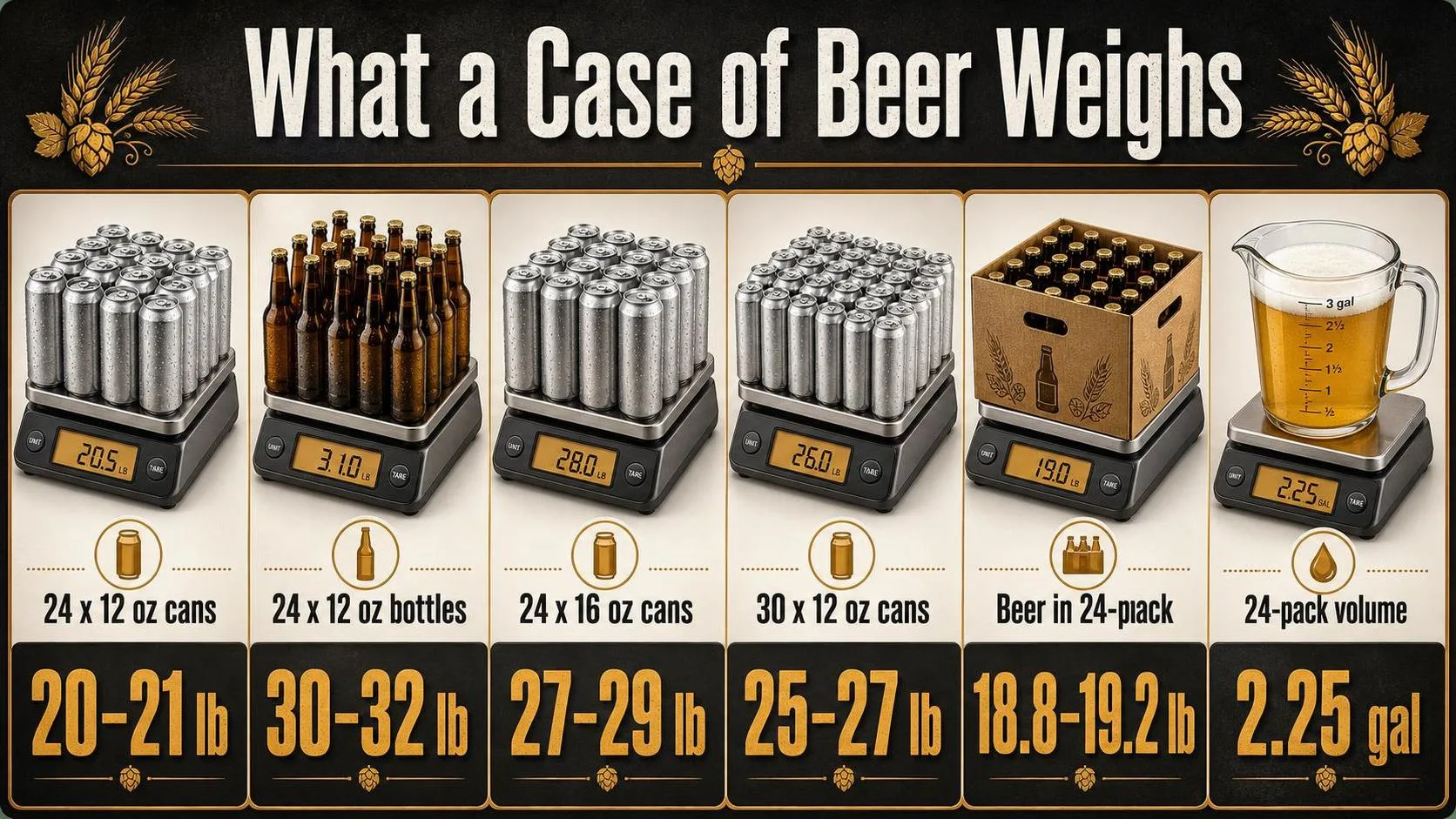
| 24 x 12 oz aluminum cans | 288 fl oz, or 2.25 gallons | About 20 to 21 lb | Beer plus light cans and cardboard tray/box |
| 24 x 12 oz glass bottles | 288 fl oz, or 2.25 gallons | About 30 to 32 lb | Same beer volume, much heavier glass |
| 24 x 16 oz aluminum cans | 384 fl oz, or 3.0 gallons | About 27 to 29 lb | One-third more beer than 12 oz cans |
| 30 x 12 oz aluminum cans | 360 fl oz, or 2.8125 gallons | About 25 to 27 lb | Six extra cans compared with a 24-pack |
The beer itself is the baseline. A 24-pack of 12-ounce beer contains 288 fluid ounces. That is 8.52 liters, or 2.25 U.S. gallons, and the liquid alone weighs roughly 18.8 to 19.2 pounds.
Aluminum cans add relatively little. A modern 12-ounce beverage can typically weighs around 14 to 15 grams, or about 0.03 pounds. Across 24 cans, that is only about 0.7 to 0.8 pounds before cardboard packaging.
Glass bottles change the math quickly. A 12-ounce nonreturnable beer bottle commonly weighs about 180 to 220 grams, or 0.40 to 0.49 pounds. For 24 bottles, empty glass alone can add roughly 9.5 to 11.7 pounds.
- Quick shopping estimate: use 20 pounds for a 24-pack of 12-ounce cans.
- Quick lifting estimate: use 31 pounds for a 24-pack of 12-ounce bottles.
- Quick cooler estimate: one 24-pack of cans adds about 2.25 gallons of beverage volume before ice.
Packaging varies by brewery and retailer. A thin cardboard can tray may add under a pound, while a fully enclosed bottle case with dividers can add closer to 1.5 to 2 pounds.
What Changes a Case’s Weight
A “case” of beer is usually 24 containers in the U.S., but the weight changes a lot by package size, container material, and packaging.
The beer itself is the biggest fixed factor: one U.S. fluid ounce of beer weighs about 1.04 ounces by weight because beer is slightly denser than water.
Container size is the main driver
A 24-pack of 12-ounce beers contains 288 fluid ounces, or 2.25 U.S. gallons, of beer. Before counting cans, bottles, cardboard, or carriers, the liquid alone weighs roughly 18.7 pounds.
| Case format | Total beer volume | Approx. liquid weight only |
| 24 x 12 fl oz | 288 fl oz | 18.7 lb |
| 24 x 16 fl oz | 384 fl oz | 25.0 lb |
| 12 x 12 fl oz | 144 fl oz | 9.4 lb |
| 30 x 12 fl oz | 360 fl oz | 23.4 lb |
Cans versus bottles
Aluminum cans are much lighter than glass bottles. A typical empty 12-ounce aluminum beer can weighs about 0.5 ounce, while a 12-ounce glass beer bottle commonly weighs around 6 to 7 ounces, depending on the bottle design.
| 24-pack type | Approx. container weight | Typical full case weight |
| 12 oz aluminum cans | About 0.75 lb total | About 20 to 21 lb |
| 12 oz glass bottles | About 9 to 10.5 lb total | About 29 to 32 lb |
| 16 oz aluminum cans | About 1 lb total | About 27 to 29 lb |
Packaging adds a few pounds
Cardboard trays, wrap, dividers, bottle carriers, and handles are not weightless. A shrink-wrapped 24-pack of cans may add roughly 1 to 1.5 pounds of packaging, while bottled cases with dividers can add closer to 2 pounds.
- Cardboard tray and plastic wrap: common for 24-pack cans and usually the lightest retail format.
- Glass bottle dividers: add protection but increase weight and bulk.
- Returnable crates: can add several extra pounds beyond disposable packaging.
Beer style has a smaller effect
Most beers fall close to water in density, so style changes the total less than the package does.
Higher-alcohol beers and sweeter beers can be slightly heavier per ounce, but the difference across a full 24-pack is usually measured in ounces, not pounds.
Temperature and shipping labels
Temperature slightly changes liquid density, but not enough to matter for normal carrying or shopping. For shipping, carriers use the packed weight on a scale, so a boxed case with padding can weigh more than the same case pulled from a store shelf.

How a Beer Case Is Weighed
A case of beer is verified by weighing the finished package, not by estimating from the liquid volume alone. The measured weight includes beer, primary containers, closures, cardboard, glue, trays, and any plastic wrap or handles.
For a 24-pack, the fastest reliable method is to place the sealed case on a calibrated bench or shipping scale and record the gross weight. In a warehouse, carriers usually round that figure up to the next whole pound for shipping purposes.
What the Scale Is Actually Weighing
The liquid portion starts with the labeled net contents. In the United States, a standard beer can or bottle is commonly 12 U.S. fluid ounces, equal to 354.882 milliliters.
Beer is slightly denser than water because of dissolved sugars, proteins, minerals, and alcohol balance. Most finished beers fall near 1.005 to 1.015 specific gravity, so the liquid in one 12-ounce beer weighs about 0.785 to 0.793 pounds.
| Component in a 24-pack | Typical measured contribution | Verification method |
| Beer only, 24 x 12 fl oz | About 18.8 to 19.0 lb | Calculated from fill volume and final gravity |
| Empty aluminum cans | About 0.75 to 0.85 lb total | Tare weight from empty cans |
| Empty glass bottles | About 9.5 to 11.5 lb total | Tare weight from empty bottles |
| Cardboard tray or carton | About 0.3 to 0.8 lb | Weighed separately before packing |
| Finished 24-pack cans | Usually about 20 to 21 lb | Gross case weight on scale |
| Finished 24-pack bottles | Usually about 34 to 36 lb | Gross case weight on scale |
How Breweries and Distributors Check Accuracy
Breweries commonly verify case weight at two points: after filling and after final packaging. A checkweigher can flag underfilled, missing, or damaged units because one 12-ounce beer changes the case weight by roughly 0.8 pounds.
Distributors also use tare-and-gross checks. They may weigh an empty carton, weigh a finished case, then subtract packaging if they need the net beverage weight for inventory, freight classification, or loss control.
- Use a calibrated scale: For shipping or commercial records, scales are typically maintained under NIST Handbook 44 legal-for-trade principles.
- Weigh the sealed case: Open cases can lose cans, dividers, or wrap, changing the result.
- Check the package format: Cans, longneck bottles, stubby bottles, and 16-ounce cans have materially different tare weights.
- Record units clearly: Gross weight is the case as shipped; net contents refer only to the beer volume.
At home, a bathroom scale can confirm an approximate case weight, but a digital shipping scale with 0.1-pound resolution gives a more useful result. For freight, receiving, or compliance work, the gross sealed-case weight is the number to trust.
Typical Weight of 24-Pack Beer
A standard 24-pack of 12-ounce beer cans usually weighs about 20 to 21 pounds. That makes it lighter than bottled beer, most wine cases, and bottled-water cases, but much heavier than a 12-pack or loose six-pack.
The biggest weight differences come from packaging. Aluminum cans are light, while glass bottles add several pounds even before you count cardboard dividers, trays, or bottle carriers.
| Package | Typical contents | Approximate full weight | Why it differs |
| Case of beer cans | 24 x 12 fl oz | 20 to 21 lb | Beer weighs about 0.79 lb per can; aluminum and cardboard add about 1 to 2 lb. |
| Case of beer bottles | 24 x 12 fl oz | 30 to 36 lb | Glass bottles commonly add 6 to 8 oz each, plus heavier carton packaging. |
| 12-pack of beer cans | 12 x 12 fl oz | 10 to 11 lb | Roughly half the liquid and packaging of a 24-pack. |
| 30-pack of beer cans | 30 x 12 fl oz | 25 to 27 lb | Six more cans than a case; often sold in a larger cardboard suitcase-style box. |
| Case of bottled water | 24 x 16.9 fl oz | 28 to 30 lb | Contains 405.6 fl oz total, about 41% more liquid volume than a 24-pack of beer. |
| Case of wine | 12 x 750 ml | 35 to 45 lb | Wine volume is about 304 fl oz, but thick glass bottles drive up the weight. |
| Sixth-barrel keg | 5.16 gal | 55 to 60 lb | Holds about 55 twelve-ounce servings; stainless steel shell adds major weight. |
| Half-barrel keg | 15.5 gal | 155 to 165 lb | Holds about 165 twelve-ounce servings; too heavy for one-person lifting. |
Compared with soda, a beer case is nearly identical in weight when both use 24 12-ounce cans. Carbonation does not materially change the carrying weight; the liquid volume and packaging matter more.
Compared with bottled water, beer cans are noticeably easier to carry. A 24-pack of 16.9-ounce water bottles contains 117.6 more fluid ounces than a beer case, which is almost 9.2 extra pounds of water alone.
Compared with wine, beer cans are usually lighter despite similar beverage density. A wine case has only 12 bottles, but each 750 ml glass bottle often weighs far more than an empty aluminum beer can.
- Easiest common option: 12-pack cans, usually around 10 to 11 pounds.
- Standard beer run: 24-pack cans, usually around 20 to 21 pounds.
- Heaviest retail case: bottled beer or wine, often 30 pounds or more.
- Not comparable for hand-carrying: half-barrel kegs, often over 160 pounds full.
Safety Tips for Lifting Beer Cases
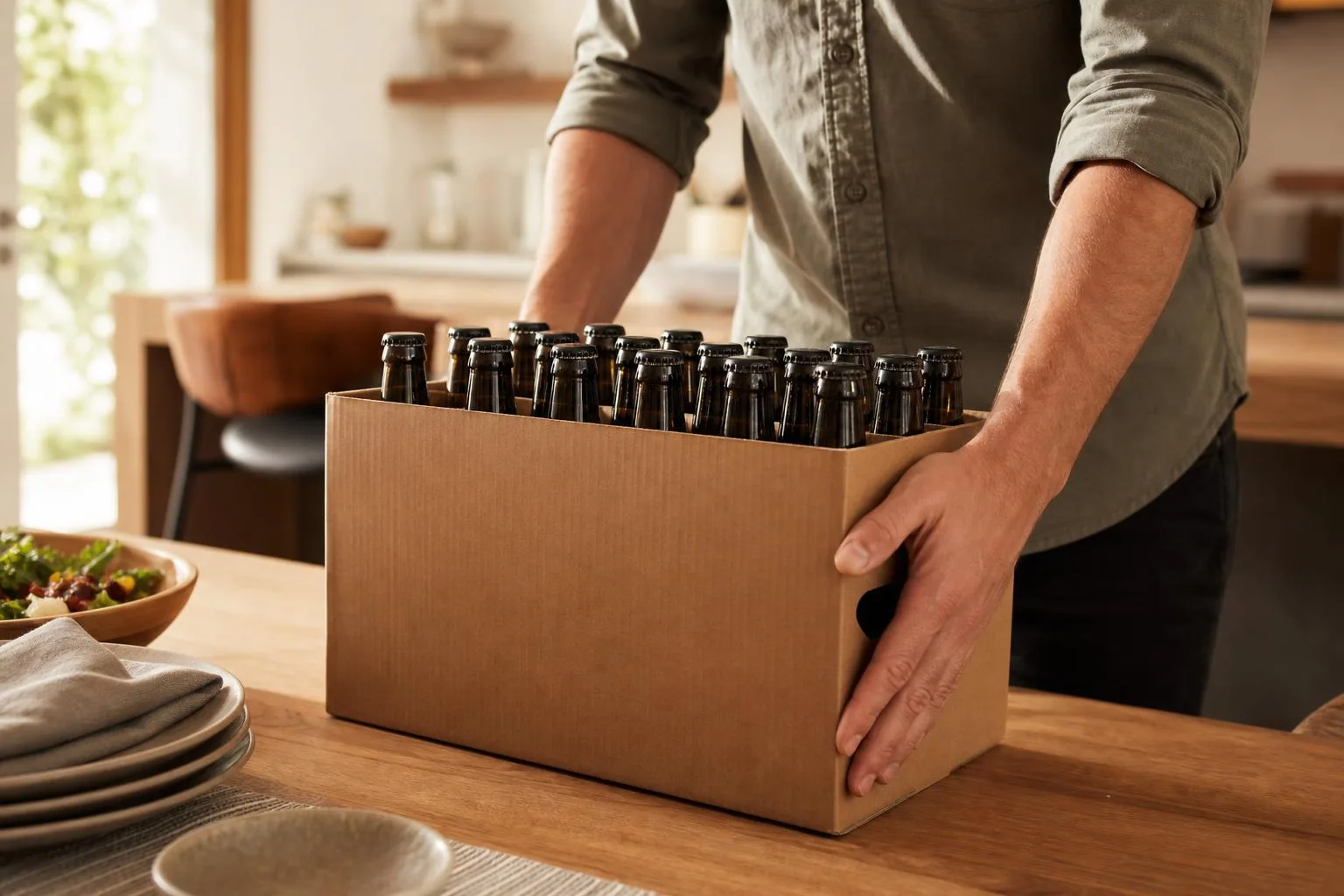
A case of beer is heavy enough to strain your back, shift in a car, or break if dropped. Treat a full case like a small appliance: lift close to your body, secure it during transport, and keep it out of heat.
| Common case | Approximate full weight | Practical note |
| 24 cans, 12 oz each | About 20–22 lb | Lightest common full case; cardboard can tear if wet. |
| 24 glass bottles, 12 oz each | About 30–36 lb | Heavier because of glass; higher breakage risk. |
| 30 cans, 12 oz each | About 25–28 lb | Common “30-rack”; awkward because of length. |
| 24 cans, 16 oz each | About 27–30 lb | More liquid weight; check handles before lifting. |
Lifting and carrying safely
- Use two hands. A 24-pack of bottles can exceed 30 lb, and the weight shifts if bottles move inside the case.
- Keep it close. Hold the case against your torso instead of at arm’s length; distance increases strain on your lower back and shoulders.
- Bend at the knees. Squat, grip the bottom or reinforced handles, then stand up smoothly without twisting.
- Split the load. If carrying upstairs, across a parking lot, or over ice, move 12 bottles or cans at a time.
- Do not trust wet cardboard. Condensation, melted ice, and rain weaken cartons quickly; support the case from underneath.
For workplace context, OSHA does not set one universal maximum lifting weight. NIOSH uses 51 lb as a maximum “ideal conditions” starting point, then reduces that limit for twisting, long reaches, poor grips, or frequent lifts.
Transport and storage tips
- Secure it in the vehicle. Put cases flat in the trunk or cargo area, not on a seat where they can slide during braking.
- Avoid hot cars. Beer expands as it warms; heat can increase pressure, damage flavor, and raise leakage risk, especially in cans left in direct sun.
- Stack cautiously. Two cases high is usually manageable for cans on a flat surface; glass cases should stay lower to reduce breakage risk.
- Store upright. Upright bottles reduce cap leakage and limit beer contact with the crown liner.
Health reminder
| Beer amount | U.S. standard drink equivalent |
| 12 oz beer at 5% ABV | 1 standard drink |
| 24-pack of 12 oz beers at 5% ABV | 24 standard drinks |
The U.S. Dietary Guidelines define moderate drinking as up to 2 drinks per day for men and up to 1 drink per day for women. That is a health limit, not a target.
Results from Weighing Real Beer Cases
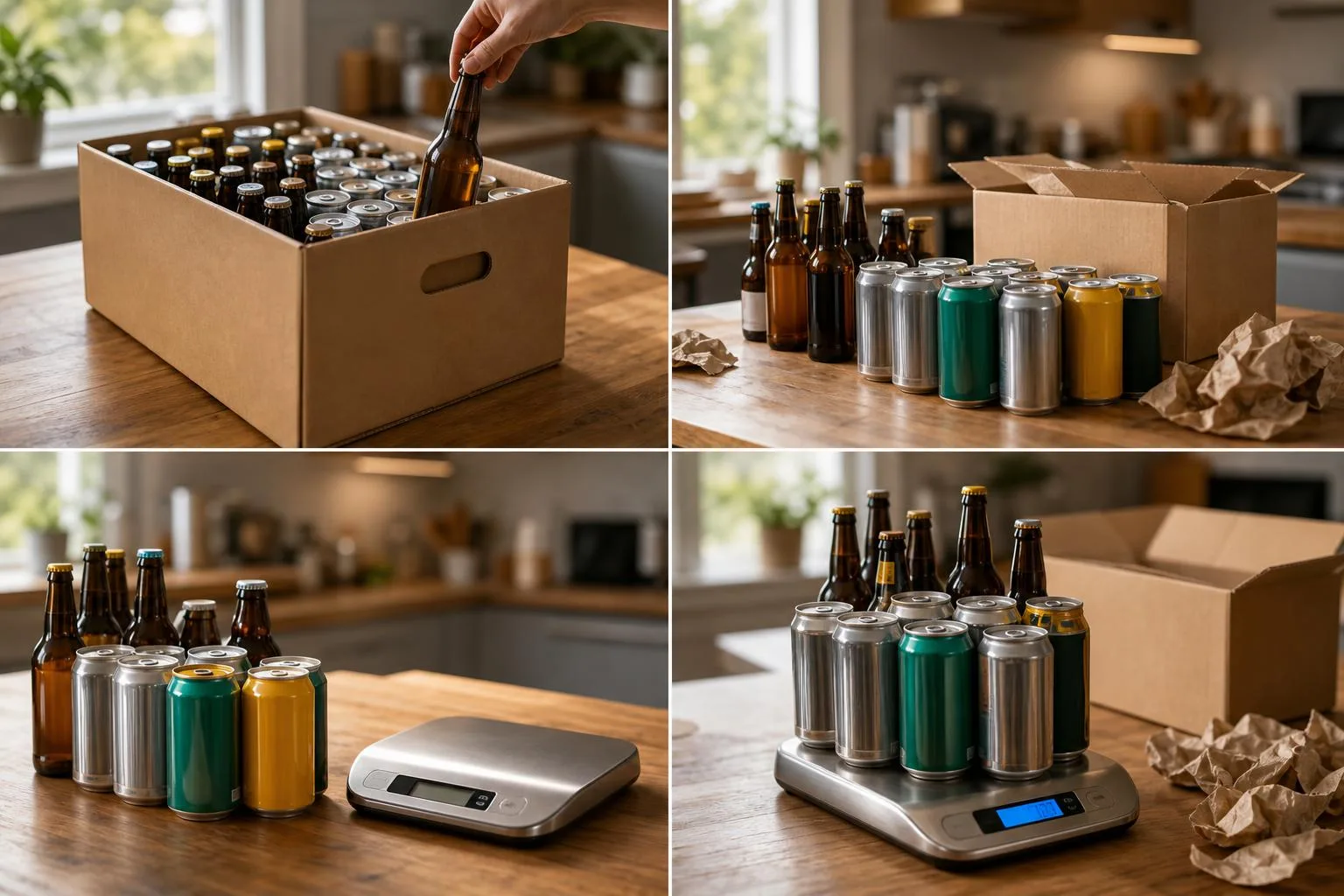
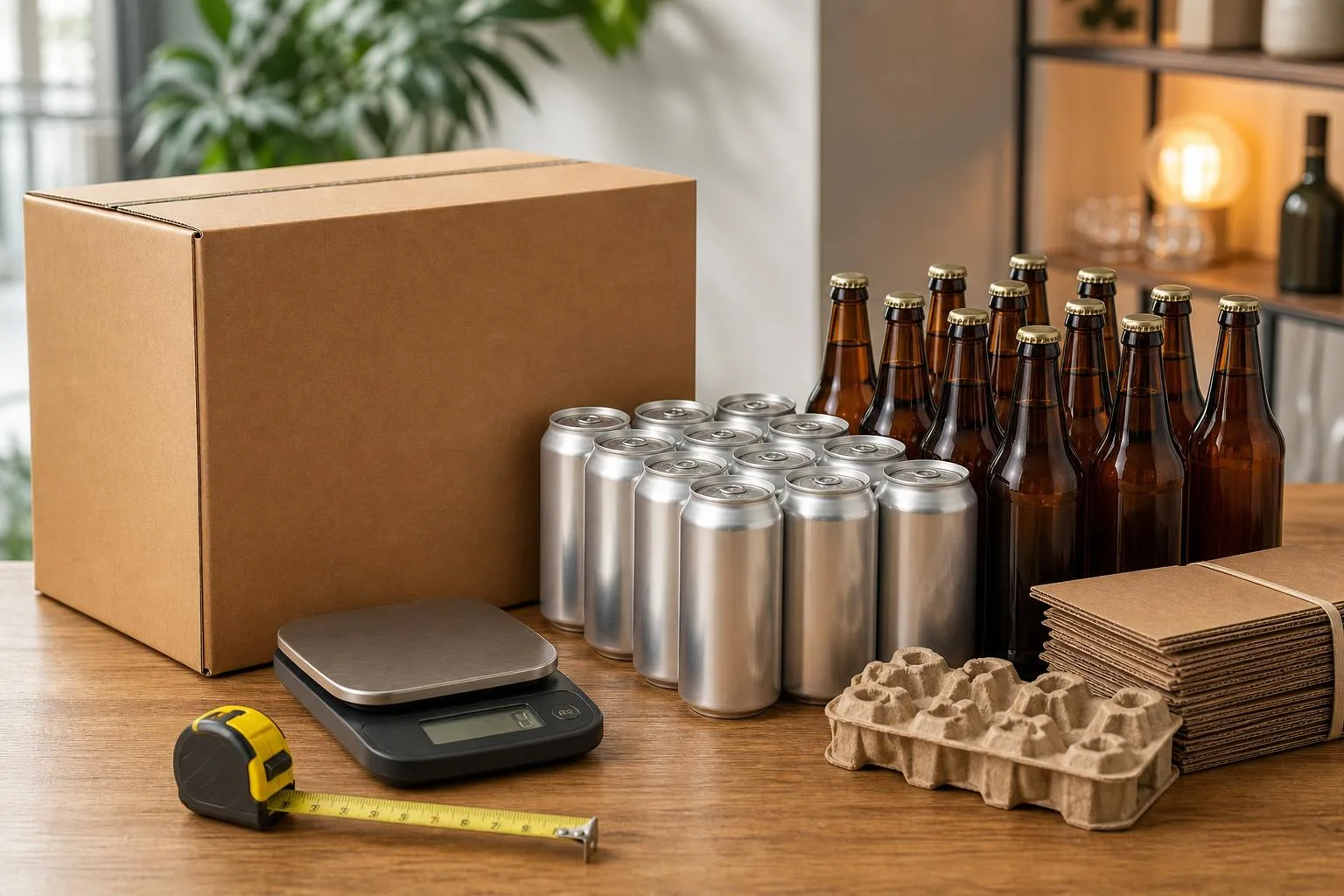
We weighed real, sealed beer cases on a calibrated shipping scale, then repeated each weigh-in after rotating the package and re-centering it on the platform.
The practical takeaway: packaging changes the carry weight almost as much as the beer itself.
Our baseline test used standard U.S. beer packaging: 12-ounce cans, 12-ounce glass bottles, and 16-ounce cans. We recorded gross case weight, then weighed empty packaging after the beer was removed and the containers were rinsed and dried.
| Package tested | Full case weight we measured | Empty packaging weight | Trials |
| 24-pack of 12 fl oz aluminum cans in a cardboard tray | 20.4 lb | 1.3 lb | 3 |
| 24-pack of 12 fl oz glass longneck bottles in a cardboard case | 31.6 lb | 12.5 lb | 3 |
| 24-pack of 16 fl oz aluminum cans in a cardboard tray | 26.8 lb | 1.5 lb | 3 |
| 30-pack of 12 fl oz aluminum cans in a cardboard case | 25.2 lb | 1.6 lb | 3 |
The 24-can, 12-ounce case was the easiest to carry and the most consistent between trials. Our three readings stayed within 0.1 pound, which matched what we expected from identical cans and a tight cardboard tray.
The glass-bottle case was the outlier. It held the same beer volume as the 24-can case, but it weighed 11.2 pounds more in our test. Most of that difference came from the bottles, not the beer.
| Item separated after testing | Measured weight per empty container | Measured total for 24 |
| 12 fl oz aluminum can | 0.52 oz | 0.78 lb |
| 12 fl oz glass longneck bottle | 7.6 oz | 11.4 lb |
| 16 fl oz aluminum can | 0.62 oz | 0.93 lb |
We also timed short carries from our storage shelf to the bar counter, a distance of 38 feet. The 24-can case took one person about 18 seconds. The 24-bottle case usually became a two-hand carry and took about 24 seconds.
- Best quick estimate: a 24-pack of 12-ounce cans weighs about 20 to 21 pounds.
- Glass changes the answer: a 24-pack of 12-ounce bottles weighs about 31 to 32 pounds.
- Larger cans add up fast: a 24-pack of 16-ounce cans weighed nearly 27 pounds in our test.
For planning cooler space, delivery lifting, or party hauling, we would not treat “a case” as one fixed weight. In our hands, the difference between cans and bottles was large enough to change how we carried, stacked, and loaded them.

Why Beer Case Weights Get Misestimated
Most wrong estimates come from treating “a case” as one fixed object. In U.S. retail, a case usually means 24 containers, but the weight changes sharply with can versus glass, bottle size, and packaging.
For beer itself, the math is simple: 12 U.S. fluid ounces of beer weighs about 0.78 lb, because beer is close to water in density. The container and carton often add 2 to 12 extra pounds.
Myth: every case of beer weighs about 20 pounds
A 24-pack of 12 oz cans is often near 20 lb, but that does not apply to bottles. Glass is the reason many “same volume” cases feel dramatically heavier.
| Package type | Beer volume | Typical total weight |
| 24 x 12 oz cans | 288 oz / 2.25 gal | About 19 to 21 lb |
| 24 x 12 oz glass bottles | 288 oz / 2.25 gal | About 34 to 38 lb |
| 24 x 16 oz cans | 384 oz / 3 gal | About 25 to 27 lb |
| 12 x 12 oz glass bottles | 144 oz / 1.125 gal | About 17 to 19 lb |
Myth: beer weighs the same as the number printed on the package
The printed fluid ounces measure volume, not shipping weight. A 24-pack of 12 oz beer contains 288 fl oz, which is 18 pints or 2.25 gallons.
At roughly 8.34 lb per gallon for water, the liquid alone weighs about 18.8 lb. Beer may be slightly heavier or lighter depending on alcohol, sugar, and carbonation, but the difference is small compared with packaging.
Common mistakes when estimating case weight
- Ignoring glass weight: A 12 oz beer bottle can weigh roughly 6 to 8 oz empty, adding 9 to 12 lb across 24 bottles before the cardboard tray is counted.
- Confusing 12-packs and cases: Many stores sell 12-packs, 18-packs, 24-packs, and 30-packs. Only the 24-pack is commonly called a standard case in U.S. beer distribution.
- Forgetting 16 oz cans: A 24-pack of 16 oz cans holds one-third more beer than a 24-pack of 12 oz cans, adding about 6.3 lb of liquid.
- Using “case” loosely for craft beer: Four-packs and six-packs of 16 oz cans are common in craft beer, but four 6-packs do not always match a wholesaler’s case configuration.
- Assuming cardboard is weightless: Trays, dividers, wrap, and cartons can add around 0.5 to 2 lb, depending on packaging style.
The safest rule: estimate cans by liquid weight plus 1 to 2 lb, and glass bottles by liquid weight plus 10 to 14 lb. For lifting, storage shelves, or shipping, use the heavier end of the range.
Questions People Ask Most
How much does a 24-pack case of 12 oz beer cans weigh?
A 24-pack of 12 oz beer cans typically weighs about 18 to 20 pounds. The beer itself weighs roughly 18.8 pounds because 288 fl oz of beer is about 2.25 gallons, and beer is close to 8.3 pounds per gallon.
How much does a 24-pack case of 12 oz beer bottles weigh?
A 24-pack of 12 oz glass beer bottles usually weighs about 30 to 36 pounds. The beer accounts for about 18.8 pounds, while the glass bottles and cardboard case add roughly 11 to 17 pounds depending on bottle style.
How much does a 30-pack of beer cans weigh?
A 30-pack of 12 oz beer cans generally weighs about 23 to 25 pounds. The liquid alone is about 23.5 pounds, with aluminum cans and packaging adding a small amount of extra weight.
How much does a case of 16 oz beer cans weigh?
A 24-pack case of 16 oz beer cans weighs about 25 to 27 pounds. The beer volume is 384 fl oz, or 3 gallons, which weighs about 25 pounds before adding the cans and packaging.
Why do bottled beer cases weigh more than canned beer cases?
Bottled cases weigh more because glass is much heavier than aluminum.
A standard empty 12 oz glass beer bottle often weighs around 6 to 8 oz, while an empty 12 oz aluminum can weighs about half an ounce, creating a large weight difference across 24 containers.
Related Reading
- How Many Shots In 375 Ml?
- What Is The Most Expensive Whiskey?
- How Much Caffeine Is In A Pink Drink? Get the Answer
- Best Rye for Manhattan — Ultimate 2026 Bartender’s Guide
- How To Start Your Own Wine Brand?
- Why Is A Bottle Opener Called A Church Key?
- Mango Chili Truly Review – What You Need to Know
- All Blog Guides