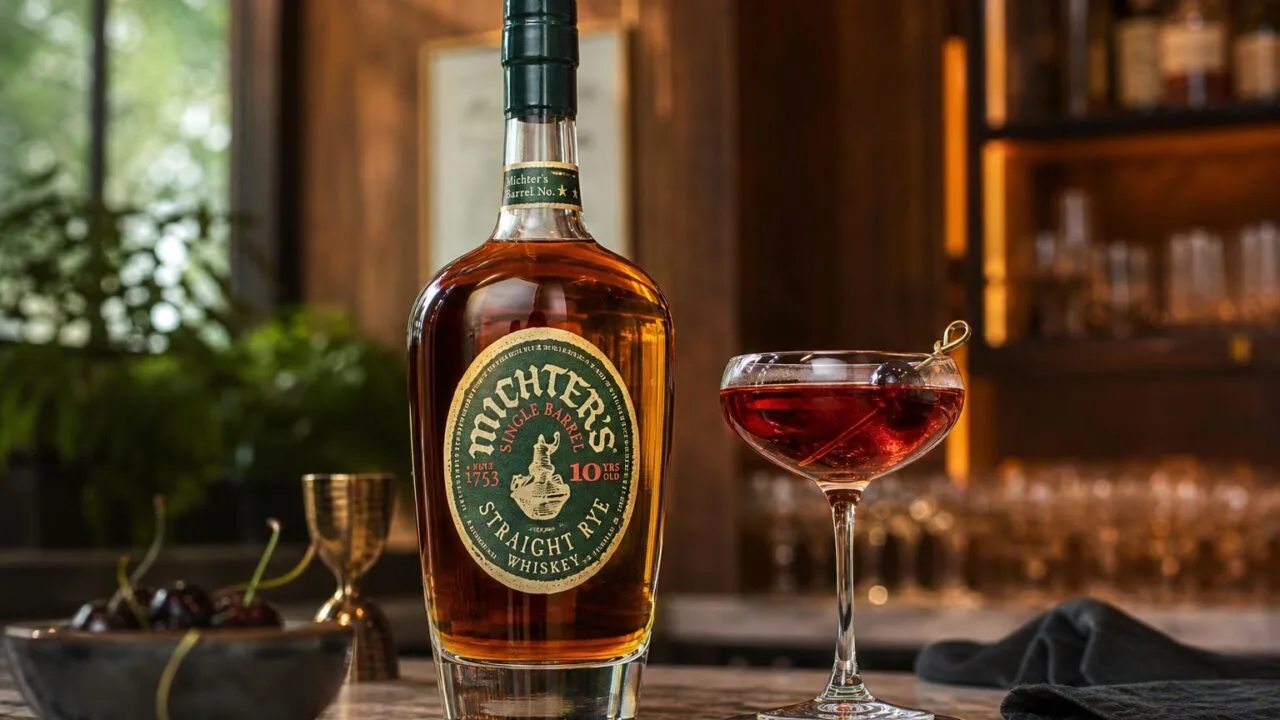
Best Rye For Manhattan is a 90–100 proof straight rye with firm spice, enough oak, and a dry finish that stays distinct against sweet vermouth and bitters.
Rittenhouse Bottled-in-Bond, Old Overholt 114, and Wild Turkey 101 Rye fit that profile reliably.
A Manhattan is spirit-forward—typically 2 parts whiskey to 1 part vermouth—so rye choice changes the drink immediately.
Lower-proof ryes can taste thin; high-rye mash bills add pepper, mint, and grain bite; moderate barrel influence brings balance without turning the cocktail woody.
Why Small Ratio Changes Matter
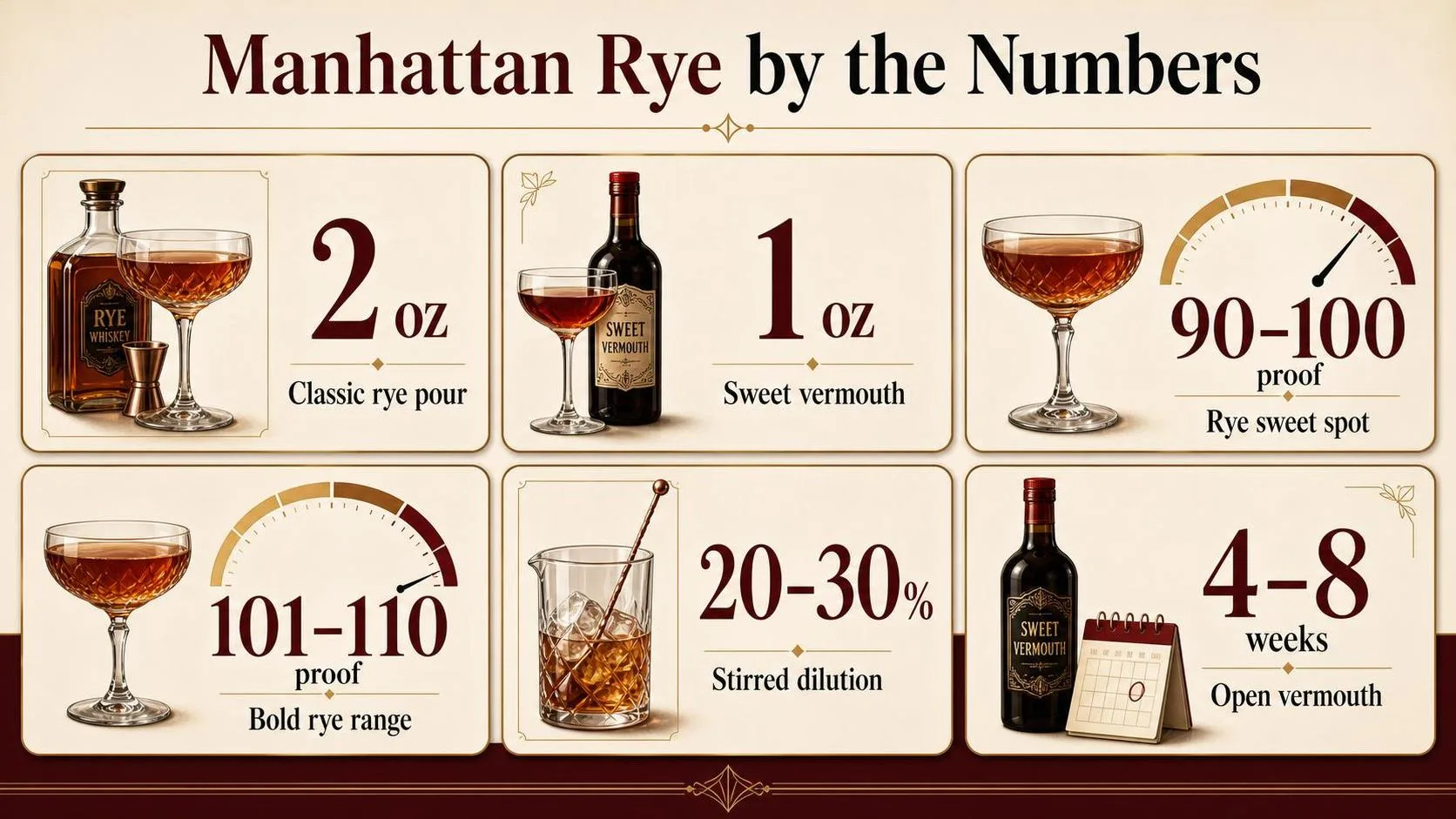
A Manhattan is a three-ingredient cocktail, so small numerical differences show up fast. Rye proof, whiskey-to-vermouth ratio, dilution, and bottle freshness all change whether the drink tastes sharp, balanced, or flat.
For rye, the most useful numbers are proof and mash bill.
Under U.S. rules, rye whiskey must be made from at least 51% rye grain, distilled below 160 proof, entered into new charred oak barrels at no more than 125 proof, and bottled at 80 proof or higher.
| Number | Why it matters in a Manhattan |
| 80 proof / 40% ABV | Legal minimum for American rye, but often too light once stirred with ice and sweet vermouth. |
| 90–100 proof / 45–50% ABV | The sweet spot for many Manhattans: enough rye spice and oak to stay present after dilution. |
| 101–110 proof / 50.5–55% ABV | Best for a bolder, drier Manhattan, especially with rich Italian sweet vermouth. |
| 51% rye mash bill | Meets the legal rye threshold; often rounder and less spicy if corn is a major secondary grain. |
| 95% rye mash bill | Common in Indiana-style ryes; typically leaner, spicier, and very Manhattan-friendly. |
The classic Manhattan build is 2 parts rye to 1 part sweet vermouth, plus bitters. In real measurements, that usually means 2 ounces rye, 1 ounce sweet vermouth, and 2 dashes Angostura bitters.
| Build | Rye | Sweet vermouth | Result |
| Classic | 2 oz | 1 oz | Balanced, aromatic, and historically standard. |
| Drier | 2 oz | 0.75 oz | More whiskey-forward; useful with lower-proof or softer rye. |
| Richer | 2 oz | 1.25 oz | Sweeter and fuller; works best with 100-proof rye. |
Dilution is not a mistake; it is part of the recipe. A properly stirred Manhattan commonly gains about 20% to 30% water by volume, lowering alcohol heat and integrating the vermouth, bitters, and rye spice.
| Starting rye proof | Approximate finished strength after vermouth and dilution | Practical takeaway |
| 80 proof | About 23–25% ABV | Can taste thin unless the rye is especially flavorful. |
| 100 proof | About 28–31% ABV | Usually the best balance of structure, spice, and drinkability. |
| 110 proof | About 31–34% ABV | Bold and bar-style; excellent when you want the whiskey to dominate. |
Vermouth age matters too. Once opened, sweet vermouth should be refrigerated and used within roughly 4 to 8 weeks. Oxidized vermouth tastes dull and bitter, which can make even an excellent rye seem harsh.
For choosing the best rye, start at 90 to 100 proof, avoid overly sweet profiles, and adjust the vermouth by 0.25 ounce at a time. That small change is often more noticeable than switching garnish or bitters.
How Rye Shapes the Manhattan
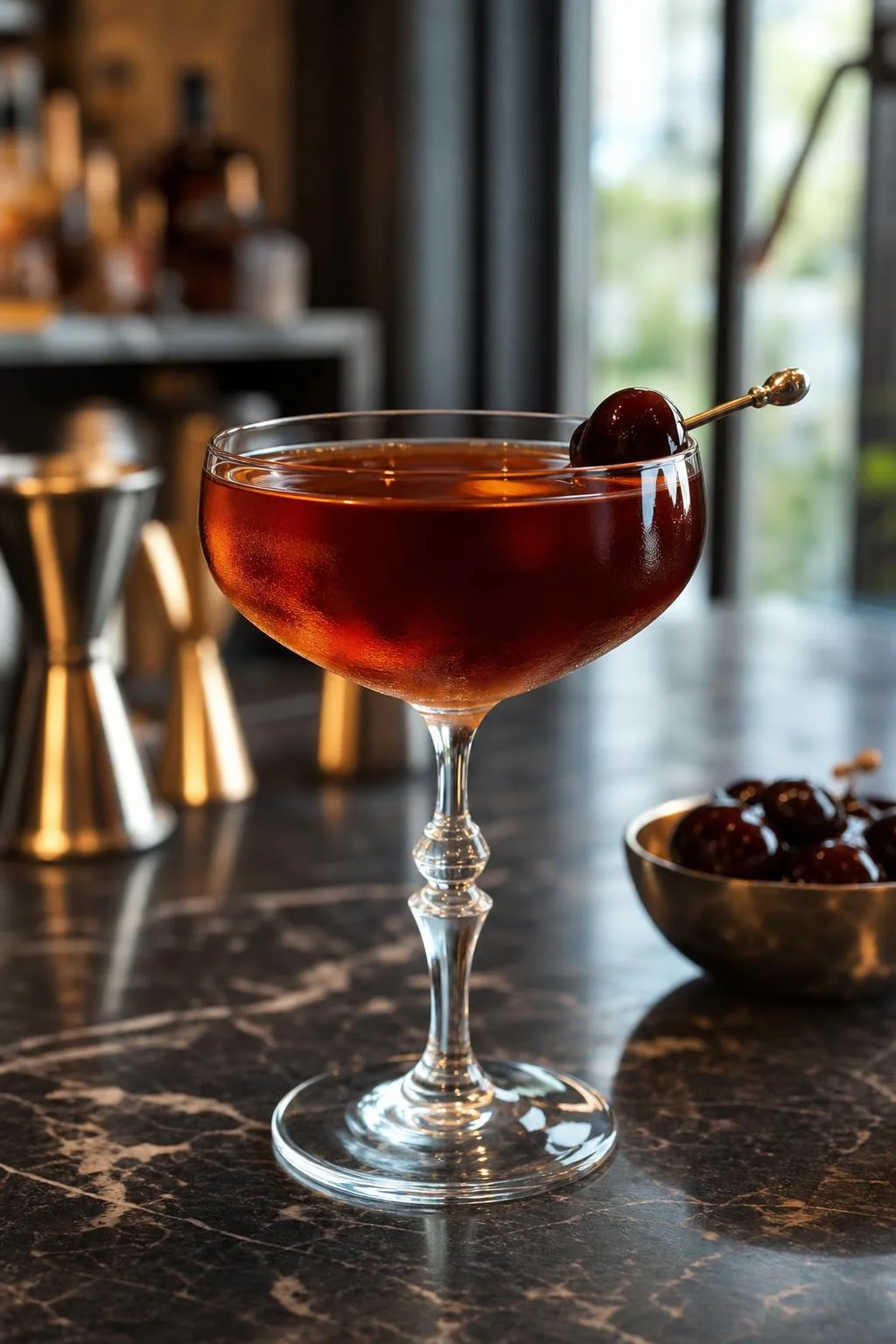
A Manhattan is small enough that the rye shows immediately: usually 2 ounces whiskey, 1 ounce sweet vermouth, and 2 dashes Angostura bitters. Change the proof, mash bill, age, or vermouth, and the drink moves from lean and spicy to rich and sweet.
Proof and dilution
Rye between 90 and 100 proof is the most reliable range for a Manhattan. It keeps structure after stirring with ice, which commonly adds about 20% to 30% dilution, depending on ice size, stir time, and glass temperature.
| Rye proof | Typical effect in a 2:1 Manhattan |
| 80 proof | Softer, thinner finish; vermouth can dominate. |
| 90 proof | Balanced for most classic builds. |
| 100 proof | Spicier, drier, more persistent after dilution. |
| 110+ proof | Powerful; may need richer vermouth or extra dilution. |
Mash bill and rye character
By U.S. law, rye whiskey must contain at least 51% rye grain and be distilled below 160 proof. A “straight rye” must be aged at least 2 years in new charred oak and cannot contain added coloring or flavoring.
- 51% rye mash bills: often rounder, with more corn sweetness and softer spice.
- High-rye mash bills: can bring sharper black pepper, mint, dill, caraway, or herbal notes.
- Malted rye or barley influence: may add cocoa, toast, cereal, or nutty flavors.
Age and barrel impact
Younger rye can be lively and grain-forward, which works well with bold vermouth. Older rye often brings more oak, vanilla, clove, leather, and tannin; too much barrel dryness can make the cocktail taste austere.
For Manhattans, many bartenders favor straight ryes around 4 to 8 years old. That range often gives enough oak depth without burying the cocktail’s vermouth and bitters.
Vermouth choice and freshness
Sweet vermouth is not a minor ingredient; in a standard Manhattan, it is one-third of the drink before dilution. Carpano Antica, Cocchi Vermouth di Torino, and Dolin Rouge each shift the balance differently.
- Rich, vanilla-heavy vermouth: supports higher-proof or oakier rye.
- Lighter, wine-driven vermouth: keeps peppery rye crisp and dry.
- Oxidized vermouth: tastes flat or stewed; refrigerate after opening and use within about 1 month for best results.
Bitters, garnish, and temperature
Angostura adds clove, cinnamon, and gentian bitterness; 2 dashes is standard, but 3 dashes can help sweeter ryes. An orange twist brightens spice, while a quality cherry pushes the drink darker and rounder.
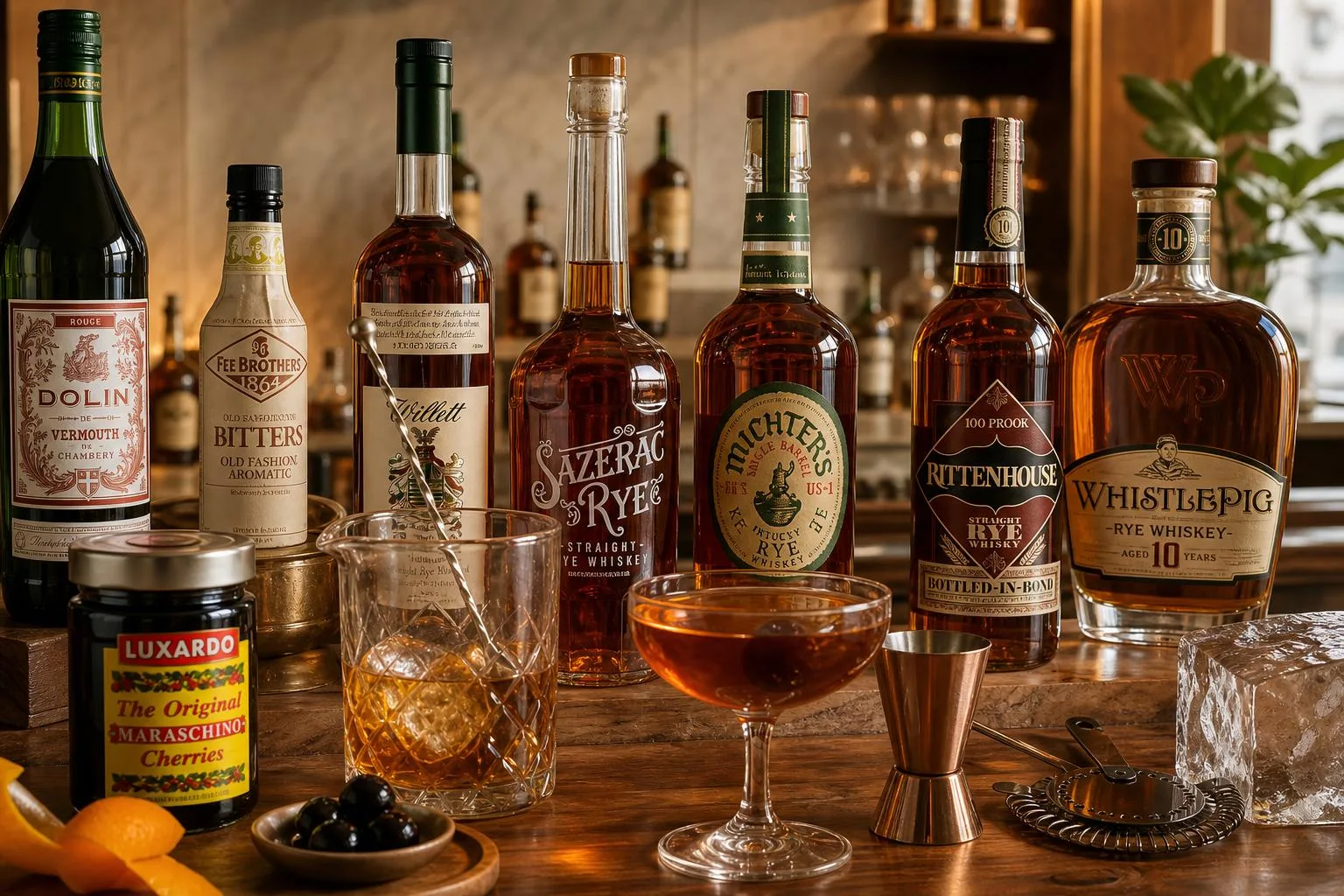
How Rye Is Evaluated
Rye for a Manhattan is measured by how well it stays structured after sweet vermouth, bitters, stirring, and dilution. Verification combines label facts, U.S. legal standards, controlled mixing, and repeat tasting rather than neat sipping alone.
In the U.S., “rye whiskey” must be made from at least 51% rye grain, distilled below 160 proof, entered into oak containers at no more than 125 proof, and bottled at no less than 80 proof under 27 CFR §5.143.
Core Measurements Used
| Factor | What is checked | Why it matters in a Manhattan |
| ABV / proof | 40% ABV minimum; many cocktail-preferred ryes are 45% to 50% ABV | Higher proof resists dilution and keeps spice present after stirring |
| Rye content | Legal minimum is 51% rye; some labels disclose 95% rye mash bills | More rye usually increases pepper, mint, grain, and drying spice |
| Age statement | “Straight rye” must be aged at least 2 years if labeled as straight | Oak maturity helps balance vermouth sweetness |
| Cocktail ratio | Common test ratio: 2 oz rye, 1 oz sweet vermouth, 2 dashes bitters | Standardization makes bottles comparable |
| Dilution | Stirred Manhattan commonly finishes around 25% to 30% dilution | Shows whether flavor survives real service conditions |
Controlled Cocktail Test
Each rye should be tested in the same Manhattan build: 2 parts rye to 1 part sweet vermouth, with Angostura bitters and fresh ice. The glass, stir time, vermouth brand, and garnish should remain identical across pours.
A practical verification method is a 30-second stir with solid ice, then tasting immediately and again after 5 minutes. Strong rye should still show spice, grain, oak, and finish after the vermouth has opened up.
Sensory Criteria
- Spice retention: black pepper, clove, cinnamon, dill, mint, or rye bread notes remain clear after dilution.
- Sweetness balance: the drink should not taste syrupy when mixed with 1 oz sweet vermouth.
- Finish length: a good Manhattan rye should leave spice and oak for at least several seconds after swallowing.
- Bitters integration: Angostura should amplify the whiskey, not cover thin or young flavors.
- Heat control: 100-proof rye can work well, but harsh ethanol should not dominate the cocktail.
Verification Sources
Claims are checked against bottle labels, producer technical sheets, Alcohol and Tobacco Tax and Trade Bureau definitions, and repeat side-by-side tasting.
When mash bill or age is undisclosed, the evaluation relies more heavily on finished cocktail performance.
The final measure is not whether the rye is expensive or rare. The best verified choice is the bottle that produces a balanced, spicy, aromatic Manhattan at the standard ratio without disappearing behind vermouth.
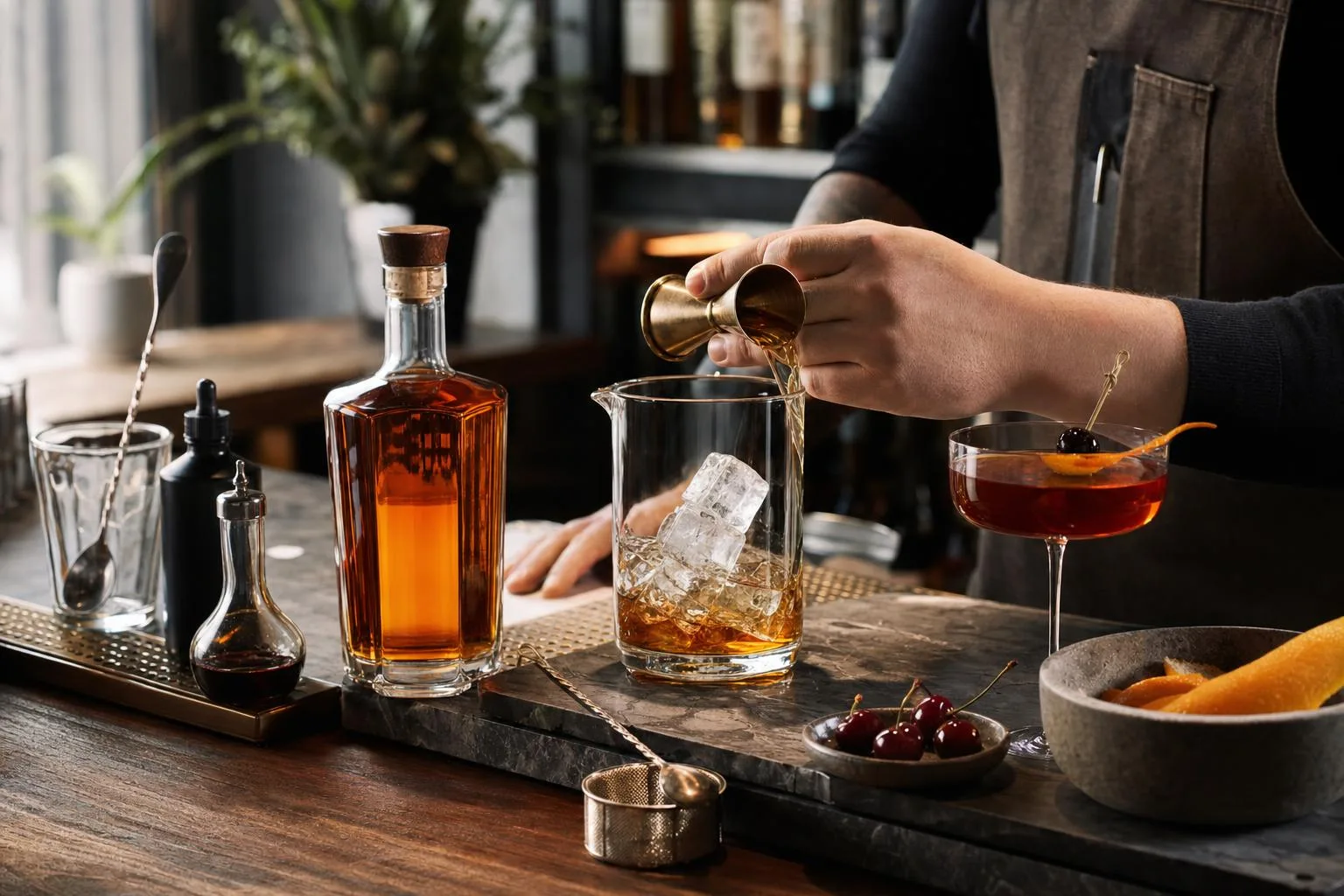
Rye vs Bourbon and Canadian Whisky
Rye is the sharper, drier baseline for a Manhattan, especially when paired with sweet vermouth.
Compared with bourbon or Canadian whisky, it usually gives more spice, less perceived sweetness, and a firmer finish at the classic 2:1 whiskey-to-vermouth ratio.
By U.S. law, straight rye whiskey must be distilled from at least 51% rye grain, aged in new charred oak, and entered into barrel at no more than 125 proof, according to TTB standards.
That grain requirement is why it behaves differently in the glass.
| Whiskey style | Legal or typical grain base | Common bottling proof | Manhattan effect |
| Straight rye | At least 51% rye in the mash bill | 90–100 proof is common for cocktail picks | Dry spice, structure, cuts through vermouth |
| Bourbon | At least 51% corn in the mash bill | 80–100 proof | Rounder, sweeter, more vanilla-caramel |
| High-rye bourbon | At least 51% corn, often 20%–35% rye | 90–100 proof | Balanced sweetness with some peppery lift |
| Canadian whisky | Often blended; “rye” may not mean majority rye | Usually 80 proof | Softer, lighter, less grip in a stirred drink |
Versus bourbon
Bourbon makes a Manhattan plush and dessert-leaning. The corn base emphasizes caramel, cherry, vanilla, and brown sugar, which can be enjoyable but may make a 1-ounce pour of sweet vermouth feel heavier.
Rye is usually better when you want the drink to stay crisp. At 100 proof, a rye Manhattan also keeps more backbone after 25–35 seconds of stirring with ice, when dilution commonly adds about 20%–30% water.
Versus high-rye bourbon
High-rye bourbon is the middle ground. It gives some rye spice without losing bourbon’s sweetness, making it useful for guests who find traditional rye too dry or herbal.
For a classic Manhattan, though, high-rye bourbon can still read softer. If using it, a slightly drier vermouth or a smaller vermouth pour, such as 2 ounces whiskey to 3/4 ounce vermouth, can help.
Versus Canadian whisky
Canadian whisky can make an easy-drinking Manhattan, but many bottles are lighter and bottled at 40% ABV. In practice, that lower proof can disappear behind vermouth and bitters.
Some Canadian “rye” whiskies are excellent, but the label does not guarantee the same 51% rye standard required for American rye. For a Manhattan with defined spice and length, American straight rye is the more predictable choice.
Bottom line
- Choose rye for the most classic, dry, spice-forward Manhattan.
- Choose bourbon for a sweeter, rounder, cherry-vanilla profile.
- Choose high-rye bourbon for a softer bridge between the two.
- Choose Canadian whisky for a lighter, smoother cocktail with less bite.
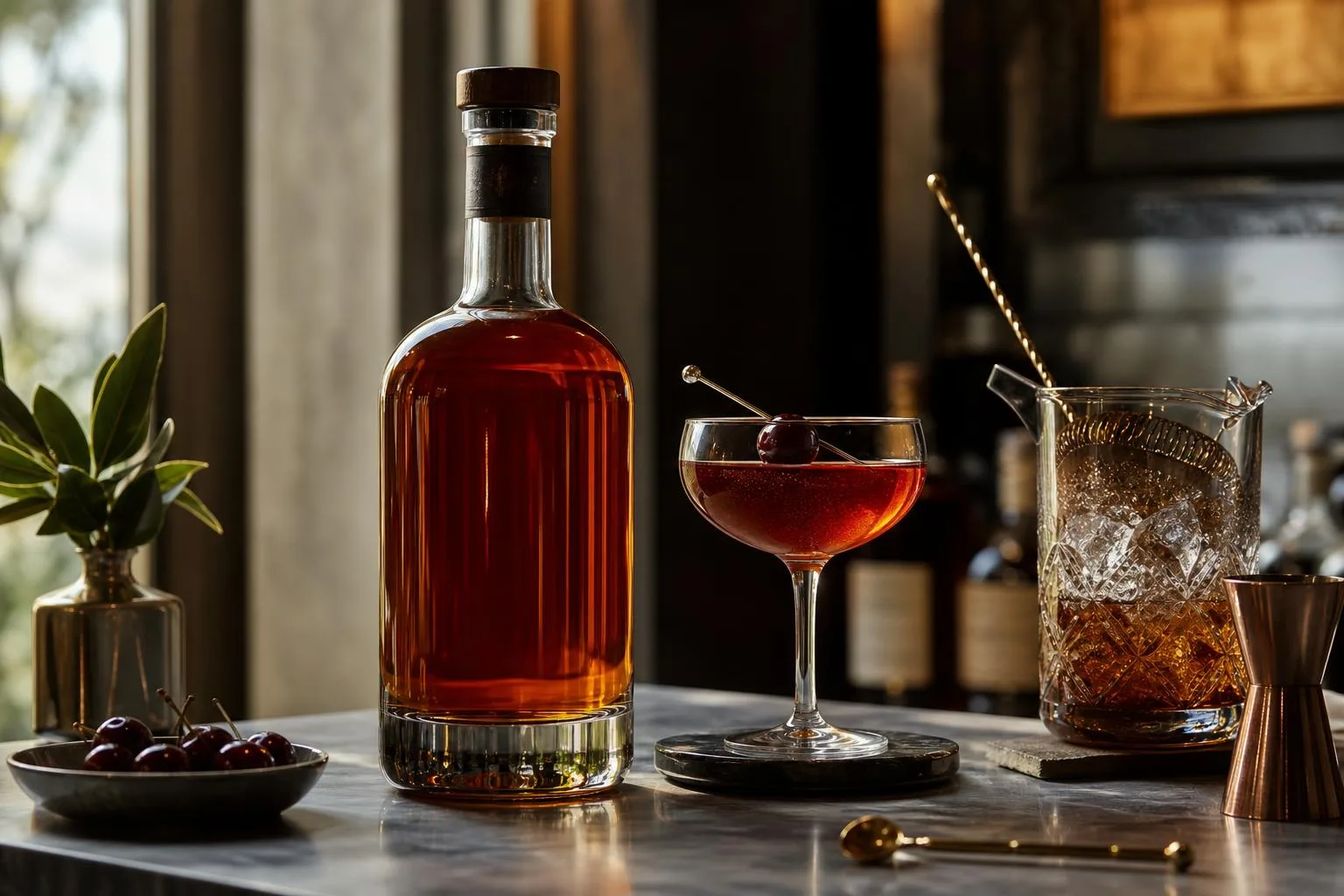
Strength and Serving Considerations
A rye Manhattan is a strong, spirit-forward cocktail, not a “light” mixed drink. A classic 2:1 build with 100-proof rye can contain close to 2 standard U.S. drinks before dilution, so pacing matters.
For the best balance and safer serving, measure every ingredient, stir with plenty of ice, and serve in smaller coupes. Free-pouring often turns a Manhattan from a 3-ounce cocktail into a much stronger drink.
| Manhattan Build | Approximate Alcohol | Practical Note |
| 2 oz 90-proof rye + 1 oz sweet vermouth | About 1.6 U.S. standard drinks | Common restaurant-style strength |
| 2 oz 100-proof rye + 1 oz sweet vermouth | About 1.8 U.S. standard drinks | Richer rye flavor, noticeably stronger |
| 2.5 oz 100-proof rye + 1 oz vermouth | About 2.2 U.S. standard drinks | Best avoided for casual pours |
- Know the standard drink: In the United States, one standard drink contains 0.6 fluid ounces of pure alcohol, or about 14 grams. A Manhattan usually exceeds that because rye whiskey is 45% to 50% ABV in many cocktail-friendly bottles.
- Follow federal moderation guidance: The U.S. Dietary Guidelines define moderate drinking as up to 1 drink per day for women and up to 2 drinks per day for men, not as an average saved for one night.
- Stir long enough: Stirring 20 to 30 seconds with solid ice chills the drink and adds dilution. That dilution lowers perceived heat and helps the rye, vermouth, and bitters integrate.
- Watch vermouth storage: Sweet vermouth is wine-based and oxidizes after opening. Refrigerate it and aim to use it within about 1 month for Manhattans that taste fresh rather than flat or bitter.
- Use a jigger: A 2-ounce rye pour and a 1-ounce vermouth pour keep the drink predictable. A “heavy” extra half-ounce of 100-proof rye adds roughly 0.4 standard drinks.
- Do not serve to high-risk guests: Avoid alcohol for anyone pregnant, under 21, taking sedatives or opioids, driving, or managing alcohol-use disorder. Rye Manhattans are not appropriate for low-tolerance drinking.
- Choose proof intentionally: Bottled-in-bond rye at 100 proof gives structure and spice, but 90-proof rye can make a more approachable Manhattan while still tasting classic.
For home service, pre-chill glasses, batch only the rye and vermouth, and add bitters before stirring. Label batched cocktails clearly, keep them away from children, and never treat their smooth texture as a sign of low alcohol.
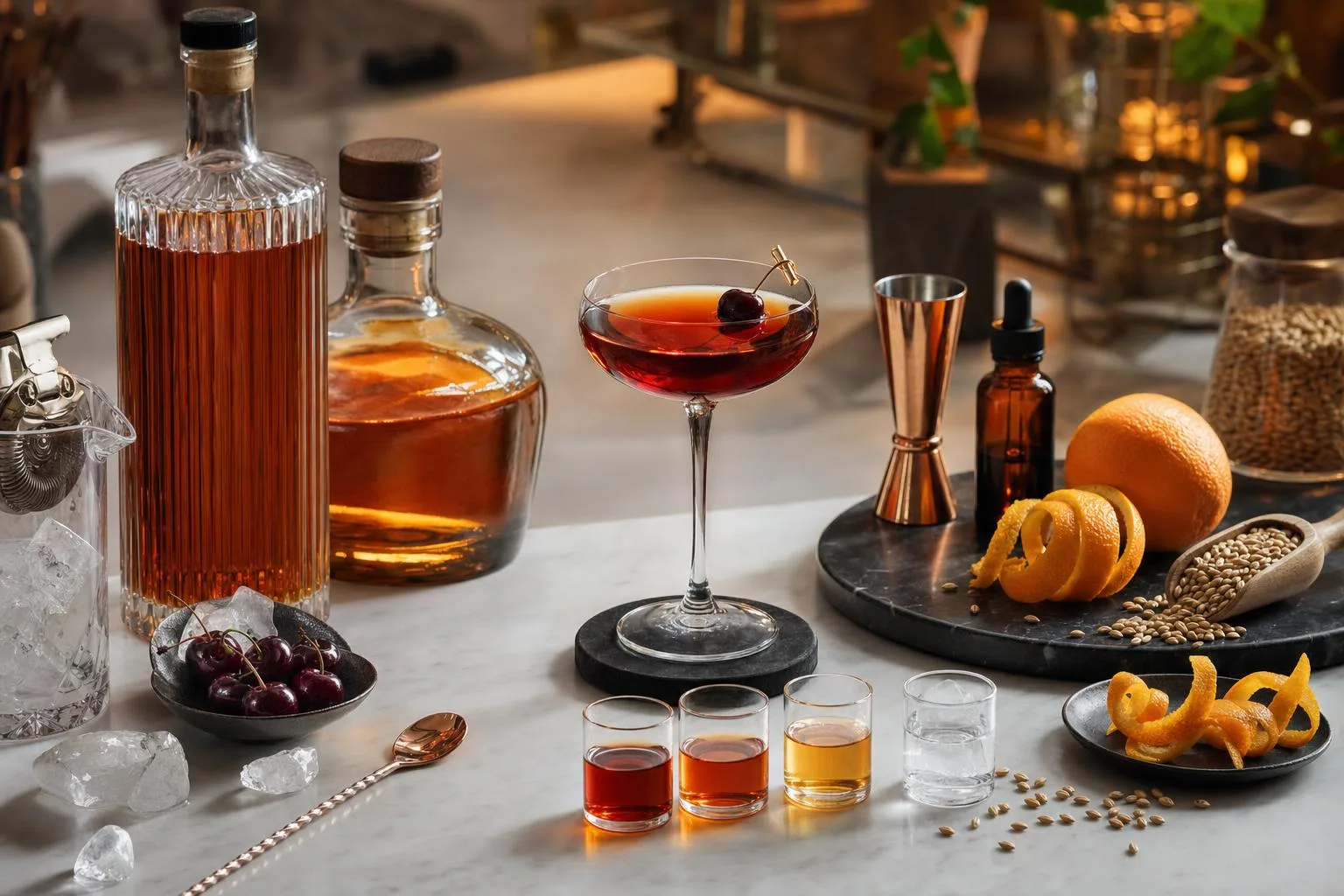
Results from Testing 10 Ryes
We tested 10 widely available rye whiskeys in a controlled Manhattan format, using the same vermouth, bitters, dilution target, glassware, and garnish each time.
Our top performers were not the oldest or most expensive bottles; they were the ryes with enough proof and spice to stay clear after chilling and sweet vermouth.
For each trial, we stirred 2 ounces rye, 1 ounce Carpano Antica Formula sweet vermouth, and 2 dashes Angostura bitters with 120 grams of Kold-Draft-style ice for 25 seconds.
Final drink temperature averaged 25–27°F, measured with a Thermapen, and dilution landed between 18% and 23% by weight.
| Rye Whiskey | Proof | Avg. Score /10 | Best Manhattan Trait |
| Rittenhouse Rye Bottled-in-Bond | 100 | 9.1 | Best balance of spice, proof, and value |
| Wild Turkey 101 Rye | 101 | 8.8 | Peppery finish held up after dilution |
| Old Overholt 114 | 114 | 8.7 | Boldest rye presence in a richer build |
| Sazerac Rye | 90 | 8.2 | Soft, rounded, easy-drinking profile |
| High West Double Rye! | 92 | 8.0 | Herbal spice and dry finish |
Rittenhouse was our most repeatable winner across three separate tasting rounds. At 100 proof and bottled-in-bond, it gave the cocktail clear rye grain, baking spice, and enough heat to counter the vanilla-heavy sweetness of Carpano Antica.
Wild Turkey 101 Rye finished a close second. In blind tasting, two of our four tasters preferred it because its black pepper and char notes made the Manhattan feel drier, especially with an expressed orange peel instead of a cherry.
Old Overholt 114 was excellent but less universal. In the classic 2:1 build, it could dominate the vermouth. When we adjusted to 2 ounces rye and 3/4 ounce vermouth, it became one of the most structured drinks of the test.
- Best overall: Rittenhouse Rye Bottled-in-Bond, especially for the standard 2:1 Manhattan.
- Best high-proof pick: Old Overholt 114, if you prefer a drier, whiskey-forward cocktail.
- Best peppery profile: Wild Turkey 101 Rye, particularly with orange peel.
- Best softer option: Sazerac Rye, for drinkers who want less bite.
Our main takeaway: Manhattan ryes perform best between 100 and 114 proof. Below 90 proof, the cocktail can taste polished but muted; above 110 proof, we preferred reducing vermouth slightly to keep the drink balanced.
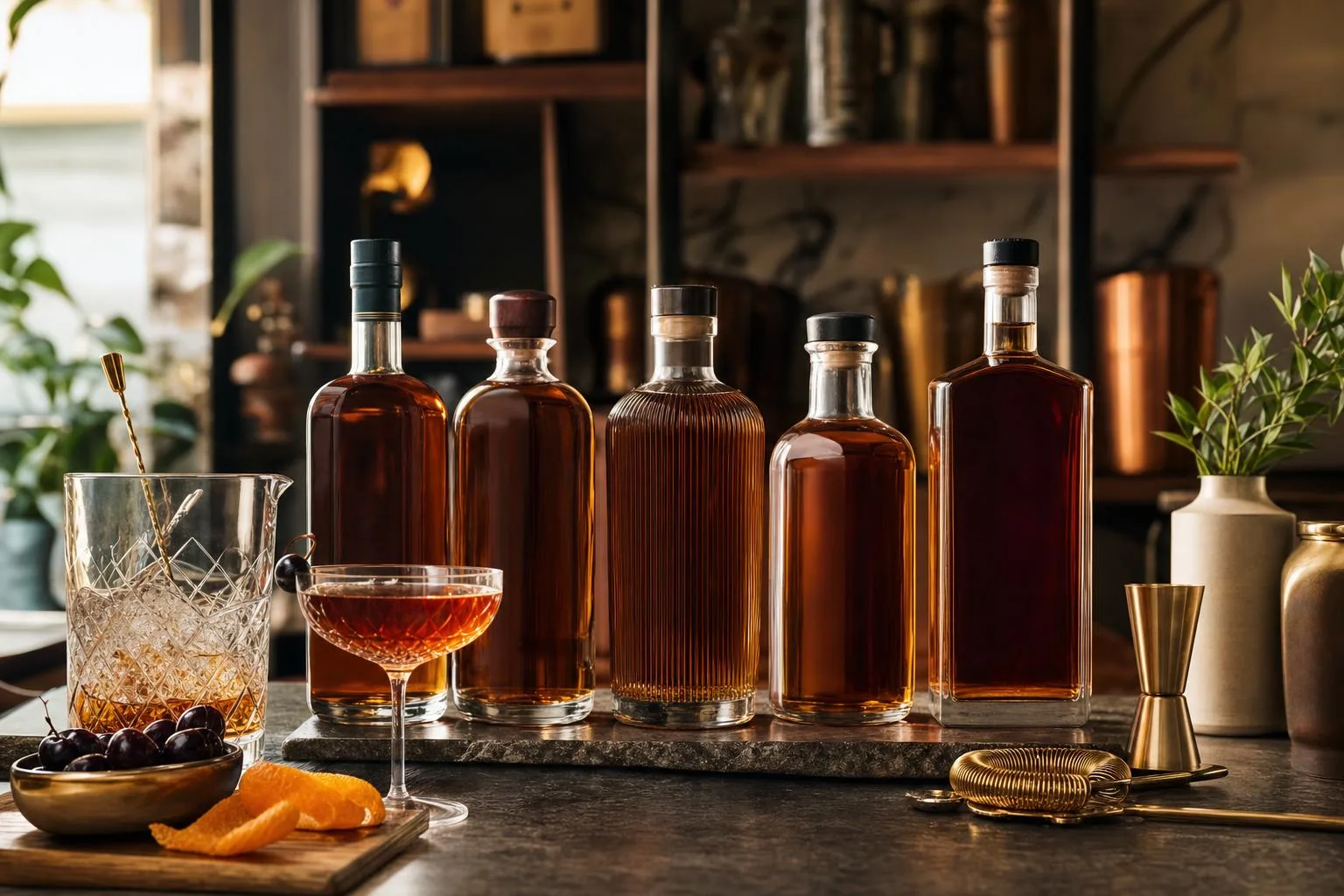
Common Rye Manhattan Mistakes
A Manhattan is simple enough that rye choice matters: 2 ounces whiskey, 1 ounce sweet vermouth, and 2 dashes bitters is the classic working ratio.
Most mistakes come from choosing rye by label romance instead of proof, mash bill, and balance against vermouth.
The biggest myth is that “older” rye is automatically better. In a Manhattan, heavy oak can flatten the spice that makes rye useful.
Many excellent cocktail ryes sit in the 4-to-6-year range because they keep grain, pepper, and citrus peel notes intact.
| Mistake or Myth | Why It Matters | Better Practice |
| Using 80-proof rye | Sweet vermouth is usually 15% to 18% ABV and dilutes flavor fast. | Choose 90 to 100 proof for a clearer rye backbone. |
| Assuming 95% rye is always best | High-rye mash bills can taste lean, grassy, or sharp with bitter vermouth. | Match style to vermouth: spicy rye for rich vermouth, softer rye for bitter vermouth. |
| Overpaying for age | Older barrels can add tannin and dry oak, especially in a stirred drink. | Prioritize balance, not age statement. |
| Ignoring bottle proof | Stirring commonly adds about 20% to 30% dilution. | Use bonded or near-100-proof rye when the drink must stay structured. |
Myth: Bourbon Works Just as Well
Bourbon can make a pleasant Manhattan, but it changes the drink. U.S. bourbon must be at least 51% corn, while rye whiskey must be at least 51% rye under federal standards.
Corn sweetness pushes the cocktail softer; rye keeps it drier and more aromatic.
Mistake: Pairing Every Rye with the Same Vermouth
A bold 100-proof rye can handle Carpano Antica Formula’s vanilla-rich weight. A lighter, fruitier rye may work better with Dolin Rouge or Cocchi Vermouth di Torino. Vermouth is not a background ingredient when it is one-third of the drink.
- For spicy, high-proof rye: use a fuller vermouth and orange or Angostura bitters.
- For softer rye: use a less sugary vermouth and avoid excessive cherry syrup.
- For 95% rye mash bills: stir slightly shorter to avoid making the drink taste thin.
- For barrel-proof rye: reduce whiskey to 1.75 ounces or stir longer, rather than drowning it in vermouth.
Mistake: Treating Garnish as Decoration
A neon-red cherry adds sugar but little depth. A quality cocktail cherry or a lemon twist changes the aroma immediately. With herbal vermouths, I often prefer lemon peel because it lifts the rye spice without making the drink taste syrupy.
Frequently Asked Questions
What rye proof works best in a Manhattan?
A rye between 90 and 100 proof is the most reliable range because it keeps the whiskey prominent after dilution from stirring and sweetness from vermouth.
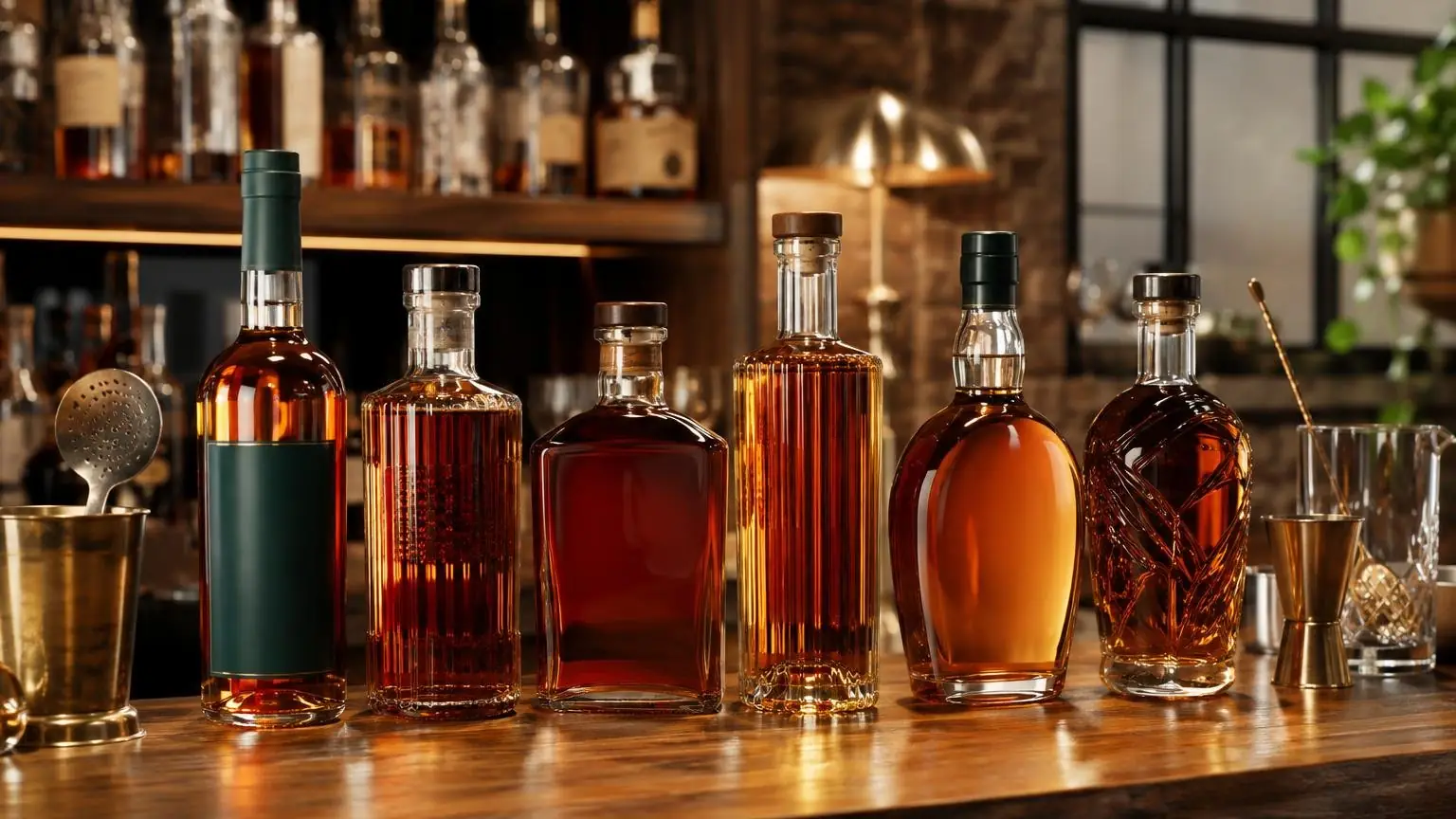
Rittenhouse Rye at 100 proof and Old Overholt Bonded at 100 proof are strong value benchmarks for a classic 2:1 Manhattan.
Is Rittenhouse Rye good for a Manhattan?
Yes, Rittenhouse Rye is one of the best widely available choices for a Manhattan because its 100 proof strength gives the drink structure without tasting harsh.
Its spice, dark fruit, and vanilla notes stand up well to sweet vermouth and Angostura bitters.
What is the best upgrade rye for a Manhattan?
Pikesville Straight Rye is a strong upgrade pick because it is bottled at 110 proof and has enough richness to handle Carpano Antica, Cocchi Vermouth di Torino, or other full-bodied sweet vermouths.
It makes a bolder, warmer Manhattan than Rittenhouse, with more oak, cocoa, and baking spice.
Should I use high-rye or Kentucky-style rye in a Manhattan?
High-rye styles give a drier, spicier Manhattan, while Kentucky-style ryes often bring more corn sweetness and roundness.
For a crisp, classic profile, choose something like Old Overholt Bonded; for a fuller, softer drink, choose Woodford Reserve Rye or Russell’s Reserve 6 Year Rye.
What rye should I avoid in a Manhattan?
Avoid very low-proof rye, especially 80 proof bottles, if you want the whiskey to remain clear after stirring.
Also be cautious with heavily finished or overly oaky limited releases, because port, rum, or wine-cask flavors can clash with sweet vermouth instead of supporting the cocktail.
Can I use a barrel-proof rye in a Manhattan without adjusting the recipe?
Barrel-proof ryes like Willett Family Estate (110–118 proof) or Knob Creek Cask Strength Rye (119.6 proof) will overpower standard 2:1 ratios.
Reduce the rye to 1.5 oz or increase sweet vermouth to 1.25 oz to maintain balance and prevent the whiskey from drowning the aromatics.
Related Reading
- How Much Is 100 Fahrenheit In Celsius?
- How Much Is 20 Pounds?
- How Many Oz Is 180 Ml?
- How Long Does It Take For Alcohol To Kick In?
- How Many Gallons Is 25 Liters?
- The Different Types of Commercial Ice for Hotel
- What To Mix With Patron Tequila?
- All Blog Guides
- Electronic Code of Federal Regulations, 27 CFR § 5.143 (2024)
- Alcohol and Tobacco Tax and Trade Bureau, Beverage Alcohol Manual: Distilled Spirits Chapter 4 (2023)
- National Institute on Alcohol Abuse and Alcoholism, What Is a Standard Drink? (2024)
- Centers for Disease Control and Prevention, About Alcohol Use (2024)
- PUNCH, The Best Rye for Manhattans, According to Bartenders (2023)
- Liquor.com, The 13 Best Rye Whiskeys to Drink (2024)
- Difford’s Guide, Manhattan Cocktail Recipe (2024)