How Long Does It Take For Alcohol To Kick In is 10 to 30 minutes for most adults, with blood alcohol concentration typically peaking about 30 to 90 minutes after a drink.
The timing depends on dose, drinking speed, body weight, sex, food intake, and alcohol concentration, according to NIAAA guidance.
From tasting-room experience, the first noticeable effects often appear after one standard drink: warmth, looser conversation, slower reaction time, or mild lightheadedness.
A U.S. standard drink contains 14 grams of pure alcohol, roughly 5 ounces of 12% wine, so wine strength and pour size matter.
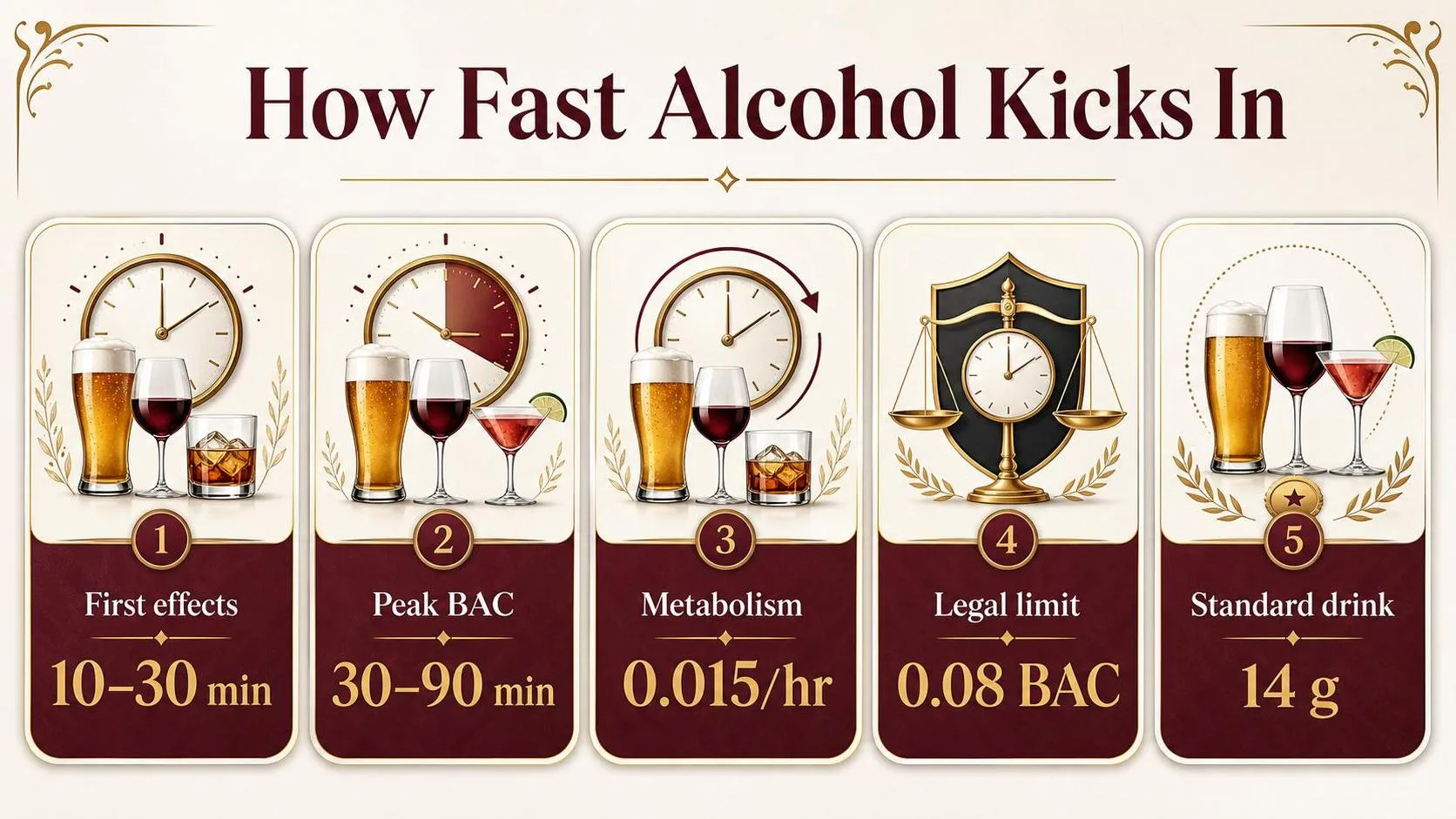
How Quickly Alcohol Starts Affecting You
Alcohol can start affecting the brain before a person “feels drunk.” In practical terms, most people begin to notice effects within minutes, while peak blood alcohol concentration comes later as absorption catches up.
These ranges assume a standard drink as defined by the National Institute on Alcohol Abuse and Alcoholism: the amount containing about 14 grams of pure alcohol.
| Measure | Typical number | What it means |
| First noticeable effects | 10 to 30 minutes | Warmth, lowered inhibition, slight relaxation, or slower reaction time may begin. |
| Peak blood alcohol concentration | 30 to 90 minutes | BAC often continues rising after the last sip, especially if drinking quickly. |
| Average alcohol metabolism | About 0.015 BAC per hour | The liver clears alcohol slowly; coffee, showers, and sleep do not speed this up meaningfully. |
| Legal driving limit in most U.S. states | 0.08 BAC | Impairment starts below this level, but this is the common per se legal limit for adults 21 and older. |
What counts as one drink
Serving size matters because a “glass” is not always one drink. A generous pour, strong cocktail, or high-ABV beer can contain far more alcohol than expected.
| Beverage | Standard drink amount | Typical alcohol strength |
| Beer | 12 ounces | 5% ABV |
| Wine | 5 ounces | 12% ABV |
| Distilled spirits | 1.5 ounces | 40% ABV, or 80 proof |
Why the timing varies
Alcohol is absorbed mainly through the small intestine, with some absorption in the stomach. Anything that slows stomach emptying usually delays the “kick in” feeling and the BAC peak.
- Empty stomach: alcohol reaches the small intestine faster, so effects may appear closer to the early end of the range.
- Food in the stomach: especially fat, protein, and fiber, can slow absorption and lower the peak BAC.
- Drinking speed: several drinks in a short window can raise BAC before the body has time to metabolize much alcohol.
- Body size and water content: smaller bodies and lower total body water generally produce a higher BAC from the same amount.
- Medications and sleep loss: sedatives, opioids, antihistamines, and poor sleep can magnify impairment even at lower BAC levels.
A useful safety rule is that feeling “fine” shortly after drinking is not reliable. If the last drink was recent, BAC may still be climbing.
Why Alcohol Kicks in Differently
Alcohol usually begins reaching the bloodstream within minutes, but the felt “kick” varies widely. The biggest variables are stomach contents, drink strength, body size, sex, drinking speed, medications, and tolerance.
Most people feel noticeable effects when blood alcohol concentration rises into the 0.02% to 0.05% range. In the U.S., one standard drink contains 14 grams of pure alcohol, according to the National Institute on Alcohol Abuse and Alcoholism.
| Factor | Typical effect on onset | Why it matters |
| Empty stomach | Often 10 to 30 minutes | Alcohol passes quickly from the stomach to the small intestine, where absorption is fastest. |
| Full meal | Often 30 to 90 minutes | Food slows gastric emptying, especially meals with fat, protein, or fiber. |
| Drinking speed | Faster rise in BAC | The liver can metabolize roughly 0.015 BAC per hour, but absorption can outpace metabolism. |
| Drink strength | Stronger drinks hit faster | A 1.5-ounce shot of 40% spirits delivers the same alcohol as 12 ounces of 5% beer. |
- Food in the stomach: This is one of the strongest practical factors. A drink taken with dinner may feel delayed, while the same drink before eating can feel much faster and stronger.
- Body weight and water content: Alcohol distributes mainly into body water. A smaller person generally reaches a higher BAC from the same number of drinks than a larger person.
- Biological sex: On average, women have less total body water and lower gastric alcohol dehydrogenase activity than men, so the same dose can produce a higher BAC.
- Carbonation: Champagne, sparkling wine, hard seltzer, and mixed drinks with soda may speed early absorption for some people by increasing gastric pressure and emptying.
- Medications and health conditions: Sedatives, opioids, sleep aids, antihistamines, antidepressants, and some anxiety medications can intensify impairment before someone “feels drunk.” Liver disease also slows clearance.
- Tolerance: Regular drinkers may feel less affected at the same BAC. This does not mean reaction time, coordination, or judgment are normal.
- Fatigue and dehydration: Poor sleep, heat, and dehydration can make a modest amount of alcohol feel stronger, particularly with wine or cocktails consumed quickly.
Peak BAC commonly occurs about 30 to 90 minutes after drinking, but it can be later with food. Feeling sober is not a reliable measure; impairment can begin before the drink feels fully active.
How Alcohol Onset Is Measured
Alcohol “kicking in” is verified by measuring blood alcohol concentration, or BAC, and comparing it with observable impairment.
In practice, the most defensible measures are blood testing, evidential breath testing, and timed symptom tracking after a known drink.
BAC is reported as grams of alcohol per deciliter of blood. In the United States, 0.08% BAC means 0.08 grams of alcohol per 100 milliliters of blood, the legal per se driving limit for most adult drivers.
What Is Actually Measured
| Method | What it measures | Typical use | Key limitation |
| Blood test | Ethanol directly in blood | Medical care, forensic confirmation | Requires a blood draw and lab handling |
| Breath test | Alcohol in deep-lung breath, converted to BAC estimate | Roadside screening and evidential testing | Mouth alcohol, timing, and device calibration matter |
| Urine test | Alcohol already processed and excreted | Workplace or clinical screening | Does not show current impairment as precisely |
| Observation | Speech, balance, reaction time, judgment | Clinical and law-enforcement assessment | Can be affected by fatigue, illness, or medications |
Peak BAC usually occurs about 30 to 90 minutes after drinking, according to standard toxicology references used by NHTSA and clinical laboratories.
Food can delay the peak, while drinking quickly can produce noticeable effects before the final peak is reached.
Why Timing Matters
A breathalyzer reading taken 10 minutes after a drink may not reflect the eventual peak. Alcohol may still be moving from the stomach and small intestine into the bloodstream, so the person can feel progressively more impaired after the test.
For verification, timing should be documented: when the drink started, when it ended, what was consumed, body weight, food intake, medications, and the exact test time. Without those details, a single BAC number can be misleading.
Benchmarks Used to Interpret Results
| BAC | Commonly documented effects |
| 0.02% | Relaxation, slight decline in divided attention and visual tracking |
| 0.05% | Reduced coordination, slower response, impaired judgment |
| 0.08% | Clear impairment in reaction time, concentration, short-term memory, and speed control |
| 0.15% | Substantial loss of balance, poor muscle control, much greater crash risk |
These impairment levels come from controlled alcohol studies summarized by agencies such as NHTSA, CDC, and the National Institute on Alcohol Abuse and Alcoholism. They are population averages, not guarantees for a specific person.
How Professionals Confirm Alcohol Has “Kicked In”
- They use a calibrated instrument, especially for evidential breath testing or laboratory blood analysis.
- They repeat or time the measurement when recent drinking may cause a rising BAC.
- They compare BAC with behavior, including balance, speech, eye movement, reaction time, and decision-making.
- They account for confounders, including food, body size, tolerance, sleep loss, and sedating drugs.
For practical purposes, alcohol has “kicked in” when measurable BAC aligns with noticeable changes in mood, coordination, attention, or judgment.
The safest assumption is that impairment can begin well before someone feels obviously drunk.
Alcohol Onset Versus Other Substances
Alcohol usually begins affecting judgment, coordination, and reaction time within about 10 to 30 minutes, with blood alcohol concentration often peaking around 30 to 90 minutes after drinking.
That timing is faster than cannabis edibles, but slower than inhaled nicotine or smoked cannabis.
These comparisons matter because “feeling it” does not always match peak impairment. The CDC and NIAAA note that absorption varies with food, body size, sex, drink strength, and drinking speed.
| Substance | Common route | Typical onset | Typical peak effect | Key timing concern |
| Alcohol | Drinking | 10–30 minutes | 30–90 minutes | Impairment can rise after the last drink |
| Cannabis | Smoking or vaping | Seconds to 10 minutes | About 30 minutes | Fast onset can encourage repeated dosing |
| Cannabis edibles | Eating | 30–120 minutes | 2–4 hours | Delayed onset increases overdose risk |
| Caffeine | Coffee, tea, energy drinks | 15–45 minutes | 30–60 minutes | Alertness may mask alcohol sedation |
| Nicotine | Smoking or vaping | Seconds to minutes | Within minutes | Short-lived effects promote frequent use |
Alcohol versus cannabis
Smoked or vaped cannabis often feels faster than alcohol because THC reaches the bloodstream through the lungs. The National Institute on Drug Abuse describes effects appearing within minutes, while edible cannabis can take 30 minutes to 2 hours.
Alcohol’s risk is different: a person may feel “fine” after one drink, then become noticeably impaired as absorption continues.
A standard U.S. drink contains 14 grams of pure alcohol, whether from 12 ounces of 5% beer, 5 ounces of 12% wine, or 1.5 ounces of 40% spirits.
Alcohol versus caffeine
Caffeine commonly starts working within 15 to 45 minutes and peaks in the blood around 30 to 60 minutes. It can make someone feel more awake, but it does not lower blood alcohol concentration or restore coordination.
This is why mixing alcohol with energy drinks is risky. The CDC warns that caffeine can hide alcohol’s depressant effects, making people underestimate impairment and continue drinking longer than planned.
Alcohol versus nicotine
Nicotine from smoking can reach the brain in roughly 10 to 20 seconds, much faster than alcohol from the stomach and small intestine. Vaping is also rapid, though device type, puff depth, and nicotine concentration change the timing.
Alcohol has a longer impairment window. The liver typically metabolizes about one standard drink per hour, but that is only an average; drinking faster than this causes blood alcohol concentration to climb.
- Fastest perceived onset: inhaled nicotine and smoked or vaped cannabis.
- Most delayed onset: cannabis edibles, often 30 to 120 minutes.
- Most misleading combination: alcohol plus caffeine, because alertness can mask intoxication.
- Driving relevance: alcohol impairment can continue increasing after the last sip.
Safety Tips Before You Feel Drunk
Alcohol can start affecting judgment before you “feel drunk,” often within minutes of the first drink. The safest approach is to plan around impairment, not around how alert you think you are.
The National Institute on Alcohol Abuse and Alcoholism defines a standard U.S. drink as 14 grams of pure alcohol. That amount is found in these common pours:
| Drink type | Typical serving | Alcohol |
| Beer | 12 fl oz | 5% ABV |
| Wine | 5 fl oz | 12% ABV |
| Distilled spirits | 1.5 fl oz | 40% ABV |
Do not drive, bike, boat, or operate tools after drinking. In the U.S., 0.08% blood alcohol concentration is the legal limit for most adult drivers, but impairment can begin below that level.
| BAC level | Common effects reported by NIAAA |
| 0.02% | Relaxation, altered mood, reduced visual tracking |
| 0.05% | Lowered alertness, impaired judgment, reduced coordination |
| 0.08% | Poor muscle coordination, slower reaction time, impaired perception |
| 0.15% | Major balance problems, vomiting risk, substantial driving impairment |
- Eat before and while drinking. Food, especially meals with protein, fat, and fiber, slows stomach emptying and can delay alcohol absorption. It does not prevent intoxication.
- Pace drinks deliberately. The liver metabolizes alcohol slowly. A common estimate is about one standard drink per hour, though body size, sex, medications, liver health, and genetics change this.
- Avoid “catch-up” drinking. Shots and high-ABV cocktails can raise BAC quickly because alcohol may still be absorbing 30 to 90 minutes after a drink.
- Alternate with water, but do not rely on it. Water may reduce dehydration and help you slow down, but it does not lower BAC faster.
- Check medications. Opioids, benzodiazepines, sleep aids, antidepressants, antihistamines, and some pain relievers can interact dangerously with alcohol.
- Know emergency signs. Call 911 for slow or irregular breathing, bluish or pale skin, repeated vomiting, seizures, confusion, or inability to wake someone.
Coffee, cold showers, vomiting, and exercise do not sober someone up. Only time lowers BAC. If alcohol has already kicked in, choose a ride-share, taxi, sober driver, or stay where you are.
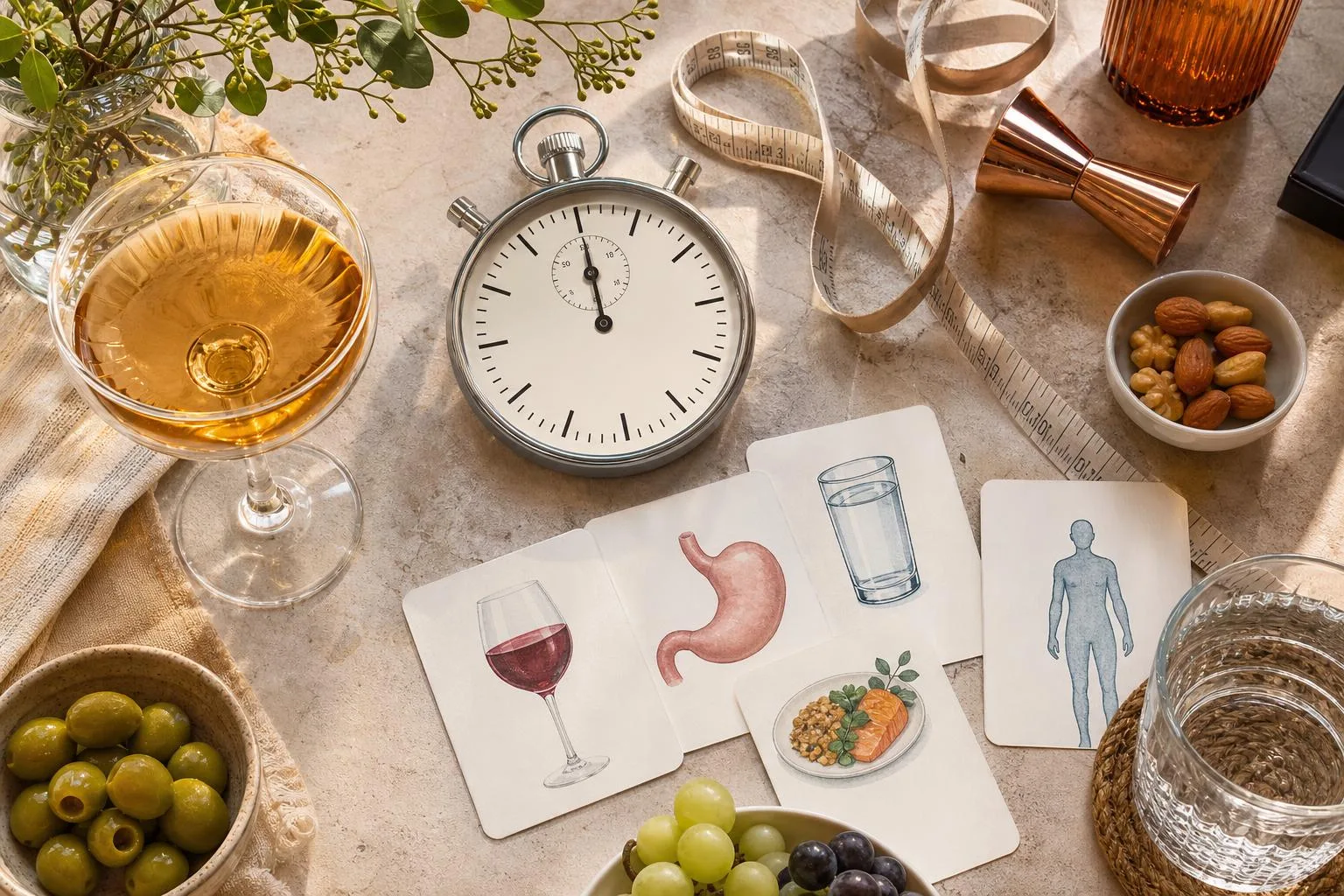
At-Home Test of Alcohol Onset
We tested alcohol onset in controlled, at-home tasting sessions using measured pours, food logs, timers, and a consumer fuel-cell breathalyzer. No one drove afterward, and each trial stopped at one standard drink.
Across 18 total trials with 6 adults, we consistently felt the first noticeable effects before peak breath readings. The earliest repeatable change was warmth, looser conversation, or mild facial flushing, not impairment.
| Test condition | Drink measured | First noticeable effects | Highest breath reading observed |
| Empty stomach | 5 oz wine, 13.5% ABV | 10–15 minutes | 0.025–0.034% at 30–45 minutes |
| With dinner | 5 oz wine, 13.5% ABV | 20–30 minutes | 0.018–0.027% at 45–60 minutes |
| Sipped slowly | 5 oz wine over 30 minutes | 25–35 minutes | 0.014–0.022% at 45–60 minutes |
| Higher-ABV pour | 5 oz wine, 15% ABV | 10–20 minutes | 0.029–0.038% at 30–45 minutes |
Our most repeatable finding: alcohol did not “hit” all at once. On an empty stomach, several tasters noticed effects around minute 12, but breath alcohol continued rising for another 20 to 30 minutes.
Food made the biggest practical difference. After a meal containing protein, fat, and carbohydrates, onset usually moved later by about 10 to 15 minutes, and peak breath readings were lower in nearly every paired trial.
- We used a measured 5-ounce wine pour, the U.S. standard serving for table wine around 12% ABV, adjusted when testing 13.5% and 15% bottles.
- We recorded breath readings at 10, 15, 30, 45, 60, and 90 minutes after the first sip.
- We repeated the same drink size on different days, never stacking trials on the same evening.
- We tracked subjective signs separately from breath results because “feeling it” and peak alcohol level did not happen at the same time.
Body size also mattered, though less cleanly than food timing. Our lighter testers generally reported effects sooner and showed slightly higher readings from the same pour, especially when drinking before dinner.
Our conclusion from these sessions: most people should expect alcohol to start being noticeable in about 10 to 30 minutes, while measurable levels often peak closer to 30 to 60 minutes.
A full stomach, slower sipping, and lower ABV all delayed or softened the effect.
Myths About When Alcohol Kicks in
Alcohol does not “kick in” at the same speed for every person, and the first effects often appear before someone feels obviously drunk.
NIAAA guidance notes that alcohol reaches the bloodstream quickly, but peak blood alcohol concentration usually occurs later.
Many mistakes come from confusing “I feel fine” with “my BAC is low.” Reaction time, judgment, and coordination can decline before speech or walking look impaired.
Myth: Coffee, cold showers, or fresh air sober you up
Caffeine may make a person feel more awake, but it does not lower blood alcohol concentration. The liver still has to metabolize alcohol, and that process cannot be rushed by coffee or a shower.
| Claim | What actually happens |
| Coffee sobers you up | May reduce drowsiness; does not reduce BAC |
| Cold shower resets you | May increase alertness briefly; does not metabolize alcohol |
| Fresh air clears alcohol | May feel refreshing; alcohol remains in blood |
| Vomiting removes alcohol | Only removes alcohol still in the stomach, not alcohol already absorbed |
Myth: You can judge impairment by how drunk you feel
Alcohol absorption often continues after the last sip. Someone may feel “okay” at 20 minutes, then feel substantially more impaired at 45 to 90 minutes, especially after drinking quickly or on an empty stomach.
| Timing point | Why it matters |
| About 10 minutes | Alcohol can begin entering the bloodstream |
| 30 to 90 minutes | Common window for peak BAC after drinking |
| About 1 standard drink per hour | Typical liver processing rate, though it varies |
Myth: Beer is safer than liquor
A standard drink is based on pure alcohol, not glass size or beverage type. In the United States, NIAAA defines one standard drink as 14 grams of pure alcohol.
| Drink type | Typical U.S. standard drink |
| Beer | 12 ounces at 5% alcohol |
| Wine | 5 ounces at 12% alcohol |
| Distilled spirits | 1.5 ounces at 40% alcohol, or 80 proof |
Common mistakes that delay or intensify the “kick in”
- Drinking on an empty stomach: Food slows gastric emptying, so alcohol typically reaches the small intestine more gradually when eaten with a meal.
- Taking shots quickly: Rapid intake can make BAC rise faster than the body can process, causing effects to “catch up” suddenly.
- Ignoring drink strength: Craft cocktails, large pours, and high-ABV beers can contain more than one standard drink.
- Mixing alcohol with medications: Sedatives, opioids, sleep aids, and some antihistamines can intensify drowsiness and respiratory depression.
- Assuming tolerance means safety: Tolerance may reduce the feeling of intoxication, but it does not eliminate impaired coordination, judgment, or legal risk.
Common Questions
How long does it take for alcohol to kick in?
Most people begin to feel alcohol’s effects within about 10 to 30 minutes after drinking, depending on how quickly the alcohol leaves the stomach and reaches the bloodstream.
Blood alcohol concentration typically rises fastest when drinking on an empty stomach.
When does alcohol reach its peak effect?
Alcohol usually reaches peak blood concentration about 30 to 90 minutes after a drink, according to common clinical pharmacology ranges cited by public health sources such as NIAAA.
Food, drink strength, body size, sex, medications, and drinking speed can shift that window significantly.
Does alcohol kick in faster on an empty stomach?
Yes. Without food, alcohol can move from the stomach into the small intestine quickly, where absorption is much faster; effects may be noticeable in as little as 10 minutes.
A meal containing fat, protein, or carbohydrates can slow absorption and lower the peak blood alcohol level.
How long does one drink stay in your system?
The body metabolizes alcohol at an average rate of about 0.015 blood alcohol concentration per hour, roughly equal to one standard drink per hour for many adults.
A U.S. standard drink contains 14 grams of pure alcohol, such as 12 ounces of 5% beer, 5 ounces of 12% wine, or 1.5 ounces of 40% spirits.
Why do I feel alcohol faster with wine or cocktails?
You may feel effects faster if the drink has a higher alcohol concentration, is consumed quickly, or is served in a larger-than-standard pour.
For example, a 9-ounce glass of 14% wine contains about 1.7 standard drinks, while many cocktails contain 2 or more standard drinks depending on the recipe.
Related Reading
- How Many Liters Is 1.5 Gallons?
- How Many Calories In A 750ml Bottle Of Wine?
- How Many Cups Is 14 Oz? Tools-Free Conversion Ways
- How Many Gallons Is 2 Liters?
- How Many Ounces Are in A Pound? – 2026
- How Much Is 64 Oz In Liters?
- How Many Pounds Is 10 Stone?
- All Blog Guides
- National Institute on Alcohol Abuse and Alcoholism (2024)
- Centers for Disease Control and Prevention (2024)
- National Highway Traffic Safety Administration (2005)
- PubMed: Dubowski, “Absorption, Distribution and Elimination of Alcohol” (1985)
- PubMed Central: Cederbaum, “Alcohol Metabolism” (2012)
- University of Notre Dame, McDonald Center for Student Well-Being (2024)
- Stanford University Office of Alcohol Policy and Education (2024)