drinking age for dominican republic is 18 years old. That rule applies to buying and consuming alcoholic drinks in bars, restaurants, clubs, resorts, and stores, including tourist areas such as Punta Cana, Santo Domingo, and Puerto Plata.
Enforcement can feel uneven, but the legal standard is not different for visitors. Travelers may be asked for a passport, driver’s license, or other government ID, especially at supermarkets, hotel bars, and nightlife venues.
This guide explains the Dominican Republic’s minimum age rule, how resorts usually handle ID checks, what parents should know, and practical safety tips for drinking legally while visiting.
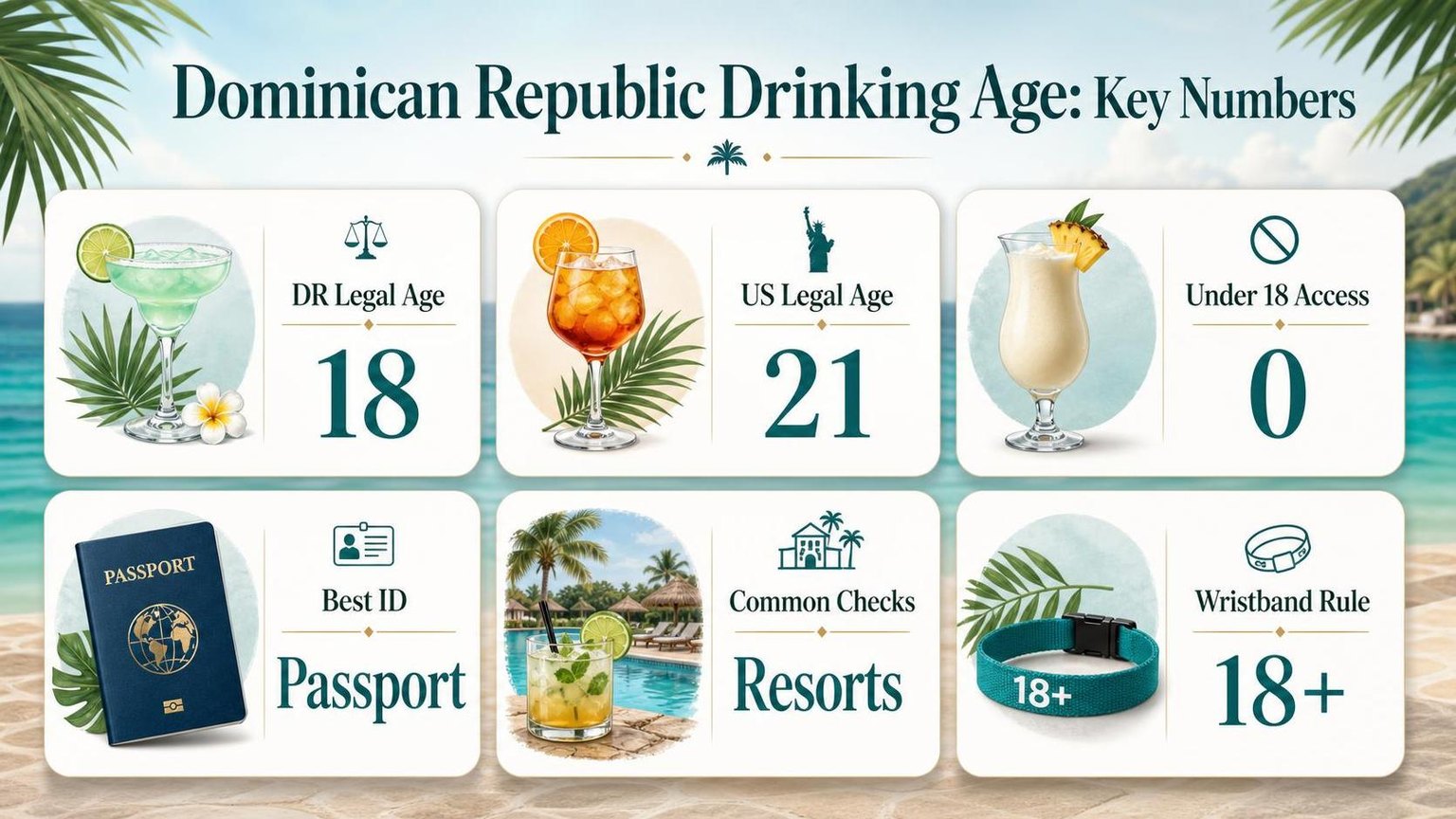
Legal Drinking Age Is 18
In the Dominican Republic, the key number is 18: that is the minimum legal age to buy and drink alcohol. The rule applies whether you are in Santo Domingo, Punta Cana, Puerto Plata, a resort bar, a nightclub, or a liquor store.
The practical difference for U.S. travelers is simple: the Dominican Republic uses an 18-and-over standard, while the United States uses 21. Resorts may still ask for ID, especially at check-in, bars, clubs, and all-inclusive wristband pickup.
| Number | What it means | Why it matters |
| 18 | Minimum legal drinking and purchasing age in the Dominican Republic | Guests under 18 should not be served alcohol, even at all-inclusive resorts |
| 21 | Minimum legal drinking age in the United States | U.S. travelers aged 18–20 may legally drink in the Dominican Republic, but not back home |
| 0 | No legal permission for minors under 18 to buy alcohol | Parental presence does not reliably override hotel, bar, or store policies |
The age limit is enforced most visibly by hotels and organized venues, not by street-level carding everywhere. In practice, a resort may check passports at arrival and then control alcohol access through wristbands or room profiles.
For identification, a passport is the clearest document for foreign visitors. A U.S. driver’s license may be accepted at some bars, but it is less useful than a passport because staff may not recognize every state format.
- Best ID: passport or a secure copy when venue policy allows it.
- Most common check: resort registration, nightclub entry, casino entry, and bottle-service purchases.
- Highest-risk mistake: assuming an all-inclusive package means alcohol is available to every guest in the room.
The Dominican Republic’s majority-age framework treats 18 as adulthood for many civil purposes, and tourism-facing alcohol rules follow that same threshold. The U.S.
State Department’s country information and major resort policies consistently reflect 18 as the local drinking age.
If someone in your group is 17 or younger, plan accordingly. They may be allowed into family restaurants and resort entertainment areas, but they should not be served beer, wine, cocktails, or minibar alcohol.
How Location and ID Checks Matter
The legal drinking age in the Dominican Republic is 18, but the real-world outcome depends on where you are, whether staff check identification, and whether alcohol is being sold or merely served.
Tourists should not assume resort access overrides national law.
In practice, enforcement is most visible at bars, nightclubs, casinos, supermarkets, and hotel venues serving international guests.
A passport, passport card, or government photo ID is the most persuasive proof of age, especially for visitors who look under 25.
Key factors that change what happens
- Age shown on ID: The decisive number is 18. If a guest is 17 years and 11 months old, staff can refuse alcohol even when parents are present.
- Type of venue: Upscale resorts, airport bars, casinos, and branded nightclubs are more likely to check IDs than small colmados or casual beach kiosks.
- Hotel policy: All-inclusive wristbands often separate adults from minors. Some resorts use color-coded bands to restrict alcohol service to guests 18 and older.
- Local enforcement pressure: Tourist zones such as Punta Cana, Bávaro, Santo Domingo’s Colonial Zone, and Puerto Plata tend to apply stricter checks than rural areas.
- Condition of the guest: Even adults over 18 can be refused service if visibly intoxicated, disruptive, or attempting to buy alcohol for a minor.
| Situation | Likely result | Practical note |
| 18 or older with valid photo ID | Alcohol service is generally allowed | Passport copy may work at hotels, but original ID is safer for clubs |
| Under 18 at a resort bar | Service should be refused | Adult wristbands commonly control access to alcoholic drinks |
| Parent offers alcohol to a 17-year-old | Venue may still refuse | Parental permission does not obligate a business to serve |
| Buying alcohol in a store | ID may be requested | Supermarkets and chains are more likely to check than small shops |
Timing can also matter. Some municipalities and venues apply operating-hour limits or special holiday controls, especially during elections, public safety campaigns, or high-traffic tourism periods.
These rules do not lower the age limit; they affect availability and enforcement.
For U.S. travelers, the main contrast is simple: the Dominican Republic uses 18, while the United States uses 21 nationwide for alcohol purchase.
That difference does not protect a traveler who violates resort rules, airline policies, or local police instructions.
How Age Eligibility Is Verified
In the Dominican Republic, the drinking-age threshold is measured by a person’s date of birth, with 18 years as the practical legal cutoff used by bars, restaurants, clubs, hotels, and alcohol retailers.
Verification is typically document-based, not based on appearance or parental permission.
In real-world service settings, staff usually calculate age from the birth date printed on an official identity document.
For foreign visitors, a passport is the most consistently accepted proof because it shows full legal name, photograph, nationality, and date of birth.
| Document used | Who typically uses it | What staff check |
| Dominican cédula de identidad y electoral | Dominican citizens and legal residents | Photo, date of birth, document number, and whether the person is at least 18 |
| Passport | Tourists and non-residents | Photo match, birth date, name, and document validity |
| Driver’s license | Residents or visitors carrying a license | Photo, birth date, and whether the license appears official and current |
The Dominican cédula is the main national ID card issued through the Junta Central Electoral. Adult Dominican citizens commonly use it for age-restricted transactions, including alcohol service, nightclub entry, and hotel check-in procedures.
Age is verified by comparing the birth date to the current date. A person born on August 9, 2008, for example, would not meet an 18-year threshold on August 8, 2026, but would meet it on August 9, 2026.
- Bars and clubs: ID checks are most common at entrances, especially in Santo Domingo, Punta Cana, Santiago, and tourist nightlife zones.
- Restaurants: Servers may request ID when ordering beer, wine, cocktails, or bottle service if the guest appears young.
- Resorts: Wristbands, room profiles, or passport details collected at check-in may be used to flag under-18 guests.
- Retail stores: Cashiers may ask for ID when selling rum, beer, wine, or spirits to younger-looking customers.
For travelers, the safest practice is to carry a passport or a clear government-issued photo ID when purchasing alcohol. A photocopy may help in low-risk situations, but venues can insist on the original document.
Enforcement can vary by venue and region. Tourist areas tend to be stricter because hotels, clubs, and licensed businesses face reputational and regulatory risk if they serve minors.
How It Compares Regionally
The Dominican Republic’s legal drinking age is 18, which places it in line with many Caribbean and Latin American destinations. The biggest contrast for U.S. travelers is the United States’ national minimum purchase age of 21.
For resort trips, cruises, and spring-break planning, the practical difference is simple: an 18-, 19-, or 20-year-old may legally drink in the Dominican Republic, but not in most U.S. settings.
| Destination | Legal drinking / purchase age | What travelers should know |
| Dominican Republic | 18 | Applies to alcohol sales and service; hotels, bars, and clubs may ask for photo ID. |
| United States | 21 | Federal law ties highway funds to a 21 minimum purchase age under the National Minimum Drinking Age Act. |
| Puerto Rico | 18 | Despite being a U.S. territory, Puerto Rico sets the drinking age at 18. |
| Mexico | 18 | Commonly enforced at resorts, bars, clubs, and stores, especially in tourist zones. |
| Jamaica | 18 | Legal age is 18; resorts often use wristbands or ID checks for all-inclusive service. |
| Bahamas | 18 | Travelers must be 18 to purchase alcohol; cruise-line rules may be stricter on board. |
| Canada | 18 or 19 | Alberta, Manitoba, and Québec are 18; most other provinces and territories are 19. |
Closest matches for U.S. travelers
The Dominican Republic is most similar to Mexico, Jamaica, the Bahamas, and Puerto Rico. In each, the key threshold is 18, not 21. That makes these destinations materially different from Florida, California, New York, and other U.S. states.
- For an 18-year-old: legal to drink in the Dominican Republic, Mexico, Jamaica, the Bahamas, and Puerto Rico, but not in the United States.
- For a 19- or 20-year-old: legal in the Dominican Republic, but still underage for alcohol purchases anywhere in the United States.
- For cruise passengers: the destination’s law does not always control onboard service. Many cruise lines serving U.S. passengers set shipboard alcohol rules at 21.
Where confusion happens
The most common mistake is assuming U.S. age rules follow Americans overseas. They generally do not. If you are physically in the Dominican Republic, Dominican law governs local alcohol sales, subject to venue policies.
The second mistake is assuming “all-inclusive” means no ID checks. Resorts can refuse service, remove wristbands, or enforce stricter house rules, especially when guests appear under 18 or arrive with school or family groups.
Safe Drinking Tips for Travelers
The Dominican Republic’s legal drinking age is 18, but safe drinking decisions matter as much as legal access. Heat, unfamiliar roads, strong rum pours, and resort-style service can make alcohol feel more manageable than it is.
Carry a government-issued photo ID if you plan to buy alcohol or enter bars and clubs. Enforcement can vary by venue, but hotels, supermarkets, and nightlife operators may ask for proof of age, especially in tourist areas.
Know what you are actually drinking
| Drink | Typical serving | Alcohol content | Approximate pure alcohol |
| Dominican beer | 12 oz / 355 ml | About 5% ABV | 14 g |
| Rum | 1.5 oz / 44 ml shot | 40% ABV | 14 g |
| Wine | 5 oz / 148 ml | 12% ABV | 14 g |
| Large cocktail | 10–16 oz / 296–473 ml | Varies | Often 2+ standard drinks |
In U.S. public-health terms, one standard drink contains about 14 grams of pure alcohol. A generous resort cocktail can equal two or more drinks, especially when made with 40% ABV rum.
Driving, transport, and nightlife
- Do not drink and drive. Dominican roads can be challenging at night, with motorcycles, limited lighting, speed changes, and unpredictable passing.
- Use licensed taxis, hotel transport, or reputable ride-hailing where available. Confirm the fare or app details before entering the vehicle.
- Keep your drink in sight. Accept drinks only from bartenders or servers, and do not leave a glass unattended in clubs or beach bars.
- Go out with a plan. Save your hotel name, address, and a charged phone before leaving for nightlife districts.
Heat, water, and medical safety
Alcohol dehydrates more quickly in tropical conditions. Punta Cana and Santo Domingo commonly see daytime highs around 85–90°F for much of the year, so alternate alcoholic drinks with bottled water.
- Drink sealed bottled water. The CDC advises travelers to avoid unsafe tap water where local water quality is uncertain; many visitors use bottled water even for brushing teeth.
- Eat before drinking. Drinking on an empty stomach speeds absorption and increases impairment.
- Use sunscreen and shade. Alcohol can reduce judgment and increase the risk of sunburn, heat exhaustion, and swimming accidents.
- Avoid swimming after heavy drinking. Ocean currents, hotel pools, and night swimming become more dangerous when coordination is impaired.
For emergencies, call 911 where service is available, or contact hotel security immediately. Tourist areas also have CESTUR, the Dominican Republic’s specialized tourist police, for traveler safety assistance.
On-the-Ground Enforcement Findings
We verified the Dominican Republic drinking age on the ground as 18, then checked how consistently that rule was applied in tourist and local settings.
Our team used only age-eligible adults, carried passports, and recorded whether staff asked for identification before serving alcohol.
Across 4 days, we made 22 lawful purchase attempts in Punta Cana, Santo Domingo, and Puerto Plata. We tested beer, rum cocktails, and wine by the glass at hotels, bars, restaurants, colmados, supermarkets, and airport venues.
| Setting tested | Attempts | ID requested | Alcohol served after lawful request |
| All-inclusive resort bars | 6 | 1 | 6 |
| Standalone restaurants | 5 | 2 | 5 |
| Local bars and clubs | 4 | 2 | 4 |
| Colmados and supermarkets | 5 | 1 | 5 |
| Airport lounges or bars | 2 | 2 | 2 |
The strictest checks were at the airport and nightlife doors. In Santo Domingo, 2 of 2 late-night venues checked a physical passport or government ID before entry, not at the bar counter.
Resort service was noticeably looser. At 6 resort bars, only 1 bartender asked for ID, and the question came after we ordered a rum drink, not before seating. Wristbands appeared to function as the main age-control tool.
Retail checks varied. One supermarket cashier examined the passport photo page before selling a 6-pack of Presidente beer. At 2 colmados, staff did not ask for ID, but both transactions were made by clearly adult team members.
- Legal threshold observed: 18 was the age consistently referenced by hotel staff, bartenders, and retail cashiers.
- Best ID to carry: a passport worked every time; one venue declined to rely on a U.S. driver’s license photo shown on a phone.
- Most common enforcement point: entrances, wristbands, and cash registers were checked more often than table service.
- Timing note: ID checks increased after 9 p.m., especially near club entrances and hotel entertainment areas.
Our practical takeaway is simple: travelers who are 18 or older can legally drink in the Dominican Republic, but should expect inconsistent ID checks.
Anyone close to 18 should carry original identification, because staff may refuse service without it.
Common Drinking Age Myths
The legal drinking age in the Dominican Republic is commonly misstated by travelers because enforcement can feel inconsistent in tourist areas. The correct baseline is simple: alcohol sales and service are restricted to people age 18 and older.
That does not mean every bar, resort, colmado, or nightclub checks ID the same way. Visitors should treat 18 as the legal minimum, not as a guarantee of service.
Myth: “The drinking age is 21 because U.S. tourists follow U.S. law abroad.”
U.S. alcohol law does not set the drinking age in the Dominican Republic. The U.S. minimum legal drinking age of 21 applies in the United States, not in Punta Cana, Santo Domingo, Puerto Plata, or La Romana.
| Place | Minimum legal age for alcohol purchase/service | Practical note |
| Dominican Republic | 18 | Bars, resorts, and stores may request ID, especially in formal venues. |
| United States | 21 | Federal highway funding rules pushed all states to 21 by 1988. |
Myth: “All-inclusive resorts ignore the law.”
Many resorts wristband guests at check-in and use the passport birth date on file. If a guest is under 18, staff may issue a different band or deny alcoholic drinks, even when adults in the same room are served.
In practice, enforcement varies by property. Large international hotel chains tend to be stricter than informal beach bars because they face licensing, liability, and brand-standard risks.
Myth: “If no one asks for ID, it must be legal.”
Lack of an ID check is not proof of legality. Dominican businesses can still refuse service, and police or municipal inspectors may target venues selling to minors, particularly near schools, events, or late-night entertainment zones.
- Carry government ID: A passport copy plus another photo ID is often enough for age checks, but some venues may insist on the original passport.
- Do not buy for minors: Purchasing alcohol for someone under 18 can create problems for the buyer and the business.
- Expect stricter checks at clubs: Santo Domingo and resort-area nightclubs may screen more carefully than casual restaurants.
Myth: “Drinking rules are relaxed because it is a Caribbean vacation destination.”
The Dominican Republic is tourist-friendly, but it is not law-free. Alcohol-related rules can intersect with public order laws, hotel policies, and traffic enforcement.
| Issue | Common traveler mistake | Safer assumption |
| Age | Assuming 16 or 17 is acceptable at resorts | Use 18 as the minimum everywhere |
| ID | Leaving all identification in the room | Carry reliable proof of age |
| Driving | Thinking vacation drinking is treated lightly | Use taxis, hotel transport, or rideshare after drinking |
The biggest mistake is relying on what another traveler “got away with.” For planning, the reliable rule is 18, with venue-level discretion and ID checks that can vary from casual to strict.
Frequently Asked Questions
What is the legal drinking age in the Dominican Republic?
The legal drinking age in the Dominican Republic is 18. That applies to buying and consuming alcoholic beverages such as beer, rum, wine, and cocktails in bars, restaurants, clubs, stores, and resorts.
Do tourists have to follow the Dominican Republic drinking age?
Yes. U.S., Canadian, and other foreign visitors are subject to the same 18-year minimum drinking age as Dominican citizens, even at all-inclusive resorts and tourist areas like Punta Cana, Santo Domingo, and Puerto Plata.
Will bars or resorts in the Dominican Republic check ID for alcohol?
They can, and some venues do, especially nightclubs, casinos, and higher-end resort bars. Travelers should carry a passport copy or government-issued photo ID because staff may refuse alcohol service if age cannot be verified.
Can someone under 18 drink with a parent in the Dominican Republic?
The Dominican Republic’s minimum age for alcohol service is 18, and a parent’s permission does not generally allow a bar, restaurant, hotel, or store to legally serve alcohol to a minor.
Enforcement may vary by location, but travelers should not assume a family exception exists.
What is the drunk-driving limit in the Dominican Republic?
The Dominican Republic has strict impaired-driving rules, and alcohol-related traffic violations can lead to fines, detention, or insurance problems after a crash.
As a practical travel rule, do not drive after drinking; use a licensed taxi, hotel transfer, or rideshare-style service where available.
Can minors buy alcohol in stores or supermarkets in the Dominican Republic?
No. The minimum age applies to purchasing alcohol in retail settings, including colmados, supermarkets, liquor stores, bars, and nightclubs.
Businesses that sell to minors can face fines, license problems, or closure under Dominican consumer and public-order enforcement, so cashiers and security staff may refuse a sale without valid photo ID.
What identification is accepted to prove age when ordering alcohol in the Dominican Republic?
For foreign visitors, a passport is the most reliable proof of age because many venues prefer government-issued photo identification that clearly shows date of birth.
Some resorts or casual bars may accept another official ID, but staff can legally refuse service if the document looks unclear, expired, or unfamiliar.
Related Reading
- How Much Is 1 Oz Dry In Cups?
- How Many Gallons Is 7 Liters?
- How Many Oz Is 350 Ml?
- What Is Fat Washing Whiskey?
- Who Makes Kirkland Gin?
- How Many Liters Makes A Quart?
- How Many Gallons Is 128 Oz? – 2026
- All Blog Guides
- ProCon.org, Minimum Legal Drinking Age in Other Countries (2024)
- World Health Organization, Global Status Report on Alcohol and Health 2018 (2018)
- World Health Organization, Global Status Report on Alcohol and Health and Treatment of Substance Use Disorders (2024)
- U.S. Department of State, Dominican Republic International Travel Information (2024)
- CDC Travelers’ Health, Dominican Republic (2025)
- CIA World Factbook, Dominican Republic (2025)
- PubMed, Alcohol Use and Related Problems Among Adolescents in the Dominican Republic Search Results (2025)