beers from the 70s and 80s that defined an era are the mass-market lagers, cult imports, and early craft pioneers that changed what Americans expected from a pint.
Budweiser, Miller Lite, Coors Banquet, Heineken, Guinness Draught, Anchor Steam, Sierra Nevada Pale Ale, and Samuel Adams Boston Lager marked shifts in advertising, distribution, flavor, and beer identity.
This era moved beer from regional loyalty and TV-driven brands toward light lager dominance, imported prestige, and hop-forward craft brewing.
The names still matter because they shaped tap lists, supermarket shelves, and American drinking habits for decades.
Light Lagers Take Over America
Light lager changed American beer by turning lower-calorie brewing into a mass-market category.
Aggressive national advertising, changing dietary preferences, and brewery consolidation pushed these beers from novelty products to bar, stadium, and supermarket staples.
Miller created the breakthrough after purchasing brands and formulas from Meister Brau.
The company reformulated Meister Brau Lite, tested Miller Lite regionally, then expanded it nationwide under the promise of “Everything you’ve always wanted in a beer. And less.”.
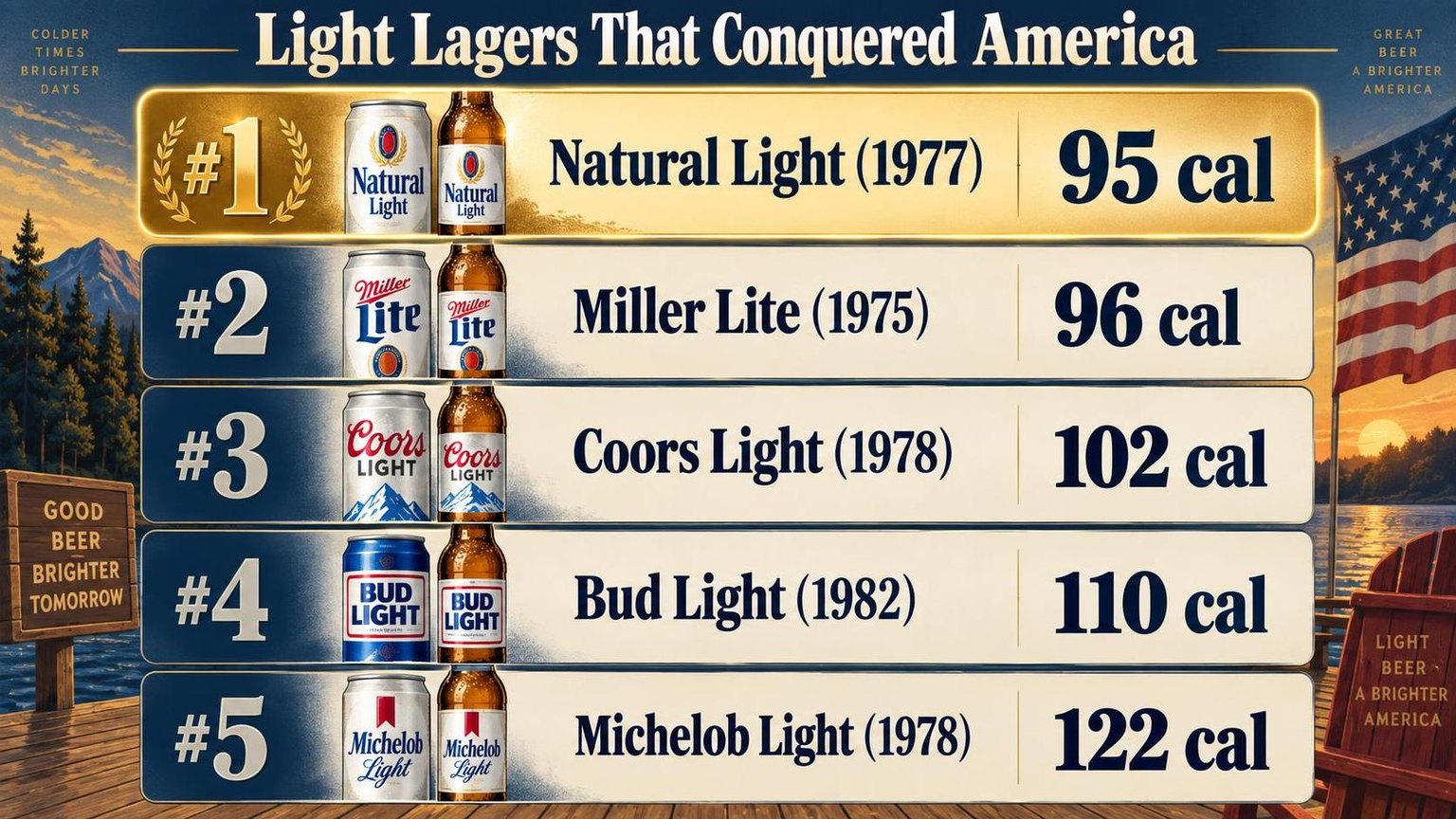
| Beer | National launch | Calories per 12 ounces | Alcohol by volume |
| Miller Lite | 1975 | 96 | 4.2% |
| Natural Light | 1977 | 95 | 4.2% |
| Coors Light | 1978 | 102 | 4.2% |
| Michelob Light | 1978 | 122 | 4.1% |
| Budweiser Light, later Bud Light | 1982 | 110 | 4.2% |
Calorie and alcohol figures reflect current brewery disclosures and may not reproduce every historical formulation.
The launch chronology comes from company histories and Smithsonian National Museum of American History materials documenting the development of light beer.
Miller’s advertising made the category culturally visible.
Campaigns created by McCann-Erickson featured retired athletes and celebrities arguing over whether Miller Lite “tastes great” or is “less filling.” Participants included Billy Martin, John Madden, Bubba Smith, and Rodney Dangerfield.
The commercials did more than explain reduced calories. They presented light beer as compatible with sports, masculinity, and social drinking, countering the perception that a diet-oriented product lacked flavor or strength.
Tavern settings and comic arguments made the sales proposition easy to repeat.
Competitors answered quickly. Anheuser-Busch introduced Natural Light before committing its flagship name to Budweiser Light.
Coors used its established association with cold refreshment, while Michelob positioned its light extension as a more upscale alternative.
Budweiser Light was shortened to Bud Light in its launch year.
Its marketing later produced “Spuds MacKenzie,” the sunglasses-wearing bull terrier introduced during the late eighties, reinforcing the era’s shift from product explanation toward lifestyle entertainment.
- Lower calories: Brewers used enzymes and extended fermentation to convert more carbohydrates into fermentable sugars, leaving fewer residual carbohydrates.
- High drinkability: Light body, restrained bitterness, strong carbonation, and cold service encouraged repeat consumption.
- National distribution: Large breweries could support refrigerated logistics, television campaigns, sports sponsorships, and widespread retail placement.
By the end of the eighties, light lager was no longer a secondary diet option. It had become a central expression of American brewing: technically consistent, heavily advertised, broadly distributed, and designed for long drinking occasions.
Imported Beers Become Status Symbols
During the 1970s and 1980s, ordering an imported beer communicated disposable income, travel awareness, and taste beyond mainstream American lager.
Green bottles, foreign labels, and higher prices made imports visible social accessories in restaurants, discos, hotel bars, and newly fashionable beer retailers.
Heineken supplied the era’s clearest status cue.
The Dutch brewer had sent beer to the United States immediately after Prohibition ended, and its long-established distribution gave it an advantage when American drinkers began seeking international brands.
Its green bottle and red star were recognizable across a crowded bar.
| Brand | Key U.S. milestone | Positioning significance |
| Heineken | Shipments resumed in December 1933 after Prohibition | Established the model for an upscale Continental import |
| Löwenbräu | Miller began brewing it domestically in 1975 | Showed how valuable imported identity had become |
| Amstel Light | Introduced to the U.S. market in 1980 | Combined European prestige with growing demand for light beer |
| Corona Extra | Entered the U.S. market in 1981 | Turned Mexican origin, clear glass, and lime service into lifestyle signals |
The dates come from Heineken’s corporate archive, Federal Trade Commission records concerning Miller and Löwenbräu, and brand histories maintained by Heineken and Constellation Brands.
Together, they show imports moving from post-Prohibition novelty toward segmented lifestyle marketing.
Löwenbräu exposed the difference between foreign branding and foreign production. Miller acquired American rights and brewed the beer in the United States with a revised recipe.
Federal regulators later required clearer disclosure of its domestic origin because advertising and Bavarian imagery could leave buyers believing it remained imported.
Packaging reinforced the premium message. Heineken’s green glass and Corona’s clear bottle stood apart from the brown bottles and cans associated with many domestic lagers.
Those colors admitted more flavor-damaging light than brown glass, but visual distinction often mattered more than ideal storage performance.
Imported beer also benefited from restaurant pricing. A bartender could present a single bottle as an affordable indulgence: more expensive than a domestic beer, yet far cheaper than imported wine or spirits.
The bottle stayed on the table, continually displaying the purchaser’s choice.
- Heineken suggested cosmopolitan European taste.
- Beck’s and St. Pauli Girl traded on German brewing credibility.
- Molson offered Canadian distinction without seeming unfamiliar.
- Corona linked beer with beaches, warm weather, and casual travel.
- Guinness signaled attachment to pub culture and stout tradition.
By the late 1980s, the import itself had become part of the drinking experience. Consumers were buying provenance, packaging, and social meaning alongside flavor—an approach later adopted by American craft brewers.
Miller Lite Changes Beer Marketing
Miller Lite did more than popularize light beer.
Its 1970s advertising turned a lower-calorie product into a masculine, mainstream choice by combining retired athletes, comedians, sports-bar arguments, and one endlessly repeatable slogan: “Tastes Great! Less Filling!”.
Miller Brewing acquired Meister Brau Lite’s formula in 1972, then reformulated and test-marketed the beer. The national launch followed in 1975, when “diet beer” still suggested compromise rather than enjoyment.
| Year | Development |
| 1967 | Biochemist Joseph Owades developed a reduced-calorie beer process used for Gablinger’s Diet Beer. |
| 1972 | Miller acquired brands and brewing assets from Meister Brau, including Meister Brau Lite. |
| 1975 | Miller Lite received its national rollout and the “Everything you’ve always wanted in a beer. And less.” positioning. |
| 1999 | Advertising Age ranked the Miller Lite campaign among the 10 greatest advertising campaigns of the 20th century. |
The campaign’s decisive move was casting recognizable men associated with toughness and competition. Former New York Jets running back Matt Snell appeared in an early commercial.
Later spots featured Bubba Smith, Dick Butkus, Deacon Jones, Mickey Spillane, Rodney Dangerfield, and baseball manager Billy Martin.
These were not polished lifestyle tableaux. The commercials staged comic disputes in taverns, locker rooms, stadiums, and other familiar male spaces. One side praised flavor; the other praised drinkability.
Viewers could repeat both claims without remembering a technical explanation of calories or brewing.
The format also made product positioning inseparable from entertainment. “Tastes Great!” answered the fear that light beer lacked flavor. “Less Filling!” promised that drinkers could consume it during long social.
Occasions without feeling as full as they might after conventional lager.
Miller’s language mattered. Calling the beer “Lite,” rather than “diet,” removed a term associated with restriction.
The deliberate spelling became a brand asset, while competitors eventually adopted “light” as the category description.
In the glass, Miller Lite remains a pale, highly carbonated American light lager with restrained malt sweetness, low bitterness, and a dry finish.
The current product lists 96 calories, 3.2 grams of carbohydrates, and 4.2% alcohol by volume per 12-ounce serving.
The larger legacy was strategic: beer advertising could build identity through recurring characters and a scripted argument.
Miller Lite helped establish light lager as a permanent national category, forcing major rivals—most consequentially Anheuser-Busch with Bud Light—to compete for drinkers seeking both familiar beer flavor and lighter body.
Coors Fuels a National Obsession
Before 1981, Coors Banquet was unavailable east of the Mississippi River. That geographic restriction turned a regional Colorado brewery into a cultural phenomenon, fueling a black market and inspiring the 1977 hit film Smokey and the Bandit.
Adolph Coors Company operated a single brewery in Golden, Colorado, at an elevation of 5,675 feet. The company brewed exclusively with Rocky Mountain spring water and refused to pasteurize its beer, requiring constant refrigeration during transport.
The Distribution Limitation
Through the 1970s, Coors sold beer in only 11 western states. The lack of pasteurization meant the product couldn’t survive long-distance, unrefrigerated shipping without spoiling.
This scarcity created mystique. Presidents Gerald Ford and Dwight Eisenhower reportedly had Coors shipped to the White House. Henry Kissinger packed it in his luggage on diplomatic flights.
Bootleggers hauled cases eastward, sometimes marking up prices 300–400% over the retail cost of roughly $1.50 per six-pack.
Smokey and the Bandit Effect
The 1977 Universal Pictures film starring Burt Reynolds grossed $126.7 million domestically. Its plot centered entirely on illegally trucking 400 cases of Coors from Texarkana, Texas, to Atlanta, Georgia.
The film cemented Coors as a rebel symbol. Sales surged, and by 1977 Coors ranked fourth among U.S. brewers despite selling in fewer than half the states.
National Expansion Timeline
| Year | States Distributed | Key Milestone |
| 1975 | 11 | Peak regional cult status |
| 1981 | 20 | First expansion east of Mississippi |
| 1985 | 44 | Coors Light launched nationally |
| 1991 | 50 | Full national distribution achieved |
Coors Light Changes the Game
Introduced in 1978, Coors Light—branded as “The Silver Bullet”—became the company’s growth engine. By 1989, Coors Light outsold Coors Banquet for the first time.
The light beer contained 102 calories and 5 grams of carbohydrates per 12-ounce serving, positioning it squarely in the light beer wars alongside Miller Lite and Bud Light.
Production Scale
- The Golden, Colorado facility remained the world’s largest single-site brewery, producing over 20 million barrels annually by the late 1980s.
- Coors used a proprietary strain of barley grown under contract in the San Luis Valley of Colorado and Montana’s Flathead Valley.
- The company manufactured its own cans and bottles through its subsidiary, Coors Ceramics, later spun off as CoorsTek in 1992.
Coors proved that scarcity and mythology could build a brand more effectively than any advertising campaign. Its journey from regional curiosity to national staple defined beverage marketing for an entire generation.
Craft Brewing Starts in Garages
President Jimmy Carter signed H.R. 1337 on October 14, 1978, legalizing homebrewing at the federal level effective February 1, 1979. That single act unlocked a generation of garage experimenters who would reshape American beer entirely.
Before 1979, homebrewing carried penalties up to $10,000 in fines and five years imprisonment under Prohibition-era statutes never repealed. Legalization removed the risk overnight.
The American Homebrewers Association, founded by Charlie Papazian in 1978, grew from roughly 1,000 members in its first year to over 10,000 by 1985. Papazian’s The Complete Joy of Homebrewing (1984) became the movement’s bible.
Garage-to-Brewery Pioneers
| Brewery | Founder(s) | Year Founded | Origin |
| New Albion Brewing | Jack McAuliffe | 1976 | Sonoma, CA — converted warehouse |
| Sierra Nevada | Ken Grossman & Paul Camusi | 1980 | Chico, CA — hand-welded homebrew equipment |
| Boston Beer Company | Jim Koch | 1984 | Kitchen recipe from great-great-grandfather |
| Anchor Brewing | Fritz Maytag (acquired 1965) | 1971 (revived) | San Francisco, CA — near-bankrupt purchase |
Jack McAuliffe’s New Albion Brewing is widely credited as America’s first modern microbrewery. It operated from 1976 to 1982, closing due to undercapitalization despite critical acclaim.
Ken Grossman built Sierra Nevada’s original brewhouse from salvaged dairy tanks and hand-fabricated copper fittings. His initial investment totaled approximately $50,000, scraped together from homebrewing supply sales.
The Numbers Tell the Story
In 1978, the United States had 89 operating breweries — the lowest count in American history. By 1989, that number climbed to 284, driven almost entirely by homebrewers turning professional.
- New Albion’s original system produced just 450 barrels per year
- Sierra Nevada brewed 950 barrels in its first full year (1981)
- Boston Beer Company sold 500 barrels of Samuel Adams Boston Lager in 1985
- Total U.S. craft production reached an estimated 50,000 barrels by 1986
These garage brewers rejected the light adjunct lagers dominating supermarket shelves. They chased flavor — amber ales, porters, stouts, and pale ales using Cascade hops grown in the Pacific Northwest.
The financial obstacles were brutal. Banks refused loans to microbreweries with no industry precedent. Most founders self-funded through savings, second mortgages, and family contributions. Failure rates exceeded 60% in the first decade.
What survived those garages permanently altered American drinking culture and laid the foundation for today’s 9,500-plus independent craft breweries.
Legacy Beers Still Worth Tasting
The defining beers of the seventies and eighties range from crisp mass-market lagers to assertive early craft ales.
Tasted today, they document how American drinkers moved from uniform refreshment toward prominent hops, richer malt, and regional identity.
These widely available survivors provide the clearest historical tasting flight. Specifications come from current brewery product pages; recipes and strength may differ from their original releases.
| Beer | Era milestone | Current strength | Why it matters |
| Miller Lite | Nationally introduced in 1975 | 4.2% ABV; 96 calories per 12 ounces | Established light beer as a major commercial category. |
| Sierra Nevada Pale Ale | First brewed in 1980 | 5.6% ABV; 38 IBU | Made Cascade-hop citrus and pine accessible nationwide. |
| Bud Light | Introduced in 1982 | 4.2% ABV | Became the era’s most consequential extension of an established lager brand. |
| Samuel Adams Boston Lager | Commercially launched in 1985 | 5% ABV; 30 IBU | Helped bring full-flavored independent beer into mainstream bars. |
| Sierra Nevada Celebration | First brewed in 1981 | 6.8% ABV; 65 IBU | Established an enduring seasonal showcase for freshly harvested hops. |
Build the Flight Around Contrast
Begin with Miller Lite, then Bud Light. Their restrained bitterness, light body, high carbonation, and clean fermentation show what large breweries prioritized: repeatability and easy drinking rather than aromatic intensity.
Follow with Boston Lager. Boston Beer describes it as a Vienna-style lager using traditional decoction brewing.
The current “Remastered” version is smoother and less weighty than many longtime drinkers remember, so treat it as an evolving brand rather than an unchanged archival recipe.
Pour Sierra Nevada Pale Ale next. Whole-cone Cascade hops deliver grapefruit peel, pine, and floral notes over firm caramel malt.
Its bitterness now seems moderate beside modern India pale ales, but the balance explains why it became a template for American pale ale.
Finish with Celebration when the winter release is fresh. Sierra Nevada brews it with newly harvested whole-cone hops rather than dried, year-old inventory. The result links early craft brewing to today’s harvest-driven beer culture.
What the Flight Reveals
- Light lager won through precision: subtle flavor was intentional, supported by cold serving temperatures and aggressive carbonation.
- Craft beer changed aroma first: Cascade hops supplied a distinctly American citrus-and-pine signature.
- Legacy does not guarantee stasis: ownership, ingredients, equipment, and consumer preferences can alter a beer while its name survives.
- Freshness remains decisive: check packaging dates, especially for hop-forward pale ales and seasonal releases.
Common Questions
Which 1970s beer helped make light beer mainstream?
Miller Lite, introduced nationally in 1975, turned reduced-calorie beer into a major US category through its “Tastes Great, Less Filling” campaign.
Miller Brewing Company marketed it with athletes and other masculine celebrities, countering the perception that light beer was only for dieters.
Why was Coors such a defining beer during the 1970s?
Coors remained unavailable east of the Mississippi for much of the decade because it used an unpasteurized product and a limited refrigerated distribution network.
Its scarcity created a cult following reflected in the 1977 film Smokey and the Bandit, whose plot centered on illegally transporting Coors from Texas to Georgia.
What made Bud Light an important beer of the 1980s?
Anheuser-Busch launched Budweiser Light in 1982 and soon shortened the name to Bud Light.
Heavy advertising, including the “Spuds MacKenzie” campaign introduced in 1987, helped it challenge Miller Lite and expand light lager into a dominant national segment.
Which beer best represented the rise of American craft brewing?
Sierra Nevada Pale Ale, first brewed in 1980, showcased Cascade hops with a citrus-forward aroma and substantially more bitterness than mainstream lagers.
The Brewers Association identifies Sierra Nevada among the early breweries that helped establish the modern American craft-beer movement.
How did Samuel Adams Boston Lager define late-1980s beer culture?
Boston Beer Company began selling Samuel Adams Boston Lager in 1985, positioning a full-flavored, all-malt lager against mass-market brands.
Its national growth showed that a small producer could use contract brewing, restaurant distribution, and premium pricing to reach drinkers beyond a local brewpub.
Further Reading
- How Many Milliliters Are In 12 Ounces?
- How Many Ounces is 1.3 Liters?
- How Many Ounces In 2 Liters?
- 11 Essential Facts About How Much Is 40 Oz In Liters (2026 Complete Hydration, Fitness & Conversion Guide)
- How Many Cinder Blocks On A Pallet? Find Out Now
- Best Brewery Washington DC: The Definitive 2026 Guide for Beer Enthusiasts
- How Many 8 Oz Cups In A Gallon? – 2026
- All Blog Guides
- Alcohol and Tobacco Tax and Trade Bureau, Beer Statistics (2025)
- United States Census Bureau, Statistical Abstract of the United States: 1980 (1980)
- Smithsonian National Museum of American History, Brewing History Initiative (2017)
- Duke University Libraries, AdViews Digital Collection (2009)
- Brewers Association, History of Craft Brewing (2025)
- CraftBeer.com, The History of Craft Beer (2025)
- Sierra Nevada Brewing Co., Our Story (2025)
- Samuel Adams, Our Story (2025)
- Coors, Our Story (2025)
- Miller Lite, History of Miller Lite (2025)