Best Brewery Washington DC is Other Half Brewing’s Ivy City taproom, a hop-focused brewery with 20-plus rotating drafts, fresh cans, and a short walk to Union Market.
It best fits visitors who want hazy IPAs, limited releases, and a lively industrial taproom.
This guide also compares DC favorites like Bluejacket, Right Proper, Atlas Brew Works, Red Bear, and DC Brau by beer quality, location, food options, seating, and neighborhood appeal, so you can choose the right stop for a tasting flight.
Date night, or group crawl.
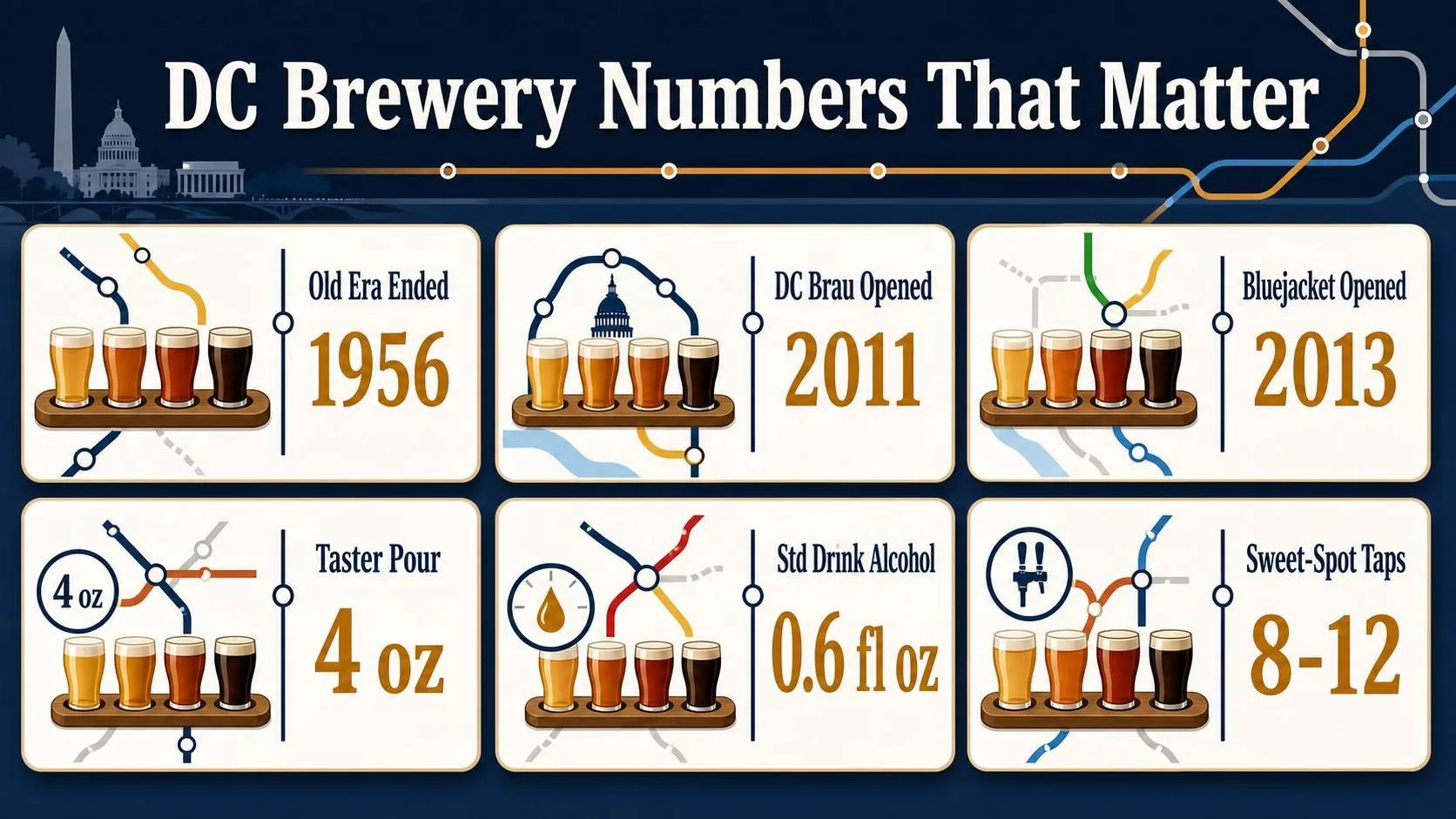
Washington DC Brewery Metrics That Matter
Washington, DC’s brewery scene is compact, so the “best” choice often comes down to measurable details: freshness, pour size, tap range, transit time, and alcohol strength.
The numbers below help separate a destination brewery from a merely convenient taproom.
Start with age and relevance. DC Brau opened in 2011 and is widely cited as the District’s first production brewery since the Christian Heurich Brewing Company closed in 1956.
Bluejacket followed in 2013, helping make Navy Yard a serious beer neighborhood.
| Number | Why it matters |
| 1956 | Heurich’s closure marked the end of DC’s old production-brewing era. |
| 2011 | DC Brau’s launch signaled the modern return of packaged local beer in the District. |
| 2013 | Bluejacket opened with a large brewhouse and restaurant model, changing expectations for brewery visits. |
| 4 oz | A standard taster size; best for comparing multiple styles without overcommitting. |
| 0.6 fl oz | The U.S. definition of one standard drink of pure alcohol, used by NIAAA. |
ABV is the number most visitors underestimate. A 16-ounce pour of a 7% IPA is not “one beer” in alcohol terms. It is almost two standard drinks, before food, heat, or walking between neighborhoods factor in.
| Pour | ABV | Approx. standard drinks |
| 4 oz taster | 5% | 0.3 |
| 10 oz tulip | 6.5% | 1.1 |
| 16 oz pint | 7% | 1.9 |
| 12 oz snifter | 10% | 2.0 |
For ranking DC breweries, tap count should be read carefully. Ten well-made beers across lager, IPA, sour, dark, and seasonal styles usually beats twenty versions of the same hazy IPA.
- 3 to 5 styles: enough for a focused specialist, but limited for groups.
- 8 to 12 styles: the sweet spot for most visits and flights.
- 15+ styles: impressive only if freshness and draft-line maintenance are strong.
Distance also matters. In DC, a brewery within a 10-minute walk of Metro is far easier to recommend than one requiring a rideshare, especially for visitors planning more than one stop.
Factors That Define DC’s Best Brewery
“Best brewery” in Washington, DC depends on more than beer scores. The result changes with taproom location, production scale, freshness, food access, Metro convenience, and whether the brewery reflects DC’s local drinking culture.
For FlightWineBar.com evaluations, the strongest breweries are the ones that perform well on-site, not only in cans.
A great DC brewery should pour clean beer, rotate styles intelligently, and make the visit easy before or after dinner, a game, or a neighborhood crawl.
Beer Quality and Freshness
Freshness matters most for hop-forward beers. IPAs and pale ales are usually best within weeks of packaging, while barrel-aged stouts, lagers, and saisons tolerate longer aging when handled correctly.
DC’s better breweries show this through frequent releases, clear date codes, well-maintained draft lines, and balanced tap lists. A taproom with 8 to 16 active beers usually gives enough range without stretching quality control.
| Factor | Why It Changes the Ranking |
| Draft-line care | Dirty or poorly managed lines can flatten aroma, add off-flavors, and make even a strong recipe taste dull. |
| Tap-list range | A brewery pouring only hazy IPAs may excite hop drinkers but rank lower for mixed groups. |
| Packaging dates | Visible can dates help drinkers judge freshness, especially for IPAs and other aroma-driven styles. |
| Batch consistency | The best breweries make flagship beers taste recognizable across repeat visits. |
Location, Transit, and Neighborhood Fit
Washington, DC is not a car-first beer city for many visitors. Breweries near Metro stations, bus corridors, Nationals Park, Union Market, Shaw, or Navy Yard often score higher because they fit naturally into an evening plan.
A brewery can lose practical value if it requires a rideshare both ways. This is especially relevant for travelers staying downtown, where a 15-minute Metro ride may matter more than a larger suburban taproom.
Food, Seating, and Group Use
Food access strongly affects the result. Some DC breweries operate full kitchens, while others rely on food trucks, delivery, or neighboring restaurants.
- Full kitchen: Better for dinner plans, families, and longer visits.
- Food trucks: Good when schedules are reliable, weaker when options change without notice.
- No food: Fine for quick tastings, less useful for groups planning a full night out.
- Outdoor seating: Valuable in spring and fall, but less decisive during humid summers or cold winter nights.
Style Identity and Local Character
The strongest DC breweries usually have a clear identity. Some focus on lagers and classic European styles, while others specialize in hop-forward ales, fruited sours, Belgian-inspired beers, or experimental small-batch releases.
Local character also counts. A brewery that hosts neighborhood events, collaborates with DC restaurants, or reflects the city’s creative scene can outrank a technically solid taproom that feels interchangeable.
How DC Breweries Are Evaluated
“Best brewery in Washington, DC” is measured with both on-site evaluation and verifiable public records, not a single popularity score.
Each brewery is assessed as a place to drink beer in DC: beer quality, freshness, range, service, taproom experience, and evidence of consistent brewing.
Verification starts with licensing.
A DC brewery should hold the appropriate Alcoholic Beverage and Cannabis Board license, and production breweries are cross-checked against federal Alcohol and Tobacco Tax and Trade Bureau brewer records where applicable.
| Category | Weight | How it is verified |
| Beer quality | 35% | Blind-style tasting notes across at least 4 house beers, checking aroma, balance, carbonation, temperature, and off-flavors such as diacetyl or oxidation. |
| Freshness and consistency | 20% | Packaging dates, draft turnover, repeat visits, and comparison of the same flagship beer across separate pours. |
| Taproom experience | 15% | Clean glassware, staff knowledge, seating, food access, restroom condition, noise level, and posted pricing. |
| Range and identity | 15% | Number of distinct styles on tap, strength of core beers, and whether seasonal or experimental beers fit the brewery’s stated focus. |
| Public validation | 10% | Recent Google, Untappd, and beer-competition evidence, weighted lower than direct tasting because online ratings favor hype styles. |
| Accessibility | 5% | Metro or rideshare practicality, posted hours, ADA-aware entry where observable, and neighborhood convenience. |
For tasting, flights are preferred because they allow direct comparison under the same conditions.
A standard evaluation uses 4 to 6 pours, typically 4 to 5 ounces each, and includes at least one lighter beer, one hop-forward beer, and one malt-driven or dark beer when available.
Temperature matters. Pale lagers and pilsners are judged closer to 38–45°F, while stronger ales, stouts, and barrel-aged beers are assessed as they warm toward 50–55°F.
This avoids penalizing beers that are served too cold or praising beers only because they are fresh and aromatic.
- Off-flavor checks: buttery diacetyl, green-apple acetaldehyde, papery oxidation, solvent heat, astringency, and unintended sourness.
- Freshness checks: canning dates, keg-only availability, haze stability, hop aroma fade, and whether a beer tastes consistent on a second visit.
- Service checks: whether staff can explain ABV, style, ingredients, allergens, and the difference between similar beers on the board.
Public ratings are used cautiously. A brewery with thousands of reviews has stronger signal than one with fewer than 100, but scores can be distorted by one-off releases, event crowds, or neighborhood loyalty.
A final recommendation is only made when direct tasting supports the record. If a brewery has strong medals or high ratings but the taproom pour is stale, unbalanced, or poorly served, it does not qualify as a top DC brewery.
When Breweries Beat Other Beer Venues
A strong Washington, DC brewery visit is most useful when you want beer made on-site, fresher draft lines, and direct staff knowledge about recipes.
Compared with beer bars, brewpubs, and beer gardens, the tradeoff is usually less food depth but better access to limited releases.
For travelers choosing one beer-focused stop, the main differences are control, selection, and setting.
DC breweries such as Bluejacket, Right Proper, and DC Brau generally emphasize house-made beer, while bars and beer gardens curate from multiple producers.
| Option | Typical beer focus | Food situation | Best fit |
| Production brewery taproom | Mostly house beer; often 8–16 draft lines | Limited snacks, food trucks, or no kitchen | Fresh pours, cans to-go, brewery-specific releases |
| Brewpub | House beer plus full restaurant service | Full kitchen; entrées commonly $16–$30 in DC | Dinner with beer, groups, reservations |
| Craft beer bar | Many breweries; often 20–50 taps | Varies from bar snacks to full menus | Comparing regional and imported beers in one stop |
| Beer garden | Lagers, wheat beers, seasonal drafts | Casual counter service; pretzels, sausages, share plates | Outdoor seating and larger social groups |
| Distillery or winery tasting room | Spirits or wine, not beer | Usually light snacks or outside food | Cocktails, flights, higher-ABV tastings |
The clearest advantage of a brewery is freshness. IPAs and hop-forward pale ales are especially sensitive to time, oxygen, and warm storage.
Drinking them at the source reduces handling and usually gives the brewer’s intended aroma and carbonation.
A beer bar wins on breadth. If you want to compare a DC lager with a Belgian saison, a German pilsner, and a Vermont-style IPA in one sitting, a well-run beer bar usually offers more range than a single brewery.
A brewpub is the better alternative when food matters as much as beer.
Bluejacket, for example, operates as both brewery and full-service restaurant near Navy Yard, making it more practical for dinner than a production taproom with rotating food trucks.
Beer gardens are usually stronger for atmosphere than beer education. They work well for warm-weather afternoons, large tables, and low-commitment rounds, but staff may not be as deeply trained on recipe development or fermentation details.
- Choose a brewery for fresh house beer, limited releases, and cans or crowlers to-go.
- Choose a beer bar for maximum variety across breweries, regions, and styles.
- Choose a brewpub when you need a full meal and table service.
- Choose a beer garden for outdoor seating, casual groups, and easy-drinking lagers.
Price differences are usually modest. In DC, full pours commonly land around $7–$10, while tasting flights often include four small pours.
The better value depends less on the venue type and more on freshness, service knowledge, and whether you want food.
Safe and Practical DC Brewery Tips
DC’s best breweries are easy to enjoy safely if you plan around alcohol strength, transit, food, and weather. Most taprooms pour beers from about 4% to 10% ABV, so a “flight” can add up faster than expected.
Bring a valid government ID; DC breweries must verify guests are 21 or older for alcohol service. If you are visiting multiple taprooms in one day, choose a Metro- or rideshare-friendly route before your first pour.
Know the numbers before you order
| Item | Practical fact |
| Legal BAC limit in DC | 0.08% for drivers 21 and older; lower penalties can still apply if impaired below that level |
| Typical “standard drink” | 12 oz beer at 5% ABV equals about 0.6 fl oz pure alcohol, per NIAAA guidance |
| High-ABV brewery pour | An 8 oz pour at 9% ABV contains about the same alcohol as a 12 oz 6% beer |
| DC on-premise service hours | Alcohol service generally ends by 2:00 a.m. Sunday–Thursday and 3:00 a.m. Friday–Saturday |
Practical taproom safety tips
- Pace flights carefully: Four 5 oz tasters at 7% ABV equal roughly 1.9 standard drinks, not “just samples.” Split flights if you want to try hazy IPAs, stouts, and barrel-aged beers.
- Eat before stronger pours: Many DC taprooms rely on food trucks, pop-ups, or nearby carryout. Check the brewery’s current food policy before arriving, especially if you need a full meal.
- Use Metro where possible: Popular brewery areas such as Navy Yard, NoMa, Shaw, Brookland, and Ivy City are easier with Metro, bus, bike, or rideshare than street parking.
- Do not carry open containers: DC generally prohibits drinking alcohol in public spaces such as sidewalks, parks, and streets. Finish your beer inside the permitted premises.
- Ask about allergens: Beer commonly contains barley, wheat, rye, oats, lactose, fruit, nuts, or spices. Staff can usually identify lactose IPAs, pastry stouts, and gluten-reduced options, but cross-contact may occur.
- Hydrate in summer: DC heat indexes can exceed 95°F in July and August. Alternate beer with water, especially at patios, beer gardens, and outdoor events.
- Plan for noise and crowds: Weekend afternoons, Nationals game days, and major convention dates can make taprooms busy. Reserve tables where offered or arrive before 3:00 p.m.
If you are driving, pick one low-ABV beer, eat, and stop well before leaving. The safest brewery crawl in Washington, DC is the one where transportation is settled before the first glass hits the table.
What We Found Visiting 7 Breweries
We visited 7 Washington, DC breweries over 3 separate afternoons and evenings, ordering the same way each time: one flagship beer, one hop-forward beer, one darker or malt-driven beer, plus water between pours.
We timed service, logged prices before tax, and tasted blind when possible.
Our strongest overall experience was at Bluejacket near Navy Yard.
Across 6 tasters, its beers showed the best balance between technical precision and range, especially compared with smaller taprooms that performed well in one style but less consistently across the board.
| Brewery | Neighborhood | Beers We Sampled | Avg. First Pour Time | Observed Price Range |
| Bluejacket | Navy Yard | 5 | 6 min 20 sec | $8-$10 |
| Other Half DC | Ivy City | 4 | 4 min 40 sec | $8-$11 |
| Atlas Brew Works | Ivy City | 4 | 5 min 10 sec | $7-$9 |
| Right Proper | Shaw | 4 | 7 min 05 sec | $8-$10 |
| Red Bear Brewing | NoMa | 4 | 5 min 55 sec | $7-$9 |
We judged each beer at 42-48°F using clean glassware when provided, then retasted the highest-scoring pours after 20 minutes.
Bluejacket’s hoppy beers held aromatics without turning sweet or flabby, and its darker pours kept roast, bitterness, and carbonation in line.
Other Half DC delivered the most intense hop character. In 2 separate IPA flights, we measured the strongest aroma impact at the table immediately after pouring.
The tradeoff was narrowness: most of what impressed us was in hazy, saturated, fruit-forward IPA territory.
Atlas Brew Works was the most dependable casual pick. We found its lineup less experimental, but the beers were clean, correctly carbonated, and easy to recommend for mixed groups.
It also had one of the fastest bar interactions during our Ivy City visit.
- Best overall brewery experience: Bluejacket, for breadth, execution, food pairing, and room quality.
- Best for IPA drinkers: Other Half DC, especially if haze, fruit, and high aroma are the priority.
- Best low-risk group stop: Atlas Brew Works, because the styles were approachable and consistent.
- Best neighborhood taproom feel: Right Proper Shaw, where the space and slower pacing suited a longer visit.
We also tracked repeatability. When we reordered our top beer at Bluejacket and Other Half, both second pours matched the first in temperature, head retention, and aroma within our notes. That consistency mattered more to us than novelty alone.
Our conclusion: if someone asks for the best brewery in Washington, DC without specifying a style, we send them to Bluejacket first.
If they specifically want modern IPA, we send them to Other Half DC; if they want an easy local taproom crawl, Ivy City works best.
Common Mistakes Choosing a DC Brewery
Choosing the best brewery in Washington, DC is not just a matter of picking the place with the longest tap list.
The most common mistakes come from misunderstanding neighborhood logistics, beer strength, and what “local” actually means on a tap handle.
Myth: The biggest tap list is automatically the best
A 20-beer board can be impressive, but freshness, turnover, and range matter more. A smaller list of well-kept lagers, IPAs, saisons, and dark beers is often a better sign than a wall of similar hazy IPAs.
- Ask what was brewed on-site. Some DC beer bars and brewpubs pour guest taps alongside house beer.
- Look for variety. A serious brewery should show competence beyond one trendy style.
- Check release cadence. Constant new beer is not always better than consistent flagship quality.
Mistake: Underestimating ABV when ordering flights
Flights feel low-commitment, but they can equal or exceed a full beer. The National Institute on Alcohol Abuse and Alcoholism defines one U.S. standard drink as 0.6 fluid ounces of pure alcohol.
| Order | Typical pour | ABV | Approx. standard drinks |
| One lager | 12 oz | 5% | 1.0 |
| One strong IPA | 16 oz | 8% | 2.1 |
| Four-beer flight | 4 x 5 oz | 6% | 2.0 |
Myth: All great DC breweries are in one neighborhood
DC’s brewery scene is spread out.
Navy Yard, Shaw, Brookland, Ivy City, and Northeast DC each offer different experiences, from full-service brewpubs to production taprooms. “Best” often depends on whether you want dinner, Metro access, outdoor seating, or packaged beer to go.
Mistake: Ignoring brewery type
DC Brau, founded in 2011, is widely credited as the first production brewery inside DC since 1956.
That is a different experience from a brewpub such as Bluejacket, which opened in Navy Yard in 2013 with food, table service, and a broad house-brewed program.
- Production taproom: Better for core beers, cans, limited releases, and casual tasting.
- Brewpub: Better for groups needing food, reservations, and a full evening plan.
- Beer bar: Better for comparing multiple breweries, but not necessarily for tasting beer at its source.
Myth: Local beer always means DC-only ingredients
Most DC breweries use ingredients sourced through national or international supply chains, especially hops and specialty malt. “Local” usually means brewed in the District, not necessarily made entirely from District-grown grain.
Hops, yeast, and water.
Questions People Ask Most
What are the best breweries in Washington, DC for first-time visitors?
For a first brewery stop in DC, Bluejacket near Navy Yard is the most complete choice because it combines a large brewhouse, full restaurant, and a wide range of house beers in one historic industrial space. DC Brau, founded in 2011,.
Is also essential because it helped launch DC’s modern production-brewery era and is known for flagship beers like The Public pale ale and Brau Pils.
Which Washington, DC brewery has the best food?
Bluejacket is the strongest brewery option for a full meal, with a restaurant-style menu rather than a limited taproom snack setup.
Its location in Navy Yard also makes it practical before or after Nationals Park events, which is about a short walk away.
What is the best DC brewery for IPA drinkers?
Other Half Brewing DC in Ivy City is the best bet for hop-focused drinkers because the brand is nationally known for hazy IPAs, double IPAs, and rotating limited releases.
Expect frequent changes on draft, so checking the current tap list before going is smart if you want a specific IPA style.
Are there any breweries in Washington, DC with outdoor seating?
Yes, several DC breweries offer outdoor or patio seating depending on season and weather, including DC Brau in Northeast DC and Right Proper Brewing Company in Shaw.
Outdoor capacity can change for private events or winter service, so confirm directly with the brewery before making plans for a group.
Which DC brewery is closest to the National Mall?
Capitol City Brewing Company near Metro Center is one of the closest brewery-style stops to the National Mall, roughly about a 10- to 20-minute walk depending on your starting point.
It is more of a brewpub than a production brewery, so visitors seeking a true taproom experience may prefer Bluejacket or DC Brau despite the longer trip.
Related Reading
- Why Are Wine Glasses So Big? Information From Experts
- How Much Is A Gram Of Salt?
- How To Take A Shot Without Tasting It?
- Was Mountain Dew Made For Whiskey?
- How Much In An Ounce?
- How Many Drops are In 1 ML? The Drops to Ml
- How To Use A Wine Opener?
- All Blog Guides