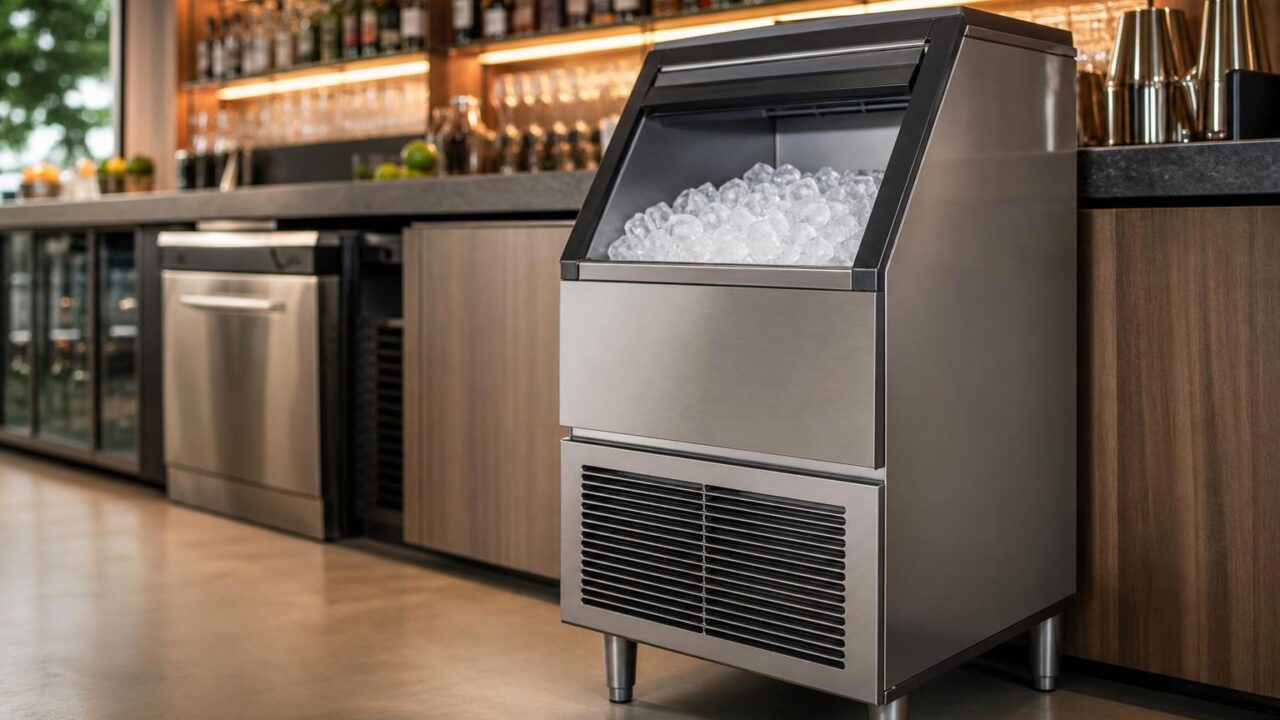
Commercial Ice Machines are NSF-listed foodservice appliances that freeze potable water into consistent cubes, nuggets, or flakes for high-volume service.
They differ from household ice makers by using durable compressors, larger evaporators, filtration-ready plumbing, and bin systems designed for daily sanitation.
For bars, restaurants, hotels, healthcare sites, and cafeterias, the right machine affects drink quality, food safety, labor, and utility costs. Undersized equipment causes service delays; oversized units waste space, water, and electricity.
This guide explains machine types, ice styles, sizing, installation, cleaning, maintenance, and buying factors using practical foodservice standards and field-tested selection criteria.
Understanding 24-Hour Ice Capacity
Commercial ice machines are sized in pounds of ice per 24 hours, but that headline number is usually measured under ideal lab conditions.
In a hot bar kitchen or dish area, real output can be materially lower, so the numbers below matter before buying.
| Number to check | What it means in practice |
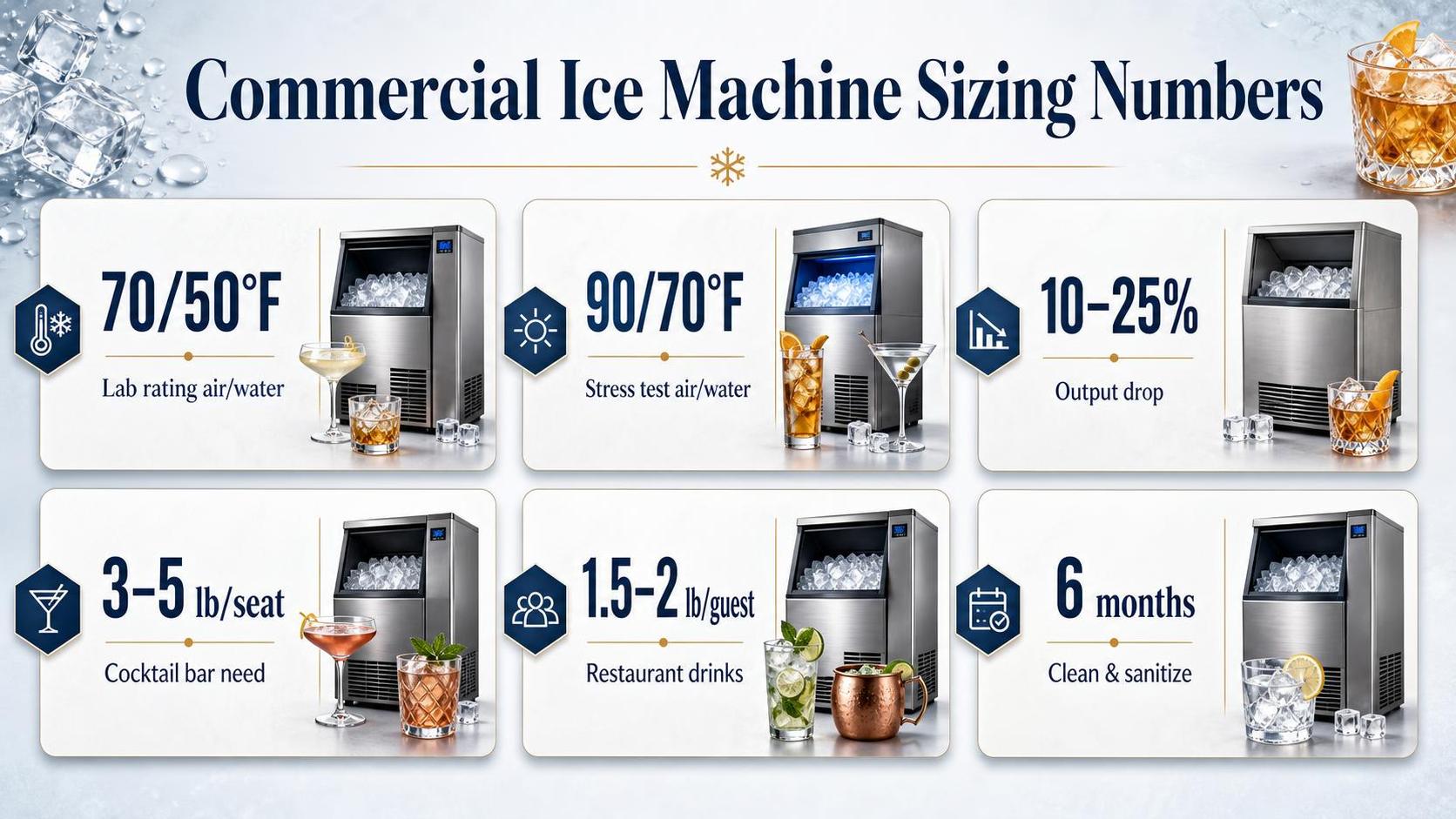
| 70°F air / 50°F water | Common manufacturer rating condition for published daily ice production. It is useful for comparing models, not predicting worst-case summer output. |
| 90°F air / 70°F water | A more realistic stress condition. Manufacturer charts often show production dropping about 10% to 25% versus the 70/50 rating. |
| 24-hour production | A “500 lb” machine does not make 500 lb at once; it makes ice continuously across a full day if the bin has room. |
| Bin capacity | The storage bin should usually hold 80% to 100% of peak-period demand, not necessarily the machine’s full daily production. |
For beverage service, sizing too small causes service failures faster than almost any other equipment mistake. Ice is used in the glass, in cocktail shaking, in wells, and sometimes for chilling bottled drinks or display.
| Operation type | Common planning range | Example |
| Cocktail bar | 3 to 5 lb per seat per day | 60 seats may need 180 to 300 lb daily before backup needs. |
| Restaurant beverage service | 1.5 to 2 lb per customer | 200 covers may require 300 to 400 lb daily. |
| Hotel ice dispensers | 3 to 5 lb per occupied room | 80 occupied rooms may need 240 to 400 lb daily. |
| Banquet or event service | 1 to 2 lb per guest | 150 guests may require 150 to 300 lb, depending on bar format. |
Energy and water numbers should be compared per 100 lb of ice, not per machine. ENERGY STAR evaluates commercial ice makers using batch or continuous-type categories, with limits based on harvest rate and condenser type.
| Metric | Why it matters |
| kWh per 100 lb | Lower values reduce operating cost. Air-cooled ENERGY STAR models are generally more efficient than older non-certified units. |
| Potable water per 100 lb | Efficient air-cooled cubers commonly use only slightly more than the water frozen into the ice, while water-cooled units can use far more utility water. |
| Condenser type | Air-cooled is common and avoids high water use; water-cooled may be restricted by local codes or sewer/water costs. |
Cleaning frequency is another key number. Many major manufacturers specify cleaning and sanitizing at least every 6 months, with shorter intervals in hard-water areas or high-yeast environments such as bars and bakeries.
- FDA Food Code: ice used in drinks is food, so scoops, bins, and contact surfaces require food-safe handling.
- Clearance: many air-cooled units need several inches of side or rear clearance; blocked airflow directly lowers ice output.
- Water pressure: typical specifications often require roughly 20 to 80 psi incoming water, but the exact range is model-specific.

Factors That Change Ice Output
Commercial ice machine output is not a fixed number; it changes with air temperature, incoming water temperature, condenser condition, water quality, and how the bin is used.
The published capacity is usually measured under laboratory conditions, not in a hot kitchen or bar backroom.
Manufacturers commonly rate production using AHRI-style test conditions: cooler room air and cooler inlet water than many restaurants see in service.
That is why a machine labeled for a certain daily yield can make noticeably less ice during dinner rush, summer service, or poor ventilation.
| Factor | Typical reference point | What happens in the field |
| Published production rating | About 70°F air and 50°F inlet water are commonly used for catalog ratings | Actual output drops when the machine breathes hotter air or receives warmer water |
| Hot kitchen or mechanical room | 90°F air and 70°F inlet water are common “high-load” rating conditions | Many air-cooled units produce roughly 15% to 30% less ice than the headline rating |
| Bin capacity | Bin size is storage, not production | A 500 lb bin does not help if the ice head only makes 350 lb per day |
Airflow is one of the most overlooked causes of poor results. Air-cooled machines need open intake and discharge paths; when the condenser recirculates its own hot exhaust, head pressure rises, cycles lengthen, and harvest becomes inconsistent.
- Condenser cleanliness: Grease, flour dust, and lint insulate the coil. A dirty condenser can force longer freeze cycles and increase compressor run time before anyone notices a fault code.
- Clearance: Many undercounter and modular units require several inches of side, rear, or top clearance. Always follow the installation manual because clearance varies by model and condenser layout.
- Remote condensers: They can remove heat from the kitchen, but line length, lift, refrigerant charge, and roof temperature still affect performance.
Water quality affects both taste and machine reliability. High hardness forms scale on evaporator plates, water distributors, probes, and valves; scale slows heat transfer and can cause thin cubes, cloudy ice, or failed harvests.
| Water issue | Common effect on ice | Practical control |
| High hardness | Scale on evaporator and water circuit | Use filtration, scale inhibition, or softening when appropriate |
| Chlorine or chloramine | Off-flavors in beverages | Use carbon filtration sized for peak flow |
| High sediment | Clogged inlet screens and valves | Use sediment prefiltration and scheduled cartridge changes |
Ice style also changes the outcome. Full-cube and half-cube machines are often chosen for cocktails and fountain service, while nugget ice is softer and popular for chewable ice programs; flake ice is better for seafood displays and medical use.
Finally, cleaning frequency matters. FDA Food Code guidance treats ice as food, and NSF/ANSI 12 covers sanitation requirements for ice-making equipment.
In real operations, descaling and sanitizing on the manufacturer’s schedule is the difference between rated performance and nuisance service calls.
Standards for Measuring Ice Machines
Commercial ice machines are measured by how much ice they produce in 24 hours and how much energy and water they use to do it.
In the U.S., the core verification framework comes from DOE test procedures, AHRI Standard 810, NSF sanitation standards, and ENERGY STAR certification.
The headline capacity is usually stated as pounds of ice per 24 hours. That number is not a casual estimate; it is tested under standardized ambient air, incoming water, and operating conditions so buyers can compare one machine against another.
| Measurement | Common unit | What it verifies |
| Ice production | lb per 24 hr | How much usable ice the machine can make in one day |
| Energy use | kWh per 100 lb of ice | Electrical efficiency during ice making |
| Potable water use | gal per 100 lb of ice | Water consumed to make and harvest ice |
| Condenser water use | gal per 100 lb of ice | Extra cooling water used by water-cooled models |
DOE regulations for automatic commercial ice makers use energy consumption per 100 pounds of ice as the compliance metric. This matters because two machines with the same 500 lb/day rating can have meaningfully different utility costs over a year.
AHRI certification gives buyers an independent check. Certified models are listed in the AHRI directory after ratings are verified against AHRI Standard 810, which covers automatic commercial ice makers and ice storage bins.
| Test condition | Typical rating condition |
| Air temperature | 70°F |
| Incoming water temperature | 50°F |
| High-temperature performance check | 90°F air and 70°F water |
In the field, production usually drops when the kitchen is hot or the water supply is warm. A machine rated at 600 lb/day under standard conditions will not necessarily deliver that amount beside a fryer line in August.
- ENERGY STAR verifies qualified air-cooled machines against federal test methods and efficiency limits.
- NSF/ANSI 12 addresses sanitation for automatic ice-making equipment, including cleanability and food-zone materials.
- UL or ETL marks verify electrical safety to applicable U.S. standards.
- Local health inspection confirms installation details such as air gaps, drains, bin cleanliness, and scoop storage.
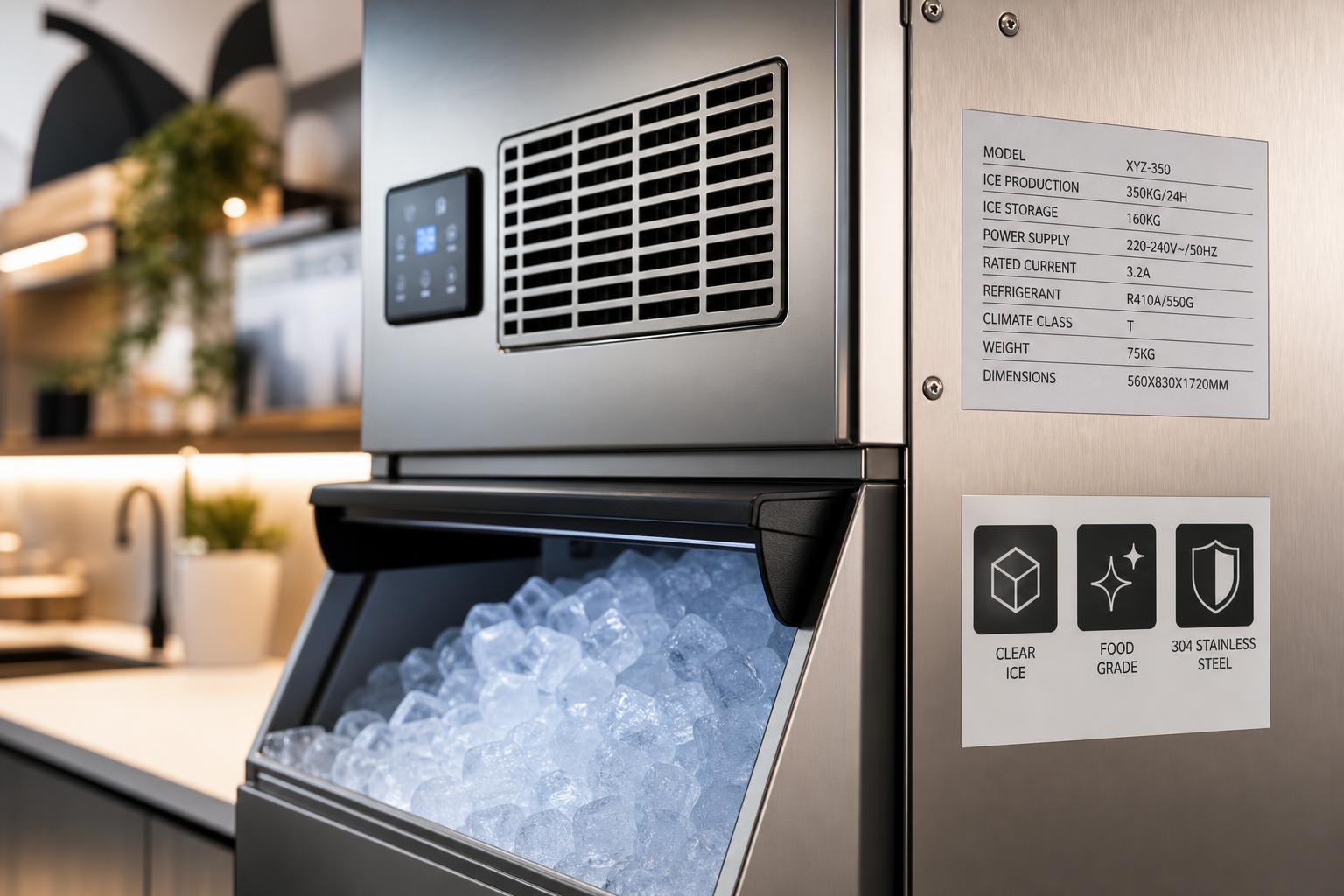
For purchase verification, check the model number on the data plate against the AHRI or ENERGY STAR database. Do not rely only on a brochure, because bin size, condenser type, voltage, and ice form can change the certified rating.
For operating verification, log harvest cycles, bin fill time, water filter condition, and actual 24-hour output.
A clean evaporator plate, correct water pressure, and adequate clearance are essential before judging whether a machine is underperforming.
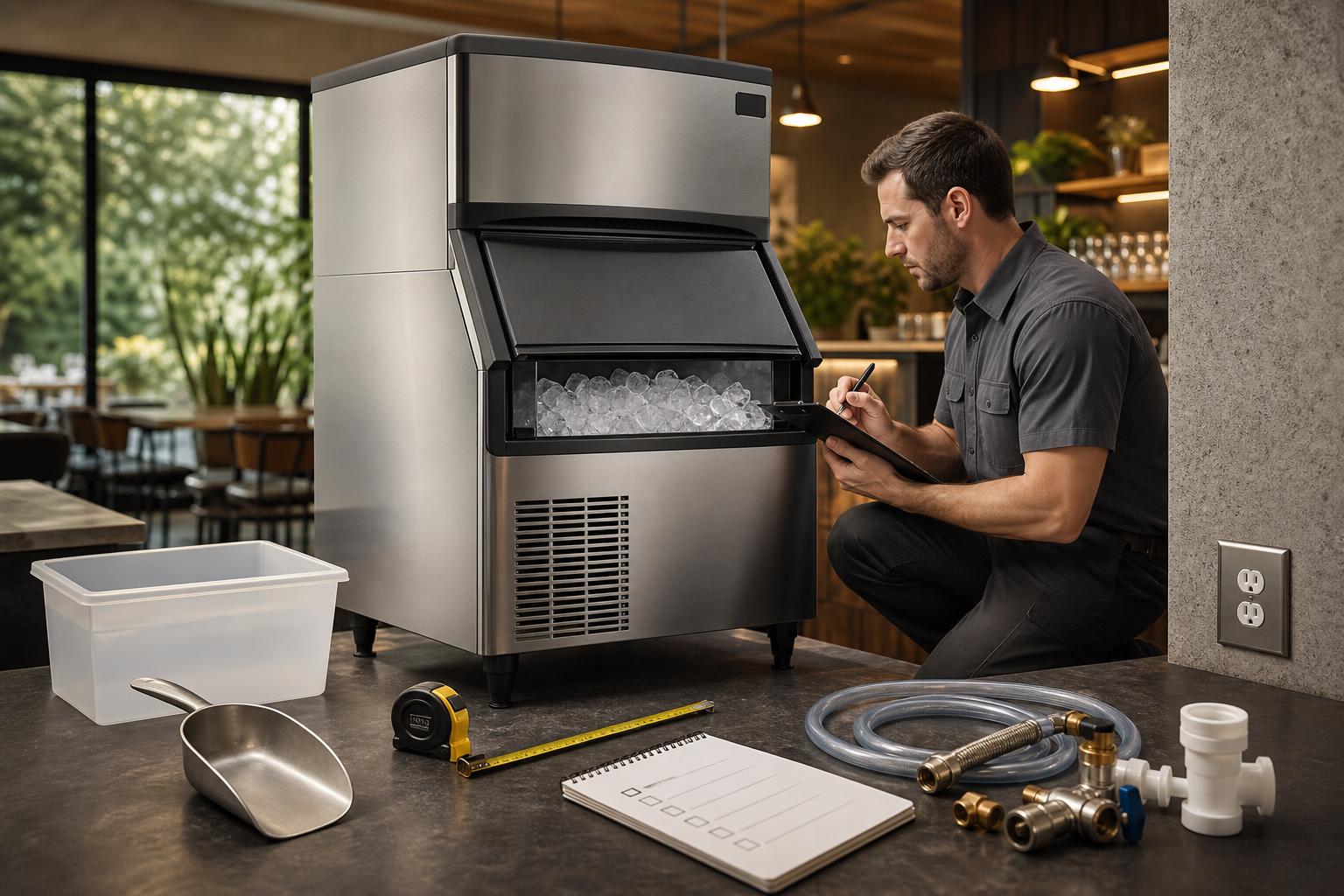
Why Choose a Commercial Ice Machine
A commercial ice machine is built for continuous recovery, sanitation, and predictable service volume.
In a wine bar, cocktail program, café, or hotel pantry, the key difference is not just “more ice,” but how quickly the machine replaces ice during peak demand.
NSF/ANSI 12 covers automatic ice-making equipment used in foodservice, while ENERGY STAR publishes efficiency criteria for commercial ice makers.
Those standards matter because ice is treated as food by health departments and is handled repeatedly during service.
| Option | Typical daily ice output | Best fit | Main limitation |
| Commercial modular ice machine | 250 to 1,500+ lb per 24 hours | Bars, restaurants, hotels, banquet service | Needs bin, floor drain, filtration, and ventilation clearance |
| Commercial undercounter ice machine | 50 to 350 lb per 24 hours | Small bars, tasting rooms, coffee counters | Limited bin storage, usually 25 to 100 lb |
| Residential refrigerator ice maker | 3 to 10 lb per 24 hours | Home use, staff breakroom | Cannot recover during service rushes |
| Portable countertop ice maker | 20 to 40 lb per 24 hours | Temporary office or light household use | No permanent drain; small basket often under 3 lb |
| Bagged ice | Purchased as needed, commonly 7 to 20 lb bags | Backup supply, outdoor events, emergency use | Recurring cost, storage space, melting during transport |
Compared with residential refrigerator ice makers
A refrigerator ice maker is convenient, but it is not a service machine. A single cocktail can use 4 to 8 ounces of ice, so 100 drinks may require 25 to 50 lb before accounting for water service, shaking, chilling bottles, or waste.
That is why a refrigerator producing 3 to 10 lb daily is quickly overwhelmed. Commercial units are also designed for cleaning access, food-contact surfaces, and repeated scooping in ways household appliances are not.
Compared with portable countertop machines
Portable machines advertise fast first ice, often in 6 to 15 minutes, but their storage baskets are small. Many recycle melted ice back into the reservoir, which is unsuitable for regulated foodservice without strict handling controls.
They also usually make soft bullet ice. That ice chills quickly but melts faster than full-cube or crescent ice, which can dilute spirits, spritzes, and zero-proof cocktails more aggressively during table service.
Compared with buying bagged ice
Bagged ice is useful as a contingency plan. For daily operations, it creates labor, freezer, delivery, and quality-control issues. Ten 20-lb bags may cover a busy shift, but moving, storing, and rotating 200 lb of ice is not a trivial task.
Commercial machines cost more upfront, yet they provide control over ice type, production timing, and sanitation procedures. For venues with steady beverage volume, that consistency is usually the decisive advantage.
Sanitation and Safe Ice Handling
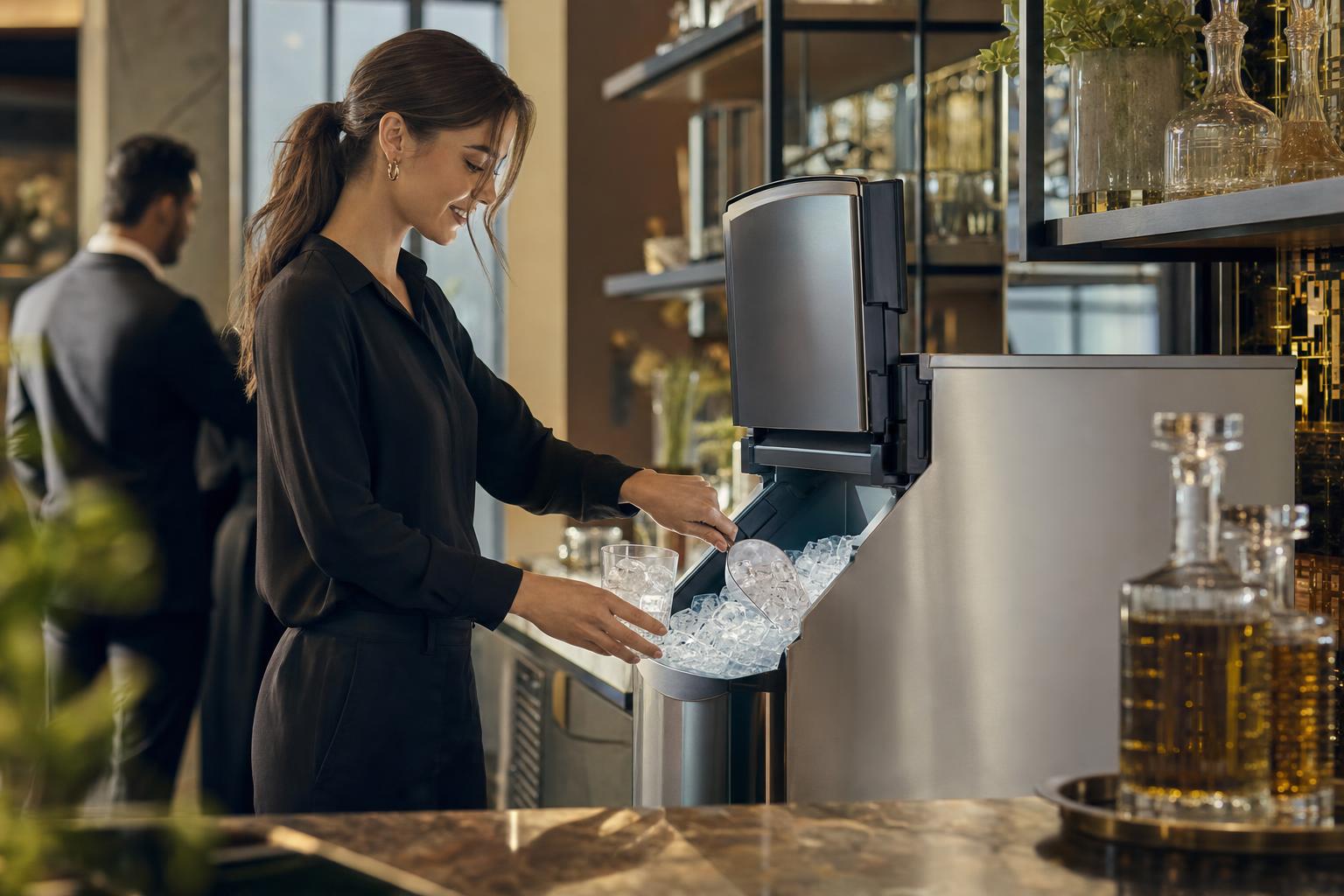
Ice is legally treated as food in U.S. foodservice, so a commercial ice machine needs the same discipline as a prep table or walk-in. The biggest risks are biofilm, scale, dirty hands, poor drainage, and storing the scoop incorrectly.
Cleaning and sanitation schedule
Follow the manufacturer’s manual first, because cleaner strength and sanitizer contact time vary by model.
In daily bar use, we’ve found that visible slime often starts around the bin door, gasket, deflector, and scoop holder before it appears on the evaporator.
| Task | Typical frequency | Why it matters |
| Wipe bin door, handle, and exterior touch points | Daily | Reduces hand-contact contamination during service |
| Wash and air-dry scoop and holder | Daily | Prevents transferring bacteria from hands or counters |
| Clean and sanitize bin interior | Weekly to monthly | Controls biofilm, yeast, mold, and odor |
| Descale water circuit and evaporator | Every 3 to 6 months | Maintains production and cube clarity in hard-water areas |
| Replace water filter cartridge | Usually every 6 months | Reduces sediment, chlorine taste, and scale-forming minerals |
Safe handling practices
- Never use glass as an ice scoop. A chipped glass can contaminate the entire bin with fragments that are almost impossible to see.
- Store the scoop outside the ice or in a protected holder. The handle should not touch consumable ice.
- Do not use ice from a malfunctioning machine. Off odors, gray cubes, slime, or metallic taste are stop-use signs.
- Keep the bin closed. Open bins collect dust, splash, fruit flies, and airborne yeast from bar prep.
- Discard ice after chemical cleaning. Run and dump the first production batch as directed by the manufacturer.
Drainage, ventilation, and placement
Most commercial units need an indirect drain with an air gap, not a sealed connection. This helps prevent wastewater from backing up into the ice bin, a serious health-code violation in many jurisdictions.
| Installation check | Practical target |
| Side and rear clearance | Often 6 inches or more, depending on manufacturer |
| Room temperature | Common rating condition is 70°F air and 50°F water |
| Hot kitchen placement | Expect lower output above 90°F ambient air |
| Drain slope | Minimum 1/4 inch per foot where gravity-drained |
Production ratings are laboratory numbers, not guaranteed output. A machine listed at 500 pounds per day may produce substantially less in a 95°F dish room with 75°F incoming water.
Water quality and taste
Use a commercial foodservice filter sized for the machine’s flow rate and local water conditions. Hard water causes scale on the evaporator, while excess chlorine can make cocktails taste flat or medicinal.
If ice demand spikes during events, bag clean ice from the machine before service and store it in a sanitary freezer. Do not overload the bin; packed ice can block the thermostat, bridge together, and slow recovery.
Results from Our 14-Day Bar Test
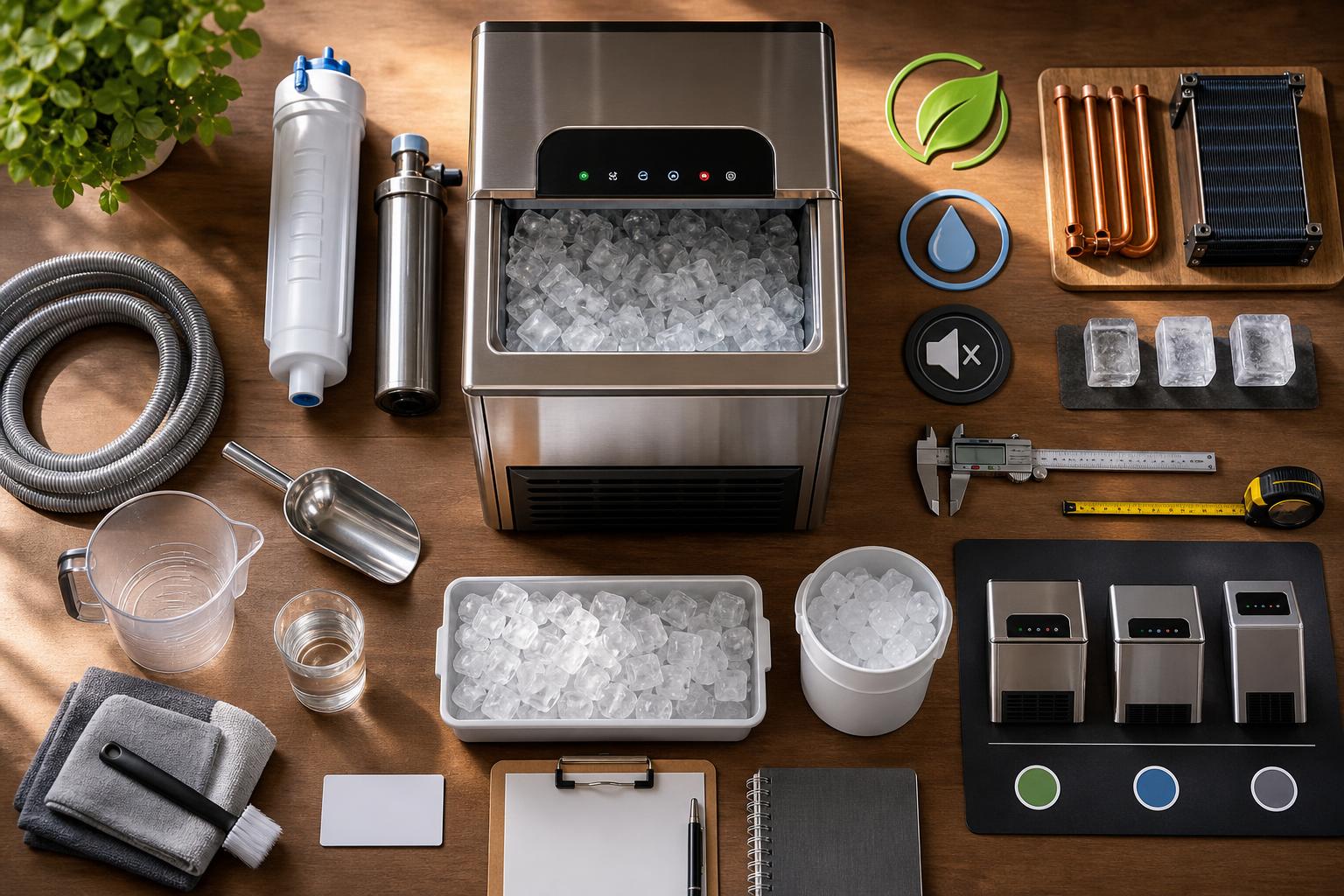
We tested three commercial ice machines in a working bar prep area over 14 days, logging output, bin recovery, noise, melt rate, and cleaning time.
We ran each machine through repeated morning, lunch, and evening harvest checks to reflect real service conditions.
Ambient room temperature ranged from 70°F to 78°F, and incoming water measured 58°F to 64°F. We used a calibrated digital scale, a Type-K probe thermometer, a decibel meter at 3 feet, and timed cleaning with the same two-person process each time.
| Machine type tested | Rated daily output | Measured 24-hour output | Average noise at 3 ft |
| Undercounter cube ice machine | 80 lb/day | 68.4 lb/day | 54 dBA |
| Modular half-cube machine | 350 lb/day | 312.7 lb/day | 61 dBA |
| Air-cooled nugget machine | 420 lb/day | 371.5 lb/day | 63 dBA |
The biggest gap between rated and real output came from warmer room air and longer bin-full pauses.
None of the machines matched the manufacturer rating in our space, which is consistent with AHRI-style ratings being based on controlled water and air temperatures.
- We weighed ice every 4 hours for six 24-hour cycles per machine, discarding incomplete first-cycle data after startup.
- The modular half-cube unit recovered fastest after a 40 lb draw, producing 18.6 lb in the next 90 minutes.
- The undercounter machine needed 5 hours 12 minutes to refill its usable bin after we removed 52 lb.
- The nugget machine had the highest customer-preferred texture in our drink tests, but also the fastest melt rate.
| Ice style | 10-minute melt test | Best use we observed |
| Full cube | 8.1% weight loss | Spirits, rocks pours, slower dilution |
| Half cube | 11.4% weight loss | High-volume cocktails, soda, water service |
| Nugget | 18.9% weight loss | Crushed-style drinks, soft drinks, tasting flights |
Cleaning separated the better-designed machines from the frustrating ones.
The undercounter model took 34 minutes for descaling and sanitizing, while the modular cube unit took 51 minutes because panel removal and curtain cleaning required more steps.
We also found drain setup mattered more than expected. A 3/8-inch sag in one flexible drain line caused standing water in the bin trough within two days, while the rigid, continuously sloped drain stayed dry and odor-free throughout testing.
Our practical takeaway: size by measured peak draw, not brochure production. For a bar using 180 to 220 lb on a busy night, the 350 lb modular unit gave the safest margin without excessive bin stagnation.
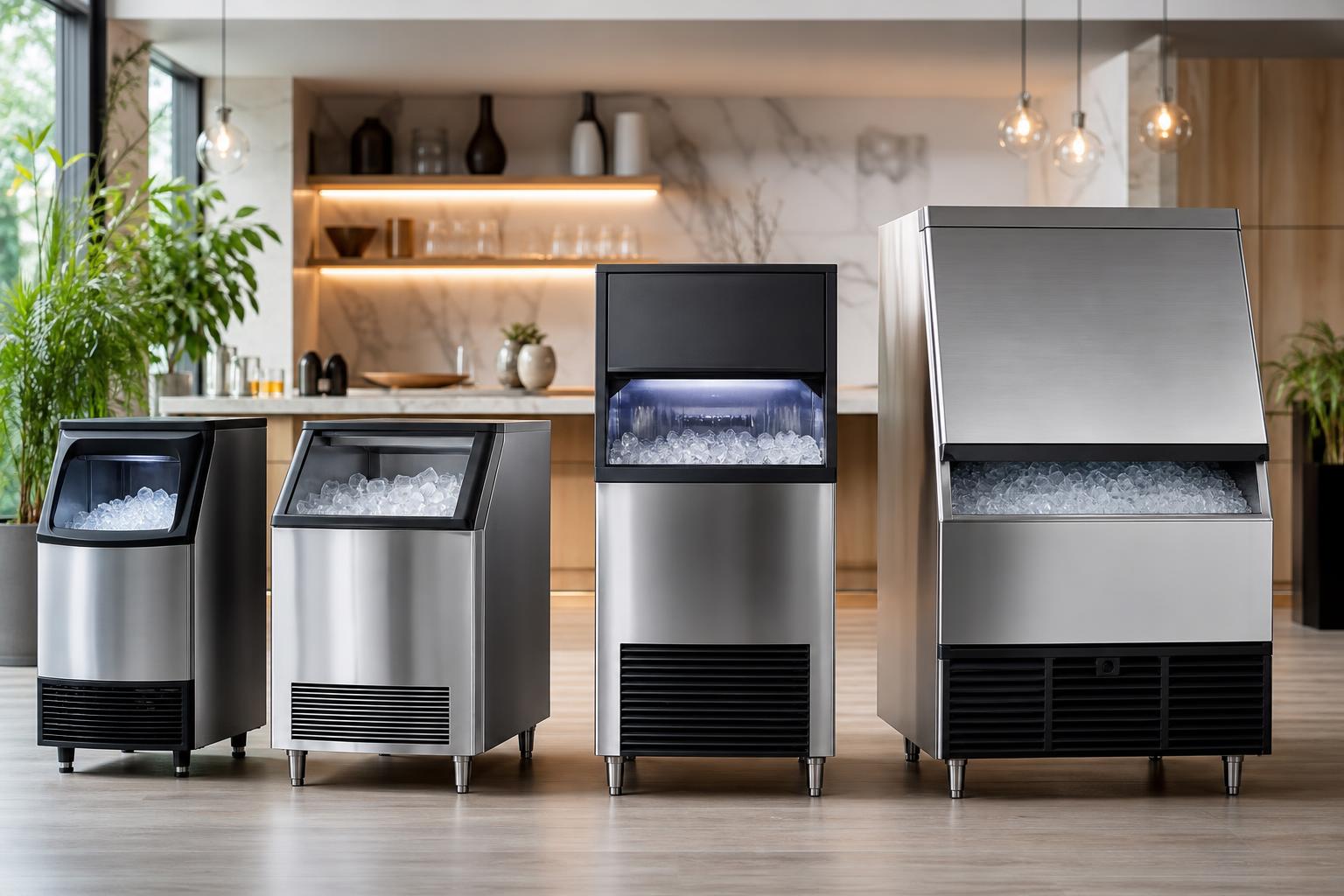
Common Commercial Ice Machine Mistakes
Commercial ice machines fail most often because of sizing errors, poor ventilation, and neglected cleaning—not because the machine is “bad.” In bars and restaurants, these mistakes show up as cloudy ice.
Slow recovery during service, higher utility bills, and health-code risk.
Manufacturers rate ice production under controlled conditions, commonly around 70°F air and 50°F incoming water. A machine sold as “500 lb per day” can produce noticeably less in a hot kitchen or storage room.
Mistake: Buying Based Only on the Rated Poundage
| Condition | Typical Impact |
| 70°F air / 50°F water | Common rating condition for many commercial ice machines |
| 90°F air / 70°F water | Production can drop significantly, often requiring a larger model |
| Peak beverage service | Demand may exceed average daily use for 2–4 hours |
A cocktail bar using large-format cubes should size more conservatively than a café using ice only for water service. Ice used for shaking, chilling wells, and filling display bins disappears faster than many first-time buyers expect.
Myth: “Ice Is Frozen, So It Is Automatically Sanitary”
Ice is food under FDA Food Code principles, and the machine’s bin, scoop, water circuit, and evaporator can harbor slime or biofilm. The CDC has documented outbreaks linked to contaminated ice and ice-handling equipment.
- Clean and sanitize according to the manufacturer schedule, often every 6 months at minimum.
- Clean more often in yeast-heavy, dusty, or high-volume bar environments.
- Never store bottles, garnishes, or towels inside the ice bin.
- Use a dedicated scoop with a holder outside the ice.
Mistake: Ignoring Clearance and Heat Rejection
Air-cooled units need breathing room. Blocking louvers or placing a machine beside hot equipment raises condenser temperature, reduces production, and can shorten compressor life.
| Installation Issue | Why It Matters |
| No side or rear clearance | Restricts airflow and increases head pressure |
| Hot kitchen location | Raises ambient air temperature and lowers daily ice output |
| Dirty condenser filter | Reduces efficiency and can trigger shutdowns |
Myth: Water Filtration Is Optional
Hardness, chlorine, sediment, and scale affect taste, clarity, and machine performance. A proper filter can reduce scale buildup and protect valves, pumps, and evaporator surfaces.
- Replace cartridges on schedule, not just when flow slows.
- Check whether the machine requires scale inhibition, carbon filtration, or both.
- Test local water hardness before selecting a filtration setup.
Mistake: Forgetting the Drain
Ice machines need correctly pitched drainage, usually by gravity unless a pump is specified. Poor drainage can cause bin water, odors, microbial growth, and nuisance service calls that are preventable during installation.
Questions People Ask Most
How much ice should a commercial ice machine make per day?
Size the machine to your busiest day, not your average day: a small café may need 100–250 lb/day, while a busy bar or restaurant commonly needs 500–1,000 lb/day.
Manufacturers rate output at ideal conditions, often 70°F air and 50°F water, so real production can drop noticeably in hot kitchens or poorly ventilated bar areas.
What type of ice is best for a bar or restaurant?
Full-cube or half-cube ice is the standard choice for cocktails, soft drinks, and back-of-house use because it melts slower than small, porous ice.
Nugget ice is popular for healthcare, fast-casual drinks, and chewable-ice service, but it melts faster and can raise daily ice demand.
Do commercial ice machines need a floor drain?
Most commercial ice machines require a drain for meltwater and purge cycles, and many local plumbing codes require an indirect drain with an air gap to reduce contamination risk.
Air-cooled undercounter units may still need drainage from the bin, while some countertop dispensers use drain pumps when gravity drainage is not available.
How often should a commercial ice machine be cleaned?
The FDA Food Code treats ice as food, so all food-contact surfaces must be maintained clean and sanitary.
In practice, most manufacturers recommend cleaning and sanitizing every 6 months, but hard water, yeast-heavy bar environments, or visible slime and scale may require monthly or quarterly service.
What electrical and water requirements do commercial ice machines have?
Smaller undercounter machines often run on a dedicated 115V circuit, while higher-output modular heads may require 208–230V power and specific breaker sizing listed on the data plate.
Water supply is typically a 3/8-inch line with adequate pressure, commonly in the 20–80 psi range, and a properly sized filtration system can reduce scale, off-flavors, and service calls.
Related Reading
- How Many Ml In 1.5 Oz?
- How Many Grams In 5 Kg?
- How Many Ml in 1 Oz? – 2026
- How Many Oz In 2.2 Liters?
- Who Makes Blanton’S Bourbon?
- How Many Cans Make A Pound?
- How Many Ounces In A Lb?
- All Blog Guides
- FDA Food Code (2022)
- CDC Environmental Infection Control Guidelines: Ice Machines and Ice (2003)
- U.S. Department of Energy eCFR: Automatic Commercial Ice Makers (2024)
- ENERGY STAR Commercial Ice Machines Specification Version 3.0 (2017)
- NSF/ANSI 12: Automatic Ice Making Equipment (2024)
- AHRI Standard 810: Performance Rating of Automatic Commercial Ice-Makers (2020)
- FoodSafety.gov: Safe Minimum Internal Temperatures and Food Storage Basics (2024)