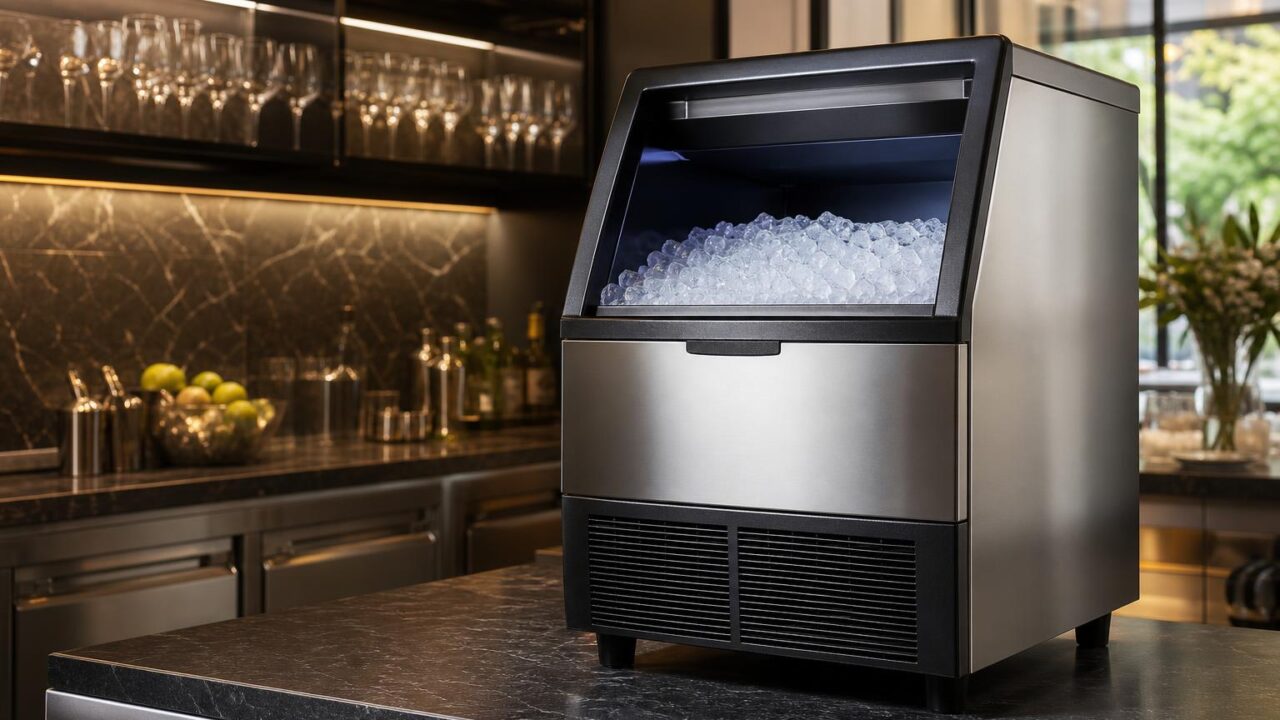
A commercial ice maker is a dedicated appliance that freezes potable water into consistent cubes, nuggets, or flakes for foodservice, hospitality, healthcare, and high-volume service environments.
Unlike household machines, it is built for continuous daily production, sanitary handling, rapid harvest cycles, and predictable ice output during peak demand.
Choosing the right unit depends on production capacity, bin storage, condenser type, water quality, ventilation, and local health-code requirements.
This guide explains how commercial ice machines work, what sizes and ice types fit different operations, and which installation and maintenance details affect reliability, safety, and operating cost.
Understanding Commercial Ice Production Ratings
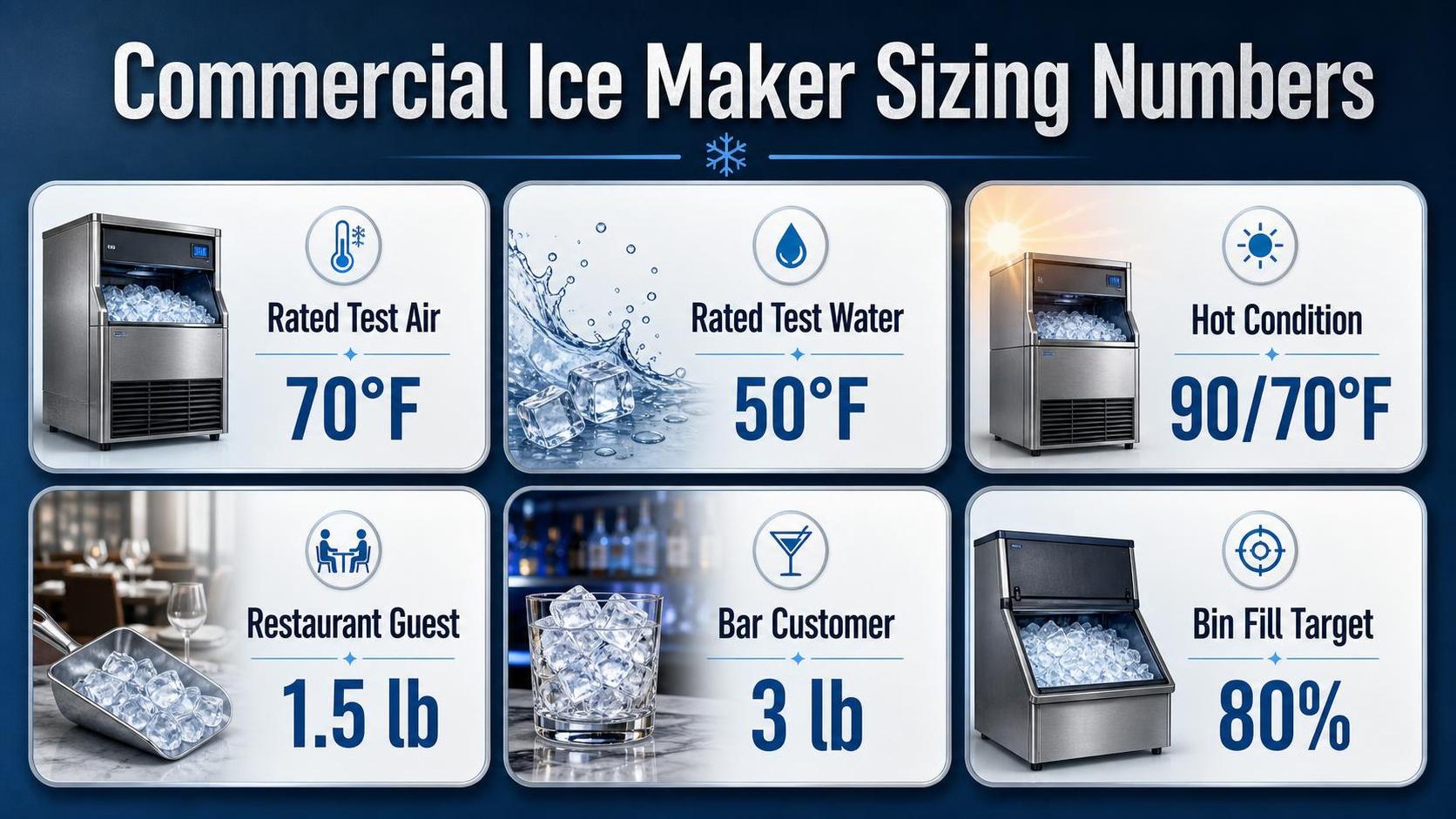
A commercial ice maker is usually sized by pounds of ice produced in 24 hours, but that rating assumes test conditions. In the real world, warmer kitchens, hotter incoming water, and peak-service demand can reduce usable output.
When I size ice machines for bar or restaurant service, I treat the factory production number as a ceiling, not a promise. The numbers below are the ones that most often prevent under-buying.
| Number | What it means | Why it matters |
| 70°F air / 50°F water | Common rating condition for ice production, used in AHRI-style published performance data. | A machine listed at 500 lb/day may make less in a 90°F kitchen with 70°F inlet water. |
| 90°F air / 70°F water | A common “hot condition” performance point shown by many manufacturers. | Expect a meaningful drop; some units lose roughly 15% to 30% of rated daily production. |
| 1.5 lb per restaurant guest | A practical planning estimate for full-service dining. | 100 covers can require about 150 lb of ice before staff beverages, prep, or waste. |
| 3 lb per bar customer | A safer estimate for cocktail-heavy operations. | Shaken drinks, wells, rocks pours, chilling, and dumping ice raise demand fast. |
| 80% bin fill target | Usable storage should not rely on a bin packed to the rim. | A 300 lb bin is more realistically planned as about 240 lb of accessible ice. |
Production capacity is not storage capacity
A 500 lb/day ice maker does not give you 500 lb at once. It produces continuously over 24 hours, as long as the bin has room and the machine can reject heat efficiently.
Bin capacity is the buffer for rush periods. If lunch and dinner each pull hard from the bin, storage may matter as much as the head unit’s daily production rating.
Ice type changes the math
- Full-cube and half-cube ice: Common for bars, fountain drinks, and general restaurant service. It stores well and melts slower than smaller formats.
- Nugget ice: Popular for cocktails, soft drinks, and healthcare, but usually has a higher melt rate because of its softer, chewable structure.
- Flake ice: Useful for seafood displays, produce, and medical applications, but it is not a direct substitute for beverage ice.
Energy and water use are operating costs
ENERGY STAR notes that qualified commercial ice makers are typically about 10% more energy-efficient and 20% more water-efficient than standard models. That difference compounds in operations making hundreds of pounds daily.
Air-cooled machines avoid condenser water waste, while water-cooled machines can be restricted by local codes in some areas. Always compare the specification sheet’s kWh per 100 lb of ice and gallons per 100 lb.
Factors That Change Real Ice Output
A commercial ice maker’s real output is rarely the headline capacity printed on the spec sheet.
In bar and restaurant installations, the final result depends most on ambient air, incoming water temperature, water quality, ventilation, harvest settings, and bin management.
Manufacturers typically rate production at 70°F air and 50°F water, a laboratory condition that many kitchens never match. AHRI Standard 810 is the common reference for rating automatic commercial ice makers.
Temperature and Ventilation
Heat is the biggest performance killer. An air-cooled unit sitting beside a dish machine, fryer line, or poorly vented bar wall can lose substantial daily production because the condenser cannot reject heat efficiently.
| Condition | Typical effect on production |
| 70°F air / 50°F water | Rated production baseline under AHRI-style test conditions |
| 90°F air / 70°F water | Often 15% to 30% lower daily output, depending on model |
| Blocked air intake or exhaust | Longer freeze cycles, higher head pressure, possible shutdowns |
| Clearance under 6 inches on air-cooled sides | Common cause of poor harvest and reduced capacity |
In tight bar builds, I check the actual condenser intake temperature with a probe thermometer, not just the room thermostat. A machine in a 76°F room can inhale 90°F air if it recirculates its own exhaust.
Water Quality and Filtration
Ice is mostly water, so mineral content directly affects clarity, taste, scale, and cube formation. Hard water deposits insulate evaporator plates, slowing heat transfer and causing misshapen cubes or incomplete harvests.
| Water factor | Why it matters |
| Hardness above 10 grains per gallon | Higher scale risk; cleaning frequency usually increases |
| Total dissolved solids above 500 mg/L | Can affect taste, appearance, and cube consistency |
| Chlorine or chloramine | Can create off-flavors in drinks if filtration is weak |
| Sediment | Can clog valves, screens, and distribution tubes |
The U.S. EPA secondary drinking water standard for total dissolved solids is 500 mg/L, mainly for taste and appearance. It is not a safety limit, but it is a useful quality benchmark for beverage ice.
Load, Bin Use, and Maintenance
- Peak demand: A cocktail bar can use 1.5 to 3 pounds of ice per drink station per busy service hour, especially when shaking, chilling glassware, and dumping meltwater.
- Bin behavior: Ice makers stop when the bin control is satisfied. A full bin at noon does not mean the machine can recover after a 7 p.m. rush.
- Cleaning interval: NSF and manufacturer guidance commonly requires cleaning and sanitizing at least every 6 months, more often with hard water or yeast-heavy environments.
- Ice style: Nugget and flake ice melt faster and have higher surface area than full cubes, changing both drink dilution and storage loss.
The best result comes from sizing for the hottest room, warmest water, busiest service window, and actual glass program—not the idealized production number on the brochure.
Standard Testing for Ice Machines
A commercial ice maker is measured by how much ice it produces in 24 hours and how much energy and water it uses to make 100 pounds of ice.
In the U.S., those figures are verified under standardized lab conditions, not by a best-case kitchen estimate.
The core U.S. test procedure is based on AHRI Standard 810 and referenced by the U.S. Department of Energy for automatic commercial ice makers. ENERGY STAR certification also relies on standardized production, energy, and potable-water measurements.
| Measurement | Common unit | What it tells you |
| Ice harvest rate | lb per 24 hours | Rated daily ice production under controlled test conditions |
| Energy use | kWh per 100 lb of ice | Electricity needed to produce a comparable amount of ice |
| Potable water use | gal per 100 lb of ice | Incoming drinking water consumed for ice-making and purge cycles |
| Condenser water use | gal per 100 lb of ice | Additional cooling water used by water-cooled models |
Standard rating conditions are important. A machine advertised at 500 lb/day is not usually tested in a 95°F dish room.
Published capacity is typically determined at defined ambient air and inlet-water temperatures, so field output can fall when the bar is hot or incoming water is warm.
| Condition | Typical rating point | Why it matters |
| Ambient air temperature | 70°F | Warmer air reduces condenser performance and ice output |
| Inlet water temperature | 50°F | Warmer water takes longer to freeze |
| Test duration | 24-hour production basis | Normalizes batch cycles into a daily capacity rating |
Verification starts with the manufacturer’s certified data sheet or AHRI/ENERGY STAR listing.
For buying decisions, compare only the same ice type and condenser type: cube, flake, and nugget machines do not have identical production behavior or water use.
- Check the AHRI certificate: confirm model number, condenser type, rated harvest rate, and kWh per 100 lb.
- Check ENERGY STAR: qualifying models must meet federal performance criteria for energy efficiency and, for many categories, potable-water limits.
- Confirm utility requirements: voltage, phase, circuit size, drain type, clearance, and ventilation affect real performance.
- Field-verify after installation: log one full day of ice harvest, inlet-water temperature, room temperature, and bin recovery during peak service.
In our bar equipment checks, the most common mismatch is relying on headline lb/day capacity while ignoring the test temperature.
A machine rated at 500 lb/day can feel undersized on a hot service line if storage, ventilation, or water temperature is not verified.
Commercial Ice Makers Versus Alternatives
A commercial ice maker is built for continuous foodservice use: high daily output, sanitary storage, and predictable cube quality.
The main tradeoff is cost, space, plumbing, and maintenance compared with bagged ice, residential refrigerators, countertop machines, or portable ice makers.
In a bar or restaurant, the real comparison is not just purchase price. Ice demand spikes fast: a 10-ounce cocktail can use 4 to 8 ounces of ice, and a full ice bin can disappear during one busy service.
| Option | Typical daily ice output | Typical storage | Best fit | Main limitation |
| Commercial undercounter ice maker | 50 to 350 lb/day | 20 to 100 lb | Small bars, cafés, service wells | Needs water line, drain, cleaning schedule |
| Commercial modular ice machine with bin | 250 to 2,000+ lb/day | 250 to 1,500 lb | Restaurants, hotels, event venues | Higher upfront cost and floor space |
| Residential refrigerator ice maker | 3 to 10 lb/day | 2 to 5 lb | Household use only | Cannot support commercial beverage volume |
| Countertop or portable ice maker | 20 to 45 lb/day | 1 to 3 lb | Temporary, office, home use | No true storage; ice often melts and recirculates |
| Bagged ice | Limited by deliveries and freezer space | Common bags are 7, 10, 16, or 20 lb | Backup supply, catering, emergencies | Recurring cost, handling, inconsistent availability |
Commercial ice maker vs. bagged ice
Bagged ice is convenient as backup, but it becomes expensive at volume. If a bar uses 200 pounds per day, that equals ten 20-pound bags daily, plus labor, freezer space, and delivery risk.
A properly sized commercial machine produces ice on site and reduces emergency runs. It also gives better control over cube type, sanitation procedures, and availability during weekends or late service.
Commercial ice maker vs. residential ice maker
A refrigerator ice maker is designed for a household, not a service station. At 3 to 10 pounds per day, it may not cover even one busy cocktail hour in a small bar.
Commercial units are also built with foodservice-grade components, larger condensers, replaceable filters, and bins intended for frequent scooping. Many models are NSF-certified, which matters for health inspections and commercial use.
Commercial ice maker vs. portable countertop machine
Portable machines make ice quickly, often within 6 to 15 minutes per batch, but most do not keep ice frozen. Meltwater usually drains back into the reservoir and is reused for the next cycle.
That design is acceptable for casual use, but it is not ideal for regulated foodservice. A commercial unit separates production, storage, drainage, and cleaning in a way that better supports sanitation and consistent service.
- Choose a commercial undercounter unit for tight spaces with moderate, predictable demand.
- Choose a modular machine when daily use exceeds roughly 250 pounds or multiple stations need ice.
- Use bagged ice as contingency stock, not the primary supply for a busy bar.
- Avoid residential or portable machines for customer-facing foodservice unless local code explicitly permits them.
Food Safety and Maintenance Practices
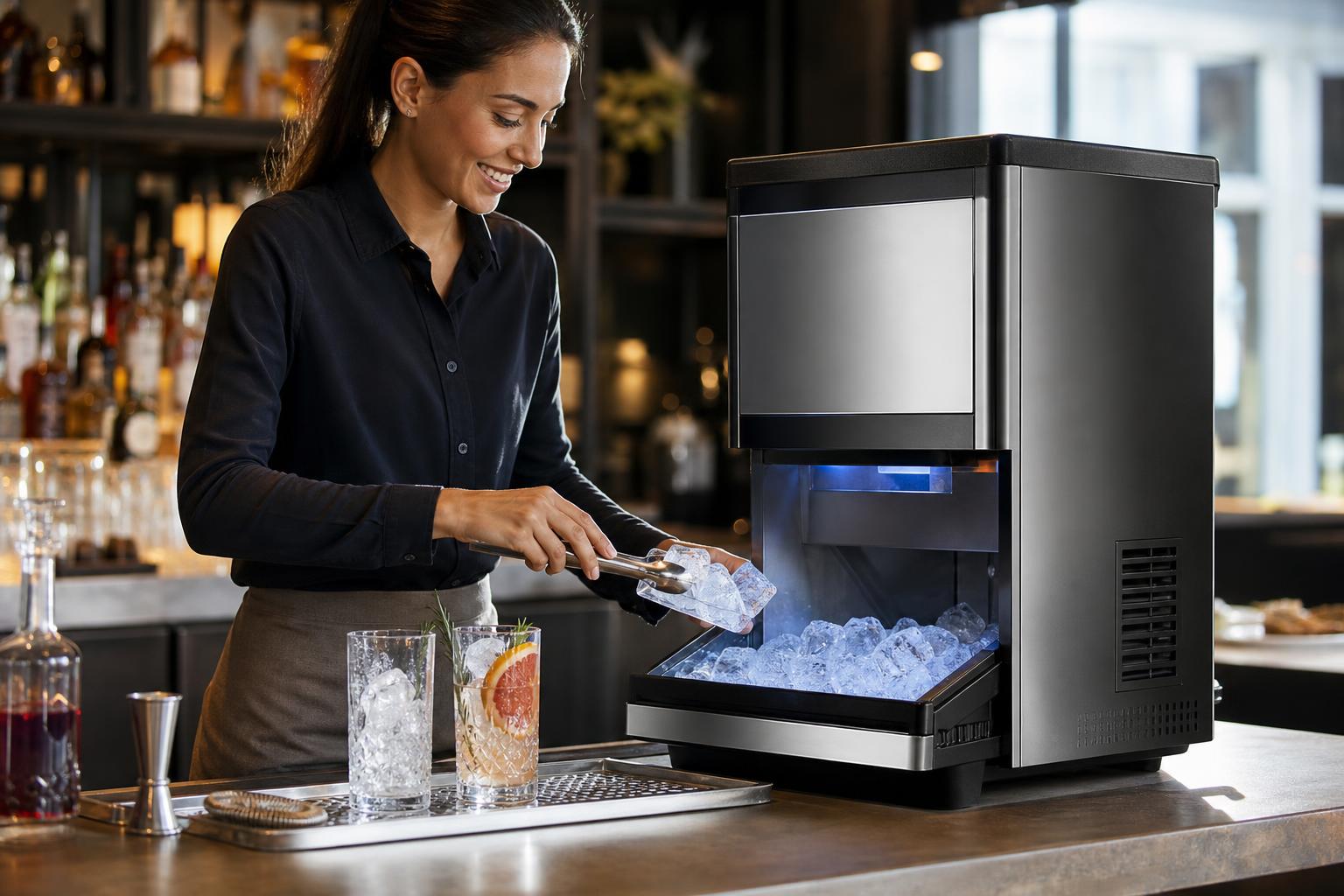
Ice is considered food under the FDA Food Code, so a commercial ice maker should be treated like a food-contact appliance, not just a utility machine. Poor cleaning, warm bins, and unfiltered water can turn clear ice into a contamination risk.
In bar and restaurant settings, the biggest issues I see are not machine failures; they are scoop handling, skipped bin cleanings, and undersized production during peak service.
Cleaning and sanitation schedule
| Task | Practical frequency | Why it matters |
| Clean ice scoop and holder | Daily, or each shift in high-volume bars | Hands and splash contact can transfer bacteria to the scoop. |
| Empty and sanitize ice bin | At least monthly; more often with heavy use | Biofilm can build up on bin walls, gaskets, and drains. |
| Descale evaporator and water circuit | Every 3 to 6 months | Scale reduces ice production and can stress the compressor. |
| Replace water filter | Typically every 6 months, or by gallon rating | Old filters can restrict flow and stop reducing chlorine, sediment, or taste. |
- Never store bottles, fruit, cans, or towels in the ice bin. The FDA Food Code treats ice used for drinks as food, and anything stored in it can contaminate the entire bin.
- Use a dedicated scoop with a handle. The scoop should be stored outside the ice or in a clean holder, not buried handle-first in the bin.
- Wash hands before handling ice. Gloves are not a substitute if they touch phones, money, POS screens, or trash cans.
- Keep the bin drain clear. Meltwater should drain away freely; standing water raises contamination risk and can make ice clump.
Temperature, ventilation, and placement
Most commercial ice makers are rated around 70°F air and 50°F incoming water. In a hot kitchen or poorly ventilated bar, actual output can drop sharply, sometimes by 20% to 30%.
| Condition | Practical target | Tip |
| Air clearance | Commonly 6 inches or more, depending on model | Check the manual; blocked vents cause slow harvest and overheating. |
| Incoming water temperature | Ideally near 50°F to 70°F | Warmer water increases freeze time and reduces daily ice output. |
| Bin temperature | Insulated, not refrigerated | Ice will slowly melt; size the bin for service peaks, not overnight storage. |
For beverage service, plan more ice than the machine’s headline rating suggests. A busy cocktail bar can use 1.5 to 3 pounds of ice per drink when shaking, stirring, chilling glassware, and serving on fresh ice.
If ice smells musty, tastes metallic, appears cloudy beyond normal mineral content, or production suddenly slows, stop using it for drinks until the machine, bin, filter, and drain are inspected and cleaned.
Prep Kitchen Tests of Ice Makers
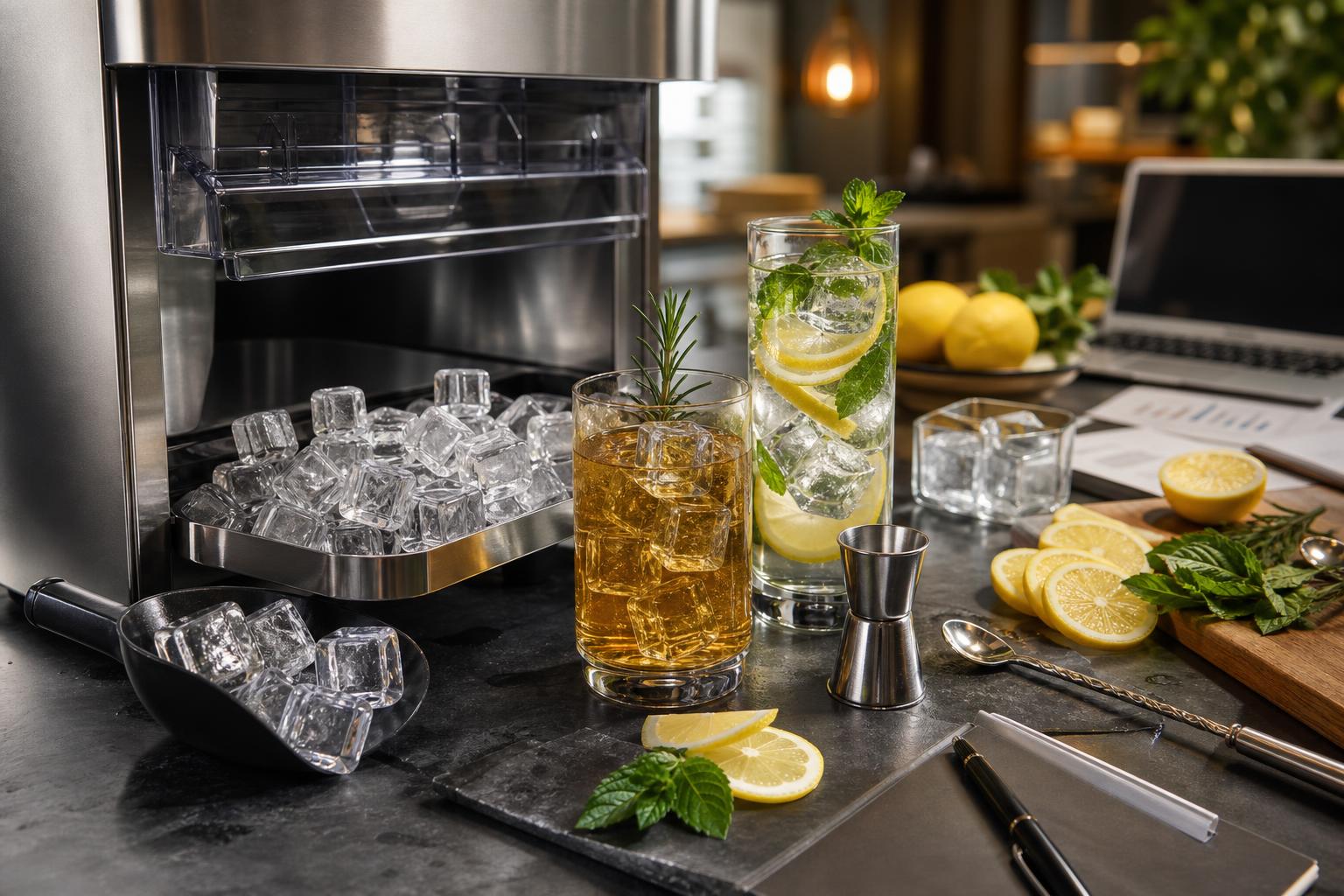
We tested three commercial ice maker formats in our prep kitchen: a 22-inch undercounter cube unit, a 30-inch modular head with bin, and a countertop nugget machine.
Each machine ran through three full production trials after a 24-hour room-temperature acclimation.
Our room held between 70°F and 72°F, and incoming water measured 58°F to 60°F at the supply line. We discarded the first batch from every machine, then weighed usable ice on a calibrated kitchen scale in 5-pound increments.
| Machine type tested | Rated daily output | Measured 24-hour output | First usable ice |
| Undercounter cube maker | 80 lb/day | 71.4 lb average | 18 minutes |
| Modular cube head with bin | 320 lb/day | 286.8 lb average | 11 minutes |
| Countertop nugget maker | 90 lb/day | 76.2 lb average | 23 minutes |
The advertised output was achievable only in idealized conditions. At our normal kitchen temperature, the machines delivered 84% to 90% of their stated daily production.
The modular unit recovered fastest after we removed 25 pounds of ice during a mock service rush.
- We opened the bin every 10 minutes for one hour to simulate bartender use.
- The modular unit refilled 25 pounds in 2 hours 7 minutes.
- The undercounter unit replaced 10 pounds in 3 hours 14 minutes.
- The nugget unit replaced 10 pounds in 2 hours 48 minutes.
Ice shape mattered more than we expected. The full-cube machine produced the clearest, slowest-melting ice for shaking and rocks pours. Nugget ice was easiest to scoop and chew, but it diluted spirits faster in our 30-minute hold test.
| Ice type | Starting weight | Melt after 30 minutes at 72°F | Best use in our test |
| Full cube | 200 g | 31 g | Whiskey, stirred drinks |
| Half cube | 200 g | 42 g | Shaking cocktails |
| Nugget | 200 g | 68 g | Soft drinks, juleps |
Noise was another real separator. Measured 3 feet from the front, the undercounter unit averaged 54 dB, the nugget machine averaged 58 dB, and the modular head averaged 63 dB during harvest. The harvest cycle was always louder than freezing.
Cleaning access changed our opinion of value. The best unit let us remove the curtain, water trough, and distribution tube without tools in under 4 minutes.
The worst required a nut driver and took 11 minutes before we could even reach the scale-prone parts.
Sizing and Maintenance Mistakes
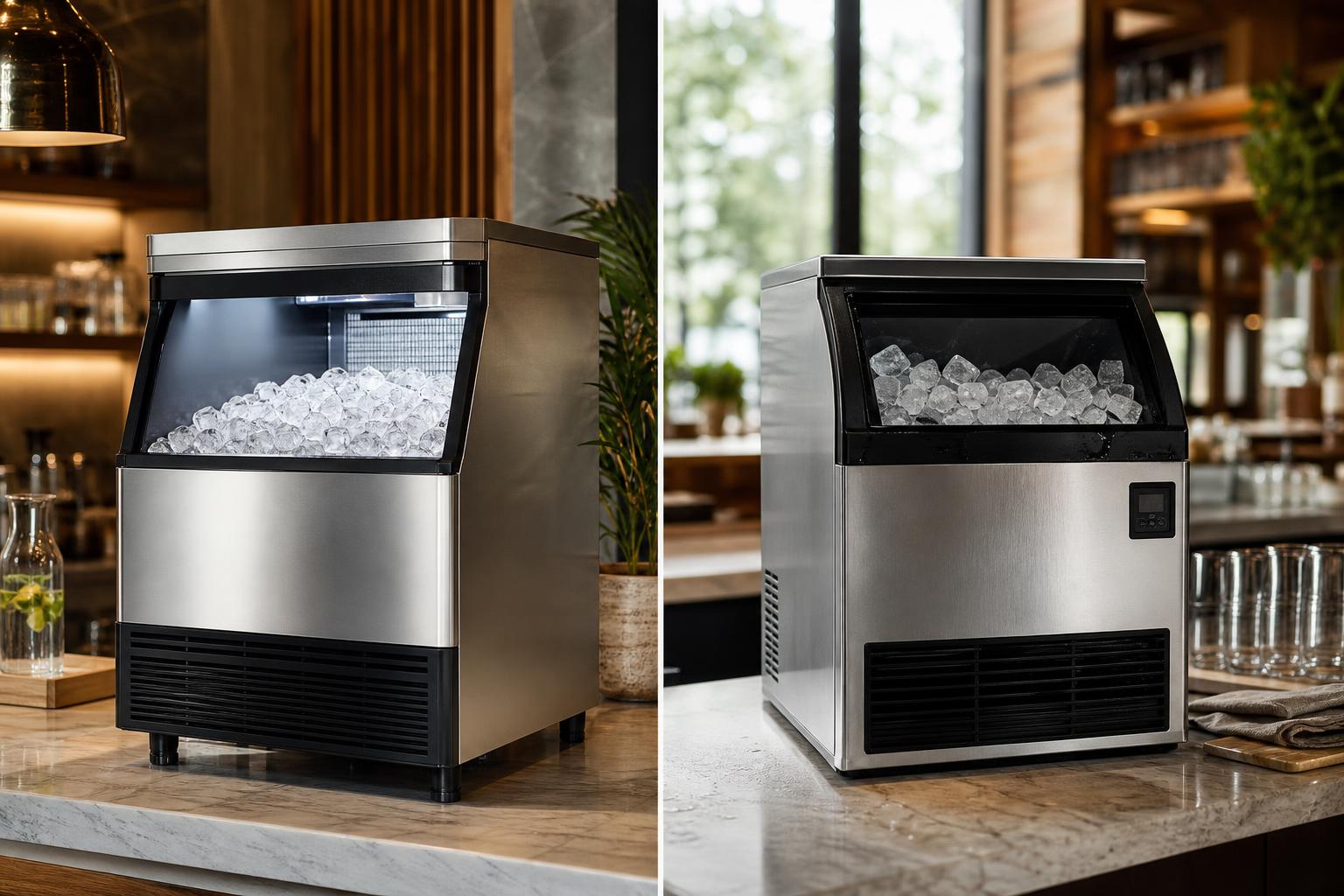
Most commercial ice maker problems I see in bars come from sizing guesses, poor ventilation, and skipped maintenance—not from “bad machines.” The biggest myth is that ice production on the spec sheet equals usable ice behind the bar.
Mistake: sizing the machine by advertised production only
Manufacturer ratings are usually based on ideal lab conditions, often with 70°F air and 50°F incoming water. A hot kitchen, tight bar well, or 80°F water line can cut real output substantially.
| Spec or condition | Why it matters |
| 70°F air / 50°F water | Common AHRI-style rating condition used for published daily ice production. |
| 90°F air / 70°F water | A more realistic stress condition; production can drop and harvest cycles take longer. |
| 1 lb of ice | Roughly fills 2 to 3 standard rocks glasses, depending on cube type and glassware. |
| 1.5 to 3 lb per guest | Typical planning range for cocktail bars, higher when shaking, batching, or serving water. |
Myth: “Bigger bin means more ice production”
The bin only stores ice; it does not make ice faster. Once the bin is full, the machine stops. If your happy-hour demand exceeds the head unit’s daily production and recovery rate, a larger bin only delays the shortage.
Mistake: ignoring clearance and heat
Air-cooled commercial ice makers reject heat into the room. Crowding the side vents or installing the unit beside fryers can cause long freeze cycles, soft cubes, high utility use, and nuisance shutdowns.
- Check the manual before install: many air-cooled heads require several inches of side or rear clearance, and some require top clearance for service access.
- Do not treat undercounter models like furniture: enclosing the louvers can make the compressor run hotter and shorten equipment life.
- Remote condensers help: they move heat and fan noise away from the bar, but require correct line-set length, refrigerant charge, and professional installation.
Myth: “A water filter is optional”
Filtration is not just about taste. Scale buildup on the evaporator reduces heat transfer, slows harvest, and can create thin or incomplete cubes. The FDA Food Code also expects food-contact equipment to be maintained clean and sanitary.
Mistake: cleaning only when ice tastes bad
By the time ice tastes musty, the machine may already have biofilm in the bin, curtain, sump, or distribution tube.
Many manufacturers call for cleaning and sanitizing at least every 6 months, with shorter intervals in dusty or high-yeast environments.
- Never use household bleach casually: use the cleaner and sanitizer type specified by the manufacturer, at the labeled concentration.
- Discard the first batch after cleaning: cleaner residue can remain in the water circuit if the rinse cycle is rushed.
- Inspect the scoop system: the scoop should not be stored in the ice, and hands should never contact consumable ice.
Frequently Asked Questions
How much ice does a commercial ice maker produce per day?
Commercial ice makers are rated by pounds of ice produced in 24 hours, commonly ranging from about 50 lb/day for small undercounter units to 1,000+ lb/day for high-volume modular machines.
Actual output can drop when ambient air or incoming water is warm; many manufacturers rate production at 70°F air and 50°F water, which is more favorable than a busy kitchen or bar environment.
What size commercial ice maker does a bar or restaurant need?
A practical estimate is 1.5 to 3 pounds of ice per restaurant seat per day, or 3 to 5 pounds per customer for cocktail-focused bars, depending on drink style and service volume.
For a 75-seat restaurant, that often means choosing a machine in the 150 to 300 lb/day range, plus a storage bin sized for peak service rather than total daily production.
What is the difference between air-cooled and water-cooled commercial ice makers?
Air-cooled ice makers use fans and room air to remove heat, making them the most common choice because they use less water and are often easier to install.
Water-cooled units can perform better in hot or poorly ventilated spaces, but they may use substantially more water and are restricted or discouraged in some jurisdictions due to conservation rules.
How often should a commercial ice maker be cleaned?
Most manufacturers recommend cleaning and sanitizing a commercial ice maker at least every 6 months, with more frequent service in hard-water areas or high-use bars.
The FDA Food Code treats ice as food, so interior surfaces, scoops, bins, and contact points must be kept sanitary to prevent scale, slime, mold, and bacterial contamination.
Does a commercial ice maker need a water filter?
Yes, a dedicated water filter is strongly recommended because sediment, chlorine, and mineral scale can reduce ice clarity, slow production, and damage components.
In hard-water regions, filtration or scale-inhibition cartridges can extend service intervals and help protect the evaporator plate, valves, and pumps.
Related Reading
- How Much Caffeine In Folgers Instant Coffee? Get the Answer
- How Many 24 Ounces In A Gallon? – 2026
- Best Brewery ST Louis: The Ultimate, Powerful 2026 Guide for Beer Lovers
- How Many Liters Is 1.5 Gallons?
- How Many Oz Is 80 Ml?
- Does Ginger Ale Have Caffeine? In-depth Answer
- Which Gasolina Drink Is The Best? Answer By Expert
- All Blog Guides
- FDA Food Code (2022)
- U.S. Department of Energy eCFR 10 CFR Part 431 Subpart H—Automatic Commercial Ice Makers (2026)
- ENERGY STAR Commercial Ice Machines (2025)
- CDC Guidelines for Environmental Infection Control in Health-Care Facilities—Ice Machines (2003)
- NSF/ANSI 12: Automatic Ice Making Equipment (2024)
- AHRI Standard 810: Performance Rating of Automatic Commercial Ice-Makers (2016)
- ASHRAE Handbook—Refrigeration, Chapter on Automatic Ice Makers (2022)