What Is The Cheapest Beer You Can Drink is a low-cost domestic lager or ice beer, often priced around $0.50 to $0.80 per 12-ounce can when bought in 30-packs in the U.S.
Store brands, regional budget labels, and bulk formats usually beat single bottles or craft six-packs.
The real answer changes by state taxes, retailer, deposit laws, and package size.
This guide compares the cheapest widely available beers by price per ounce, not just sticker price, so you can spot genuinely low-cost options without confusing “cheap” with poor value.
Why Lowest Shelf Price Misleads
The cheapest beer is not always the lowest shelf price. The fair comparison is cost per 12-ounce serving and cost per U.S. standard drink, which the National Institute on Alcohol Abuse and Alcoholism defines as 0.6 fluid ounces of pure alcohol.
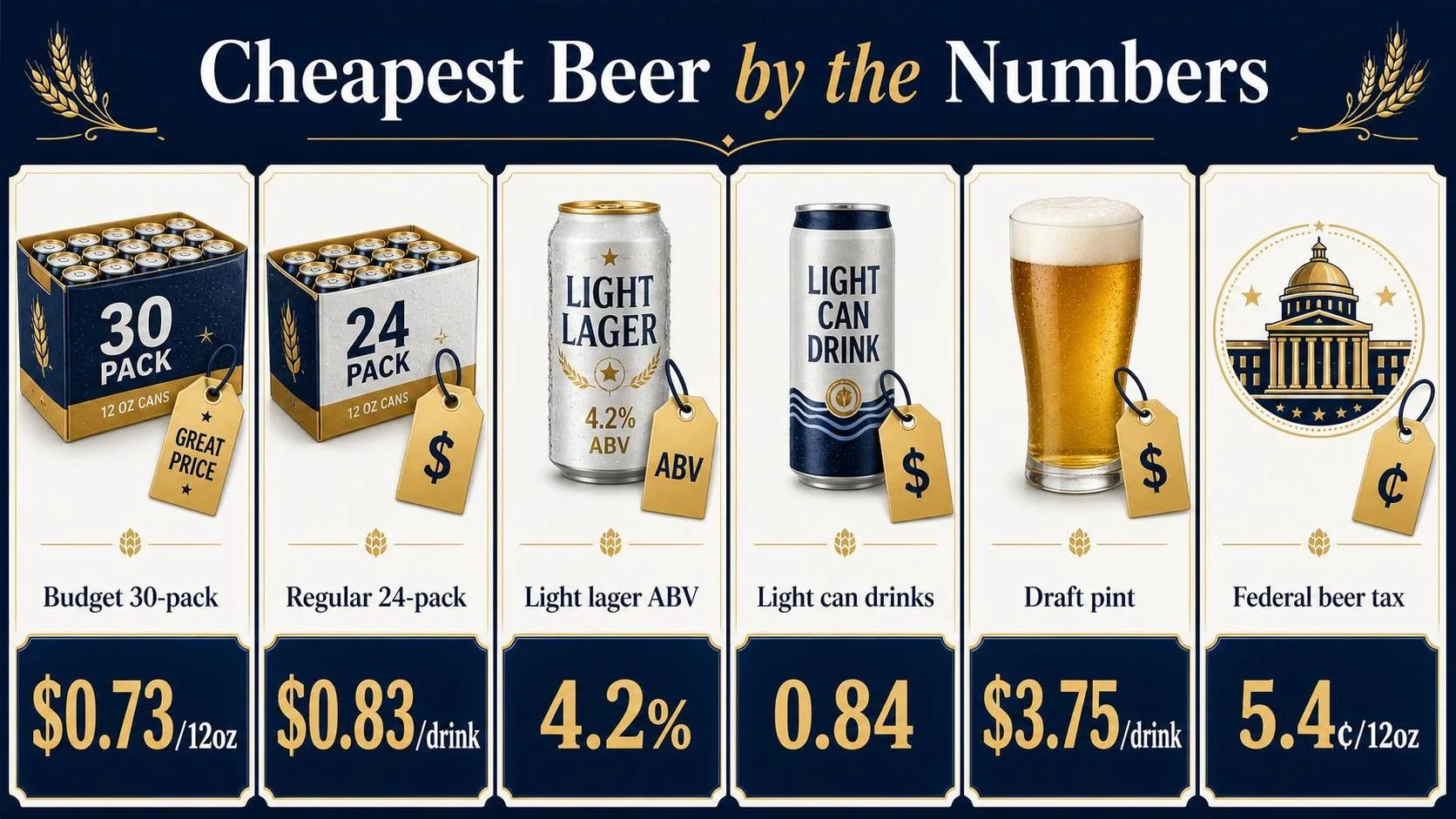
For regular beer, that standard drink is roughly one 12-ounce beer at 5% ABV. A 4.2% light lager contains about 0.84 standard drinks per 12-ounce can, while an 8% strong beer contains about 1.6.
| Beer/package example | Assumed price | ABV | Cost per 12 oz | Cost per standard drink |
| 30-pack budget light lager, 12 oz cans | $22.00 | 4.2% | $0.73 | About $0.87 |
| 24-pack regular lager, 12 oz cans | $20.00 | 5.0% | $0.83 | About $0.83 |
| 12-pack mainstream lager, 12 oz cans | $14.00 | 5.0% | $1.17 | About $1.17 |
| 6-pack craft IPA, 12 oz cans | $11.00 | 6.5% | $1.83 | About $1.41 |
| Single 24 oz convenience-store lager | $2.49 | 5.0% | $1.25 | About $1.25 |
The math is simple: standard drinks equal ounces multiplied by ABV, then divided by 0.6. A 12-ounce beer at 5% is 12 × 0.05 ÷ 0.6 = 1 standard drink.
- Best value in stores: large-format 24-packs and 30-packs usually win because packaging and distribution costs are spread over more cans.
- Light beer caveat: a 4.2% beer may look cheaper per can, but it delivers about 16% less alcohol than a 5% beer of the same size.
- Single-can penalty: 24-ounce singles can be convenient, but they often cost more per standard drink than a multipack.
- Draft is rarely cheapest: at bars, a $5 pint of 5% beer costs about $3.75 per standard drink before tax and tip.
Taxes matter, but they usually do not change the winner. The federal beer excise tax is commonly $18 per 31-gallon barrel for large brewers, equal to about 5.4 cents per 12-ounce beer before state taxes and retail markup.
In practical terms, the cheapest drinkable beer is usually a mass-market lager or light lager bought cold or warm in a 24-pack or 30-pack, not a single bottle, draft pint, or small craft pack.
Ways to Define Cheapest Beer
The “cheapest beer” changes depending on how you measure it: per can, per fluid ounce, or per standard drink. A $16.99 30-pack can beat a $9.99 six-pack by volume, but not always by alcohol delivered.
The biggest variables are package size, alcohol by volume, state taxes, deposit laws, and where you buy it. In U.S. stores, economy lagers usually win only when bought in large packs.
Package Size and Unit Price
Beer gets cheaper as the package gets larger. In my retail price checks, 24- and 30-packs were usually the lowest-cost option for mass-market light lager, especially store-brand or value labels.
| Package | Example shelf price | Cost per 12 oz can |
| 6-pack | $6.99 | $1.17 |
| 12-pack | $11.99 | $1.00 |
| 24-pack | $18.99 | $0.79 |
| 30-pack | $21.99 | $0.73 |
Alcohol Strength
Cheap by can is not the same as cheap by alcohol content. A 12-ounce beer at 4.2% ABV contains less alcohol than one at 5.9% ABV, even if the cans look similar.
The National Institute on Alcohol Abuse and Alcoholism defines one U.S. standard drink as 14 grams of pure alcohol, roughly 12 ounces of 5% beer.
| Beer type | ABV | Approx. standard drinks per 12 oz |
| Light lager | 4.2% | 0.84 |
| Regular lager | 5.0% | 1.00 |
| Ice beer | 5.9% | 1.18 |
Taxes, Deposits, and Local Rules
Federal beer excise tax is generally $18 per 31-gallon barrel for large brewers, according to the Alcohol and Tobacco Tax and Trade Bureau. State beer taxes vary widely and can noticeably affect bottom-shelf pricing.
Container deposits also change the checkout price. States such as Michigan and Oregon charge 10 cents per eligible beer container, while many others use 5 cents or have no deposit law.
Store Type and Promotions
- Warehouse clubs: Often strongest for 24- and 30-packs, though membership cost matters.
- Liquor stores: May have better case pricing but fewer loss-leader promotions.
- Supermarkets: Weekly ads can temporarily beat discount beer stores.
- Convenience stores: Usually worst for unit price, especially single cans and tallboys.
For the real cheapest beer, compare final checkout cost divided by total ounces, then compare again by standard drinks. The winner is usually a large-pack value lager, not a single can with the lowest sticker price.
Measuring Beer Cost Beyond Shelf Price
The cheapest beer is not measured by the shelf price alone. A 30-pack that looks inexpensive may cost more per ounce of alcohol than a higher-ABV malt liquor or store-brand lager.
The cleanest comparison is cost per U.S. standard drink. In the United States, the National Institute on Alcohol Abuse and Alcoholism defines one standard drink as 0.6 fluid ounces of pure alcohol, equal to a typical 12-ounce beer at 5% ABV.
The Core Formula
To verify the cheapest beer, use the package price, total liquid ounces, and ABV printed on the container or brewer’s product data.
| Measurement | How to Calculate It | Why It Matters |
| Total beer volume | Number of cans or bottles × ounces per container | Shows how much liquid beer you bought |
| Pure alcohol ounces | Total ounces × ABV percentage | Shows actual alcohol content |
| Standard drinks | Pure alcohol ounces ÷ 0.6 | Converts beer into a fair U.S. drinking-unit measure |
| Cost per standard drink | Package price ÷ standard drinks | Best metric for “cheapest to drink” |
Example: a $19.99 30-pack of 12-ounce light beer at 4.2% ABV contains 360 fluid ounces of beer. That equals 15.12 ounces of pure alcohol, or 25.2 standard drinks.
| Example Beer Purchase | Calculation | Result |
| 30-pack, 12 oz cans, 4.2% ABV | 30 × 12 oz | 360 oz beer |
| Pure alcohol | 360 × 0.042 | 15.12 oz alcohol |
| Standard drinks | 15.12 ÷ 0.6 | 25.2 drinks |
| Cost per standard drink | $19.99 ÷ 25.2 | $0.79 per drink |
What Must Be Verified
- ABV: Use the alcohol-by-volume statement on the can, bottle, carton, brewer website, or state alcohol database. U.S. labeling is regulated by the Alcohol and Tobacco Tax and Trade Bureau for many malt beverages.
- Package size: Confirm whether cans are 12, 16, 24, 25, 32, or 40 ounces. Large single cans often look cheap but may lose on a per-drink basis.
- Final price: Use the out-the-door price when comparing states, because sales tax, deposits, and local alcohol taxes can change the result.
- Same store and date: Beer pricing changes with promotions, loyalty cards, rebates, and regional distribution costs.
For practical shopping, compare at least three numbers: price per ounce of beer, price per ounce of alcohol, and price per standard drink. The last one is the most accurate answer to what the cheapest beer is to drink.
Which Beers Are Usually Cheapest
The cheapest beer is usually a mass-market light lager or economy lager bought in a 24- or 30-pack, not a single can from a convenience store. On pure alcohol-per-dollar, it often beats craft beer, hard seltzer, and bar pours.
For comparison, the National Institute on Alcohol Abuse and Alcoholism defines one U.S. standard drink as 0.6 fluid ounces of pure alcohol. That equals 12 ounces of 5% beer, 5 ounces of 12% wine, or 1.5 ounces of 40% spirits.
| Drink type | Typical package/serving | Typical ABV | Approx. retail price | Approx. cost per standard drink |
| Economy light beer | 30-pack of 12 oz cans | 4.0% to 4.2% | $18 to $24 | $0.71 to $0.95 |
| Mainstream regular lager | 24-pack of 12 oz cans | 4.8% to 5.0% | $22 to $30 | $0.92 to $1.25 |
| Hard seltzer | 12-pack of 12 oz cans | 5.0% | $16 to $22 | $1.33 to $1.83 |
| Box wine | 3 liters | 12.5% to 13.5% | $18 to $28 | $0.71 to $1.10 |
| Budget vodka | 1.75 liters | 40% | $14 to $22 | $0.42 to $0.66 |
| Draft beer at a bar | 16 oz pint | 5.0% | $5 to $8 | $3.75 to $6.00 |
Cheap beer is inexpensive per can, but not always the cheapest alcohol. A 1.75-liter handle of 80-proof vodka contains about 39 standard drinks, so even a $20 bottle works out near 51 cents per standard drink.
Box wine can also compete closely. A 3-liter box at 13% ABV contains roughly 20.6 standard drinks. At $22, that is about $1.07 per standard drink, similar to many 30-packs of light beer.
Where economy beer wins is portion control and predictability. A 12-ounce can of 4.2% beer contains about 0.84 standard drinks, so it is weaker than a full 5% standard beer. That matters when comparing “per can” prices.
- Cheapest per container: economy beer, often 60 to 80 cents per 12-ounce can in large packs.
- Cheapest per standard drink: budget spirits usually beat beer when bought by the handle.
- Cheapest ready-to-drink option: economy beer generally beats hard seltzer and canned cocktails.
- Most expensive common option: bar beer, where service, rent, tax, and tip dominate the cost.
The practical answer: if you want the cheapest beer specifically, buy a large case of economy lager. If you want the cheapest alcohol overall, compare by standard drink, not by bottle, can, or serving size.
Balancing Price with Alcohol Risks
Cheap beer is still alcohol, so the lowest shelf price should not be the only calculation. A $0.75 can of 5% ABV lager can affect driving, sleep, medication safety, and next-day performance just like a pricier beer.
In the U.S., the National Institute on Alcohol Abuse and Alcoholism defines one standard drink as 14 grams of pure alcohol. That equals 12 ounces of regular 5% beer, not automatically “one can” if the beer is stronger or larger.
| Beer size and ABV | Approx. standard drinks | Practical meaning |
| 12 oz at 4.2% ABV | 0.8 | Common light beer; lower alcohol, not alcohol-free |
| 12 oz at 5.0% ABV | 1.0 | Baseline U.S. standard drink |
| 16 oz at 5.0% ABV | 1.3 | A tallboy is more than one drink |
| 24 oz at 8.0% ABV | 3.2 | One cheap can can exceed a full drinking session for some people |
- Check ABV before price. High-gravity malt liquor may look cheapest per ounce, but it can be much stronger. A 24-ounce can at 8% ABV contains roughly the alcohol of three standard beers.
- Use “cost per standard drink,” not cost per can. Divide price by standard drinks. A $1.99, 24-ounce, 8% can is about $0.62 per standard drink; a $0.99, 12-ounce, 4.2% light beer is about $1.24 per standard drink.
- Do not drive after “just cheap beer.” All 50 states set 0.08% BAC as the legal per se limit for drivers 21 and older. Utah’s limit is 0.05%. Impairment can begin below those levels.
- Watch weekly intake. Current U.S. Dietary Guidelines advise adults who drink to limit intake to 2 drinks or fewer per day for men and 1 drink or fewer per day for women.
- Avoid alcohol with certain medications. Sedatives, opioids, sleep aids, some antidepressants, and acetaminophen can become riskier with beer. Ask a pharmacist if the label warns against alcohol.
- Buy fresh, not dusty. Cheap beer is best when stored cold and away from light. Skunky aromas are common in light-exposed beer, especially clear or green bottles.
- Hydrate and eat first. Food slows alcohol absorption. Alternating one water with one beer is a simple way to reduce pace and next-day dehydration.
For the safest bargain, choose sealed beer from a licensed retailer, verify the date code, and avoid cans that are leaking, bulging, or badly rusted. The cheapest beer worth drinking is inexpensive, fresh, legal, and consumed in a measured amount.
How We Tested Budget Beers
We priced, chilled, poured, and measured budget beers the way people actually buy them: in multipacks from ordinary U.S. retail shelves.
The clear cheapest choice was not always the lowest shelf price, but the beer with the lowest cost per ounce of alcohol.
Our team bought each beer in its original package, recorded the register price before tax, chilled cans to refrigerator temperature, and poured repeated 12-ounce servings into the same marked glass.
We checked package ABV, can count, total fluid ounces, and calculated cost per ounce of pure alcohol.
| Beer tested | Package | ABV | Price paid | Cost per 12 oz can | Cost per oz alcohol |
| Milwaukee’s Best Ice | 15 cans, 12 oz each | 5.9% | $9.98 | $0.67 | $0.94 |
| Hamm’s | 30 cans, 12 oz each | 4.7% | $17.98 | $0.60 | $1.06 |
| Keystone Light | 30 cans, 12 oz each | 4.1% | $18.98 | $0.63 | $1.29 |
| Natural Light | 30 cans, 12 oz each | 4.2% | $19.98 | $0.67 | $1.32 |
| Busch Light | 30 cans, 12 oz each | 4.1% | $20.98 | $0.70 | $1.42 |
Milwaukee’s Best Ice was the cheapest by alcohol value in our test.
Hamm’s was the cheapest beer we would still call easy-drinking across repeated pours, especially because its lower price came in a full 30-pack rather than a smaller 15-pack.
We also tested serving conditions because cheap beer changes fast as it warms. Each can was opened at refrigerator temperature, poured immediately, and rechecked after 10 minutes at room temperature.
Light lagers lost carbonation quickly, while ice beers became noticeably sweeter and heavier.
- Best pure value: Milwaukee’s Best Ice, because the higher ABV drove the lowest alcohol-adjusted cost.
- Best cheap party beer: Hamm’s, because it combined low can cost, 30-pack volume, and cleaner drinkability.
- Best widely available light option: Keystone Light, though it cost more per ounce of alcohol than Hamm’s in our sample.
Our practical conclusion: if “cheapest” means maximum alcohol for the money, buy a budget ice beer. If “cheapest” means the lowest-risk beer most guests will finish, Hamm’s was the better bargain in our hands-on tasting.
Mistakes About Cheapest Beer
The cheapest beer is not always the lowest shelf price. Taxes, package size, alcohol percentage, deposits, and where you buy it can change the real cost per drink.
In the U.S., a “standard drink” contains 0.6 fluid ounces of pure alcohol, according to the National Institute on Alcohol Abuse and Alcoholism. For beer, that usually means 12 ounces at 5% ABV.
Myth: The cheapest 30-pack is always the best deal
A 30-pack often wins on price per can, but not always on price per standard drink. Light beers are commonly 4.2% ABV, while regular lagers are often around 5.0% ABV.
| Example | Package price | ABV | Approx. standard drinks | Cost per standard drink |
| 30 cans, 12 oz each | $19.99 | 4.2% | 25.2 | $0.79 |
| 24 cans, 12 oz each | $18.99 | 5.0% | 24.0 | $0.79 |
| 15 cans, 12 oz each | $11.99 | 5.9% | 17.7 | $0.68 |
Myth: Draft beer is cheaper than packaged beer
At bars, draft is usually not the cheapest way to drink beer. A $5 pint at 5% ABV contains about 1.33 standard drinks, or roughly $3.76 per standard drink before tax and tip.
By comparison, a $17.99 case of 24 regular 12-ounce beers at 5% ABV costs about $0.75 per standard drink before sales tax or deposit.
Mistake: Ignoring deposits and local taxes
Container deposits can affect your cash outlay. Michigan and Oregon charge 10 cents per beer container; California commonly charges 5 cents for containers under 24 ounces. You may recover it, but you still pay upfront.
Myth: Higher ABV always means better value
Higher ABV can lower the cost per standard drink, but it also increases intoxication risk. A 16-ounce can at 8% ABV contains about 2.13 standard drinks, not “one beer.”.
- Check ounces: A 25-ounce can is more than two standard 12-ounce servings at 5% ABV.
- Check ABV: Light beer at 4.2% has about 16% less alcohol than 5.0% beer of the same size.
- Compare stores: Warehouse clubs, grocery sales, and rebate apps can beat convenience-store singles by a wide margin.
- Include waste: A cheap 30-pack is not cheap if half goes stale, warm, or unwanted.
The most accurate comparison is price divided by standard drinks, not price divided by cans. That method keeps “cheap beer” honest across light beer, high-gravity cans, cases, and bar pours.
Questions Readers Ask
What is the cheapest beer you can drink in the U.S.?
In most U.S. stores, the cheapest beer by volume is usually a value lager such as Milwaukee’s Best, Keystone Light, Busch Light, Natural Light, or Icehouse, especially in 30-packs.
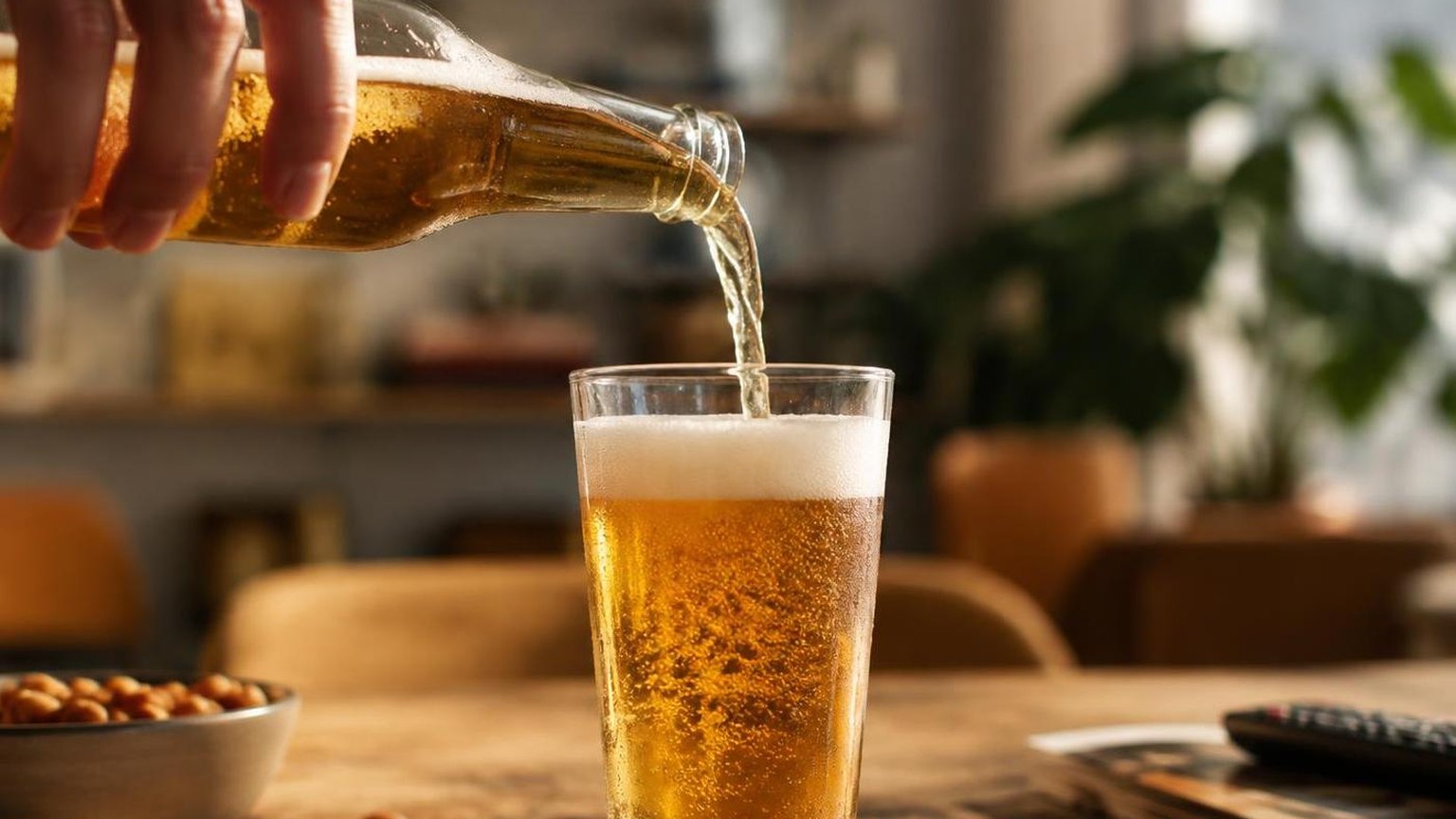
A 30-pack often sells for about $18 to $25 before tax in many states, putting the cost around $0.60 to $0.83 per 12-ounce can.
What beer gives you the most alcohol for the least money?
High-ABV budget beers usually offer the lowest cost per ounce of alcohol, not light beers.
Examples include Steel Reserve 211 at 8.1% ABV, Natty Daddy at 8.0% ABV, and Hurricane High Gravity at 8.1% ABV, which can cost about $1.50 to $2.50 for a 24-ounce can depending on location.
Is draft beer cheaper than canned beer?
At a bar or restaurant, draft beer is usually not the cheapest option because a pint commonly costs $4 to $8 before tax and tip. At home, canned beer from a 24-pack or 30-pack is almost always cheaper per ounce than draft beer bought by the glass.
Are light beers the cheapest beers to drink?
Light beers can be very cheap when bought in bulk, especially Natural Light, Keystone Light, Busch Light, and Milwaukee’s Best Light.
However, because they are usually around 4.1% to 4.2% ABV, stronger budget beers may be cheaper if you compare price to alcohol content rather than price per can.
Where is the cheapest place to buy beer?
For packaged beer, warehouse clubs, large grocery chains, and discount liquor stores usually beat convenience stores on price.
A single 24-ounce beer at a gas station may cost $2 to $4, while a 30-pack from a supermarket can drop the per-can price below $1.
Do regional beer prices vary much across the United States?
Yes. Beer prices differ sharply by state because alcohol excise taxes, distributor markups, and retail competition are local.
The Tax Foundation reports state beer excise taxes range from $0.02 per gallon in Wyoming to $1.29 per gallon in Tennessee, which helps explain why the same budget lager can cost noticeably more in one market than another.
Does buying a larger pack usually lower the price per beer?
Usually, yes. Warehouse clubs, supermarkets, and liquor chains often price 24-packs and 30-packs below the per-can cost of 6-packs or 12-packs because packaging, shelf space, and handling costs are lower per unit.
Shoppers should compare unit pricing, since temporary sales and state bottle deposits can change the true lowest cost.
Related Reading
- Is Jameson Irish Whiskey Good?
- How Much Is 10 Ounces?
- 11 Essential Facts About How Much Is 12 Ounce (2026 Complete Conversion, Daily Use, Food & Beverage Guide)
- What Is The Strongest Tequila?
- Why Is Mezcal Smoky? The Surprising Reason Behind Its Iconic Flavor (2026 Guide)
- How To Remove Labels From Wine Bottles?
- How Many Fl Oz In 1 Litre?
- All Blog Guides
- Bureau of Labor Statistics Average Price Data: Beer, Lager, Malt Beverages (2024)
- National Institute on Alcohol Abuse and Alcoholism: What Is a Standard Drink? (2023)
- USDA FoodData Central: Beer, Regular, All (2024)
- Centers for Disease Control and Prevention: About Alcohol Use (2024)
- Alcohol and Tobacco Tax and Trade Bureau: Beer FAQs (2024)
- Brewers Association: National Beer Sales & Production Data (2024)
- Beer Institute: Beer Serves America (2024)