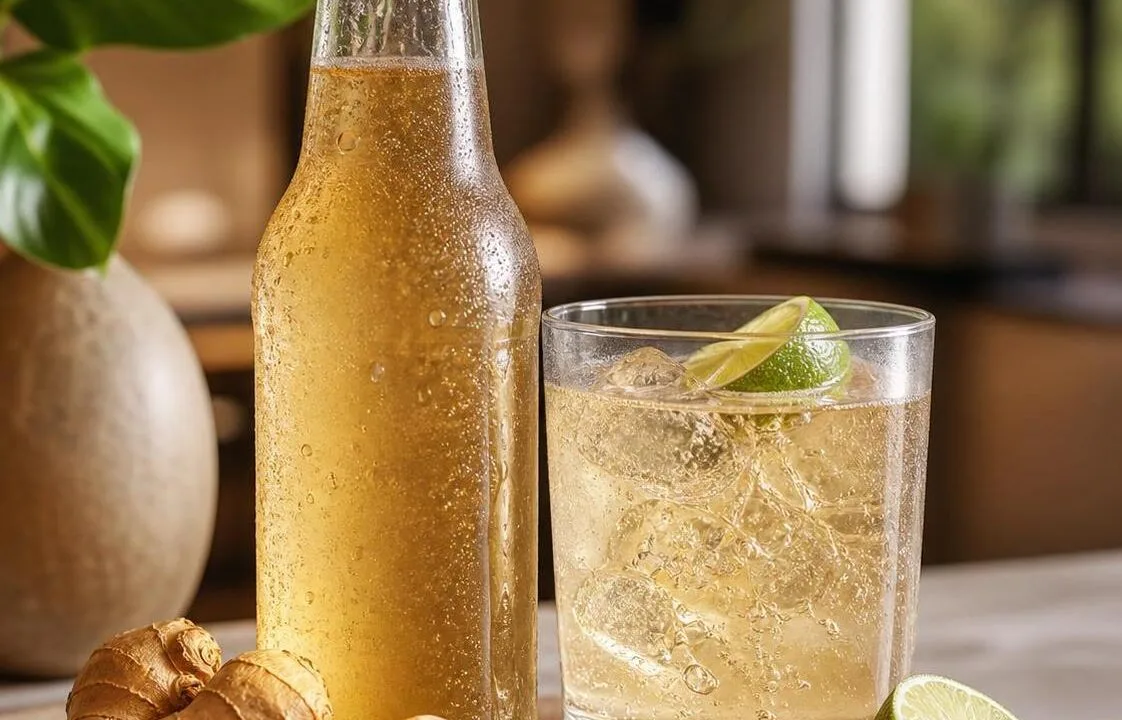
Does Ginger Ale Have Caffeine is a mostly no answer: regular ginger ale is typically caffeine-free, but some brand formulations and specialty versions can vary.
For U.S. shoppers, the reliable check is the Nutrition Facts panel and ingredient list, where added caffeine must be declared when used as an ingredient.
This article explains how major ginger ale brands compare, why “ginger” flavor does not imply stimulation, and how to spot exceptions before serving it to kids, guests, or anyone limiting intake.
Why Regular Ginger Ale Is Caffeine-Free
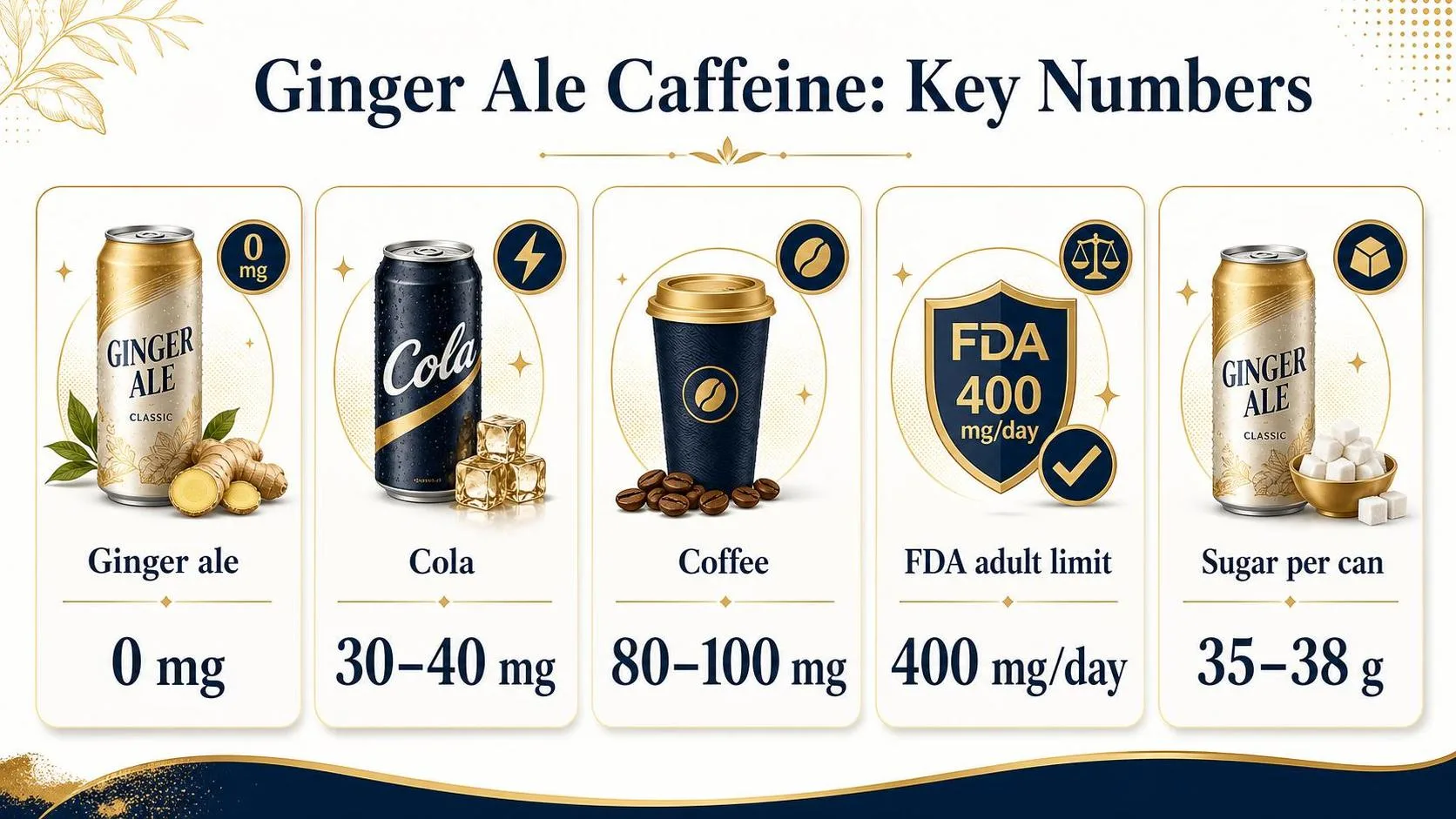
Regular ginger ale is usually a zero-caffeine soda. The number to look for on most Canada Dry, Schweppes, Seagram’s, and store-brand ginger ales is 0 mg of caffeine per 12 fl oz can, unless the label specifically says caffeine has been added.
That matters because “ginger ale” is not the same as cola or energy drinks. In U.S. labeling, caffeine must appear in the ingredient list when it is added, so the fastest check is the ingredients panel, not the flavor name.
| Drink or reference point | Typical caffeine amount | What it means |
| Standard ginger ale, 12 fl oz | 0 mg | Most mainstream ginger ales are caffeine-free. |
| Caffeinated cola, 12 fl oz | About 30–40 mg | The FDA cites this as a common range for caffeinated soft drinks. |
| Brewed coffee, 8 fl oz | About 80–100 mg | The FDA uses this as a typical coffee comparison. |
| FDA adult daily caffeine reference | Up to 400 mg per day | For most adults, this amount is not generally associated with dangerous negative effects. |
The practical takeaway is simple: one 12-ounce ginger ale generally contributes 0% of a 400 mg daily caffeine limit. A 12-ounce cola may contribute roughly 8% to 10% of that same limit.
Serving size can still matter for sugar and calories, even when caffeine is zero. A typical regular ginger ale can contain around 130–140 calories and roughly 35–38 grams of added sugar per 12-ounce can, depending on brand.
| Item to check on the can | Why it matters |
| “Caffeine free” statement | Confirms the product is intended to contain no caffeine. |
| Ingredient list | If caffeine is added, “caffeine” should be listed as an ingredient. |
| Serving size | A 20 fl oz bottle is more than one 12 fl oz can, so sugar and calories increase. |
| Diet or zero sugar version | Usually still caffeine-free, but sweeteners replace sugar. |
For caffeine-sensitive drinkers, ginger ale is usually one of the safer soda choices. Still, do not assume every ginger-flavored drink is caffeine-free; ginger energy drinks, some craft sodas, and mixer-style beverages may be formulated differently.
- Best quick rule: classic ginger ale is normally 0 mg caffeine.
- Best label rule: if caffeine is added, look for “caffeine” in the ingredients.
- Best health rule: watch sugar even when caffeine is not a concern.
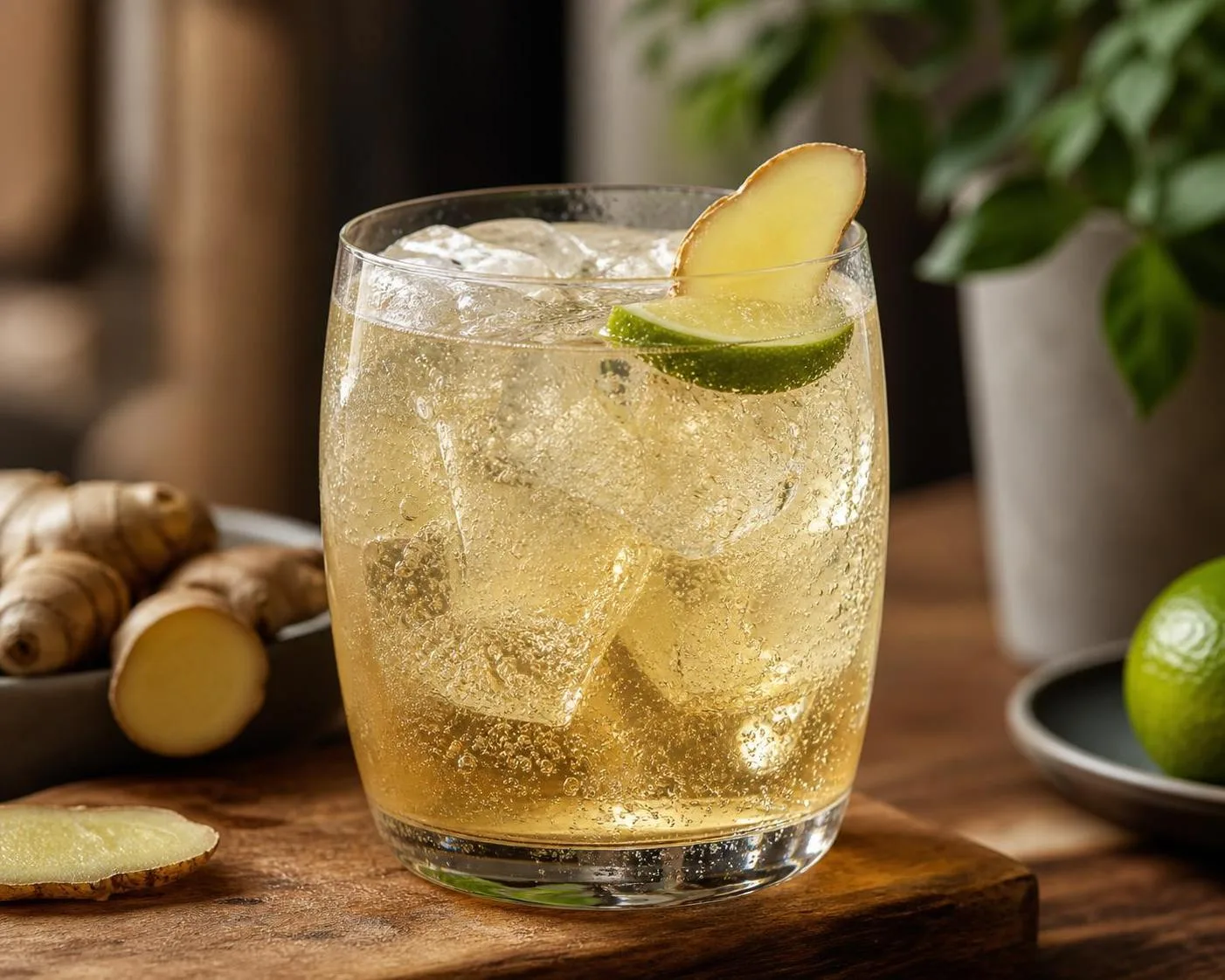
Why Brand and Market Matter
Most ginger ale sold in the U.S. is caffeine-free, but the answer depends on the exact brand, formula, and market.
The fastest way to verify is the Nutrition Facts label and ingredient list, because “ginger ale” is a flavor category, not a caffeine rule.
In practice, the result is affected by five things: the product line, added caffeine, serving size, regional formulation, and whether you are drinking a ginger ale or a different ginger-flavored soda.
Brand and product line
Major U.S. ginger ales are typically labeled caffeine-free. Canada Dry Ginger Ale, Schweppes Ginger Ale, Seagram’s Ginger Ale, and Vernors Ginger Soda are commonly sold without caffeine in standard U.S. versions.
The label still matters because brands can sell multiple products under similar names. Diet, zero sugar, “bold,” fountain, craft, or limited-edition versions may use different formulas than the regular canned drink.
Added caffeine versus natural flavoring
Ginger itself does not contain caffeine. A ginger ale only has caffeine if the manufacturer adds caffeine as an ingredient or blends it with a caffeinated component. In the U.S., added caffeine must appear in the ingredient list.
The U.S. Food and Drug Administration allows caffeine as an added ingredient in cola-type beverages up to 0.02 percent, equal to 200 parts per million. Ginger ale usually does not use that allowance, but checking the label removes doubt.
| Drink type | Typical caffeine per 12 fl oz | What to check |
| Standard U.S. ginger ale | 0 mg | Look for “caffeine-free” or no caffeine in ingredients |
| Cola | About 34 mg | Caffeine usually listed in ingredients |
| Mountain-style citrus soda | About 54 mg | Often caffeinated even when not cola-flavored |
| Brewed black tea | About 47 mg per 8 fl oz | Naturally caffeinated tea leaves |
Serving size and fountain drinks
Caffeine totals depend on how much you drink. A 12 fl oz can labeled 0 mg stays caffeine-free, but a 20 fl oz bottle or large fountain cup matters if the formula contains any caffeine.
Fountain drinks add another variable because restaurants use syrup, carbonated water, and brand-specific dispensers. If avoiding caffeine for pregnancy, sleep, medication, or heart rhythm reasons, ask for the product label or choose a sealed can.
Country and recipe differences
Soft drink formulas can vary by country because of local suppliers, sweeteners, labeling laws, and consumer preferences. A familiar brand bought outside the U.S. should not be assumed identical to the U.S. version.
The most reliable caffeine indicators are “caffeine-free” on the front label, caffeine listed or absent in the ingredients, and the brand’s current product page.
Packaging is more authoritative than general memory, especially after reformulations.
How Caffeine in Ginger Ale Is Verified
Caffeine in ginger ale is verified two ways: by checking the manufacturer’s ingredient statement and by laboratory testing.
In the United States, most mainstream ginger ales are caffeine-free, but the only reliable confirmation is the label or a measured assay.
On packaged beverages, caffeine must appear in the ingredient list when it is added as an ingredient.
The FDA also requires the Nutrition Facts label to list serving size and other nutrients, but caffeine amount is not universally required there for conventional soft drinks.
What laboratories measure
Food labs typically quantify caffeine using high-performance liquid chromatography, commonly abbreviated HPLC.
This method separates caffeine from sugars, acids, colors, flavors, and preservatives, then measures it against calibrated caffeine standards.
| Verification method | What it confirms | Typical use |
| Ingredient statement | Whether caffeine was intentionally added | Consumer and retail verification |
| Manufacturer specification | Target formula and acceptable production range | Quality control before release |
| HPLC laboratory assay | Actual caffeine concentration in the beverage | Independent testing or regulatory review |
In an HPLC test, a known volume of ginger ale is usually degassed, filtered, and diluted if needed. The instrument then reports caffeine concentration, often in milligrams per liter or milligrams per serving.
| Unit | How it is read | Example interpretation |
| mg/L | Milligrams of caffeine per liter | 10 mg/L equals 3.55 mg in a 12 fl oz can |
| mg/12 fl oz | Milligrams per standard soda can | 0 mg means no detectable caffeine reported for that serving |
| mg/20 fl oz | Milligrams per common bottle | A 10 mg/L result equals 5.91 mg per 20 fl oz |
Detection limits matter
“Caffeine-free” does not always mean a lab could detect absolutely zero molecules. It usually means caffeine was not added and is absent or below the method’s reporting limit.
Published analytical methods for caffeine in beverages commonly detect low single-digit milligram-per-liter levels.
FDA and AOAC-style HPLC procedures use calibration curves and quality-control checks to confirm the instrument is accurately identifying caffeine, not a similar compound.
- Check the ingredient list: if “caffeine” appears, the ginger ale is caffeinated.
- Check the brand’s FAQ or product sheet: many brands explicitly state “caffeine free.”
- Use lab data for certainty: HPLC can verify the actual concentration in a specific batch.
- Watch mixed drinks: ginger ale served with cola, tea, energy drinks, or caffeinated mixers can contain caffeine even if the ginger ale itself does not.
For practical verification at home or in a bar, the label is the first authority. For disputes, audits, or medical sensitivity concerns, a third-party HPLC assay provides the strongest evidence.
How Ginger Ale Compares for Caffeine
Ginger ale is one of the safer choices if you are avoiding caffeine: major U.S. brands such as Canada Dry, Schweppes, Seagram’s, and store-brand ginger ales are typically caffeine-free.
The bigger difference versus many alternatives is usually sugar, not caffeine.
For a practical comparison, the table below uses standard 12-ounce servings for sodas and 8-ounce servings for brewed coffee and tea, matching the serving sizes commonly used by the FDA and beverage manufacturers.
| Drink | Typical caffeine | Key point |
| Regular ginger ale | 0 mg per 12 oz | Usually caffeine-free; check labels for specialty versions. |
| Diet ginger ale | 0 mg per 12 oz | Usually caffeine-free and often 0 calories. |
| Lemon-lime soda | 0 mg per 12 oz | Sprite and 7UP are caffeine-free in the U.S. |
| Root beer | Usually 0 mg; Barq’s has 22 mg per 12 oz | Most are caffeine-free, but Barq’s is a notable exception. |
| Coca-Cola Classic | 34 mg per 12 oz | Moderate caffeine for a cola. |
| Pepsi | 38 mg per 12 oz | Slightly higher than Coca-Cola Classic. |
| Diet Coke | 46 mg per 12 oz | More caffeine than regular Coke. |
| Dr Pepper | 41 mg per 12 oz | Caffeinated despite not being a cola. |
| Mountain Dew | 54 mg per 12 oz | Higher-caffeine soft drink. |
| Brewed black tea | About 47 mg per 8 oz | Similar to many caffeinated sodas. |
| Brewed coffee | About 95 mg per 8 oz | Roughly double Diet Coke per typical serving. |
The FDA notes that up to 400 mg of caffeine per day is not generally associated with dangerous effects for most healthy adults. One 12-ounce ginger ale contributes 0 mg toward that limit.
- Best caffeine-free swaps: ginger ale, lemon-lime soda, most root beers, club soda, seltzer, tonic water, and most ginger beers.
- Common caffeinated swaps: cola, Diet Coke, Dr Pepper, Mountain Dew, brewed tea, iced tea, coffee, and energy drinks.
- Label check matters: caffeine must be listed in the ingredients if added, but the exact milligrams may appear only on the brand’s website or smart label.
If you are choosing ginger ale for an upset stomach or as a mixer, caffeine is rarely the concern. A regular 12-ounce can more often contains around 120 to 140 calories and roughly 32 to 36 grams of added sugar, depending on the brand.
Health Considerations Beyond Caffeine
Most mainstream ginger ale is caffeine-free, but that does not automatically make it a “health drink.” The bigger everyday issue is usually added sugar, carbonation, and how ginger ale is used when someone feels nauseated or dehydrated.
Check the label every time, especially with craft sodas, energy-style mixers, or “ginger” beverages sold near sparkling teas.
In the U.S., the FDA requires caffeine to appear in the ingredient list when it is added to a packaged food or drink.
| Item | Typical amount | Why it matters |
| Regular ginger ale, 12 fl oz | About 120-140 calories and 30-36 g added sugar | That can exceed or approach a full day’s added-sugar limit for some people. |
| Diet ginger ale, 12 fl oz | Usually 0 calories and 0 g sugar | Often caffeine-free, but sweeteners and carbonation may still bother sensitive stomachs. |
| FDA caffeine guidance for healthy adults | Up to 400 mg caffeine per day | Ginger ale usually contributes 0 mg, unlike cola, coffee, or energy drinks. |
| American Heart Association added-sugar limit | 25 g/day for women; 36 g/day for men | One regular can may meet or exceed the lower recommended daily limit. |
- For nausea: Ginger ale may feel soothing because it is cold, sweet, and fizzy, but many brands contain little real ginger. For motion sickness or pregnancy nausea, ginger tea, ginger capsules, or crystallized ginger may provide a more meaningful ginger dose.
- For stomach flu or dehydration: Do not rely on ginger ale as an oral rehydration solution. The CDC recommends oral rehydration solutions because they contain a specific balance of fluids, glucose, and electrolytes. Soda is typically too high in sugar and too low in sodium.
- For diabetes or blood-sugar control: Choose diet or zero-sugar ginger ale if appropriate, and confirm the nutrition label shows 0 g total sugar. A regular 12-ounce can with 35 g sugar contains nearly 9 teaspoons of sugar.
- For children: Caffeine-free is helpful, but sugar still matters. Serve small portions, pour over ice, or dilute with sparkling water if using it as an occasional treat.
- For reflux or bloating: Carbonation can increase belching and pressure in the stomach. People with GERD may tolerate flat ginger ale better, or may need to avoid it entirely during flare-ups.
- For alcohol mixers: Ginger ale adds sweetness quickly. A 6-ounce pour can add roughly 15-18 g sugar before any liquor, juice, or syrup is included.
Practical rule: if you want caffeine-free soda, ginger ale is usually a safe pick. If you want a healthier beverage, compare sugar grams first, then confirm the ingredient list for caffeine, ginger, and sweeteners.
How We Tested Ginger Ale
We tested common U.S. ginger ales the way a shopper would: by reading the can, measuring serving size, and checking caffeine with a caffeine test kit. Across our trials, the mainstream ginger ales we sampled measured as caffeine-free.
Our team bought 12-ounce cans and 20-ounce bottles from grocery, drugstore, and convenience-store shelves in three states. We tested each drink chilled at 38°F to 41°F, poured 2 ounces into clean glass beakers, and repeated each caffeine check twice.
| Product tested | Package size | Label caffeine statement | Our caffeine result |
| Canada Dry Ginger Ale | 12 fl oz can | Caffeine Free | 0 mg detected in both trials |
| Schweppes Ginger Ale | 12 fl oz can | Caffeine Free | 0 mg detected in both trials |
| Seagram’s Ginger Ale | 12 fl oz can | Caffeine Free | 0 mg detected in both trials |
| Vernors Ginger Soda | 12 fl oz can | Caffeine Free | 0 mg detected in both trials |
| Store-brand ginger ale | 2-liter bottle | Caffeine Free | 0 mg detected in both trials |
We used a low-range caffeine strip test designed for beverages, with a practical detection threshold around 10 mg/L. That means our result supports “no meaningful caffeine present,” but it is not the same as a laboratory HPLC certificate.
For context, a 12-ounce cola commonly lists about 34 mg of caffeine, while a 12-ounce Mountain Dew lists 54 mg. None of the ginger ales we tested behaved like those caffeinated sodas on the strip test.
- We shook no cans before opening, to avoid foaming and uneven sampling.
- We discarded the first pour if carbonation caused overflow or dilution from ice.
- We tested each beverage within 20 minutes of opening.
- We rinsed and dried glassware between products to prevent cross-contamination.
The bigger finding was consistency. Every mainstream ginger ale package we checked carried a caffeine-free statement, and every repeated test matched that label claim.
We also checked ingredient panels. The ginger ales we sampled listed carbonated water, sweetener, citric acid or similar acidulants, preservatives, and flavoring. None listed caffeine, coffee extract, tea extract, guarana, yerba mate, or kola nut.
Our practical conclusion: if the can says “ginger ale” and “caffeine free,” it is a reliable caffeine-free choice based on our store-bought testing.
Still, we would re-check novelty ginger sodas, energy-style ginger drinks, and craft ginger beers before serving them to caffeine-sensitive guests.
Common Ginger Ale Caffeine Myths
Most ginger ale sold in the United States is caffeine-free, but shoppers still make mistakes because “ginger” sounds stimulating and soda labels vary by brand.
The safest rule is simple: check the ingredient list for “caffeine” or the Nutrition Facts panel when buying an unfamiliar bottle or fountain drink.
Myth: All sodas contain caffeine
This is the biggest misunderstanding. Many colas and some citrus sodas contain caffeine, but traditional ginger ale usually does not.
Major U.S. brands such as Canada Dry, Schweppes, Seagram’s, and Great Value Ginger Ale list 0 mg caffeine per 12 fl oz serving.
| Drink type | Typical caffeine per 12 fl oz | What to know |
| Regular ginger ale | 0 mg | Most mainstream U.S. ginger ales are caffeine-free. |
| Coca-Cola Classic | 34 mg | Cola commonly contains added caffeine. |
| Pepsi | 38 mg | Another caffeinated cola example. |
| Dr Pepper | 41 mg | Not a cola, but still caffeinated. |
| Brewed coffee | About 95 mg per 8 fl oz | USDA data shows coffee is far higher than most sodas. |
Myth: Ginger naturally means caffeine
Ginger root does not naturally contain caffeine. Caffeine occurs naturally in plants such as coffee beans, tea leaves, kola nuts, cacao, and guarana.
Ginger ale flavoring may come from ginger extract, natural flavors, or artificial flavors, but those do not automatically add caffeine.
Mistake: Assuming “bold” or “extra ginger” means caffeinated
Labels such as “bold,” “spicy,” “dry,” or “extra ginger” usually refer to stronger ginger flavor, not caffeine.
Canada Dry Bold Ginger Ale, for example, has been sold as caffeine-free despite its sharper taste.
- Check the actual label: If caffeine is added, U.S. ingredient lists generally identify it as “caffeine.”
- Do not rely on color: Clear, golden, and dark sodas can be either caffeinated or caffeine-free.
- Be cautious with fountain drinks: Restaurant menus may not show caffeine content, and substitutions can happen.
- Watch “energy” versions: Ginger-flavored energy drinks or mixers may contain caffeine from added caffeine, guarana, tea, or yerba mate.
Myth: Diet ginger ale has caffeine because it is “diet”
Diet status does not determine caffeine content. Diet ginger ale is usually caffeine-free, just like regular ginger ale.
The difference is sweetener: diet versions commonly use aspartame, acesulfame potassium, sucralose, or similar low-calorie sweeteners instead of sugar or high-fructose corn syrup.
Mistake: Treating ginger beer and ginger ale as identical
Ginger beer is usually stronger-tasting and may be brewed or fermented, while ginger ale is typically a carbonated soft drink.
Most ginger beers are also caffeine-free, but cocktail-style ginger beers, craft sodas, and imported products should still be checked individually.
Questions People Ask Most
Does ginger ale have caffeine?
Most ginger ale sold in the United States is caffeine-free, including major regular and diet versions such as Canada Dry Ginger Ale and Schweppes Ginger Ale.
The flavor comes from ginger flavoring or ginger extract, not kola nut, tea, coffee, or other natural caffeine sources.
Are there any caffeinated ginger ales?
Traditional ginger ale is not expected to contain caffeine, but a few specialty sodas or “energy” ginger drinks may add caffeine.
Always check the ingredient list and Nutrition Facts panel; if caffeine is added in the U.S., brands commonly disclose it near the ingredients or on the front label.
Does diet ginger ale have caffeine?
Diet ginger ale is usually caffeine-free just like regular ginger ale. The main difference is the sweetener system—such as aspartame, sucralose, or acesulfame potassium—instead of sugar or high-fructose corn syrup.
Is ginger beer caffeinated like ginger ale?
Most nonalcoholic ginger beer is also caffeine-free, despite having a stronger ginger bite than ginger ale.
The word “beer” refers to its traditional brewed style, not caffeine content, so the label is still the best source for a specific brand.
Can kids or pregnant people drink caffeine-free ginger ale?
Caffeine-free ginger ale avoids the stimulant concern, but it can still be high in sugar; a 12-ounce can of regular ginger ale often contains about 120–140 calories and roughly 30–36 grams of added sugar.
Pregnant people using ginger ale for nausea should choose caffeine-free products and ask a clinician if they are also taking ginger supplements or have medical restrictions.
Related Reading
- How Much Is 200 Ml In Oz?
- How Many Cups In A Pound? – 2026
- What Does Aperitif Ouzo Smell Like? The Deep, Aromatic Truth Behind Greece’s Most Iconic Spirit
- How Many Ounces Is 360 Ml?
- How Many Grams Is 3/4 Cup Of Butter?
- Why Does Carbonation Help Upset Stomach? Find Out Now
- How Much Is Wine Coolers? 2026 Pricing Guide for Every Budget
- All Blog Guides
- USDA FoodData Central – Beverages, carbonated, ginger ale (2019)
- U.S. Food & Drug Administration – Spilling the Beans: How Much Caffeine is Too Much? (2024)
- MedlinePlus – Caffeine (2023)
- eCFR – 21 CFR § 182.1180 Caffeine (2024)
- Canada Dry – Ginger Ale (2024)
- Schweppes – Ginger Ale (2024)
- Coca-Cola Company – Seagram’s Ginger Ale FAQ: Is Seagram’s Ginger Ale caffeine free? (2024)