How Long Does Open Champagne Last? is 1–3 days in the refrigerator when sealed with a Champagne stopper. After opening, pressure drops fast, bubbles escape, and oxidation softens citrus, toast, and mineral notes that make Champagne taste fresh.
Storage method decides the difference between a lively second glass and a flat pour. Keep the bottle cold, upright, and tightly sealed; avoid spoon tricks, loose foil, or room-temperature storage because they do not preserve carbonation reliably.
How Long Open Champagne Lasts
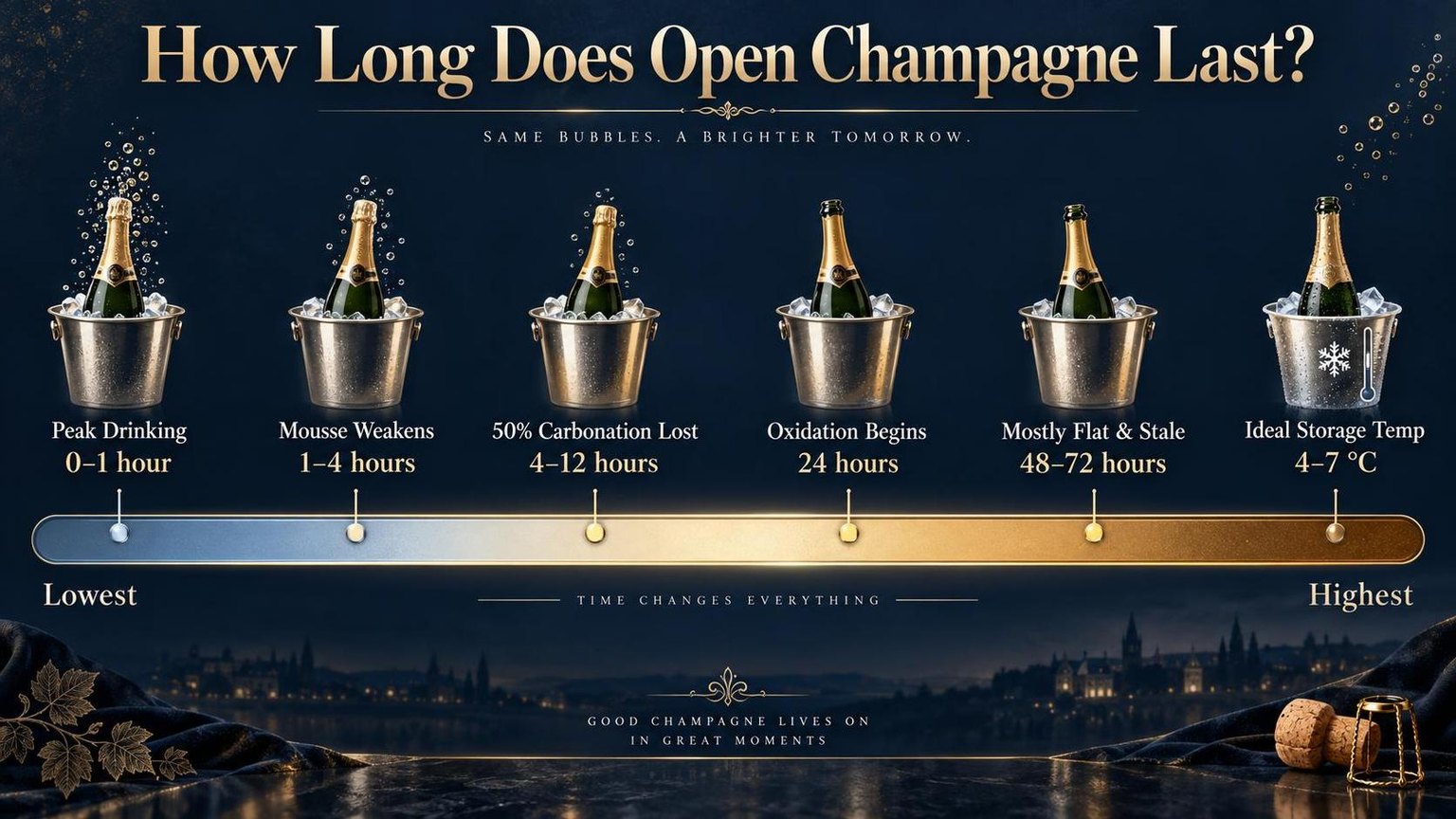
Open Champagne deteriorates faster than still wine because dissolved CO₂ escapes rapidly once the bottle is unsealed. With proper storage and a hermetic Champagne stopper, you can preserve drinkable quality for 1–3 days in most cases.
Timeline by Champagne Style
The style and age of the Champagne directly affect how long it holds up after opening. Younger, more vigorous wines retain carbonation longer than aged or delicate cuvées.
| Champagne Style | With Stopper (Refrigerated) | Without Stopper |
| Non-Vintage Brut | 1–3 days | 4–6 hours |
| Vintage / Prestige Cuvée | 1–2 days | 2–4 hours |
| Blanc de Blancs | 1–3 days | 4–6 hours |
| Rosé Champagne | 1–2 days | 3–5 hours |
| Demi-Sec / Sweet Champagne | 2–3 days | 4–6 hours |
Residual sugar in demi-sec styles acts as a mild preservative, giving these bottles a slight edge over bone-dry brut after opening.
What Happens Hour by Hour
Freshly opened Champagne contains approximately 49 million bubbles per bottle, according to research published in the Journal of Agricultural and Food Chemistry. That effervescence drops measurably within the first hour.
- 0–1 hour: Peak carbonation and aromatics. Ideal drinking window.
- 1–4 hours: Noticeable reduction in mousse. Flavors remain intact but perlage weakens.
- 4–12 hours (stoppered, refrigerated): Approximately 50% of original carbonation lost. Still pleasant to drink.
- 24 hours: Significant flatness. Fruit flavors begin oxidizing, developing bruised-apple notes.
- 48–72 hours: Minimal fizz remains. Acidity sharpens, and the wine tastes noticeably stale.
Key Factors That Accelerate Decline
Temperature is the single biggest variable. CO₂ stays dissolved longer at lower temperatures—ideally 4–7 °C (39–45 °F). Every degree warmer speeds gas loss.
- Headspace volume: A half-empty bottle loses carbonation faster than one with just a glass poured.
- Stopper seal quality: A purpose-built Champagne stopper with a clamp maintains roughly 2–3 atmospheres versus the original 5–6 atmospheres at disgorgement.
- Bottle movement: Agitation releases dissolved CO₂ into the headspace, accelerating flatness.
The old trick of dangling a silver spoon in the bottle neck has been scientifically debunked—it does nothing to preserve carbonation. Invest in a proper Champagne stopper rated to hold pressure instead.
Why Champagne Loses Bubbles Fast
Champagne holds approximately 49 million bubbles per bottle, pressurized at 5–6 atmospheres (roughly 70–90 psi).
Once the cork releases, dissolved CO₂ escapes relentlessly—and the physics behind this loss explain why flat Champagne arrives far sooner than most drinkers expect.
The Science of CO₂ Escape
A sealed 750 ml bottle contains about 5 liters of dissolved carbon dioxide. At room temperature (20°C), CO₂ escapes roughly 2.5 times faster than at refrigerator temperature (4°C).
Each bubble nucleates on microscopic imperfections in the glass—tiny cellulose fibers, dust particles, or scratches. A single nucleation site can release 30 bubbles per second, draining dissolved gas rapidly.
Pressure Drop Timeline After Opening
| Time After Opening | Approximate Pressure Remaining | Perceived Fizz Level |
| 0 minutes (sealed) | 5–6 atm | Full effervescence |
| 1 hour (no stopper) | ~2–3 atm | Noticeably softer |
| 3–4 hours (no stopper) | ~1 atm | Mostly flat |
| 12–24 hours (no stopper) | Near 0 atm | Completely flat |
| 24 hours (with Champagne stopper) | ~3–4 atm | Still lively |
Why Champagne Loses Gas Faster Than Beer or Sparkling Water
Champagne’s higher initial pressure—nearly triple that of most beers at 2 atmospheres—creates a steeper pressure gradient against the atmosphere. Greater difference means faster equilibration and quicker CO₂ loss.
The wide, open coupe glass accelerates this further. Its large surface area exposes more liquid to air compared to a narrow flute, which reduces the escape surface by roughly 50%.
Key Factors That Accelerate Fizz Loss
- Temperature: Warm Champagne above 12°C loses carbonation measurably faster because CO₂ solubility drops as temperature rises.
- Pouring technique: Aggressive pouring releases up to 2 million bubbles per glass before the first sip. Pouring at an angle along the glass wall retains 25% more dissolved CO₂, according to research from the University of Reims.
- Volume remaining: A half-empty bottle has more headspace, allowing gas to expand and escape faster.
- Glass cleanliness: Detergent residue or excessive scratches create additional nucleation sites, accelerating bubble formation and CO₂ depletion.
Keeping the bottle cold, sealed with a hermetic Champagne stopper, and as full as possible gives you the best chance of preserving effervescence into the next day.
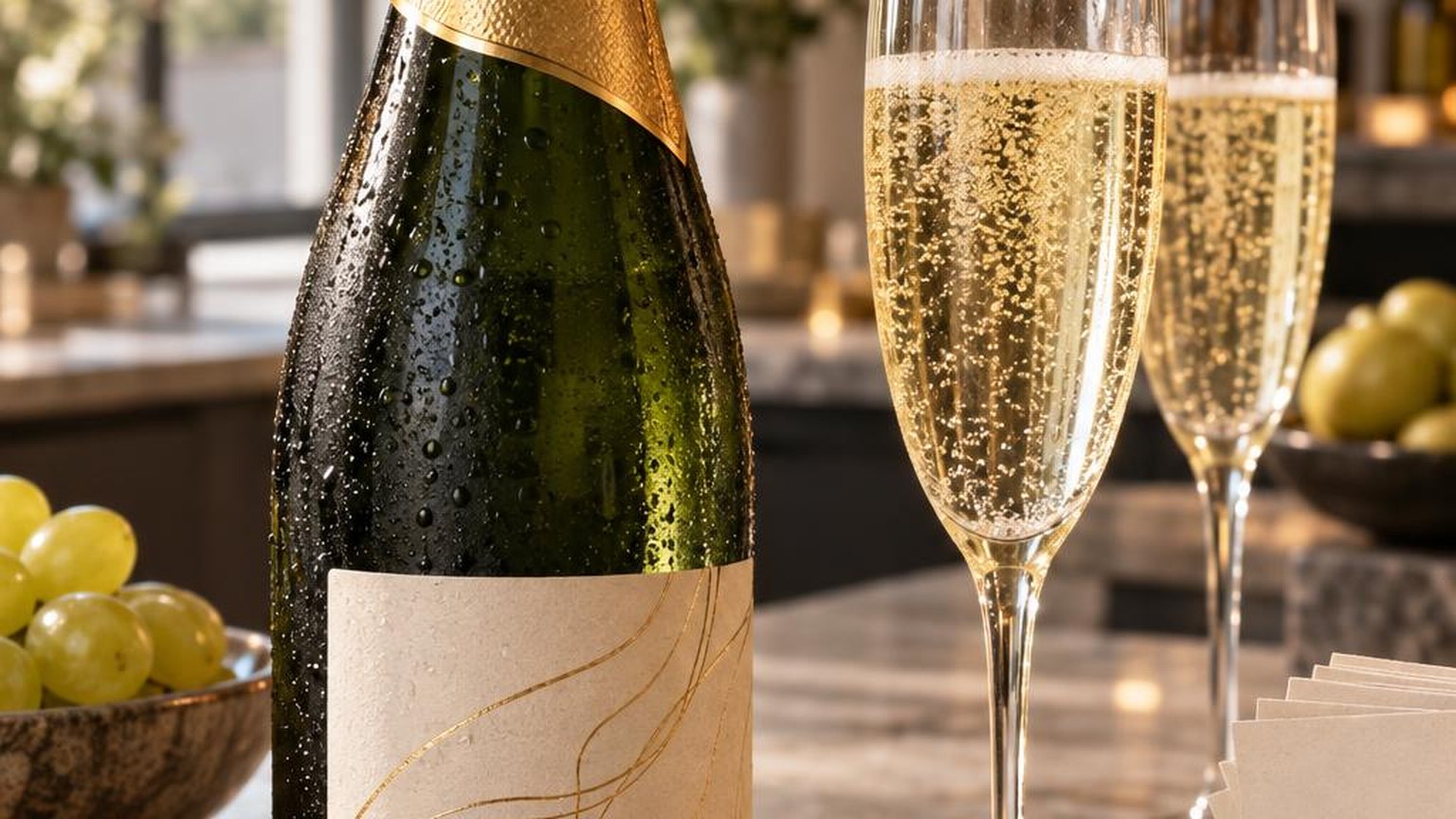
Best Storage After Opening Champagne
Proper storage after opening directly determines whether your Champagne retains its effervescence for 1 day or 5 days. Temperature, seal type, and bottle orientation each play measurable roles in preserving dissolved CO₂.
Temperature Is the Primary Factor
Cold temperatures slow CO₂ release from solution. At 4°C (39°F), Champagne retains carbonation roughly 2–3 times longer than at room temperature (20°C/68°F). Refrigerate immediately after pouring.
Never store opened Champagne at room temperature. CO₂ solubility drops as liquid warms, accelerating bubble loss within hours. A standard refrigerator set between 3–5°C is ideal.
Seal Comparison: What Actually Works
Not all closures perform equally. A hermetic Champagne stopper outperforms every improvised method by maintaining internal pressure.
| Seal Method | Pressure Retained After 24 Hours | Drinkable Window (Refrigerated) |
| Hermetic Champagne stopper | ~80–90% of original pressure | 3–5 days |
| Hinged bottle stopper (generic) | ~50–60% | 1–3 days |
| Plastic wrap + rubber band | ~30–40% | 12–24 hours |
| Spoon in the neck (myth) | No measurable difference vs. open bottle | 12–18 hours |
| No seal at all | ~10–15% | 4–8 hours |
Stanford University research and studies published in the Journal of Agricultural and Food Chemistry have confirmed the spoon method is ineffective. It provides no physical barrier against gas escape.
Bottle Orientation and Fill Level
Store opened Champagne upright, never on its side. An upright position minimizes the surface area exposed to air, reducing both oxidation and CO₂ loss.
Fill level matters significantly. A bottle that is three-quarters full retains carbonation far longer than one that is one-quarter full. More headspace means more room for dissolved CO₂ to escape into.
Additional Storage Guidelines
- Keep the bottle away from light, which accelerates flavor degradation through lightstrike.
- Avoid opening and resealing repeatedly — each opening releases a burst of pressurized CO₂.
- Use a smaller container if transferring leftover Champagne; less headspace preserves more fizz.
- Vintage and prestige cuvées with complex flavor profiles remain enjoyable slightly longer (up to 5 days) because their appeal is less dependent on aggressive carbonation.
Investing $8–$15 in a quality hermetic Champagne stopper is the single most effective step. It pays for itself after preserving just one bottle of decent Champagne.
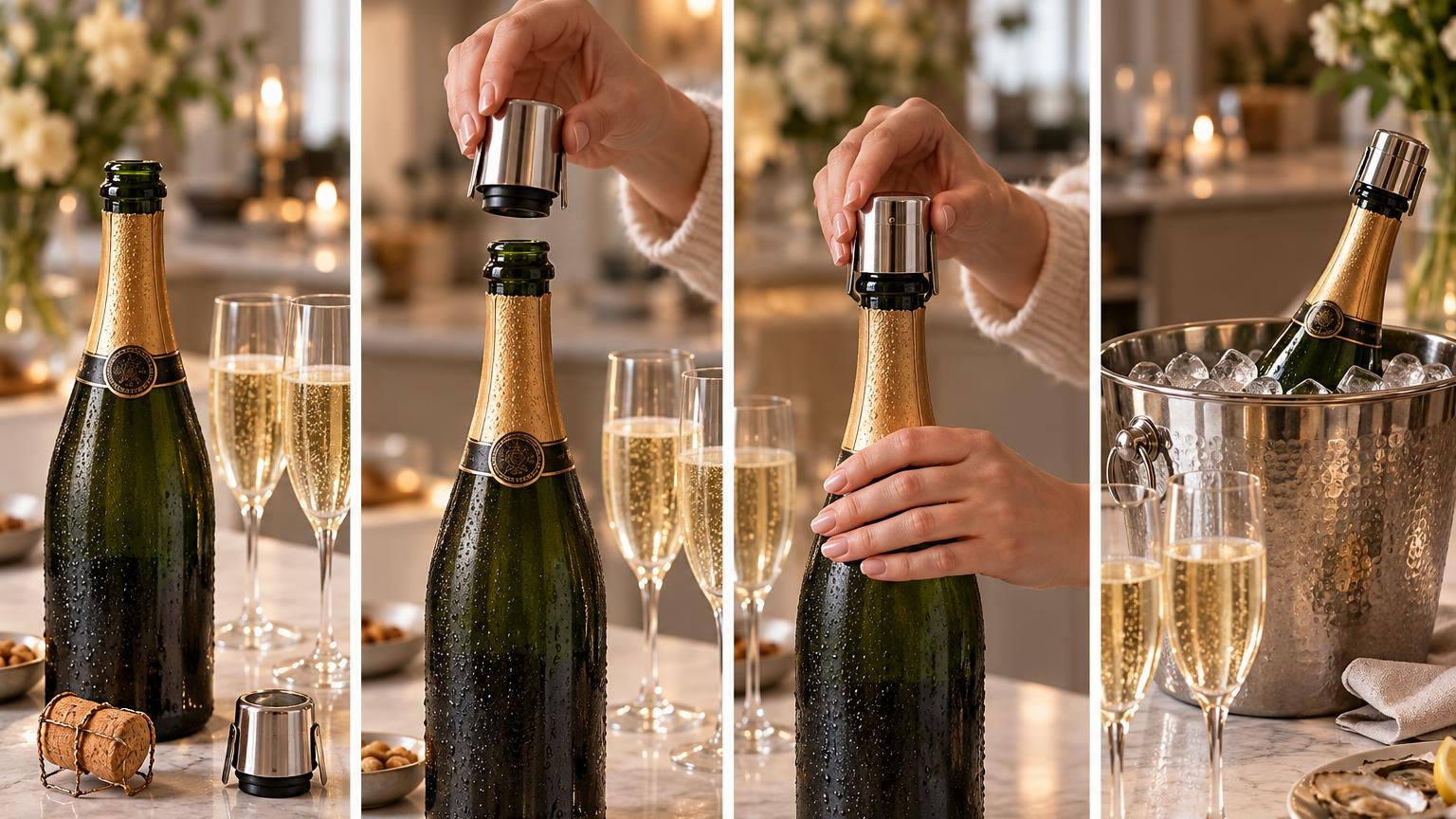
How Stopper Type Changes Shelf Life
The stopper you use after popping a bottle of Champagne directly determines how many days of drinkable fizz remain. Not all closures perform equally—pressure retention varies dramatically between stopper designs.
Champagne’s sparkle comes from dissolved CO₂ held at roughly 5–6 atmospheres of pressure in a sealed bottle. Once opened, that pressure begins escaping immediately. A good stopper slows this loss; a poor one barely helps at all.
Stopper Performance Comparison
| Stopper Type | Estimated Freshness Window (Refrigerated) | Pressure Retention |
| Hermetic Champagne stopper (hinged clamp) | 3–5 days | High — maintains ~2–3 atmospheres after 48 hours |
| Dedicated vacuum wine stopper | 1–2 days | Low — not designed for carbonated wines |
| Original cork pushed back in | 12–24 hours | Very low — poor seal, cork expands unevenly |
| Plastic wrap + rubber band | 8–12 hours | Minimal — emergency method only |
| No stopper at all | 2–4 hours | None |
Why Hermetic Stoppers Win
Hermetic Champagne stoppers use a metal clamp that locks onto the bottle’s lip, compressing a silicone or rubber gasket against the rim. This creates an airtight seal that resists the outward force of CO₂.
Brands like Le Creuset, Westmark, and Kloveo manufacture dedicated Champagne stoppers rated for pressures up to 6 atmospheres. They typically cost $8–$20 and last for years.
Why Vacuum Stoppers Underperform
Standard vacuum wine stoppers actively remove air from the bottle. For still wine, that’s beneficial. For Champagne, the pumping action extracts dissolved CO₂ along with oxygen, accelerating fizz loss rather than preventing it.
The Cork Reinsertion Problem
Champagne corks expand 1.5–2× their compressed diameter after removal. Forcing the original cork back in rarely achieves a gas-tight seal. Even if partially reinserted, CO₂ escapes around the edges throughout the night.
- Best option: Hermetic clamp-style Champagne stopper, stored upright at 4–7 °C
- Acceptable backup: Dedicated sparkling wine stopper with a spring mechanism
- Avoid: Vacuum pumps, loose corks, or leaving the bottle open while you “finish it later”
Investing under $15 in a proper Champagne stopper can extend your bottle’s life by 3–4 days compared to improvised methods. That’s the single highest-impact storage decision after refrigeration.
Signs Open Champagne Has Spoiled
Spoiled Champagne won’t make you sick, but it becomes unpleasant to drink. Recognizing deterioration early prevents you from ruining a cocktail or dish with flat, oxidized wine.
The signs fall into three categories: visual, aromatic, and taste-based.
Visual Indicators
Fresh Champagne produces persistent streams of fine bubbles rising from the glass bottom.
Spoiled Champagne shows few or zero bubbles, indicating CO₂ pressure has dropped below 1 atmosphere — compared to 5–6 atmospheres when properly sealed.
Color shifts signal oxidation. Young Champagne ranges from pale straw to light gold. Once exposed to air for 48–72 hours, it deepens to amber or dark gold. Visible cloudiness or floating particles suggest microbial contamination.
Aroma Changes
- Vinegar smell: Acetic acid bacteria convert ethanol to acetic acid when oxygen is present. A sharp, sour odor confirms this process has begun.
- Wet cardboard or musty scent: Indicates oxidation has degraded the wine’s aromatic compounds, particularly the fruity esters and thiols.
- Flat or muted nose: Fresh Champagne releases volatile aromatics carried by escaping CO₂. Without carbonation, the bouquet collapses significantly.
- Sulfur or rotten egg odor: Hydrogen sulfide development from stressed or degraded lees contact in improperly stored bottles.
Taste Differences: Fresh vs. Spoiled
| Attribute | Fresh Champagne | Spoiled Champagne |
| Carbonation | Lively, persistent mousse | Flat or barely fizzy |
| Acidity | Bright, crisp (pH 3.0–3.1) | Harsh, vinegary (pH dropping further) |
| Fruit character | Citrus, apple, stone fruit notes | Dull, washed-out, or absent |
| Finish | Clean, lingering minerality | Bitter, metallic, or astringent |
| Sweetness balance | Integrated dosage | Cloying or oddly sweet from oxidation byproducts |
The 24-Hour Rule
With a quality Champagne stopper maintaining roughly 3–4 atmospheres of pressure, most bottles remain acceptable for 24–48 hours refrigerated.
Beyond 72 hours, even well-sealed bottles typically lose over 80% of their original carbonation.
If any two signs from different categories appear simultaneously — such as color change plus vinegar aroma — the Champagne has deteriorated beyond enjoyable drinking.
Use it for cooking sauces or vinaigrettes instead of discarding it entirely.
Uses for Flat Leftover Champagne
Flat Champagne retains its acidity (pH 3.0–3.3) and residual sugar even after losing carbonation. These properties make it a versatile ingredient in cooking, cleaning, and beauty applications rather than a candidate for the drain.
Cooking and Baking
The tartaric and malic acids in flat Champagne tenderize proteins effectively. Use it as a 1:1 substitute for white wine in pan sauces, risottos, and cream reductions.
- Champagne vinaigrette: Combine 3 tablespoons flat Champagne, 1 tablespoon Dijon mustard, and 6 tablespoons olive oil for a bright salad dressing.
- Poaching liquid: Poach pears or salmon in flat Champagne with aromatics for 15–20 minutes at a gentle simmer (around 180 °F / 82 °C).
- Batter and batters: Flat Champagne creates lighter tempura and pancake batters because residual dissolved CO₂ still provides some lift during frying.
- Champagne sorbet: Mix 750 ml flat Champagne with 200 g sugar syrup and freeze, stirring every 30 minutes for approximately 3 hours.
Household Cleaning
Champagne’s acidity cuts grease and dissolves mineral deposits. It works on glass, stainless steel, and porcelain surfaces without harsh chemicals.
| Application | Method | Contact Time |
| Glass and mirror streak removal | Spray undiluted, wipe with microfiber cloth | 1–2 minutes |
| Stainless steel degreasing | Apply with soft sponge, rinse | 3–5 minutes |
| Red wine stain on fabric | Blot stain, pour Champagne directly, launder | 10–15 minutes soak |
| Tarnished jewelry (gold only) | Submerge in shallow dish of Champagne | 20 minutes |
Beauty and Skincare
The tartaric acid in Champagne acts as a mild alpha hydroxy acid (AHA) exfoliant. Dermatologists classify tartaric acid among effective AHAs at concentrations above 1%.
- Hair rinse: Pour 120 ml flat Champagne through hair after shampooing to remove product buildup and add shine. Rinse with cool water after 2 minutes.
- Foot soak: Add 250 ml flat Champagne to warm water and soak feet for 15 minutes to soften calluses.
- DIY toner: Mix equal parts flat Champagne and distilled water, apply with a cotton pad. Refrigerate and use within 48 hours.
Flat Champagne stored in the refrigerator remains usable for these non-drinking purposes for up to 5 days. Beyond that, bacterial growth and off-odors make it unsuitable even for household use.
Common Questions
How long does open Champagne last in the refrigerator?
An opened bottle of Champagne stored in the refrigerator with a hermetic Champagne stopper retains acceptable effervescence for 3–5 days.
Without a stopper, carbonation drops by roughly 40% within the first 4 hours, and the wine goes flat within 24 hours. Non-vintage cuvées lose fizz faster than vintage Champagnes due to lower pressure at disgorgement.
Can you drink Champagne that was left open overnight?
Champagne left open overnight at room temperature is safe to drink but will have lost most of its dissolved CO₂—fresh Champagne holds approximately 49 million bubbles per glass.
And an unsealed bottle at 20 °C loses the majority within 8–12 hours.
The wine will taste flat and oxidized, with muted fruit and a duller acidity. It remains usable for cooking sauces or vinaigrettes rather than drinking.
Does a spoon in the bottle keep Champagne fizzy?
The dangling-spoon trick is a persistent myth debunked by controlled studies, including a well-known 1994 experiment by Champagne scientist Gérard Liger-Belair.
Researchers found no measurable difference in CO₂ retention between bottles with a spoon and those left open. A proper Champagne stopper with a clamp seal is the only effective tool for preserving carbonation.
What is the best way to store open Champagne?
Seal the bottle immediately with a lever-style Champagne stopper—not a cork or plastic wrap—and refrigerate at 4–7 °C (39–45 °F).
Cold temperature slows CO₂ escape because gas solubility increases as liquid temperature decreases. Keep the bottle upright to minimize the surface area exposed to air and reduce oxidation.
How can you tell if open Champagne has gone bad?
The clearest sign is a complete absence of bubbles when poured, indicating the wine has gone flat. Off-putting aromas such as wet cardboard, vinegar, or bruised apple signal oxidation or acetic acid bacteria activity.
A color shift from pale gold to deep amber in a non-vintage brut also indicates excessive oxidation and degraded quality.
Does vintage Champagne last longer after opening than non-vintage?
Vintage and prestige cuvées generally hold up 1–2 days longer after opening because their more complex flavor profiles—developed through extended lees aging (typically 36+ months versus the 15-month minimum for NV)—remain.
Interesting even as carbonation fades.
The deeper autolytic character, with notes of brioche and toasted almond, compensates somewhat for lost effervescence. However, bubble retention itself is governed by bottle pressure and temperature, not aging time.
Can you re-cork open Champagne with the original cork?
Once removed, a Champagne cork expands to roughly 1.5 times the diameter of the bottle opening within minutes, making reinsertion nearly impossible without breaking it.
Forcing a swollen cork back in creates an unreliable seal that does not maintain the 5–6 atmospheres of pressure needed for proper carbonation.
Use a purpose-built Champagne stopper instead—models with stainless-steel clamps cost under $10 and form an airtight seal rated to hold up to 4 atmospheres.
- How Many Calories Are in a Glass of Sparkling Wine?
- Is Champagne Gluten Free? The Most Accurate Answer
- How Many Calories In A Bottle Of Champagne 750Ml? The Surprising Truth You Need to Know (Complete Guide)
- How Many Calories in a Bottle of Champagne? The Eye-Opening Truth You Must Know Before Your Next Celebration
- Alcohol Content in Champagne Explained
- How Many Mimosas in a Bottle of Champagne?
- How To Bring Champagne On A Cruise?
- All Alcohol Guides
- USDA FoodKeeper App – Food Safety Guidelines (2023)
- FDA – Wine and Spirits Storage and Safety (2024)
- National Institutes of Health – Ethanol Oxidation and Wine Spoilage (2017)
- University of California Davis – Department of Viticulture and Enology, CO₂ Loss in Sparkling Wine (2019)
- Comité Champagne – Official Champagne Bureau, Storage and Serving Guidelines (2024)
- Wine Spectator – How Long Does Open Champagne Keep? (2023)
- Journal of Agricultural and Food Chemistry – CO₂ Dissolved in Champagne and Sparkling Wines (2009)