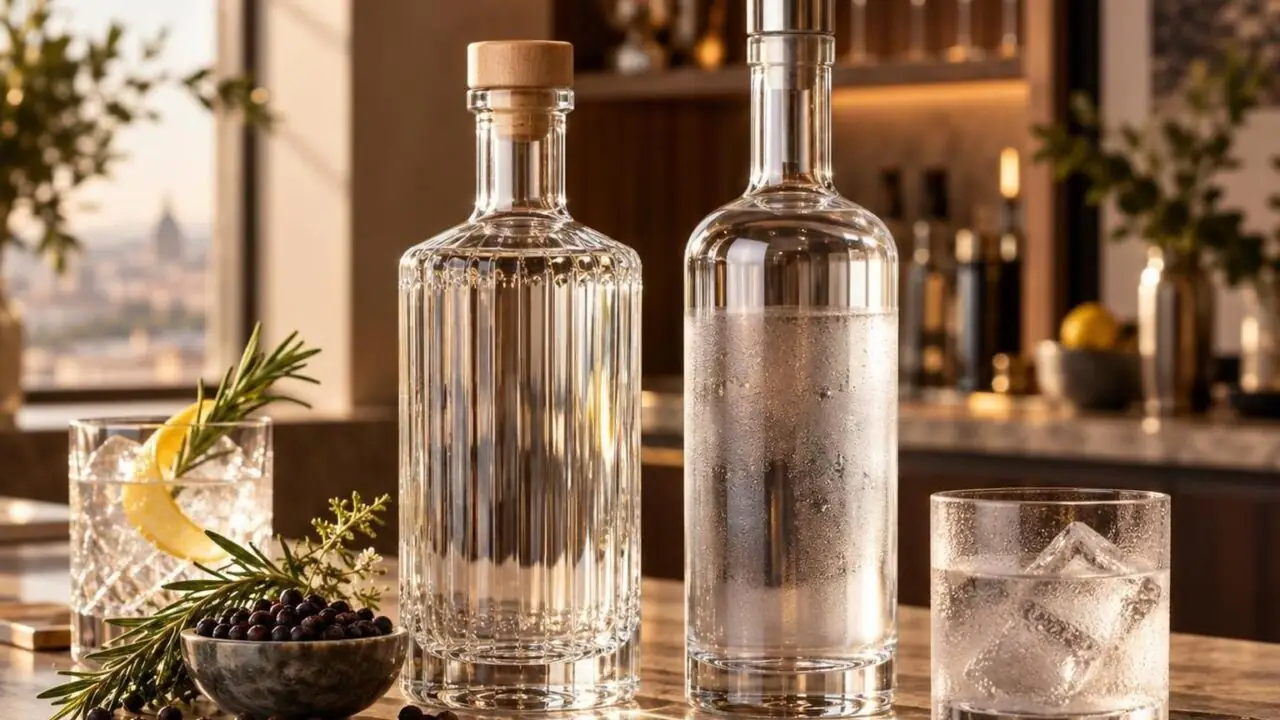
difference between gin and vodka is that gin must taste primarily of juniper, while vodka is defined by a neutral profile after distillation and filtration.
Both spirits can start from grain, potatoes, grapes, or other fermentable materials, but their legal identities diverge at flavor.
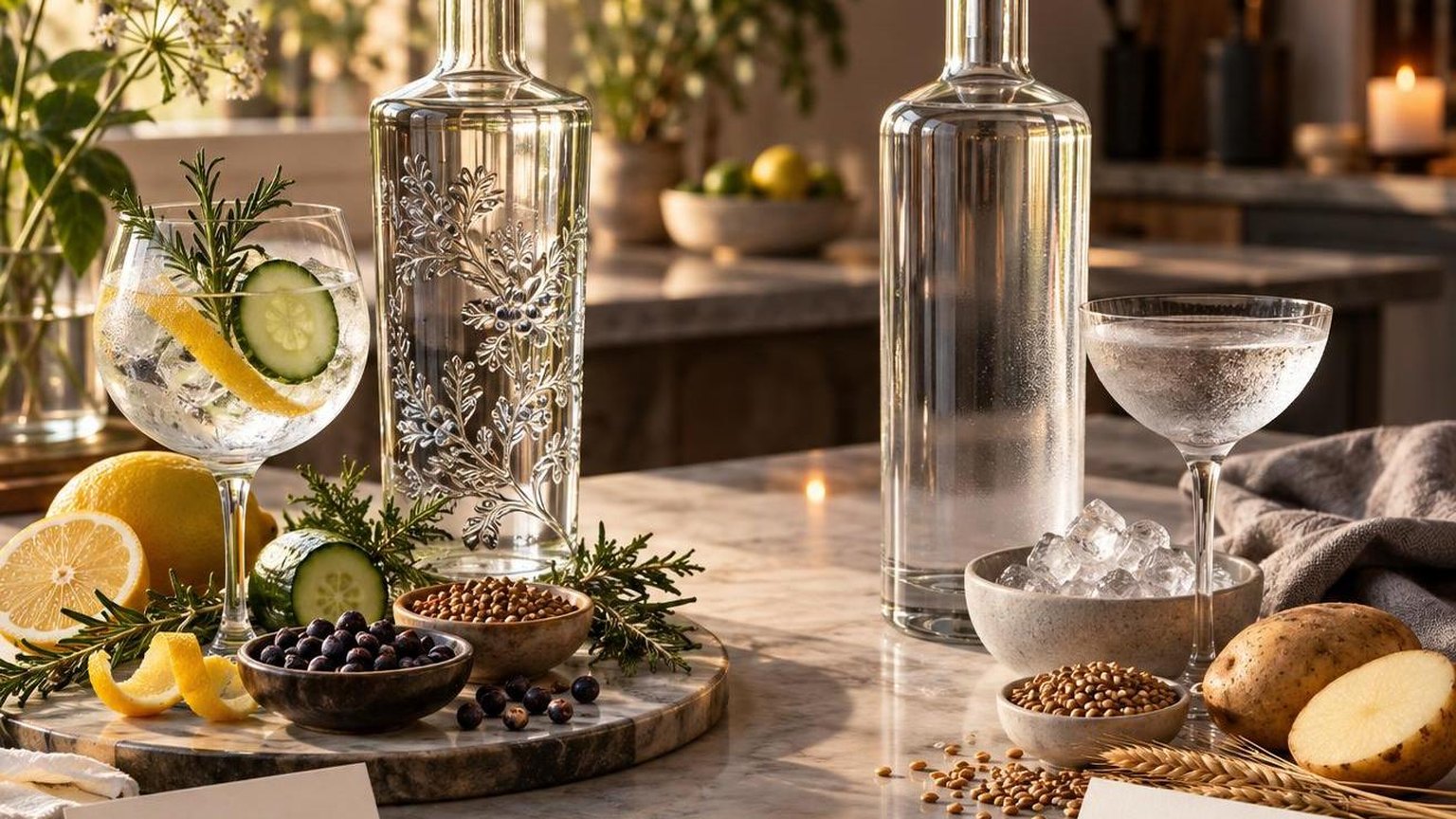
Gin gets its character from botanicals such as coriander seed, citrus peel, angelica root, and juniper berries. Vodka is typically bottled to emphasize smoothness, texture, and purity rather than aroma.
This guide compares ingredients, production rules, flavor, cocktails, calories, ABV, and buying choices so you can choose the right bottle for a martini, tonic, or clean mixed drink.
Base Ingredients and Legal Definitions
Vodka and gin share a common origin as neutral grain spirits, yet their legal definitions diverge sharply once botanicals enter the equation.
Understanding these regulatory distinctions clarifies why two spirits from identical base materials taste fundamentally different.
Base Ingredients
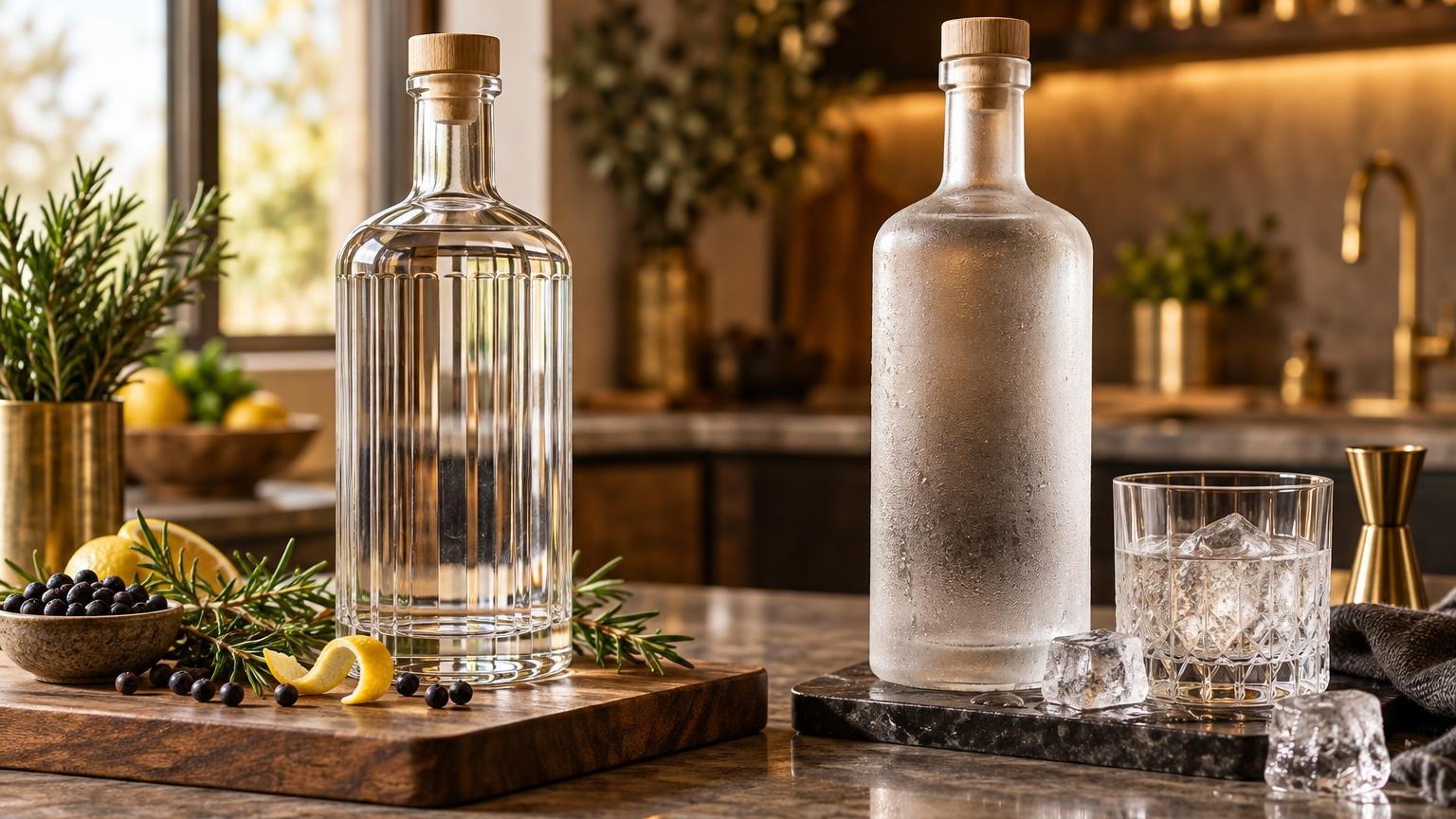
Both spirits can be distilled from virtually any fermentable agricultural material. Grain remains the most common base for commercial production worldwide.
- Vodka: Commonly produced from wheat, rye, corn, potatoes, or grapes. Tito’s uses corn; Belvedere uses Polish rye; Chopin uses potatoes.
- Gin: Typically starts as a grain-neutral spirit (wheat or corn), then undergoes redistillation or maceration with juniper berries and other botanicals. Hendrick’s uses a wheat-and-corn base; Tanqueray uses English wheat.
The base ingredient matters less in vodka than most consumers assume. Multiple distillations and charcoal filtration strip nearly all congeners from the source material.
Legal Definitions by Market
Regulations in the United States and European Union set distinct identity standards for each spirit. The differences center on flavor, minimum ABV, and required ingredients.
| Criterion | Vodka (US – 27 CFR §5.155) | Gin (US – 27 CFR §5.151) |
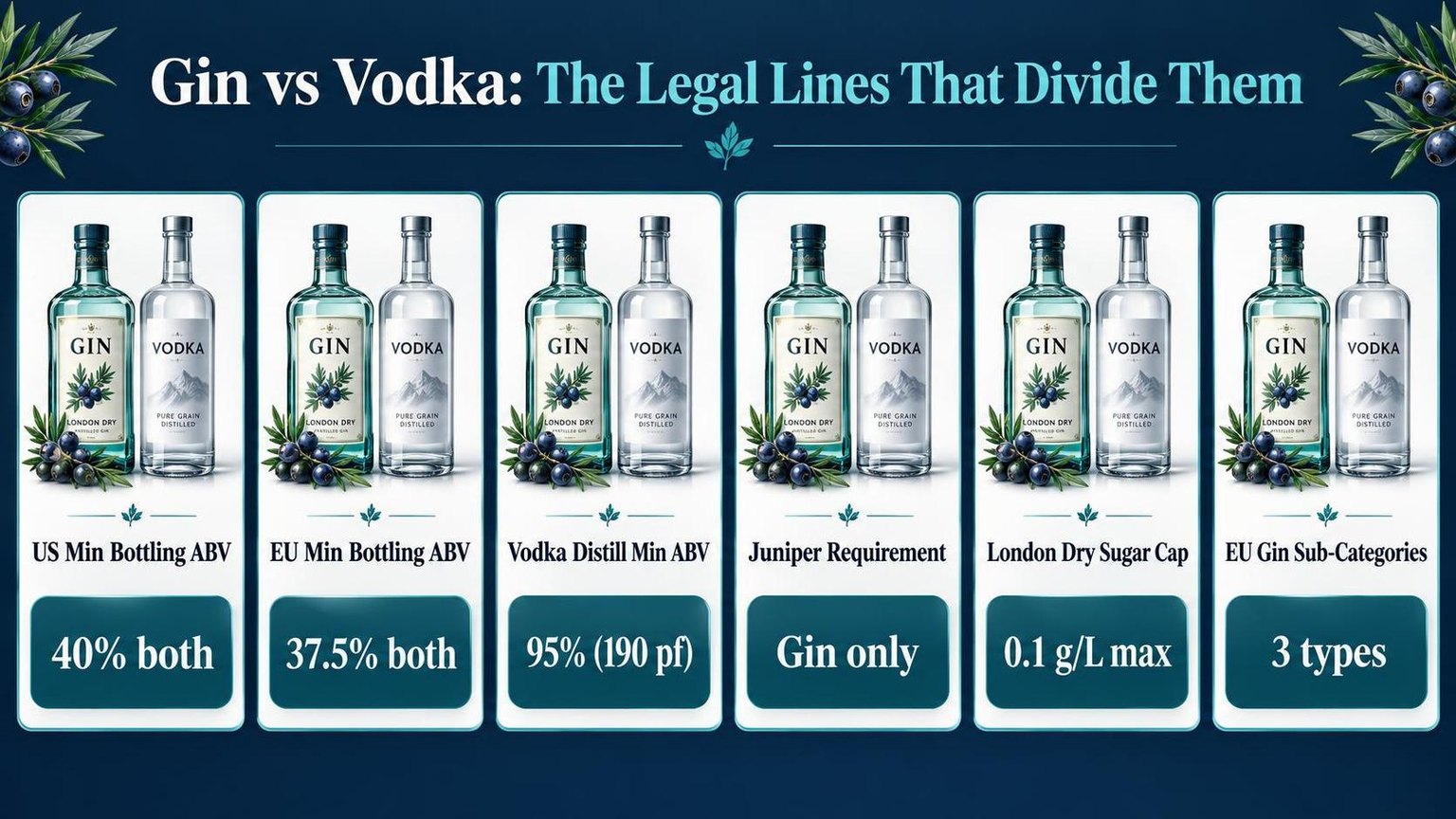
| Minimum bottling ABV | 40% (80 proof) | 40% (80 proof) |
| Distillation minimum ABV | 95% (190 proof) | Not specifically mandated at same threshold |
| Dominant flavor requirement | None — must be “without distinctive character, aroma, taste, or color” | Must derive primary flavor from juniper berries |
| Botanical requirement | None | Juniper berries mandatory |
| Added sugar permitted | No (US standard) | Yes, in compound gin; restricted in distilled gin (EU limit: 0.1 g/L sweetener for “London Dry”) |
EU Regulation (EC) No 2019/787
The EU separates gin into three sub-categories with escalating production requirements, each carrying distinct labeling rules.
- Gin: Minimum 37.5% ABV. Juniper-predominant flavor required. May use natural or nature-identical flavorings added to a neutral spirit.
- Distilled Gin: Minimum 37.5% ABV. Botanicals must be redistilled in the neutral spirit, not simply infused post-distillation.
- London Dry Gin: Minimum 37.5% ABV. All flavors introduced exclusively through redistillation. Maximum 0.1 g of sugar per liter. No artificial colors or flavorings permitted.
EU vodka regulations require a minimum of 37.5% ABV — 2.5 percentage points lower than the US standard. Non-traditional base materials (anything beyond grain or potatoes) must be declared on the label.
Why the Distinction Matters
Gin is, in regulatory terms, a flavored vodka — a neutral spirit redistilled with botanicals. Every gin begins its life as a spirit that could legally be labeled vodka.
The juniper mandate is the single legal threshold that separates the two categories.
For cocktail selection at a wine bar, this shared lineage means gin and vodka occupy interchangeable structural roles in mixed drinks. The botanical profile of gin adds aromatic complexity; vodka provides a deliberately neutral canvas.
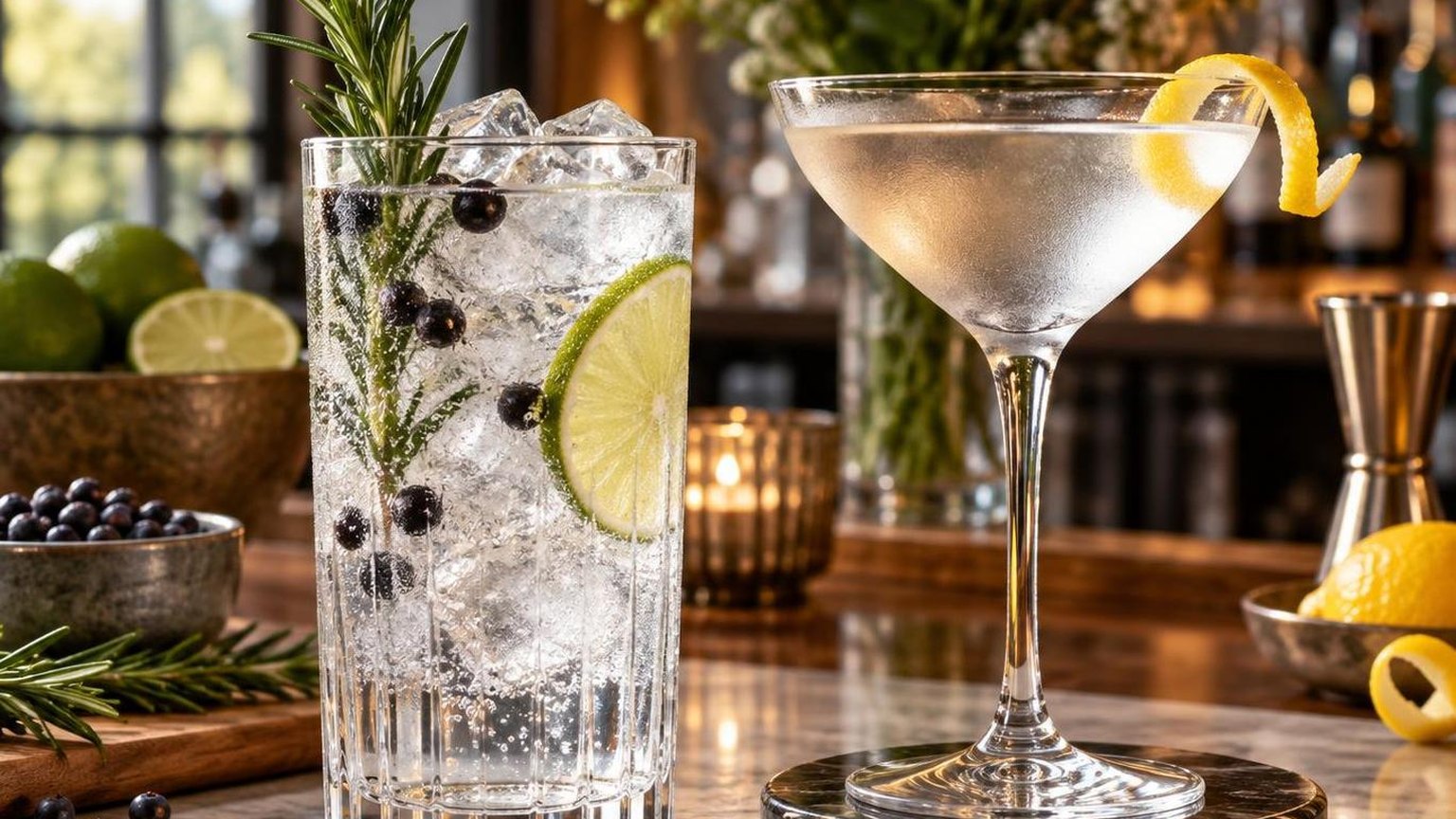
Why Gin Tastes Botanical
Gin’s botanical character is not accidental—it is a legal requirement. EU regulation (EC) No 110/2008 mandates that juniper berries must be the predominant flavoring in any spirit labeled gin.
This single rule shapes every bottle on the market.
Juniper berries contain over 50 volatile compounds, with α-pinene and myrcene driving the signature piney, resinous aroma. These terpenes vaporize during distillation between 155–165 °C, infusing the spirit as it condenses.
Common Botanicals and Their Key Compounds
| Botanical | Primary Flavor Compound | Flavor Profile |
| Juniper berries | α-Pinene, myrcene | Piney, resinous |
| Coriander seed | Linalool | Citrus, floral |
| Angelica root | α-Phellandrene | Earthy, musky |
| Orris root | Irones | Violet, powdery |
| Cassia bark | Cinnamaldehyde | Warm, spicy |
| Citrus peel | Limonene | Bright, zesty |
Most London Dry gins use between 6 and 10 botanicals. Bombay Sapphire uses exactly 10. Hendrick’s incorporates 11, adding cucumber and rose as distinguishing elements.
How Botanicals Enter the Spirit
Distillers use two primary methods to extract botanical flavor: maceration and vapor infusion. Many producers combine both techniques in a single distillation run.
- Maceration (steeping): Botanicals soak directly in the neutral base spirit for 12–48 hours before distillation. This extracts heavier, earthier compounds from roots and bark.
- Vapor infusion: Botanicals sit in a perforated basket inside the still’s neck. Rising alcohol vapor passes through them, capturing lighter, more delicate aromatic molecules. Bombay Sapphire popularized this method using a Carter-Head still.
Why Vodka Lacks This Complexity
Vodka is distilled to a minimum of 95% ABV under EU law and 95% ABV under US TTB regulations (27 CFR 5.143). At that purity level, nearly all congeners—flavor-bearing compounds—are stripped away.
Gin, by contrast, is redistilled at lower proof specifically to retain botanical volatiles. The final distillate typically comes off the still at 70–80% ABV, preserving far more aromatic complexity.
Gas chromatography studies show London Dry gin contains 20–40 identifiable aromatic compounds per sample. Unflavored vodka typically registers fewer than 5 in comparable analyses.
The Role of Juniper Quantity
Commercial gin recipes use approximately 25–35 grams of juniper per liter of finished spirit. Some navy-strength gins push beyond 40 g/L to compensate for higher bottling proof, which can mask lighter aromatics.
Angelica root serves as a fixative, binding volatile top notes so they persist in the glass rather than flashing off immediately. Without it, the bright citrus and floral layers would dissipate within seconds of pouring.
Every botanical contributes a specific aromatic layer. The distiller’s skill lies in balancing these layers so juniper leads without overwhelming the ensemble—a craft more akin to perfumery than brewing.
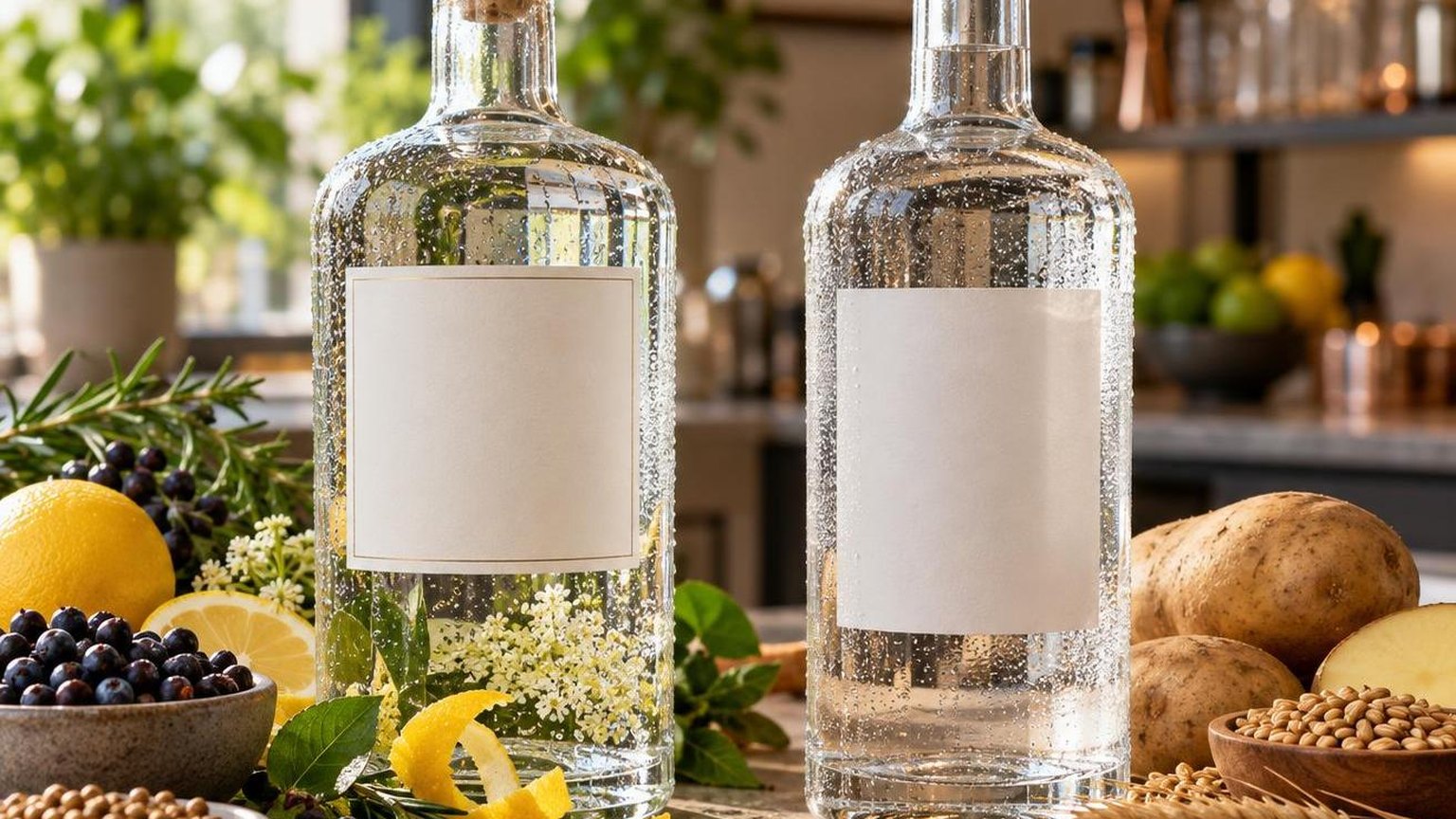
Why Vodka Tastes Neutral
Vodka’s defining characteristic is its near-absence of flavor, aroma, and color. The U.S.
TTB (Alcohol and Tobacco Tax and Trade Bureau) legally defines vodka as a spirit “without distinctive character, aroma, taste, or color.” This neutrality is engineered through two deliberate production choices.
High-proof distillation and aggressive filtration.
Distillation at High Proof
Vodka is typically distilled to at least 95% ABV (190 proof) before dilution. At that concentration, nearly all congeners—flavor-carrying compounds like esters, aldehydes, and fusel oils—are stripped away during the condensation process.
For comparison, bourbon leaves the still at no more than 80% ABV (160 proof) by law, retaining far more congeners. The higher the distillation proof, the fewer flavor molecules survive.
| Spirit | Typical Distillation Proof | Congener Retention |
| Vodka | 190 proof (95% ABV) | Very low |
| Gin | 190 proof before botanical infusion | Low base, then botanicals added |
| Bourbon | 125–160 proof (62.5–80% ABV) | High |
| Scotch whisky | 140–190 proof (70–95% ABV) | Moderate to high |
Multiple Distillation Passes
Many premium vodkas undergo three to six distillation passes in column stills. Each pass further reduces congener content.
A 2017 study in the Journal of the Institute of Brewing found that triple-distilled spirits contained roughly 50% fewer total congeners than single-distilled equivalents.
Column (continuous) stills are far more efficient at stripping flavor than traditional pot stills. A single column still can achieve 95%+ ABV in one pass, whereas pot stills rarely exceed 70% ABV per run.
Filtration as the Final Purifier
After distillation, vodka passes through activated charcoal, sometimes repeatedly. Charcoal filtration adsorbs residual fatty acids, sulfur compounds, and trace esters that survived distillation.
- Activated carbon: The most common medium; 1 gram provides roughly 3,000 m² of surface area for adsorption.
- Silver birch charcoal: Used by several Russian and Polish producers for a marginally softer mouthfeel.
- Quartz crystal and diamond dust: Marketing-driven choices with minimal proven impact on congener removal.
Base Ingredient Matters Less Than Process
Vodka can be made from grain, potatoes, grapes, corn, or even milk whey. Despite different starting sugars, the extreme distillation proof erases most origin characteristics.
Blind tasting studies, including a widely cited 2005 New York Times panel, found that tasters struggled to distinguish grain vodka from potato vodka when both were distilled above 95% ABV and charcoal-filtered.
Ultimately, vodka’s neutrality is not accidental. It is the result of distilling to near-azeotrope purity and then filtering out whatever traces remain—leaving ethanol, water, and very little else on the palate.
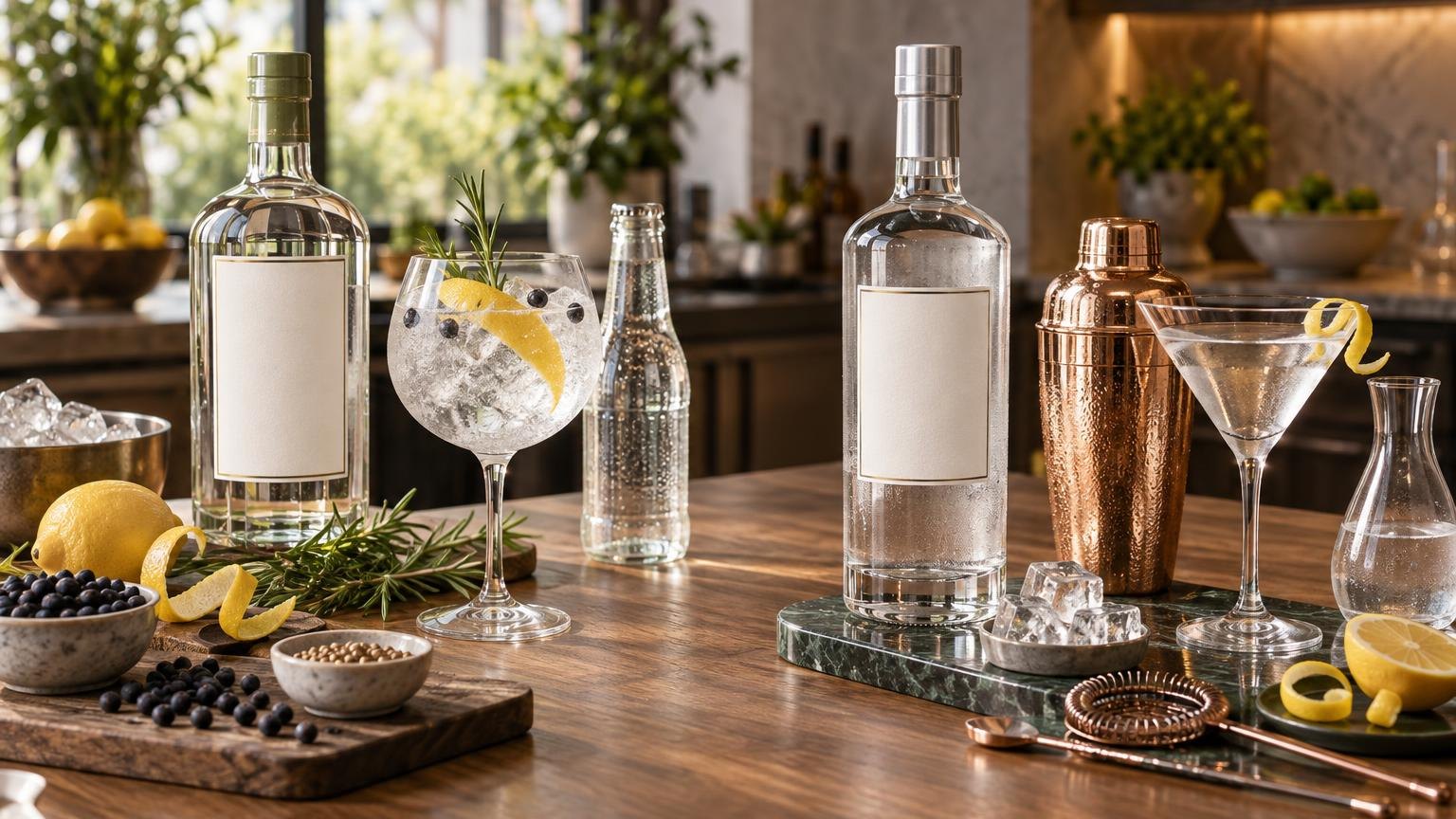
Production Differences That Matter
Vodka and gin share a common starting point—neutral grain spirit—but diverge sharply at the flavoring and distillation stage.
That single fork in the process creates two fundamentally different spirits with distinct legal definitions, flavor profiles, and serving applications.
Base Spirit Origins
Both spirits begin as a high-proof neutral spirit, typically distilled to at least 95% ABV (190 proof) before dilution. The base can come from grains, potatoes, grapes, or even sugarcane.
| Attribute | Vodka | Gin |
| Base ingredients | Grain, potato, grape, corn | Grain-based neutral spirit (most common) |
| Required botanical | None | Juniper berries (mandatory by EU and US law) |
| Minimum US bottling ABV | 40% (80 proof) | 40% (80 proof) |
| Typical distillation count | 3–6 times or more | 1–3 times after botanical infusion |
| TTB legal definition | “Without distinctive character, aroma, taste, or color” | “Possessing the characteristic flavor of juniper” |
| Carbon filtration | Standard practice | Rarely used post-botanical distillation |
Vodka: Stripping Flavor Away
Vodka production aims to remove character. Repeated distillation and charcoal filtration strip congeners—flavor-carrying chemical compounds. The US TTB definition explicitly requires vodka to lack distinctive taste or aroma.
Some premium brands distill up to 6 or even 10 times. Others use activated carbon filtration, passing the spirit through carbon columns to adsorb remaining impurities. The goal is purity and smoothness above all.
Gin: Building Flavor In
Gin production does the opposite—it adds complexity. After creating a clean neutral spirit, distillers reintroduce flavor through botanicals. Juniper must predominate, but producers typically use 6 to 30 additional botanicals.
Common botanicals include coriander seed, angelica root, citrus peel, orris root, cassia bark, and cardamom. Each distillery’s proprietary recipe creates its signature profile.
Three primary methods exist for botanical infusion:
- Steep and boil (pot distillation): Botanicals soak directly in the base spirit inside the pot still, then the mixture is redistilled. Beefeater uses this traditional method with a 24-hour steeping period.
- Vapor infusion: Botanicals sit in a basket above the boiling spirit. Rising vapors pass through, extracting delicate flavors. Bombay Sapphire popularized this technique using a Carter-Head still.
- Compound method: Cold infusion of botanicals or addition of natural essences without redistillation. This produces lower-quality “bathtub gin” and does not qualify as “distilled gin” under EU regulations (Regulation EC 110/2008).
Why It Matters at the Bar
Vodka’s neutrality makes it a blank canvas—ideal for cocktails where mixers drive the flavor.
Gin’s botanical complexity interacts with other ingredients, which is why a Martini tastes completely different depending on which spirit you choose.
A London Dry Gin and Tonic delivers 20+ aromatic compounds from the botanicals alone, before the quinine and citrus garnish even enter the equation. Vodka tonic, by contrast, lets the tonic water dominate the sensory experience entirely.
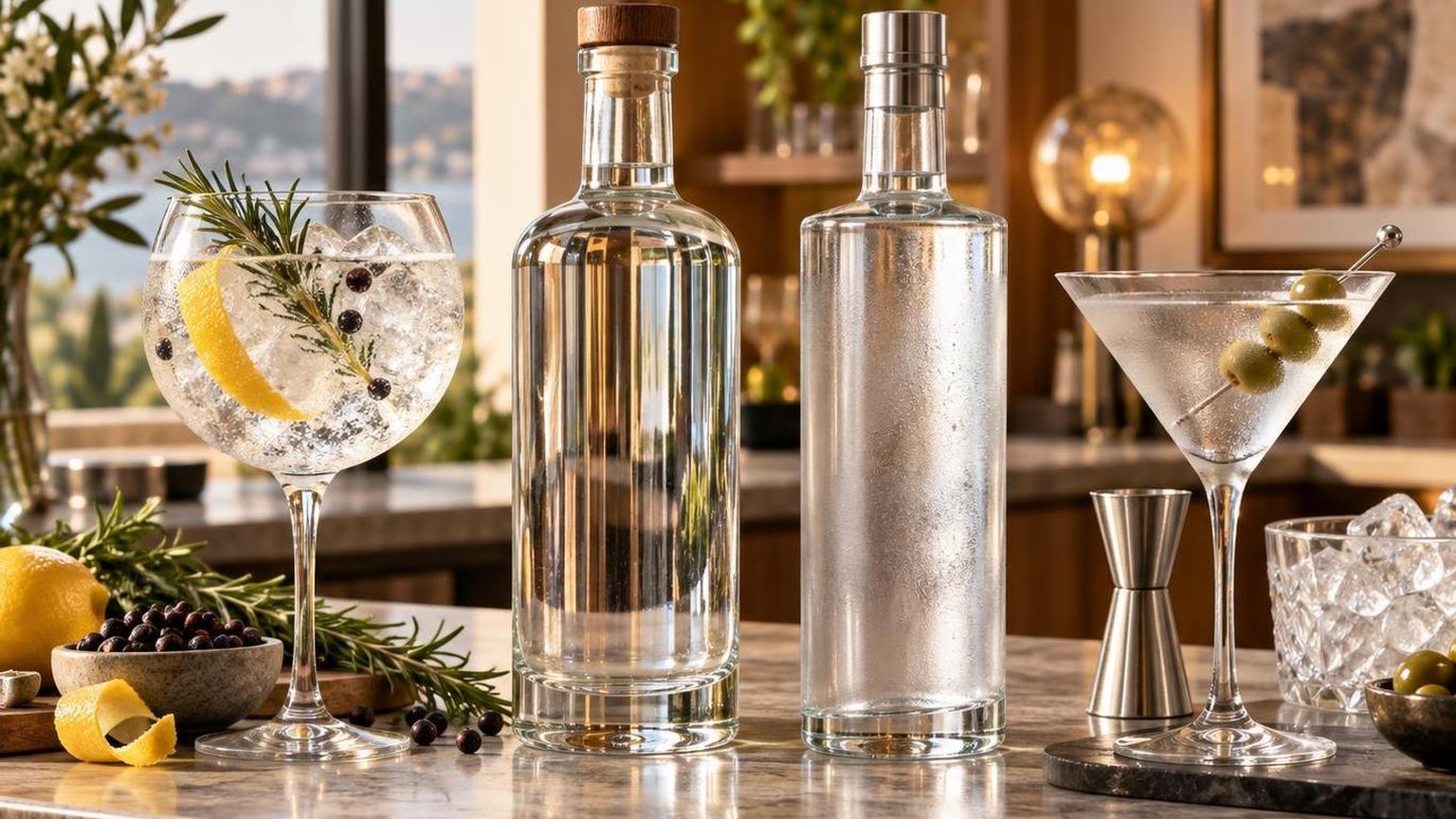
Best Uses in Cocktails
Gin and vodka occupy distinct roles behind the bar. Gin’s botanical complexity makes it the backbone of aromatic, spirit-forward drinks, while vodka’s neutral profile lets other ingredients shine.
The IBA (International Bartenders Association) officially codifies 77 cocktails—gin anchors 14 of them, vodka 12.
Classic Gin Cocktails
Gin defines several of the world’s most enduring cocktails, many dating to the 19th century. The botanical profile interacts with citrus, vermouth, and tonic in ways vodka cannot replicate.
- Martini — 60 ml gin, 10 ml dry vermouth. The original specification predates the vodka variant by roughly 60 years (first documented in the 1880s).
- Negroni — Equal parts gin, Campari, and sweet vermouth (30 ml each). Invented around 1919 in Florence, it relies on juniper to balance Campari’s bitterness.
- Gin & Tonic — British officers in colonial India mixed quinine tonic with gin in the early 1800s. The juniper and quinine pairing is synergistic; substituting vodka removes half the flavor equation.
- Tom Collins — 45 ml Old Tom gin, 30 ml lemon juice, 15 ml simple syrup, topped with soda. First recorded in Jerry Thomas’s 1876 bartending guide.
Classic Vodka Cocktails
Vodka’s rise in American cocktail culture began in the 1950s. Its neutrality makes it the preferred base when fruit, coffee, or cream flavors should dominate.
- Moscow Mule — 45 ml vodka, 120 ml ginger beer, 15 ml lime juice. Created in 1941 at the Chatham Hotel in New York, it helped establish Smirnoff in the U.S. market.
- Cosmopolitan — 40 ml citrus vodka, 15 ml Cointreau, 30 ml cranberry juice, 10 ml lime. Popularized by Toby Cecchini at The Odeon in Manhattan in 1988.
- Espresso Martini — 50 ml vodka, 30 ml coffee liqueur, 25 ml fresh espresso. Dick Bradsell invented it at Fred’s Club in London in 1983. Vodka lets espresso remain the star.
- Bloody Mary — 45 ml vodka, 90 ml tomato juice, plus spices. Vodka’s absence of competing botanicals allows the savory profile to come through cleanly.
Side-by-Side Comparison
| Factor | Gin | Vodka |
| Flavor contribution | Herbal, floral, citrus botanicals | Minimal; clean ethanol warmth |
| Best paired with | Vermouth, tonic, citrus bitters | Fruit juices, cream, coffee |
| IBA-listed cocktails | 14 | 12 |
| Typical ABV in cocktails | 40–47% | 37.5–40% |
| Substitutability | Rarely replaced without flavor loss | Easily swapped with other neutral spirits |
A practical rule: if the cocktail’s name references a flavor ingredient—Espresso Martini, Cosmopolitan—vodka is likely the base. If the spirit itself is the flavor engine, gin belongs in the glass.
Questions People Ask Most
What is the fundamental difference in flavor between gin and vodka?
Vodka is distilled to be as neutral and flavorless as possible, while gin must contain juniper berries and typically includes 6–10 additional botanicals such as coriander, angelica root, and citrus peel.
The EU spirit regulations (Regulation 2019/787) legally require gin to have a “predominant” juniper taste.
Whereas vodka is defined as a spirit “without any predominant character.” This botanical infusion is why gin registers a distinct piney, herbal profile that vodka deliberately avoids.
Are gin and vodka made from the same base spirit?
Yes — most London Dry gins begin as a neutral grain spirit virtually identical to vodka, typically distilled from wheat or corn to at least 96% ABV before redistillation with botanicals.
The key divergence occurs in the final production step: vodka undergoes carbon filtration and dilution to preserve neutrality, while gin is redistilled or steeped with juniper and other botanicals.
Brands like Ketel One even produce both a vodka and a botanical-infused line from the same base distillate.
Do gin and vodka differ in calorie or sugar content?
At the same proof, gin and vodka are nearly identical in calories — a standard 1.5 oz (44 ml) pour of 80-proof spirit contains roughly 97 calories and zero grams of sugar, fat, or carbohydrates according to USDA data.
Flavored vodkas and sweetened “New Western” gins can deviate significantly, with some flavored vodkas adding 3–5 g of sugar per serving. For unsweetened, unflavored bottles at 40% ABV, the nutritional difference is negligible.
Can you substitute gin for vodka in cocktails?
Substitution works in some cocktails but alters the drink’s character substantially. A Martini made with gin (its original base, pre-1950s) tastes herbal and complex, while a vodka Martini emphasizes the vermouth and dilution.
Gin overpowers delicate mixers in drinks like a Moscow Mule or Cosmopolitan, whereas vodka disappears in botanical-forward cocktails like a Negroni — so swapping depends on whether you want the spirit to contribute flavor or act as a neutral carrier.
Which spirit is older — gin or vodka?
Vodka’s documented origins trace to 8th–9th century Eastern Europe, with the earliest written record appearing in Polish court documents from 1405.
Gin emerged later, evolving from a Dutch juniper-flavored spirit called “jenever” first produced in the 16th century and popularized in England after the 1689 accession of William of Orange.
Vodka predates gin by roughly 200–300 years, though both spirits have evolved dramatically from their original medicinal formulations.
Further Reading
- What Is Vodka Proof?
- How Long Does Vodka Last? Find Out Now
- How Many Shots of Pink Whitney To Get Drunk?
- Does Vodka Evaporate Over Time?
- Is Smirnoff Gluten Free? – What You Need to Know?
- Do Flavored Vodkas Have Sugar?
- Does Vodka Freeze? The Truth You Didn't Know
- Skyy Blue Vodka Review – Basic Information You Must Know
- What To Mix With Pink Whitney? Get Answer Now
- All Alcohol Guides
- TTB — Distilled Spirits Standards of Identity (2024)
- USDA FoodData Central — Gin Nutrition (2024)
- USDA FoodData Central — Vodka Nutrition (2024)
- National Institute on Alcohol Abuse and Alcoholism — What Is a Standard Drink? (2024)
- PubMed Central — Juniper Berry Essential Oil Composition and Biological Activity (2020)
- CDC — Dietary Guidelines for Alcohol (2024)
- MasterClass — Gin vs. Vodka: Key Differences (2022)
- The Spruce Eats — What Is the Difference Between Gin and Vodka? (2023)
- Difford's Guide — History of Gin (2024)