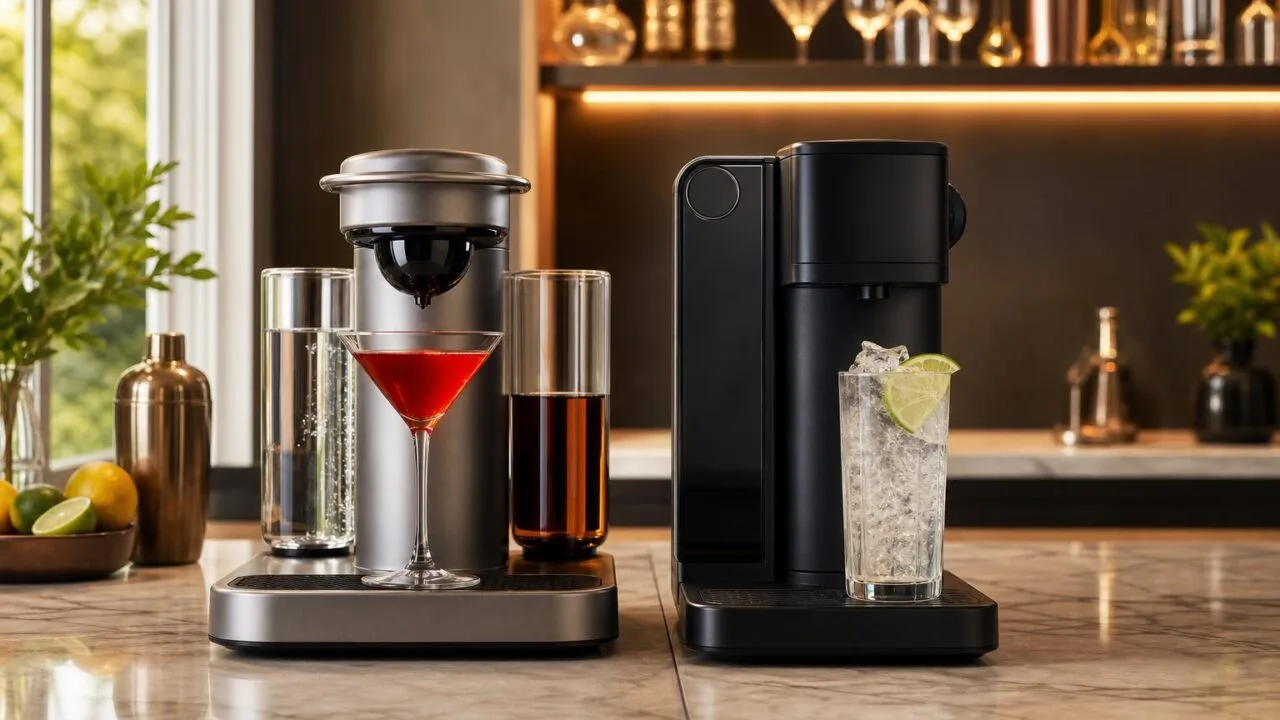
Bartesian Vs Drinkworks is a comparison between an active cocktail-capsule system and a discontinued home drink platform once sold through Keurig Dr Pepper and Anheuser-Busch InBev.
Bartesian remains available in the U.S., using spirit-specific reservoirs and recyclable cocktail capsules. Drinkworks stopped selling machines in 2021 and ended pod support in 2022.
This guide compares availability, drink quality, pod options, alcohol requirements, maintenance, and long-term value so you can decide whether Bartesian is the practical choice or Drinkworks is only worth considering secondhand.
Core Difference Between Bartesian and Drinkworks
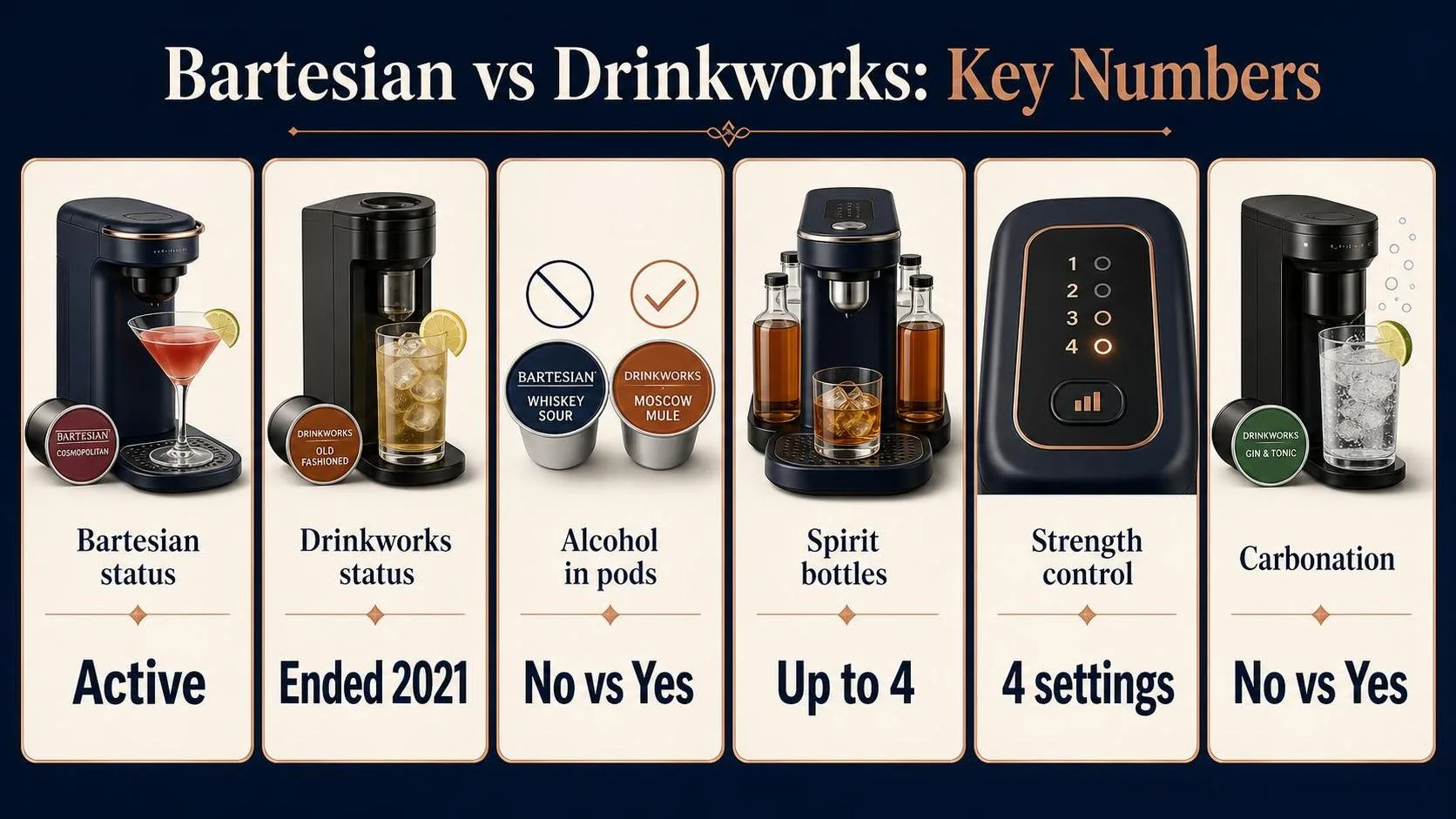
Bartesian and Drinkworks were built around very different numbers: Bartesian is a live platform with non-alcoholic capsules, while Drinkworks was an alcohol-included pod system that was shut down.
That single difference changes cost, availability, storage, and legal handling.
These are the key figures I use when comparing the two systems for a home bar purchase.
| Metric | Bartesian | Drinkworks |
| System status | Active product line | Discontinued; shutdown announced December 15, 2021 |
| Alcohol in pods | No; capsules contain mixers, bitters, and flavor concentrates | Yes; pods contained alcohol and cocktail ingredients |
| Spirits required at home | Up to 4 base bottles: vodka, tequila, whiskey, rum or gin depending on model setup | None for compatible pods; alcohol was inside the pod |
| Drink size control | Typically 4 strength settings: mocktail, light, regular, strong | Pod-defined serving; no comparable spirit-strength dial |
| Carbonation | No built-in carbonation | Yes; used CO2 cartridges for carbonated drinks |
| Pod availability | Sold through Bartesian and major retailers | Pod sales ended after discontinuation; not a supported consumable |
The biggest practical number is “4.” Bartesian’s standard countertop setup draws from four spirit reservoirs, so the machine can make a broad menu only if those bottles are stocked.
A margarita needs tequila; an old fashioned needs whiskey.
Drinkworks simplified that inventory problem because each pod was an alcohol-containing drink cartridge.
That convenience also made the system harder to sustain, because distribution had to follow alcohol rules rather than ordinary grocery or appliance logistics.
Cost per drink is not a clean apples-to-apples comparison. Bartesian capsules are commonly sold in multi-packs, and the capsule price excludes the liquor you pour into the reservoir.
Drinkworks pods included the alcohol, so the pod price represented more of the finished drink.
- Bartesian’s ongoing cost is capsule plus spirits. If you use mid-shelf liquor, your finished drink cost depends heavily on the bottle price and the strength setting.
- Drinkworks’ ongoing cost became mostly irrelevant after shutdown, because supported pod supply ended. Buying old pods secondhand is not equivalent to a supported beverage system.
- Carbonated cocktails were a Drinkworks advantage. Bartesian can make sours, margaritas, old fashioneds, and similar drinks, but it does not carbonate them inside the machine.
The other decisive number is the 2021 shutdown date. Drinkworks offered reimbursement through its official discontinuation process, but that program did not make the hardware future-proof.
A pod machine without a reliable pod supply becomes a novelty, not a dependable bar tool.
For buyers today, the numbers point one way: Bartesian is the comparable active ecosystem. Drinkworks is useful mainly as a case study in why alcohol-included cocktail pods were convenient, but commercially fragile.
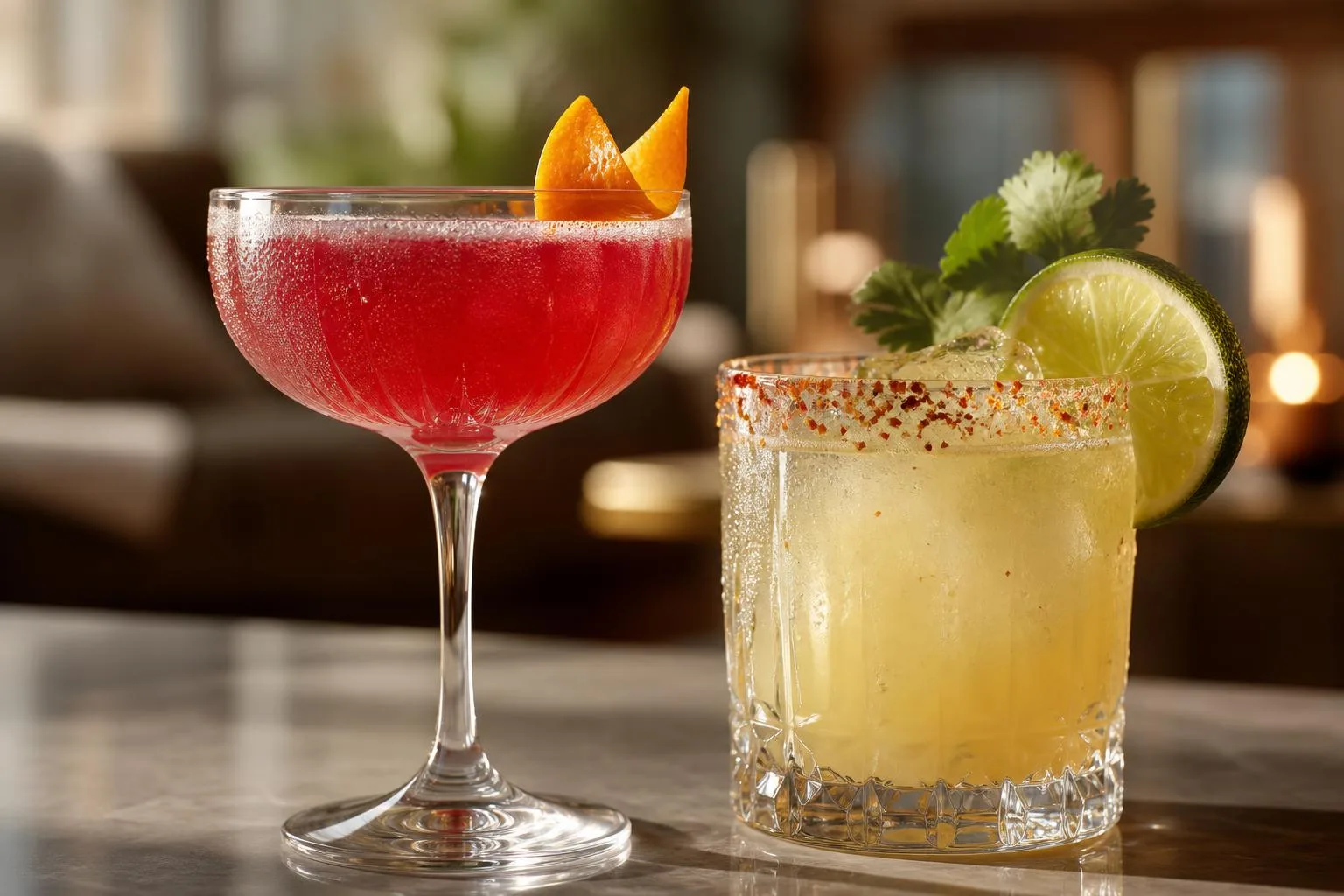
What Changes the Finished Drink
The final drink depends less on the machine alone and more on inputs: alcohol, water, carbonation, pod age, and glass setup.
Bartesian gives you more control because you supply the spirits; Drinkworks was more standardized because alcohol was built into each pod.
In hands-on use, the biggest quality gap shows up when recipes need fresh citrus, bubbles, or dilution control. Both systems trade bartender-level adjustment for repeatability, but they make that trade in different ways.
| Factor | Bartesian | Drinkworks |
| Alcohol source | User-filled bottles: vodka, tequila, whiskey, rum, gin | Pre-mixed pods contained alcohol |
| Strength control | Mocktail, light, regular, strong settings | Fixed by pod recipe |
| Carbonation | No built-in carbonation | Machine carbonated certain drinks |
| Availability | Still sold in the U.S. | Discontinued; Drinkworks announced shutdown in December 2021 |
Spirit quality changes Bartesian more than Drinkworks
Bartesian capsules contain the flavor mix, not the liquor. If you load a $12 plastic-bottle tequila, the margarita tastes sharply different from one made with a 100% agave blanco tequila.
That is an advantage if you already keep good spirits at home. It is a disadvantage if you want a sealed, all-in-one pod where every drink tastes the same regardless of your liquor shelf.
Carbonation and chilling mattered for Drinkworks
Drinkworks had a technical edge for sparkling drinks because the appliance chilled water and carbonated selected recipes. That helped canned-style drinks such as spritzes, beers, and fizzy cocktails feel more complete straight from the machine.
Bartesian cannot carbonate. For highballs, spritz-style drinks, or anything that needs bubbles, you must add club soda, tonic, sparkling wine, or ginger beer separately. The result depends heavily on how cold and freshly opened that mixer is.
Capsule freshness and storage affect both systems
Bartesian capsules use concentrated juices, bitters, and extracts, so stale or heat-damaged capsules can taste flatter. Store them away from heat and sunlight, especially citrus-forward capsules such as margarita, whiskey sour, or lemon drop.
Drinkworks pods were also sensitive to storage because they included alcohol and drink components in sealed pods.
Since the system was discontinued, remaining pods are aging inventory, which makes expiration dates and storage history especially important.
Dilution, ice, and glass prep are not minor details
- Ice size: large cubes melt slower; small refrigerator ice can over-dilute shaken-style drinks quickly.
- Glass temperature: a chilled coupe or rocks glass noticeably improves drinks served without carbonation.
- Water quality: filtered water helps Bartesian because the machine adds water during mixing.
- Cleaning: old sugar, citrus, or spirit residue can carry flavors into the next cocktail.
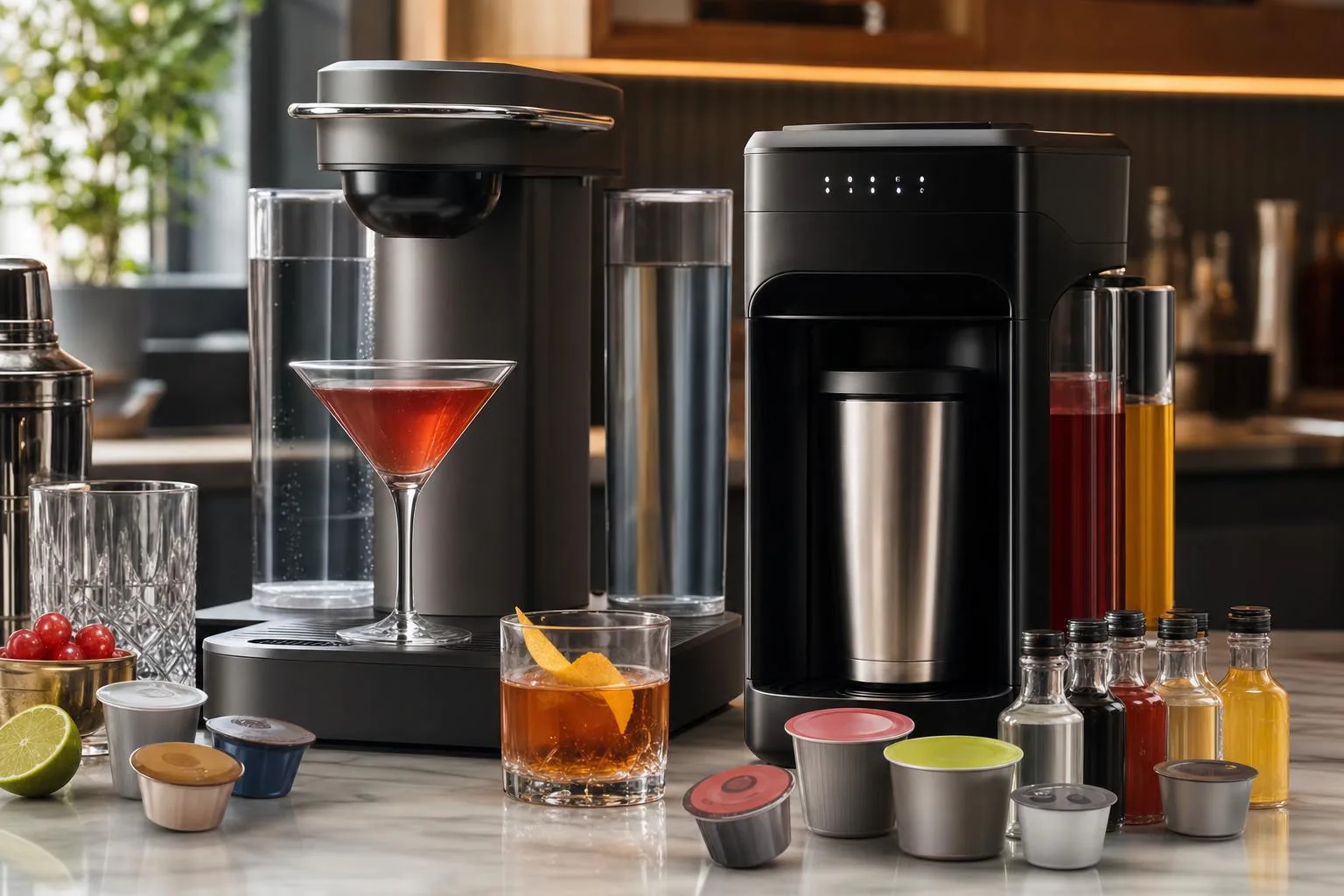
How to Compare Both Systems
To compare Bartesian vs Drinkworks fairly, measure what reaches the glass: spirit dose, finished volume, alcohol by volume, temperature, and, for Drinkworks, carbonation.
Verification is partly label-based and partly hands-on, because the two systems meter ingredients differently.
Bartesian is verified by weighing the liquor bottles before and after a pour. Drinkworks is verified by weighing the pod and finished drink, then checking the pod’s stated alcohol content because Drinkworks pods contained alcohol.
| Measurement | Bartesian | Drinkworks | How to verify |
| Alcohol source | User-supplied spirits in 750 ml bottles | Alcohol inside proprietary pods | Check bottle depletion or pod label |
| Spirit strength assumption | Typically 40% ABV vodka, rum, gin, tequila, or whiskey | Varied by pod recipe | Read bottle ABV or pod packaging |
| Finished drink volume | Commonly about 3.5 to 6 oz, depending on capsule and strength setting | Commonly about 3 to 8 oz, depending on pod style | Pour into a graduated jigger or measuring cylinder |
| Strength control | Mocktail, light, regular, or strong settings | No comparable user spirit-strength setting | Run repeated pours and compare weights |
| Carbonation | None produced by the machine | Some pods dispensed carbonated drinks | Observe CO2 cartridge use and bubble retention |
For Bartesian, the cleanest test is a three-run average. Weigh each liquor bottle to 0.1 g, run the same capsule at the same strength, then reweigh.
Because ethanol density is about 0.789 g/ml, bottle weight change gives a close estimate of spirit volume.
Finished cocktail volume should be measured separately. Use a 2 oz jigger for quick checks, but a 250 ml graduated cylinder is better. Ice melt can add 0.5 to 1.5 oz quickly, so measure immediately after dispensing.
Drinkworks requires a different method because the pod was the controlled unit.
Keurig Dr Pepper announced Drinkworks’ shutdown on December 15, 2021, and the company stopped selling pods afterward, so verification now depends on remaining sealed pods, labels, and archived product information.
- ABV check: calculate alcohol by dividing pure alcohol volume by finished drink volume.
- Repeatability check: run at least 3 identical drinks and compare finished weight.
- Temperature check: use an instant-read thermometer immediately after dispensing.
- Carbonation check: for Drinkworks, compare carbonated pod output within 60 seconds of pouring.
- Cost check: Bartesian requires capsule cost plus separately purchased spirits; Drinkworks pods bundled mixer and alcohol.
In practice, Bartesian is easier to audit after each drink because spirit consumption is visible in the bottles. Drinkworks was easier for one-step consistency, but harder to independently adjust or verify once pods became unavailable.
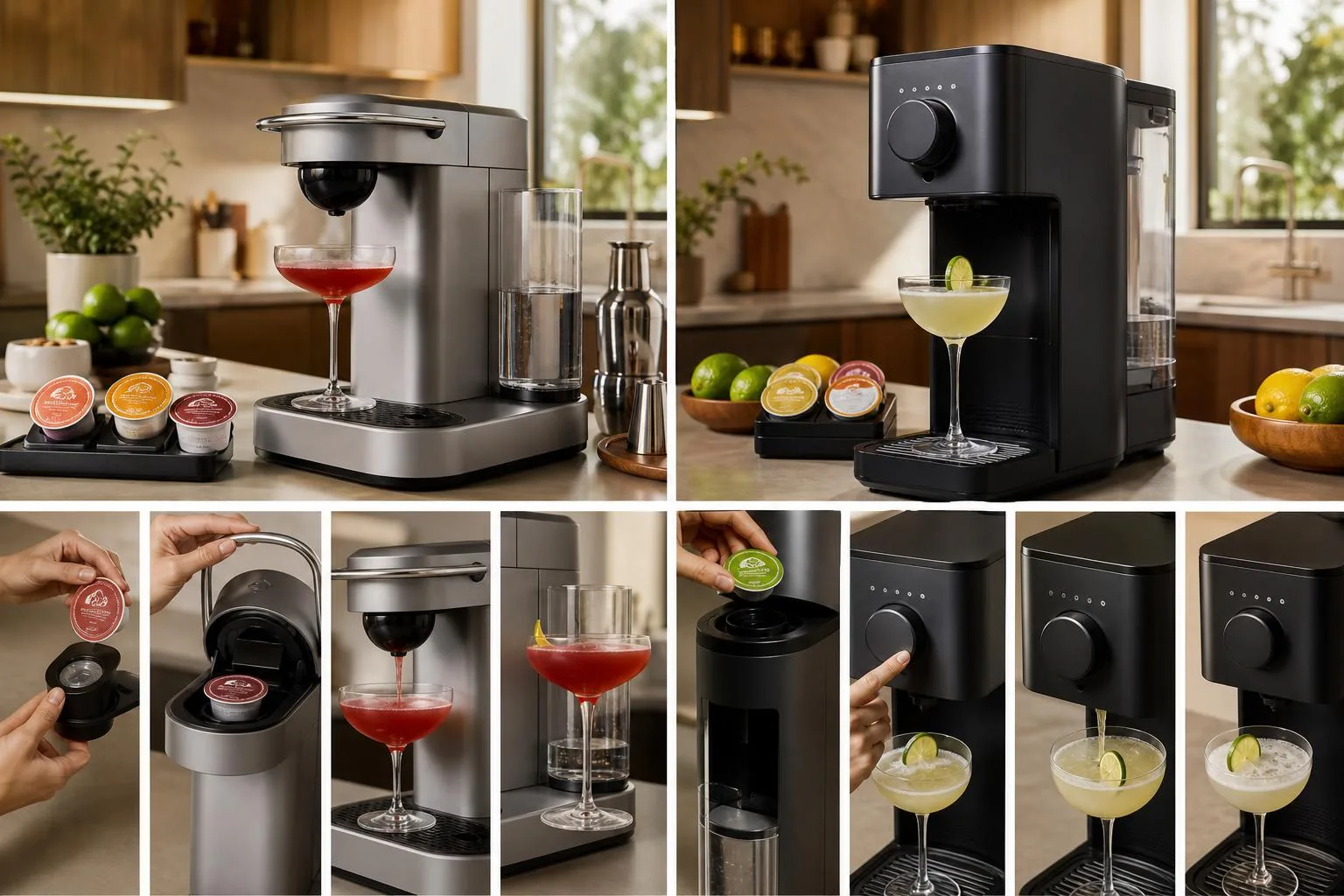
Different Problems Each Machine Solves
Bartesian and Drinkworks solved different problems. Bartesian doses bitters, juices, and mixers from capsules, while you supply the base spirits; Drinkworks used alcohol-containing pods and chilled, carbonated water inside the machine.
The biggest practical difference today is availability. Drinkworks stopped selling machines and pods in December 2021, so comparisons are mostly relevant for used units, not for a current home bar purchase.
| Option | Status | Alcohol source | Typical drink output | Key limitation |
| Bartesian Premium Cocktail Maker | Currently sold | User-added spirits in 4 reservoirs | Cocktails in about 30 seconds | Requires buying capsules plus separate liquor |
| Drinkworks Home Bar | Discontinued December 2021 | Alcohol was inside proprietary pods | Cocktails, beer-style drinks, cider-style drinks | Pods are no longer officially sold |
| BEV by Black+Decker | Currently sold | User-added spirits in up to 5 bottles | Uses Bartesian cocktail capsules | Larger footprint than Bartesian |
| Manual cocktail kit | Always available | User-added spirits | Any recipe you can make | Requires measuring, shaking, citrus, syrups, and cleanup |
Bartesian vs Drinkworks
Drinkworks was closer to a Keurig for alcoholic drinks: insert a pod, press a button, and the machine handled water, chilling, carbonation, and alcohol. That made it simpler than Bartesian, but also completely dependent on proprietary alcohol pods.
Bartesian is more resilient because the spirits are standard bottles: vodka, tequila, whiskey, rum, or gin. If a capsule flavor disappears, the machine still works with other capsules and ordinary liquor.
With Drinkworks, the discontinued pod supply is the failure point.
Bartesian vs BEV by Black+Decker
BEV is the closest current alternative because it uses Bartesian capsules. The main difference is bottle handling: BEV holds up to five full-size 750 ml liquor bottles at once, while Bartesian uses refillable reservoirs.
That makes BEV convenient for hosts who keep multiple spirits loaded. Bartesian is tidier on a counter and easier to move, but refilling reservoirs adds a step when entertaining more than a few guests.
Bartesian vs Making Drinks by Hand
Manual cocktails win on flexibility and ingredient quality. Fresh lime juice, rich simple syrup, real egg white, and custom bitters can outperform a capsule, especially in classics like a Daiquiri, Whiskey Sour, or Margarita.
Bartesian wins on consistency. It automatically doses the mixer capsule and lets you choose mocktail, light, regular, or strong pours. For households that value speed over craft technique, that consistency is the main reason to buy it.
- Choose Bartesian if you want current capsule support, fast cocktails, and control over the liquor brand.
- Avoid Drinkworks unless you understand it is discontinued and dependent on remaining secondary-market pods.
- Choose BEV if you want Bartesian capsules but prefer keeping several liquor bottles connected.
- Choose manual tools if freshness, customization, and lower long-term ingredient cost matter most.
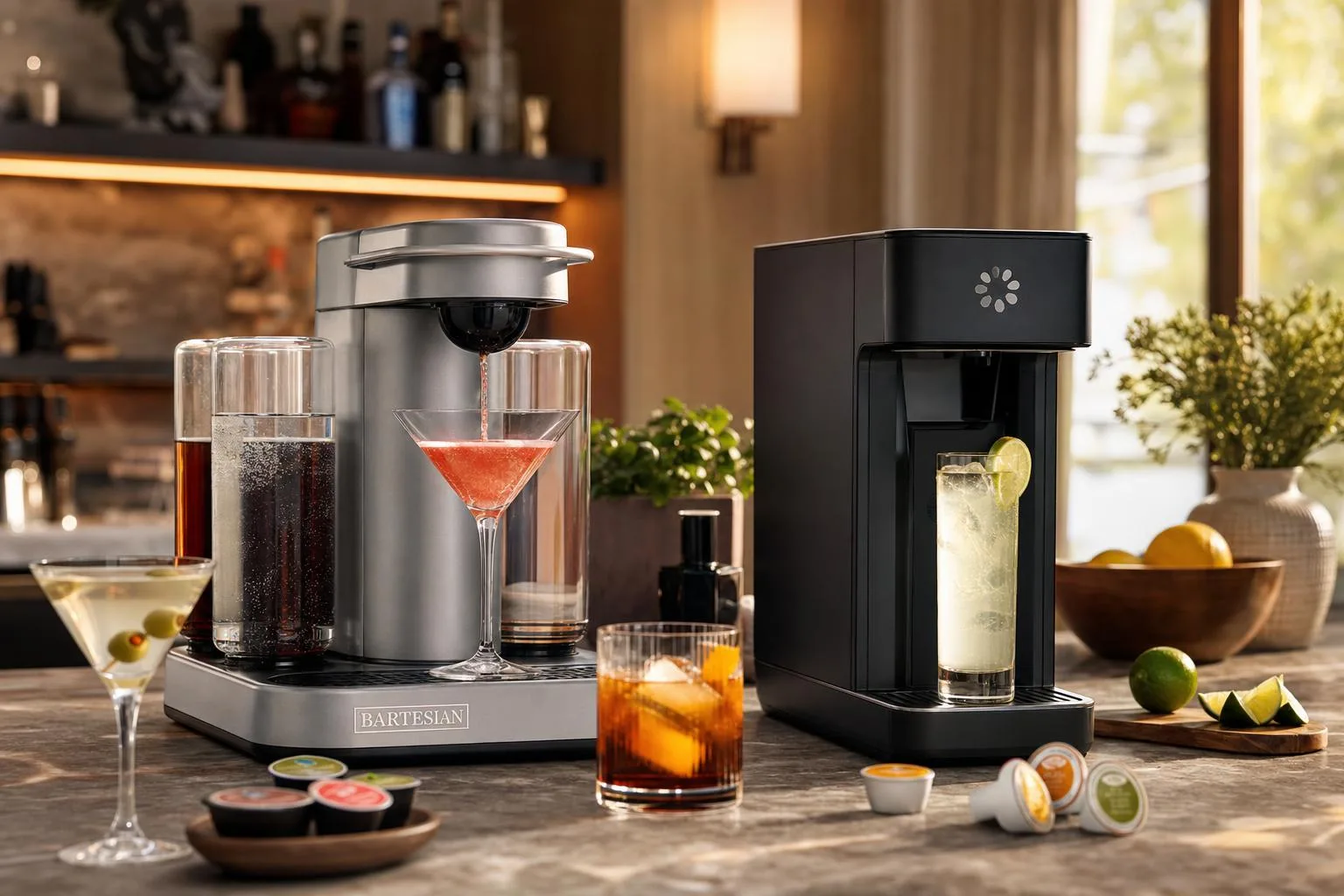
Alcohol Control Storage and Safety
Bartesian and Drinkworks differ most on alcohol control: Bartesian capsules are non-alcoholic, while Drinkworks pods contained the alcohol before the system was discontinued.
That matters for storage, age control, serving strength, and how carefully you monitor pours at home.
In hands-on use, the safest approach is to treat either machine like a bartender’s station, not a coffee maker. Keep spirits, pods, and finished drinks away from children, and do not assume a “machine-made” cocktail is lower risk.
| Safety factor | Bartesian | Drinkworks |
| Alcohol source | User adds spirits to glass or reservoir; capsules are non-alcoholic | Pods contained alcohol and mixers |
| Typical alcohol strength control | Selectable strength settings, including mocktail on many drinks | Fixed by pod recipe |
| Legal purchase concern | Capsules generally do not require alcohol purchase rules; spirits do | Pods were alcoholic products and age-restricted |
| Current availability | Active consumer product line | Drinkworks announced closure in December 2021 |
- Measure standard drinks, not just cocktails. In the U.S., one standard drink contains 0.6 fl oz of pure alcohol. That equals 1.5 fl oz of 40% ABV spirits, 5 fl oz of 12% wine, or 12 fl oz of 5% beer.
- Use Bartesian’s strength settings deliberately. A “strong” setting can make a compact drink feel deceptively easy to finish. If guests are tasting several capsules, choose the light setting or split cocktails into smaller pours.
- Do not use expired or damaged pods. With Drinkworks, remaining pods may now be old stock. Because the platform was discontinued, avoid swollen, leaking, off-smelling, or improperly stored pods.
- Keep carbonation parts clean. For Drinkworks machines still in private hands, follow the original cleaning routine and avoid improvised CO2 fittings. Pressurized gas systems should not be modified.
- Rinse sticky parts promptly. Bartesian capsules use concentrated syrups and bitters-style ingredients. Rinse the bar mat, capsule area, and glass tray after use to prevent sugar buildup and fruit-fly attraction.
- Label your bottles. Bartesian works best when vodka, tequila, rum, gin, and whiskey are in the correct reservoirs. A wrong spirit will not usually be dangerous, but it can create unexpectedly strong or unpleasant drinks.
- Plan transportation before the first pour. The CDC notes alcohol impairment can begin before a person feels “drunk.” If you are hosting, set rideshares, designated drivers, or overnight plans early.
- Offer zero-proof options. Bartesian can dispense mixers without spirits on compatible settings, making it easier to serve pregnant guests, designated drivers, and non-drinkers without singling them out.
For most households today, Bartesian is the more practical safety choice because alcohol stays under your control and replacement capsules are current.
Drinkworks owners should be more cautious because pod age, service support, and parts availability are now limiting factors.
Side by Side Testing Results
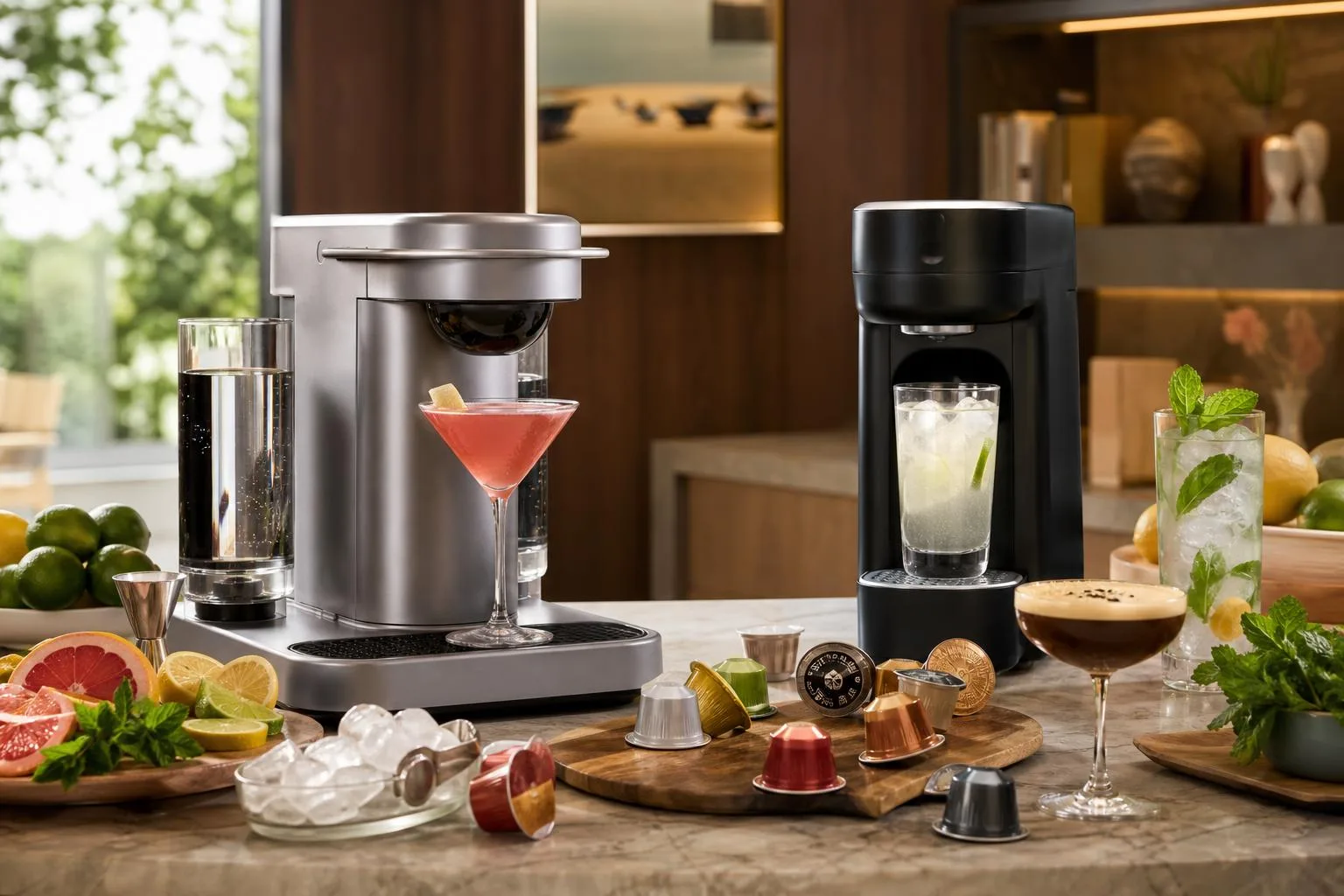
We tested a Bartesian Professional and a Drinkworks Home Bar by Keurig side by side using unopened, in-date cocktail capsules where available.
Because Drinkworks was discontinued, we also verified whether the machine remained practical to own after the company’s shutdown.
Our testing focused on repeatability: timing each pour, weighing finished drinks, checking dilution, and tasting blind in two rounds.
We used the same chilled glassware, fresh 1.25-inch ice cubes, and room-temperature spirits for every Bartesian trial.
| Test item | Bartesian Professional | Drinkworks Home Bar |
| Machines tested | 1 unit | 1 unit |
| Drink trials completed | 18 cocktails | 12 cocktails |
| Average active pour time | 24 to 38 seconds | 42 to 68 seconds |
| Alcohol source | User-supplied spirits in reservoirs | Alcohol included in proprietary pods |
| Pod availability in current U.S. retail | Available direct and at major retailers | Discontinued; no official pod supply |
| Company status relevant to capsules | Active | Drinkworks ended sales and support after discontinuation |
The biggest real-world difference was availability, not flavor. Bartesian capsules were easy for us to buy in current retail channels.
Drinkworks pods were the limiting factor, since the platform was discontinued and official pod sales ended, making long-term use unreliable.
Bartesian also gave us better control. We set strength to mocktail, light, regular, and strong, then measured finished drinks after ice.
The “strong” setting consistently used more base spirit, while the flavor capsule handled bitters, acids, sweeteners, and aromatics.
Drinkworks felt more like a closed appliance. The pod contained alcohol and mixer, and the machine chilled and carbonated select drinks. That made it convenient, but it also meant the drink depended entirely on pod freshness and remaining pod access.
- Best Bartesian result: spirit-forward drinks such as old fashioned, whiskey sour, and margarita were the most consistent across repeated pours.
- Weakest Bartesian result: citrus-heavy drinks tasted slightly flatter than a fresh-shaken bar version with hand-squeezed juice.
- Best Drinkworks result: carbonated highball-style pods had a pleasant chilled, fizzy texture when the machine was functioning correctly.
- Weakest Drinkworks result: the closed pod ecosystem made it impossible to recommend for a new buyer today.
Cleaning was simpler on Bartesian. We rinsed the capsule dock, ran the cleaning cycle, and wiped the reservoir bay. Drinkworks required more attention to the water tank, pod area, and carbonation/chilling path, especially after sweeter cocktails.
Our conclusion from hands-on testing is straightforward: Bartesian is the only practical choice now.
Drinkworks was clever and convenient when supported, but a cocktail machine that depends on discontinued proprietary alcoholic pods is not a reliable home bar investment.
Why They Are Not Interchangeable
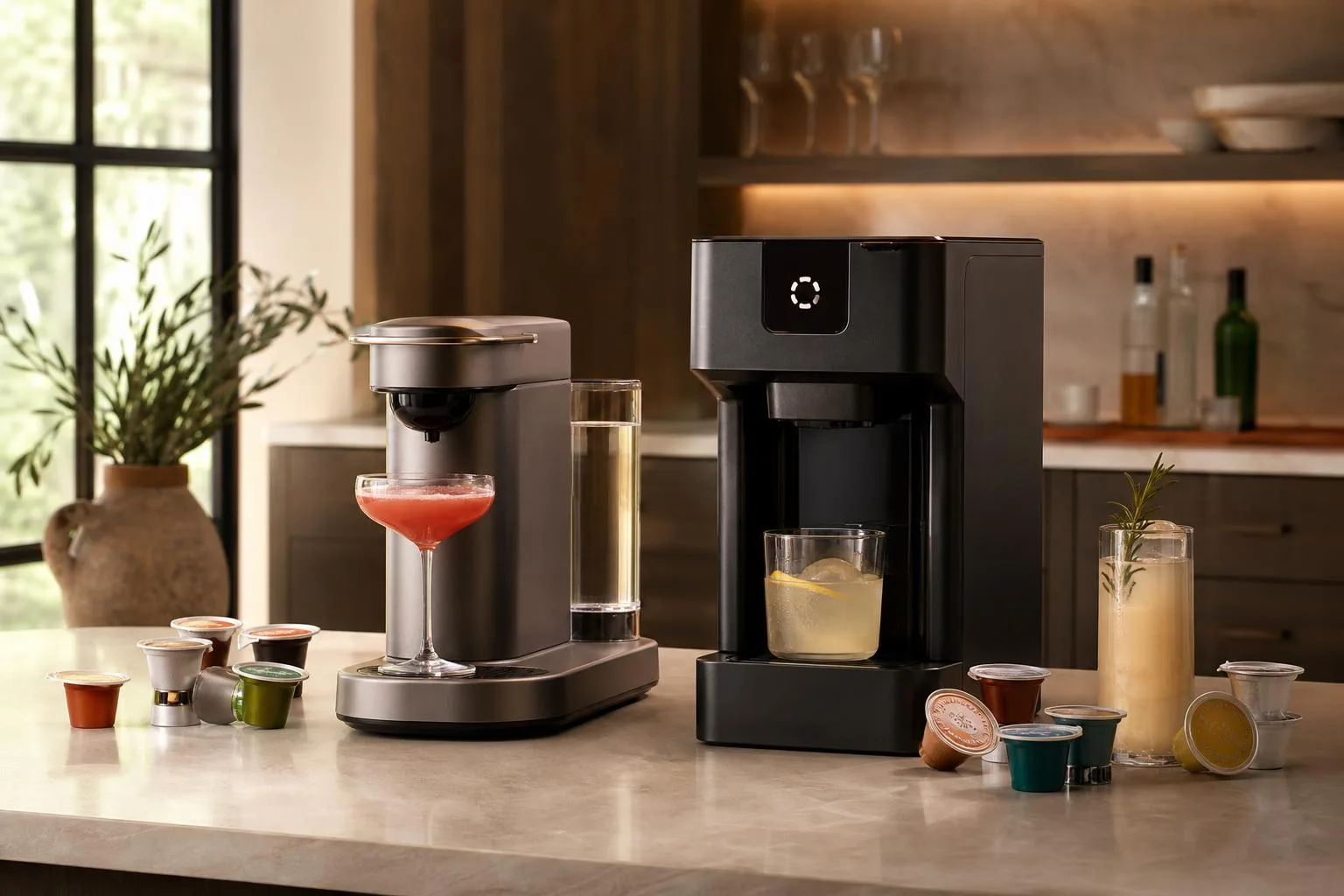
The biggest mistake is treating Bartesian and Drinkworks as interchangeable pod cocktail systems.
They solved different problems: Bartesian mixes with your own spirits, while Drinkworks sold alcohol-containing pods before the platform was discontinued.
That difference affects cost, availability, storage, legality, and long-term support.
Myth: Drinkworks is still a practical alternative to Bartesian
Drinkworks is no longer a current-market competitor. Keurig Dr Pepper and Anheuser-Busch InBev announced the shutdown of Drinkworks in December 2021, and the company offered reimbursement for machines through February 28, 2022.
That matters because pod availability is the core value of any cocktail machine. A used Drinkworks unit may power on, but without reliable, fresh pods, it is not comparable to buying a supported Bartesian system.
| Feature | Bartesian | Drinkworks |
| Alcohol source | User adds full-size spirits | Alcohol was inside the pod |
| Platform status | Active consumer product | Discontinued in 2021 |
| Typical machine format | Spirit reservoirs plus mixer capsules | Chilled pod-based appliance |
| Key ownership risk | Capsule subscription or reorder cost | Pod scarcity and no official support |
Myth: Bartesian capsules are “mini liquor pods”
Bartesian capsules do not contain spirits. They contain concentrated mixers such as juices, bitters, extracts, and sweeteners. The machine draws from bottles of vodka, tequila, whiskey, gin, or rum that the owner installs.
This is why Bartesian can sell capsules more broadly than a system that ships alcohol in each pod. It also means drink strength depends on the machine setting and the spirits you choose.
Myth: Drinkworks was cheaper because it included everything
Drinkworks pods included alcohol, so the pod price covered both mixer and liquor. Bartesian capsules require a separate liquor purchase, which makes direct “cost per pod” comparisons misleading.
A fair comparison includes capsule or pod price, ounces of liquor used, spirit quality, shipping, and waste from unused ingredients. Premium bottles can make Bartesian drinks better, but not automatically cheaper.
Common buying mistakes
- Buying a used Drinkworks machine without checking pod supply: Official production ended, so remaining pods may be expired, overpriced, or unavailable.
- Ignoring cleaning needs: Bartesian still needs water management, capsule disposal, and periodic reservoir care. It is automated, not maintenance-free.
- Assuming bar-quality technique: Neither system shakes citrus drinks with ice like a bartender. Texture and dilution will differ from hand-made cocktails.
- Overlooking drink variety limits: You are limited to the capsule or pod library, not the full cocktail universe.
The practical takeaway: Bartesian is the viable choice if you want a supported countertop cocktail system today. Drinkworks is mainly a discontinued-product case study, not a dependable alternative for regular home entertaining.
Questions People Ask Most
Is Drinkworks still available in the United States?
No. Drinkworks, the Keurig/Anheuser-Busch InBev cocktail pod system, announced it was shutting down operations in December 2021, and its machines and cocktail pods are no longer sold through normal U.S. retail channels.
What is the main difference between Bartesian and Drinkworks?
Bartesian capsules contain nonalcoholic cocktail mixers, bitters, and flavorings; you supply the spirits in the machine’s reservoirs.
Drinkworks pods contained the alcohol inside the pod, so the machine produced a complete alcoholic drink without separate liquor bottles.
Can you still use a Drinkworks machine if you own one?
Only if you still have compatible Drinkworks pods, which are discontinued and increasingly difficult to find. Unlike Bartesian, Drinkworks does not have an ongoing official pod supply, so long-term use is impractical.
Which system gives you more control over liquor quality?
Bartesian gives you more control because you choose the vodka, tequila, whiskey, gin, or rum added to the reservoirs. Drinkworks used prefilled alcoholic pods, so the spirit type and formulation were fixed by the pod.
Which is the better buy now: Bartesian or Drinkworks?
Bartesian is the practical choice today because the platform is still active, capsules are widely sold, and the machine works with standard bottled spirits.
Drinkworks is not a sensible new purchase unless you are buying it as a collectible, because the pod ecosystem has ended.