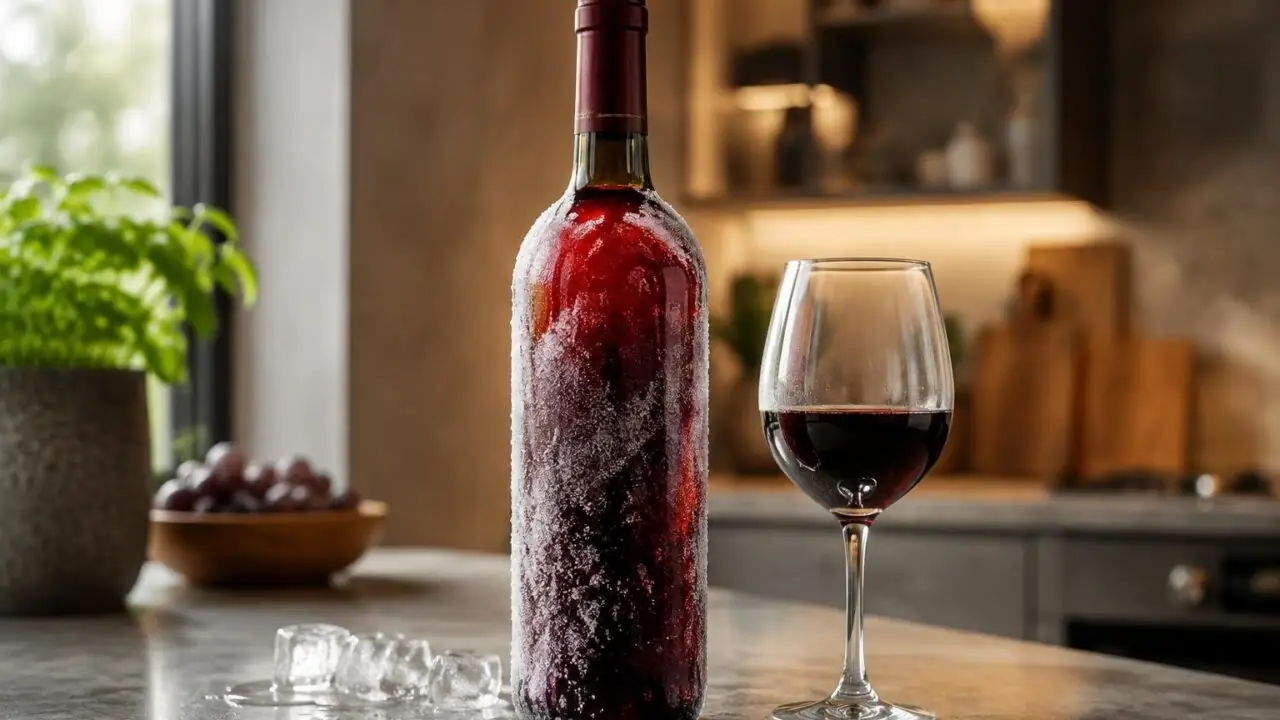
How long does it take wine to freeze depends on alcohol content, but a standard 12% ABV bottle reaches a solid state in approximately 5–6 hours in a typical home freezer set to −18 °C (0 °F).
Higher-alcohol wines like fortified Port (20% ABV) require closer to 8 hours.
Wine freezes at roughly −5 °C to −9 °C (23 °F to 15 °F), well above the freezer’s operating temperature. The sugar concentration, bottle size, and freezer efficiency all shift the timeline.
Understanding these variables prevents cracked bottles and wasted wine.
Freezing Point of Wine by Style
Wine does not have one fixed freezing point because alcohol, sugar, acids, and other dissolved compounds depress the freezing temperature. Most wines begin forming ice between approximately −4°C and −10°C, or 25°F and 14°F.
The ranges below indicate when ice crystals may first appear, not when the bottle becomes completely solid. Actual results vary with alcohol by volume, residual sugar, bottle movement, and freezer temperature.
| Wine style | Typical alcohol | Approximate freezing onset | Why it differs |
| Low-alcohol white or rosé | 7–10% ABV | −3°C to −5°C; 27°F to 23°F | Less ethanol provides less protection against freezing. |
| Standard white wine | 11–13.5% ABV | −5°C to −7°C; 23°F to 19°F | Moderate alcohol and limited residual sugar lower the freezing point below water. |
| Standard red wine | 12–15% ABV | −5°C to −8°C; 23°F to 18°F | Higher alcohol generally produces a lower freezing onset. |
| Sparkling wine | 11–12.5% ABV | −5°C to −7°C; 23°F to 19°F | Its base wine freezes similarly to still wine, but pressure creates an additional bottle hazard. |
| Sweet or dessert wine | 7–14% ABV | −5°C to −9°C; 23°F to 16°F | Both sugar and ethanol depress freezing, although composition varies widely. |
| Fortified wine | 15–22% ABV | −8°C to −12°C; 18°F to 10°F | Added spirit supplies substantially more ethanol than ordinary table wine. |
Why Wine Freezes Gradually
Water-rich ice forms first. The remaining liquid becomes increasingly concentrated in ethanol, sugar, acids, and flavor compounds, so its freezing point continues to fall.
A bottle may therefore contain solid crystals, slush, and concentrated liquid at the same time.
A household freezer commonly operates near −18°C, or 0°F, below the initial freezing range of every style in the table. Even fortified wine can freeze partially during prolonged storage, despite remaining liquid longer than table wine.
Sparkling Wine Requires Extra Caution
Freezing water expands, while sparkling wine already contains dissolved carbon dioxide under pressure. Ice formation can push out the cork, compromise the closure, or crack the glass.
Do not intentionally freeze a sealed bottle, and discard one that develops a crack or leak.
These values are practical estimates based on ethanol-water freezing behavior and normal wine composition.
A producer’s ABV label helps predict relative resistance: higher alcohol usually means a lower freezing point, while substantial residual sugar lowers it further.
How Alcohol Content Affects Freezing Time
Alcohol lowers water’s freezing point through a process called freezing point depression.
The higher a wine’s ABV, the colder the temperature required to solidify it—and the longer it takes in a standard household freezer set to −18°C (0°F).
Pure ethanol freezes at −114°C (−173°F). Water freezes at 0°C (32°F). Wine sits between these extremes, with its freezing point determined primarily by alcohol concentration.
Freezing Points by Wine Type and ABV
| Wine Type | Typical ABV | Approximate Freezing Point | Time to Freeze in Home Freezer |
| Moscato d’Asti | 5–5.5% | −3°C (27°F) | 2–3 hours |
| Riesling (German Kabinett) | 8–9% | −4°C (25°F) | 3–4 hours |
| Pinot Grigio | 12–13% | −5°C (23°F) | 4–5 hours |
| Cabernet Sauvignon | 13.5–15% | −6°C (21°F) | 5–6 hours |
| Zinfandel (high-alcohol) | 15–16% | −7°C (19°F) | 6–8 hours |
| Port / Fortified Wine | 19–22% | −10 to −12°C (10–14°F) | May never fully solidify |
Each 1% increase in ABV lowers the freezing point by roughly 0.4–0.6°C. This relationship is approximately linear across typical wine alcohol levels of 5–22%.
Why Fortified Wines Resist Freezing
Port, Sherry, and Madeira at 19–22% ABV have freezing points near −12°C. A home freezer at −18°C can partially freeze them, but the high ethanol concentration prevents full solidification.
The result is a slushy, viscous mass rather than a solid block.
Key Variables Beyond ABV
- Residual sugar: Wines with 50+ g/L residual sugar (like Sauternes) experience additional freezing point depression, requiring even lower temperatures.
- Bottle size: A standard 750 mL bottle freezes more slowly than a 375 mL half-bottle due to greater thermal mass.
- Container material: Glass insulates more than metal or plastic, adding 30–60 minutes to freeze time compared to wine poured into an aluminum pan.
- Freezer load: A full freezer maintains temperature more efficiently but absorbs new heat sources more slowly, potentially extending freeze time by 15–20%.
The practical takeaway: a forgotten 13% ABV table wine in the freezer will begin forming ice crystals around hour 4 and risk cracking its bottle by hour 6 as the expanding ice exerts outward pressure on the glass.
Timeline From Freezer to Solid Ice
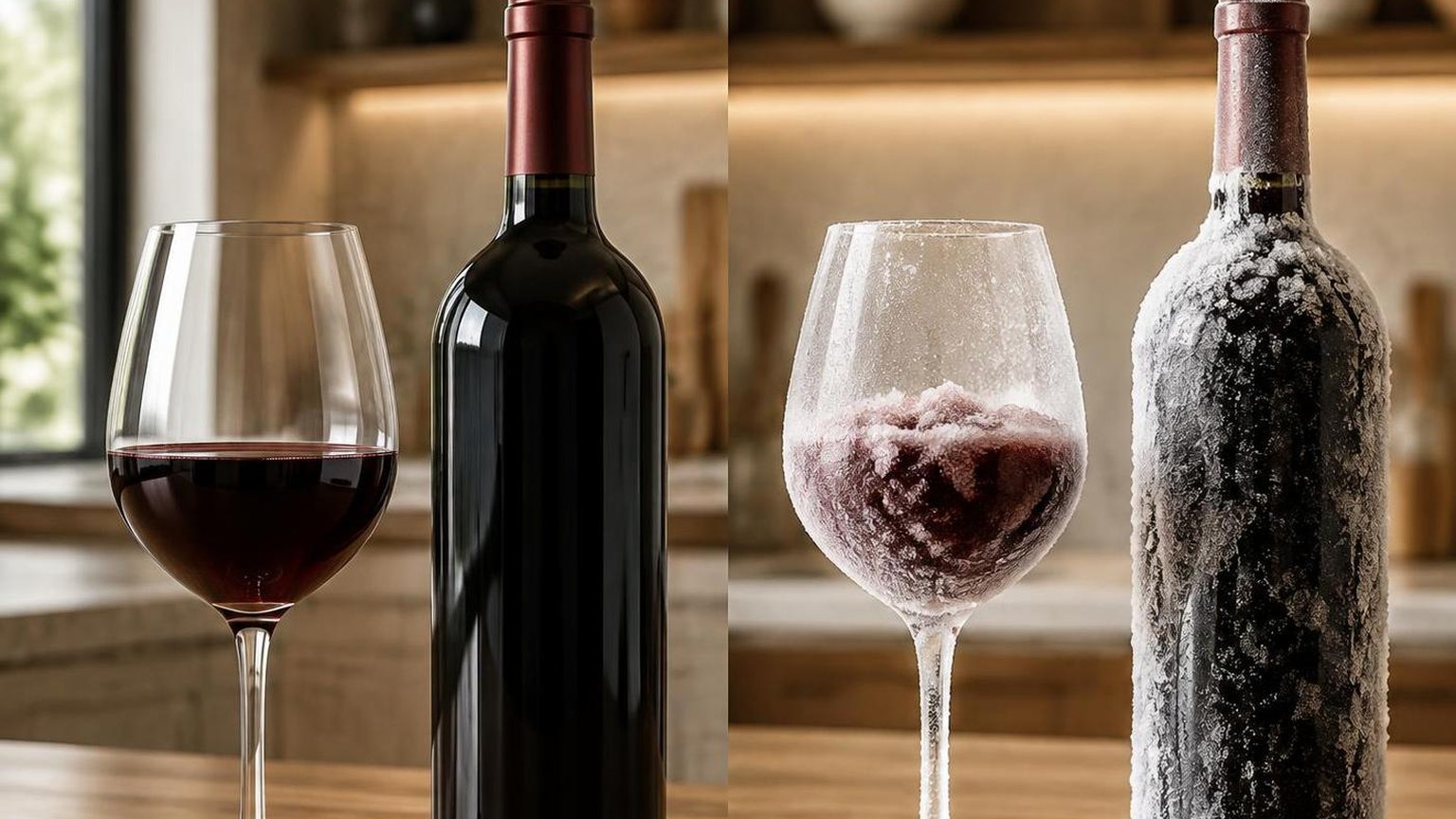
A standard 750 ml bottle of wine placed in a home freezer set to −18 °C (0 °F) follows a predictable freezing timeline.
Alcohol content, sugar levels, and bottle shape all influence exact timing, but most wines begin forming ice crystals within 1–2 hours.
Freezing Timeline by Wine Type
| Wine Type | Typical ABV | First Ice Crystals | Slushy Stage | Fully Solid |
| Moscato d’Asti | 5–5.5% | 30–45 min | 1.5–2 hr | 3–4 hr |
| Riesling (off-dry) | 8–10% | 45–60 min | 2–2.5 hr | 4–5 hr |
| Pinot Grigio / Sauvignon Blanc | 12–13% | 1–1.5 hr | 2.5–3 hr | 5–6 hr |
| Cabernet Sauvignon / Syrah | 13.5–15% | 1.5–2 hr | 3–4 hr | 6–8 hr |
| Fortified (Port, Sherry) | 18–22% | 3–4 hr | 6–8 hr | 10–14 hr |
Why Alcohol Shifts the Timeline
Ethanol’s freezing point is −114 °C (−173 °F). When dissolved in water, it lowers the mixture’s freezing point proportionally. A 12% ABV wine freezes at roughly −5 °C (23 °F); a 20% ABV fortified wine drops to approximately −9 °C (16 °F).
Stage-by-Stage Breakdown
- 0–30 minutes: The bottle chills rapidly from room temperature (~20 °C) toward 0 °C. No ice forms yet.
- 30–90 minutes: Temperature drops below the wine’s freezing point. Water molecules begin crystallizing along the glass walls where heat transfers fastest.
- 90 minutes–4 hours: Ice crystals expand inward, creating a slush. Remaining liquid concentrates in alcohol and sugar, resisting further freezing.
- 4–8 hours: Most table wines reach a near-solid state. A small pocket of high-alcohol liquid may persist at the center.
The Bottle-Explosion Risk Window
Water expands roughly 9% when it freezes. Cork ejection or glass fracture typically occurs between 3–5 hours for a standard 12–13% ABV bottle. Screw-cap bottles are slightly more vulnerable because the seal offers less give than a cork.
Setting a phone timer for 25–30 minutes lets you chill wine quickly without crossing into the danger zone. Beyond 90 minutes at −18 °C, any forgotten table wine is at real risk.
Does Bottle Shape Change Freezing Speed
Bottle geometry directly influences how fast wine reaches its freezing point of approximately −5°C (23°F). Thicker glass insulates more, wider bottles expose more surface area, and taller bottles create uneven cooling gradients from top to bottom.
The critical variable is the surface-area-to-volume ratio. A higher ratio means more glass contacts cold air, accelerating heat transfer from the wine to the freezer environment.
| Bottle Type | Typical Glass Thickness | Approximate Weight (empty, 750 mL) | Estimated Time to Freeze at −18°C |
| Burgundy (wide, sloped shoulders) | 2.5–3.0 mm | 400–500 g | 4–5 hours |
| Bordeaux (straight shoulders, standard) | 2.5–3.0 mm | 450–550 g | 5–6 hours |
| Champagne / Sparkling | 4.0–5.0 mm | 800–900 g | 6–7 hours |
| Half bottle (375 mL, Bordeaux style) | 2.5–3.0 mm | 250–300 g | 2.5–3.5 hours |
| Magnum (1.5 L, Bordeaux style) | 3.0–3.5 mm | 900–1,100 g | 7–9 hours |
Burgundy bottles freeze faster than Bordeaux bottles of the same volume. Their wider body diameter—roughly 88 mm versus 76 mm—creates a larger surface-area-to-volume ratio.
Champagne bottles take significantly longer because their glass is nearly twice as thick as standard wine bottles. That extra mass acts as thermal insulation, slowing heat loss by roughly 25–40%.
Volume Matters More Than Shape
A 375 mL half bottle freezes in roughly half the time of a standard 750 mL bottle. A 1.5 L magnum can take nearly twice as long. Volume scales the thermal mass that must be cooled.
- Half bottles (375 mL): highest surface-area-to-volume ratio among standard formats, freeze fastest
- Standard bottles (750 mL): baseline reference; shape differences account for a 30–60 minute variance
- Magnums (1.5 L): lowest ratio, slowest to freeze; the deep punt adds slight glass mass
Practical Considerations
Laying a bottle on its side in a freezer increases surface contact with cold air across the bottle’s length. This can reduce freezing time by 15–20 minutes compared to standing upright.
The punt—the indentation at the bottle’s base—adds glass weight without adding volume. Bottles with deep punts, common in Burgundy and sparkling wines, carry 30–60 g of extra glass that marginally slows cooling.
Regardless of shape, no standard 750 mL wine bottle should remain in a −18°C freezer beyond 4 hours without monitoring. Expansion during freezing generates enough pressure to crack glass or expel the cork.
Risks of Freezing Wine in Glass Bottles
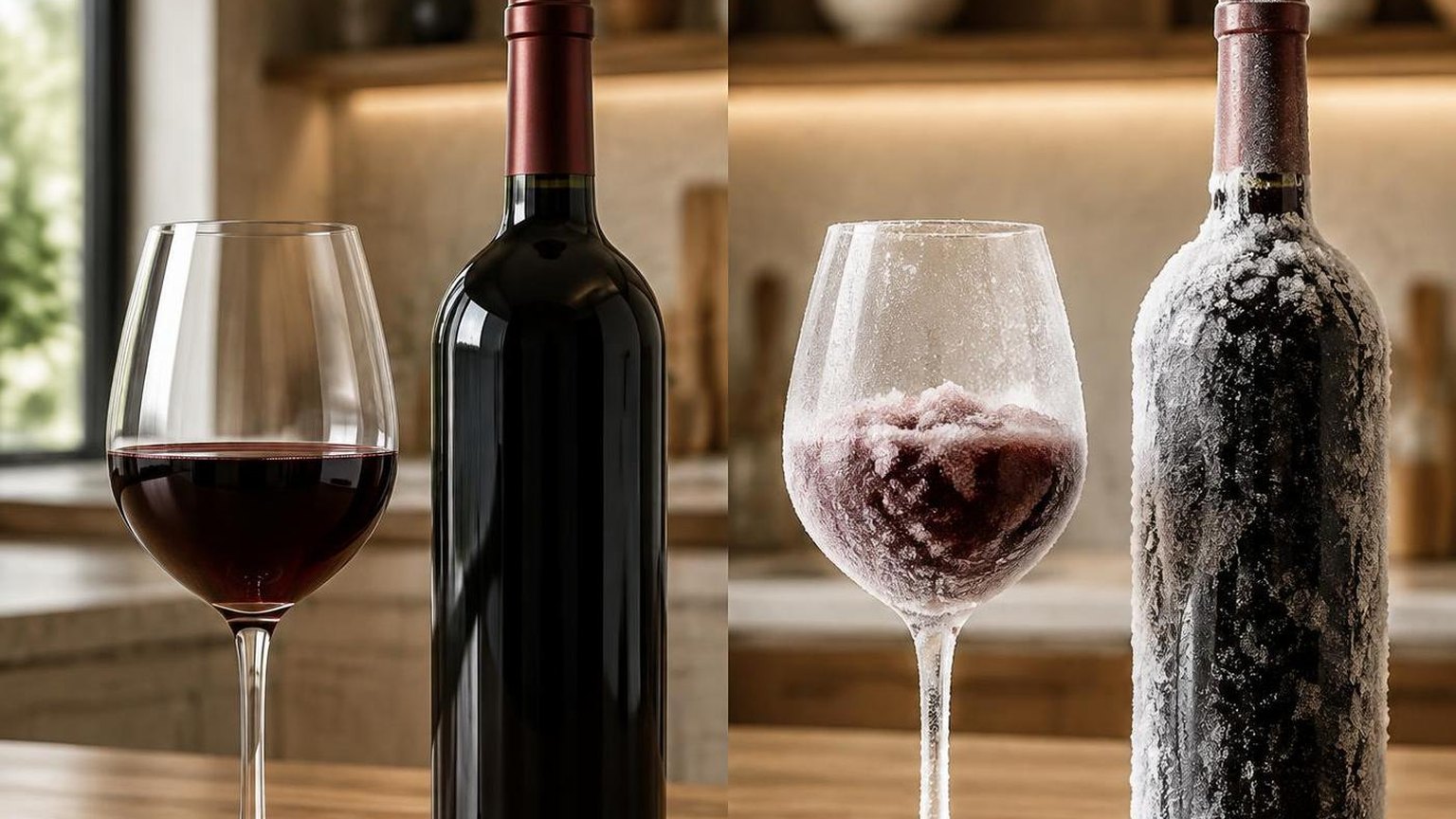
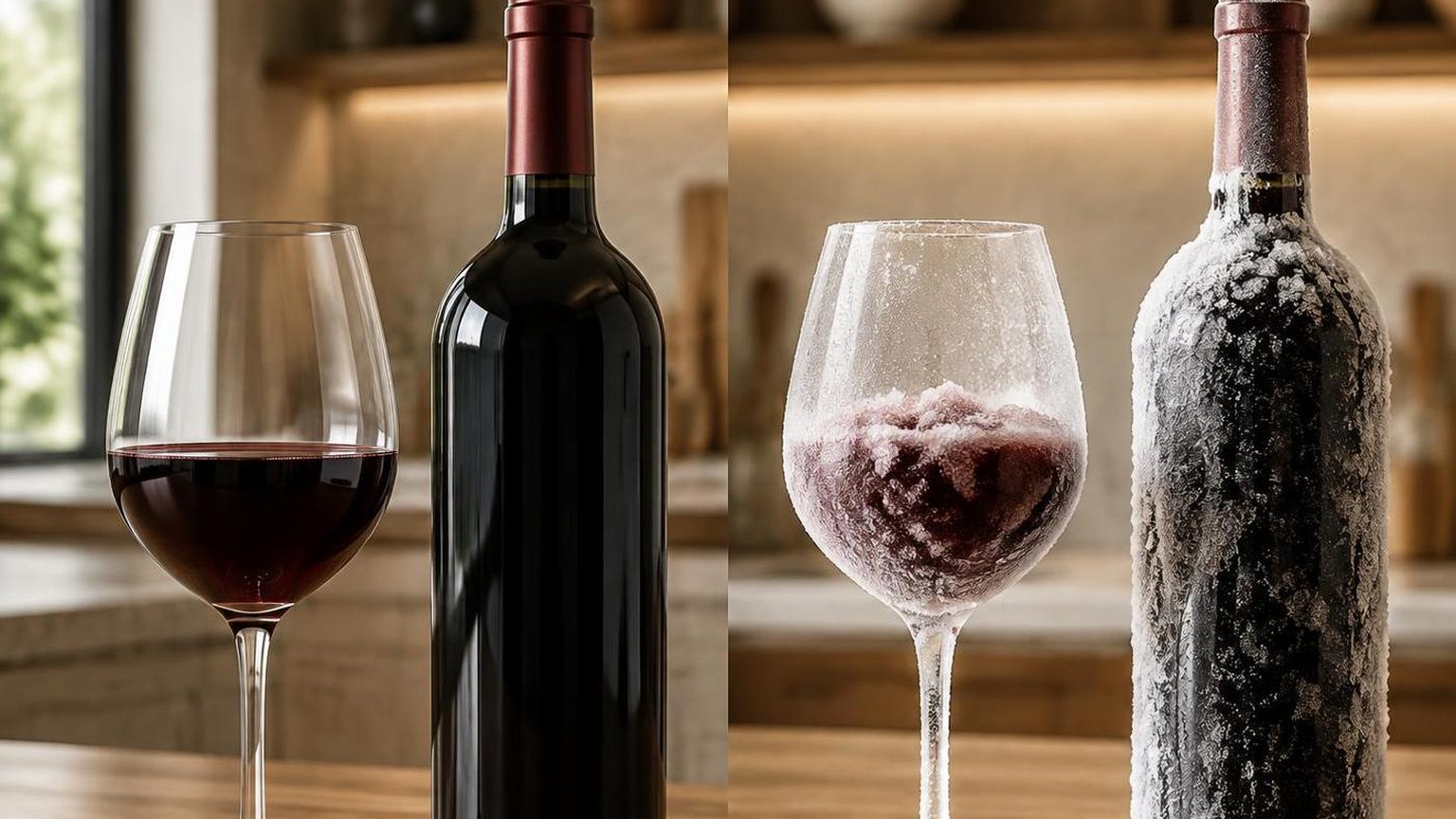
Wine expands approximately 9% by volume when it freezes, and standard glass bottles cannot accommodate that expansion.
The result ranges from pushed-out corks to catastrophic bottle fractures, leaving you with a sticky, glass-shard-filled mess in your freezer.
How Expansion Causes Damage
A standard 750 mL wine bottle holds roughly 730–750 mL of liquid with minimal headspace. When that liquid freezes and expands by 9%, it needs approximately 66–68 mL of additional space that simply does not exist inside the sealed bottle.
The weakest point fails first. In most cases, the cork is forced outward before the glass cracks. However, if the cork holds firm, internal pressure can exceed 3–4 atmospheres, shattering the bottle entirely.
Temperature Thresholds and Timing
| Wine Type | Approximate Freezing Point | Time to Freeze (Standard Freezer, −18 °C / 0 °F) |
| Wine at 10% ABV | −5 °C (23 °F) | 4–6 hours |
| Wine at 12.5% ABV | −6 °C (21 °F) | 5–7 hours |
| Wine at 14% ABV | −7 °C (19 °F) | 6–8 hours |
| Fortified wine at 20% ABV | −10 °C (14 °F) | 8–12 hours |
Forgetting a bottle in a −18 °C freezer for even 5 hours puts most table wines at serious risk of cork ejection or glass failure.
Specific Risks to Assess
- Glass shards in food: A shattered bottle can scatter tiny fragments across freezer contents, contaminating stored food and creating a safety hazard.
- Cork contamination: Pushed corks expose wine to freezer odors and potential bacterial contact, making the wine unsafe or unpleasant to drink.
- Sparkling wine danger: Bottles of Champagne or Prosecco already contain 5–6 atmospheres of CO₂ pressure. Freezing adds expansion force on top of that existing pressure, making explosive failure far more likely and more violent.
- Freezer damage: Leaked wine containing tartaric acid (pH 3.0–3.6) can corrode metal shelving and stain plastic liners permanently.
- Flavor degradation: Even if the bottle survives, ice crystal formation disrupts colloidal structures—tannin complexes, color pigments, and tartrate salts precipitate out irreversibly, leaving the wine flat and texturally thin after thawing.
If you need to chill wine quickly, submerge the bottle in an ice-water-salt bath instead. This method drops temperature to serving range within 15–20 minutes without any freezing risk.
Best Practices for Chilling Wine Quickly
Freezing wine risks blown corks, shattered bottles, and dulled flavors. Faster, safer chilling methods exist that reach ideal serving temperatures in a fraction of the time without any freezing risk.
The Ice-Salt Water Bath Method
Submerging a bottle in a mixture of ice, water, and 2–3 tablespoons of salt drops wine to serving temperature in 15–20 minutes.
Salt lowers water’s freezing point to approximately −21 °C (−6 °F), accelerating heat transfer dramatically compared to ice alone.
This method works because liquid-to-glass contact conducts thermal energy roughly 25 times faster than air-to-glass contact in a standard freezer or refrigerator.
Chilling Time Comparisons by Method
| Method | Time to Reach 7–10 °C (45–50 °F) | Freezing Risk |
| Ice-salt water bath | 15–20 minutes | None |
| Ice water bath (no salt) | 25–30 minutes | None |
| Freezer | 40–60 minutes | High if forgotten |
| Refrigerator | 2–3 hours | None |
| Wet towel + freezer | 20–30 minutes | Moderate if forgotten |
Practical Tips to Avoid Freezing Accidents
- Set a timer. Most freezer-related wine disasters happen because a bottle is forgotten. Set a 30-minute alarm as a hard maximum.
- Never freeze sparkling wine. CO₂ pressure inside a bottle of Champagne reaches about 5–6 atmospheres (73–88 psi). Expansion from freezing can cause explosive failure.
- Use a wine thermometer. Infrared or probe thermometers confirm target temperatures: 6–10 °C (43–50 °F) for whites and rosés, 12–18 °C (54–64 °F) for reds.
- Rotate the bottle. Spinning the bottle every 3–4 minutes in an ice bath circulates wine against the cold glass, cutting chill time by roughly 30%.
Rapid-Chill Accessories
Stainless-steel wine chilling rods stored in a freezer reach −18 °C (0 °F) and cool a glass of wine in about 5 minutes. They bypass the bottle entirely, making overcooling easy to control.
Single-bottle electric chillers use thermoelectric Peltier elements to bring a room-temperature white to 10 °C (50 °F) in roughly 10–15 minutes with no ice required.
Questions Readers Ask
How long does it take a standard bottle of wine to freeze in a home freezer?
A 750 ml bottle of wine typically takes 4–6 hours to freeze solid in a standard home freezer set to −18 °C (0 °F).
The exact time depends on alcohol content, sugar level, and bottle shape—thinner bottles lose heat faster than wide-bottomed Burgundy-style bottles.
At what temperature does wine actually freeze?
Most table wines with 12–14% ABV freeze between −5 °C and −8 °C (23 °F to 17.6 °F).
Fortified wines like Port at 19–22% ABV require colder temperatures, typically around −10 °C to −14 °C (14 °F to 7 °F), because ethanol lowers the freezing point proportionally to its concentration.
Will a wine bottle explode if left in the freezer too long?
Yes. Water expands roughly 9% when it freezes, and since wine is approximately 85% water, the expanding ice can push the cork out or crack the glass bottle.
This commonly happens after 6–8 hours in a −18 °C freezer when the wine reaches full solidification.
How quickly can you chill wine in the freezer without freezing it?
Placing a room-temperature bottle in a −18 °C freezer brings white wine to ideal serving temperature (7–10 °C) in about 25–30 minutes and red wine to its recommended range (14–18 °C) in roughly 15–20 minutes.
Setting a timer is critical—beyond 60 minutes, you risk slushy wine and potential bottle damage.
Does freezing wine ruin its flavor?
Freezing and thawing disrupts the colloidal suspension of tannins and tartrate crystals, often making the wine taste flatter and less aromatic after thawing. Tartaric acid may precipitate as visible crystals on the cork or bottle bottom.
The wine remains safe to drink but is generally better suited for cooking than for serving in a glass.
Does red wine freeze faster or slower than white wine?
Red and white wines freeze at nearly the same rate when ABV is identical, because alcohol content—not color—determines the freezing point.
However, many dry whites sit around 11–13% ABV while full-bodied reds reach 13.5–15% ABV, so in practice those higher-alcohol reds take slightly longer to freeze, sometimes an extra 30–60 minutes.
Can you freeze wine in ice cube trays for cooking?
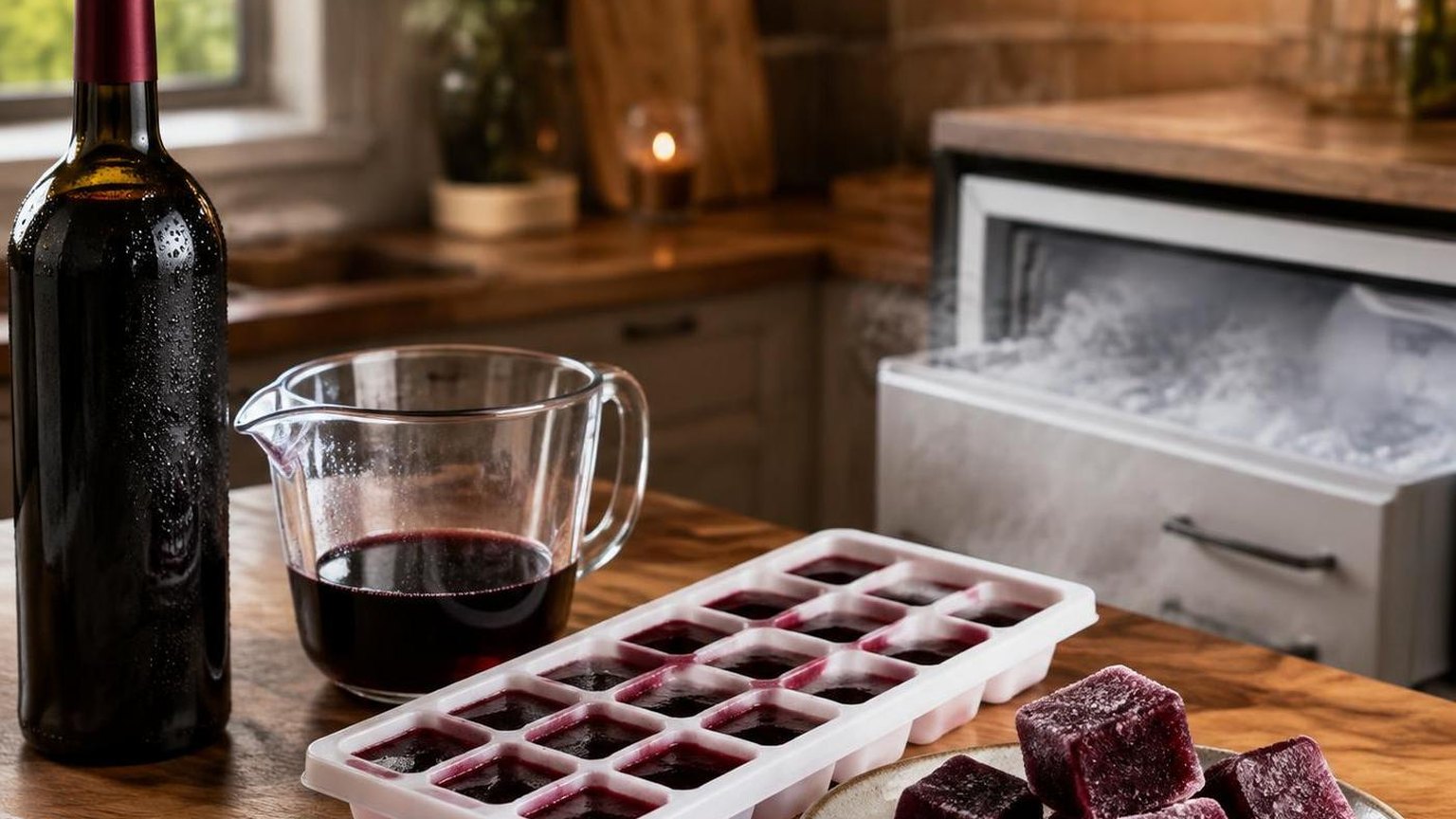
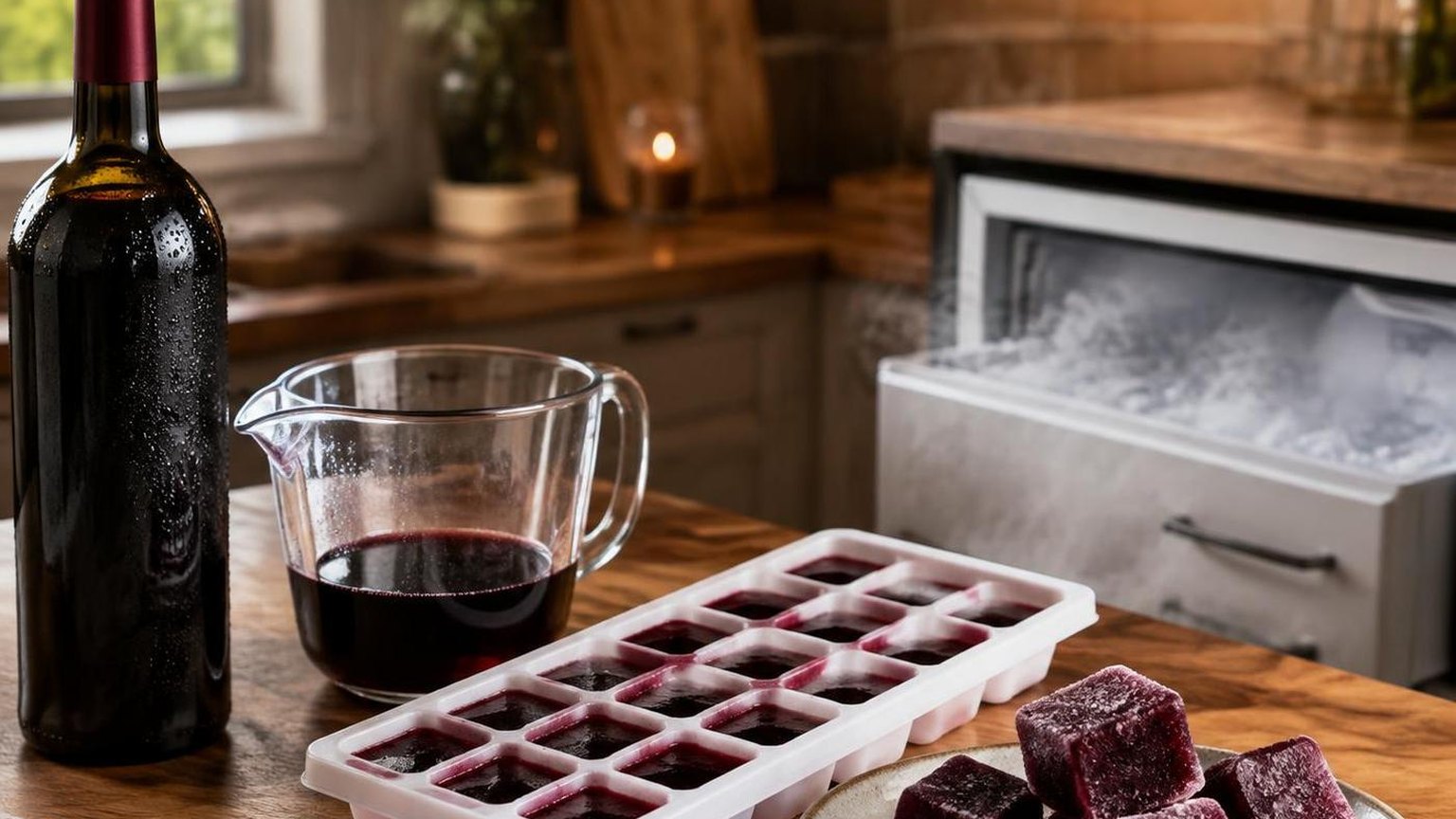
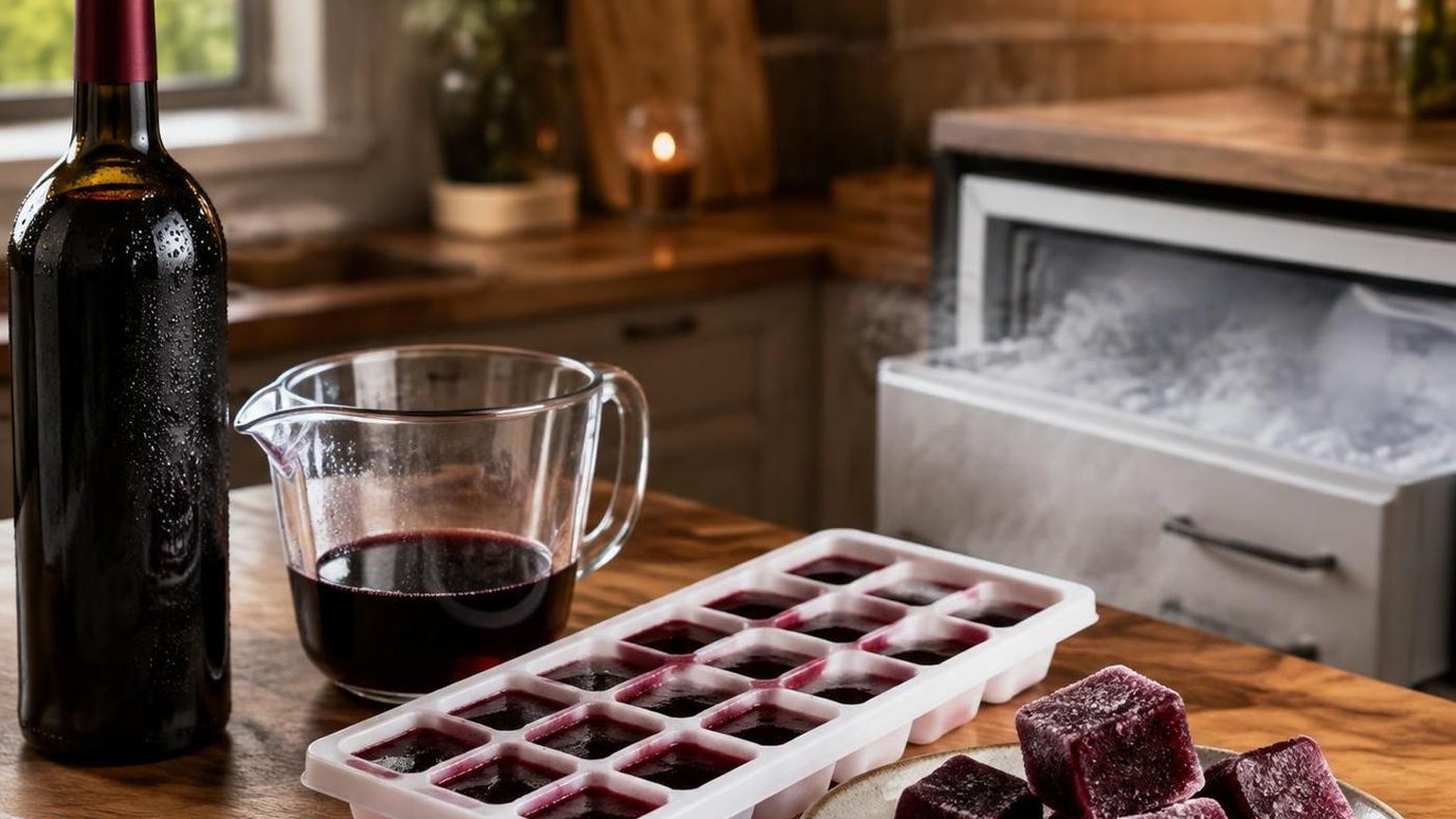
Freezing wine in standard ice cube trays works well and takes only 1–2 hours because the small 30 ml portions lose heat far faster than a full bottle.
Each cube equals roughly two tablespoons, a convenient portion for deglazing pans or enriching sauces. Frozen wine cubes stored in airtight bags keep for up to 3 months without significant oxidation.
How long does sparkling wine take to freeze, and is it more dangerous?
Sparkling wine like Champagne (typically 12% ABV) begins freezing at around −6 °C (21 °F) and can reach a dangerous state in as little as 2–4 hours in a home freezer.
The combination of dissolved CO₂ at 5–6 atmospheres of pressure and ice expansion makes sparkling bottles significantly more likely to shatter violently compared to still wine, so they should never be left unattended in a freezer.
Related Guides
- Cheap Sweet Wines with High Alcohol Content
- Does Wine Make You Sleepy? The Most Accurate Answer
- How To Tell If Wine Is Corked? Information From Experts
- How Many Bottles of Wine in a Box?
- What A Good Sweet Wine? – The Definitive Answer
- What Is A Sweet Wine? – 2026
- Drinks at Red Lobster for Cocktails, Beer, and Wine
- All Alcohol Guides
- University of Illinois Extension – Wine Science (2023)
- USDA FoodData Central – Wine Composition (2024)
- National Center for Home Food Preservation – Freezing Basics (2023)
- CRC Handbook / PubChem – Ethanol Freezing Point Data (2024)
- Journal of Food Science – Freezing Point Depression in Alcoholic Beverages (2006)
- FDA – Safe Food Handling and Storage Temperatures (2024)
- University of California Davis – Viticulture & Enology (2023)
- NIST Chemistry WebBook – Ethanol Thermophysical Properties (2023)