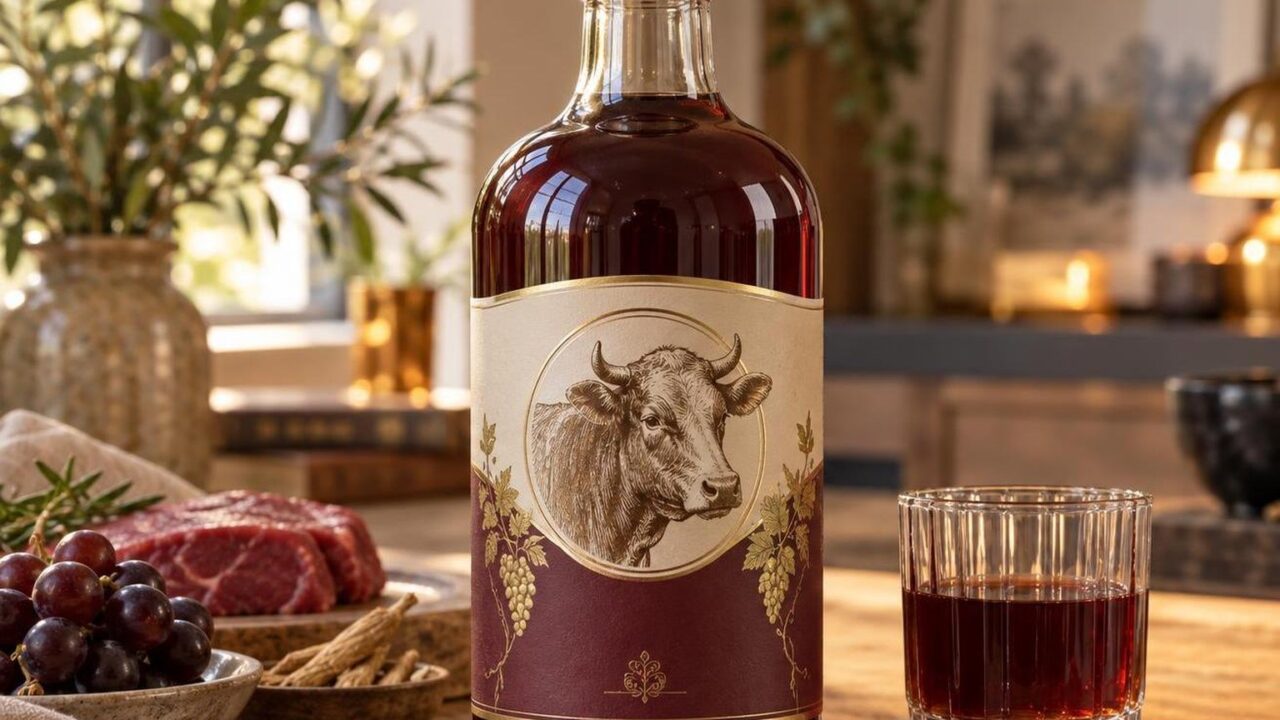
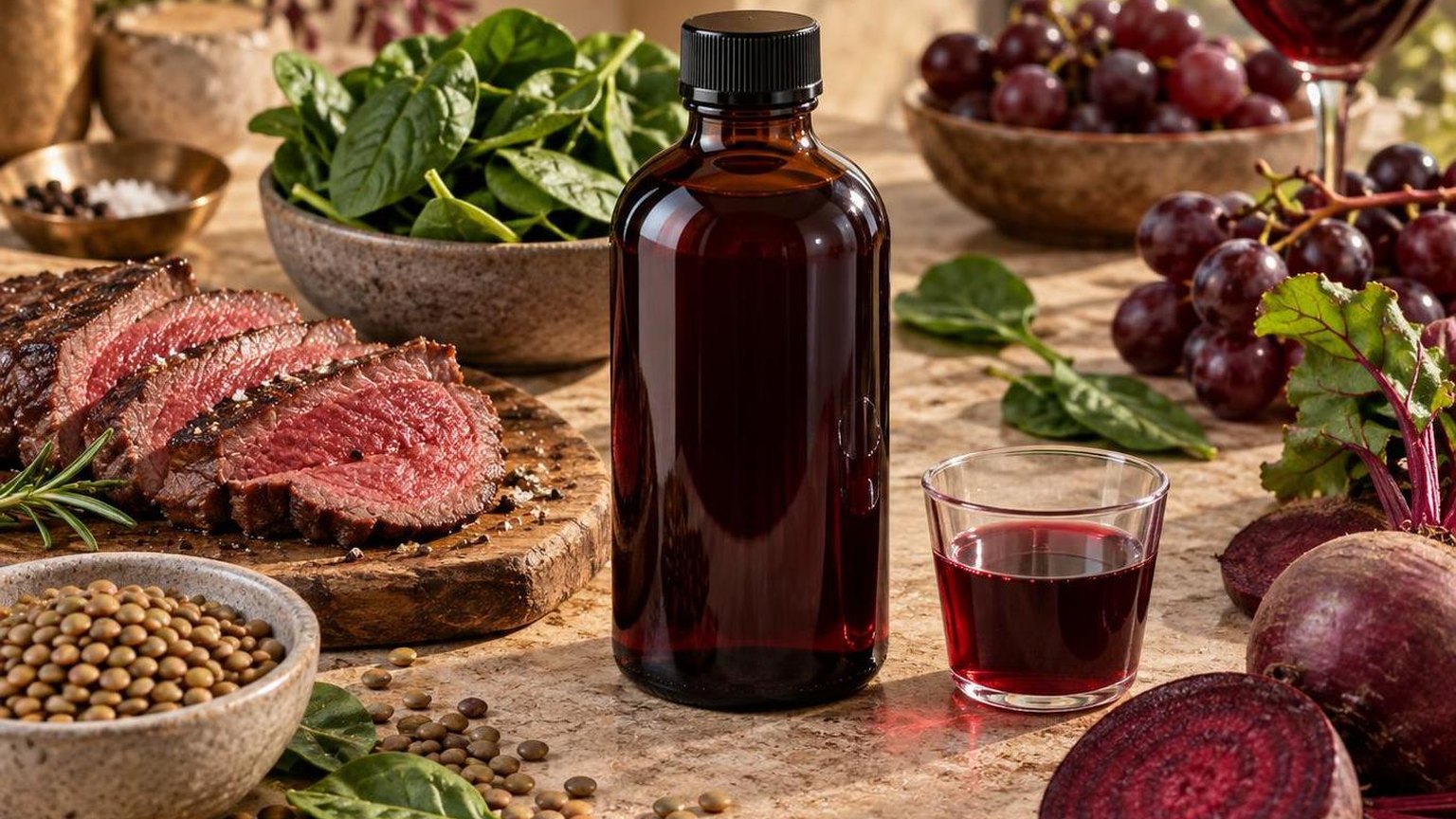
beef iron and wine tonic is a fortified medicinal wine historically made with beef extract, soluble iron compounds, and alcohol, marketed to “build blood” and stimulate appetite.
Its appeal came from two real nutrient associations: heme iron in beef and iron’s established role in hemoglobin formation.
Modern readers should treat it as a period patent-medicine concept, not a reliable anemia treatment.
Wine can reduce dietary iron absorption in some contexts, alcohol adds health risks, and iron deficiency needs testing, dosing, and follow-up with a clinician rather than a tonic label.
What Beef Iron and Wine Tonic Was
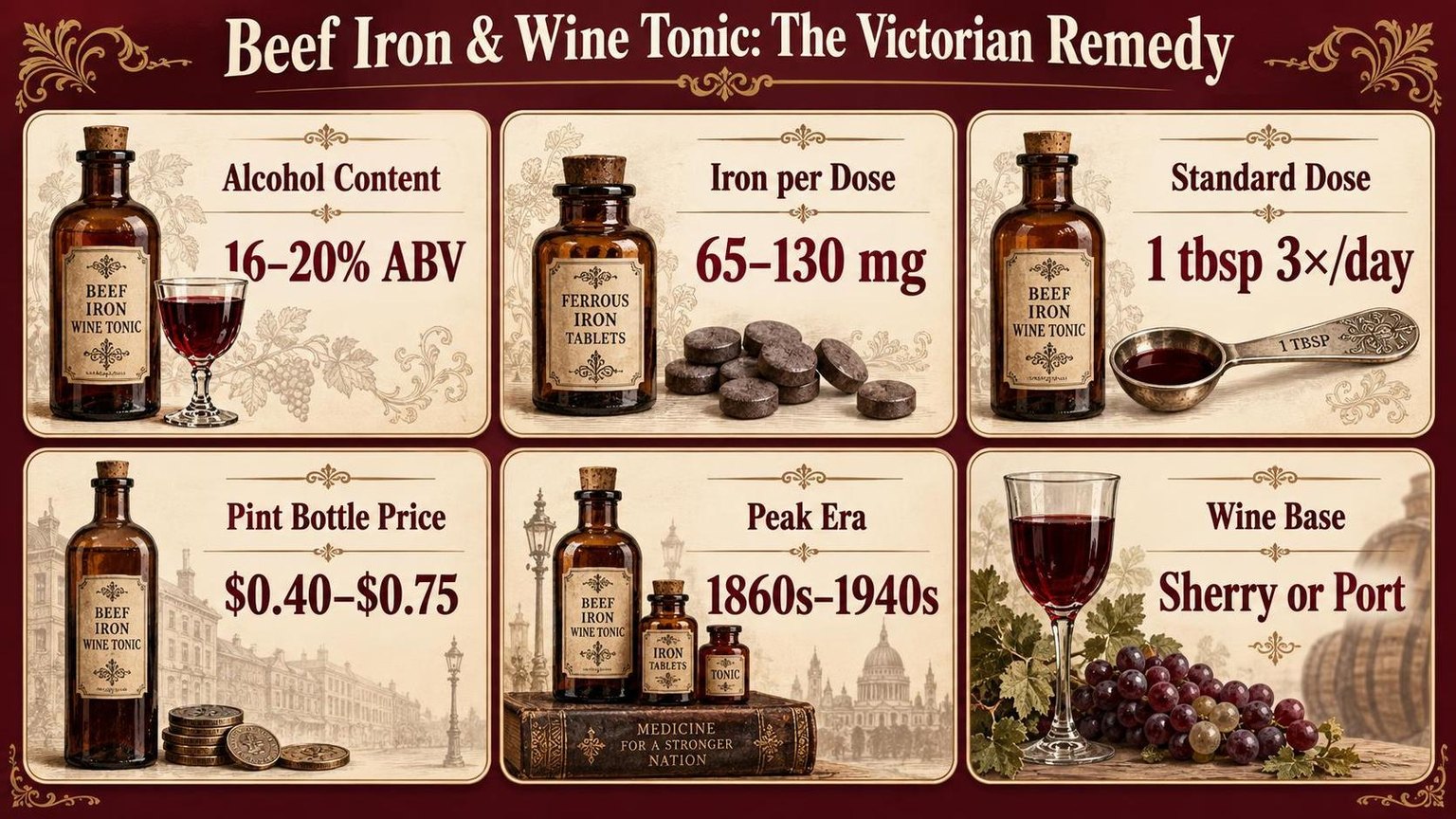
Beef iron and wine tonic was a medicinal preparation combining extract of beef, iron salts, and sherry or port wine into a single restorative drink.
Pharmacies across Britain, Canada, and the United States sold it from the 1860s through the mid-20th century as a treatment for anemia, debility, and convalescence.
The formula appeared in official pharmaceutical references including the British Pharmacopoeia and the National Formulary of the United States. It carried the Latin designation Vinum Ferri et Extracti Carnis.
Standard Composition
The tonic followed a relatively consistent formula across manufacturers. A typical 16-fluid-ounce (473 mL) bottle contained three active components in specific proportions.
| Ingredient | Typical Amount per Fluid Ounce (30 mL) | Purpose |
| Extract of beef (Liebig’s type) | Equivalent of 2–4 grains (130–260 mg) | Protein and amino acid source |
| Iron citrate or iron ammonium citrate | 1–2 grains (65–130 mg) | Elemental iron supplementation |
| Sherry wine or port wine | ~25 mL (bulk of volume) | Solvent, preservative, palatability |
The alcohol content typically ranged from 16% to 20% by volume, comparable to the fortified wine base. Some formulations added citric acid to improve iron solubility.
How It Was Made
Pharmacists prepared it by dissolving iron ammonium citrate in warm water, then mixing this solution with fresh beef extract. The combined liquid was added to sherry wine and stirred until uniform.
Justus von Liebig’s commercially produced beef extract, introduced in 1865, became the standard source material. This concentrated paste derived from South American cattle processed at the Fray Bentos plant in Uruguay.
Recommended Dosage
Physicians prescribed one tablespoon (15 mL) taken three times daily, usually before meals. This delivered roughly 3–6 grains (195–390 mg) of iron citrate per day alongside protein fractions from the beef extract.
- Anemia patients: 3 tablespoons daily for 4–8 weeks
- Post-illness convalescence: 2–3 tablespoons daily
- General “debility” or fatigue: 1–2 tablespoons daily
Major Manufacturers
Dozens of pharmaceutical firms produced their own versions. Wyeth, Parke-Davis, and the British firm Allen & Hanburys were among the most prominent. In Canada, the product was especially popular under brands like Dr.
Williams’ and Bovril-based preparations.
Prices in the early 1900s ranged from 40 to 75 cents per pint bottle, equivalent to roughly $13–$24 in 2024 dollars. Pharmacists also compounded it from scratch at lower cost using bulk ingredients.
Regulatory Classification
The tonic occupied an ambiguous category—part food, part medicine, part alcoholic beverage.
The 1906 Pure Food and Drug Act in the United States required accurate labeling of alcohol and drug content, which began constraining extravagant therapeutic claims.
By the 1940s, advances in hematology and the availability of standardized ferrous sulfate tablets made the tonic largely obsolete. Its high alcohol content also drew scrutiny as temperance-era regulations tightened across North America.
Iron Content in Beef Wine Tonics
“Beef, iron and wine tonic” describes a historical product category, not a standardized formula. The meaningful iron quantity comes from an added iron compound; beef extract and wine do not guarantee a nutritionally significant dose.
Read the Supplement Facts or Drug Facts panel rather than estimating iron from the product name. Compare the labeled elemental iron per serving, serving size, iron compound, alcohol content, and directions.
How Much Iron May a Tonic Provide?
Formulas vary by manufacturer and period. Some vintage labels state iron as a medicinal ingredient, while others emphasize beef extract, fortified wine, or flavor without disclosing enough information to calculate elemental iron reliably.
| Reference amount | Elemental iron | Context |
| U.S. Daily Value | 18 mg | Used for percent Daily Value on current food and supplement labels |
| Adult men | 8 mg daily | Recommended Dietary Allowance |
| Women ages 19–50 | 18 mg daily | Recommended Dietary Allowance |
| Pregnancy | 27 mg daily | Recommended Dietary Allowance |
| Adults | 45 mg daily | Tolerable Upper Intake Level from all sources |
These reference values come from the National Institutes of Health Office of Dietary Supplements. The upper limit is not a target; clinicians may prescribe larger therapeutic doses for confirmed deficiency under medical supervision.
Elemental Iron Determines the Dose
A label may name ferrous sulfate, ferrous gluconate, ferric ammonium citrate, or another compound.
The compound’s total weight is not equal to its elemental iron weight, so products containing similar quantities of iron salt can deliver different iron doses.
| Common compound | Approximate elemental iron by weight |
| Ferrous fumarate | 33% |
| Ferrous sulfate, anhydrous | 32% |
| Ferrous sulfate heptahydrate | 20% |
| Ferrous gluconate | 12% |
Hydration state and formulation affect these percentages. Use the declared elemental-iron amount whenever available instead of converting the ingredient weight yourself.
Does the Beef Add Meaningful Iron?
Beef contains absorbable heme iron, but tonic labels may use “beef” to mean concentrated extract rather than a serving of meat.
USDA FoodData Central reports that cooked beef varies by cut; the tonic’s undisclosed extract quantity prevents a dependable meat-based calculation.
Added iron salts are nonheme iron. Their absorption changes with iron status, meal composition, and dose. Vitamin C can improve nonheme absorption, while calcium, phytates, and polyphenols can reduce it.
Practical Label Check
- Confirm elemental iron per measured serving, not per bottle.
- Multiply by the number of servings actually taken.
- Check whether the product contains alcohol, sugar, or undeclared proprietary ingredients.
- Do not use vintage or collectible bottles; composition, seals, and stability are uncertain.
- Keep iron products away from children because acute overdose can be fatal.
Wine is not required for iron absorption and is not a treatment for anemia. Persistent fatigue or suspected deficiency warrants blood testing, because iron can be harmful when anemia has another cause or iron stores are already adequate.
Why Wine Was Used Medicinally
Wine served as the primary pharmaceutical solvent for over 2,000 years before modern alcohol extraction methods existed.
Physicians from Hippocrates (circa 400 BCE) through the 19th century prescribed wine-based preparations because ethanol dissolved active compounds that water alone could not.
The practice had a specific pharmacological rationale. Ethanol acts as a superior solvent for alkaloids, glycosides, and mineral salts compared to water.
Wine as a Drug Delivery System
Wine offered three functional advantages that no other widely available liquid could match in the pre-industrial era.
- Solvent capacity: Ethanol at wine’s typical 10–14% ABV dissolves iron salts, quinine, and botanical alkaloids more effectively than plain water
- Preservation: Alcohol content and low pH (typically 3.0–3.6) inhibited bacterial growth, giving wine-based tonics a shelf life of months rather than days
- Palatability: Wine’s residual sugars (2–20 g/L depending on style) and fruit flavors masked the metallic bitterness of dissolved iron compounds
- Caloric contribution: A standard 150 mL dose of fortified medicinal wine delivered roughly 100–130 calories, beneficial for malnourished patients
Historical Precedent in Pharmacopoeias
Medicated wines appeared in every major Western pharmacopoeia from the 16th through early 20th centuries. Their inclusion was formal, not folk tradition.
| Pharmacopoeia | Year | Medicated Wine Entries |
| London Pharmacopoeia | 1618 | Listed vinum preparations including iron-fortified wines |
| United States Pharmacopeia (USP) | 1820 | Included Vinum Album and Vinum Rubrum as official solvents |
| British Pharmacopoeia | 1867 | Recognized Vinum Ferri (wine of iron) as a standard preparation |
| USP Revision | 1900 | Still listed 7 official medicated wines including Vinum Ferri Amarum |
| USP XII | 1942 | Dropped all medicated wine monographs |
Sherry and port were preferred bases because their fortification to 17–20% ABV improved both solvent strength and preservation.
The Iron-Wine Connection Specifically
Wine’s natural tartaric acid (2–6 g/L) played a critical chemical role. It chelated iron into iron tartrate, a compound with significantly better gastrointestinal absorption than inorganic iron salts like ferrous sulfate.
The British Medical Journal noted in 1883 that iron dissolved in wine produced fewer digestive complaints than iron pills. Physicians observed that patients tolerated wine-based iron at doses that caused nausea in tablet form.
Red wine itself contains 2–5 mg of iron per liter naturally. While nutritionally insignificant alone, this contributed marginally when combined with added iron citrate or iron ammonium citrate in commercial beef, iron, and wine tonics.
By the 1890s, manufacturers like Wyeth and Parke-Davis standardized their formulations to deliver approximately 4–8 grains (260–520 mg) of iron per fluid ounce, using wine as both solvent and flavor vehicle.
Safety Risks of Historic Tonics
Historic beef, iron, and wine tonics carried genuine health hazards that modern regulation would never permit.
These products combined poorly standardized iron compounds, unregulated alcohol content, and raw animal extracts—a trio of risks consumers unknowingly accepted for decades.
Alcohol Content Disguised as Medicine
Most beef, iron, and wine tonics contained between 14% and 22% alcohol by volume.
Marketed as health restoratives, they were frequently consumed by populations explicitly advised against alcohol—including pregnant women, children, and individuals with liver disease.
| Product | Approx. Alcohol by Volume | Recommended Daily Dose | Alcohol per Dose |
| Wyeth’s Beef, Iron & Wine | ~18% | 1 tablespoon (15 mL), 3× daily | ~2.7 mL ethanol per dose |
| Hood’s Beef, Iron & Wine | ~20% | 1 tablespoon, 3× daily | ~3.0 mL ethanol per dose |
| Typical sherry wine (for comparison) | ~18% | N/A | N/A |
At three doses daily, a consumer ingested roughly 8–9 mL of pure ethanol—equivalent to about one-third of a standard alcoholic drink—without recognizing it as alcohol consumption.
Iron Toxicity Concerns
Iron dosing in these tonics was imprecise. Ferric ammonium citrate and iron pyrophosphate were common forms used, with per-dose iron content varying widely between batches due to minimal quality controls.
- The lethal dose of elemental iron is approximately 60 mg/kg body weight in children, making unsecured tonics a poisoning risk in households.
- Chronic excess iron intake (above 45 mg/day for adults) contributes to hemochromatosis, liver damage, and oxidative stress.
- No labeling standards required manufacturers to declare exact elemental iron content before the Pure Food and Drug Act of 1906.
Microbiological Hazards
Beef extract production in the 19th century lacked pasteurization standards.
Liebig’s process concentrated meat juices through evaporation, but temperatures were not consistently sufficient to eliminate bacterial endospores or prion-related proteins.
Bovine spongiform encephalopathy (BSE) was not identified until 1986. For over a century, consumers ingested concentrated bovine nervous-system-adjacent tissues with zero prion screening.
Regulatory Gaps Before 1906
The 1905 Collier’s exposé series “The Great American Fraud” specifically targeted alcohol-laden patent medicines.
Samuel Hopkins Adams documented tonics containing undisclosed narcotics, heavy metals, and dangerously high alcohol percentages sold without restriction.
- Before 1906, no federal law required ingredient disclosure on patent medicines in the United States.
- The Pure Food and Drug Act of 1906 forced manufacturers to list alcohol, morphine, cocaine, and other substances on labels for the first time.
- Many beef, iron, and wine tonics disappeared from the market within a decade of the Act’s passage, unable to survive ingredient transparency.
These regulatory changes revealed what consumers had long suspected: therapeutic claims for beef, iron, and wine tonics rested on alcohol’s euphoric effects rather than any validated nutritional mechanism.
Modern Alternatives to Beef Wine Tonic
Beef iron and wine tonic dominated pharmacy shelves for over a century, but modern nutritional science offers more bioavailable, better-tasting alternatives.
Today’s iron supplements deliver precise dosing without the metallic aftertaste or alcohol content that made the original tonic notorious.
Iron Supplement Forms Compared
Different iron salt forms vary dramatically in elemental iron content and absorption rates. Choosing the right form determines both effectiveness and side-effect profile.
| Supplement Form | Elemental Iron per Dose | Absorption Rate | Common Side Effects |
| Ferrous sulfate (325 mg tablet) | 65 mg | 10–15% | Nausea, constipation |
| Ferrous gluconate (325 mg tablet) | 36 mg | 10–15% | Milder GI upset |
| Ferrous fumarate (325 mg tablet) | 106 mg | 10–15% | Constipation, dark stools |
| Iron bisglycinate (25 mg chelated) | 25 mg | Up to 4× higher than sulfate | Minimal GI distress |
| Carbonyl iron (various) | ~100 mg | Slower, saturable | Lower toxicity risk |
| Traditional beef iron & wine tonic (1 tbsp) | ~5–8 mg | Variable | Alcohol content (~14%), taste |
Liquid Iron Supplements
For those who preferred the tonic’s liquid format, several modern liquid alternatives exist. Floradix Iron + Herbs provides 10 mg of ferrous gluconate per 10 mL dose with B-vitamins and herbal extracts.
It contains no alcohol, artificial preservatives, or animal-derived ingredients.
Spatone iron-rich water, sourced from Snowdonia, Wales, delivers 5 mg of naturally occurring ferrous iron per sachet. Clinical studies show its absorption rate reaches approximately 40%, far exceeding standard tablet forms.
Food-Based Approaches
Dietary strategies can replicate the iron-boosting intent of beef wine tonic without supplementation. Combining heme and non-heme iron sources with vitamin C enhances absorption significantly.
- Beef liver — 6.5 mg iron per 3-ounce serving, plus vitamin B12 and folate
- Oysters — 7.8 mg iron per 3-ounce serving of Eastern oysters
- Dark chocolate (70–85% cacao) — 3.4 mg iron per ounce
- Cooked spinach — 6.4 mg per cup, improved absorption when paired with citrus
- Fortified cereals — up to 18 mg per serving in brands like Total
When Oral Supplements Fail
Intravenous iron infusions bypass GI absorption entirely. Ferric carboxymaltose (Injectafer) delivers up to 750 mg of iron in a single 15-minute infusion.
This option suits patients with inflammatory bowel disease, celiac disease, or documented oral iron intolerance.
The recommended daily iron intake remains 8 mg for adult men and 18 mg for premenopausal women, per the National Institutes of Health.
Any supplementation exceeding these levels warrants medical supervision to avoid iron overload and hemochromatosis risk.
The beef iron and wine tonic served its era well. Modern alternatives deliver the same therapeutic goal — correcting iron deficiency — with superior precision, safety data, and far better compliance rates among patients.
Common Questions
What was beef, iron and wine tonic?
Beef, iron and wine tonic was a late-19th- and early-20th-century patent medicine combining beef extract, an iron compound, wine, and sometimes added stimulants or flavorings.
Manufacturers promoted it for anemia, fatigue, poor appetite, and recovery from illness, but formulas varied by brand and were not evaluated under modern drug standards.
Did beef, iron and wine tonic contain meaningful nutrition from beef?
Beef extract supplied concentrated flavor and small amounts of amino acids and minerals, not the protein or calories provided by a serving of meat.
Historical advertisements often implied greater restorative value than the product’s beef-derived ingredients could deliver.
Could the iron in the tonic treat iron-deficiency anemia?
An iron compound could raise iron intake, but benefit depended on its chemical form, dose, absorption, and whether the person actually had iron deficiency.
Modern treatment uses measured elemental-iron doses and laboratory monitoring because anemia can also result from bleeding, vitamin deficiencies, chronic disease, or inherited conditions.
How much alcohol did beef, iron and wine tonic contain?
Alcohol content differed among brands because wine served as both an ingredient and a solvent, and some proprietary medicines contained substantial alcohol.
Historical U.S. labeling was less standardized, so the original bottle label or a documented formula is needed to determine a specific product’s alcohol percentage.
Is vintage beef, iron and wine tonic safe to drink?
No vintage bottle should be consumed because its ingredients may have degraded, the seal may have failed, and the liquid may contain microbial, metal, or packaging contaminants.
It may also deliver an unknown dose of iron or alcohol, making the bottle suitable as a collectible rather than a beverage or medicine.
What is the modern alternative to beef, iron and wine tonic?
Suspected iron deficiency should be assessed with tests such as a complete blood count and serum ferritin rather than treated with an alcoholic tonic.
Clinicians can recommend a standardized iron supplement and investigate blood loss, while iron-rich foods such as beef, beans, lentils, and fortified cereals support ongoing dietary intake.
Further Reading
- How Many Calories In 750 Ml Of Wine?
- What Does Bad Wine Taste Like? Most Correct Answer
- What Does Marsala Wine Taste Like? Answer From Expert
- How Many Calories In A Glass Of Chardonnay Wine?
- Does Port Wine Go Bad?
- What Is Moscato Wine? – 2026
- How Many Calories Are in Taylor Port Wine?
- What Does Corked Wine Taste Like? Answer From Expert
- How Many Calories In A Bottle Of Moscato?
- All Alcohol Guides
- National Institutes of Health – Office of Dietary Supplements: Iron Fact Sheet (2023)
- U.S. Food & Drug Administration – CFR Title 21, Part 172: Food Additives Permitted for Direct Addition to Food (2024)
- National Library of Medicine / PubMed – Iron Deficiency Anemia: Evaluation and Management (2013)
- U.S. National Library of Medicine – History of Medicine: Patent Medicines and Tonics (2023)
- Smithsonian National Museum of American History – Patent Medicine Collection (2023)
- Harvard T.H. Chan School of Public Health – The Nutrition Source: Iron (2023)
- CDC – Recommendations to Prevent and Control Iron Deficiency in the United States (1998)
- USDA FoodData Central – Nutrient Database (2024)
- British Pharmacopoeia Commission / Wellcome Library – Historical Formulary References to Vinum Ferri (Beef, Iron and Wine) (2020)
- Journal of the History of Medicine and Allied Sciences, Oxford Academic (1953)