“How Long Does Whiskey Last?” is answered by storage condition: an unopened bottle can remain drinkable for decades, while an opened bottle typically keeps its best flavor for 1–2 years.
Whiskey does not spoil like milk, but oxygen, heat, light, and evaporation gradually damage aroma and taste. The bottle’s fill level matters because more air accelerates oxidation.
This guide explains how to judge whiskey’s age, recognize quality loss, and store bourbon, Scotch, rye, and other styles correctly. Keep bottles upright, tightly sealed, and away from sunlight and temperature swings.
A whiskey with sediment, cloudiness, an unusual smell, or a flat flavor may have deteriorated, although these signs do not always indicate a safety hazard. Learn when to drink, preserve, or discard an opened bottle.
How Long Unopened Whiskey Lasts
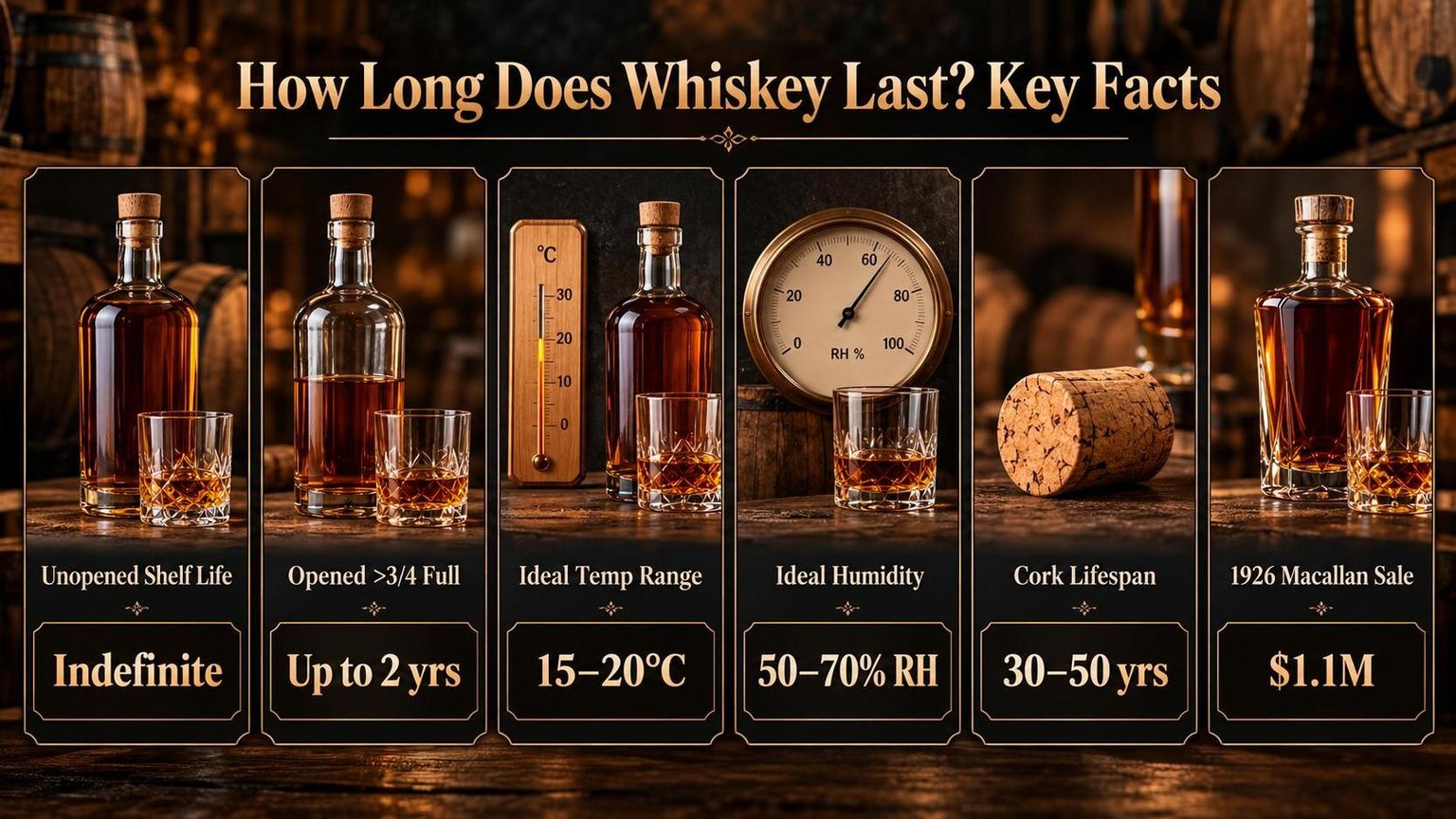
Unopened whiskey lasts indefinitely when stored correctly. The high alcohol content—typically 40–65% ABV—acts as a natural preservative that prevents bacterial growth and spoilage, unlike wine or beer which degrade within years.
Distillers and spirits scientists confirm that whiskey does not age further once bottled. The maturation process stops entirely when liquid leaves the cask.
A bottle of bourbon sealed in 1970 tastes virtually identical to when it was first bottled, assuming proper storage.
Storage Conditions That Preserve Unopened Whiskey
Three factors determine whether an unopened bottle maintains its original profile over decades: light exposure, temperature stability, and bottle orientation.
- Temperature: Store between 15–20°C (59–68°F). Sustained heat above 25°C accelerates chemical reactions that alter flavor compounds.
- Light: UV radiation breaks down terpenes and congeners. Keep bottles in dark cabinets or closed boxes to prevent photodegradation.
- Position: Always store upright. High-proof alcohol degrades natural cork over time, causing seal failure and evaporation. Wine rules do not apply here.
- Humidity: Maintain 50–70% relative humidity. Extremely dry environments can shrink corks, allowing slow oxidation.
Shelf Life by Whiskey Type (Unopened)
All unopened whiskeys share effectively unlimited shelf life, but certain variables create minor differences in long-term resilience.
| Whiskey Type | Typical ABV | Unopened Shelf Life | Key Risk Factor |
| Bourbon | 40–62.5% | Indefinite | Cork degradation from high proof |
| Scotch (Single Malt) | 40–46% | Indefinite | UV sensitivity of delicate phenols |
| Scotch (Cask Strength) | 50–65% | Indefinite | Cork erosion at high ABV |
| Irish Whiskey | 40–46% | Indefinite | Light exposure |
| Japanese Whisky | 40–55% | Indefinite | Temperature fluctuations during transit |
| Rye Whiskey | 40–57.5% | Indefinite | Seal integrity over long storage |
Real-World Evidence of Longevity
In 2021, a bottle of 1926 Macallan 60-Year-Old sold at Sotheby’s for $1.1 million. Tasting notes confirmed the liquid remained intact after 95 years in glass. The bottle had been stored upright in a temperature-controlled cellar.
Samples from Prohibition-era medicinal whiskey bottled in the 1920s have been analyzed and found chemically stable. Ethanol concentration remained within 1–2% of original label proof after nearly a century.
When Unopened Whiskey Can Go Wrong
Seal failure is the primary threat. Natural corks dry out or crumble after 30–50 years, especially in low-humidity environments. Once the seal breaks, oxidation begins immediately—even without opening the bottle.
Synthetic closures and screw caps largely eliminate this risk. Bottles sealed with metal caps from the 1980s onward show almost zero evaporation loss in controlled studies.
Check older bottles periodically for fill-level drops, which signal a compromised seal.
How Long Opened Whiskey Lasts
Opened whiskey begins a slow decline the moment air enters the bottle. Oxidation alters flavor compounds, particularly esters and aldehydes, changing the whiskey’s character over months rather than days.
How quickly depends on the fill level, storage conditions, and proof.
General Timeline by Fill Level
The amount of air in the bottle is the single biggest factor. More headspace accelerates oxidation exponentially. Use this table as a practical guide.
| Fill Level | Estimated Quality Window | Key Risk |
| More than 3/4 full | Up to 2 years | Minimal oxidation; flavor stays close to original |
| 1/2 to 3/4 full | 6–12 months | Noticeable softening of sharp notes |
| 1/4 to 1/2 full | 3–6 months | Flattening of mid-palate complexity |
| Below 1/4 full | 1–3 months | Rapid flavor degradation; stale, cardboard-like notes |
Why Proof Matters
Higher-proof whiskeys resist degradation longer. Ethanol acts as a solvent that stabilizes volatile aroma compounds. A cask-strength bourbon at 60% ABV holds its profile roughly 30–50% longer than a 40% ABV bottling under identical conditions.
Whiskeys bottled at 46% ABV or above also skip chill filtration more often. That retained body gives them a slight buffer against the thinning effect of oxidation.
Storage Conditions That Accelerate or Slow Decline
- Temperature swings: Fluctuations above 10°F (5.5°C) push air in and out of the bottle, speeding oxidation. Store between 59–68°F (15–20°C).
- Direct sunlight: UV radiation breaks down terpenes and phenolic compounds within weeks. Always store in darkness or inside a cabinet.
- Upright position: Whiskey must stand upright. Cork contact with high-proof spirit degrades the cork, introducing off-flavors and allowing micro-leaks.
- Seal integrity: Natural cork dries out faster than synthetic stoppers or screw caps. A dried cork can lose its seal in as little as 6–8 months if the bottle is rarely opened.
Practical Steps to Extend Shelf Life
Transfer whiskey below the quarter-full mark into a smaller 200 mL or 375 mL bottle. This eliminates excess headspace immediately. Use glass, never plastic, which leaches chemicals into the spirit.
Private Preserve or similar inert gas sprays (argon/nitrogen blend) displace oxygen in the headspace. Two to three short bursts before resealing can add months of quality retention.
Parafilm wrapped around the closure creates a secondary oxygen barrier. It costs under $10 for a 50-foot roll and is standard practice among collectors storing bottles worth $200 or more.
Does Opened Whiskey Ever Become Unsafe?
No. Whiskey’s minimum 40% ABV prevents bacterial growth entirely. An opened bottle stored for 10 years won’t make you sick. It will, however, taste flat, muted, and potentially unpleasant — a shadow of the distiller’s intent.
Does Whiskey Expire or Spoil
Whiskey does not expire in the way perishable foods do. Its high alcohol content—typically 40–68% ABV—prevents bacterial growth that causes spoilage.
However, whiskey can degrade in quality over time through oxidation, evaporation, and light exposure.
The distinction matters: whiskey won’t make you sick even decades after opening, but it can become unpleasant to drink. Understanding the difference between safety and quality is essential for every collector and casual drinker.
Why Whiskey Doesn’t Spoil Like Wine or Beer
Ethanol at concentrations above 20% ABV creates an inhospitable environment for virtually all foodborne pathogens.
Since bottled whiskey starts at a minimum of 40% ABV (80 proof), microbial contamination is effectively impossible under normal storage.
Wine (12–15% ABV) and beer (4–6% ABV) lack this protection. Both contain residual sugars and lower alcohol levels that permit bacterial and yeast activity after opening.
Whiskey’s distillation process also removes proteins and carbohydrates that microorganisms need to thrive.
What Actually Degrades Whiskey
Three measurable factors cause whiskey to lose quality over time, even though it remains safe to consume.
| Factor | Mechanism | Impact Timeline |
| Oxidation | Oxygen in headspace reacts with congeners and esters | Noticeable after 6–12 months (bottle ⅓ full) |
| Evaporation | Volatile compounds escape through imperfect seals | Measurable loss within 1–2 years of opening |
| UV light exposure | Photodegradation breaks down flavor compounds like vanillin | Detectable changes after several months of direct sunlight |
| Temperature fluctuation | Expansion and contraction weakens cork seal integrity | Cumulative damage over years of cycling |
Sealed vs. Opened: A Critical Distinction
An unopened bottle with an intact seal can remain stable for 100+ years. Auction houses regularly sell pre-Prohibition bottles from the early 1900s that remain drinkable, though flavor profiles shift subtly over extreme timescales.
Once opened, the clock starts. A bottle that is 75% full retains quality for roughly 1–2 years. At 25% full, the increased oxygen-to-whiskey ratio accelerates degradation, and noticeable flavor loss can occur within 3–6 months.
Signs Your Whiskey Has Degraded
- Flattened aroma — reduced intensity on the nose, especially vanillin and fruit esters
- Muted palate — loss of mid-palate complexity and shortened finish
- Off-notes — cardboard, wet paper, or excessive oakiness from oxidized tannins
- Color change — slight fading or dulling, particularly in lighter whiskeys like Irish single pot still
- Lowered fill level — visible evaporation below the original fill line, sometimes called the “angel’s share in the bottle”
None of these signs indicate a safety hazard. Degraded whiskey is disappointing, not dangerous. The 40%+ ABV ensures it remains microbiologically stable regardless of how the flavor has changed.
Signs Your Whiskey Has Deteriorated
Whiskey doesn’t spoil like milk or meat, but it absolutely degrades. Oxidation, light exposure, and temperature fluctuations break down congeners and esters — the compounds responsible for flavor, aroma, and color.
Recognizing deterioration early prevents you from serving compromised spirit.
Visual Changes
Hold the bottle against a white background in natural light. Deteriorated whiskey shows measurable differences from its original state.
- Color fading: UV light breaks down tannins and lignin compounds extracted during barrel aging. A bourbon that sat in direct sunlight for 6–12 months can lose 15–20% of its color intensity.
- Cloudiness or haze: Fatty acid esters precipitate out of solution when whiskey is stored below 4°C (39°F) or after significant oxidation. Non-chill-filtered expressions are more susceptible.
- Sediment or particles: Floating debris or flakes on the surface suggest cork degradation. Natural cork breaks down over decades, releasing tannin fragments into the liquid.
Aroma Red Flags
Your nose detects deterioration before your palate does. Pour a small amount into a Glencairn glass and evaluate at arm’s length first, then closer.
- Flat or muted nose: Volatile aroma compounds (ethyl acetate, isoamyl acetate) evaporate first. An opened bottle stored 3–4 years often loses 30–40% of its aromatic complexity.
- Nail polish or acetone sharpness: Acetic acid formation from prolonged oxygen contact produces vinegar-like or solvent notes absent from fresh pours.
- Wet cardboard or musty smell: Indicates cork taint from 2,4,6-trichloroanisole (TCA), the same compound that causes corked wine. Concentrations as low as 2–5 parts per trillion are detectable.
Taste Indicators
If aroma checks pass, take a small sip. Compare against known benchmarks for that expression.
| Indicator | What It Means | Common Cause |
| Thin, watery mouthfeel | Alcohol evaporation reduced proof | Loose cap or cork; bottle less than ⅓ full for 12+ months |
| Harsh, sharp bitterness | Oxidized tannins and phenolic compounds | Excessive oxygen in headspace |
| Loss of finish length | Long-chain esters have broken down | Heat cycling above 25°C (77°F) repeatedly |
| Sour or vinegar notes | Ethanol converting to acetic acid | Open bottle stored 4+ years with large headspace |
The Headspace Rule
Oxidation accelerates proportionally with headspace. A bottle that’s ¾ full remains stable for roughly 1–2 years after opening. At ¼ full, noticeable degradation typically occurs within 6 months.
When deterioration is detected, the whiskey isn’t dangerous to drink — ethanol at 40% ABV prevents pathogenic bacterial growth. The issue is strictly quality.
If multiple signs above are present, that bottle has passed its prime and won’t represent the distiller’s intent.
Best Ways to Store Whiskey 马会
Proper storage directly determines whether your whiskey retains its original character for decades or deteriorates within months.
Temperature stability, light exposure, and bottle orientation are the three critical variables every collector must control.
Temperature Control
Store whiskey between 15°C and 20°C (59°F–68°F). Fluctuations beyond a 5°C range within 24 hours accelerate oxidation and can break the seal integrity over time.
Never store bottles near radiators, ovens, or south-facing windows. Sustained exposure above 25°C (77°F) causes ethanol evaporation through the cork, a phenomenon distillers call the “angel’s share.”.
Light Exposure
Ultraviolet radiation degrades terpenes and phenolic compounds responsible for whiskey’s flavor. A 2017 Scotch Whisky Research Institute study confirmed measurable color and flavor changes after just 60 days of direct sunlight exposure.
Store bottles in closed cabinets, dark cellars, or UV-filtered display cases. Even standard indoor fluorescent lighting can cause slow degradation over years.
Bottle Orientation
Always store whiskey bottles upright. Unlike wine, whiskey’s 40–68% ABV will chemically degrade natural cork when in prolonged contact, causing crumbling and taint.
If using cork-sealed bottles, tip the bottle briefly once every 3–4 months. This keeps the cork slightly moist enough to maintain its seal without prolonged spirit contact.
Opened vs. Unopened Storage Comparison
| Factor | Unopened Bottle | Opened Bottle |
| Shelf life | Indefinite (decades+) | 1–2 years at best quality |
| Oxidation rate | Negligible | Increases as headspace grows |
| Ideal fill level | Factory fill | Above 50% volume |
| Cork integrity | Reliable for 10+ years | Check every 6 months |
| Recommended action | Store upright, dark, cool | Decant to smaller bottle below ⅓ full |
Strategies for Opened Bottles
- Decant to smaller containers: Transfer whiskey to a 200 mL or 375 mL bottle when the original drops below one-third full. Less headspace means less oxygen contact.
- Use Private Preserve or argon gas: Inert gas sprays displace oxygen in the bottle neck. One 2-second burst before resealing extends quality by 6–12 months.
- Parafilm the closure: Wrapping Parafilm M around the cap or cork creates an additional oxygen barrier, reducing evaporation by up to 90%.
- Avoid decorative pourers: Open-top pourers expose the spirit to constant airflow, accelerating oxidation within weeks.
Humidity Considerations
Maintain ambient humidity between 50% and 70%. Excessively dry conditions below 40% cause corks to shrink and lose their seal. Overly humid environments above 80% promote mold growth on labels and closures.
A basic hygrometer costs under $15 and provides the monitoring needed to protect bottles worth hundreds or thousands of dollars.
Questions People Ask Most
Does unopened whiskey go bad?
Unopened whiskey stored upright in a cool, dark place at 15–20 °C lasts indefinitely. The high alcohol content (40% ABV minimum) prevents microbial growth, and the sealed bottle stops oxidation.
Bottles from the 1950s and 1960s have been opened and found perfectly drinkable, though subtle flavor shifts can occur if exposed to temperature swings or direct sunlight over decades.
How long does whiskey last after opening?
An opened bottle retains its intended flavor profile for roughly 1–2 years if kept at least half full.
Once the fill drops below the halfway mark, the increased headspace accelerates oxidation, and noticeable flavor degradation typically occurs within 6 months.
Transferring the remaining whiskey to a smaller bottle reduces air contact and extends quality.
Can you tell if whiskey has oxidized too much?
Oxidized whiskey develops a flatter, more astringent or cardboard-like taste and may lose its aromatic complexity—particularly top notes of fruit and spice. The color can also lighten slightly.
It won’t make you sick, but it no longer represents the distiller’s intended profile.
Does storing whiskey on its side shorten its shelf life?
Yes. Unlike wine, whiskey’s 40–65% ABV will degrade a natural cork over time, causing it to crumble and break the seal. A compromised cork lets air in, accelerating oxidation, and dissolved cork compounds can introduce off-flavors.
Always store bottles upright; if you want to keep the cork supple, briefly tilt the bottle once every few months.
Do miniature bottles and decanters affect how long whiskey keeps?
Miniature bottles (50 mL) with factory seals last just as long as full-size bottles—indefinitely unopened.
Crystal decanters, however, are not airtight; whiskey in a typical decanter begins losing volatile aromatics within 2–3 months.
Lead-crystal decanters pose an additional risk: studies have shown lead leaching into spirits reaches measurable levels (up to 200+ µg/L) within 24 hours of contact.
Does whiskey continue to age or improve once bottled?
No. Maturation stops the moment whiskey leaves the oak cask. A 12-year-old bourbon bottled in 2010 is still a 12-year-old bourbon in 2025—it does not become a 27-year-old spirit.
In-bottle changes are purely oxidative and generally detrimental rather than beneficial, which is why sealed, well-stored bottles hold their quality while opened ones slowly decline.
Further Reading
- Basil Hayden Dark Rye Review – Information From Experts
- What Makes Irish Whiskey Different?
- What Do You Mix Jameson With?
- How To Make Crystal Clear Ice Cubes For Whiskey?
- What Is Pink Whitney Bottle? Information From Experts
- What To Mix With Irish Cream?
- Can You Freeze Whiskey?
- Is Moonshine Illegal In Texas?
- All Alcohol Guides
- TTB – Alcohol and Tobacco Tax and Trade Bureau: Beverage Alcohol Manual (2024)
- FDA – CPG Sec 510.400 Dealcoholized Wine and Malt Beverages (2023)
- USDA FoodData Central – Whiskey Nutrient Data (2024)
- NIH/NIAAA – Understanding Alcohol: What's a Standard Drink? (2023)
- PubMed – Volatile Composition and Sensory Properties of Whisky During Aging in Oak Barrels (2017)
- Scotch Whisky Association – What Is Scotch Whisky? (2024)
- Whisky Advocate – Does Whiskey Go Bad? (2022)
- MasterClass – How to Store Whiskey: 5 Tips for Storing Whiskey (2022)
- University of Edinburgh – Scotch Whisky Research Institute Collaboration (2020)
- The Whiskey Wash – How Long Does an Open Bottle of Whiskey Last? (2023)