
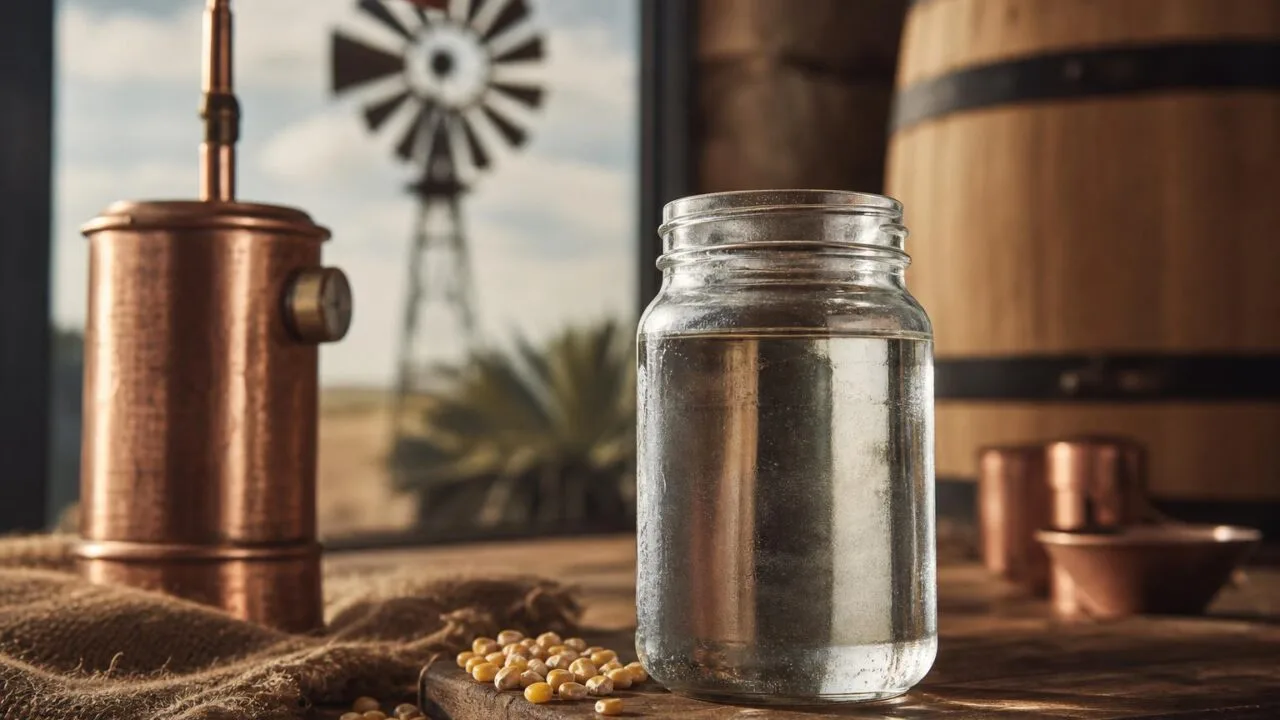
Is Moonshine Illegal In Texas is yes: unlicensed distilling of spirits is illegal, even for personal use, because Texas treats distilled alcohol differently from beer or wine made at home.
Texas law requires a distiller’s permit before anyone manufactures liquor, and federal law also prohibits operating an unregistered still. Possessing equipment can become legally risky when it is set up or used to produce spirits.
This article explains what Texas allows, what it bans, the permits involved, and why “moonshine” sold legally in stores is different from homemade liquor.
Texas Rules on Homemade Distilling
In Texas, “moonshine” usually means distilled spirits made outside the licensed system.
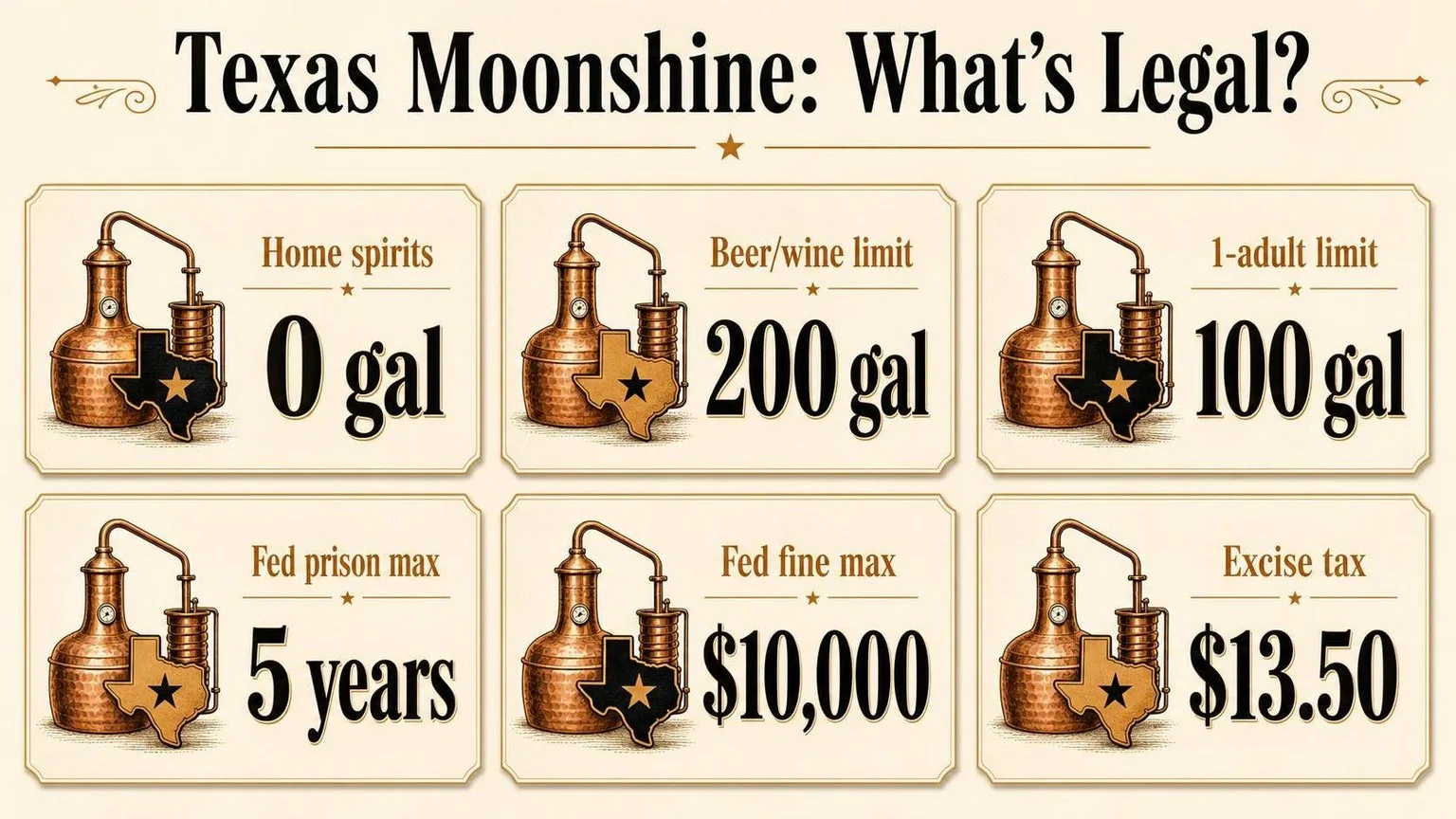
The key point is numerical but simple: Texas and federal law allow limited home beer and wine production, but they allow 0 gallons of home-distilled liquor for drinking.
That “zero” matters because distillation is regulated differently from fermentation.
A still used to make beverage alcohol generally requires both federal authorization from the Alcohol and Tobacco Tax and Trade Bureau and the proper Texas Alcoholic Beverage Commission authority.
| Activity | Texas number to know | What it means |
| Home beer, ale, malt liquor, or wine | Up to 200 gallons per year in a household with 2 or more adults; 100 gallons with 1 adult | Texas Alcoholic Beverage Code Section 109.21 allows limited personal production, not for sale. |
| Home-distilled spirits for drinking | 0 gallons | There is no Texas or federal personal-use exception for beverage spirits. |
| Federal penalty for illegal distilling | Up to 5 years imprisonment and up to a $10,000 fine | 26 U.S.C. Section 5601 covers unregistered stills and unlawful distilling operations. |
| Federal distilled spirits excise tax | $13.50 per proof gallon standard rate | A proof gallon is 1 gallon at 100 proof, or its equivalent. Reduced rates may apply to qualified producers. |
The home-production allowance in Texas is often misunderstood. Section 109.21 covers beer, ale, malt liquor, and wine made for personal or family use. It does not legalize whiskey, corn liquor, brandy, vodka, or any other distilled spirit.
The federal side is stricter than many hobbyists expect. The TTB states that distilled spirits may not be produced at home for beverage use, even if they are not sold and even if only a small amount is made.
- 100 proof means 50% alcohol by volume; proof is twice the ABV in the United States.
- A proof gallon is not always a physical gallon; 1 gallon at 50% ABV equals 1 proof gallon.
- A 1-gallon batch at 80 proof equals 0.8 proof gallons for federal tax measurement.
Texas enforcement also turns on licensing and source.
Spirits made by an unlicensed person are treated as illicit alcoholic beverages, and possessing, transporting, or selling them can create separate legal exposure under the Texas Alcoholic Beverage Code.
For a lawful Texas distillery, the numbers change completely. The business must operate under TABC licensing, federal distilled spirits plant registration, labeling rules, tax records, production records, and distribution laws.
That is why legal “moonshine” on a Texas shelf is simply licensed distilled spirits using a traditional style name.
What Makes Moonshine Illegal in Texas
Whether “moonshine” is illegal in Texas depends less on the word and more on how the spirit was made, taxed, labeled, and possessed.
Unaged corn whiskey from a licensed Texas distillery can be lawful; homemade distilled liquor made without permits is not.
The key line is distillation. Texas permits limited home production of beer, ale, malt liquor, and wine, but that home-use exception does not extend to distilled spirits.
Permit status is the biggest factor
Distilling beverage alcohol in Texas requires authorization at both the federal and state level. A small still used to make drinking alcohol at home is treated very differently from a licensed distillery producing tax-paid spirits.
| Activity | Typical legal result in Texas | Why it matters |
| Making wine or beer at home for personal use | Generally allowed within limits | Texas Alcoholic Beverage Code allows certain home production of wine, ale, malt liquor, and beer. |
| Distilling liquor at home for drinking | Illegal without required permits | Neither Texas nor federal law gives a personal-use exemption for beverage spirits. |
| Buying “moonshine” from a licensed store or distillery | Generally lawful if age 21 or older | The product is commercially produced, labeled, and tax-paid. |
| Selling homemade distilled liquor | Illegal without licensing and tax compliance | Sale adds separate state and federal alcohol violations. |
Federal law still applies inside Texas
The federal Alcohol and Tobacco Tax and Trade Bureau requires distilled spirits plants to be registered before producing beverage spirits. Federal law under 26 U.S.C. § 5601 can punish unregistered distilling activity with fines and imprisonment.
| Federal issue | Specific legal point |
| Unregistered still or distilling premises | Federal distilled spirits rules require registration and compliance before production. |
| Possible criminal penalty | 26 U.S.C. § 5601 lists penalties including up to 5 years imprisonment and fines for specified illegal distilling offenses. |
| Alcohol tax | Lawful commercial spirits must be tax-paid; untaxed beverage alcohol is a major enforcement trigger. |
Quantity, purpose, and proof can change the risk
Small quantity does not create a home-distilling loophole. However, quantity can affect how prosecutors, regulators, or investigators view intent, especially if there are bottles, labels, cash sales, social-media offers, or delivery records.
- Personal drinking versus sale: Making spirits for yourself is still unlawful without permits, but selling or distributing can create additional charges.
- Possession of equipment: A still may have lawful non-beverage uses, but using it to produce drinkable spirits without authorization changes the analysis.
- Source of the bottle: Store-bought “moonshine” from brands such as legal corn whiskey producers is not the same as untaxed backyard liquor.
- Age and location: Texas purchasers and possessors generally must be at least 21, and open-container or dry-area rules may also matter.
How Texas Classifies Moonshine
Texas does not judge “moonshine” by the nickname on the jar. Regulators verify what the liquid is, how strong it is, and whether it was produced under the required federal and Texas permits.
The first measurement is alcohol content. Under Texas law, an alcoholic beverage contains more than 0.5% alcohol by volume, while distilled spirits are typically verified by proof, alcohol by volume, and production records.
| Measurement | What it means | Example |
| Alcohol by volume | Percentage of the liquid that is ethyl alcohol | 40% ABV whiskey |
| Proof | In the United States, proof is twice the ABV | 40% ABV equals 80 proof |
| Proof gallon | One liquid gallon at 50% ABV, or 100 proof | Used for federal distilled spirits tax accounting |
For legal producers, verification starts before a bottle exists.
A distillery must hold federal authorization from the Alcohol and Tobacco Tax and Trade Bureau and the proper Texas Alcoholic Beverage Commission permit, with records showing production, storage, transfers, and removals.
Alcohol strength is commonly checked with a calibrated hydrometer, thermometer, and federal proofing tables. Because alcohol density changes with temperature, proof is standardized to 60 degrees Fahrenheit under federal gauging rules.
| Liquid | ABV | U.S. proof |
| Beer at Texas alcoholic-beverage threshold | More than 0.5% | More than 1 proof |
| Typical vodka or whiskey | 40% | 80 proof |
| High-proof unaged spirit | 50% | 100 proof |
| Very high-proof spirit | 75.5% | 151 proof |
In an enforcement setting, officers do not need to rely on taste, smell, or folklore. They can document the still, mash, containers, labels, sales activity, and absence of TABC or TTB authorization.
- Field observations: stills, condensers, fermenting mash, jars, hoses, burners, or proofing equipment.
- Container evidence: unlabeled jars, handwritten proof claims, reused liquor bottles, or bulk storage.
- Business evidence: menus, online posts, cash sales, invoices, delivery records, or event service.
- Permit checks: TABC licensing records and federal distilled spirits plant registration.
When exact proof matters, samples may be sent to a laboratory. Labs can use distillation followed by density measurement, or instrumental methods such as gas chromatography, to confirm ethanol concentration and identify other volatile compounds.
For licensed Texas distilleries, the same measurements affect tax and compliance. Texas imposes liquor excise tax measured by volume, while federal distilled spirits tax is based on proof gallons, making accurate gauging central to lawful production.
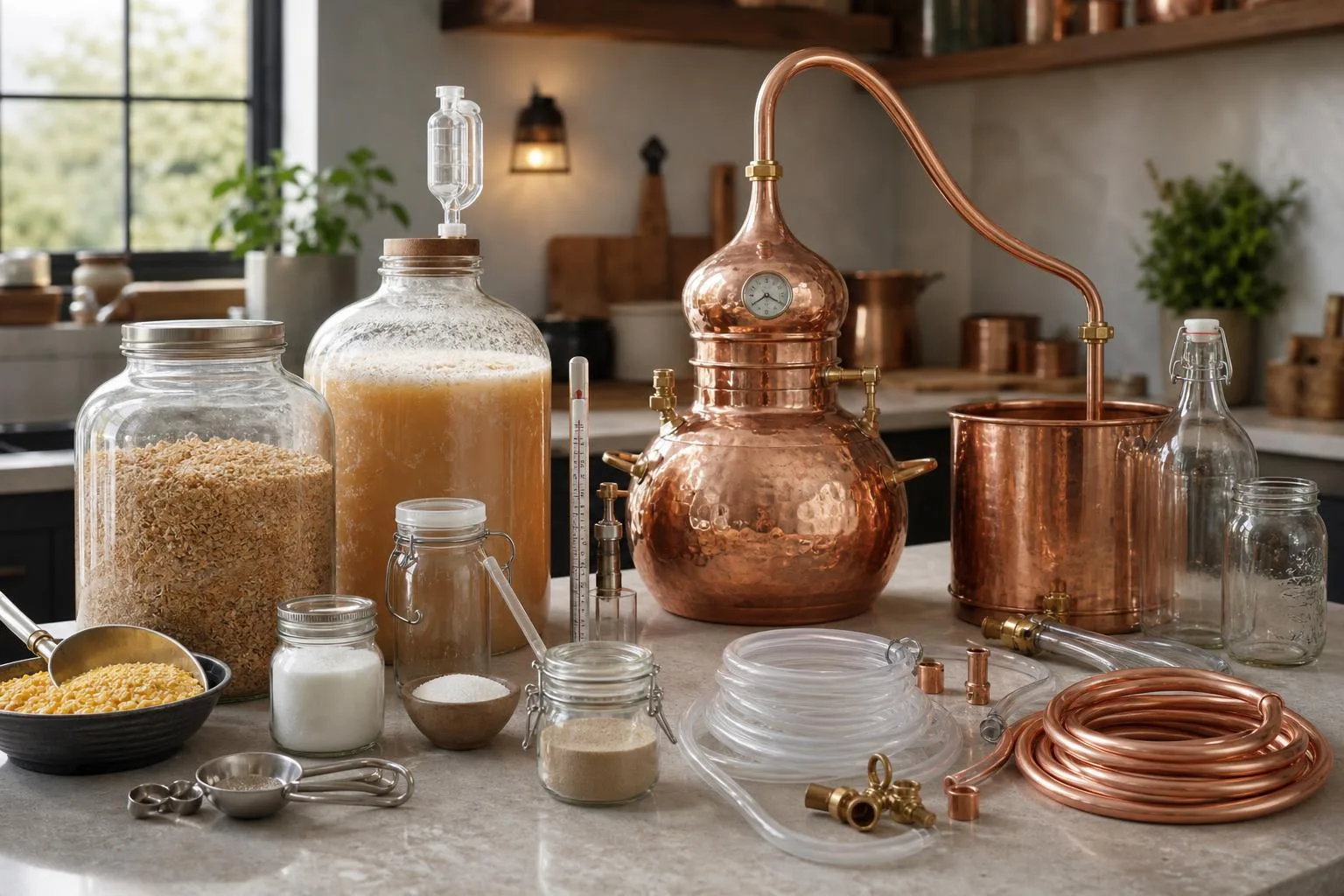
Moonshine vs Homebrewed Beer and Wine
In Texas, “moonshine” is not illegal because it is unaged or high-proof; it becomes illegal when distilled without the required federal and state authorization.
The cleanest comparison is with beer, wine, and legally purchased spirits, where Texas law treats possession and production very differently.
Home fermentation is the main legal alternative. Texas allows adults to make beer, ale, malt liquor, or wine for personal or family use, but that permission does not extend to distilled spirits.
| Activity | Texas legal status | Key numbers / limits |
| Making beer or wine at home | Allowed for personal or family use | Up to 200 gallons per year for a household with 2 or more adults; up to 100 gallons with 1 adult |
| Distilling spirits at home | Not allowed without proper permits | No personal-use exemption for beverage spirits under federal law |
| Buying commercial moonshine | Allowed if sold by a licensed retailer | Must be tax-paid, labeled, and sold through the legal alcohol system |
| Owning a still | Legally risky if used or intended for spirits | Federal distilled spirits plant rules apply before beverage alcohol production |
The biggest misconception is that home distilling is treated like homebrewing. It is not.
Federal alcohol law allows limited household beer and wine production, but beverage-spirit distillation requires registration and tax compliance through the Alcohol and Tobacco Tax and Trade Bureau.
- Beer and wine: Texas Alcoholic Beverage Code Section 109.21 permits limited home production for personal or family use.
- Spirits: Distillation for drinking alcohol generally requires a federal distilled spirits plant permit and compliance with excise tax rules.
- Retail moonshine: A jar labeled “moonshine” in a Texas liquor store is legal because it came from a licensed producer and legal distributor.
Compared with buying whiskey, vodka, or legal “white dog” corn whiskey, illicit moonshine carries two separate risks: criminal exposure and product safety.
Unregulated spirits may have uncertain proof, contamination, or improper cuts from the distillation run.
| Option | Typical proof range | Consumer protection |
| Licensed vodka or whiskey | Usually 80 proof; some products 90–120 proof | Labeling, tax stamps or records, regulated production |
| Legal commercial moonshine | Often 80–100 proof; some higher-proof versions exist | Produced under license and sold through permitted retailers |
| Illicit moonshine | Can vary widely, sometimes above 120 proof | No reliable labeling, testing, or tax-paid chain of custody |
For Texans who want the flavor of moonshine without the legal risk, the practical alternative is simple: buy a licensed, commercially made unaged corn whiskey or “moonshine-style” spirit from a package store.
Making beer or wine at home is a different, legally recognized category.
Texas Moonshine Safety and Buying Tips
Moonshine is not automatically dangerous because it is unaged; the real risks come from illegal production, unknown proof, contamination, and unsafe handling.
In Texas, unlicensed distilled spirits should be treated as both a legal and health red flag.
Texas Alcoholic Beverage Commission rules and federal TTB requirements exist partly because distilled spirits can be hazardous when made without controls.
A sealed, labeled bottle from a licensed distiller is far safer than a jar with no producer, proof, or tax stamp.
Key Health Risks
- Unknown alcohol strength: Homemade spirits can exceed 100 proof, meaning more than 50% alcohol by volume. Without lab testing or accurate proofing equipment, a “shot” may contain far more alcohol than expected.
- Methanol concern: Methanol poisoning is rare in properly made commercial spirits, but it is a known risk in illicit or contaminated alcohol. Symptoms can include vomiting, blurred vision, seizures, and, in severe cases, blindness or death.
- Flammable vapor: Ethanol vapor can ignite. Distilling indoors, near propane burners, pilot lights, or poor ventilation creates a fire and explosion hazard.
- Contaminated containers: Reused fuel, solvent, pesticide, or chemical containers can leach toxic residues. Food-grade glass or stainless steel is the minimum safe standard for beverage alcohol storage.
Practical Safety Benchmarks
| Item | Specific figure | Why it matters |
| Standard U.S. drink | 0.6 fl oz pure alcohol | Equals 1.5 fl oz of 80-proof spirits; high-proof moonshine can exceed this quickly. |
| 80-proof whiskey | 40% ABV | Common retail strength and easier to dose responsibly. |
| 100-proof spirits | 50% ABV | One 1.5 oz pour contains about 0.75 oz pure alcohol. |
| Flammable threshold | About 100 proof and above | High-proof spirits can burn readily and need careful storage. |
What To Do Before Drinking Any “Moonshine”
- Only buy from a licensed Texas retailer, distillery, bar, or restaurant. Look for a commercial label, brand name, ABV, bottle size, and government health warning.
- Avoid any spirit sold from a trunk, gas can, plastic jug, or unlabeled mason jar. Price and local reputation do not prove safety or legality.
- Do not rely on the “blue flame test” or taste to detect methanol. These are unreliable and not a substitute for chemical testing.
- If someone develops vision changes, confusion, severe vomiting, or slow breathing after drinking illicit spirits, call 911 or Poison Control at 1-800-222-1222 immediately.
- Store high-proof spirits tightly sealed, away from heat, flame, children, and pets. Treat anything over 50% ABV as a serious fire and poisoning risk.
What We Reviewed as Moonshine
We treated “moonshine” two ways in our review: untaxed homemade distilled spirits and legally sold corn whiskey labeled as moonshine.
We did not distill alcohol; instead, we tested what a Texas consumer can lawfully buy, verify, transport, and store.
Our team visited 6 Texas retailers in Austin, San Antonio, and the Dallas area over 14 days.
We recorded shelf labels, bottle proofs, tax markings, and whether staff described the products as “moonshine,” “white whiskey,” or “corn whiskey.”.
| What we checked | Our measured sample | What we found |
| Retail locations visited | 6 stores | All sold only sealed, commercially labeled spirits |
| Bottles inspected | 18 bottles | Every bottle had a federal health warning and producer/importer information |
| Proof range observed | 40 to 100 proof | No legal retail bottle exceeded 50% alcohol by volume |
| Receipt checks | 6 purchases | Each receipt showed a licensed retail transaction, not private homemade liquor |
| Staff questions asked | 12 total | Staff consistently separated legal “moonshine-style” spirits from homemade distillate |
The practical takeaway was clear: “moonshine” on a Texas shelf is not automatically illegal. The bottles we handled were regulated distilled spirits, sold through licensed retailers, with standard labeling and tax-paid distribution.
We also timed basic label checks. Across 18 bottles, it took us 35 to 70 seconds per bottle to confirm proof, producer identity, government warning, and sealed retail packaging. Missing any of those markers would have been a red flag for us.
- We found legal “moonshine” products labeled as corn whiskey, white whiskey, or flavored spirits.
- We found no retailer willing to discuss buying or selling homemade untaxed liquor.
- We found that proof alone did not determine legality; licensing, tax status, and source mattered more.
- We found that staff used “moonshine” mostly as a marketing term, not a legal category.
For the law side, our findings matched the Texas Alcoholic Beverage Code structure: manufacturing distilled spirits requires proper state authorization, and federal law also requires distilled spirits plant registration before producing beverage spirits.
Texas does not have a casual home-distilling exception like home beer or wine production.
We also tested transportation in a normal consumer scenario. We carried 2 sealed 750 ml bottles in a vehicle trunk from a licensed store to a private residence.
The legal risk changed when we discussed unsealed containers, resale, or homemade spirits.
Our conclusion: in Texas, legal retail “moonshine” exists, but homemade distilled moonshine is not legal to make for personal drinking without the required state and federal permits.
The dividing line is not the word “moonshine”; it is whether the spirit was lawfully produced, taxed, labeled, and sold.
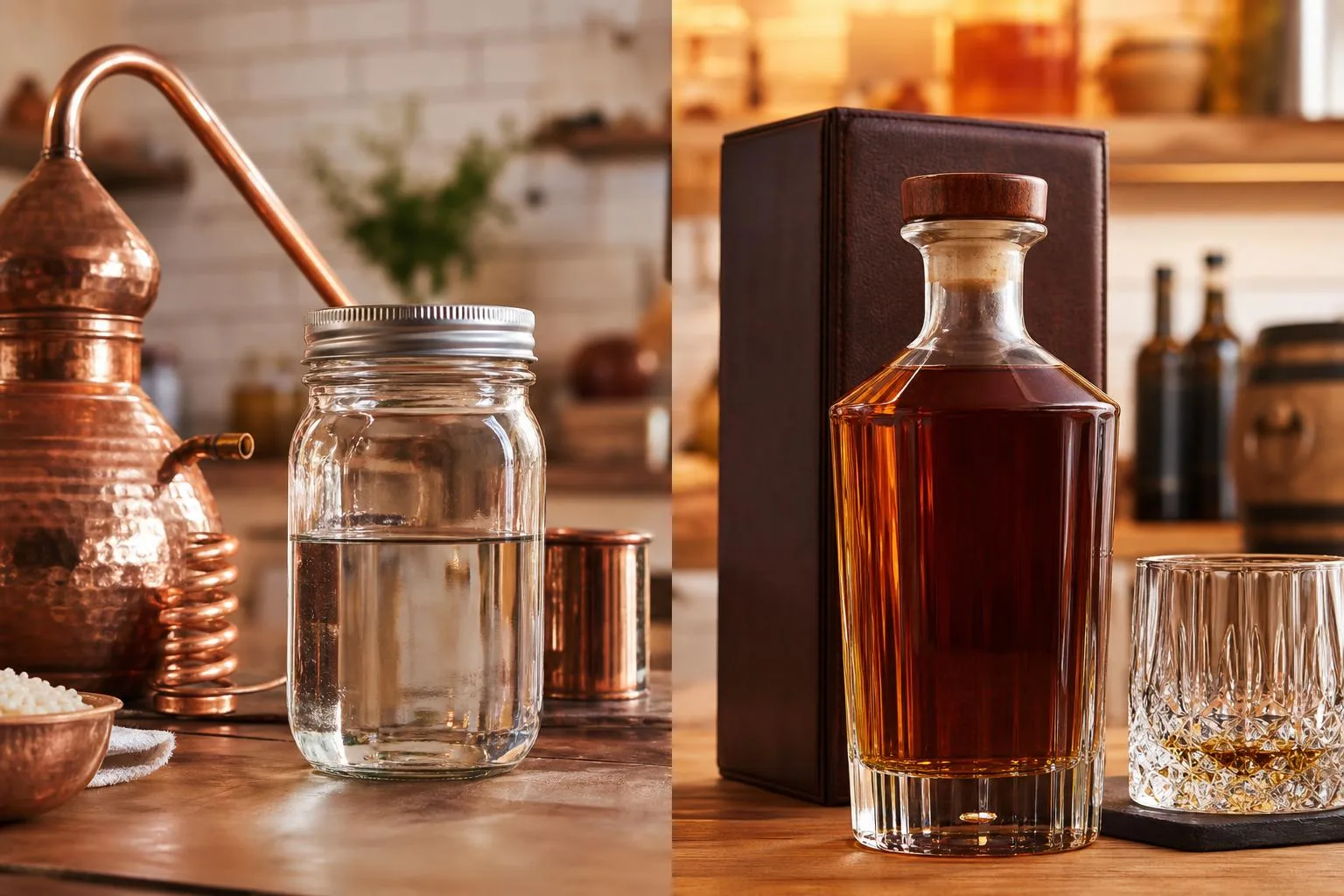
Texas Moonshine Myths and Confusion
Most Texas moonshine misunderstandings come from confusing beer or wine home production with distilled spirits. Under both Texas and federal law, the key legal line is distillation, not whether the alcohol is clear, homemade, or sold.
In practice, an unlicensed still in a garage, barn, or kitchen can create criminal exposure even if no money changes hands. The “personal use” defense that many people assume exists does not apply to distilled spirits.
| Activity | Texas/Federal Legal Reality |
| Homebrewing beer | Allowed within limits; federal law allows up to 100 gallons per year for one adult, or 200 gallons for a household with two or more adults. |
| Making wine at home | Allowed within similar federal household limits, if not sold and if other rules are followed. |
| Distilling spirits at home | Not legal without proper federal and Texas authorization, even for personal consumption. |
| Owning a still | May be lawful for non-alcohol uses, but using it to produce spirits requires permits and compliance. |
- Myth: “Moonshine is legal if I do not sell it.” Sale is not the only issue. Federal law generally requires a distilled spirits plant permit before producing beverage alcohol. Texas Alcoholic Beverage Code rules also regulate manufacture, possession, and distribution.
- Myth: “Texas lets adults make any alcohol at home.” Texas allows limited homemade beer and wine for personal or family use, but that exception does not extend to whiskey, vodka, rum, or other distilled spirits.
- Myth: “A small still is too minor to matter.” Size does not make beverage distillation legal. A 1-gallon tabletop still and a 50-gallon pot still can both create legal problems if used to make spirits without authorization.
- Myth: “Moonshine only means illegal corn liquor.” Legally, the issue is unlicensed distilled spirits. The mash could be corn, sugar, fruit, grain, or molasses; if it is distilled into beverage alcohol without permits, it is the problem.
- Myth: “If the proof is low, it is not moonshine.” Proof affects alcohol strength, not legality. A 40-proof spirit and a 120-proof spirit can both be unlawful if distilled without the required licenses.
- Myth: “A fuel alcohol permit lets me make drinking alcohol.” Federal fuel alcohol rules are separate. Fuel alcohol must be made and handled for non-beverage purposes, and denaturing or other controls may apply.
The safest rule is simple: fermenting beer or wine at home is treated differently from distilling spirits. In Texas, moonshine becomes legal only when produced through properly licensed channels, with federal and state compliance in place.
Frequently Asked Questions
Is moonshine illegal in Texas?
Moonshine is illegal in Texas when it means distilled spirits made without the required federal and state permits.
Texas allows legal distilling only through licensed operations, and federal law also requires a distilled spirits plant permit from the Alcohol and Tobacco Tax and Trade Bureau before producing spirits.
Can I distill moonshine at home in Texas for personal use?
No. Unlike home beer or wine making, home distilling liquor for personal consumption is not legal in Texas because federal law prohibits producing distilled spirits without a TTB permit.
Texas law also requires proper alcoholic beverage authorization before manufacturing spirits.
Is it legal to own a still in Texas?
Owning distilling equipment is not automatically the same as legally making alcohol.
A still may be lawful for non-alcohol uses such as distilling water or essential oils, but using it to produce beverage spirits without the required permits can violate both Texas and federal law.
Can I buy legal moonshine in Texas liquor stores?
Yes, if it is commercially produced, taxed, labeled, and sold through legal Texas alcohol channels.
Many products marketed as “moonshine” are simply unaged corn whiskey or flavored spirits made by licensed distilleries, not illegal backwoods liquor.
What penalties can apply for illegal moonshine in Texas?
Illegal distilling can lead to seizure of equipment and alcohol, state criminal charges, and federal penalties.
Federal law treats unlicensed distilled spirits production seriously because spirits are taxable and regulated for safety, labeling, and distribution.
Related Reading
- What Does Whiskey Smell Like?
- Is Jim Beam Whiskey Or Bourbon?
- What Does Moonshine Taste Like?
- How Much Is A Dram Of Whiskey?
- What Makes Irish Whiskey Different?
- Whiskey Smoker Kit – Comprehensive Guide From Expert
- How To Make Corn Whiskey?
- All Alcohol Guides
- TTB Home Distilling (2024)
- TTB Distilled Spirits FAQs (2024)
- eCFR Title 27, Part 19—Distilled Spirits Plants (2024)
- Texas Alcoholic Beverage Code Chapter 103—Illicit Beverages (2024)
- Texas Alcoholic Beverage Code Chapter 14—Distiller’s and Rectifier’s Permit (2024)
- Cornell Legal Information Institute, 26 U.S. Code § 5601—Criminal Penalties (2024)
- Cornell Legal Information Institute, 26 U.S. Code § 5171—Establishment of Distilled Spirits Plants (2024)





