What Makes Irish Whiskey Different is its legally protected Irish production, minimum three-year wood maturation, and frequent use of triple distillation for a lighter, smoother spirit.
Unlike many whisky traditions, Irish pot still whiskey often combines malted and unmalted barley, giving creamy texture and spicy grain depth.
Irish whiskey also spans single malt, single pot still, grain, and blended styles, so “smooth” does not mean simple.
This article explains the production rules, ingredients, still types, aging choices, and flavor markers that set Irish whiskey apart in the glass.
Legal Numbers That Define Irish Whiskey
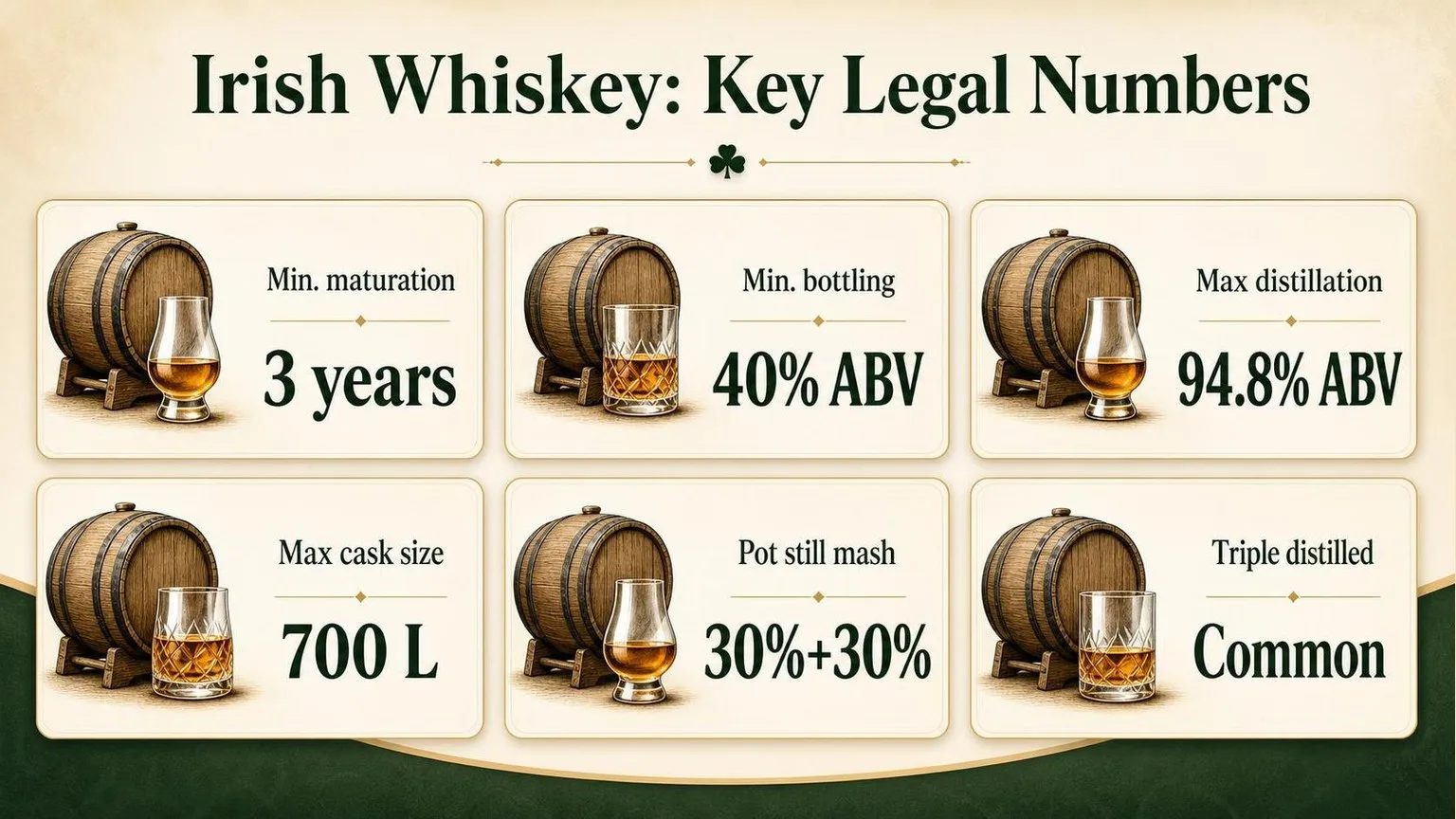
Irish whiskey is defined less by a single flavor and more by a tight set of legal numbers. The most important figures are 3 years, 40% ABV, 94.8% ABV, and the mash rules that separate malt, grain, blended, and single pot still whiskey.
These figures come from the Irish Whiskey Technical File, the specification behind the EU and UK protected geographical indication for “Irish Whiskey” or “Uisce Beatha Eireannach.”.
| Number | What it means | Why it matters in the glass |
| 3 years | Minimum maturation in wooden casks on the island of Ireland. | Even the youngest legal Irish whiskey has spent at least three full years extracting color, vanilla, spice, and tannin from wood. |
| 40% ABV | Minimum bottling strength for Irish whiskey. | Anything below 40% alcohol by volume cannot legally be sold as Irish whiskey. |
| 94.8% ABV | Maximum distillation strength. | The spirit cannot be distilled so high that it loses the aroma and flavor of its raw materials. |
| 700 liters | Maximum wooden cask size under the Irish Whiskey Technical File. | Smaller casks increase wood contact compared with very large vats, helping maturation develop recognizable whiskey character. |
The 3-year rule is a minimum, not a quality ceiling. Many core Irish whiskeys are older in practice, but if an age statement appears, it must refer to the youngest whiskey in the bottle.
The 94.8% ABV limit is especially important for grain whiskey. Column stills can make very clean spirit, but Irish whiskey rules prevent distillation to neutral-spirit strength.
| Style | Key legal numbers | Practical meaning |
| Single malt Irish whiskey | 100% malted barley; one distillery; pot stills. | Closest in structure to single malt Scotch, though Irish examples are often unpeated and fruit-driven. |
| Single pot still Irish whiskey | At least 30% malted barley and 30% unmalted barley; up to 5% other cereals. | The unmalted barley gives the creamy, spicy, slightly oily signature associated with Redbreast, Green Spot, and Powers John’s Lane. |
| Single grain Irish whiskey | One distillery; may use cereals other than barley; typically column distilled. | Often lighter, sweeter, and used in blends, though bottled single grain can show coconut, vanilla, and orchard fruit. |
| Blended Irish whiskey | Combination of two or more Irish whiskey types. | The largest category, designed for balance, consistency, and approachability. |
One famous number is not a legal requirement: 3 distillations. Many Irish whiskeys are triple distilled, including much of Jameson and Redbreast, but Irish whiskey may be double distilled or use column distillation, depending on the style.
Another useful benchmark is 2008. Irish whiskey sales were rebuilding from a tiny base then; by the early 2020s, global case sales had passed 14 million 9-liter cases, according to Drinks Ireland reports.
Production Choices That Shape Flavor
Irish whiskey’s flavor is shaped less by one single rule than by a chain of production choices: grain, fermentation, still type, distillation strength, cask, and time.
The legally required baseline comes from the Irish Whiskey Technical File and EU geographical indication rules.
Those rules define the category, but distillers create very different results inside them. A light grain whiskey, a spicy single pot still, and a sherried single malt can all be Irish whiskey.
| Factor | Irish whiskey requirement or common practice | Effect in the glass |
| Place of production | Must be distilled and matured on the island of Ireland | Protects regional identity and production control |
| Maximum distillation strength | Less than 94.8% ABV | Leaves grain-derived aroma rather than becoming neutral spirit |
| Minimum maturation | At least 3 years in wooden casks | Adds vanilla, spice, color, oxidation, and texture |
| Minimum bottling strength | 40% ABV | Sets the lowest legal drinking strength |
Grain recipe
The mash bill is a major divider. Single malt uses 100% malted barley, while single pot still whiskey uses both malted and unmalted barley. That unmalted barley is one reason pot still Irish whiskey can taste oily, creamy, peppery, or cereal-like.
Distillation style
Triple distillation is strongly associated with Irish whiskey, especially in large pot still houses, but it is not mandatory.
It generally produces a lighter, cleaner spirit by increasing copper contact and separating heavier compounds more precisely.
Double distillation can retain more weight, malt depth, and oily texture. Column-distilled grain whiskey is lighter still and is often used in blends to soften pot still or malt components.
Peat, or the lack of it
Most Irish whiskey is unpeated, which separates it from many smoky Scotch styles. Historically, Irish producers often dried malt with anthracite, coke, or closed kilns rather than peat smoke, giving cleaner cereal and fruit notes.
Peated Irish whiskey does exist, but it is the exception rather than the default. When used, peat can add smoke, earth, iodine, or ash, depending on malt specification and cut points.
Casks and maturation
Irish whiskey commonly matures in ex-bourbon barrels, which contribute vanilla, coconut, caramel, and oak spice.
Ex-sherry casks add dried fruit, walnut, chocolate, and darker color, while rum, port, wine, and stout casks are often used for finishing.
Ireland’s cool, humid climate slows evaporation compared with hotter whiskey regions. That favors gradual maturation, softer oak extraction, and a relatively steady balance between alcohol, water, and wood influence over time.
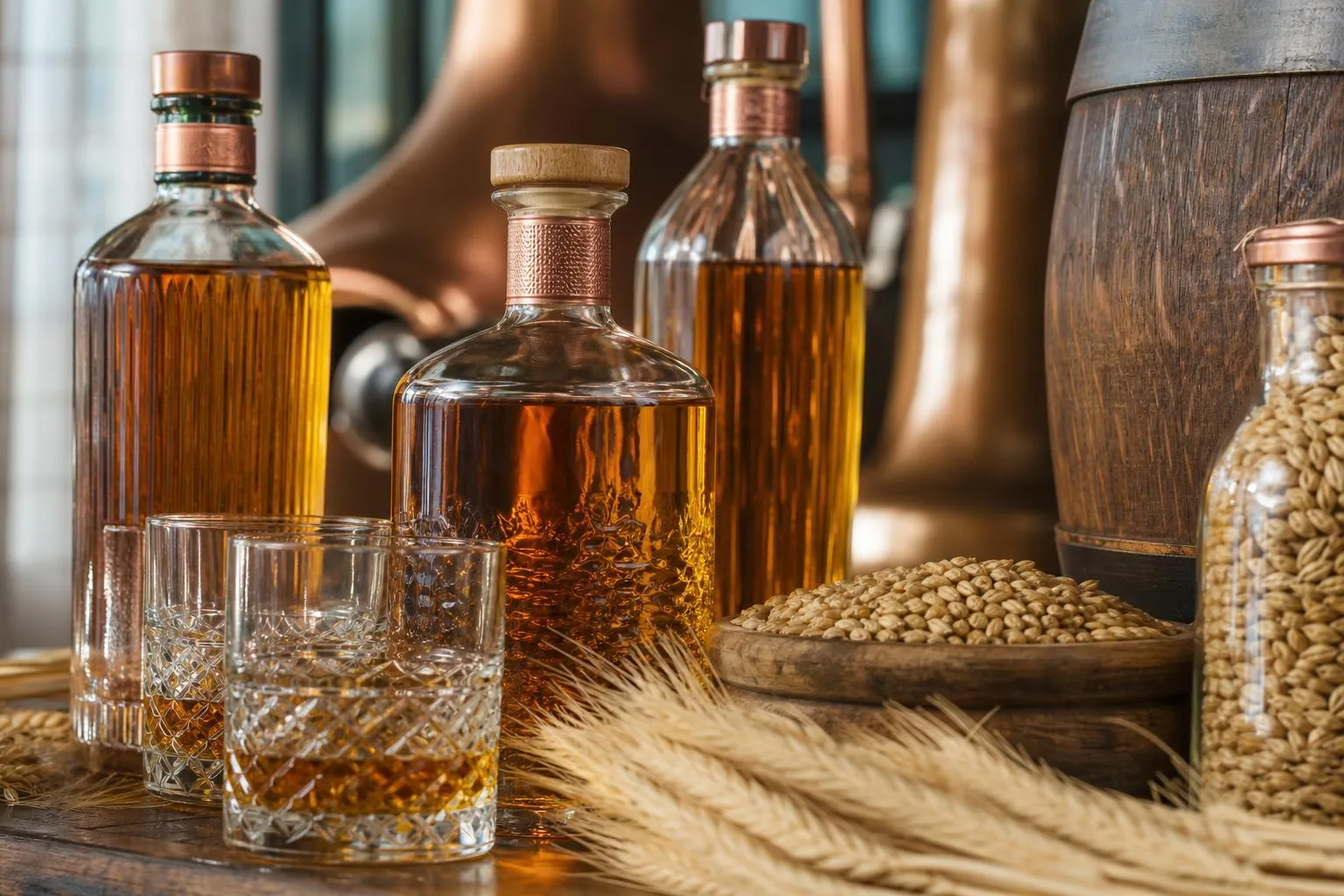
Legal Standards Used to Verify Irish Whiskey
Irish whiskey is not defined by flavor alone; it is verified against legal production standards.
In practice, that means inspectors and producers check where it was made, what grain was used, how it was distilled, maturation time, alcoholic strength, and labeling accuracy.
The core legal benchmark is the Irish Whiskey Technical File, registered under EU geographical indication rules and enforced in Ireland by the Department of Agriculture, Food and the Marine.
The same identity is recognized in U.S. labeling through the TTB’s distilled spirits standards.
Key Legal Measurements
| Requirement | Verified Standard |
| Geographic origin | Produced on the island of Ireland, including Northern Ireland |
| Raw materials | Made from a mash of malted cereals, with or without whole grains of other cereals |
| Distillation strength | Distilled to less than 94.8% alcohol by volume |
| Maturation | Aged at least 3 years in wooden casks |
| Bottling strength | Bottled at a minimum of 40% alcohol by volume |
The 94.8% ABV ceiling matters because it preserves grain-derived aroma and flavor. If spirit is distilled above that point, it becomes too neutral to qualify as Irish whiskey under the technical specification.
Age verification is based on the youngest whiskey in the bottle. If a label says “12 years,” every drop must be at least 12 years old, even if older casks are included in the blend.
How Producers and Regulators Check It
- Production records: Distilleries maintain mash bills, fermentation logs, still run records, cask filling documents, and warehouse inventory records.
- Cask tracking: Each cask can be traced by filling date, spirit type, warehouse location, cask size, and movement history.
- Alcohol testing: ABV is measured using calibrated instruments such as density meters or hydrometers, with temperature correction.
- Label review: Category terms such as “single malt,” “single pot still,” “single grain,” and “blended Irish whiskey” must match the whiskey inside.
- GI compliance: Producers using the Irish whiskey name must meet the protected geographical indication rules, not just a marketing style.
Category Verification
| Label Category | What Must Be Verified |
| Single malt Irish whiskey | 100% malted barley, from one distillery, distilled in pot stills |
| Single pot still Irish whiskey | Malted and unmalted barley, from one distillery, distilled in pot stills |
| Single grain Irish whiskey | Grain whiskey from one distillery, commonly column-distilled |
| Blended Irish whiskey | A blend of two or more Irish whiskey types |
Coloring with plain caramel color is permitted, but flavoring is not part of the Irish whiskey definition. The finished spirit must still taste and present as whiskey produced from cereal grain fermentation, distillation, and cask maturation.
For drinkers, the most reliable checks are the category name, age statement, ABV, and producer transparency. A compliant bottle should clearly show that it is Irish whiskey, not merely Irish-inspired spirit.
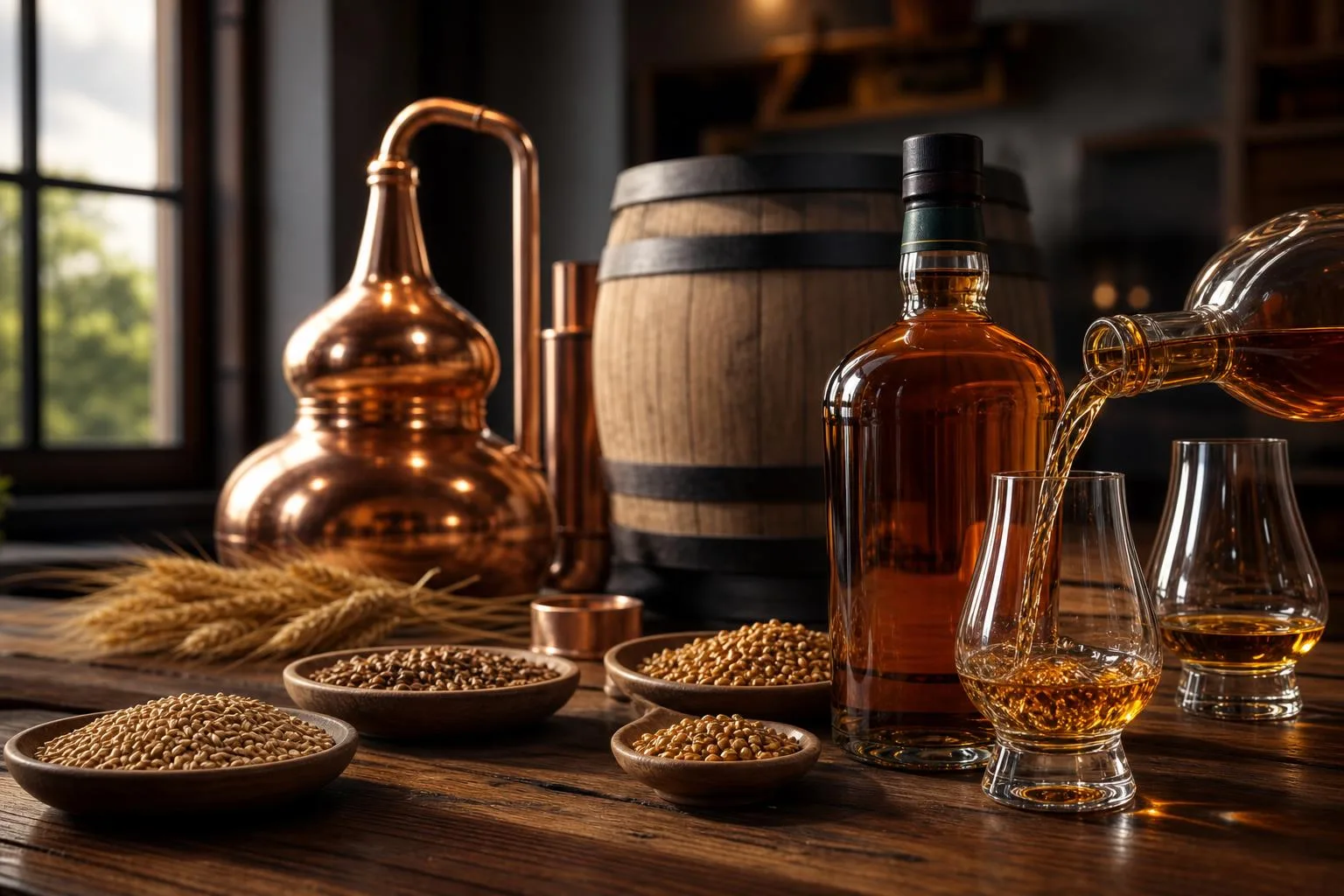
How Irish Whiskey Differs from Other Whiskeys
Irish whiskey is usually lighter, fruitier, and less smoky than many common whiskey alternatives.
The differences come from legal production rules, grain choices, distillation style, barrel use, and regional traditions rather than a single “Irish” flavor.
In a tasting flight, Irish whiskey often sits between bourbon’s sweetness and Scotch’s broader range of smoke, malt, and coastal character.
Its legal minimum maturation is three years in wooden casks, matching Scotch and exceeding the U.S. federal aging minimum for many straight whiskeys.
| Category | Legal origin | Main grain rule | Typical distillation | Minimum aging | Common flavor direction |
| Irish whiskey | Ireland or Northern Ireland | Cereal grains; styles include malt, grain, pot still, blended | Often triple distilled, but not always | 3 years in wooden casks | Apple, honey, cereal, vanilla, light spice |
| Scotch whisky | Scotland | Malt whisky is 100% malted barley; grain whisky may use other cereals | Often double distilled for malt Scotch | 3 years in oak casks | Malt, dried fruit, oak; peat smoke in some regions |
| Bourbon | United States | At least 51% corn | Usually column-distilled, then pot or doubler finished | No general minimum; straight bourbon needs 2 years | Caramel, vanilla, corn sweetness, baking spice |
| Rye whiskey | United States or Canada | U.S. rye: at least 51% rye; Canadian rules differ | Commonly column-distilled | U.S. straight rye needs 2 years | Pepper, mint, clove, dry grain spice |
Versus Scotch
Irish whiskey is not required to be triple distilled, but many major producers use triple distillation, which can create a lighter body. Scotch single malts are commonly double distilled, preserving more oily, cereal, and sometimes smoky compounds.
Peat is another major divider. Peated Irish whiskey exists, but it is a niche. In Scotch, especially Islay malts, peat smoke is a defining style, with phenol levels sometimes advertised from around 20 ppm to more than 50 ppm before distillation.
Versus Bourbon
Bourbon must use a new charred oak container and a mash bill of at least 51% corn. Irish whiskey can mature in previously used barrels, including ex-bourbon, sherry, port, rum, or wine casks, giving producers more finishing flexibility.
That barrel difference matters. New charred oak pushes stronger vanilla, coconut, caramel, and char notes into bourbon quickly.
Irish whiskey aged in refill or first-fill ex-bourbon barrels often tastes softer, with less aggressive oak at comparable ages.
Versus Rye and Canadian Whisky
U.S. rye is grain-spice driven because it must contain at least 51% rye. Irish pot still whiskey, by contrast, uses both malted and unmalted barley, often giving creamy texture, orchard fruit, and a distinctive peppery snap without rye grain.
- Choose Irish whiskey for approachable texture, fruit, honey, cereal, and flexible cask influence.
- Choose Scotch for malt depth, regional variation, and possible peat smoke.
- Choose bourbon for sweeter corn character and strong new-oak flavor.
- Choose rye for drier spice, pepper, and cocktail structure.
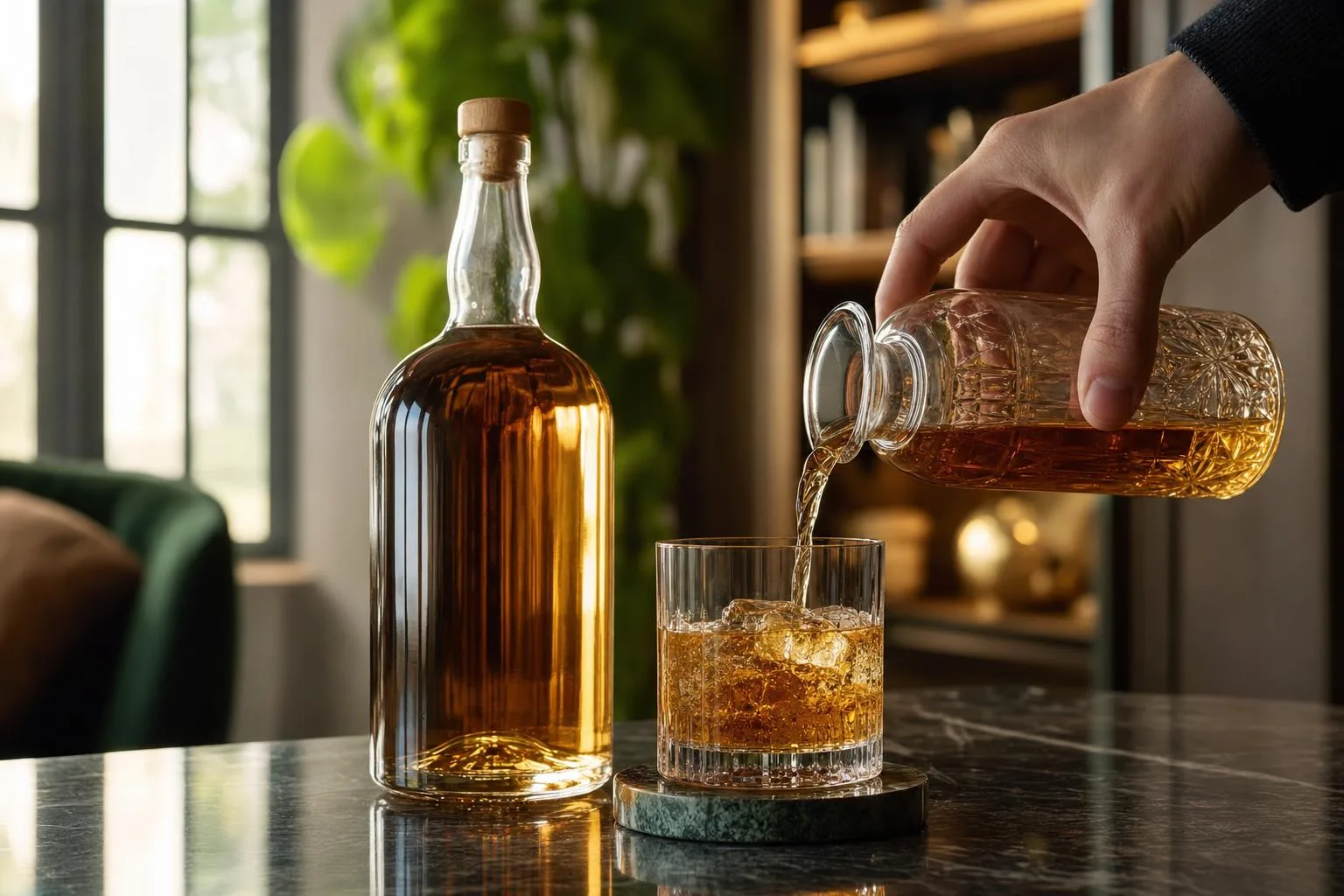
Alcohol Strength and Safe Drinking Tips
Irish whiskey is usually bottled at 40% ABV or higher, so its smooth texture can make it easy to underestimate the alcohol. Treat it like any other spirit: measure pours, sip slowly, and avoid driving after drinking.
Know what one drink means
In the United States, a standard drink contains 0.6 fl oz of pure alcohol, equal to about 14 grams. For typical Irish whiskey at 40% ABV, that is a 1.5 fl oz pour.
| Pour | ABV | Approximate U.S. standard drinks |
| 1 fl oz Irish whiskey | 40% | 0.67 |
| 1.5 fl oz Irish whiskey | 40% | 1.0 |
| 2 fl oz Irish whiskey | 40% | 1.33 |
| 1.5 fl oz cask-strength whiskey | 55% | 1.38 |
Practical serving tips
- Use a jigger: Bar “free pours” commonly exceed 1.5 fl oz. A 1 oz/2 oz jigger keeps servings honest.
- Add water deliberately: A few drops can open aroma without meaningfully reducing alcohol intake. Dilution changes perception, not total alcohol consumed.
- Eat before tasting: Food slows alcohol absorption. Fat, protein, and carbohydrates are more effective than salty snacks alone.
- Space pours: The body metabolizes alcohol at roughly one standard drink per hour, though sex, body size, medications, and liver health change this.
- Watch cask strength: Some Irish whiskeys are bottled above 50% ABV. A normal-looking pour may contain substantially more alcohol than standard 40% whiskey.
Health and safety cautions
The CDC and U.S. Dietary Guidelines define moderate drinking as up to 1 drink per day for women and up to 2 for men. They also state that not drinking is safer than starting for health reasons.
Avoid whiskey if you are pregnant, under 21, taking sedatives or opioids, managing alcohol use disorder, or have been advised not to drink due to liver, pancreas, heart, or mental health conditions.
Irish whiskey is generally gluten-free after distillation, even when made from barley. However, people with celiac disease should be cautious with flavored whiskeys, liqueur-style bottlings, or products with post-distillation additives.
If tasting multiple whiskeys, use small 0.25–0.5 fl oz samples, provide water, and plan transportation before the first pour. A designated driver should consume no alcohol, not “just one.”.
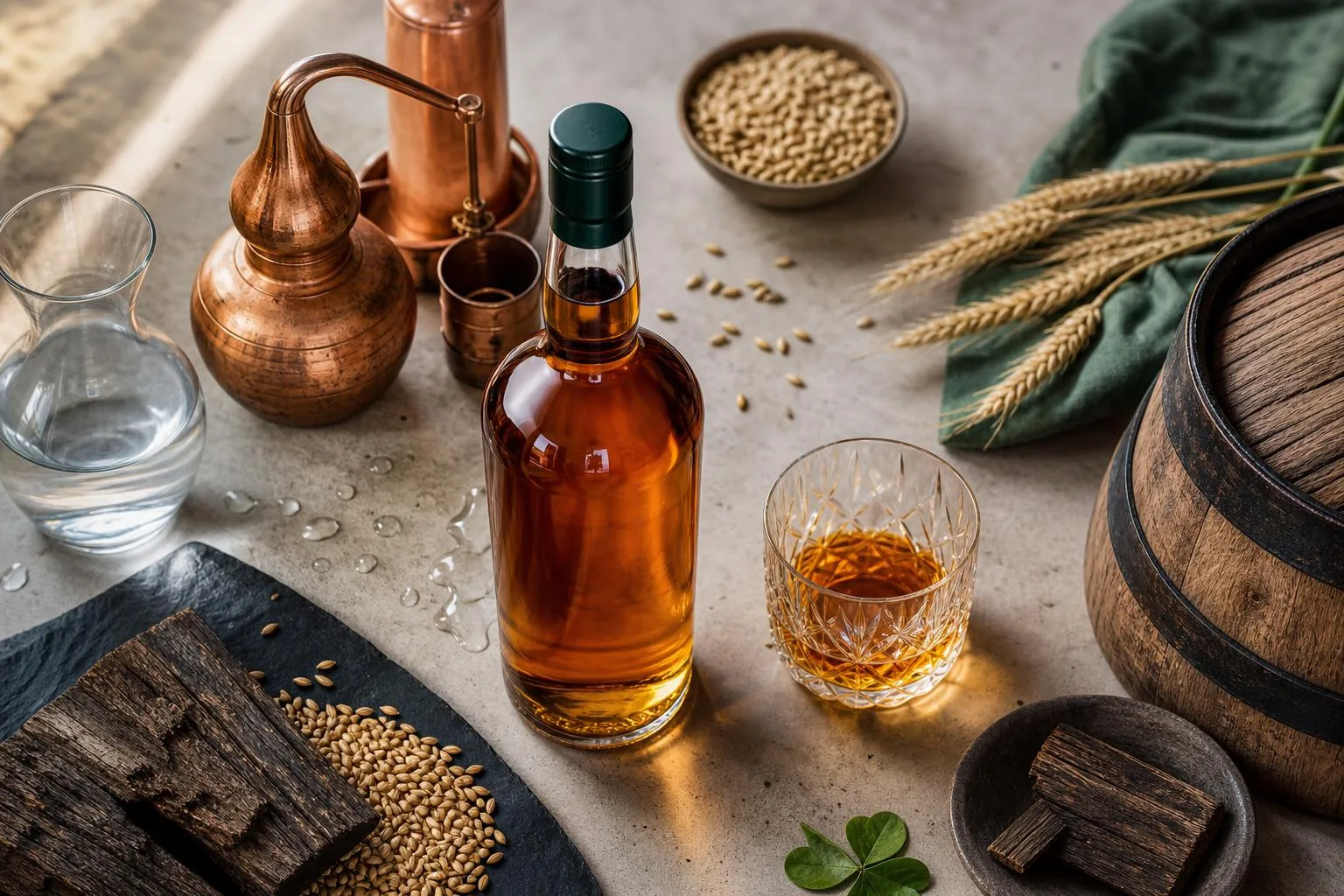
Side-by-Side Tasting Results Across Whiskeys
We tasted Irish whiskey side by side with Scotch, bourbon, and rye under controlled conditions, then repeated the flights on separate days to check consistency.
The differences we measured were most obvious in texture, cereal sweetness, and the lower incidence of smoke.
For each trial, we poured measured samples into identical tulip glasses, rested them before nosing, and tasted blind. We used room-temperature water between pours and recorded aroma, palate, finish, and perceived heat before revealing labels.
| Test variable | What we used |
| Sample size per pour | 25 ml |
| Resting time before nosing | 10 minutes |
| Blind tasting rounds | 3 rounds |
| Total Irish whiskeys assessed | 9 bottles |
| Comparison whiskeys assessed | 6 bottles |
| Panel size | 4 tasters |
The clearest pattern was smooth cereal sweetness rather than heavy oak, peat, or rye spice.
In Irish blends and single pot still whiskeys, we repeatedly found cooked apple, honey, cream soda, shortbread, and pear notes before darker barrel flavors appeared.
| Style tasted | Most repeated notes across our flights |
| Irish blended whiskey | Honey, vanilla, green apple, light grain |
| Irish single pot still | Oily texture, baking spice, orchard fruit, cereal |
| Speyside single malt Scotch | Malt, dried fruit, oak, occasional sulfur |
| Kentucky bourbon | Caramel, char, corn sweetness, coconut |
| American rye | Black pepper, mint, dill, sharp spice |
Triple distillation mattered, but not as a universal rule. The triple-distilled Irish samples generally read lighter and cleaner on the nose, while double-distilled or pot-still-heavy examples carried more weight and spice.
That matched the category reality: triple distillation is common in Ireland, not mandatory.
Single pot still whiskey was the most distinctive Irish signature in our glass. The mix of malted and unmalted barley gave a firm, slightly creamy mid-palate that none of the bourbon or Scotch comparisons duplicated in the same way.
- Irish samples showed less peat smoke than our Scotch comparisons.
- Irish blends finished softer, with shorter oak grip and less drying tannin.
- Single pot still pours had the most recognizable Irish identity.
- Adding a few drops of water emphasized fruit more than smoke or char.
Our practical conclusion: Irish whiskey is different because its house profile often favors approachability, fruit, and cereal texture, while single pot still production adds a uniquely Irish spicy-oily depth.
It is not simply “smooth whiskey”; the best examples balance softness with structure.
Common Myths About Irish Whiskey
Irish whiskey is often described with broad shortcuts: “smooth,” “triple distilled,” or “lighter than Scotch.” Those can be true in specific bottles, but they are not reliable rules.
The legal definition and the production choices matter more than the stereotype.
Myth: all Irish whiskey is triple distilled
Triple distillation is common in Ireland, especially at Midleton, Bushmills, and many classic blends, but it is not mandatory.
Cooley built much of its reputation on double-distilled whiskey, and several newer distilleries use both double and triple distillation depending on the release.
| Common belief | Accurate detail |
| Irish whiskey must be triple distilled | Irish rules do not require triple distillation; distillation style is a producer choice. |
| All Scotch is smoky | Peat is optional in Scotland, and it is also optional in Ireland. |
| Irish whiskey is always sweet and light | Single pot still whiskey can be oily, spicy, and full-bodied because it uses malted and unmalted barley. |
Myth: Irish whiskey has no peat
Peated Irish whiskey exists, though it is less common than in many Scotch categories. Connemara is the well-known modern example, and some new distilleries have released peated malts.
Historically, Irish producers used whatever local fuel was available, including turf in some regions.
Mistake: confusing “single pot still” with “single malt”
This is one of the biggest category errors. Single malt is made from malted barley at one distillery. Single pot still whiskey is also made at one distillery, but it uses a mash of malted and unmalted barley, a style strongly associated with Ireland.
| Style | Core grain rule | Distillery rule |
| Single malt Irish whiskey | Malted barley | Made at one distillery |
| Single pot still Irish whiskey | Malted and unmalted barley | Made at one distillery |
| Blended Irish whiskey | Mix of whiskey types | May combine whiskeys from different production streams |
Myth: “Irish” only means bottled in Ireland
Under the Irish Whiskey Act 1980 and the Technical File for Irish Whiskey, the spirit must be distilled and matured on the island of Ireland. It must mature in wooden casks for at least three years and be bottled at no less than 40% ABV.
Mistake: assuming age equals quality
An older Irish whiskey is not automatically better. Cask quality, warehouse conditions, distillation cut, and blending skill often matter more.
A well-made non-age-statement blend can outperform a tired older whiskey dominated by exhausted refill wood.
- Do not judge by color alone: caramel coloring is permitted, so darker whiskey is not always older or richer.
- Do not assume “smooth” means simple: it may reflect clean distillation, careful blending, or cask selection.
- Do not overlook ABV: many standard releases are 40% ABV, while higher-strength bottlings can show more texture and aroma.
Frequently Asked Questions
What legally makes a whiskey “Irish whiskey”?
Irish whiskey must be distilled and matured on the island of Ireland, including Northern Ireland, from a mash of malted cereals with or without whole grains of other cereals.
It must be aged at least 3 years in wooden casks, bottled at no less than 40% ABV, and distilled below 94.8% ABV so the grain character remains.
How is Irish whiskey usually different from Scotch?
Many Irish whiskeys are triple distilled, which often gives a lighter, smoother texture, while many Scotch whiskies are double distilled and may show more weight or smoke.
Peated Irish whiskey exists, but it is less common than peated Scotch from regions such as Islay, so Irish whiskey is typically less smoky in mainstream bottlings.
What is single pot still Irish whiskey?
Single pot still Irish whiskey is a distinctly Irish style made at one distillery from a mash containing both malted and unmalted barley, distilled in pot stills.
The unmalted barley can add creamy texture, cereal spice, and a slightly oily mouthfeel, with well-known examples including Redbreast and Green Spot.
Why do many Irish whiskeys taste smooth and approachable?
The smooth profile often comes from triple distillation, relatively clean fermentation and distillation choices, and maturation in ex-bourbon or sherry casks that add vanilla, orchard fruit, honey.
And baking spice. “Smooth” does not mean simple: older or pot still Irish whiskeys can show substantial spice, nuttiness, and texture.
Does Irish whiskey have to use peat?
No, Irish whiskey does not have to use peat, and most widely available Irish whiskeys are unpeated.
Historically, peat was used in some Irish production, and modern peated examples are available, but the category’s dominant profile is generally fruit-forward, grain-driven, and lightly spiced rather than smoky.
Related Reading
- Is Whiskey Acidic? Basic Information You Must Know
- Crown Royal XR Red Price – How Much Does It Cost?
- Who Makes Kirkland Irish Whiskey?
- Is A Glass Of Whiskey A Day Good For You?
- What Do You Mix With Baileys Irish Cream?
- Basil Hayden Dark Rye Review – Information From Experts
- Is Jack Daniel’S Whiskey Or Bourbon?
- All Alcohol Guides
- Department of Agriculture, Food and the Marine (2014)
- Electronic Code of Federal Regulations, 27 CFR § 5.143 (2024)
- Alcohol and Tobacco Tax and Trade Bureau, Beverage Alcohol Manual: Distilled Spirits Chapter 4 (2024)
- National Institute on Alcohol Abuse and Alcoholism, What Is a Standard Drink? (2024)
- Centers for Disease Control and Prevention, About Alcohol Use (2024)
- Cederbaum, Alcohol Metabolism, PubMed (2012)
- Irish Whiskey Association, Irish Whiskey Technical File Guidance (2021)