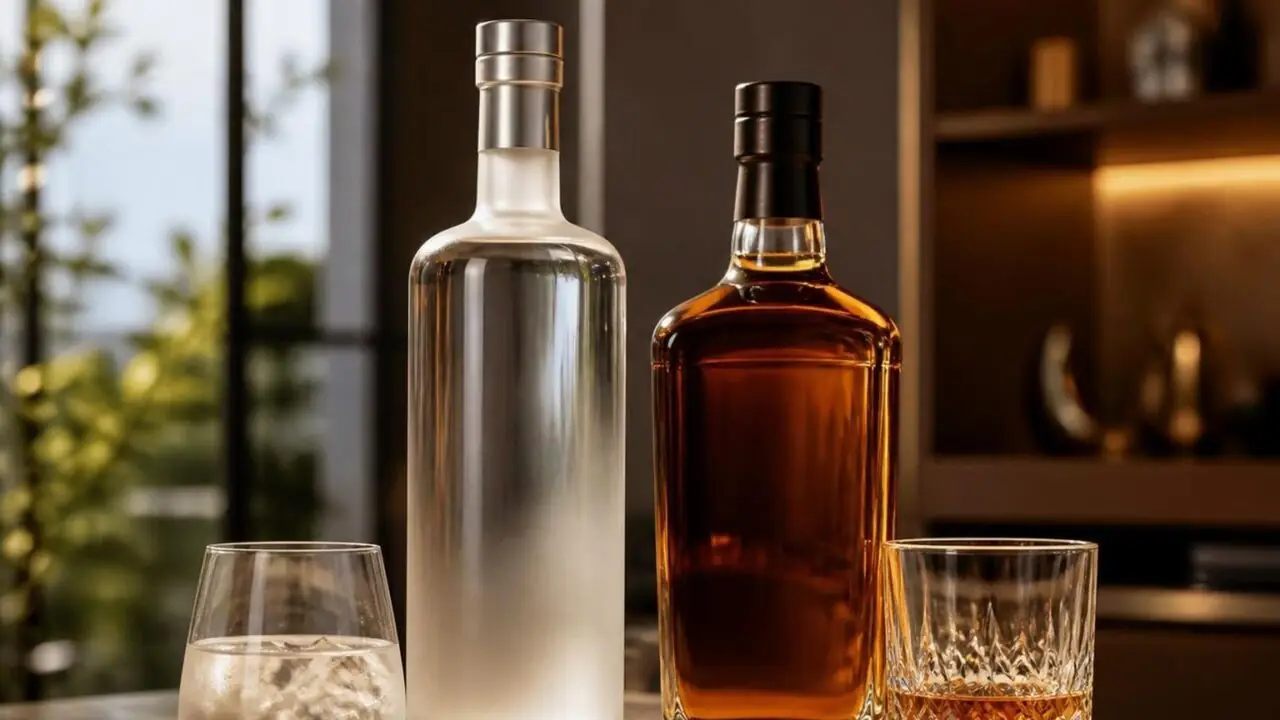
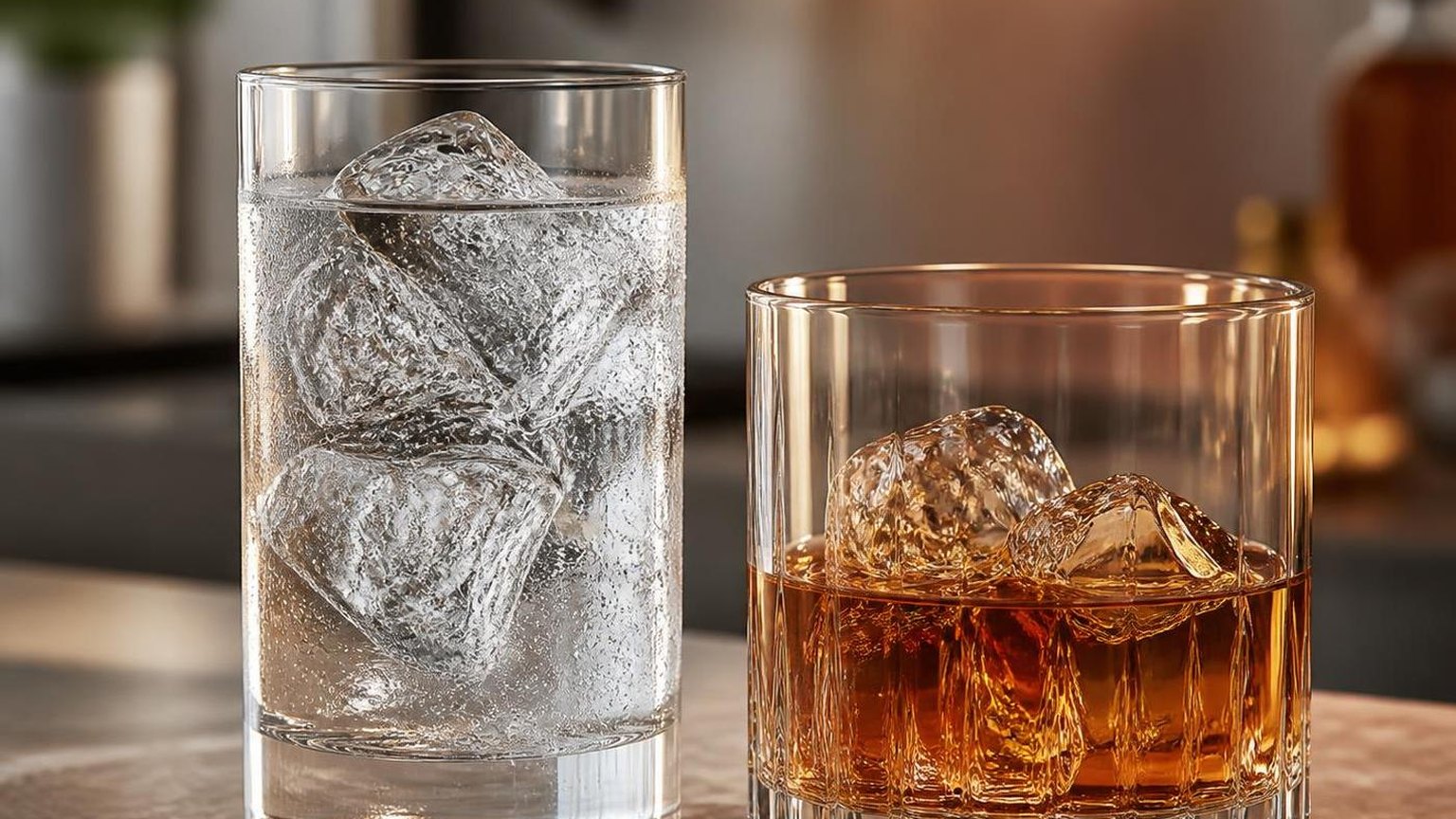
The difference between vodka and whiskey is that vodka is a neutral, usually unaged spirit distilled for purity, while whiskey is a grain spirit aged in wood for color, aroma, and flavor.
Vodka commonly tastes clean and light; whiskey shows oak, spice, caramel, smoke, or malt.
This guide compares base ingredients, distillation, aging, flavor, alcohol levels, labeling rules, calories, serving styles, cocktail use, and food pairing.
Use it to choose the right bottle for sipping, mixing, collecting, or pairing with dinner without relying on brand myths or vague tasting claims.
Vodka and whiskey at a glance
Vodka and whiskey are both distilled spirits, but they are built to taste very different. Vodka is usually made to be neutral and clean. Whiskey is made to keep grain character, barrel influence, and age-driven flavor.
The quickest distinction is production intent. Vodka is distilled to high proof to strip out most congeners, the flavor compounds created during fermentation and distillation.
Whiskey is distilled lower, then matured in wood, so more aroma, color, and texture remain in the glass.
| Feature | Vodka | Whiskey |
| Typical base ingredients | Any fermentable material; common examples are wheat, rye, corn, potatoes, and grapes | Grain-based spirit; common grains are corn, rye, wheat, and malted barley |
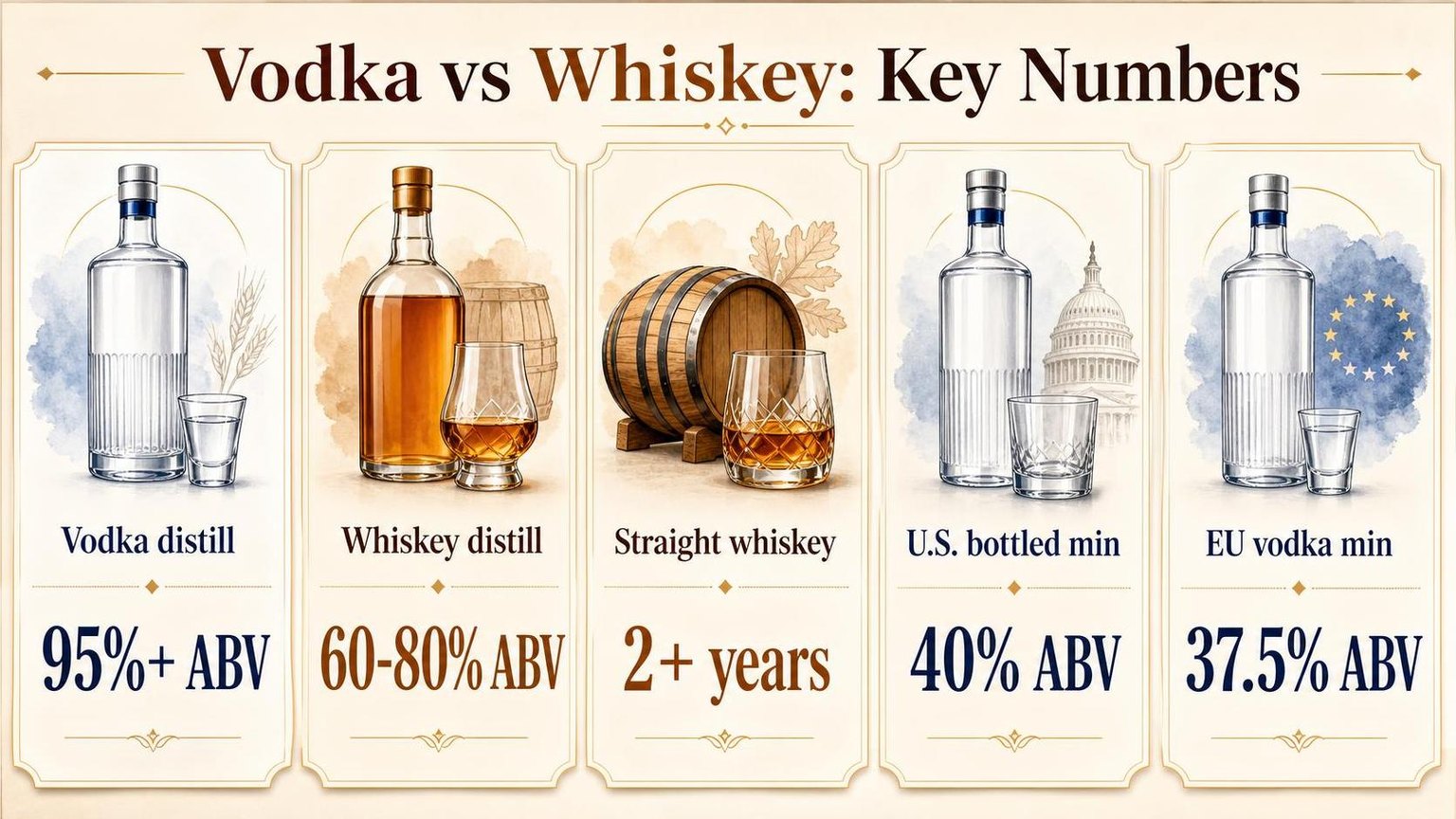
| Distillation proof | In the U.S., distilled at or above 95% ABV (190 proof) | Usually distilled well below 95% ABV to preserve flavor; many styles come off the still around 60% to 80% ABV |
| Aging requirement | No aging required | Most major styles require aging; straight whiskey in the U.S. must age at least 2 years |
| Color | Typically clear | Amber to deep brown, mainly from barrel aging |
| Bottling minimum | At least 40% ABV in the U.S. | At least 40% ABV for whiskey in the U.S. |
Under U.S. regulations, vodka is neutral spirits without distinctive character, aroma, taste, or color. Whiskey is distilled from fermented grain mash and stored in oak containers, except corn whiskey, which does not have to be aged in wood.
That legal framework explains the sensory gap. A standard vodka may show pepper, citrus, or creaminess, but those notes are subtle.
A whiskey can show vanilla, toffee, smoke, dried fruit, coconut, baking spice, or leather because grain choice and barrel time matter.
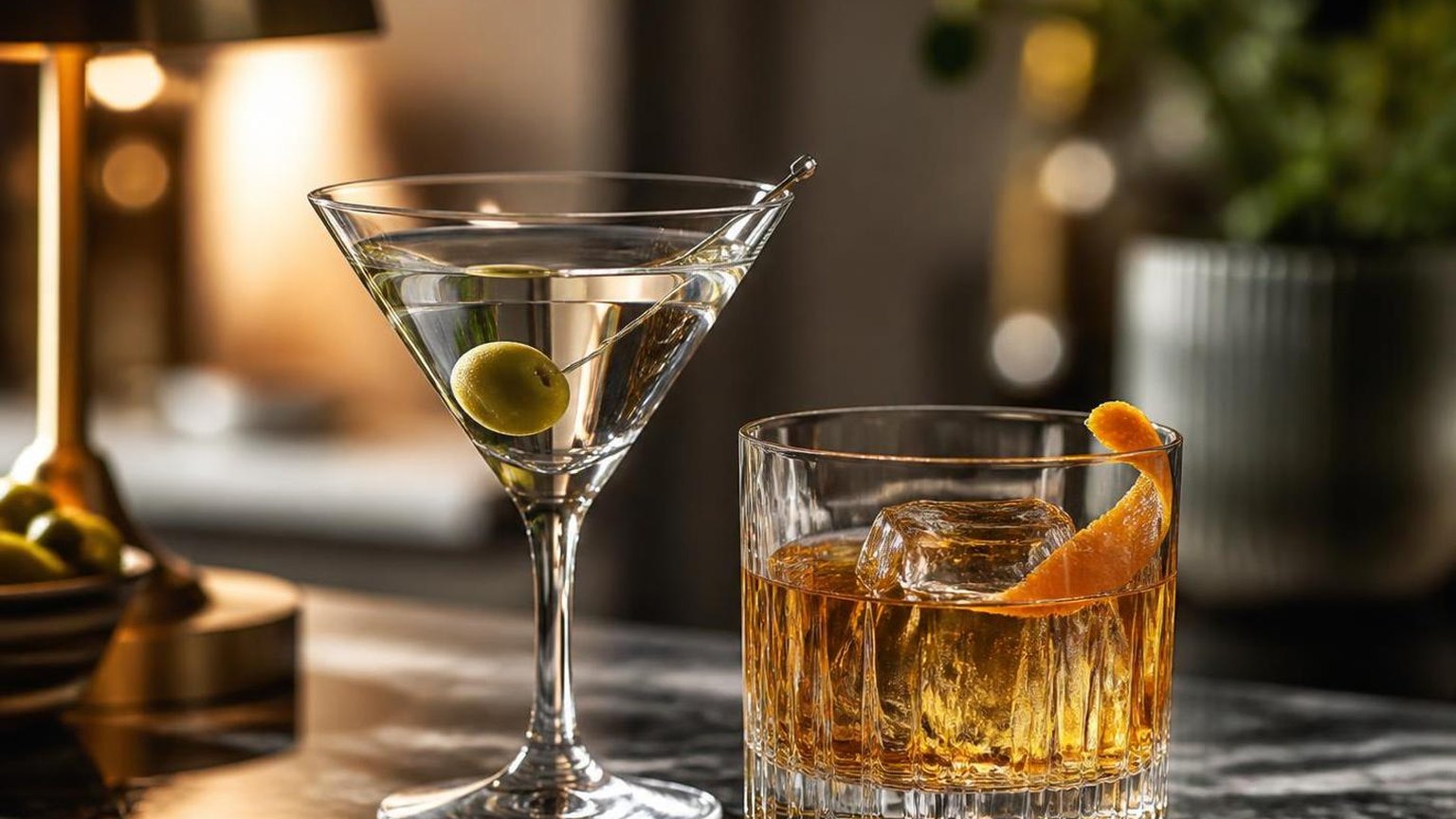
- Vodka is usually the better fit for cocktails where mixers lead, such as a Vodka Soda or Espresso Martini.
- Whiskey suits spirit-forward drinks, including an Old Fashioned or Manhattan, because it contributes strong flavor on its own.
- Texture differs too. Vodka often feels lighter and cleaner. Whiskey often feels richer from congeners, oak extraction, and oxidation during aging.
In practical terms, vodka is the blank canvas. Whiskey is the finished painting. If you want neutrality, choose vodka. If you want complexity, grain identity, and barrel character, choose whiskey.
Ingredients and grains used
Vodka and whiskey can start with some of the same farm crops, but the ingredient rules and production goals differ sharply. Vodka is built for neutrality after repeated distillation and filtration.
Whiskey is built to keep grain character, fermentation flavor, and barrel-derived complexity.
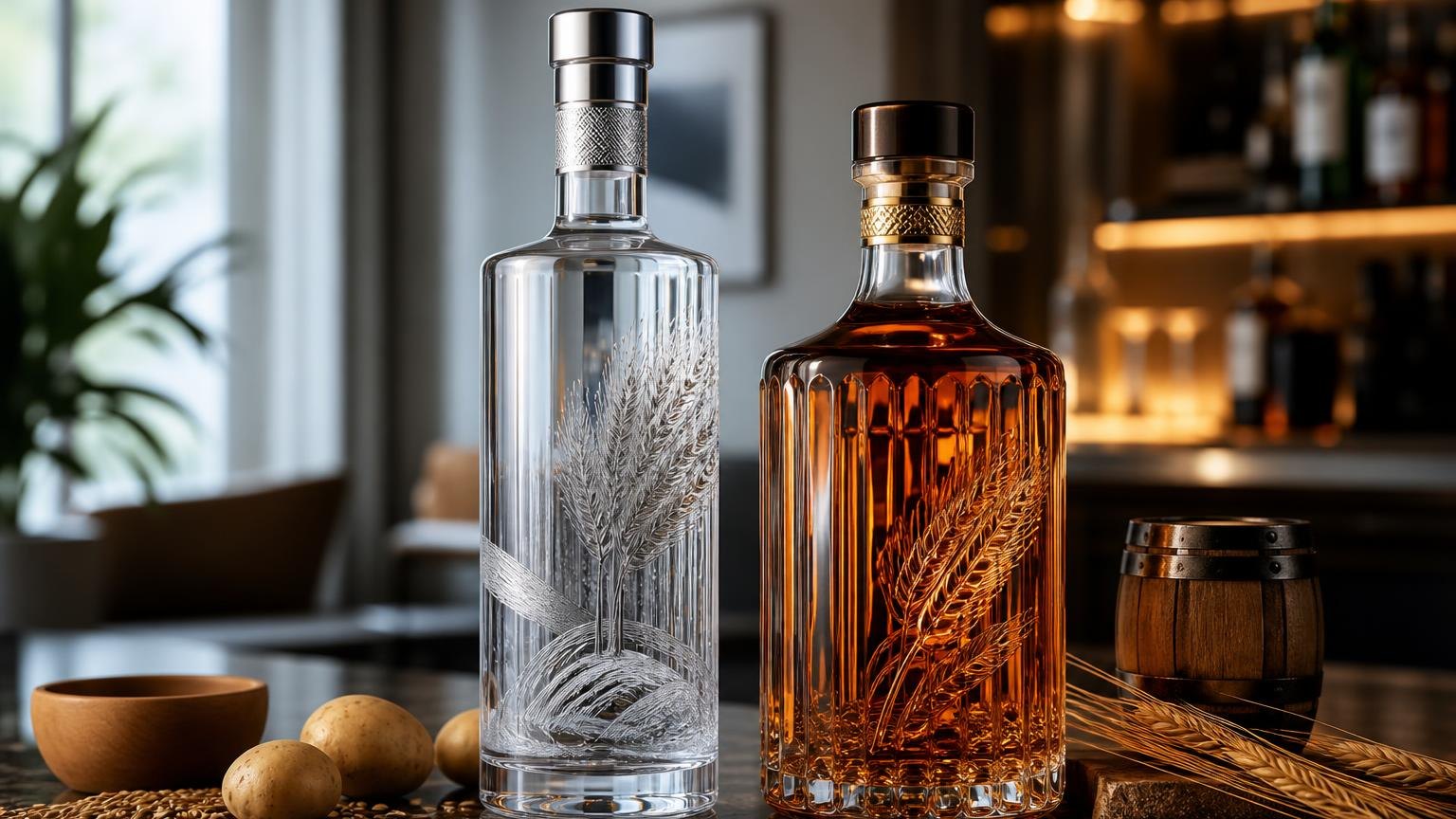
Vodka can be made from almost any fermentable agricultural raw material. In the U.S. and EU, common bases include wheat, rye, corn, potatoes, and sometimes grapes or sugar beet molasses.
The source matters less to the final spirit because vodka is distilled to a very high proof, stripping out most congeners.
Whiskey is more tightly tied to grain choice. It is made from a mash of cereal grains, then distilled below vodka strength so more flavor compounds remain.
Those grains shape texture, sweetness, spice, oiliness, and the flavors that later interact with oak during aging.
| Spirit | Main raw materials | Key legal or technical numbers |
| Vodka | Wheat, rye, corn, potatoes, grapes, molasses | EU vodka must be at least 37.5% ABV; U.S. bottled vodka must be at least 40% ABV |
| Whiskey | Barley, corn, rye, wheat, malted barley | U.S. whiskey is distilled below 95% ABV; Scotch whisky is distilled below 94.8% ABV |
| Bourbon | Corn with other grains in the mash bill | At least 51% corn |
| Rye whiskey | Rye with supporting grains | In the U.S., at least 51% rye |
| Single malt Scotch | 100% malted barley | Made at one distillery from water and malted barley |
For vodka, wheat often produces a softer texture, rye can feel peppery, corn tends to read slightly sweet, and potato vodka can seem creamier.
Those differences exist, but they are usually subtle in the glass because legal definitions emphasize clean aroma and taste.
For whiskey, grain differences stay obvious. Corn brings sweetness and body. Rye adds black pepper, clove, and sharper herbal notes. Wheat softens the palate.
Malted barley contributes biscuit, nut, and cereal flavors, while also supplying enzymes that convert starch into fermentable sugar during mashing.
Malted grain use is a major separator. Whiskey often relies on malted barley for enzyme activity, especially in Scotch and many American mash bills.
Vodka may use malted grain in the mash, but it is not central to the spirit’s identity because the final goal is purity, not grain expression.
- Vodka prioritizes a neutral base, so raw material choice is usually less visible after distillation.
- Whiskey preserves more of the original grain character, so mash bill choice is a primary flavor driver.
- If a label names bourbon, rye, or single malt, the grain recipe is not marketing language; it defines the product.
Distillation and proof differences
Vodka and whiskey separate most clearly at the still. Vodka is usually distilled to a much higher alcohol concentration, while whiskey is distilled lower to keep grain, fruit, or malt character in the spirit.
Those production choices affect flavor, legal limits, barrel entry strength, and the proof printed on the bottle. The result is a cleaner, more neutral vodka and a more aromatic, oak-shaped whiskey.
In the U.S., vodka is defined by the TTB as a neutral spirit distilled or treated after distillation “without distinctive character, aroma, taste, or color.” Producers commonly distill vodka in column stills to about 190 proof.
Or 95% alcohol by volume, which is near the federal maximum for neutral spirits.
Whiskey is handled differently because distillers want congeners to survive distillation.
Pot stills and column stills are both used, but the distillation proof is lower than vodka, preserving esters, higher alcohols, aldehydes, and grain-derived compounds that create aroma and texture.
| Measure | Vodka | Whiskey |
| Typical distillation strength | Often up to 190 proof (95% ABV) | Usually below 160 proof (80% ABV) in the U.S. |
| U.S. legal distillation limit | Neutral spirits can reach 190 proof | Must be distilled at less than 160 proof |
| U.S. bottling minimum | 80 proof (40% ABV) | 80 proof (40% ABV) |
| Barrel entry limit | Not typically a defining factor | No more than 125 proof (62.5% ABV) for bourbon, rye, wheat, malt, and rye malt whiskey |
That “less than 160 proof” rule matters. Bourbon, rye, wheat, malt, and rye malt whiskey cannot be distilled to 160 proof or higher in the U.S., and they must enter new charred oak containers at no more than 125 proof.
Vodka often undergoes additional filtration, including charcoal filtration, after distillation.
Whiskey generally does not aim for neutrality, so filtration is lighter or omitted, especially when producers want to retain mouthfeel and cask-derived compounds.
On the shelf, both spirits are commonly sold at 80 proof in the U.S., but whiskey often appears in wider proof ranges.
Bottled-in-bond whiskey is fixed at 100 proof, and cask-strength releases frequently exceed 110 proof, sometimes reaching 120 to 140 proof.
- Higher vodka distillation proof removes flavor compounds.
- Lower whiskey distillation proof preserves grain and fermentation character.
- Whiskey’s barrel entry proof shapes extraction of vanillin, tannins, and caramelized wood sugars during aging.
Aging rules and barrel influence
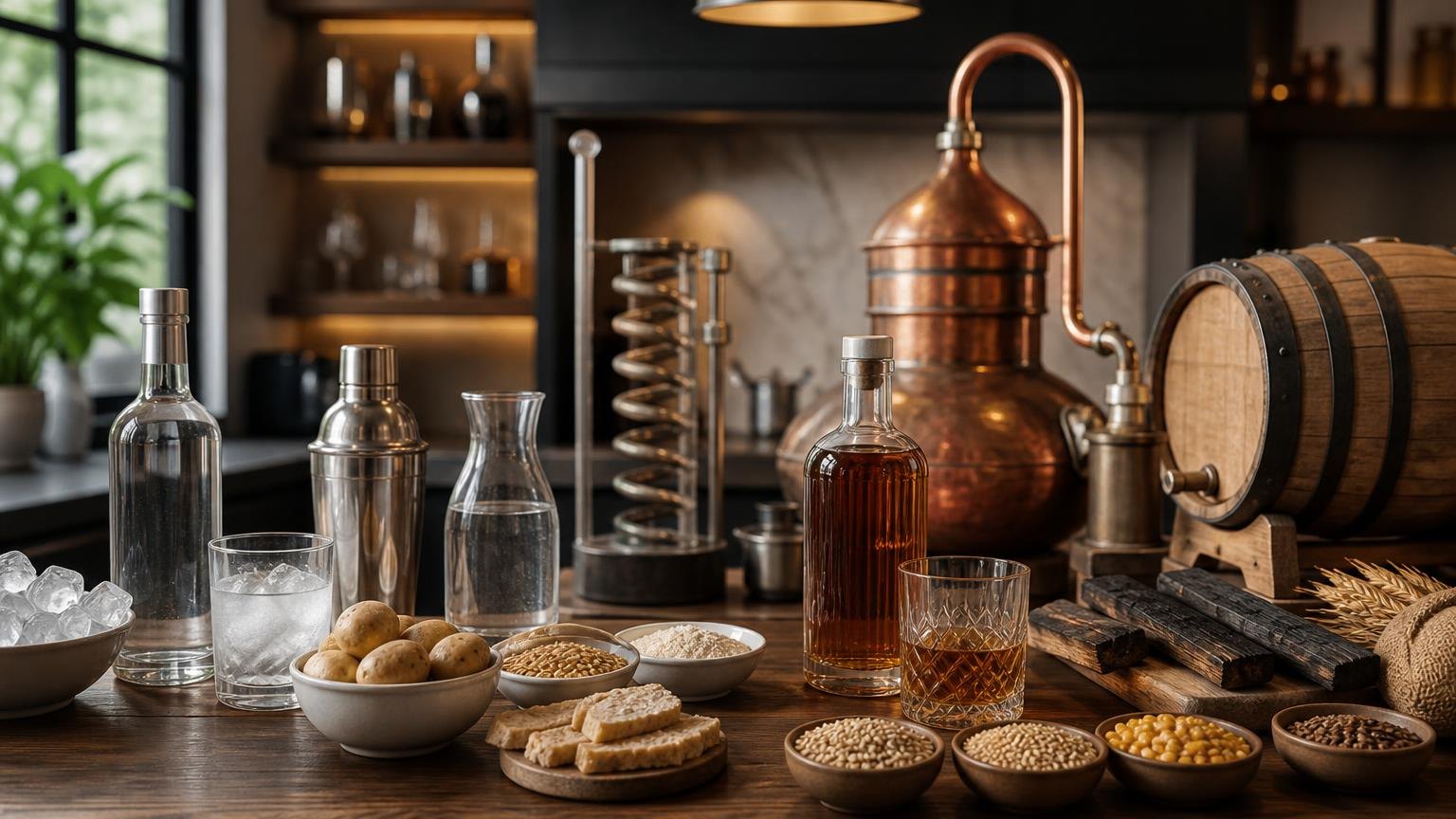
Vodka and whiskey split sharply on maturation. Vodka is usually bottled unaged, while whiskey often spends years in oak, where wood and oxygen change its color, texture, and flavor.
The legal rules reinforce that difference. In the United States, vodka has no aging requirement, but many whiskey categories require oak storage and, in some cases, a minimum time in barrel.
Under U.S. regulations, vodka is a neutral spirit distilled or treated so it lacks distinctive character, aroma, color, or taste. It can be rested in tank or filtered, but time in wood is not central to the category.
Whiskey is different because barrel aging is built into major styles. Bourbon must be stored in new charred oak containers. Straight whiskey must age at least 2 years. Bottled-in-bond must age at least 4 years.
Scotch whisky also depends on cask time. By law, it must mature in oak casks for at least 3 years in Scotland. Irish whiskey must be aged at least 3 years in wooden casks, usually not exceeding 700 liters.
| Spirit | Minimum aging rule | Container rule | Typical color impact |
| Vodka (U.S.) | 0 years | No barrel required | Usually clear |
| Straight whiskey (U.S.) | 2 years | Oak required by category | Gold to amber |
| Bottled-in-bond whiskey (U.S.) | 4 years | Oak aging required | Amber |
| Scotch whisky | 3 years | Oak casks | Gold to deep amber |
| Irish whiskey | 3 years | Wooden casks, up to 700 L | Gold to amber |
Barrel influence comes from extraction, oxidation, and evaporation. Oak contributes vanillin, oak lactones, tannins, and caramelized sugars.
Charred barrels also filter spirit through a carbon layer, softening harsh notes and adding smoke, toffee, and spice.
New charred oak gives bourbon stronger wood impact because the barrel has not been used before. Scotch often uses ex-bourbon or ex-sherry casks, so the wood effect is usually less aggressive and layered with prior cask flavors.
Climate matters. In Kentucky, hotter summers can speed extraction and evaporation, often pushing bourbon toward mature flavors in 4 to 8 years.
In cooler Scottish warehouses, maturation is slower, which is one reason age statements of 10, 12, or 18 years are common.
- Vodka aims for neutrality, so barrel flavor is usually absent.
- Whiskey gains color naturally from oak, not from the distillate itself.
- Longer aging does not always mean better quality, but it usually means more wood influence and more evaporation loss.
Flavor profile and aroma differences
Vodka and whiskey differ most in how much flavor they are designed to keep. Vodka is usually distilled to high proof and filtered to minimize aroma, while whiskey is distilled to preserve grain character and then gains more aroma from oak aging.
In the U.S. and EU, vodka is commonly distilled close to 95% ABV before dilution. That high distillation strength removes many congeners, the flavor-active compounds that create fruit, spice, grain, smoke, and barrel notes.
Whiskey keeps far more congeners because it is generally distilled at lower proof and matured in wood.
Bourbon cannot enter the barrel above 62.5% ABV, and Scotch whisky is typically distilled below 94.8% ABV, preserving more cereal and fermentation character.
| Feature | Vodka | Whiskey |
| Typical distillation strength | Often near 95% ABV | Usually well below 95% ABV |
| Barrel aging | Usually none | Required or standard in most styles |
| Main aroma drivers | Ethanol, subtle grain/mineral notes | Congeners, oak compounds, oxidation |
| Sensory intensity | Low to moderate | Moderate to high |
In the glass, vodka often smells faintly of ethanol, clean cereal, black pepper, cream, or a slight citrus note. Texture matters more than aroma intensity.
Rye-based vodka can seem drier and more peppery, while wheat-based vodka often reads softer and rounder.
Whiskey presents a wider aromatic range because fermentation, distillation, barrel type, char level, and age all add compounds. Common notes include vanilla, caramel, toffee, coconut, clove, dried fruit, apple, nuts, leather, and smoke.
Many whiskey aromas come directly from oak chemistry.
Lignin breakdown contributes vanillin; hemicellulose breakdown adds caramel-like notes; oak lactones can smell like coconut; phenolic compounds from peat can create medicinal or smoky aromas in some Scotch styles.
- Vodka flavor is usually neutral, crisp, and short on the finish.
- Whiskey flavor is layered, sweeter or spicier, and usually longer on the palate.
- Vodka highlights purity and mouthfeel; whiskey highlights raw material, cask, and age.
Temperature changes the contrast. Served cold, vodka becomes even less aromatic and more texture-driven. Whiskey is usually poured at room temperature, where volatile compounds rise faster and make the nose a major part of the tasting experience.
The practical difference is simple: vodka aims for restraint, whiskey rewards attention. If you want a quiet base for cocktails, vodka fits. If you want aroma, length, and identifiable notes from grain and oak, whiskey delivers more complexity.
Calories carbs and alcohol content
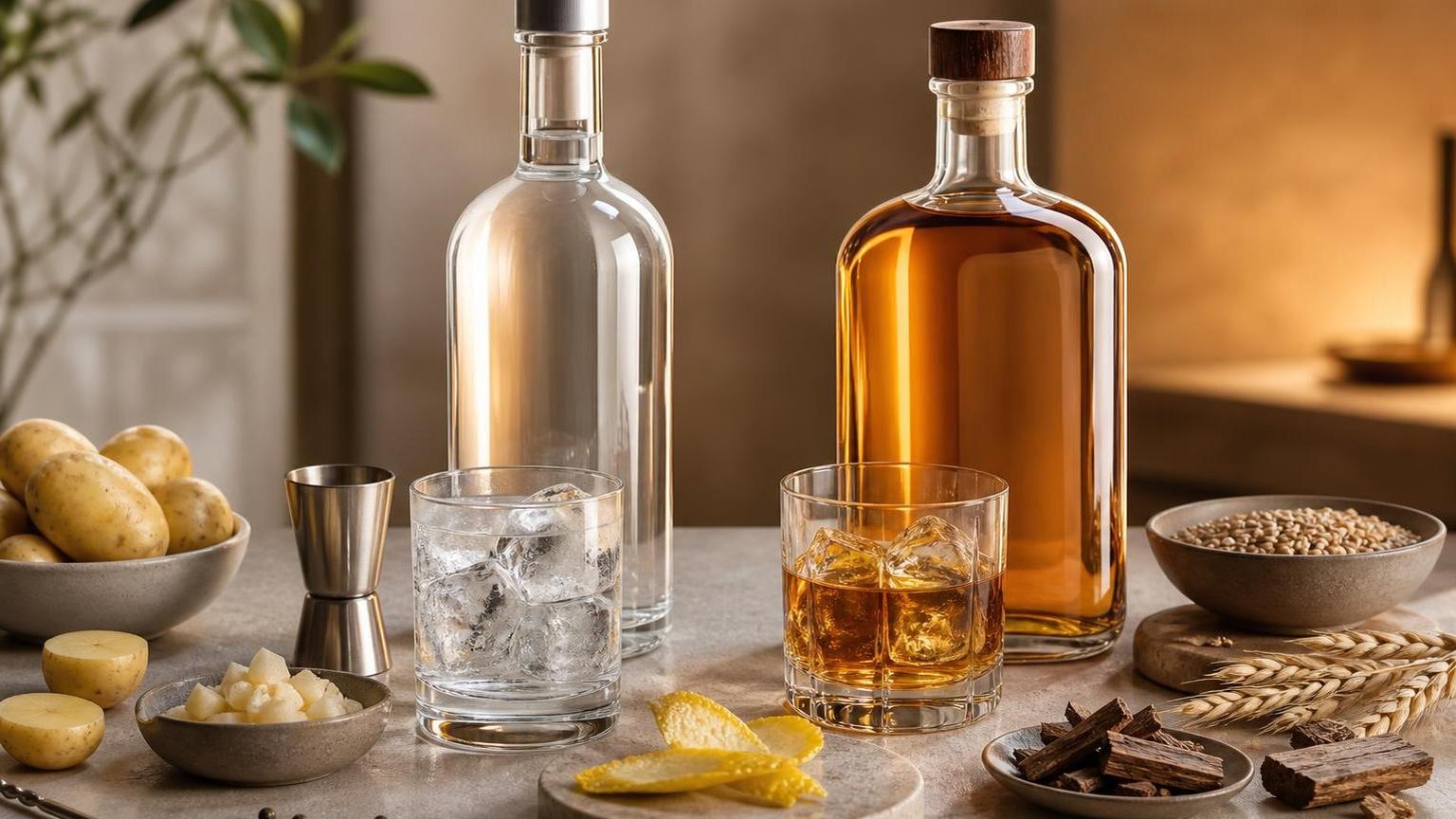
Vodka and whiskey can look similar on a label because both are usually 40% alcohol by volume in the US. Their nutrition profile is also close in a standard pour, but production method and proof change the final numbers in the glass.
In the US, a standard drink contains about 14 grams of pure alcohol. For 80-proof spirits, that equals 1.5 fluid ounces, which is the benchmark used in most calorie and alcohol comparisons.
| Drink | Serving | ABV | Alcohol | Calories | Carbs |
| Vodka, unflavored, 80 proof | 1.5 fl oz | 40% | 14 g | about 97 | 0 g |
| Whiskey, 80 proof | 1.5 fl oz | 40% | 14 g | about 97 | 0 g |
| Vodka, 90 proof | 1.5 fl oz | 45% | about 15.8 g | about 110 | 0 g |
| Whiskey, 100 proof | 1.5 fl oz | 50% | about 17.5 g | about 123 | 0 g |
Calories in distilled spirits come almost entirely from ethanol, which provides 7 calories per gram.
That is why vodka and whiskey at the same proof land in nearly the same range, even though whiskey starts from grain mash and vodka can be made from grain, potatoes, or other fermentable ingredients.
Carbohydrates are where many drinkers expect whiskey to differ. In plain distilled vodka and straight whiskey, carbs are typically zero per 1.5-ounce serving because distillation removes nearly all sugar and starch from the finished spirit.
Small label variations happen. Some databases list whiskey at 105 calories per shot instead of 97, often because the serving size, proof, or brand was different.
| What changes the numbers | Effect |
| Higher proof | More alcohol per ounce, so calories rise fast |
| Larger pour | A 2-ounce pour has about 33% more alcohol and calories than 1.5 ounces |
| Flavored vodka | May add sugar and carbs, depending on brand |
| Liqueur-based whiskey drinks | Often much higher in carbs and calories from mixers or added sweeteners |
For a clean comparison, compare unflavored vodka to straight whiskey at the same proof and the same pour size.
In that setup, neither has a meaningful calorie or carb advantage; the bigger difference comes from what you mix with them and how much you pour.
Best uses in cocktails and sipping
Vodka and whiskey work best in different drinking contexts because they bring different flavor loads to the glass.
Vodka is usually bottled at 40% ABV and designed to stay neutral, while whiskey carries grain, oak, spice, smoke, or caramel from distillation and barrel aging.
That difference shapes both cocktail structure and sipping style. Use vodka when you want texture and alcohol without competing flavors. Use whiskey when the base spirit should remain clearly identifiable after dilution, citrus, sugar, or ice.
| Spirit | Best cocktail role | Best sipping format | Why it works |
| Vodka | Clean base for citrus, fruit, coffee, or savory drinks | Chilled neat, from freezer or refrigerator, in 1.5-2 oz pours | Low flavor intensity lets mixers dominate while alcohol provides body |
| Whiskey | Spirit-forward or bitters-driven drinks with visible oak and grain character | Neat, with a few drops of water, or over one large cube in 1.5-2 oz pours | Barrel compounds and congeners stay noticeable through dilution |
Best uses for vodka
Vodka excels in cocktails where neutrality is the point. In a Vodka Martini, Moscow Mule, Bloody Mary, Espresso Martini, or Cosmopolitan, it carries the drink without adding smoke, vanilla, or tannin that would shift the balance.
Its flexibility matters in high-acid builds. Lemon, lime, tomato, ginger beer, coffee, and fruit liqueurs can be pushed harder because vodka contributes less aroma than aged spirits.
That makes it useful for guests who want a cold, crisp drink rather than a spirit-led one.
For sipping, serve vodka cold. Many producers recommend 32-40°F for a smoother mouthfeel. At that range, ethanol burn softens and the texture feels rounder, especially in premium vodkas distilled multiple times or filtered through charcoal.
Best uses for whiskey
Whiskey performs best when the drink should taste like whiskey.
An Old Fashioned, Manhattan, Whiskey Sour, Irish Coffee, or Mint Julep depends on the spirit’s oak, cereal, and spice notes to stay present after sugar, bitters, citrus, or dilution.
Because whiskey is barrel-aged, it often shows vanillin, lactones, and tannins that vodka does not. Those compounds make it stronger in short builds and stirred cocktails. A 2 oz pour still reads clearly after 20-30% dilution from ice.
For sipping, start neat in a tulip-shaped glass at about 60-65°F. Add 3-5 drops of water if the whiskey is 43-50% ABV to open aroma. Use a large cube only when you want slower dilution and a softer finish.
- Choose vodka for bright, cold, mixer-driven drinks.
- Choose whiskey for aromatic, spirit-forward cocktails.
- Serve vodka colder than whiskey for best texture.
- Sip whiskey warmer to capture aroma and oak detail.
Questions Readers Ask
What is the main difference between vodka and whiskey?
Vodka is usually distilled to a very high proof and filtered to keep flavor, aroma, and color minimal.
Whiskey is distilled at a lower proof and then aged in wood, which preserves grain character and adds compounds from the barrel such as vanilla, spice, caramel, and toast.
Are vodka and whiskey made from different ingredients?
Vodka can be made from many fermentable materials, including wheat, rye, corn, potatoes, and grapes, as long as the final spirit remains neutral.
Whiskey is typically made from grains such as corn, rye, wheat, and malted barley, and the grain bill strongly shapes the final flavor.
Why does whiskey have color while vodka is usually clear?
Most vodka is clear because it is not aged in wood and is often filtered before bottling. Whiskey gets most of its amber or golden color from time in oak barrels, where it extracts color and flavor from the toasted or charred wood.
Does vodka or whiskey have more alcohol?
Most standard vodkas and whiskeys sold in the US are bottled at 40% alcohol by volume, or 80 proof. The range can vary, though: flavored vodkas may be lower, while barrel-proof whiskeys often exceed 50% ABV and can reach 60% or more.
Why does whiskey usually taste stronger than vodka?
Whiskey often tastes stronger because it contains more congeners and barrel-derived compounds, not necessarily because it has more alcohol.
Vodka is designed to be neutral, so even at the same 40% ABV, it can seem smoother and less intense on the palate.
Which one is better for cocktails, vodka or whiskey?
Vodka works best when you want other ingredients to lead, such as in a Moscow Mule, Cosmopolitan, or Vodka Soda. Whiskey is better when you want the base spirit to stay prominent, as in an Old Fashioned, Manhattan, or Whiskey Sour.
Is whiskey aged longer than vodka?
Vodka is generally not aged at all, so it can go from distillation to bottling quickly once it is filtered and proofed.
Whiskey is usually aged for years; for example, straight bourbon must be aged at least 2 years to be labeled “straight,” and many premium bottlings age 4 to 12 years or longer.
Do vodka and whiskey have the same calories and carbs?
A 1.5-ounce serving of 80-proof plain vodka or whiskey has roughly 95 to 100 calories and essentially zero carbs after distillation.
Calories rise when the proof increases or when sugar and flavorings are added, which is why flavored vodka and sweet whiskey liqueurs are different from straight spirits.
Related Reading
- How To Make Corn Whiskey?
- What To Mix With Jack Daniels Honey?
- What To Mix With Baileys Irish Cream?
- How Long Does Whiskey Last Unopened?
- How To Make Whiskey Taste Better?
- Who Makes Kirkland Whisky?
- What To Mix With Irish Cream?
- What Can You Mix With Baileys?
- All Alcohol Guides