How Long Do Beers Last in the Fridge? — 6 to 24 months unopened, depending on style, packaging, and freshness date; opened beer lasts 1 day before carbonation and flavor collapse.
Refrigeration slows oxidation, hop fade, and microbial risk, but it does not stop aging. Light lagers and hop-forward IPAs taste best within 3 to 6 months; stronger stouts, porters, and bottle-conditioned beers can hold longer.
This guide explains fridge shelf life, date codes, spoilage signs, and storage choices that protect flavor.
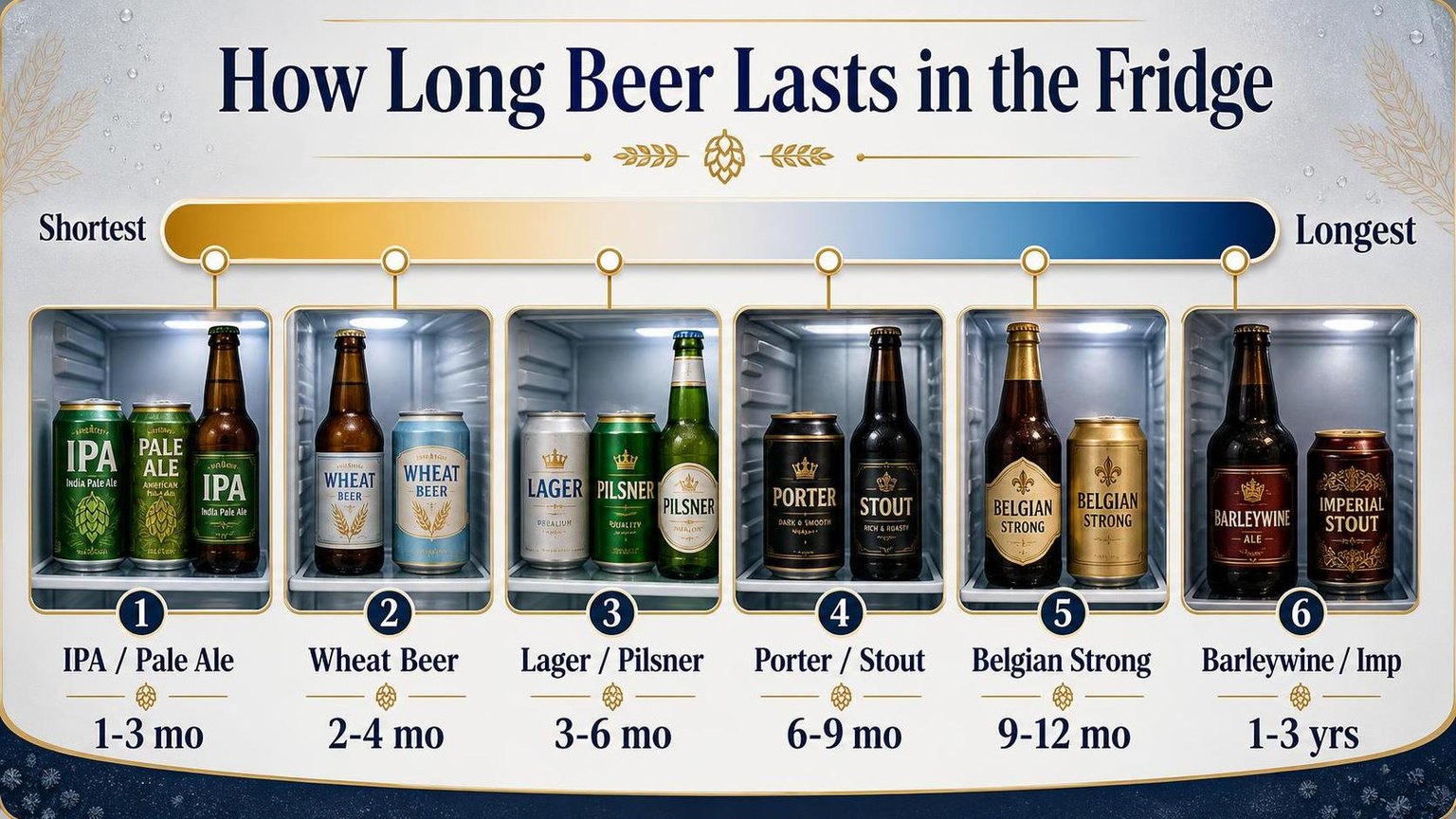
How Long Refrigerated Beer Stays Drinkable
Refrigeration slows beer staling, but it does not stop it. Cold storage preserves hop aroma, limits oxidation damage, and keeps carbonation more stable, so beer usually stays drinkable longer in a fridge than at room temperature.
For most unopened beer, the practical question is quality, not safety.
Beer is low in oxygen, acidic, and alcoholic enough that properly sealed commercial bottles and cans rarely become hazardous; they instead lose freshness, aroma, and foam performance over time.
| Beer type | Best quality in fridge | Still usually drinkable |
| Mass-market lager, pilsner, wheat beer | 3-6 months | 6-9 months |
| IPA, pale ale, hop-forward seasonal | 1-3 months | 3-6 months |
| Amber ale, porter, stout | 4-8 months | 8-12 months |
| High-ABV ales, Belgian styles, imperial stout | 6-12 months | 12-24 months |
Hop-forward beer fades fastest because hop oils are volatile and oxidize easily. An IPA kept cold can still lose bright citrus and pine notes within 60 to 90 days after packaging, even if it remains fully carbonated and visually normal.
Darker, malt-driven beers usually hold up better.
Roasted malt, caramel flavors, and higher alcohol levels mask age-related dullness, so a refrigerated porter or stout often tastes acceptable for many months longer than a refrigerated IPA from the same brewery.
Package type matters. Cans block 100% of light and usually protect beer better than clear or green bottles, which allow light-struck skunky aromas to form when exposed to sunlight or strong retail lighting.
| Storage factor | Effect on shelf life |
| Constant 35-40°F | Best preservation of aroma and carbonation |
| Frequent warm-cold cycling | Speeds staling and flavor loss |
| Can or brown bottle | Better protection from light damage |
| Clear or green bottle | Higher risk of skunky off-flavor |
Once opened, beer changes fast. In the fridge, an opened bottle or can usually keeps acceptable carbonation for about 1 day, sometimes 2 days if tightly resealed, but hop aroma and foam drop within hours.
- Check the packaging date, not only the “best by” date.
- Store beer upright to reduce oxygen contact at the closure.
- Drink hoppy beer first and strong ales later.
- Discard beer with leaking seals, sourness in non-sour styles, or visible contamination.
Fridge Shelf Life by Beer Style
Refrigeration slows staling, but beer style still determines how long flavor holds. Alcohol, hop load, oxidation sensitivity, package type, and live yeast all change the timeline.
Cold storage near 38 to 40°F preserves beer better than a warm garage or pantry.
Lighter, delicate beers fade first. High-hop beers also lose character quickly because hop oils and bitterness compounds degrade, even in the fridge. Strong, dark, and mixed-fermentation beers usually keep their profile longer.
| Beer style | Best fridge window | What changes first |
| American light lager, pilsner, helles, kölsch | 3 to 6 months | Loss of crispness, muted malt, paper-like oxidation |
| Wheat beer, hefeweizen, witbier | 2 to 4 months | Banana, clove, and citrus notes drop fast; haze may compact |
| Pale ale, IPA, hazy IPA, session IPA | 1 to 3 months | Hop aroma collapses, bitterness softens, fruit notes dull |
| Amber ale, brown ale, porter, stout | 6 to 9 months | Roast smooths out; stale cocoa or cardboard can emerge later |
| Belgian dubbel, tripel, strong ale | 9 to 12 months | Esters mellow; oxidation can add sherry-like notes |
| Barleywine, imperial stout, old ale | 1 to 3 years | Hop edge recedes; alcohol integrates; oxidation becomes evident |
| Sour ale, lambic, gueuze, mixed fermentation | 1 to 5 years | Acidity softens, funk evolves, carbonation may shift |
Hop-forward beer is the shortest-lived category. Many breweries recommend drinking IPA within 30 to 90 days of packaging, because oxygen and time strip volatile hop compounds responsible for citrus, pine, and tropical aromas.
Unpasteurized craft beer generally has a shorter ideal window than pasteurized macro lager.
Cans usually protect beer better than clear or green bottles because they block all light, reducing lightstruck “skunky” reactions caused by iso-alpha acids and riboflavin exposure.
High-ABV beer lasts longer because alcohol and heavier malt structure buffer flavor loss. Some beers above 8% ABV improve for months, but that applies more to barleywine, imperial stout, and Belgian strong ale than to double IPA.
- Store bottles upright to limit oxygen contact at the cap.
- Keep temperature steady; cycling from cold to warm speeds staling.
- Check the packaged-on date, not only the best-by date.
- Once opened, drink the beer the same day; carbonation and aroma fall within hours.
Opened Beer Storage Time Limits
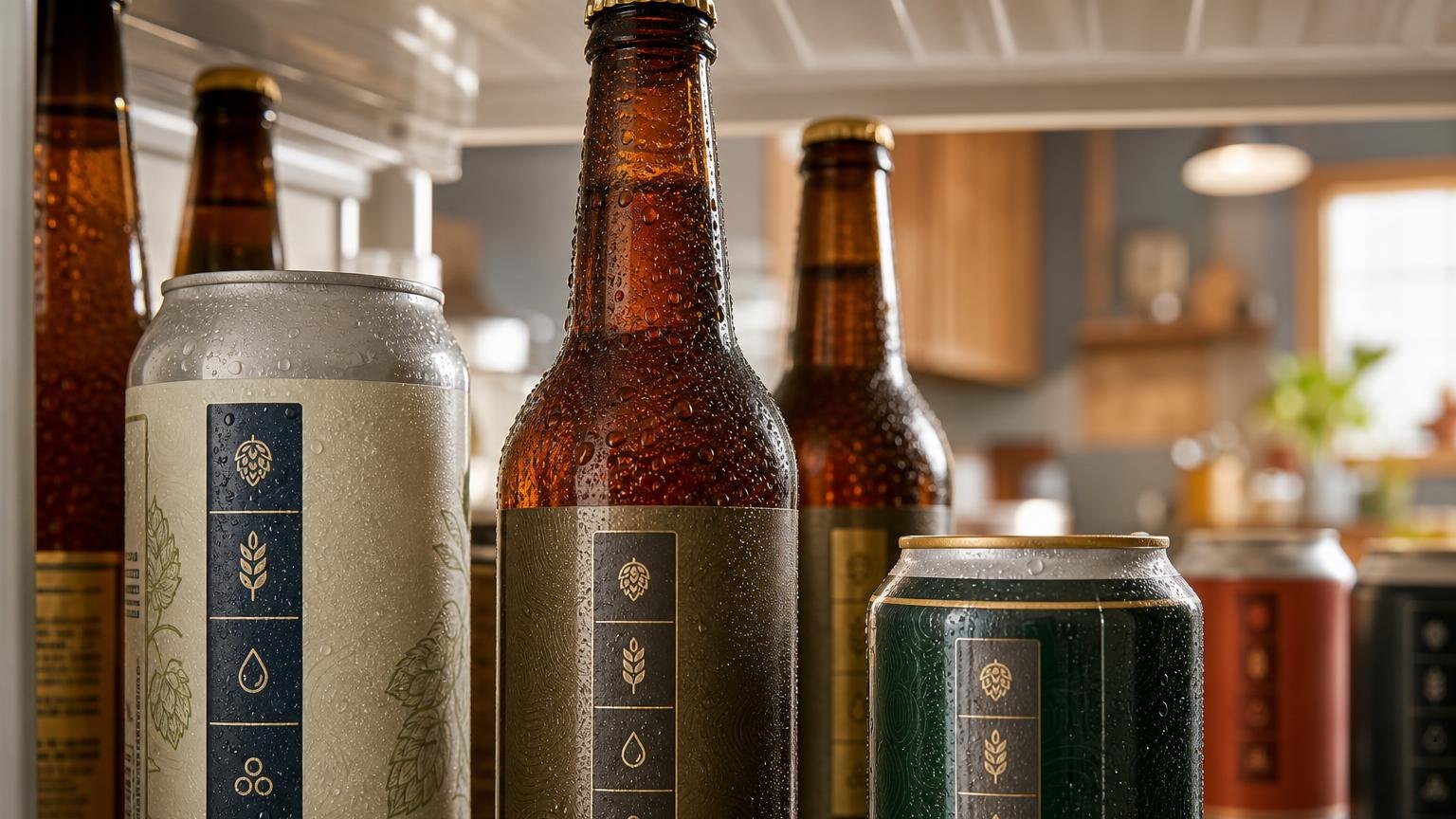
Opened beer has a short safe-quality window, even in a cold refrigerator. Once the seal breaks, carbon dioxide escapes, oxygen enters, and hop aromas fade fast. Refrigeration slows those changes, but it does not stop them.
For most beers, the best drinking window after opening is measured in hours, not days. At standard refrigerator temperatures of 35-40°F, flavor loss starts immediately, and carbonation drops each time the container is moved or poured.
| Beer type or package | Best quality in fridge after opening | What changes first |
| Standard lager, pilsner, blonde ale | Up to 24 hours | Carbonation and crispness |
| IPA, pale ale, hop-forward beer | 8-24 hours | Hop aroma and bitterness balance |
| Wheat beer, kölsch, light sour | Up to 24 hours | Lively foam and bright aroma |
| Porter, stout, brown ale | 24-48 hours | Fresh malt aroma and creamy texture |
| High-ABV ales, barleywine, imperial stout | 1-3 days | Oxidation notes before carbonation loss dominates |
| Growler, partially consumed | 12-36 hours | Rapid flattening from large headspace |
An opened bottle or can stored upright lasts longer than one left on its side. Upright storage reduces liquid contact with the air pocket and limits leakage around the cap or can opening.
Hop-forward beers degrade fastest because volatile hop oils dissipate quickly after exposure to oxygen. That is why an IPA can taste muted by the next day, even when it still looks normal and remains safe to drink.
Darker, stronger beers usually hold up better because bold malt flavors mask small changes. They still lose carbonation, but oxidation is less obvious than in light lagers or aromatic pale ales.
- Recap the bottle or cover the can opening tightly. A silicone beer cap or stopper works better than foil.
- Keep the beer at 35-40°F. Warmer storage speeds staling and foaming loss.
- Store it upright. Less surface area touches oxygen.
- Do not save beer that was left out for many hours and then chilled again for quality.
If an opened beer smells papery, wet-cardboard-like, sour when it should not, or pours flat, its quality window has passed. It is often still microbiologically safe for a short time, but it will not taste like the brewer intended.
Cans Bottles and Growlers Compared
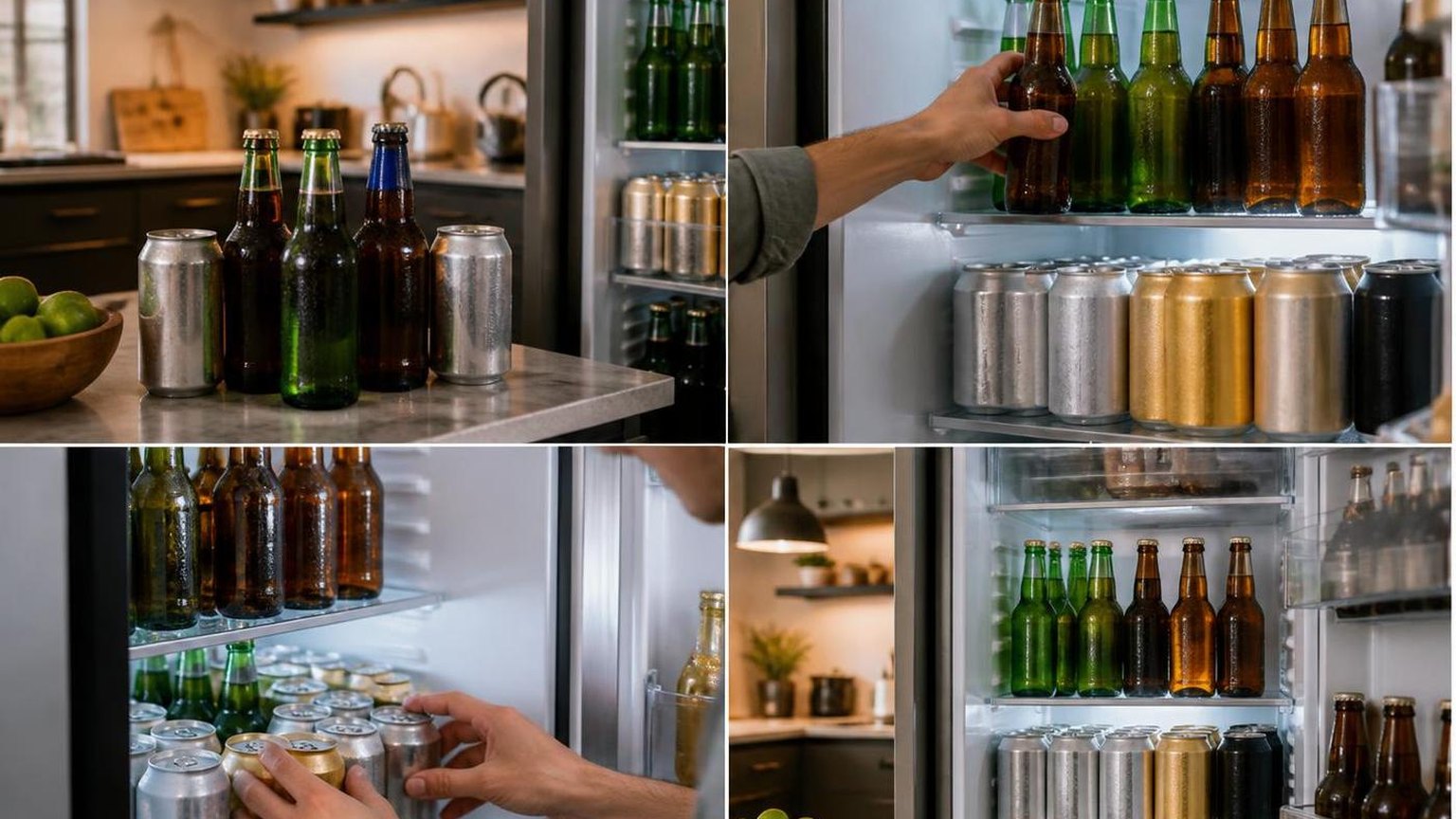
Package type changes how long beer stays fresh in the fridge. The main variables are light exposure, oxygen pickup, and how well the closure holds pressure over time.
Cans protect beer best, bottles vary by glass color, and growlers are the shortest-term option.
Cans are the strongest barrier against the two biggest flavor killers: light and oxygen.
Aluminum blocks 100% of light, including the UV and blue wavelengths that trigger “skunky” aromas when they react with iso-alpha acids from hops. Modern can seams also limit oxygen pickup, which helps preserve hop aroma longer.
Bottles perform differently by color. Brown glass blocks most UV light, commonly cited around 90% or more, while green glass blocks much less and clear glass blocks very little.
That matters most for pale lagers, pilsners, and hop-forward beers, which show lightstruck character quickly if exposed.
Growlers are for short-term storage, not cellaring. Most are 32 or 64 ounces and are filled from a draft line, which usually introduces more oxygen than a packaged can or bottle from the brewery.
Once filled, the larger headspace and less precise seal make staling happen faster.
| Package | Unopened in fridge | After opening | Main strength | Main weakness |
| Can | Best within 6-9 months for most standard beers; hop-forward styles often show decline after 3-6 months | About 1 day before carbonation and aroma drop sharply | Total light protection | Flavor still fades with age and heat exposure |
| Brown bottle | Often 6-9 months refrigerated; some stronger or darker beers last longer | About 1 day | Good light protection | Some oxygen ingress through cap over time |
| Green or clear bottle | Similar age range if kept dark, but more vulnerable to damage from light exposure | About 1 day | Easy to inspect visually | High risk of skunking |
| Growler | About 1-3 days for best quality; some breweries advise within 24 hours | Within hours, usually same day | Convenient draft takeaway | Fast oxidation and carbonation loss |
For storage, keep beer cold and steady, ideally around 35-40°F. Upright storage reduces the beer’s contact with the closure and minimizes oxidation risk. Temperature swings age beer faster than constant refrigeration.
- Choose cans for IPAs, pale ales, and pilsners.
- Choose brown bottles over green or clear when freshness matters.
- Buy growlers only if you plan to drink them within 24-72 hours.
- Once any package is opened, resealing slows loss slightly but does not stop staling.
If the goal is maximum shelf life in the fridge, cans usually win, brown bottles are close behind, and growlers come last by a wide margin.
Best Fridge Temperature for Beer
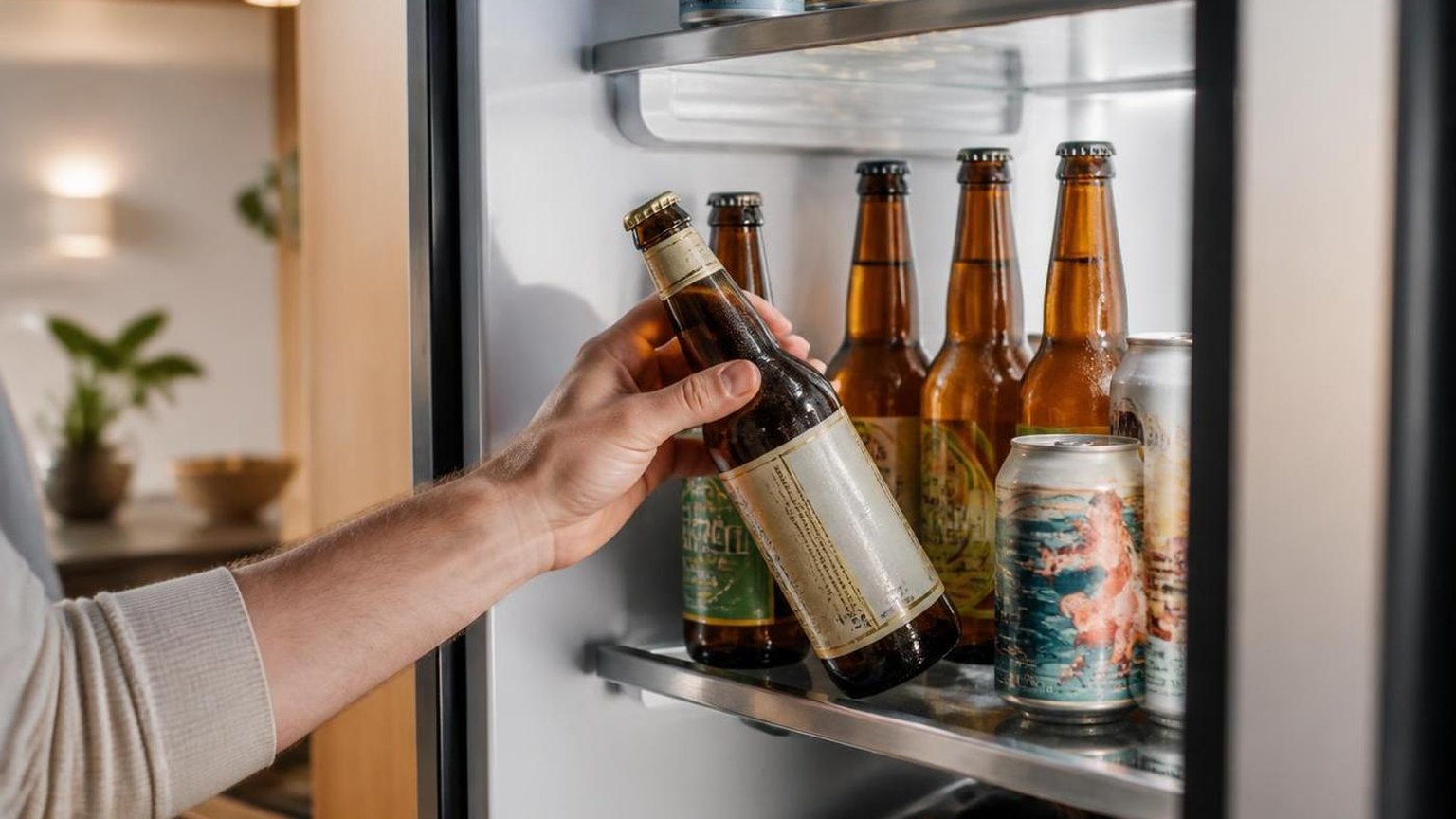
Beer keeps best in a cold, stable refrigerator, not an extra-cold one. For most styles, the practical storage target is 38-45°F, because colder temperatures slow staling while avoiding the flavor muting that happens near freezing.
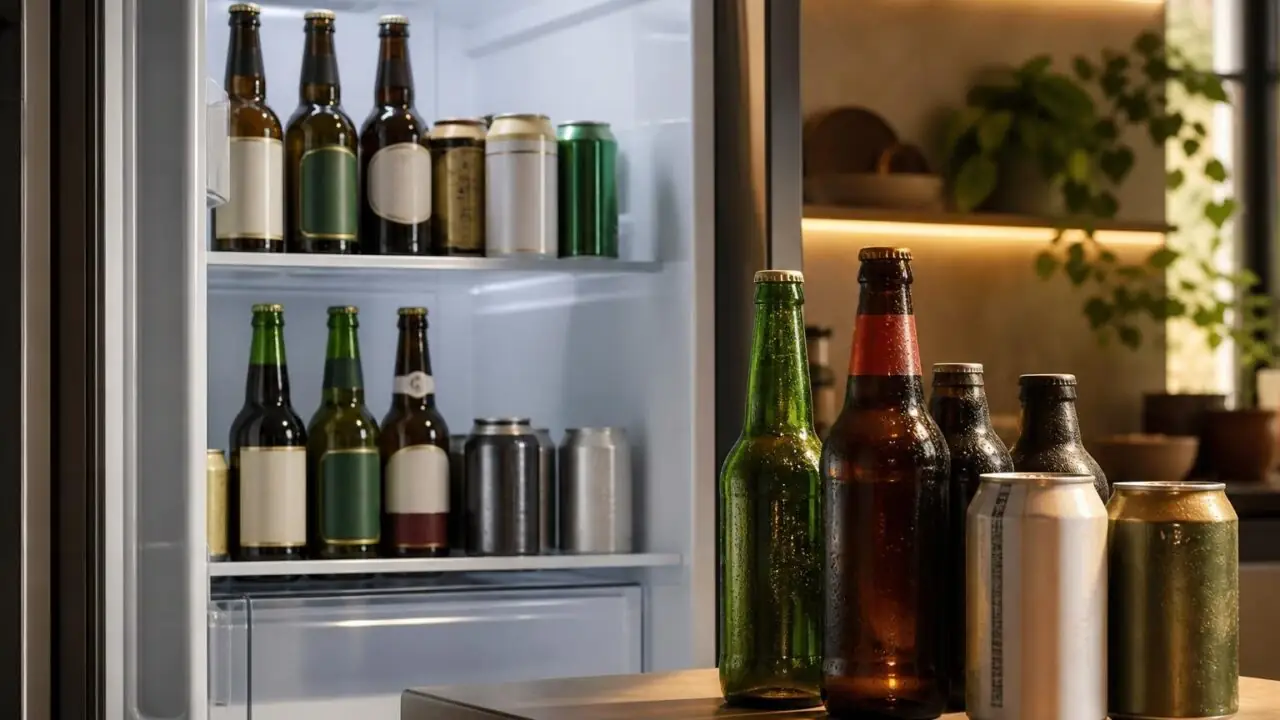
Standard household refrigerators often run about 37-40°F. That range is excellent for preserving beer over days, weeks, and months, especially when bottles or cans stay upright and away from the door.
| Beer use | Best fridge temperature | Why it works |
| Longer storage for most beer | 38-40°F | Slows oxidation and flavor loss without risking partial freezing |
| General serving range for lagers and pilsners | 40-45°F | Keeps beer crisp while allowing aroma and carbonation to show |
| General serving range for pale ales, IPAs, wheat beers | 45-50°F | Improves hop aroma and malt flavor compared with near-freezing service |
| High-ABV ales, stouts, porters | 50-55°F | Lets complex malt, roast, and alcohol notes open up |
For storage, colder is usually better until beer approaches freezing. Most beer freezes around 27-28°F, not 32°F, because alcohol lowers the freezing point. A fridge set below 34°F can still create slush or ice crystals in spots with poor airflow.
Temperature stability matters as much as the exact number. Repeated swings from 38°F to 50°F speed staling reactions and can push more oxygen through crown-cap seals over time. A steady shelf in the back of the fridge is better than the door.
Hop-forward beers benefit most from colder storage. IPAs and pale ales lose bright hop aroma quickly, so 38-40°F helps retain citrus, pine, and tropical notes longer than warm pantry storage. This does not stop aging; it slows it.
- Set the refrigerator to 38-40°F for mixed beer storage.
- Use a thermometer, because many fridge dials are inaccurate by several degrees.
- Store cans and bottles upright to reduce oxidation and limit cap contact.
- Keep beer out of the door, where opening causes the largest temperature swings.
- Move stronger stouts or Belgian ales out 10-20 minutes before serving if you want fuller aroma.
If one number is needed, use 39°F. It is cold enough for shelf-life protection and close to the ideal storage point for most everyday beer styles in a home refrigerator.
Signs Refrigerated Beer Has Gone Bad
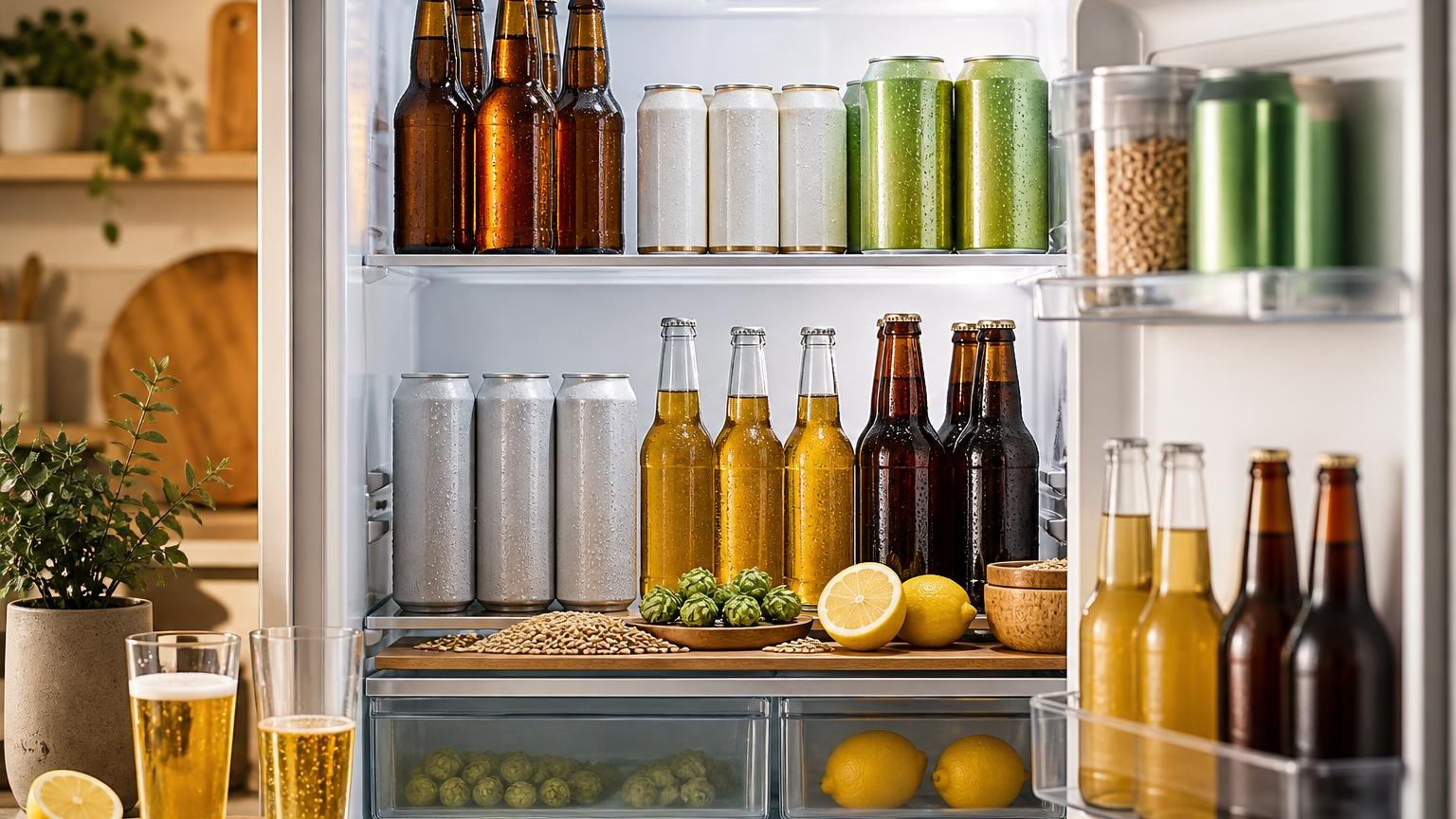
Refrigeration slows beer staling, but it does not stop oxidation, light damage, or flavor breakdown. A beer can still become noticeably worse in the fridge, especially if it sat warm before chilling or stayed stored for months past packaging.
The clearest warning signs are aroma, flavor, appearance, and package condition. Beer that is unsafe from spoilage is uncommon in sealed commercial packages, but beer that tastes old, flat, or damaged is common.
Smell and flavor changes
Oxidized beer often smells like wet cardboard, paper, or stale cereal. Hop-forward beers show this fastest because hop oils fade quickly, even under refrigeration.
Malt-heavy styles can shift toward honey-like sweetness, sherry notes, or dull caramel. Sour, vinegary, or buttery aromas in a beer that should be clean can also signal microbial spoilage or severe age damage.
| Sign | What it usually means |
| Wet cardboard or papery taste | Oxidation from age or poor package seal |
| Skunky smell | Lightstrike, common in clear or green bottles |
| Flat taste and no snap | CO2 loss from old crown, damaged can seam, or repeated temperature swings |
| Sharp sourness in a non-sour beer | Possible infection or advanced spoilage |
| Butter or movie-popcorn note | Diacetyl from instability or contamination |
Appearance problems
Unexpected haze matters most in beers packaged to be bright and clear. A pilsner or lager turning cloudy months later can indicate protein breakdown, yeast disturbance, or contamination.
Look for floating strands, clumps, or pellicle-like films after opening. Sediment alone is not always bad, especially in bottle-conditioned beer, hefeweizen, or unfiltered styles.
Carbonation and package clues
Beer that pours lifeless and loses foam within seconds is often stale or under-carbonated. Over-foaming, gushing, or bulging cans can point to contamination or refermentation inside the package.
| Package clue | Action |
| Dented seam on a can | Discard if the seam is compromised, leaking, or rusting |
| Bulging can end | Do not drink; pressure buildup can indicate spoilage |
| Loose cap or seepage | Discard because oxygen ingress and contamination risk rise sharply |
When to dump it
- Dump beer with vinegar-like aroma, gushers, slime, or visible film in a style that should not have it.
- Dump any beer from a swollen can or leaking bottle.
- If it only tastes papery, dull, or less bitter, it is usually stale rather than dangerous.
How to Make Beer Last Longer
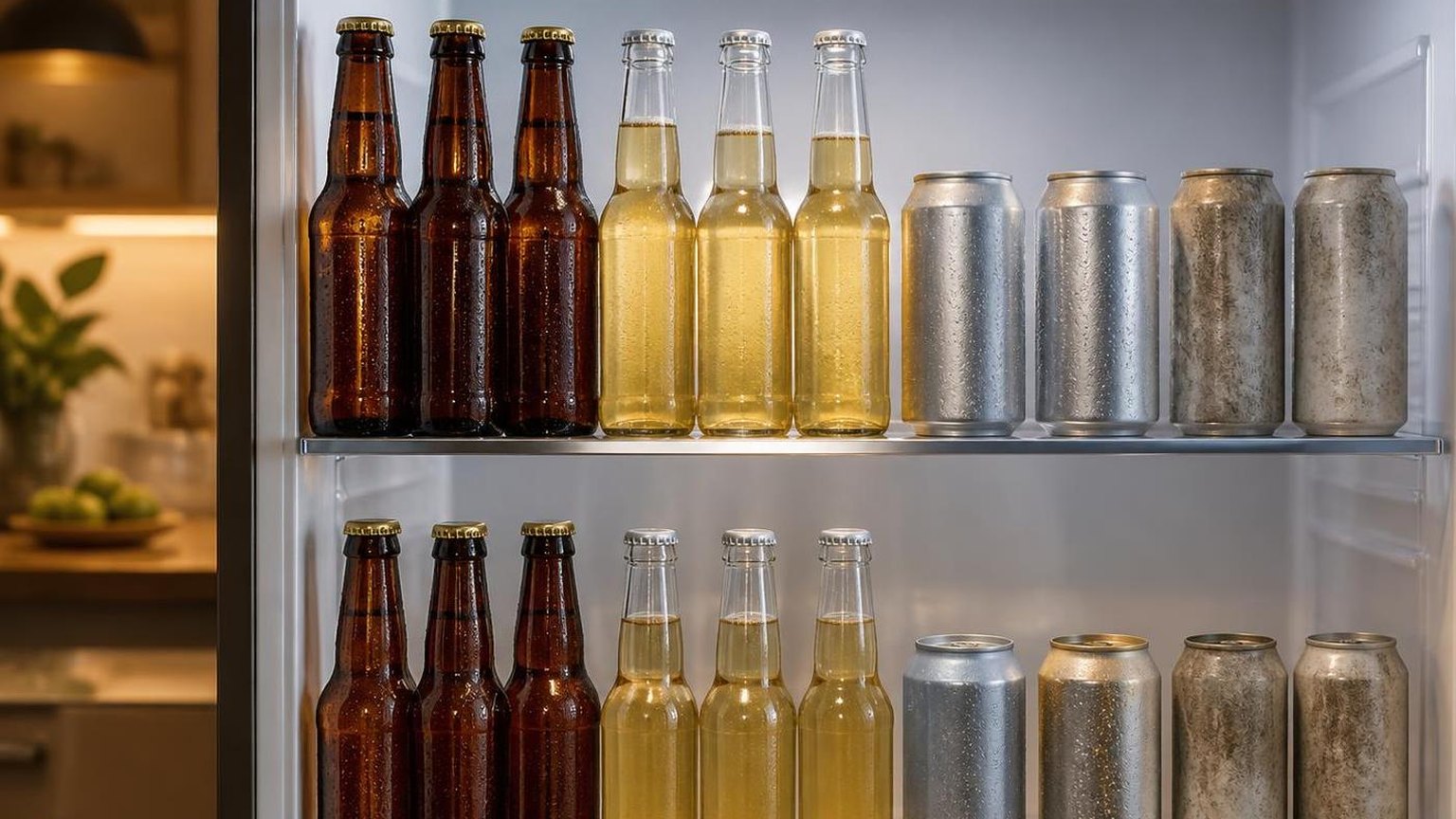
Beer lasts longer when you slow the reactions that damage flavor: oxidation, light exposure, and heat-driven staling. The practical rule is simple: keep beer cold, dark, upright, and undisturbed from purchase to pour.
Temperature matters most. Brewers and retailers commonly store beer near 38-45°F because colder storage slows chemical changes that create cardboard, sherry-like, or dull malt flavors.
| Storage factor | Best practice | Why it helps |
| Temperature | Keep at 38-45°F | Slows oxidation and staling reactions |
| Light | Store in total darkness | Prevents skunky aromas caused by lightstruck compounds |
| Bottle position | Store upright | Reduces beer-to-cap contact and keeps sediment compact |
| Movement | Avoid shaking and frequent transport | Limits agitation and oxygen pickup at the closure |
Light is the fastest way to ruin delicate hop aroma. UV and blue light react with iso-alpha acids from hops and create 3-methyl-2-butene-1-thiol, the same family of compounds associated with skunky aroma.
That is why clear and green bottles offer less protection than brown bottles or cans. If beer came in a clear bottle, treat darkness as mandatory, not optional.
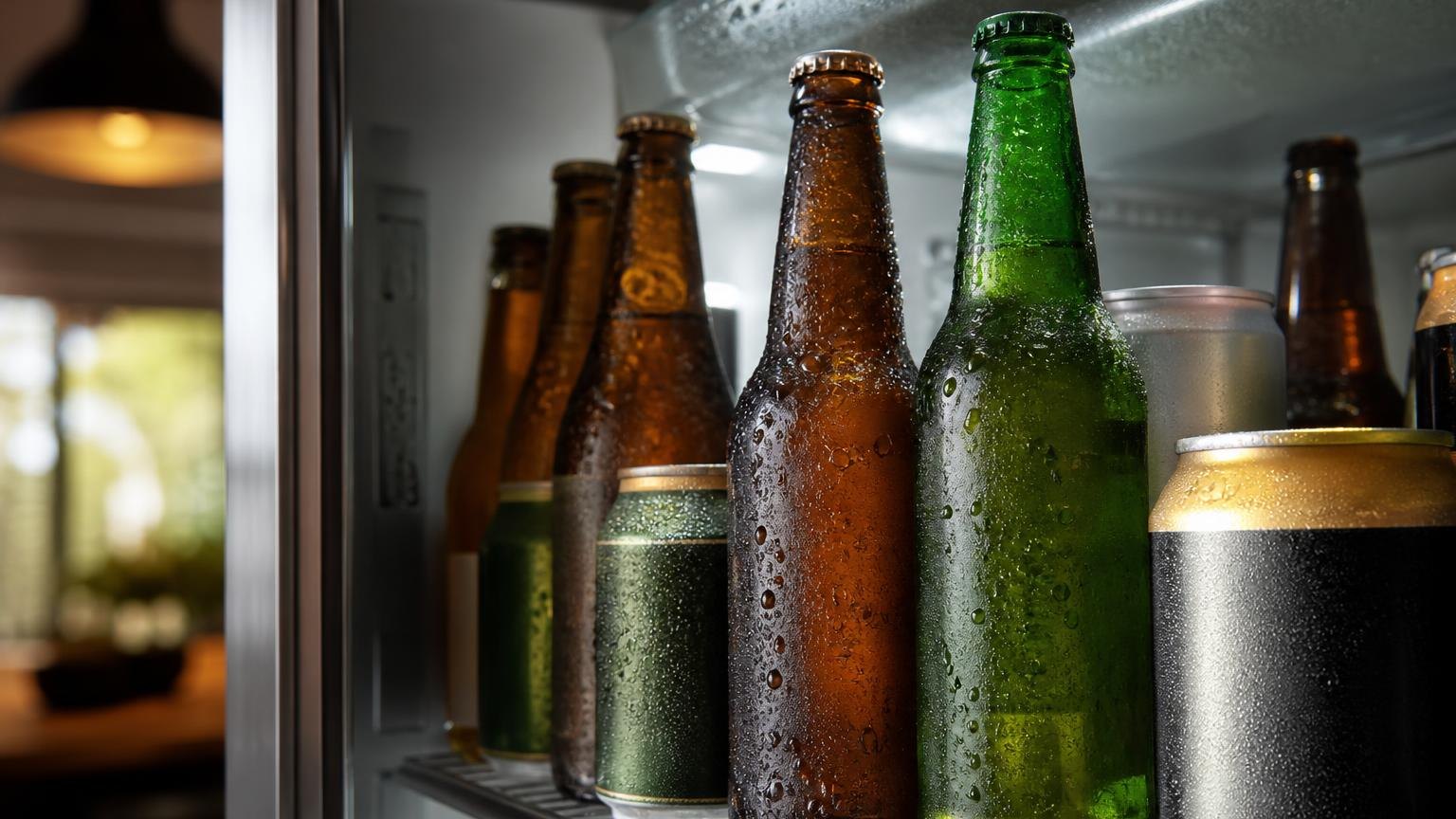
- Put beer in the main body of the fridge, not the door. Door shelves warm up every time the fridge opens.
- Leave beer in its carton or closed case. Cardboard blocks light and reduces temperature swings.
- Store bottles and cans upright. This is standard advice from many breweries for flavor stability.
- Do not freeze beer. Most beer starts freezing around 28°F, depending on alcohol content, and expansion can damage seals or break bottles.
- Buy smaller quantities if you drink slowly. Freshness drops with time even under good storage.
| What to avoid | Risk |
| Warm room storage above 68°F | Faster oxidation and stale flavor development |
| Sunlight or fluorescent light | Skunky aroma in minutes to hours |
| Repeated chilling and warming | More condensation, temperature stress, and flavor decline |
For opened beer, use time instead of storage tricks. Recap if possible and refrigerate immediately, then finish within 1 day because carbonation and hop aroma fade fast once oxygen enters the bottle or can.
Frequently Asked Questions
How long does beer last in the fridge after you buy it?
Most beer keeps its best flavor for about 6 to 9 months in a refrigerator held near 38 to 40°F if it was fresh when purchased.
Refrigeration slows oxidation and staling, but it does not stop them, so hop-forward styles usually fade sooner than darker or higher-alcohol beers.
Does beer actually go bad in the fridge, or does it only lose quality?
Commercial beer rarely becomes unsafe from normal refrigerated storage if the can or bottle stays sealed and undamaged. The bigger issue is quality loss: aromas flatten, malt turns dull, and cardboard-like oxidation notes can develop over time.
How long do IPAs and other hoppy beers last in the fridge?
IPAs, pale ales, and dry-hopped beers are best consumed within about 60 to 120 days of packaging, even if refrigerated.
Their hop oils and bright bitterness fade faster than in malt-driven styles, which is why package dates matter more for these beers.
How long do lagers, stouts, and high-ABV beers last in the fridge?
Standard lagers and pilsners often show good quality for around 6 months when kept cold, while porters and stouts can hold up 6 to 12 months.
Strong ales, imperial stouts, and barleywines may last a year or more, and some improve with age if oxidation stays controlled.
How long does opened beer last in the fridge?
Opened beer is best within the same day and usually declines sharply after 1 to 2 days, even when re-capped and refrigerated.
Carbonation escapes and oxygen enters immediately, causing flat texture and stale flavors faster than any sealed-storage timeline.
Do cans last longer than bottles in the fridge?
Cans usually protect beer better because they block 100% of light and limit flavor damage from UV exposure.
Brown bottles perform well, but green and clear bottles allow more light-struck damage, which can create skunky aromas even before age becomes the main problem.
How can you tell if refrigerated beer is too old to drink?
Check the package date first, then smell and taste for wet cardboard, papery notes, muted hops, metallic character, or unusual sourness in a beer that should not be sour.
If the container is bulging, leaking, or gushes unexpectedly, discard it because that can indicate heat damage or contamination.
What is the best way to store beer in the fridge so it lasts longer?
Store beer upright at a steady refrigerator temperature, ideally around 38°F, and keep it away from the door where temperatures swing most.
Cold, dark, stable storage reduces oxidation, light damage, and cap contact, which helps preserve flavor closer to the brewery’s intended profile.
Related Reading
- How Many Ounces Is A Water Bottle?
- Top 15 Substitution for Shaoxing Wine (Ranked 2026)
- How Many Cups Is 7 Oz?
- How Many Pounds Is 12 Stone?
- How Much Is 20 Ounces? A Surprisingly Practical Question With Real-Life Answers
- How Many Gallons Is 55 Liters?
- What Is the Legal Drinking Age in Vietnam?
- All Blog Guides
- FoodKeeper App (2024)
- National Library of Medicine: Aging of beer: a critical review (2009)
- National Library of Medicine: Evolution of Chemical and Sensory Properties during Aging of Top-Fermented Beer according to Storage Conditions (2006)
- Brewers Association: Beer Storage and Transportation Manual (2019)
- Brewers Association: Draught Beer Quality Manual (2019)
- Cicerone Certification Program: How to Store Beer (2023)
- BeerAdvocate: Proper Beer Storage (2021)