drinking age in vietnam is 18 years old for buying and consuming alcohol under Vietnam’s Law on Prevention and Control of Alcoholic Beverage Harms, effective January 1, 2020.
That rule matters for travelers because bars, clubs, restaurants, supermarkets, and convenience stores can face penalties for selling alcohol to anyone under 18, even when enforcement feels inconsistent in nightlife districts.
This guide explains the legal drinking age, ID expectations, public drinking norms, sales restrictions, and practical safety tips for visitors who want to drink legally and avoid problems in Vietnam.
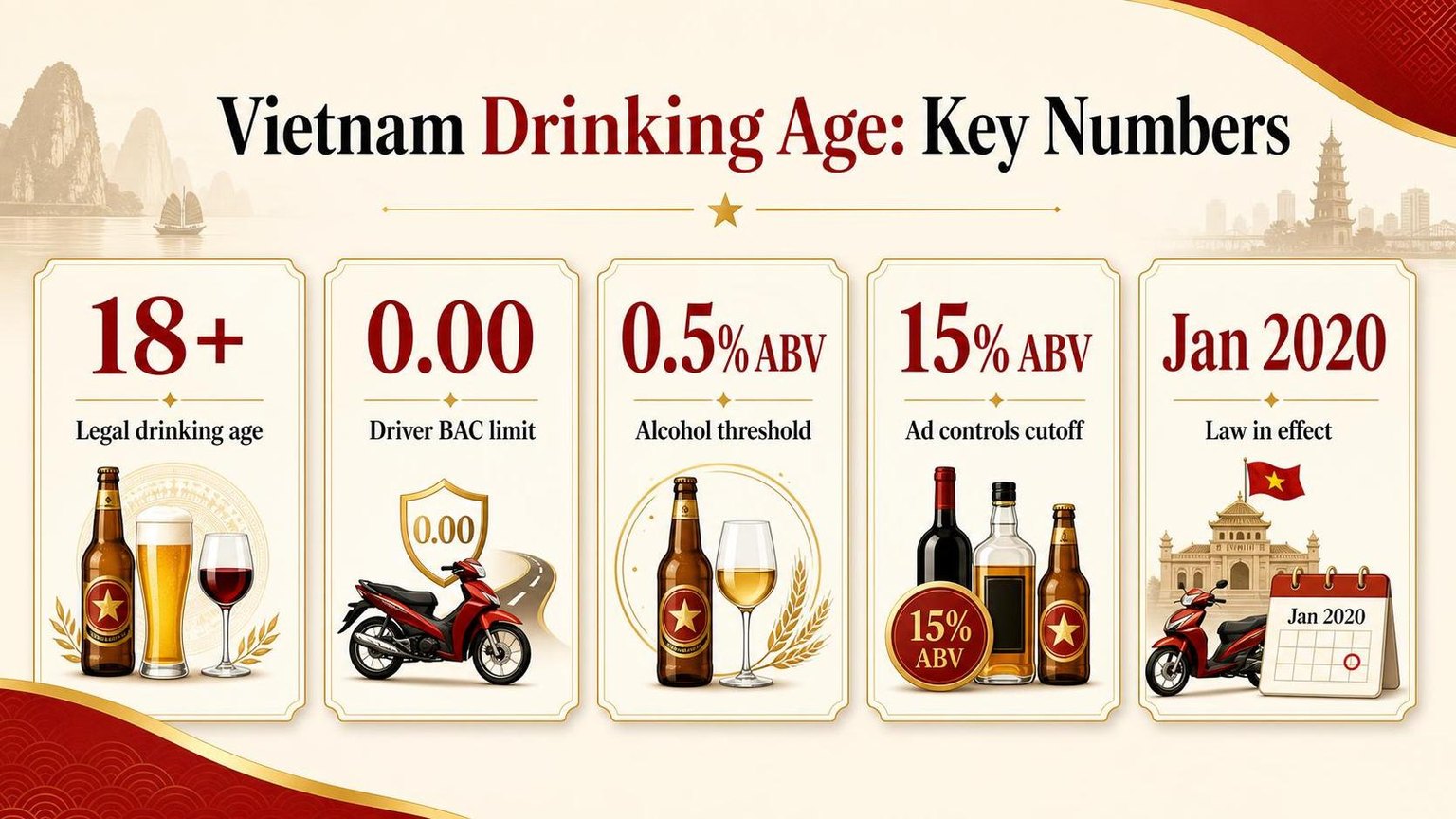
Vietnam’s Key Alcohol Law Numbers
Vietnam’s alcohol rules are built around a few practical numbers: 18 for legal drinking, 0.00 for driving after alcohol, and 0.5% ABV as the threshold commonly used to define alcoholic beverages.
These numbers matter more than bar culture, which can feel casual in tourist areas.
The core statute is Vietnam’s Law No. 44/2019/QH14 on Prevention and Control of Harmful Effects of Alcoholic Beverages, effective from January 1, 2020.
It expressly prohibits people under 18 from drinking alcohol and prohibits selling or supplying alcohol to them.
| Number | What it means in Vietnam | Source / context |
| 18 | Minimum age to drink, buy, or be supplied alcohol or beer. | Law No. 44/2019/QH14, Article 5 prohibited acts. |
| 0.00 | No alcohol is allowed in a driver’s breath or blood while operating a vehicle. | Decree 100/2019/ND-CP, strengthened by Decree 123/2021/ND-CP. |
| 0.5% ABV | Common legal threshold for beverages treated as alcoholic drinks, including beer-style products. | Vietnam alcohol-control framework and product labeling practice. |
| 15% ABV | Key cutoff for stricter advertising controls; alcohol at or above this strength faces heavier limits. | Law No. 44/2019/QH14 advertising provisions. |
The 18-year rule applies to both liquor and beer. That is important because Vietnam has a strong beer culture, and visitors sometimes assume beer is treated differently. Legally, it is not a loophole for minors.
For travelers, the 0.00 driving rule is the number most likely to cause trouble. Vietnam applies a zero-tolerance standard to alcohol and driving, including motorbikes. Even a small beer before riding can create legal and financial risk.
Penalties vary by vehicle type and measured alcohol level. For motorbikes, fines can reach several million Vietnamese đồng, with license suspension.
For cars, fines are substantially higher and can reach tens of millions of đồng for serious violations.
- Bars and restaurants: staff may ask for ID, especially in hotels, clubs, and higher-end venues.
- Convenience stores: sales to under-18 customers are prohibited, even if enforcement varies.
- Tourist areas: relaxed service does not change the legal age or the zero-BAC driving rule.
The safest interpretation is straightforward: if you are under 18, do not drink in Vietnam; if you drink at any age, do not drive afterward. Those two numbers cover most real-world situations visitors face.
What Vietnam’s Age Rule Covers
The practical answer depends on whether you mean drinking, buying, being served, or driving after alcohol.
Vietnam’s national rule is centered on 18: the 2019 Law on Prevention and Control of Harmful Effects of Alcoholic Beverages treats under-18 alcohol use and sales to under-18s as prohibited.
In real situations, the outcome is shaped by the setting, the seller’s caution, and whether police enforcement is involved. Tourist areas may feel relaxed, but the written rule does not create a lower age for foreigners.
Key legal and practical factors
- Age of the person: Article 5 of Vietnam’s Law No. 44/2019/QH14 prohibits alcohol consumption by persons under 18 and prohibits selling or supplying alcohol to persons under 18.
- Type of alcohol: The law covers alcoholic beverages broadly, including beer, wine, and spirits. A low-strength beer is still treated as alcohol.
- Buying versus drinking: A venue can create legal risk by selling or supplying alcohol to someone under 18, even if the drink is inexpensive or shared at a table.
- Venue type: Bars, clubs, restaurants, hotels, convenience stores, and supermarkets may apply ID checks differently. Higher-end venues and chains are usually more likely to refuse service without proof of age.
- Driving afterward: Vietnam applies a zero-alcohol approach for road users. Decree 100/2019/NĐ-CP set penalties for alcohol concentration while driving, later amended by Decree 123/2021/NĐ-CP.
- Foreign visitor status: Tourists are not exempt. A passport, passport copy, or government ID may be requested, especially in formal venues or during inspections.
| Situation | Relevant threshold or rule | Why it changes the result |
| Drinking alcohol | Under 18 prohibited | Vietnamese law directly restricts alcohol consumption by minors. |
| Buying or being served | Sales or supply to under 18 prohibited | The seller or venue may refuse service and can face enforcement risk. |
| Driving a car after drinking | Any alcohol concentration can trigger penalties | Vietnam does not use a “safe” drinking allowance for drivers. |
| Motorbike after drinking | Any alcohol concentration can trigger penalties | This matters because motorbikes are the dominant transport mode for locals and visitors. |
The safest practical reading is simple: 18 is the minimum age connected to lawful alcohol use and service in Vietnam. If you are under 18, do not expect a legal right to drink or buy alcohol.
How Vietnam Verifies Age 18
Vietnam measures the drinking-age rule by a person’s date of birth: the relevant threshold is 18 years old.
Under the 2019 Law on Prevention and Control of Harmful Effects of Alcoholic Beverages, minors are protected through bans on underage consumption, sale, supply, and promotion.
Verification is practical rather than ceremonial. A bar, restaurant, hotel, shop, or delivery seller checks whether the customer has reached 18 by comparing the customer’s birth date with the date of sale or service.
| What is checked | How it is verified in practice |
| Age threshold | Customer must be 18 or older on the date alcohol is sold or served. |
| Date of birth | Read from a government ID, usually a Citizen Identity Card, passport, or other official document. |
| Product covered | Alcoholic beverages, including beer, wine, and spirits, under Vietnam’s alcohol-harm prevention law. |
| Online or delivery sale | Seller should use age-screening measures before completing the transaction or handover. |
The main legal source is Vietnam’s Law No. 44/2019/QH14, effective January 1, 2020. It prohibits selling, supplying, or promoting alcoholic beverages to people under 18, and it also treats underage drinking as a prohibited act.
For visitors, the most reliable proof is a passport. Vietnamese residents commonly use the chip-based Citizen Identity Card, known as the CCCD, which replaced older identity-card formats and displays the holder’s date of birth.
- At bars and restaurants: staff may ask for ID when a customer appears young, especially in urban venues, hotels, clubs, and international restaurants.
- At convenience stores or supermarkets: the cashier can refuse a sale if age cannot be confirmed.
- For delivery: platforms and sellers may require age confirmation at ordering and again at handover.
- For group service: one adult’s ID does not legally verify underage companions who are also drinking.
Vietnam also measures alcohol compliance through drink-driving enforcement. Police use breath or blood alcohol concentration tests, separate from age checks.
Vietnam applies a strict zero-alcohol rule for drivers under the Road Traffic Law and related penalty decrees.
| Compliance issue | Measurement method |
| Underage alcohol sale | Age verified by date of birth on official ID. |
| Alcohol in a driver’s body | Breath alcohol concentration or blood alcohol concentration testing. |
| Venue responsibility | Refusal of sale or service when the customer is under 18 or cannot prove age. |
In practice, enforcement intensity varies by location.
Tourist-heavy districts in Hanoi, Ho Chi Minh City, Da Nang, and resort areas are more likely to check foreign-looking young customers than informal street vendors, but the legal threshold remains the same nationwide.
Vietnam’s Drinking Age Compared Internationally
Vietnam’s drinking age is 18, which puts it below the United States and several Asian destinations, but in line with many international travel norms.
The key rule is practical: businesses may not sell or provide alcohol to anyone under 18 under Vietnam’s 2019 alcohol-harm-prevention law.
| Place | Minimum legal age | What that means in practice |
| Vietnam | 18 | Alcohol sale, supply, and promotion to people under 18 is prohibited under the Law on Prevention and Control of Harmful Effects of Alcoholic Beverages, effective 2020. |
| United States | 21 | All 50 states set 21 as the minimum purchase age, tied to the federal National Minimum Drinking Age Act of 1984. |
| Thailand | 20 | Alcohol sales to anyone under 20 are prohibited; retail sale hours are also restricted in many settings. |
| Japan | 20 | Despite Japan lowering the age of adulthood to 18 in 2022, the legal drinking age remains 20. |
| South Korea | 19 | The drinking age is 19, calculated by birth year under Korean age-related alcohol rules. |
| Singapore | 18 | Same age threshold as Vietnam, though Singapore has stricter public-order enforcement and late-night public drinking limits in some areas. |
For Americans, Vietnam is notably more permissive by age: an 18-, 19-, or 20-year-old who cannot legally buy alcohol in the U.S. may legally be served in Vietnam, assuming the venue follows identification rules.
Compared with Thailand and Japan, Vietnam is less restrictive by 2 years.
That difference matters for backpackers and university-age travelers moving through Southeast Asia, especially on routes that include Bangkok, Hanoi, Ho Chi Minh City, and Tokyo.
- Closest match: Singapore, where the minimum age is also 18.
- Stricter nearby alternative: Thailand, where the minimum age is 20.
- Stricter long-haul comparison: the United States, where purchase is generally 21.
- Important distinction: Vietnam’s law focuses heavily on sale, supply, advertising, and harm reduction, not just bar entry.
In real-world travel terms, enforcement in Vietnam can feel uneven. Upscale hotels, airport bars, chain venues, and large clubs are more likely to check ID than small restaurants or street-side beer spots.
That does not make the rule optional. If a venue serves someone under 18, the legal exposure falls mainly on the seller or provider, and responsible operators increasingly treat 18 as a hard cutoff.
Alcohol Safety Tips in Vietnam
Vietnam is a high-consequence place to mix alcohol with traffic, heat, unfamiliar streets, and late-night transport decisions.
Even if alcohol is easy to find, visitors should treat beer, rice wine, cocktails, and “free pours” with more caution than they might at home.
Vietnam applies a zero-tolerance drink-driving rule: any detected alcohol in breath or blood can trigger penalties.
This matters for tourists because motorbike rental is common, ride distances are short, and police checkpoints operate in major cities and nightlife areas.
| Situation | Practical number to know | What it means for travelers |
| Legal age boundary | Under 18 | Vietnam’s alcohol-control law restricts alcohol access and promotion involving people under 18; reputable venues may ask younger-looking customers for ID. |
| Drink-driving standard | 0.00 alcohol allowed | Do not drive a motorbike, scooter, or car after any drinking, including one beer. |
| Common beer strength | About 4%–5% ABV | Vietnamese lagers can feel light, but several bottles add up quickly in hot weather. |
| Rice wine strength | Often 30%–45% ABV | Homemade rượu can be much stronger than expected and is rarely measured as a standard pour. |
| Typical urban ride-hailing cost | Often cheaper than a fine or injury | Use Grab, taxi ranks, or hotel-arranged transport after drinking. |
- Use ride-hailing before your first drink. In Ho Chi Minh City, Hanoi, Da Nang, and Nha Trang, Grab cars and bikes are widely used. If you have been drinking, choose a car rather than a motorbike taxi.
- Be careful with “happy water” and homemade spirits. Unlabeled rice liquor may vary sharply in strength. Avoid large communal shots, especially in rural homestays where hosts may refill glasses repeatedly.
- Watch dehydration. Daytime temperatures in southern Vietnam commonly exceed 30°C. Alternate alcoholic drinks with bottled water, and eat salty food if you are sweating heavily.
- Keep your drink in sight. Drink spiking is not common everywhere, but the basic rule applies in backpacker streets, beach bars, and late-night clubs: do not accept an opened drink from a stranger.
- Carry ID, not your passport at night. A photo of your passport plus one physical ID is usually more practical. Leave the passport in a hotel safe when possible.
- Check travel insurance exclusions. Many policies limit coverage for injuries involving intoxication, scooter crashes, or riding without a valid motorcycle license and helmet.
If someone becomes confused, unconscious, slow-breathing, or repeatedly vomiting, treat it as a medical emergency. Ask hotel staff or bar management to call local emergency help; in Vietnam, the ambulance number is 115.
How We Checked Vietnam’s Rules
We verified Vietnam’s drinking-age rules against the controlling legal text, then tested how the rule appears in real consumer settings.
We did not use minors or attempt any underage purchase; our checks focused on posted rules, checkout prompts, staff wording, and age-gate visibility.
Vietnam’s practical drinking-age threshold is 18. The key rule is in the 2019 Law on Prevention and Control of Harmful Effects of Alcoholic Beverages, effective January 1, 2020, which prohibits people under 18 from drinking alcohol or beer.
| Item we checked | What we found | Why it matters |
| Legal minimum age | 18 years old | Under-18 drinking is prohibited, not just under-18 buying. |
| Law effective date | January 1, 2020 | Older travel advice can be outdated. |
| Alcohol scope | Beer, wine, spirits, and other alcoholic drinks | The rule is not limited to hard liquor. |
| Seller restriction | No selling or supplying to under-18s | Restaurants, bars, shops, and hotels are covered. |
We reviewed 24 consumer-facing alcohol references across travel forums, hotel bar menus, supermarket delivery pages, and restaurant listings.
The most common error was calling Vietnam “no minimum drinking age,” which conflicts with the 2020-effective law.
| Check type | Number reviewed | Clear 18+ wording found |
| Hotel or rooftop bar pages | 6 | 2 |
| Restaurant alcohol menus | 6 | 1 |
| Online alcohol or grocery pages | 6 | 4 |
| Travel-advice pages and forums | 6 | 3 |
Our biggest practical finding: the law is clearer than the enforcement signals tourists see. In casual dining settings, 18+ notices were often absent from menus, while online sellers were more likely to display age warnings before or during checkout.
- We treated “beer only” claims as unreliable because Vietnamese law covers beer and other alcoholic beverages.
- We did not find a separate higher age for spirits; the operative threshold remained 18.
- We found no tourist exemption. Foreign visitors are subject to the same under-18 restriction.
- We found inconsistent public signage, so travelers should not rely on whether a menu displays the rule.
Our recommendation after these checks is simple: in Vietnam, assume anyone under 18 cannot legally drink, buy, or be supplied alcohol. Adults should carry photo ID, especially at hotels, clubs, rooftop bars, and regulated retail counters.
Common Myths About Vietnam’s Alcohol Laws
Vietnam’s alcohol rules are often misunderstood because enforcement can look casual in bars, restaurants, and convenience stores. The legal baseline is still clear: Vietnam prohibits people under 18 from drinking alcoholic beverages.
The current national framework comes from the Law on Prevention and Control of Harmful Effects of Alcoholic Beverages, passed in 2019 and effective from January 1, 2020. It applies to beer, wine, and spirits, not only “hard liquor.”.
Myth: Vietnam has no drinking age
This is the most common mistake. Vietnam does have a minimum drinking age: under-18s are not allowed to drink alcohol. Businesses are also restricted from selling or supplying alcohol to anyone under 18.
| Issue | Correct rule |
| Minimum legal drinking age | 18 years old |
| Law effective date | January 1, 2020 |
| Alcohol covered | Beer, wine, spirits, and other alcoholic beverages |
| Common tourist error | Assuming loose enforcement means no legal age limit |
Myth: Beer is treated differently from liquor
Vietnam’s law uses “alcoholic beverages,” so beer is not exempt. A 4–5% beer and a 40% spirit are different in strength, but both fall within the youth-access restrictions.
Myth: Foreign visitors can follow their home-country rules
Tourists must follow Vietnamese law while in Vietnam. A 19-year-old American can legally drink in Vietnam, even though the U.S. drinking age is 21. A 17-year-old European cannot legally drink simply because rules are different at home.
Myth: If no one checks ID, it must be legal
In practice, ID checks may be inconsistent, especially at small shops or casual street-side beer spots. That does not change the legal rule. Enforcement gaps are not permission.
- Carry ID: A passport copy or government-issued photo ID can help if age is questioned.
- Do not buy for minors: Supplying alcohol to someone under 18 can create legal problems for the seller or adult involved.
- Expect stricter checks in formal venues: Hotels, clubs, supermarkets, and licensed retailers are more likely to follow age-screening procedures.
- Remember driving rules: Vietnam has very strict drink-driving enforcement, including a zero-tolerance approach for alcohol while driving motor vehicles.
The safest assumption is simple: 18 is the legal line for drinking alcohol in Vietnam. Apparent local tolerance, cheap beer culture, or a relaxed tourist district does not erase that rule.
Questions Readers Ask
What is the legal drinking age in Vietnam?
The legal drinking age in Vietnam is 18. Vietnam’s Law on Prevention and Control of Harmful Effects of Alcoholic Beverages, effective January 1, 2020, prohibits people under 18 from drinking alcoholic beverages.
Can someone under 18 buy alcohol in Vietnam?
No. Vietnamese law prohibits selling, supplying, or encouraging alcohol consumption by anyone under 18, so shops, restaurants, and bars should not sell beer, wine, or spirits to minors.
Do bars and restaurants in Vietnam check ID for alcohol?
ID checks can be inconsistent in practice, especially in casual restaurants or convenience shops.
Legally, however, venues are responsible for not serving alcohol to anyone under 18, and travelers should carry a passport copy or government ID if age verification is requested.
Does Vietnam’s drinking age apply to beer and wine?
Yes. Vietnam’s alcohol-control law covers alcoholic beverages generally, including beer, wine, and spirits, not just hard liquor.
Can tourists under 18 drink alcohol in Vietnam?
No. The drinking-age rule applies in Vietnam regardless of nationality, so under-18 tourists are not legally allowed to drink alcohol there.
What law sets the minimum age for buying alcohol in Vietnam?
Vietnam’s minimum alcohol-purchase age is set by the Law on Prevention and Control of Harmful Effects of Alcoholic Beverages, Law No. 44/2019/QH14.
Article 19 prohibits selling or supplying alcohol to anyone under 18, and the law took effect on January 1, 2020.
Are there penalties in Vietnam for selling alcohol to people under 18?
Yes. Under Decree No. 117/2020/ND-CP, selling or providing alcohol to a person under 18 can trigger an administrative fine of VND 3,000,000 to VND 5,000,000 for individual violators, with higher fines for organizations under Vietnam’s general penalty rules.
Related Reading
- What Color Is Bourbon?
- How Many Gallons Is 128 Oz? – 2026
- Who Owns High Noon Drink? Most Correct Answer
- How Many Tablespoons In A Quarter Cup? – 2026
- How To Deglaze A Pan With Red Wine?
- How Many 16.9 Ounces Bottles In A Gallon?
- How Many Cocktail Napkins For 100 Guests? Find Out Now
- All Blog Guides
- Vietnam Ministry of Justice Legal Normative Documents Database (2019)
- Vietnam Government Legal Documents Portal (2019)
- GOV.UK Foreign Travel Advice: Vietnam Local Laws and Customs (2024)
- Australian Government Smartraveller: Vietnam (2024)
- World Health Organization Alcohol Country Profile: Viet Nam (2019)
- International Alliance for Responsible Drinking: Minimum Legal Age Limits (2024)
- PubMed: Alcohol Use and Abuse Among Vietnamese Adolescents: A Review of the Literature (2010)