Which Alcohol Is Least Harmful To Your Liver is best answered with a concrete fact: no type of alcohol is liver-safe; ethanol itself is the liver toxin.
Beer, wine, and spirits all deliver ethanol, which the liver must metabolize into acetaldehyde, a damaging compound linked to fatty liver, hepatitis, fibrosis, and cirrhosis.
The least harmful choice is not drinking; the next-lower-risk approach is drinking less often and in smaller amounts.
This article explains how alcohol dose, drink size, binge patterns, existing liver disease, sex, medications, and body weight change liver risk, using guidance from the CDC, NIH, and hepatology research.
Total Ethanol Matters Most
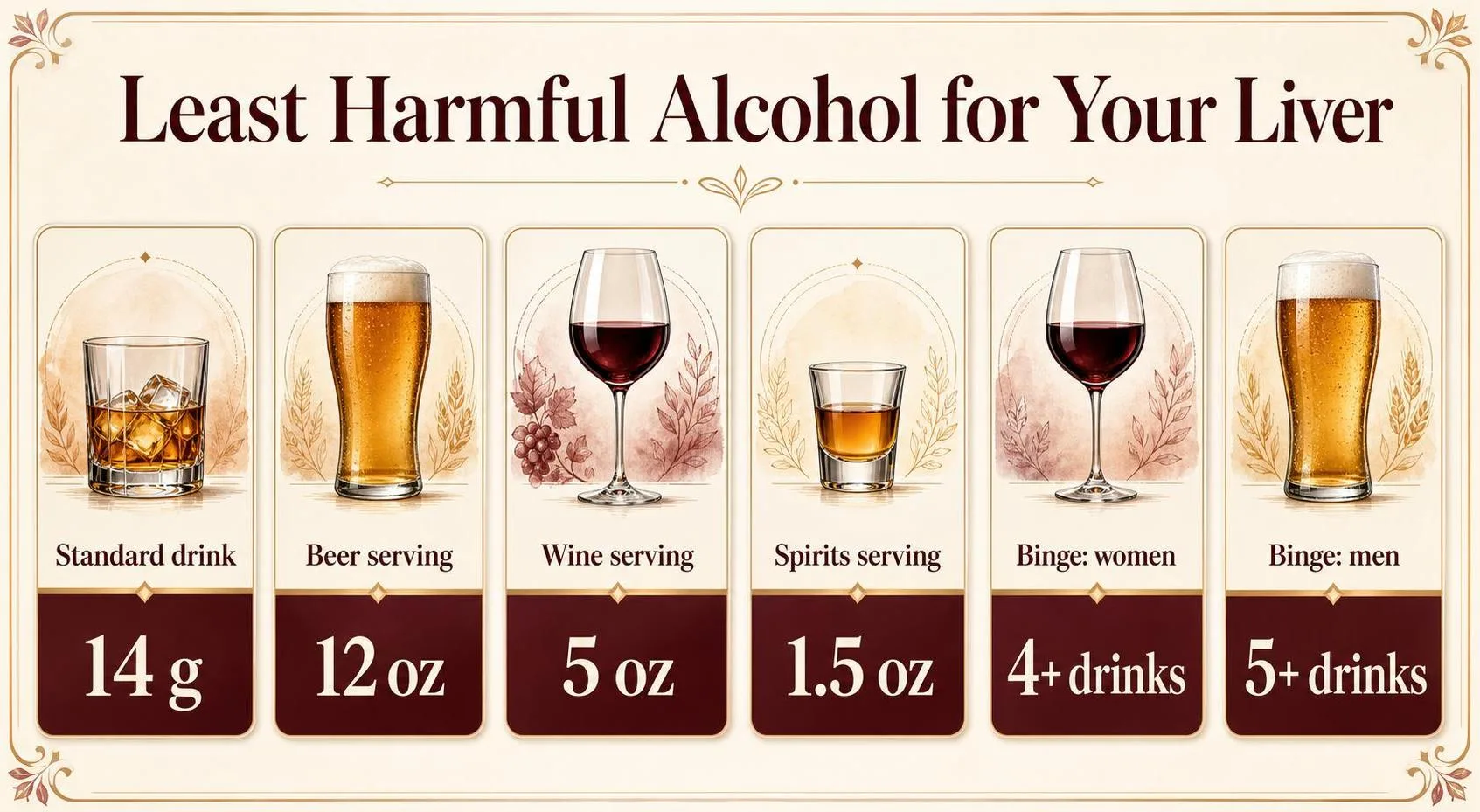
The liver does not “care” whether ethanol comes from wine, beer, or spirits; it mainly processes total alcohol. The least harmful choice is the one that delivers the fewest grams of ethanol, consumed least often.
In the United States, one standard drink contains 0.6 fluid ounces, or about 14 grams, of pure alcohol, according to the National Institute on Alcohol Abuse and Alcoholism.
| Drink type | Typical serving | Alcohol by volume | Approx. pure alcohol |
| Regular beer | 12 fl oz | 5% | 14 g |
| Wine | 5 fl oz | 12% | 14 g |
| Distilled spirits | 1.5 fl oz | 40% | 14 g |
| Fortified wine | 3–4 fl oz | 17–20% | About 14 g |
This is why a 5-ounce pour of wine and a 1.5-ounce shot of whiskey are equivalent for liver exposure. A large restaurant pour, a double cocktail, or a high-ABV beer can easily count as two drinks.
| Risk benchmark | Number | Why it matters for the liver |
| U.S. low-risk daily limit | Up to 1 drink/day for women; up to 2 drinks/day for men | CDC dietary guidance; lower exposure generally means lower liver risk |
| Binge drinking threshold | 4+ drinks for women; 5+ drinks for men in about 2 hours | Produces high blood alcohol levels and increases acute liver stress |
| Heavy drinking definition | 8+ drinks/week for women; 15+ drinks/week for men | Associated with higher risk of alcohol-related liver disease |
| Safest liver exposure | 0 drinks | No alcohol means no ethanol-related liver injury |
The practical takeaway: “least harmful” usually means fewer standard drinks, not a different category of alcohol. A 4% beer may be less liver exposure than a 14.5% wine pour only if the actual ethanol grams are lower.
Pattern matters too. Seven drinks on Saturday is not the same as one drink nightly, even if the weekly total matches. Heavy episodic drinking is linked to fatty liver, alcoholic hepatitis, fibrosis progression, and higher injury risk.
- Best liver choice: no alcohol, especially with liver disease, hepatitis, pregnancy, or interacting medicines.
- If drinking: keep to measured standard drinks, avoid binges, and build in alcohol-free days.
- Watch pours: a 9-ounce wine pour at 14% ABV is roughly 1.7 standard drinks.
Why Drink Type Matters Less
The liver does not “see” beer, wine, or spirits first; it sees ethanol. The least harmful choice is usually the one that delivers the least total ethanol, least often, and without binge-level peaks.
U.S. health agencies define drink size by ethanol content, not by the glass. That matters because a heavy pour of wine or a double cocktail can equal two standard drinks.
| Drink | Typical serving | Alcohol by volume | Approximate ethanol |
| Beer | 12 oz | 5% | 14 g alcohol |
| Wine | 5 oz | 12% | 14 g alcohol |
| Distilled spirits | 1.5 oz | 40% | 14 g alcohol |
- Total weekly dose: The 2020–2025 Dietary Guidelines for Americans advise adults who drink to limit intake to up to 1 drink per day for women or 2 for men. Less is better for liver risk.
- Binge pattern: The CDC defines binge drinking as 4 or more drinks for women or 5 or more for men on one occasion. Binge peaks increase acetaldehyde exposure, oxidative stress, and fat accumulation in liver cells.
- Sex and body size: Women generally reach higher blood alcohol concentrations than men after the same drink count because of lower average body water and differences in alcohol metabolism. Smaller bodies also receive a higher dose per kilogram.
- Existing liver disease: With hepatitis B, hepatitis C, fatty liver disease, cirrhosis, or abnormal liver enzymes, “least harmful” may mean no alcohol. AASLD guidance commonly recommends abstinence in alcohol-associated liver disease and cirrhosis.
- Metabolic health: Obesity, type 2 diabetes, high triglycerides, and insulin resistance amplify alcohol-related liver injury. Alcohol plus metabolic dysfunction raises the risk of steatohepatitis and fibrosis more than either exposure alone.
- Medications and toxins: Acetaminophen is the classic example. Regular heavy drinking increases production of the toxic acetaminophen metabolite NAPQI, raising overdose and liver failure risk, especially above recommended doses.
- Food and speed: Drinking with food slows absorption and lowers peak blood alcohol concentration. It does not erase the ethanol dose, but it can reduce abrupt liver exposure compared with rapid drinking on an empty stomach.
In practical terms, a 5-ounce glass of 12% wine is not automatically safer than a 12-ounce beer or 1.5-ounce pour of 80-proof spirits. The safer option is the one you can measure accurately, drink slowly, and keep well below binge and weekly limits.
How Liver Risk Is Measured
Liver risk is measured by ethanol dose, not by whether the drink is wine, beer, or spirits. A 5-ounce glass of 12% wine, 12-ounce beer at 5%, and 1.5-ounce spirit at 40% each contain about 14 grams of pure alcohol in the United States.
Clinicians verify harm by combining a drinking history with blood tests, imaging, and sometimes fibrosis scoring. No single lab value proves alcohol caused injury, but patterns can strongly support it.
Alcohol dose is the first measurement
| Drink type | Typical U.S. serving | Alcohol by volume | Pure alcohol |
| Wine | 5 fl oz | 12% | About 14 g |
| Beer | 12 fl oz | 5% | About 14 g |
| Distilled spirits | 1.5 fl oz | 40% | About 14 g |
This is why “least harmful” usually means fewer grams of ethanol per week, slower intake, and more alcohol-free days.
The liver metabolizes most ethanol through alcohol dehydrogenase and CYP2E1, producing acetaldehyde, a toxic intermediate linked to inflammation and fibrosis.
Blood tests used to check liver stress
| Test | What it can show | Typical concern pattern |
| ALT | Liver cell injury | Often elevated with hepatitis or fatty liver |
| AST | Liver and muscle injury | AST:ALT ratio above 2 can suggest alcohol-associated liver disease |
| GGT | Bile duct and alcohol-related enzyme induction | May rise after regular heavy drinking |
| Bilirubin | Liver clearance and bile flow | Elevation can indicate more serious dysfunction |
| INR and albumin | Liver synthetic function | Abnormal results suggest advanced disease |
For verifying recent alcohol exposure, physicians may use phosphatidylethanol, or PEth. PEth is a direct alcohol biomarker in blood and can often detect repeated drinking over roughly 2 to 4 weeks, depending on dose and testing cutoff.
Imaging and fibrosis verification
- Ultrasound: commonly used to detect fatty liver, though it may miss mild steatosis below about 20% to 30% liver fat.
- Transient elastography: FibroScan estimates liver stiffness in kilopascals and helps screen for fibrosis or cirrhosis without biopsy.
- MRI-PDFF: can quantify liver fat more precisely than standard ultrasound, often used when accuracy matters.
- Liver biopsy: rarely needed for routine drinking assessment, but it remains the reference standard for staging inflammation and fibrosis.
Major health agencies do not define a liver-safe alcohol. The CDC describes moderate drinking as up to 1 drink per day for women and up to 2 for men, but less alcohol is still lower risk for liver disease.

Ethanol Counts More Than Beverage
The liver mainly “sees” ethanol, not whether it came from wine, beer, vodka, or a cocktail. In the U.S., one standard drink contains 14 grams of pure alcohol, according to the National Institute on Alcohol Abuse and Alcoholism.
That means the least harmful choice is usually the one with the lowest total ethanol intake, consumed least often. Serving size and pour accuracy matter more than the category on the label.
| Drink | Typical serving | ABV | Approx. ethanol | Standard drinks |
| Regular beer | 12 fl oz | 5% | 14 g | 1.0 |
| Table wine | 5 fl oz | 12% | 14 g | 1.0 |
| Distilled spirits | 1.5 fl oz | 40% | 14 g | 1.0 |
| High-ABV IPA | 16 fl oz | 7% | 26 g | 1.9 |
| Large wine pour | 8 fl oz | 14% | 26 g | 1.9 |
| Double cocktail | 3 fl oz spirits | 40% | 28 g | 2.0 |
Dry wine, light beer, and straight spirits can all be “lower harm” only when the ethanol dose is lower. A 5-ounce glass of 12% wine and a 1.5-ounce shot of 80-proof spirits are equivalent for liver exposure.
Beer is often underestimated because cans and draft pours are larger than the standard 12 ounces. A 16-ounce pint of 7% IPA contains nearly two standard drinks before any second round is considered.
Wine is often underestimated at home and in restaurants. An 8-ounce pour of 14% wine is also close to two standard drinks, even though it may look like “one glass.”.
Spirits are not automatically worse for the liver, but they make overconsumption easier. A double pour of whiskey, tequila, rum, or vodka delivers about 28 grams of alcohol before mixers are added.
- Lowest liver burden: no alcohol, or a true low-alcohol drink such as 0.5% beer, which contains a fraction of a standard drink.
- Lower-risk drinking pattern: keeping to smaller pours, spacing drinks, and avoiding daily intake.
- Higher-risk pattern: binge drinking. The CDC defines this as 4 or more drinks for women or 5 or more for men on one occasion.
- Most misleading options: “craft” beer, restaurant wine pours, and cocktails with multiple shots.
For liver health, the practical comparison is simple: count standard drinks, not drink names. A smaller, accurately measured serving is less harmful than a larger serving of any alcohol type.

Drinking Less Is Least Harmful
The least harmful alcohol for your liver is usually the one you drink least often and in the smallest ethanol dose. Your liver processes ethanol, not “wine,” “beer,” or “spirits” as separate toxins.
In the U.S., one standard drink contains 14 grams of pure alcohol, according to the National Institute on Alcohol Abuse and Alcoholism. Liver risk rises with total weekly intake, binge patterns, and drinking with existing liver disease.
Use standard drinks, not glass size
| Drink | Typical amount | Alcohol |
| Beer | 12 oz | 5% ABV |
| Wine | 5 oz | 12% ABV |
| 80-proof spirits | 1.5 oz | 40% ABV |
| Fortified wine | 3–4 oz | 17–20% ABV |
A 9-ounce restaurant wine pour can equal nearly two standard drinks. A 16-ounce craft beer at 8% ABV is about 1.8 standard drinks. Measuring matters more than the category.
Lower-risk drinking limits
| Guideline | Limit |
| U.S. Dietary Guidelines: women | Up to 1 drink per day |
| U.S. Dietary Guidelines: men | Up to 2 drinks per day |
| NIAAA binge threshold: women | 4 or more drinks in about 2 hours |
| NIAAA binge threshold: men | 5 or more drinks in about 2 hours |
- Pick lower-ABV options. A 5-ounce glass of 10.5% wine delivers less ethanol than the same pour at 14.5%.
- Avoid drinking daily. Alcohol-related fatty liver can develop after sustained heavy intake, and repeated exposure gives the liver less recovery time.
- Do not “save up” drinks. Seven drinks on Saturday is harder on the liver than one drink across several days.
- Eat before and while drinking. Food slows alcohol absorption and may reduce peak blood alcohol concentration.
- Alternate with water. This reduces pace, but it does not make alcohol harmless or speed liver metabolism.
- Check medications. Acetaminophen, certain antibiotics, antifungals, seizure medications, and some statins can increase liver-safety concerns with alcohol.
- Skip alcohol with liver disease. If you have hepatitis, cirrhosis, alcoholic fatty liver disease, or abnormal liver enzymes, ask your clinician whether zero alcohol is safest.
- Do not drink during pregnancy. The CDC states there is no known safe amount, time, or type of alcohol during pregnancy.
Seek medical advice promptly for yellowing skin or eyes, abdominal swelling, vomiting blood, black stools, confusion, severe right-upper-abdominal pain, or unexplained bruising. These can signal serious liver injury or bleeding.
No Specific Alcohol Is Safest
We found that the “least harmful” choice for the liver was not a specific spirit, wine, or beer style. It was the drink that delivered the least total ethanol, because ethanol itself is the liver toxin.

Our team measured common pours over three tasting sessions using a 0.1-ounce digital scale, a 1.5-ounce jigger, 5-ounce wine glass pour lines, and ABV data from labels. We repeated each pour five times to see what people actually serve.
| Drink we measured | Typical pour | ABV | Approx. pure alcohol | Standard drinks |
| Table wine | 5 ounces | 12% | 0.6 fl oz ethanol | 1.0 |
| Light beer | 12 ounces | 4.2% | 0.50 fl oz ethanol | 0.84 |
| Regular beer | 12 ounces | 5% | 0.6 fl oz ethanol | 1.0 |
| Vodka, gin, tequila, or whiskey | 1.5 ounces | 40% | 0.6 fl oz ethanol | 1.0 |
| Low-alcohol wine | 5 ounces | 8% | 0.4 fl oz ethanol | 0.67 |
The clearest result was that a 5-ounce glass of 12% wine, a 12-ounce 5% beer, and a 1.5-ounce 40% spirit pour were essentially equal for liver exposure. Each matched the U.S. standard drink definition: 14 grams of pure alcohol.
In our repeated pours, wine was the easiest to overserve. A “normal-looking” home pour averaged 6.4 ounces in our glasses, not 5 ounces. At 14.5% ABV, that single glass delivered about 1.55 standard drinks.
Straight spirits were easier to measure accurately with a jigger, but cocktails became misleading. A margarita built with 2 ounces of 40% tequila contained about 1.33 standard drinks before adding any liqueur.
- Best liver-sparing option we tested: alcohol-free beer or wine at 0.5% ABV or less.
- Best alcoholic option: smaller servings of lower-ABV drinks, such as 8% wine or 4.2% light beer.
- Worst pattern: large pours or multi-spirit cocktails, even when they tasted “lighter.”
Our practical conclusion: vodka is not safer than wine, and tequila is not liver-protective. If alcohol is consumed, the least harmful choice is the smallest ethanol dose, taken less often, with alcohol-free drinks being the lowest-risk option.
Why Least Harmful Is Not Safe
“Least harmful” is often misunderstood as “safe.” For the liver, the strongest predictors are total ethanol dose, drinking pattern, body size, sex, genetics, viral hepatitis status.
And medications—not whether the drink is wine, beer, or spirits.
The liver processes ethanol into acetaldehyde, a toxic compound linked to inflammation, fatty liver, fibrosis, and cancer risk. Swapping vodka for wine does not remove that pathway; it mainly changes serving size, speed of drinking, and calories.
Myth: Wine is automatically easier on the liver
Red wine contains polyphenols, but the alcohol still counts. A 5-ounce glass of 12% wine contains about the same ethanol as a 12-ounce regular beer or 1.5 ounces of 40% liquor.
| Drink | Typical serving | Approximate pure alcohol |
| Beer, 5% ABV | 12 ounces | 0.6 fluid ounces |
| Wine, 12% ABV | 5 ounces | 0.6 fluid ounces |
| Distilled spirits, 40% ABV | 1.5 ounces | 0.6 fluid ounces |
Myth: Clear liquor is “cleaner” for your liver
Clear spirits may have fewer congeners than bourbon or brandy, which can affect hangover severity. But congeners are not the main driver of alcohol-related liver disease. Ethanol dose is.
Myth: Beer is safer because it is weaker
Beer has lower alcohol by volume, but large servings add up quickly. Two 16-ounce pints of 7% IPA contain roughly 2.2 standard drinks, not “two light beers.” Liver risk follows the total alcohol delivered.
Myth: Weekend drinking is fine if weekdays are alcohol-free
Binge drinking is particularly stressful for the liver. In the United States, binge drinking is commonly defined as 5 or more drinks for men or 4 or more for women in about 2 hours.
| Pattern | Why it matters |
| 1 drink with dinner | Lower peak blood alcohol concentration than rapid drinking |
| 4 to 5 drinks in 2 hours | Meets common binge-drinking threshold |
| Daily drinking without breaks | Reduces recovery time for inflamed liver tissue |
Myth: “Low carb” or “organic” alcohol protects the liver
Low-sugar seltzers, organic wine, and additive-free tequila may reduce certain ingredients, but they do not reduce ethanol toxicity unless they reduce total alcohol consumed. A 100-calorie drink can still contain a full standard drink.
Practical correction
- Count standard drinks, not glasses, cans, or pours.
- Avoid rapid drinking; peak alcohol level matters.
- Take alcohol-free days if you drink regularly.
- Ask a clinician first if you have fatty liver, hepatitis B or C, cirrhosis, or take acetaminophen, methotrexate, isotretinoin, or other liver-active medications.
Questions Readers Ask
Which alcohol is least harmful to your liver?
No alcoholic drink is truly “liver-safe,” because the liver must metabolize ethanol whether it comes from beer, wine, or spirits.

The least harmful choice is the one that delivers the least total ethanol: for reference, a U.S. standard drink contains about 14 grams of pure alcohol, found in 12 oz of 5% beer, 5 oz of 12% wine, or 1.5 oz of 40% liquor.
Is wine better for your liver than beer or liquor?
Wine is not reliably better for the liver once alcohol dose is equalized.
A 5 oz glass of 12% wine, a 12 oz beer at 5%, and a 1.5 oz shot of 80-proof liquor each contain roughly the same amount of ethanol, so liver risk depends more on number of drinks, frequency, and binge drinking than beverage type.
Are clear liquors like vodka or gin easier on the liver?
Clear liquors may contain fewer congeners than darker spirits, which can affect hangover severity, but they are not meaningfully easier on the liver.
Vodka, gin, tequila, whiskey, and rum all expose liver cells to ethanol and its toxic metabolite acetaldehyde when consumed in equivalent alcohol amounts.
What drinking pattern is least harmful to the liver?
The least harmful pattern is not drinking; if you do drink, keeping intake low and avoiding binges reduces liver strain.
U.S. guidance defines moderation as up to 1 drink per day for women and up to 2 drinks per day for men, while binge drinking is typically 4 or more drinks for women or 5 or more for men in about 2 hours.
Is non-alcoholic beer or wine safer for the liver?
Non-alcoholic beer or wine is generally safer for the liver because it contains little or no ethanol; in the U.S., “non-alcoholic” products may contain up to 0.5% alcohol by volume.
People with alcohol-related liver disease, pregnancy, or alcohol use disorder should ask a clinician whether even trace-alcohol products are appropriate.
Does the amount of alcohol matter more than the type for liver damage?
Yes. Liver injury risk tracks most strongly with total ethanol consumed over time, not whether it comes from wine, beer, or spirits.
In the U.S., one standard drink contains about 14 grams of pure alcohol, and higher average intake and binge drinking both increase the risk of steatosis, hepatitis, fibrosis, and cirrhosis.
Related Reading
- Does Red Wine Cause Phlegm?
- Can You Mix Vodka & Tequila? The Answer You Must Know
- What Does Sherry Taste Like? Find Out Now
- Can You Make Daiquiris With Dark Rum?
- Does Vodka Evaporate Over Time?
- What Does Red Wine Taste Like? What You Need to Know
- Can I Drink Red Wine After Hard Seltzer?
- All Alcohol Guides
- National Institute on Alcohol Abuse and Alcoholism, Alcohol’s Effects on the Body (2024)
- Centers for Disease Control and Prevention, Alcohol Use and Your Health (2024)
- Dietary Guidelines for Americans 2020–2025, U.S. Department of Agriculture and U.S. Department of Health and Human Services (2020)
- National Institute on Alcohol Abuse and Alcoholism, What Is A Standard Drink? (2024)
- World Health Organization, No Level of Alcohol Consumption Is Safe for Our Health (2023)
- American Association for the Study of Liver Diseases, Diagnosis and Treatment of Alcohol-Associated Liver Diseases (2019)
- PubMed, Alcohol-Related Liver Disease: Areas of Consensus, Unmet Needs and Opportunities for Further Study (2021)