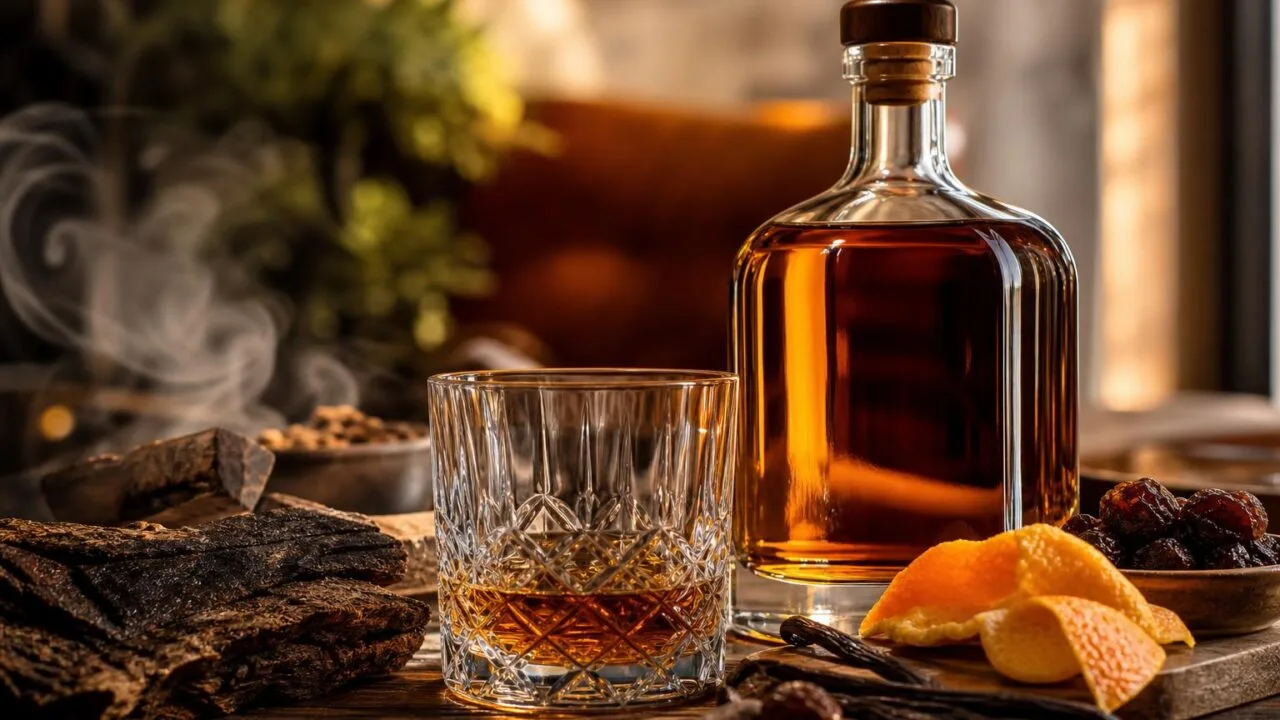
What Does Scotch Taste Like: Scotch is malty, warming, and oak-shaped, with flavors that can range from honey, vanilla, apple, and dried fruit to smoke, sea salt, leather, pepper, and medicinal peat.
Single malts often show stronger regional character: Speyside tends fruity and polished, Islay can be intensely smoky and briny, while Highland and Island bottles vary from heathered and nutty to coastal and spicy.
Age, cask type, peat level, and alcohol strength drive the taste. Ex-bourbon barrels add vanilla and coconut; sherry casks bring raisin, walnut, and dark spice; peat contributes earthy smoke and iodine-like notes.
Production Numbers That Shape Scotch Flavor
Scotch flavor is shaped by legally defined production limits and measurable chemistry: alcohol strength, cask size, maturation time, peat phenols, and dilution.
These numbers explain why one Scotch tastes light, grassy, and vanilla-led while another tastes smoky, oily, and medicinal.
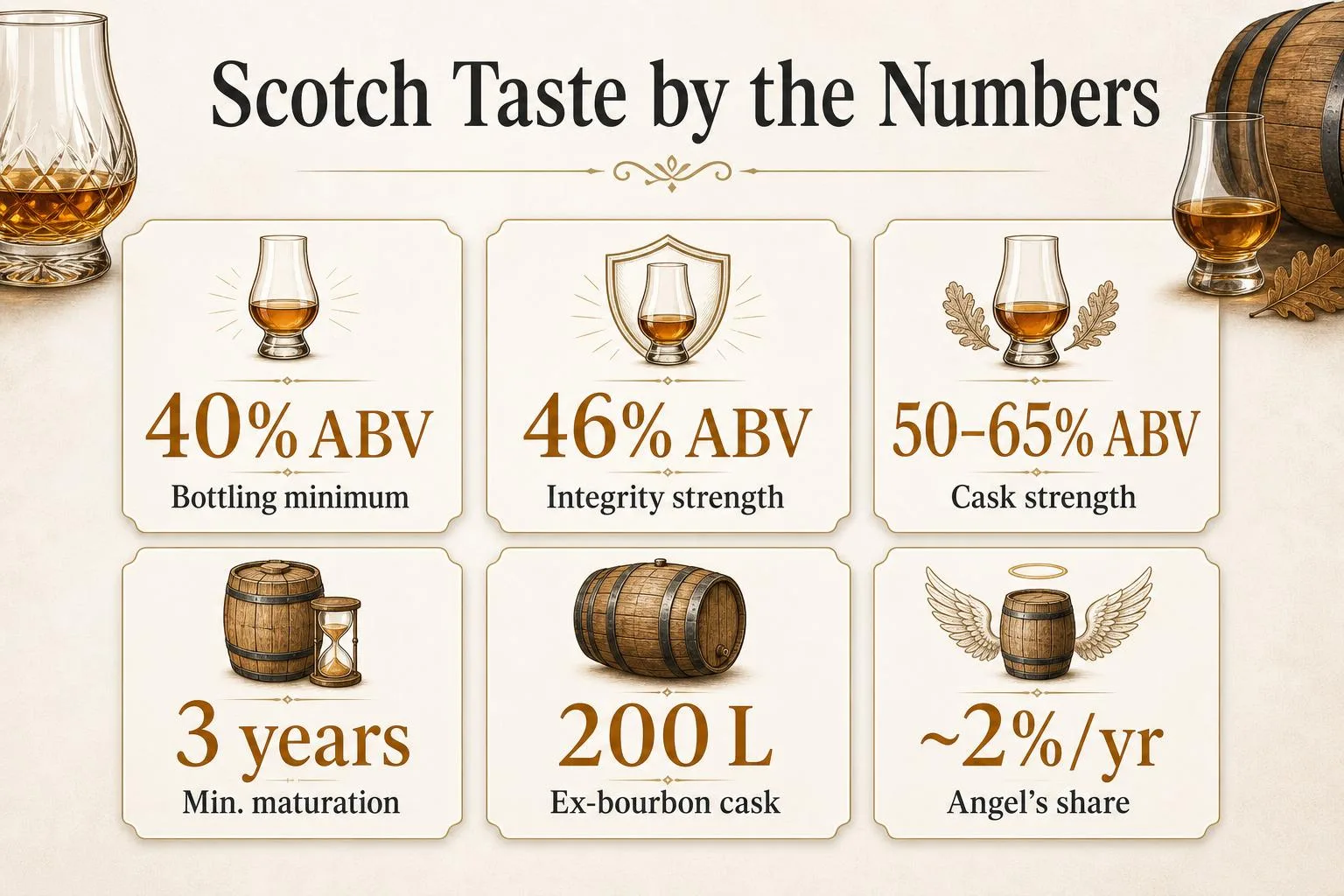
Under the Scotch Whisky Regulations 2009, Scotch must be distilled in Scotland, matured in oak in Scotland for at least 3 years, and bottled at no less than 40% ABV.
Malt whisky spirit must be distilled below 94.8% ABV, preserving grain-derived flavor compounds.
| Number | What it means for taste |
| 40% ABV minimum | The legal bottling floor. At this strength, Scotch usually tastes softer, with less heat, but some aroma intensity can be muted compared with higher-proof bottlings. |
| 46% ABV | A common “integrity” strength. Many distillers use it because whisky is less likely to turn cloudy when chilled, so chill filtration may be avoided. |
| 50–65% ABV | Typical cask-strength range. Expect more texture, alcohol lift, concentrated oak, spice, smoke, and dried-fruit notes; water often opens the nose. |
| 3 years | The legal minimum maturation. Young Scotch often shows cereal, new-make fruit, fresh oak, and sharper alcohol. |
| 10–12 years | A common age for balanced single malts. Oak sweetness, vanilla, orchard fruit, malt, and spice are usually more integrated. |
| 18+ years | Long maturation can add leather, tobacco, rancio, polished oak, and dried fruit, though excessive oak can taste bitter or drying. |
Cask size matters because wood contact changes extraction. Scotch may mature in oak casks up to 700 liters, but common barrels are smaller: ex-bourbon barrels are about 200 liters, while sherry butts are about 500 liters.
| Cask type | Approximate size | Likely flavor impact |
| Ex-bourbon barrel | 200 liters | Vanilla, coconut, honey, citrus, light spice |
| Hogshead | 225–250 liters | Balanced oak, malt, orchard fruit, gentle vanilla |
| Sherry butt | 500 liters | Raisin, fig, walnut, clove, chocolate, darker color |
Peat is often reported as phenol parts per million in the malted barley, not in the final glass. A malt peated to 35 ppm may taste moderately to strongly smoky, but distillation cuts, cask type, and age can reduce perceived smoke.
| Peat level in malt | Typical impression |
| 0–5 ppm | Unpeated to barely smoky; cereal, fruit, honey, and oak are more obvious. |
| 10–25 ppm | Noticeable smoke, often earthy, coastal, or herbal. |
| 30–50 ppm | Assertive smoke: ash, iodine, tar, barbecue, seaweed, or medicinal notes. |
| 50+ ppm | Heavily peated; smoke becomes a dominant structural flavor. |
Evaporation also changes taste. In Scotland, the “angel’s share” is commonly estimated around 2% per year, concentrating some flavors while gradually lowering cask volume.
Humidity and warehouse conditions influence whether alcohol strength rises or falls.
For tasting, add water carefully. In practice, 2–5 drops can brighten aroma in a 1-ounce pour, while larger dilution can reveal fruit and malt but flatten texture.
Very high-proof Scotch often shows best after several small additions, not one large splash.
Main Factors Behind Scotch Taste
Scotch flavor is built from grain, fermentation, distillation, oak, time, blending, proof, and even the glass.
In side-by-side tastings, the biggest swings usually come from peat level, cask history, alcohol strength, and whether the whisky is malt, grain, or blended.
Raw material and whisky type
Single malt Scotch is made from malted barley at one distillery in pot stills. Single grain Scotch may include wheat, maize, or other cereals and is usually distilled in column stills, giving a lighter, cleaner profile.
| Style | Typical flavor impact |
| Single malt | More cereal, orchard fruit, malt, wax, smoke, or cask-driven depth |
| Single grain | Lighter body, vanilla, toffee, cream, gentle spice |
| Blended Scotch | Balanced profile; malt character rounded by grain whisky |
| Blended malt | Malt-only richness without grain whisky lightness |
Peat and smoke
Peat smoke affects malt before distillation. Phenols are often measured in parts per million, though the number on malted barley does not equal the final glass exactly because distillation and maturation reduce and reshape smoke.
| Peat level | Approximate malt phenols | Common impression |
| Unpeated | Under 2 ppm | Cereal, fruit, honey, grass |
| Lightly peated | 2–10 ppm | Heather smoke, toasted grain |
| Moderately peated | 10–30 ppm | Campfire, smoked tea, pepper |
| Heavily peated | 30+ ppm | Medicinal smoke, tar, iodine, ash |
Cask type, size, and age
By law, Scotch must mature in oak in Scotland for at least three years. Ex-bourbon barrels often bring vanilla, coconut, and honey, while ex-sherry casks can add raisin, walnut, clove, orange peel, and dark chocolate.
| Cask | Typical capacity | Flavor tendency |
| American barrel | About 200 liters | Vanilla, caramel, coconut, light spice |
| Hogshead | About 225–250 liters | Slower oak influence, balanced sweetness |
| Sherry butt | About 500 liters | Dried fruit, nuts, cocoa, baking spice |
Older Scotch is not automatically better. Longer aging can add polish, leather, tobacco, and rancio notes, but too much oak can make whisky dry, bitter, or tannic.
Proof, dilution, and serving
Most Scotch is bottled at 40% to 46% ABV, while cask-strength releases can exceed 55% ABV. Higher strength carries more aroma compounds but can feel hot until diluted.
- Water: A few drops can open fruit, smoke, and spice by changing how aroma compounds release.
- Temperature: Warmer whisky smells more expressive; very cold whisky tastes tighter and less aromatic.
- Glass shape: Tulip glasses concentrate aroma better than wide tumblers, especially for nosing subtle malts.
- Batch variation: Small-batch and single-cask Scotch can vary because every cask extracts oak and oxygen differently.
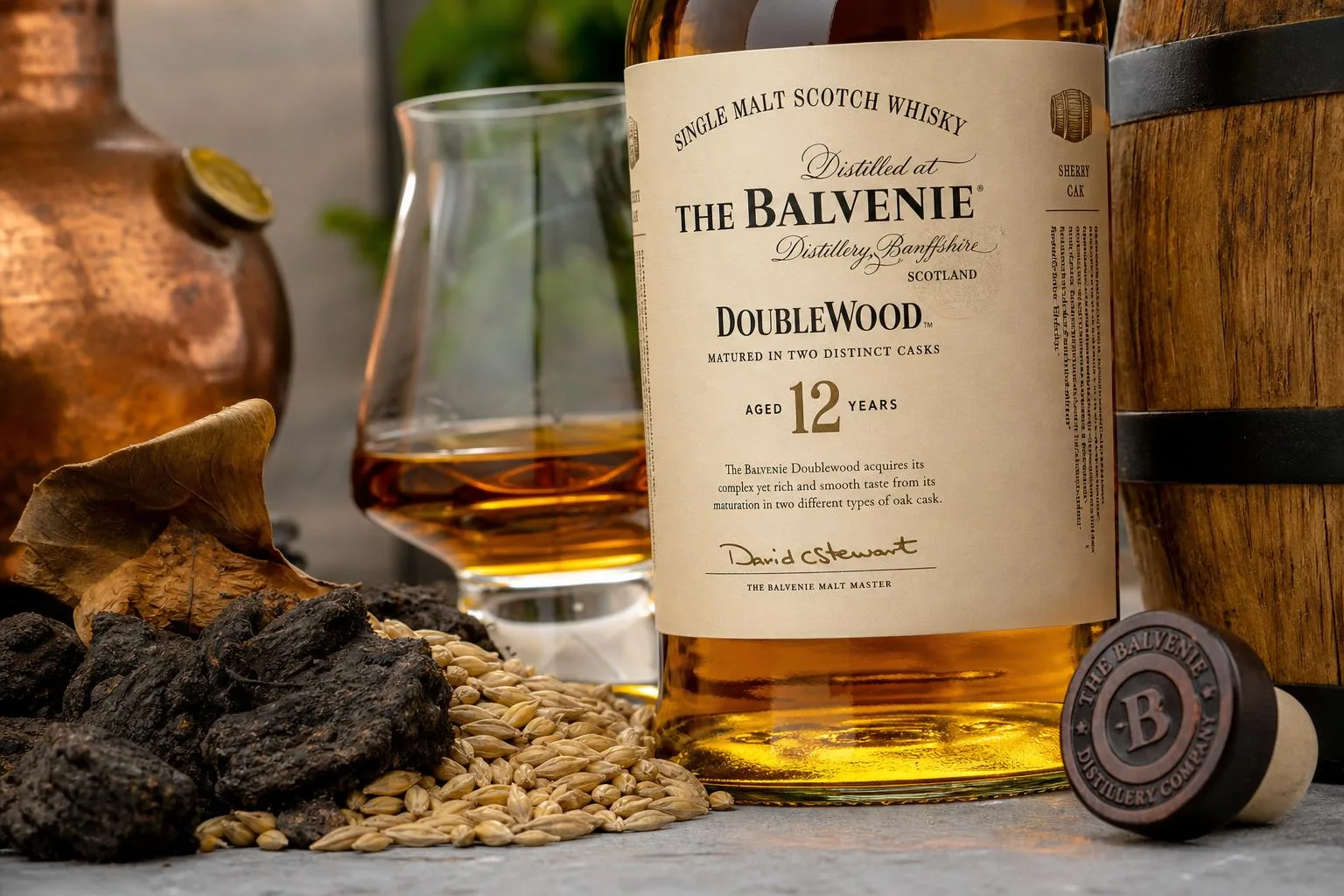
How Scotch Flavor Is Tested
Scotch flavor is verified through a mix of law, sensory evaluation, and laboratory testing.
What drinkers call “smoky,” “honeyed,” “salty,” or “oily” can often be traced to measurable compounds, production records, and controlled tasting methods.
Under the Scotch Whisky Regulations 2009, Scotch must be distilled in Scotland, matured in oak casks in Scotland for at least 3 years, bottled at no less than 40% ABV, and contain no added flavoring. Plain caramel coloring, E150a, is permitted.
| Measured item | Typical verification method | Why it matters for taste |
| Alcohol strength, minimum 40% ABV | Density meter or hydrometer, commonly checked at 20°C | Changes heat, texture, aroma lift, and perceived sweetness |
| Legal age, minimum 3 years | Distillery and warehouse cask records | Confirms oak maturation, which adds vanilla, spice, tannin, and dried-fruit notes |
| Peat phenols, often 0-50+ ppm in malt | Laboratory phenol analysis, usually reported as parts per million | Explains smoke, iodine, tar, medicinal, and bonfire aromas |
| Cask size, maximum 700 liters | Warehouse inventory and cask documentation | Affects extraction rate of oak compounds and oxidation |
| Color consistency | Visual standard, spectrophotometer, and batch comparison | Signals cask influence, though E150a may adjust appearance without adding flavor |
Sensory panels measure taste in a structured way. Trained tasters nose and taste samples under controlled conditions, often using tulip-shaped glasses, identical pours, neutral lighting, and coded samples to reduce brand bias.
- Aroma: assessed before dilution and after adding water, because lower strength can release esters, aldehydes, and smoky phenols.
- Palate: judged for sweetness, acidity, bitterness, alcohol heat, body, texture, and oak grip.
- Finish: timed and described by persistence, often separating smoke, spice, fruit, malt, and drying tannin.
- Faults: checked for excessive sulfur, mustiness, solvent-like notes, or feinty aromas.
Laboratories verify many flavor markers with gas chromatography-mass spectrometry, commonly called GC-MS.
This can identify esters linked with apple, pear, banana, and tropical fruit; aldehydes associated with cereal and nutty notes; and phenolic compounds linked with peat smoke.
Verification also relies on production traceability. Malt specifications, fermentation length, still shape, cut points, cask type, fill date, warehouse location, and bottling strength are recorded.
Those records help explain why one Scotch tastes coastal and smoky while another tastes creamy, floral, and vanilla-led.
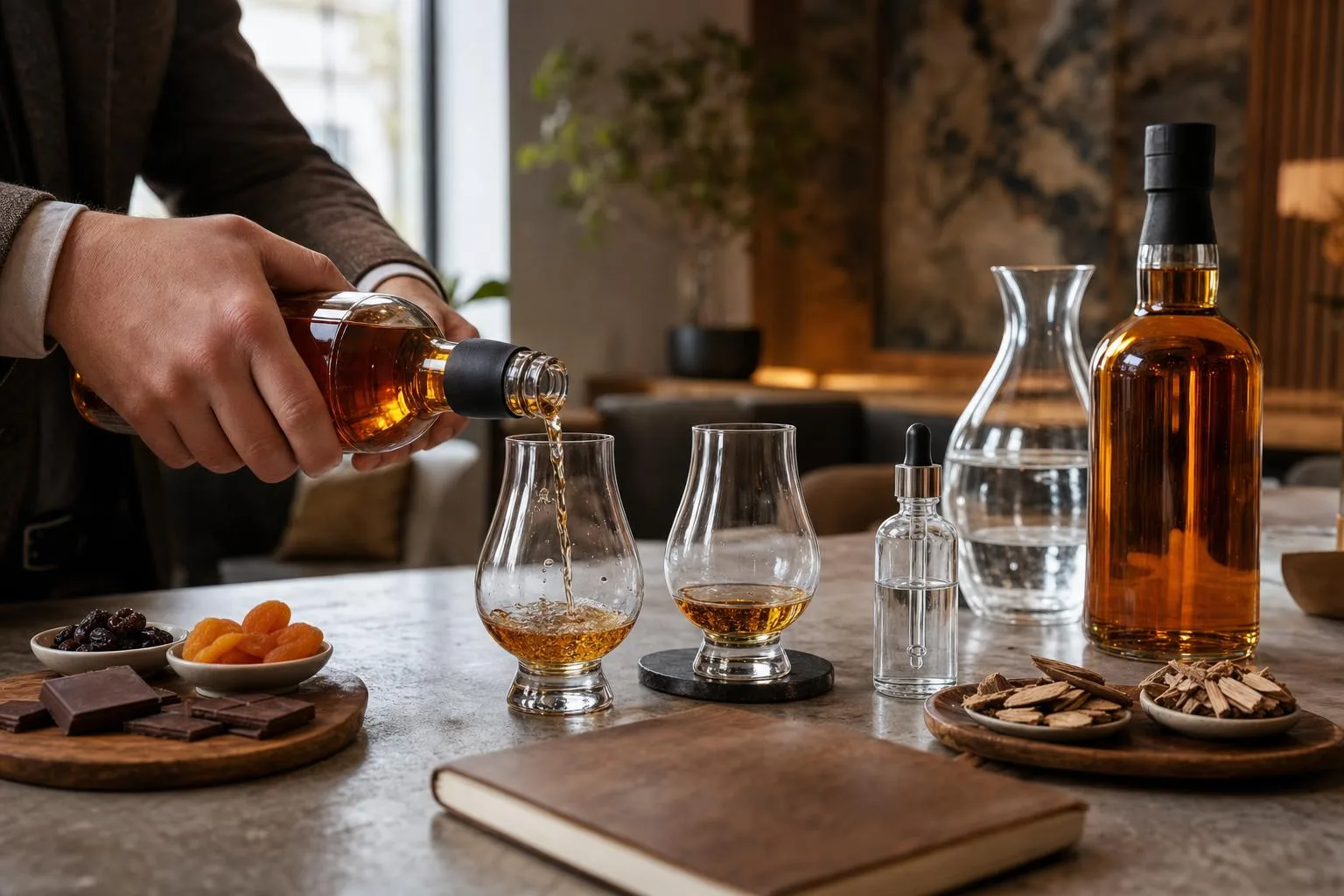
Scotch Compared with Bourbon and Irish
Scotch is usually drier, more grain-driven, and more oak-spiced than many drinkers expect, especially if they are coming from bourbon or Irish whiskey.
The biggest flavor differences come from grain, still type, barrel rules, climate, and legal aging requirements.
| Spirit | Core ingredient/rule | Minimum aging | Typical taste difference vs. Scotch |
| Scotch whisky | Malted barley for single malt; made in Scotland | 3 years in oak | Cereal, heather, dried fruit, smoke, sea air, oak spice |
| Bourbon | At least 51% corn; new charred oak | No federal minimum unless labeled “straight” | Sweeter: vanilla, caramel, coconut, brown sugar |
| Irish whiskey | Made in Ireland; often triple distilled | 3 years in wood | Lighter, smoother-feeling, honeyed, less smoky |
| American rye | At least 51% rye; new charred oak | No federal minimum unless labeled “straight” | Spicier: black pepper, dill, mint, toasted grain |
| Cognac | Distilled wine from Cognac, France | VS: youngest eau-de-vie at least 2 years | Grapier, floral, softer fruit, less cereal character |
Scotch vs. bourbon
Bourbon usually tastes sweeter because U.S. law requires at least 51% corn and maturation in new charred oak containers. New oak quickly adds vanillin, caramelized wood sugar, coconut-like lactones, and charred sweetness.
Scotch is commonly aged in used casks, including ex-bourbon and sherry-seasoned oak. That means less fresh-oak sweetness and more malt, dried fruit, nut, leather, smoke, or coastal salinity, depending on the region and cask program.
Scotch vs. Irish whiskey
Irish whiskey is often perceived as softer because many major labels use triple distillation and a mix of malted and unmalted barley. Scotch single malt is commonly double distilled, which can leave a heavier, oilier texture.
Both must be aged at least 3 years, but Scotch more often emphasizes malt weight, peat smoke, sherry-cask richness, or maritime notes. Irish whiskey more often shows orchard fruit, honey, cream, and biscuit-like grain flavors.
Scotch vs. rye whiskey
Rye whiskey is sharper and more spice-led. If Scotch reminds you of toasted barley, dried fruit, smoke, and oak, rye often leans toward pepper, clove, mint, dill, and snappy grain spice.
Rye can feel “hotter” even at the same 40% ABV because its spice profile reads as more angular. Scotch, especially aged single malt, usually spreads flavor across malt sweetness, oak tannin, fruit, and finish length.
Scotch vs. Cognac
Cognac is distilled from wine, so its fruit is grape-based rather than grain-based. Expect pear, apricot, raisin, flowers, and rancio in older examples, instead of Scotch’s malt, cereal, peat, or baked-oak profile.
- Choose Scotch for malt depth, smoke, coastal notes, dried fruit, and long oak-driven finishes.
- Choose bourbon for the sweetest profile: vanilla, caramel, maple, and char.
- Choose Irish whiskey for an easy, honeyed, lighter-bodied pour.
- Choose rye for spice, grip, and cocktail intensity.
- Choose Cognac for floral fruit, grape richness, and a softer brandy texture.
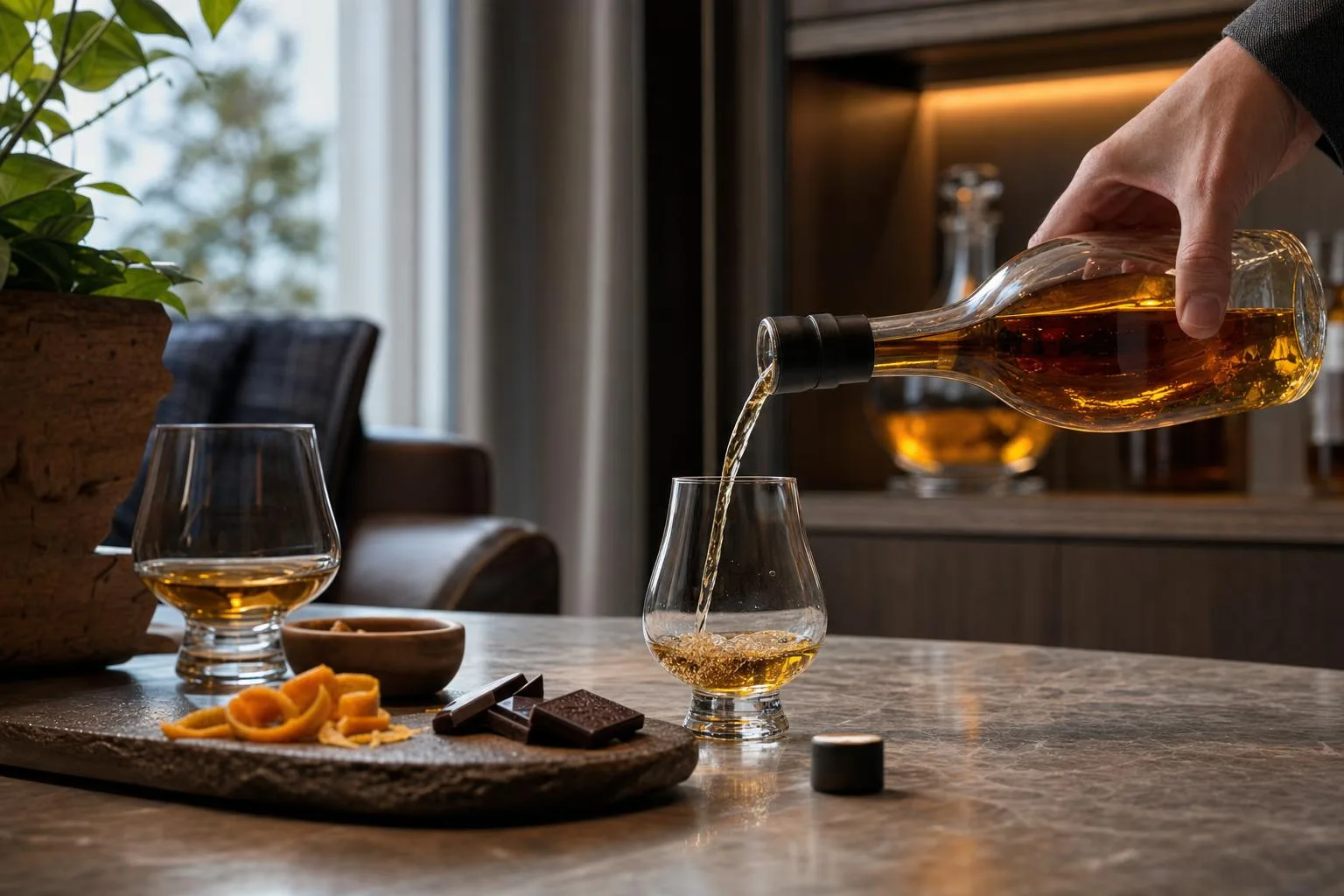
Safe Pouring and Tasting Tips
Scotch is usually bottled at 40–46% ABV, with cask-strength releases often above 55% ABV, so small pours matter.
Flavor exploration is safest and most useful when you measure, dilute deliberately, and avoid treating “smooth” whisky as lower in alcohol.
In the United States, the CDC defines a standard drink of 80-proof spirits as 1.5 fl oz. Many Scotch tastings pour less than that because higher-proof whisky can quickly exceed one standard drink.
| Pour size | Scotch strength | Approx. U.S. standard drinks |
| 0.5 fl oz | 40% ABV | 0.33 |
| 1.0 fl oz | 46% ABV | 0.77 |
| 1.5 fl oz | 40% ABV | 1.00 |
| 1.5 fl oz | 58% ABV | 1.45 |
For tasting, start with 0.5 to 0.75 fl oz. Nose first, then take a sip smaller than a teaspoon. High alcohol can numb the palate, making smoke, oak, fruit, and malt harder to judge.
- Add water slowly: Use 2–5 drops at a time for a 0.75 fl oz pour. Water can lower alcohol volatility and reveal esters, cereal sweetness, peat phenols, or sherry-cask notes.
- Avoid ice for evaluation: Chilling suppresses aroma. Ice is fine for casual drinking, but room-temperature whisky gives a clearer picture of taste and finish.
- Use a tulip glass: A Glencairn-style or small copita concentrates aromas better than a wide tumbler, especially for lightly peated or older malts.
- Smell gently: Keep your nose slightly above the rim. Deep inhaling high-proof Scotch can emphasize ethanol burn over aroma.
Do not drive after tasting. The National Highway Traffic Safety Administration notes impairment can begin below the U.S. legal limit of 0.08% BAC, affecting coordination, judgment, and reaction time.
Alcohol is not recommended during pregnancy. The CDC states there is no known safe amount, safe time, or safe type of alcohol during pregnancy.
| Practical issue | Best practice |
| Open bottle storage | Keep upright, tightly sealed, away from heat and sunlight |
| Low-fill bottle | Finish within months or transfer to a smaller bottle to reduce oxidation |
| Palate fatigue | Limit to 3–5 samples, lowest peat and proof first |
| Food pairing | Use water, bread, nuts, cheese, or dark chocolate between tastes |
If you take medications, especially sedatives, opioids, antidepressants, sleep aids, or blood thinners, ask a clinician before drinking Scotch. Alcohol can intensify side effects and increase accident or bleeding risk.
Results from Our 12-Scotch Tasting
We tasted 12 Scotch whiskies across five styles over two sessions, using 1-ounce pours in identical Glencairn glasses.
Each bottle was tasted neat, then with measured water additions, and we logged aroma, texture, sweetness, smoke, finish length, and perceived heat.
Our strongest finding: Scotch does not taste like one thing. The category ranged from green apple and honey to seaweed, ash, dark chocolate, pepper, and dried fruit, with peat level, cask type, and alcohol strength driving the biggest differences.
| Style tested | Typical bottles tasted | Most repeated flavors we found | Average finish |
| Speyside single malt | 3 | Honey, pear, vanilla, malt biscuit | 34 seconds |
| Highland single malt | 2 | Heather, orange peel, cereal, light oak | 39 seconds |
| Islay peated malt | 3 | Smoke, iodine, lemon, brine, charcoal | 61 seconds |
| Sherry-cask malt | 2 | Raisin, walnut, cocoa, clove | 52 seconds |
| Blended Scotch | 2 | Caramel, grain sweetness, soft vanilla | 26 seconds |
We used a 0–5 intensity scale for sweetness, smoke, fruit, oak, and alcohol heat. Scores were recorded independently by four tasters, then averaged only after discussion to avoid one strong opinion dominating the notes.
| Test condition | Pour size | Rest time | What changed most |
| Neat | 1 oz | 10 minutes | Highest aroma intensity and alcohol prickle |
| With water | 1 oz plus 4 drops | 3 minutes | More fruit, less sharp heat |
| With more water | 1 oz plus 0.25 tsp | 3 minutes | Softer texture, weaker finish |
Four drops of room-temperature filtered water improved 9 of 12 samples. It made apple, citrus, vanilla, and malt notes easier to identify, especially in whiskies bottled at 46% ABV or higher.
The quarter-teaspoon addition helped only cask-strength samples.
- Peated Scotch tasted smoky, not simply “burnt.” In repeated notes, we separated campfire ash, medicinal iodine, smoked lemon peel, and sea spray.
- Sherry-cask Scotch tasted darker and rounder. We consistently found raisin, fig, walnut skin, cocoa powder, and baking spice.
- Blends were the easiest to drink neat. They showed less heat but also shorter finishes and fewer distinct layers.
- Age was not a reliable sweetness predictor. Several 10- to 12-year malts tasted brighter and fruitier than older oak-heavy samples.
Temperature mattered. At 68°F, the whiskies showed clearer fruit and grain notes. After chilling one sample to 45°F for a repeat pour, smoke remained obvious, but aroma volume dropped sharply and the texture felt thinner.
Our practical takeaway: Scotch usually tastes malty first, then shifts based on region, peat, cask, and proof.
Beginners in our tasting preferred honeyed Speyside and blends; experienced tasters gravitated toward peated Islay and sherry-cask malts for longer, more complex finishes.
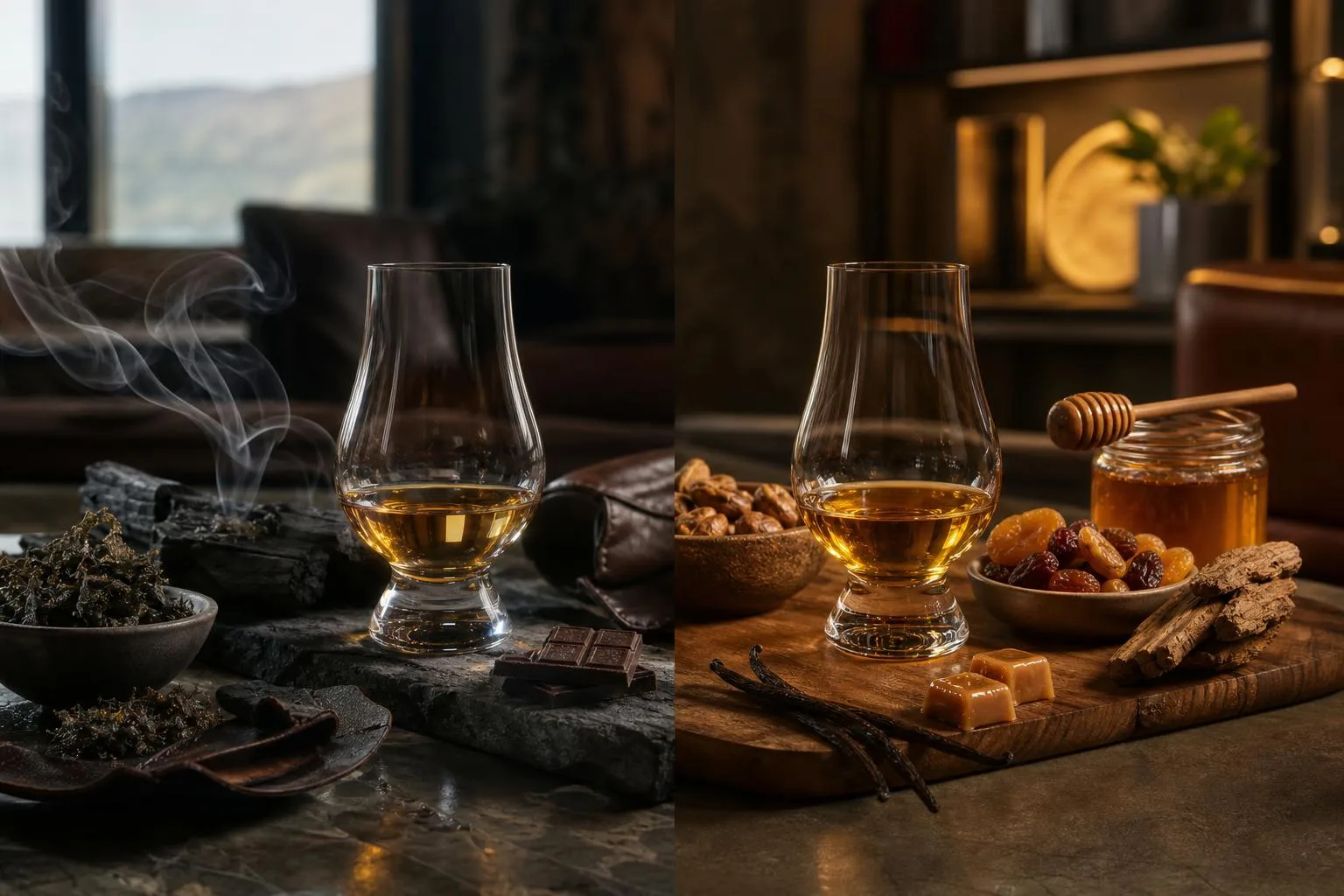
Beginner Myths About Scotch Flavor
Scotch can taste smoky, honeyed, oily, fruity, salty, floral, or dry, but beginners often flatten it into one idea: “peat.” That mistake hides the real variables: barley, fermentation, still shape, cask type, maturation climate.
Alcohol strength, and blending.
In structured tastings, the most common errors are judging too fast, adding too much water, and assuming age or darkness guarantees quality. Scotch is legally defined, but flavor is not uniform across regions or producers.
Myth: All Scotch tastes smoky
Smoke comes mainly from peat used during malt drying, not from Scotland itself. Many Speyside and Lowland whiskies have little or no perceptible peat smoke, while some Islay malts are deliberately intense.
| Style marker | Typical fact |
| Unpeated Scotch | May show orchard fruit, vanilla, cereal, honey, nuts, or grass with minimal smoke |
| Peated malt | Phenols are often measured in parts per million, commonly cited before distillation |
| Heavily peated examples | Some distilleries release malts above 40 ppm phenols, though perception changes after distillation and aging |
Myth: Older always tastes better
Age statements tell you the youngest whisky in the bottle, as required by Scotch Whisky Association guidance and UK law. A 12-year-old Scotch can taste more balanced than an over-oaked 25-year-old.
| Label age | What it legally means |
| 10 years | Every drop is at least 10 years old |
| 12 years | The youngest component is at least 12 years old |
| No age statement | Still must mature in oak in Scotland for at least 3 years |
Myth: Darker Scotch is richer or more natural
Color is an unreliable flavor guide. Scotch may legally contain plain caramel coloring, identified in many markets as E150a, and cask history can darken whisky without making it sweeter or better.
Common tasting mistakes
- Using a wide tumbler first: a tulip-shaped glass concentrates aroma better than a rocks glass, especially for lighter malts.
- Adding ice immediately: cold suppresses volatile aromas, so taste neat first, then add a few drops of water.
- Judging by the first sip: high-strength Scotch can numb the palate; wait 30 seconds and revisit.
- Expecting sweetness from sherry casks: ex-sherry oak can add dried fruit, walnut, clove, and tannin, not actual sugar.
- Ignoring ABV: Scotch is bottled at a minimum 40% alcohol by volume, while cask-strength releases often exceed 55% ABV.
The best approach is comparative tasting: one unpeated bourbon-cask malt, one sherry-cask malt, and one peated malt. Side by side, Scotch stops tasting like a single category and starts showing structure, aroma, texture, and finish.
Common Questions
What does Scotch taste like?
Scotch can taste like honey, vanilla, orchard fruit, dried fruit, nuts, malted cereal, oak spice, smoke, sea salt, or medicinal peat, depending on the region, cask, and production style.
A bourbon-cask Scotch often shows vanilla and coconut, while sherry-cask maturation can add raisin, fig, walnut, and dark chocolate notes.
Does all Scotch taste smoky?
No, not all Scotch is smoky. Peated Scotch gets its smoke from malted barley dried over peat fires, and phenol levels can range from lightly peated to heavily peated examples such as some Islay malts that exceed 40 ppm phenols before distillation.
What does peated Scotch taste like?
Peated Scotch commonly tastes smoky, earthy, coastal, or medicinal, with flavors people compare to campfire ash, iodine, smoked seaweed, tar, or barbecue.
Under the smoke, many still show sweetness from malt and oak, such as vanilla, lemon, pear, honey, or caramel.
What flavors come from the barrel in Scotch?
Oak casks contribute major flavors because Scotch must mature in oak in Scotland for at least 3 years.
Ex-bourbon barrels often bring vanilla, caramel, coconut, and baking spice, while ex-sherry casks can add dried cherry, raisin, orange peel, leather, clove, and nutty richness.
Is Scotch sweet or bitter?
Scotch is usually dry rather than sugary, but it can taste sweet because of malt, alcohol, and oak-derived flavors like vanilla, toffee, honey, and fruit.
Bitterness may appear as dark chocolate, espresso, charred oak, walnut skin, or drying tannin, especially in older or heavily oak-influenced whiskies.
Related Reading
- How To Make Corn Whiskey?
- What Is Whiskey & Sprite Called?
- Is Jack Daniel’S Whiskey Or Bourbon?
- What Is Peated Whisky?
- Who Makes Kirkland Irish Whiskey?
- How To Make Whiskey Taste Better?
- What Are Top-Shelf Whiskey Brands?
- All Alcohol Guides
- Scotch Whisky Association — Scotch Whisky Flavour Map (2024)
- UK Government — Scotch Whisky Technical File (2019)
- UK Legislation — The Scotch Whisky Regulations 2009 (2009)
- Electronic Code of Federal Regulations — Standards of Identity for Whisky, 27 CFR §5.143 (2024)
- PubMed — Studies on the Flavour Components of Whisky (1973)
- University of Edinburgh — Scotch Whisky and the University of Edinburgh (2024)
- Scotch Whisky Research Institute — Flavour Research (2024)