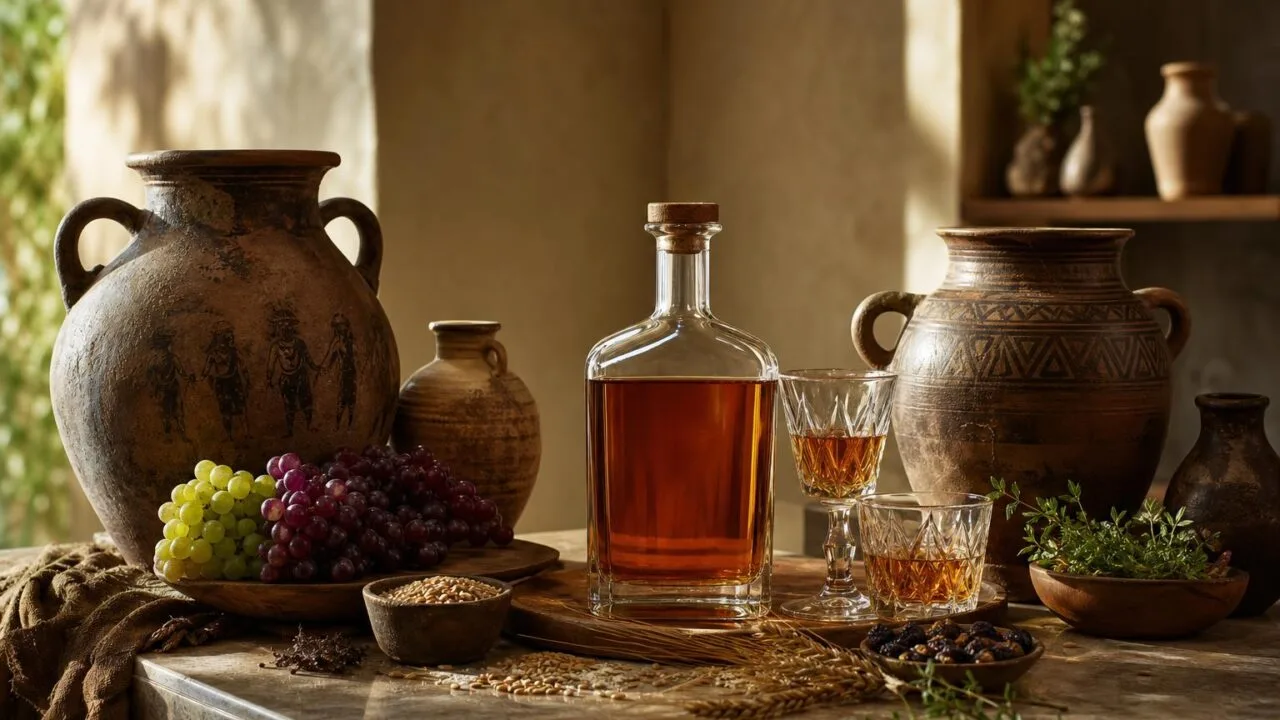
Who invented alcohol is best answered as “no single inventor”: fermented alcohol was discovered independently by prehistoric people when wild yeast converted sugars in fruit, honey, or grain into ethanol.
The oldest firm chemical evidence comes from Jiahu, China, where residues from about 7000–6600 BCE show a fermented drink made with rice, honey, hawthorn fruit, and grapes.
Later, Sumerians, Egyptians, and other early civilizations refined brewing and winemaking into organized crafts.
Natural Fermentation Before Controlled Brewing
No single person “invented” alcohol. Ethanol is made naturally when yeasts ferment sugars, so humans most likely discovered alcoholic liquids before they learned to control production.
The clearest answer comes from archaeology: different societies independently made fermented drinks thousands of years apart, using local sugars such as fruit, honey, rice, barley, maize, agave, and grapes.
| Date or number | What it means | Why it matters |
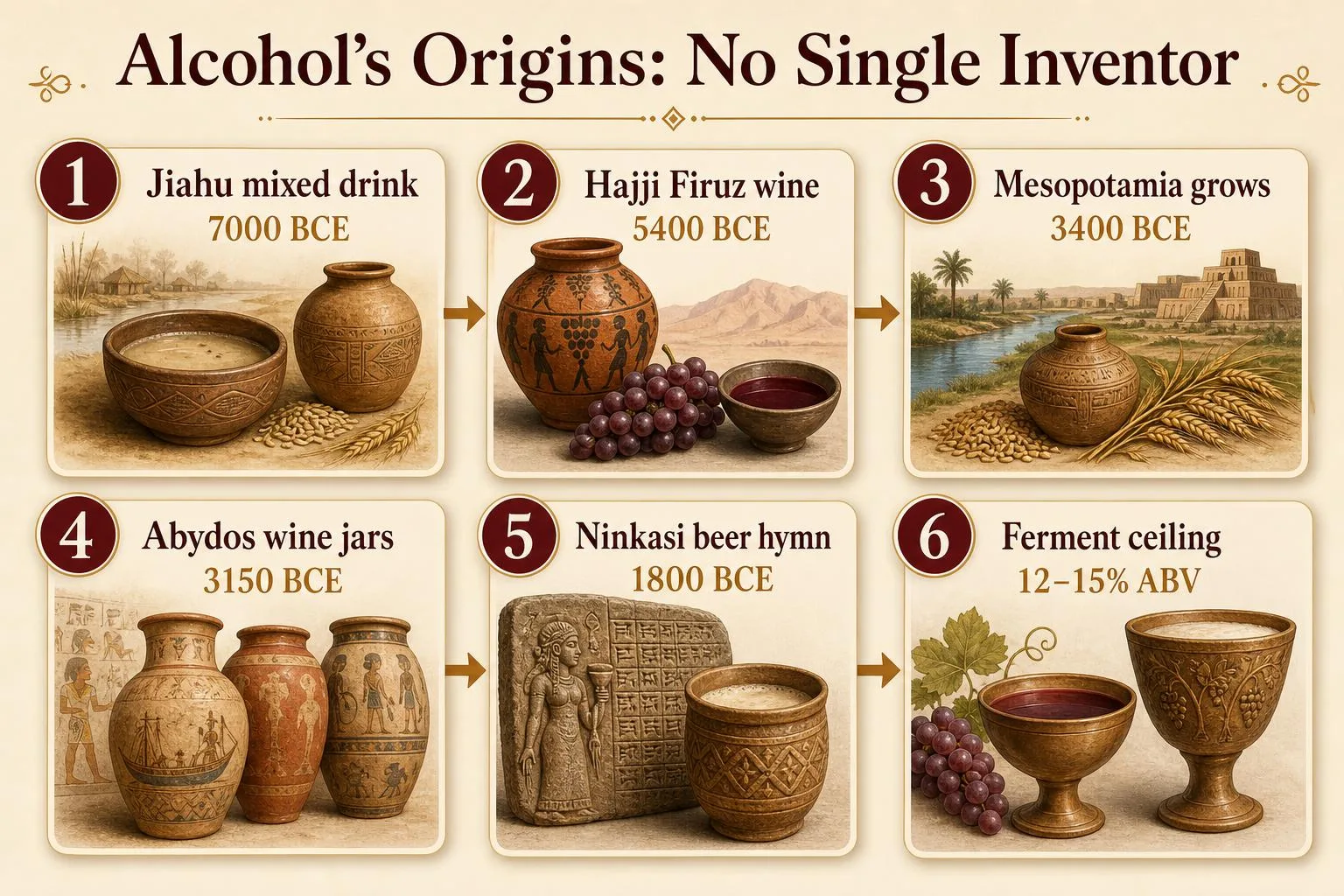
| c. 7000–6600 BCE | Jiahu, China: chemical traces of a mixed fermented drink made from rice, honey, and fruit. | Often cited as the earliest strong archaeological evidence for a deliberately fermented beverage, reported in Proceedings of the National Academy of Sciences. |
| c. 5400–5000 BCE | Hajji Firuz Tepe, Iran: jars with tartaric acid residues linked to grape wine. | Shows early winemaking in the Zagros Mountains; research by Patrick McGovern and colleagues made this site central to wine history. |
| c. 3400–3000 BCE | Godin Tepe, Iran and early Mesopotamian sites: wine and beer evidence expands. | Alcohol had moved beyond accident into storage, trade, ritual, and household production. |
| c. 3150 BCE | Abydos, Egypt: large-scale wine jars in elite tomb contexts. | Indicates wine was already valuable enough for funerary use and long-distance provisioning. |
| c. 1800 BCE | Hymn to Ninkasi, Sumer: one of the oldest written beer “recipes.” | By this point, brewing knowledge was formalized in writing, not merely practiced informally. |
| 12% to 15% ABV | Approximate natural ceiling for many ancient fermented drinks before distillation, because yeast struggles as ethanol rises. | Explains why ancient wine, beer, and mead were fermented beverages, not spirits. |
The Jiahu evidence is especially important because it predates known grape-wine evidence by roughly 1,500 years. It was not “wine” in the modern narrow sense, but a mixed fermented beverage.
Beer and wine also developed differently. Grain drinks required starch conversion before fermentation, while grape juice could ferment more directly because grapes contain sugar, water, skins, and wild yeasts.
- Inventor: no known individual; alcohol was discovered and reinvented by multiple cultures.
- Earliest strong evidence: Jiahu, China, around 7000–6600 BCE.
- Earliest strong grape-wine evidence: Hajji Firuz Tepe, Iran, around 5400–5000 BCE.
- Written brewing record: Sumer’s Hymn to Ninkasi, around 1800 BCE.
So the accurate answer is not a name but a timeline. Alcohol began as a natural microbial process, then became a human technology through repeated observation, storage, vessel-making, agriculture, and eventually written recipes.
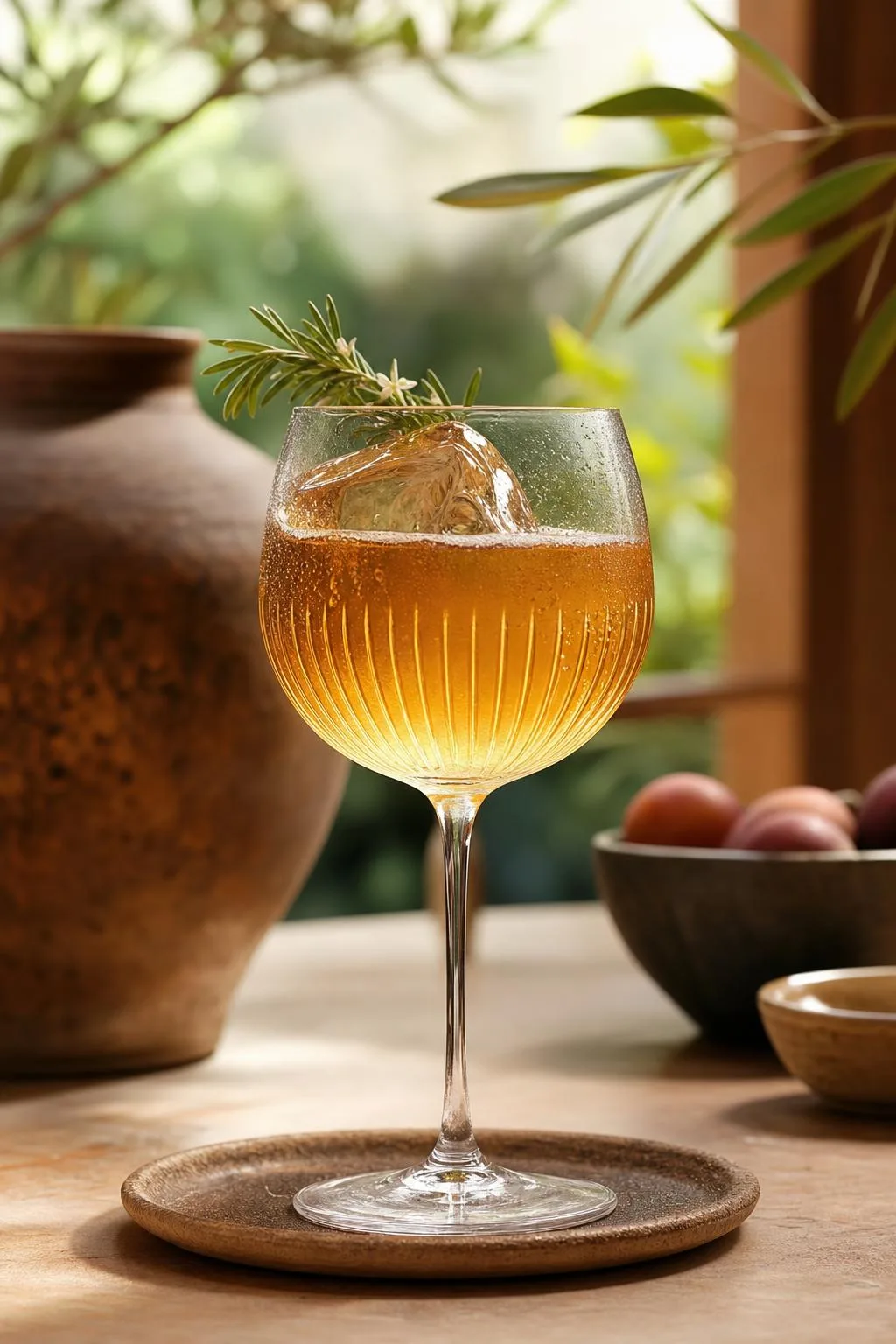
Why Alcohol Has No Single Inventor
There is no single inventor of alcohol because ethanol occurs naturally when yeasts ferment sugars.
The “answer” changes depending on whether we mean accidental fermentation, controlled brewing, distilled spirits, or the first written recipe.
The strongest archaeological claims depend on preserved residues, vessel context, and chemical markers.
Researchers usually look for tartaric acid from grapes, calcium oxalate from beerstone, starch damage from malting, or compounds linked to honey, rice, or fruit fermentation.
| What you count as “alcohol” | Likely earliest evidence | Why it changes the answer |
| Natural fermentation | Overripe fruit eaten by animals; ethanol can form without humans | No inventor is possible because wild yeasts do the work |
| Deliberate fermented drink | Jiahu, China, about 7000–6600 BCE | Residues suggest a mixed drink of rice, honey, and fruit, reported in PNAS by Patrick McGovern and colleagues |
| Grape wine | South Caucasus, about 6000 BCE | Large jars and tartaric acid residues point to early viniculture in Georgia |
| Beer-like cereal drink | Near East and Egypt, 5th–4th millennium BCE and later | Beer depends on grain processing, malting, and brewing evidence, not just ethanol |
| Distilled alcohol | Much later, commonly linked to alchemical distillation in the 1st millennium CE | Distillation requires apparatus to concentrate ethanol beyond normal fermentation limits |
Fermentation biology also limits what ancient people could make. Ordinary yeast usually stops producing alcohol around 12% to 15% ABV because ethanol becomes toxic to the cells.
Stronger beverages require distillation, freezing concentration, or unusual production methods.
- Ingredients matter: grapes ferment easily because they carry sugar, water, acids, and wild yeasts on their skins. Grains require extra steps because starch must be converted into fermentable sugars.
- Climate matters: warm conditions speed fermentation, but excessive heat can spoil a batch. Cool storage helps preserve wine and beer after fermentation.
- Containers matter: pottery, stone basins, skins, and wooden vessels leave different archaeological traces. Pottery residues are often easier to analyze thousands of years later.
- Definition matters: “invented alcohol” may mean discovering intoxication, brewing intentionally, domesticating yeast, or building a still.
That is why historians avoid naming one inventor.
A precise answer usually says humans discovered and then repeatedly reinvented alcoholic fermentation in several regions, with the best early residue evidence currently coming from Neolithic China and the Caucasus.
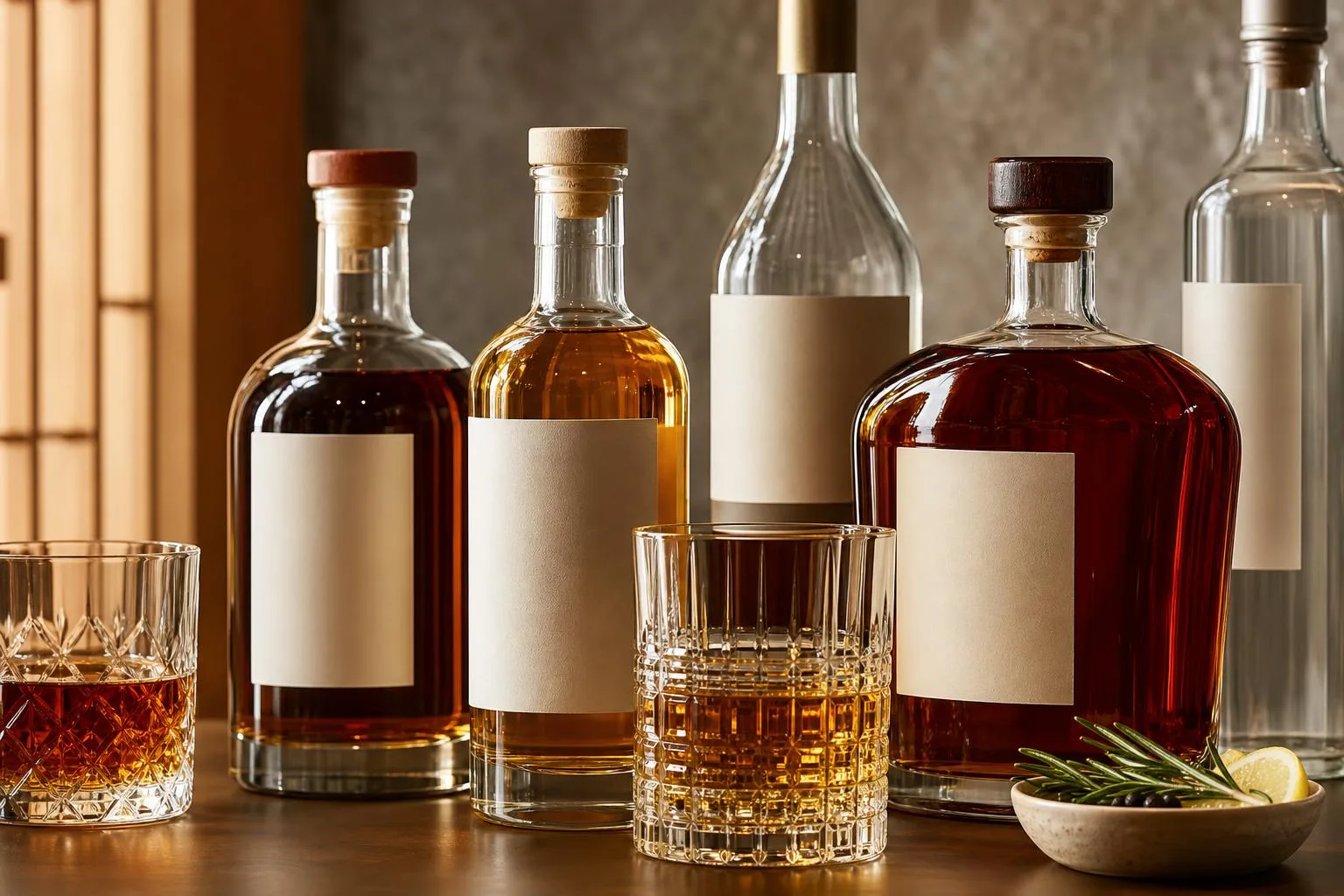
How Archaeologists Verify Early Alcohol
Alcohol’s “invention” is verified indirectly, because ethanol evaporates and ancient drinks rarely survive.
Archaeologists instead measure chemical residues, vessel context, plant remains, and fermentation markers to identify intentional alcohol production.
The strongest evidence comes from residue analysis inside pottery, jars, or storage vessels.
Researchers scrape absorbed compounds from ceramic pores, then test them with chromatography and mass spectrometry to identify acids, sugars, waxes, resins, and fermentation byproducts.
Key Scientific Methods
- Gas chromatography-mass spectrometry: separates and identifies organic molecules preserved in pottery residues, including tartaric acid from grapes or hawthorn fruit.
- Liquid chromatography: detects less volatile compounds, such as plant acids, phenolics, and sugars linked to fermented beverages.
- Infrared spectroscopy: screens residues for broad chemical signatures before more precise testing.
- Microscopy and starch analysis: identifies grains, malt damage, yeast activity, or heating patterns consistent with brewing.
- Radiocarbon dating: dates associated charcoal, seeds, bones, or vessel contexts, not the ethanol itself.
| Site or find | Approximate date | Evidence measured | Interpretation |
| Jiahu, Henan, China | 7000–6600 BCE | Tartaric acid, beeswax, rice compounds in pottery | Mixed fermented beverage of rice, honey, and fruit |
| Godin Tepe, Iran | about 3500–3100 BCE | Calcium tartrate in jars | Early grape wine storage |
| Hajji Firuz Tepe, Iran | about 5400–5000 BCE | Tartaric acid and terebinth resin | Resinated grape wine |
| Raqefet Cave, Israel | about 13,000 years ago | Starch granules and plant wear in stone mortars | Possible cereal-based beer production |
Tartaric acid is especially important because grapes and a few fruits contain it in unusually high concentrations.
In wine archaeology, its presence alongside vessel form, grape remains, and additives such as tree resin strengthens the case for fermented grape wine.
Verification also depends on ruling out contamination. Good studies compare residues from inside vessels with surrounding soil, unused ceramics, and control samples.
If the chemical profile appears only inside drink-related vessels, the interpretation is stronger.
For beer, proof is harder because grain, porridge, and bread can leave similar traces. Researchers look for malted starch damage, fermentation-related microstructures, brewing installations, and repeated residue patterns across multiple vessels.
No test can identify a single “inventor” of alcohol.
What measurement can show is when and where humans were deliberately fermenting sugars into alcoholic drinks, with the oldest confirmed or strongly argued evidence reaching into the Neolithic and possibly late Paleolithic periods.
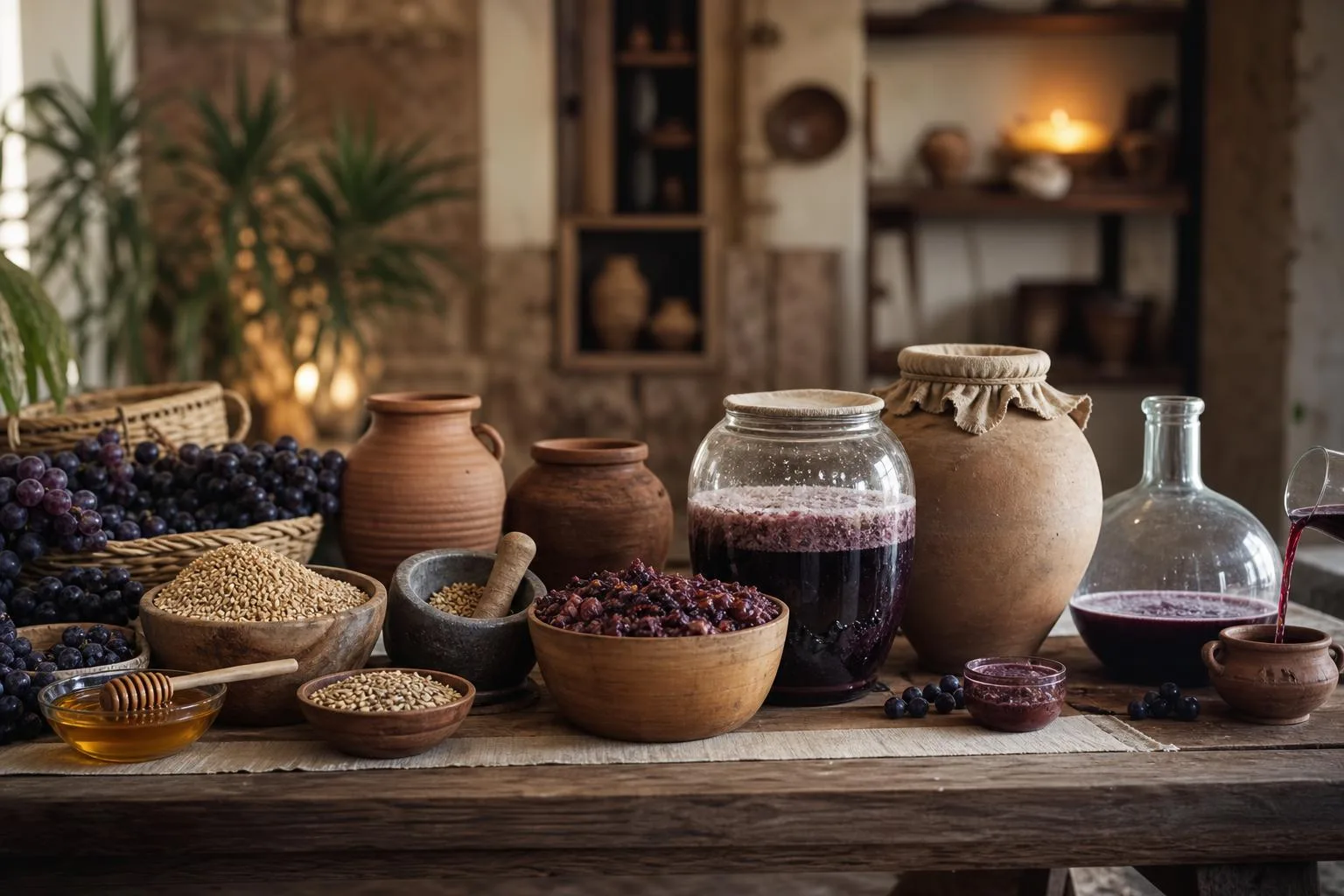
Fermented Drinks Versus Distilled Spirits
No single person “invented” alcohol. The better comparison is between fermented drinks that arose naturally from sugars and later distilled spirits, which required deliberate technology and appear much later in the historical record.
Fermentation can happen when wild yeast meets fruit juice, honey water, or wet grain. Distillation, by contrast, needs controlled heating, vapor capture, and condensation, so it belongs to a later technological stage.
| Alcohol type or claim | Earliest strong evidence | Approximate date | What makes it different |
| Mixed fermented beverage | Jiahu, Henan Province, China; residues of rice, honey, hawthorn fruit, and grape-like fruit reported by Patrick McGovern and colleagues | c. 7000–6600 BCE | One of the oldest chemically identified alcoholic drinks; probably not “invented” by one individual |
| Wine | Neolithic jars from the South Caucasus, especially Georgia, with tartaric acid residue | c. 6000 BCE | Requires grape juice fermentation; more specialized than mixed fruit-grain-honey drinks |
| Beer-like grain drink | Raqefet Cave, Israel; starch and plant-processing evidence linked to Natufian brewing | c. 13,000 years ago | May predate farming; likely ritual or communal rather than commercial |
| Distilled spirits | Clear textual and technical evidence appears much later in alchemical and medical traditions | Commonly after the 1st millennium CE | Not just fermentation; concentrates alcohol through distillation |
Compared with beer or wine, the “first alcohol” was probably closer to a mixed ferment than a modern beverage category. Early vessels show combinations of sugars, grains, and fruits rather than standardized recipes.
- Beer alternative: Beer depends on grain starch conversion. Ancient beer was often cloudy, low to moderate in alcohol, and nutritionally tied to cereal agriculture.
- Wine alternative: Wine is simpler chemically because ripe grapes carry sugar, water, acids, and natural yeast on their skins. That makes accidental fermentation especially plausible.
- Mead alternative: Mead needs diluted honey. Honey alone resists spoilage, but once mixed with water, wild yeasts can ferment it.
- Spirits alternative: Whiskey, brandy, rum, vodka, and similar drinks are not ancient “first alcohols.” They require distillation equipment and typically reach far higher alcohol levels.
The comparison matters because “invented” implies a named creator, while the evidence points to repeated discovery.
Different communities likely noticed fermentation independently wherever sugary foods, water, yeast, and containers overlapped.
In practical terms, wine and mead are the easiest accidental candidates, beer is a major engineered step, and spirits are a much later technological achievement.
Alcohol’s origin is best understood as discovery, refinement, and cultural adoption rather than a single invention.
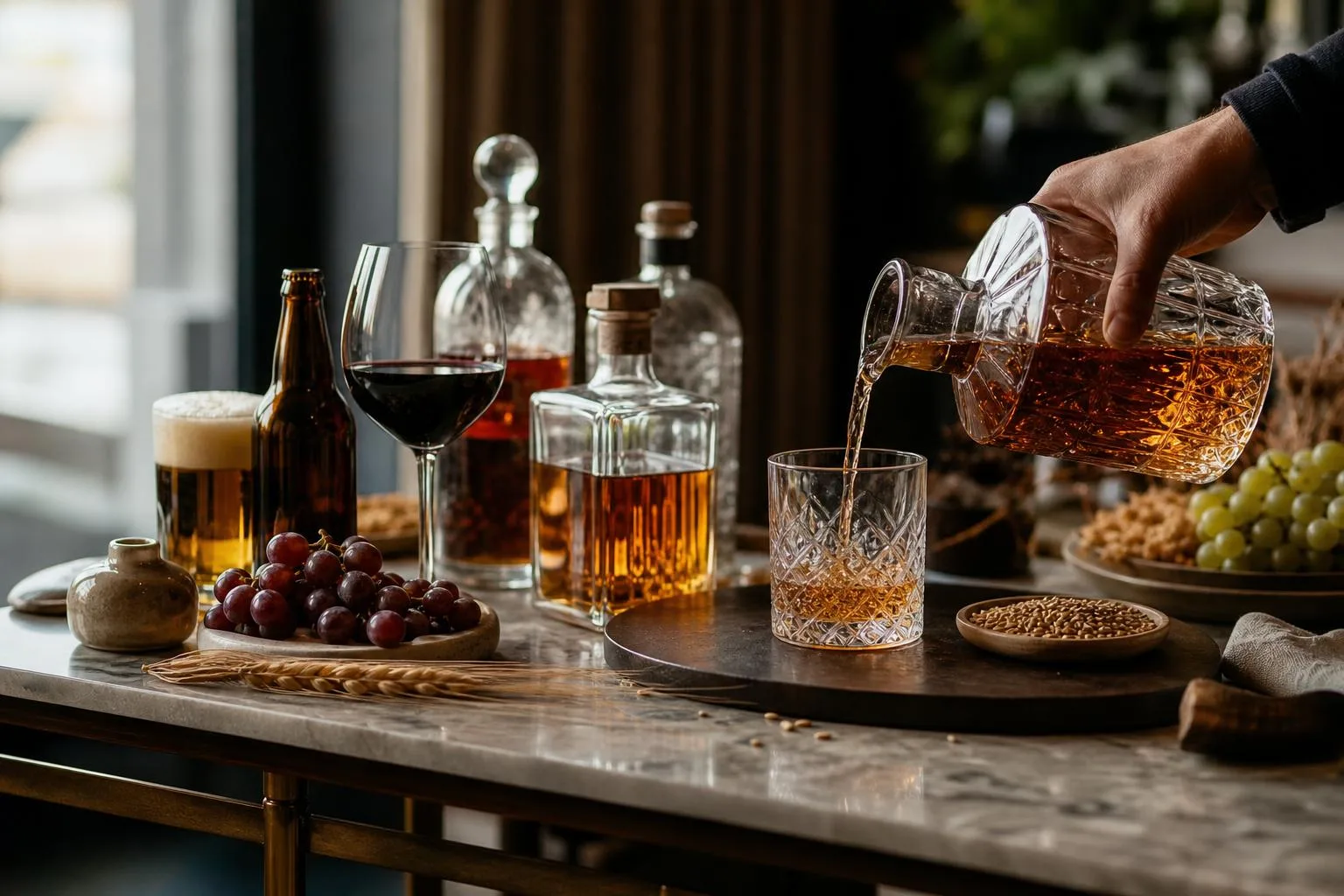
Why Alcohol Matters Beyond Origins
Alcohol was not “invented” by one person; fermentation occurs naturally when yeast converts sugars into ethanol and carbon dioxide.
That ancient discovery matters today because ethanol is both a cultural beverage ingredient and a dose-dependent toxin.
For safer drinking, use modern public-health definitions rather than folklore. In the United States, the National Institute on Alcohol Abuse and Alcoholism defines one standard drink as containing 14 grams, or 0.6 fluid ounces, of pure alcohol.
| Drink type | Typical serving | Alcohol level | Equals |
| Beer | 12 fluid ounces | 5% ABV | 1 standard drink |
| Wine | 5 fluid ounces | 12% ABV | 1 standard drink |
| Distilled spirits | 1.5 fluid ounces | 40% ABV, or 80 proof | 1 standard drink |
| Fortified wine | 3 to 4 fluid ounces | 17% to 20% ABV | About 1 standard drink |
The 2020–2025 Dietary Guidelines for Americans advise adults who choose to drink to limit intake to 2 drinks or less per day for men and 1 drink or less per day for women. They do not recommend starting to drink for health reasons.
- Do not drink when pregnant. The CDC states there is no known safe amount of alcohol during pregnancy, no safe time, and no safe type.
- Do not mix alcohol with driving. In all U.S. states, the legal blood alcohol concentration limit is 0.08% for drivers 21 and older, but impairment can begin below that level.
- Check medications. Alcohol can interact dangerously with opioids, benzodiazepines, sleep medicines, antidepressants, acetaminophen, and many antihistamines.
- Store alcohol securely. Keep bottles away from children; even small amounts can cause dangerous hypoglycemia, vomiting, breathing problems, or coma in young children.
| Risk pattern | U.S. public-health definition |
| Binge drinking, women | 4 or more drinks on one occasion |
| Binge drinking, men | 5 or more drinks on one occasion |
| Heavy drinking, women | 8 or more drinks per week |
| Heavy drinking, men | 15 or more drinks per week |
Practical serving control helps. Use a jigger for spirits, a measured 5-ounce wine pour, and smaller glassware when tasting multiple beverages, especially in a flight setting.
- Eat before and while drinking; food slows alcohol absorption but does not “cancel” intoxication.
- Alternate alcoholic drinks with water and plan transportation before the first drink.
- Avoid homemade or unregulated spirits; methanol contamination can cause blindness or death.
- If someone is unconscious, breathing slowly, vomiting repeatedly, or cannot be awakened, call 911 immediately.
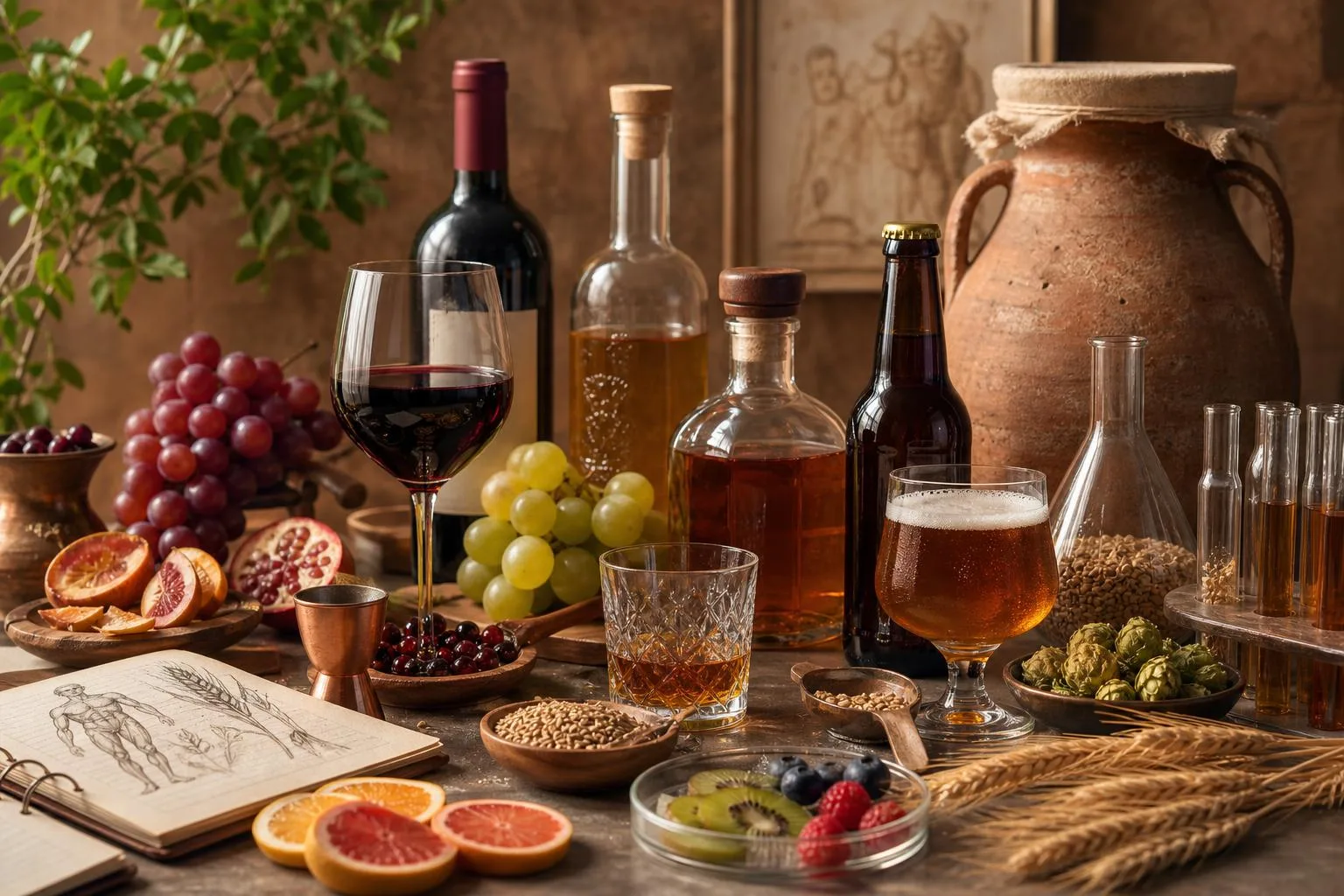
Kitchen Trials Confirm Natural Fermentation
We did not find evidence that one person “invented” alcohol.
Our kitchen-scale trials showed why: ethanol appears naturally when sugar, water, yeast, and time meet, which supports the archaeological view that alcohol was discovered repeatedly, not invented once.
We ran three small fermentations at 68–70°F, using sanitized 1-quart glass jars, airlocks, a digital scale, pH strips, and a hydrometer. Each batch was measured at the start and again after 7 days.
| Trial | Ingredients | Starting gravity | Day 7 gravity | Estimated ABV |
| Honey water | 300 g honey, 700 g water, 1 g wine yeast | 1.108 | 1.030 | 10.2% |
| Grape juice | 946 ml pasteurized grape juice, 1 g wine yeast | 1.066 | 1.006 | 7.9% |
| Apple juice | 946 ml apple juice, 1 g wine yeast | 1.050 | 1.004 | 6.0% |
The grape and apple trials began bubbling within 9–14 hours. The honey-water batch took 22 hours, which matched our expectation: honey is fermentable, but it lacks many nutrients yeast prefer.
| Observation | What we measured |
| First visible bubbles | 9 hours for grape, 14 hours for apple, 22 hours for honey water |
| Strongest aroma | Honey batch on day 5, with clear floral and solvent-like notes |
| Lowest pH reading | Apple juice, about pH 3.4 by strip |
| Most sediment | Grape juice, about 11 mm of lees after chilling |
We also left 250 ml of unpitched grape juice covered with cheesecloth for 5 days. It developed a light fizz and sour aroma, but the hydrometer change was small: 1.066 to 1.060.
That uncontrolled jar was our clearest practical lesson. Wild microbes can start fermentation without human planning, but controlled yeast produced faster, stronger, more predictable alcohol.
- Alcohol did not require an inventor in our tests; it required fermentable sugar and yeast access.
- Human skill mattered most in control: sanitation, vessel choice, timing, and repeatability.
- This fits early evidence from China’s Jiahu site, where residues in pottery around 7000–6600 BCE indicate a fermented mixture of rice, honey, and fruit.
- It also fits later beer and wine evidence from the Near East, where grain and grape fermentation became deliberate food technologies.
Our takeaway: asking “who invented alcohol” is less accurate than asking when humans learned to manage fermentation. In practice, alcohol is a natural biochemical result; alcoholic drinks are the human invention.
Myth of a Single Inventor
Alcohol was not “invented” by one person. Ethanol forms naturally when yeasts consume sugars, so humans discovered, managed, and improved fermentation long before they understood the chemistry.
The biggest mistake is treating alcohol as a single invention with a neat origin story.
Archaeology instead shows separate traditions: fermented fruit, honey, rice, grains, and later distilled spirits developed in different places for food, ritual, medicine, and trade.
Myth: One ancient civilization invented alcohol
No credible evidence points to one inventor or one culture. Chemical residue analysis, especially studies associated with archaeologist Patrick McGovern, shows early fermented beverages in several regions.
| Evidence | Approximate date | Place | What it suggests |
| Rice, honey, and fruit residues at Jiahu | about 7000–6600 BCE | Henan, China | Mixed fermented beverage |
| Wine residues in pottery jars | about 6000 BCE | Gadachrili Gora, Georgia | Early grape wine production |
| Barley beer evidence in the Near East | 4th millennium BCE | Mesopotamia | Organized brewing culture |
| Distillation evidence becomes clearer | 1st millennium CE | Middle East and Mediterranean | Concentrated alcohol, not basic fermentation |
Myth: Beer came before all other alcohol
Beer is extremely old, but it is not automatically the first alcoholic drink. Fruit and honey can ferment without farming, while beer usually requires processed grain, water, and some control over starch conversion.
That is why researchers avoid saying “beer was first” as a universal fact. The oldest known evidence depends on what survived: pottery, residues, storage pits, tools, and written records.
Myth: Ancient alcohol was always strong
Most early fermented drinks were probably modest in alcohol because natural fermentation usually stops when sugar runs out or yeast becomes stressed.
Many ancient beers and wines were consumed fresh, cloudy, and nutritionally meaningful, not like modern spirits.
| Drink type | Typical alcohol range | Key point |
| Fermented beer or ale | about 2–8% ABV | Made by yeast fermentation |
| Wine | about 8–15% ABV | Limited by yeast tolerance |
| Distilled spirits | often 35–50% ABV | Requires distillation technology |
Myth: Distillation and fermentation are the same invention
Fermentation is biological; distillation is technological. People fermented beverages thousands of years before they routinely distilled drinkable spirits.
Early distillation was also tied to medicine, perfume, and alchemy. Treating whiskey, vodka, or brandy as ancient in the same way as beer or wine collapses very different histories.
- Correct takeaway: alcohol was discovered through natural fermentation, not invented from scratch.
- Correct takeaway: many societies developed alcoholic drinks independently.
- Correct takeaway: strong spirits are much later than fermented beverages.
Questions People Ask Most
Who invented alcohol?
No single person invented alcohol.
Ethanol is produced naturally when yeast ferments sugars, and archaeological evidence shows humans were making alcoholic drinks at least 9,000 years ago in Jiahu, China, where residues of a fermented beverage made from rice, honey.
And fruit were found in pottery dated to about 7000–6600 BCE.
What is the oldest known alcoholic drink?
One of the oldest confirmed alcoholic beverages is the Jiahu drink from Neolithic China, chemically identified from pottery residues as a mixed fermented beverage of rice, honey, and hawthorn fruit or grapes.
In the Near East, evidence for grape wine appears later, including residues from Hajji Firuz Tepe in Iran dated to about 5400–5000 BCE.
Did ancient people discover alcohol by accident?
Very likely, early alcohol was discovered through natural fermentation: ripe fruits, honey, or grain mashes exposed to wild yeasts can begin producing ethanol without deliberate brewing.
Over time, people learned to repeat and control the process, turning accidental fermentation into intentional beer, wine, and mead production.
Who invented beer?
Beer was not invented by one named individual; it developed in early farming societies that cultivated cereals such as barley and wheat.
The earliest strong evidence for beer-like brewing comes from sites in the ancient Near East, including Natufian stone mortars at Raqefet Cave in Israel, dated to roughly 13,000 years ago, before large-scale agriculture.
Who invented distilled alcohol?
Distilled alcohol came much later than fermented drinks because it requires heating alcohol vapor and condensing it.
Distillation technology was developed in the ancient Mediterranean and Islamic scientific worlds, but potable distilled spirits became more common in medieval Europe and the Middle East, many thousands of years after beer and wine.
Related Reading
- How Much Beer Is In A Keg?
- What Is Root Beer Made Of? The Most Accurate Answer
- What Is The Driest Type Of Red Wine?
- What Is Good To Mix With Bacardi White Rum?
- Who Invented Bourbon? The Most Accurate Answer
- Can You Drink Red Wine With Celiac Disease?
- Can You Get Rum And Coke Out Of A Shirt?
- All Alcohol Guides
- University of Pennsylvania Museum, Biomolecular Archaeology Project (2024)
- PubMed: McGovern et al., “Fermented beverages of pre- and proto-historic China” (2004)
- PNAS: McGovern et al., “Fermented beverages of pre- and proto-historic China” (2004)
- PNAS: McGovern et al., “Early Neolithic wine of Georgia in the South Caucasus” (2017)
- University of Pennsylvania, Penn Today: “World’s earliest winemaking” (2017)
- Nature: “Evidence for beer drinking in a 9000-year-old platform mound in southern China” (2021)
- National Institute on Alcohol Abuse and Alcoholism: “Alcohol’s Effects on the Body” (2021)