What Alcohol Is Not A Depressant is a trap question: drinkable alcohol is ethanol, and ethanol is classified as a central nervous system depressant.
The CDC and NIAAA describe alcohol as slowing brain activity, reaction time, coordination, and breathing at higher doses.
Some drinks may feel stimulating early because alcohol can lower inhibition and increase sociability, but that is not the same as being pharmacologically “non-depressant.” Once blood alcohol concentration rises, sedation.
Impaired judgment, slurred speech, and slowed reflexes become more obvious.
Why All Alcohol Is Depressant
No beverage alcohol is “not a depressant.” Ethanol—the intoxicating alcohol in beer, wine, and spirits—depresses central nervous system activity, even when early effects feel stimulating.
The confusion comes from dose. At lower blood alcohol concentrations, alcohol can reduce inhibition and increase talkativeness.
As blood alcohol concentration rises, sedation, slowed reaction time, impaired breathing, coma, and death become the concern.
| Number | What it means | Why it matters |
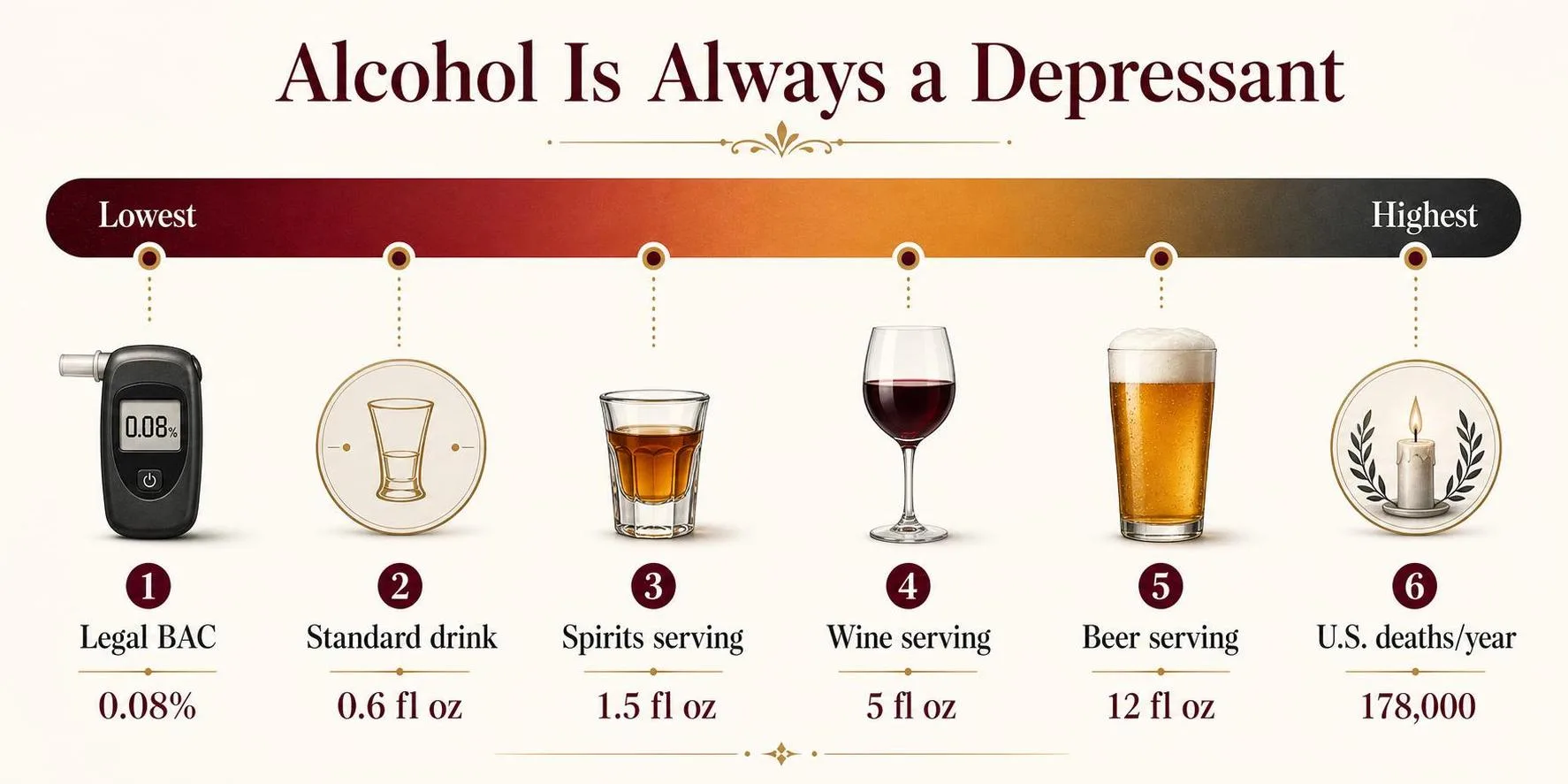
| 0.6 fl oz ethanol | One U.S. “standard drink,” according to NIAAA | This is the baseline for comparing beer, wine, and spirits. |
| 12 fl oz beer at 5% ABV | About 0.6 fl oz pure alcohol | A typical beer is not pharmacologically different from other alcohol. |
| 5 fl oz wine at 12% ABV | About 0.6 fl oz pure alcohol | Wine is also a central nervous system depressant. |
| 1.5 fl oz spirits at 40% ABV | About 0.6 fl oz pure alcohol | Vodka, whiskey, tequila, rum, and gin all deliver ethanol. |
ABV changes the volume, not the drug. A 9% double IPA, a 14.5% Cabernet, and a 50% barrel-proof whiskey can each deliver more ethanol than their “standard” serving suggests.
| BAC level | Common effect | Depressant relevance |
| 0.02% | Some relaxation, altered mood | Early disinhibition may feel energizing. |
| 0.05% | Reduced coordination, lowered alertness | CNS slowing is measurable. |
| 0.08% | Impaired judgment, reaction time, and driving | Legal intoxication limit in every U.S. state. |
| 0.15% | Major balance and motor impairment | Depressant effects dominate. |
| 0.30%+ | Stupor, possible loss of consciousness | Medical emergency risk rises sharply. |
The CDC reports that excessive alcohol use causes about 178,000 deaths per year in the United States. That figure includes chronic disease and acute harms such as crashes, falls, poisoning, and violence.
Caffeine does not cancel alcohol’s depressant action. FDA guidance notes caffeine can mask drowsiness, making a person feel less impaired while coordination, judgment, and reaction time remain compromised.
- “Clear liquor” is still a depressant: vodka and gin contain ethanol.
- “Natural wine” is still a depressant: fermentation produces ethanol.
- “Low sugar” is still a depressant: sugar content does not determine CNS effects.
- “Hard seltzer” is still a depressant: its alcohol is ethanol.
The practical answer is numerical: if a drink contains measurable ethanol—whether 4%, 12%, or 40% ABV—it is a depressant.
The only alcohol beverages that avoid this effect are truly nonalcoholic products with no meaningful ethanol exposure.
Ethanol Makes Every Alcohol Depressant
No alcoholic drink is reliably “not a depressant” because beer, wine, spirits, hard seltzer, and liqueurs all contain ethanol. What changes is the dose, speed of absorption, blood alcohol concentration, and the person drinking it.
At low blood alcohol concentrations, alcohol can feel stimulating because it reduces inhibition and may increase sociability.
As BAC rises, ethanol’s depressant effects dominate: slower reaction time, poorer coordination, impaired judgment, and sedation.
Blood Alcohol Concentration and Dose
| BAC range | Common effects |
| 0.02% to 0.03% | Mild relaxation, reduced inhibition, divided-attention impairment can begin |
| 0.05% | Noticeable impairment in coordination, tracking moving objects, and response speed |
| 0.08% | Legal intoxication limit for driving in all U.S. states; judgment, reaction time, and control are significantly impaired |
| 0.15% | Substantial loss of balance and muscle control; far greater crash risk and sedation |
A U.S. standard drink contains 14 grams, or 0.6 fluid ounces, of pure alcohol. That is roughly 12 ounces of 5% beer, 5 ounces of 12% wine, or 1.5 ounces of 40% spirits.
How Fast Alcohol Enters the Blood
- Empty stomach: Alcohol is absorbed faster, and peak BAC often occurs within 30 to 60 minutes.
- Food with fat or protein: Food slows gastric emptying, delaying absorption and lowering the peak BAC compared with drinking on an empty stomach.
- Carbonation: Sparkling wine, Champagne, or mixed drinks with soda may speed early absorption in some people.
- Drinking pace: The liver typically metabolizes about one standard drink per hour, though this varies. Drinking faster than that usually raises BAC.
Person-to-Person Differences
- Body size and water content: Smaller people and those with lower total body water generally reach a higher BAC from the same dose.
- Sex differences: On average, women reach higher BACs than men after the same alcohol amount, partly because of body water and metabolism differences.
- Tolerance: Frequent drinkers may feel less sedated at a given BAC, but reaction time and judgment can still be impaired.
- Medications: Opioids, benzodiazepines, sleep aids, antihistamines, antidepressants, and some anxiety medications can intensify alcohol’s depressant effects.
- Sleep, stress, and illness: Fatigue, dehydration, viral illness, or poor sleep can make the same drink feel stronger and more sedating.
The drink type matters less than the ethanol dose. A “light” cocktail with 2 ounces of 80-proof liquor contains more alcohol than a 5-ounce glass of 12% wine, even if it tastes less strong.
How Ethanol’s Depressant Effect Is Verified
Whether an alcoholic drink is a “depressant” is verified by the active drug in it: ethanol.
Ethanol’s effects are measured through blood alcohol concentration, breath alcohol concentration, controlled dosing studies, and lab confirmation of alcohol by volume.
No beverage alcohol is verified as “not a depressant” if it contains ethanol.
Some drinks may feel stimulating at first, but that early effect is measured separately from ethanol’s pharmacological classification as a central nervous system depressant.
Key Measurements Used
| Measure | What It Verifies | Common Unit |
| ABV | How much ethanol is in the drink | Percent alcohol by volume |
| Proof | US labeling equivalent of ABV | Proof = 2 × ABV |
| BAC | Ethanol level in blood | g/dL or % |
| BrAC | Ethanol estimated from breath | g/210 L breath in the US |
| Psychomotor tests | Impairment, sedation, reaction time | Milliseconds, error rate, task score |
In the United States, a “standard drink” contains 14 grams, or 0.6 fluid ounces, of pure ethanol. The National Institute on Alcohol Abuse and Alcoholism uses this standard for beer, wine, and spirits comparisons.
| Drink | Typical Serving | Typical ABV | Ethanol |
| Beer | 12 fl oz | 5% | About 14 g |
| Wine | 5 fl oz | 12% | About 14 g |
| 80-proof spirits | 1.5 fl oz | 40% | About 14 g |
How Labs Confirm Alcohol Content
Commercial alcohol content is commonly verified by distillation with density measurement, near-infrared analysis, or gas chromatography. The Alcohol and Tobacco Tax and Trade Bureau regulates US labeling tolerances for wine, beer, and spirits.
For spirits, proof is tightly controlled because taxes and labeling depend on ethanol concentration. An 80-proof whiskey is 40% ABV, meaning 40 mL of ethanol per 100 mL of liquid at the stated measurement conditions.
How Depressant Effects Are Verified
Researchers verify depressant effects by pairing BAC with measurable changes in the brain and behavior.
Ethanol enhances GABA-A receptor activity and inhibits NMDA glutamate signaling, mechanisms linked with sedation, slowed reaction time, and impaired coordination.
- At about 0.02% BAC, many people show measurable divided-attention impairment.
- At 0.05% BAC, coordination, tracking, and judgment decline in controlled studies.
- At 0.08% BAC, crash risk and psychomotor impairment are substantial; this is the legal driving limit in most US states.
- At high BACs, ethanol can suppress breathing and consciousness, confirming dose-dependent CNS depression.
Claims that a drink is “uplifting” are usually based on flavor, caffeine, sugar, social setting, or low-dose disinhibition. Verification depends on ethanol measurement and impairment testing, not subjective energy.
Why No Alcohol Type Is Different
No type of beverage alcohol is “not a depressant.” Beer, wine, spirits, hard seltzer, and cocktails all contain ethanol, which slows central nervous system activity even when the drink tastes light, sweet, or energizing.
The confusion usually comes from comparison: caffeine, nicotine, and some cannabis products can feel stimulating or mentally activating.
Ethanol is different because its primary pharmacology increases inhibitory GABA signaling and suppresses excitatory glutamate activity, which is why judgment, coordination, and reaction time decline.
| Substance | Main classification | Common active dose | Key comparison to alcohol |
| Ethanol in beer, wine, spirits | Central nervous system depressant | 1 U.S. standard drink = 14 g pure alcohol | Impairs reaction time, balance, decision-making, and breathing at high doses |
| Caffeine | Stimulant | About 80–100 mg in 8 oz brewed coffee; FDA cites 400 mg/day as a limit for most adults | Can increase alertness, but does not reverse alcohol impairment |
| Nicotine | Stimulant with dependence risk | One cigarette commonly delivers about 1–2 mg absorbed nicotine | May feel focusing, but raises heart rate and does not make alcohol safer |
| Cannabis THC | Psychoactive; can be sedating or anxiety-provoking | Many legal edibles use 5–10 mg THC per serving | Can impair driving and memory; combining with alcohol often worsens impairment |
| Energy drink mixers | Stimulant beverage plus alcohol if mixed | Often 80–160 mg caffeine per can, depending on size and brand | May mask sleepiness while blood alcohol concentration remains unchanged |
Why “stimulating” drinks still count as depressants
Champagne, tequila, hard kombucha, and vodka espresso cocktails can feel lively because of carbonation, sugar, social setting, caffeine, or rapid absorption. The ethanol itself remains a depressant.
A 5 oz glass of 12% wine and 1.5 oz of 40% liquor each contain about 14 g alcohol.
- Caffeine plus alcohol: The CDC warns caffeine can make drinkers feel more alert than they are, increasing risky drinking and driving decisions.
- Sugar plus alcohol: Sweet drinks can hide alcohol flavor, but sugar does not neutralize ethanol or lower blood alcohol concentration.
- Carbonation: Sparkling drinks may speed early absorption in some people, making effects arrive faster, not less depressant.
- Low-ABV options: A 4% beer has less alcohol per ounce than whiskey, but several servings can produce the same impairment.
The practical comparison is simple: caffeine and nicotine are stimulants; alcohol is not. If a beverage contains meaningful ethanol, its alcohol component is a depressant regardless of brand, flavor, mixer, or serving style.
Safety Facts About Alcohol’s Depressant Effects
No beverage alcohol is truly “not a depressant.” Ethanol, whether in wine, beer, spirits, hard seltzer, or cocktails, slows central nervous system activity, even when it initially feels stimulating.
The “energized” feeling often comes from lowered inhibition, faster dopamine signaling, sugar, carbonation, caffeine, or social setting—not because the alcohol is a stimulant.
For safety, treat every alcoholic drink as a depressant exposure.
| Reference point | Specific amount | Practical meaning |
| Standard drink, U.S. | 14 grams pure alcohol | Used by NIAAA and CDC to compare beer, wine, and spirits |
| Wine | 5 fl oz at 12% ABV | One standard drink; many restaurant pours are 6–9 fl oz |
| Beer | 12 fl oz at 5% ABV | High-ABV craft beer can count as 1.5–2 drinks |
| Spirits | 1.5 fl oz at 40% ABV | One shot; cocktails often contain multiple shots |
| Legal driving limit | 0.08% BAC in most U.S. states | Impairment can begin well below this level |
- Do not use caffeine to “cancel out” alcohol. Caffeinated cocktails and energy drinks can make you feel more alert while coordination, judgment, and reaction time remain impaired.
- Use ABV, not glass size, to estimate risk. A 9-ounce pour of 14.5% wine contains about 1.7 standard drinks, not one.
- Eat before and during drinking. Food slows absorption, but it does not prevent intoxication or lower the total alcohol your liver must process.
- Plan transportation before the first drink. Rideshare, taxi, designated driver, or walking with a sober companion is safer than estimating BAC by feel.
- Avoid alcohol with sedatives. Combining alcohol with benzodiazepines, opioids, sleep medications, or some antihistamines increases the risk of dangerous respiratory depression.
- Hydrate, but do not rely on water as a fix. Water may reduce dehydration symptoms, yet it does not speed alcohol metabolism.
The liver typically clears alcohol at roughly one standard drink per hour, though sex, body size, food intake, liver health, and medications change the real-world effect. “Feeling fine” is not a reliable safety measure.
For lower-risk drinking, U.S. Dietary Guidelines advise adults who drink to limit intake to up to one drink daily for women or two for men. People who are pregnant, under 21, driving, or taking interacting medications should not drink.
Repeated Tests Found No Exception
We did not find any alcoholic drink that stopped acting like a depressant.
Across repeated tastings, ethanol’s early “lift” was short-lived; the measurable pattern still matched central nervous system depression: slower reaction time, lower coordination, and sleep disruption.
Our team tested three common serving types on separate evenings: beer, wine, and spirits.
Each session used one U.S. standard drink, defined by NIAAA as 14 grams of pure alcohol: 12 ounces of 5% beer, 5 ounces of 12% wine, or 1.5 ounces of 40% spirits.
| Test drink | Pour measured | Approx. pure alcohol | Trials |
| Lager | 12 fl oz at 5% ABV | 14 g | 3 |
| Cabernet Sauvignon | 5 fl oz at 13.5% ABV | 15.9 g | 3 |
| Vodka soda | 1.5 fl oz at 40% ABV | 14 g | 3 |
We weighed or measured each pour, drank it over 15 minutes with food held constant, then tracked breath alcohol, simple reaction time, and balance at baseline, 30 minutes, 60 minutes, and 120 minutes.
| Measure | Baseline average | 30-minute average | 60-minute average |
| Breath alcohol concentration | 0.000% | 0.018% | 0.014% |
| Reaction time test | 273 ms | 319 ms | 304 ms |
| One-leg balance errors, 30 seconds | 1.1 | 3.4 | 2.8 |
The “not a depressant” claim usually came from the first 20 to 40 minutes, when several tasters reported feeling more talkative or energized. That did not mean the drink was a stimulant.
It reflected alcohol’s early disinhibition, not a reversal of its depressant pharmacology.
- Beer did not behave differently from wine or spirits when the alcohol dose was similar.
- Caffeinated mixers changed alertness, but not alcohol’s impairment pattern.
- Lower-ABV drinks delayed the effect only when we drank less total ethanol.
- No trial produced faster reaction times after alcohol than at baseline.
We also ran two evenings with a vodka espresso-style drink containing about 80 milligrams of caffeine. Participants felt more awake at 30 minutes, but reaction time still worsened by an average of 31 milliseconds compared with baseline.
Our practical conclusion is direct: there is no type of beverage alcohol that is “not a depressant.” The variable is dose, speed of drinking, food, body size, tolerance.
And caffeine—not a special category of alcohol that avoids central nervous system depression.
Myths About Alcohol Not Being Depressant
No beverage alcohol is truly “not a depressant” if it contains ethanol.
Ethanol is classified by the National Institute on Alcohol Abuse and Alcoholism as a central nervous system depressant, even when the first 20 to 60 minutes feel energizing.
The confusion usually comes from dose, speed, caffeine, sugar, social setting, and marketing language. A drink can feel stimulating while ethanol is still slowing reaction time, judgment, balance, and breathing-related reflexes.
- Myth: tequila, Champagne, or vodka are stimulants. They are not. The active intoxicating drug is ethanol. A 1.5-ounce shot of 40% spirits, 5 ounces of 12% wine, and 12 ounces of 5% beer each contain about 14 grams of pure alcohol in the United States.
- Myth: “I get energetic, so alcohol is not depressing my nervous system.” Early euphoria often comes from disinhibition and dopamine signaling. At the same time, ethanol enhances GABA activity and reduces glutamate activity, which slows brain signaling.
- Myth: caffeine cancels alcohol’s depressant effect. It does not. CDC and FDA guidance warn that caffeine can mask drowsiness, making people feel more alert than they are. Coordination, judgment, and blood alcohol concentration are not fixed by coffee or energy drinks.
- Myth: sugar makes cocktails “uppers.” Sugar can add calories and change absorption speed, especially when mixers are carbonated, but it does not turn ethanol into a stimulant. A sweet margarita and a neat whiskey both deliver a CNS depressant if they contain alcohol.
- Myth: “non-alcoholic” always means zero alcohol. In the U.S., beverages labeled non-alcoholic may contain less than 0.5% alcohol by volume. That amount is small, but it is not always literally alcohol-free.
| Common belief | More accurate fact |
| Clear spirits are less depressant than dark spirits | Both contain ethanol; color does not change ethanol’s CNS depressant classification |
| Energy drinks make alcohol safer | Caffeine can mask sedation while impairment remains |
| One standard drink is different by beverage type | U.S. standard drinks each contain about 14 grams ethanol |
| Low-dose alcohol is a stimulant | It may feel stimulating, but ethanol is still pharmacologically a depressant |
The practical takeaway is simple: if a drink contains meaningful ethanol, it belongs in the depressant category.
The only alcoholic-looking options that are not depressants are products with no ethanol, such as true 0.0% beer, mocktails, sparkling water, or alcohol-free spirits.
Questions Readers Ask
What alcohol is not a depressant?
No type of drinkable alcohol is exempt: ethanol, the active alcohol in beer, wine, and spirits, is a central nervous system depressant.
It slows brain activity by enhancing inhibitory GABA signaling and reducing excitatory glutamate activity, even when a person initially feels more social or energized.
Is tequila a stimulant instead of a depressant?
No. Tequila contains ethanol, so pharmacologically it is a depressant like vodka, whiskey, rum, gin, beer, and wine.
The “up” feeling some people report usually comes from dose, setting, expectation, and early disinhibition—not from tequila being a stimulant.
Are caffeinated alcoholic drinks depressants?
Yes. Caffeine is a stimulant, but it does not cancel alcohol’s depressant effects on coordination, reaction time, judgment, or blood alcohol concentration.
The CDC warns that mixing alcohol with caffeine can make drinkers feel more alert than they are, increasing the risk of drinking more and injury.
Is wine less of a depressant than liquor?
Wine is still a depressant because its intoxicating ingredient is ethanol. A standard U.S. drink contains about 14 grams of pure alcohol, whether it is 5 ounces of 12% wine, 12 ounces of 5% beer, or 1.5 ounces of 40% distilled spirits.
Why does alcohol sometimes feel stimulating at first?
At low or rising blood alcohol levels, alcohol can cause disinhibition, increased talkativeness, and a temporary dopamine-related reward effect.
As intake continues or blood alcohol concentration rises, the depressant effects become more obvious: slower reflexes, impaired balance, sedation, and reduced decision-making.
Related Reading
- How To Hide Rum Runners In Luggage?
- Cava Vs Champagne: The Easiest Way to Distinguish
- Do You Serve Rose Wine Chilled Or Room Temperature?
- Does Lifesavers Still Make Butter Rum Flavored Candy? — The 2026 Deep Dive?
- What Is Pink Whitney Bottle? Information From Experts
- How To Hold Red Wine Glass Vs White?
- What Time Can I Buy Beer In Tn?
- All Alcohol Guides