
Which Alcohol Is Good For Kidney Disease is none; alcohol does not protect kidneys, and avoiding it is the safest default for many people with chronic kidney disease, especially with high blood pressure, diabetes, liver disease.
Or medications that interact with alcohol.
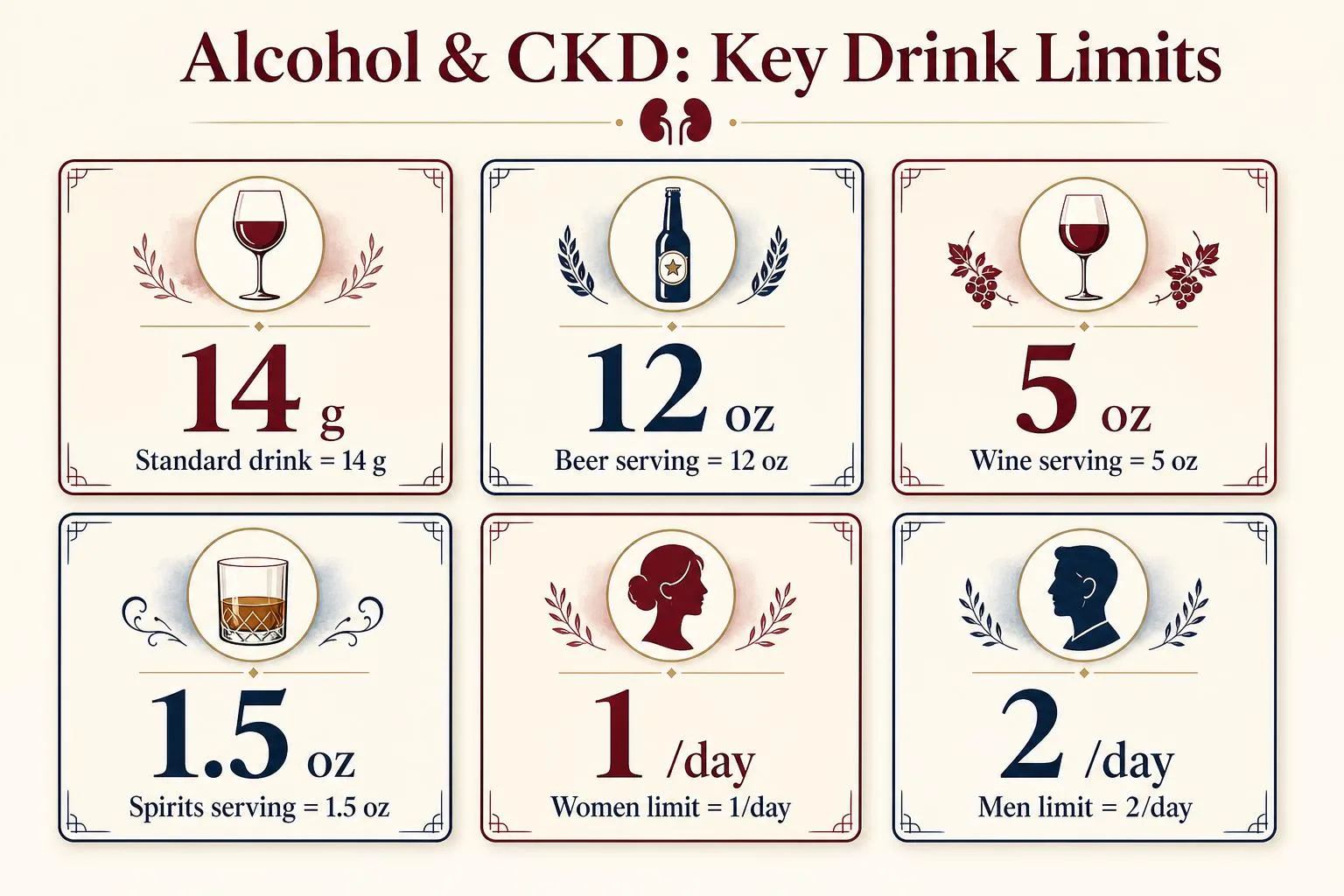
If a nephrologist allows drinking, the National Kidney Foundation advises strict moderation: up to 1 drink per day for women and 2 for men. One drink means 12 ounces beer, 5 ounces wine, or 1.5 ounces spirits.
Kidney disease changes how your body handles fluid, blood pressure, electrolytes, and medicines.
This guide explains why “least harmful” depends on CKD stage, dialysis status, transplant medications, potassium, phosphorus, and your clinician’s limits.
Factors That Determine Alcohol Safety
No alcohol is “good” for kidney disease. The practical question is whether alcohol can fit safely with your eGFR, albuminuria, blood pressure, medications, potassium, phosphorus, diabetes control, and dialysis plan.
For many adults with stable chronic kidney disease, clinicians use the same “moderate drinking” ceiling as the U.S. Dietary Guidelines.
But that ceiling is not a prescription, and it may be too high for people with uncontrolled hypertension, liver disease, pancreatitis, falls risk, or interacting medicines.
| Number | What it means for kidney disease |
| 1 standard drink | 14 grams of pure alcohol. In real pours, that equals 12 ounces of 5% beer, 5 ounces of 12% wine, or 1.5 ounces of 40% spirits. |
| Up to 1 drink/day | Common U.S. upper limit for women. With CKD, “up to” means some days none, and only if your nephrology team says it fits your lab results and medications. |
| Up to 2 drinks/day | Common U.S. upper limit for men. This is not safer for kidneys than abstaining; it is a harm-reduction ceiling for people who already drink. |
| 5 ounces of wine | A true wine serving. At bars, generous pours are often 6 to 9 ounces, turning one glass into 1.2 to 1.8 standard drinks. |
| eGFR below 60 | One major threshold for chronic kidney disease when present for at least 3 months. Alcohol decisions should be more conservative as eGFR falls. |
| ACR 30 mg/g or higher | Albumin in urine at this level suggests kidney damage. Blood pressure and diabetes control matter more than choosing beer, wine, or liquor. |
If your doctor allows alcohol, wine or clear spirits are often easier to fit than beer for some CKD diets because beer can add fluid, carbohydrate, and phosphorus. That does not make wine or vodka kidney-protective.
| Drink | Kidney-relevant issue |
| Beer | Larger fluid volume per drink; may contain phosphorus additives in some products; can worsen gout risk in susceptible patients. |
| Wine | Lower volume per standard drink; still raises alcohol exposure and can worsen sleep, blood pressure, and triglycerides. |
| Spirits | Smallest fluid volume, but mixers can be high in sugar, potassium, or phosphorus; intoxication risk rises quickly with large pours. |
The National Kidney Foundation and kidney dietitians commonly emphasize the same rule: count alcohol as fluid if you have a fluid restriction.
On dialysis, one 12-ounce beer uses far more of the daily fluid allowance than a measured 5-ounce wine pour.
Alcohol can also push blood pressure upward, and high blood pressure is a leading driver of kidney decline. If your readings are not at goal, abstaining is usually the most kidney-smart choice, regardless of drink type.
- Avoid alcohol if you are pregnant, have active liver disease, pancreatitis, alcohol use disorder, or were told not to drink with opioids, sedatives, metronidazole, or certain diabetes medicines.
- Ask your nephrologist first if you have stage 4 or 5 CKD, are on dialysis, have a transplant, or take immunosuppressants.
- Measure pours: for kidney disease, “one” drink should mean one standard drink, not a heavy restaurant pour.

Why No Kidney Safe Alcohol Exists
There is no single “kidney-safe” alcohol choice. The effect depends on kidney function, blood pressure, diabetes control, medications, hydration, and how much alcohol is actually poured.
For someone with chronic kidney disease, the same drink can be low-risk in one setting and unsafe in another. Nephrologists usually focus less on the alcohol type and more on dose, frequency, lab values, and complications.
Kidney Stage and Current Lab Results
Lower estimated glomerular filtration rate, or eGFR, means less reserve if alcohol causes dehydration, low blood pressure, vomiting, or medication problems. People with advanced CKD often need stricter limits than people with early-stage disease.
| CKD category | eGFR, mL/min/1.73 m² | Why alcohol matters |
| G1-G2 | 60 or higher | Risk often depends more on diabetes, blood pressure, and binge drinking. |
| G3 | 30-59 | Dehydration, high blood pressure, and medication interactions become more important. |
| G4-G5 | Below 30 | Small fluid, potassium, phosphorus, or blood pressure changes may be clinically significant. |
Serving Size and Drinking Pattern
A “standard drink” in the United States contains 14 grams of pure alcohol. Many bar pours exceed this, especially wine and spirits served in large glasses.
| Drink | Typical standard amount | Alcohol |
| Beer | 12 oz at 5% ABV | 14 g |
| Wine | 5 oz at 12% ABV | 14 g |
| Distilled spirits | 1.5 oz at 40% ABV | 14 g |
The CDC defines moderate drinking as up to 1 drink daily for women and up to 2 for men. Binge drinking is 4 or more drinks for women, or 5 or more for men, on one occasion.
Medical Conditions and Medications
- High blood pressure: Alcohol can raise blood pressure, a major driver of CKD progression.
- Diabetes: Alcohol can cause delayed hypoglycemia, especially with insulin or sulfonylureas.
- Diuretics and ACE inhibitors: Alcohol may worsen dizziness, dehydration, or low blood pressure.
- Transplant medicines: Alcohol can complicate liver function monitoring and drug safety.
- History of gout: Beer and spirits can increase uric acid flares in susceptible people.
Ingredients Beyond Alcohol
Beer may add fluid volume, carbohydrates, purines, potassium, and phosphorus. Sweet cocktails can contain 20-40 grams of sugar per serving. Mixers such as cola may add phosphorus additives, which many CKD patients are told to limit.
The safest answer is individualized. A kidney clinician can interpret eGFR, urine albumin, potassium, phosphorus, blood pressure, liver tests, and medications before advising whether any alcohol is appropriate.

How Clinicians Assess Alcohol Risk
There is no alcohol that is “kidney-protective” once chronic kidney disease is present.
Clinicians verify whether alcohol is reasonably safe by measuring kidney function, urine protein, blood pressure, electrolytes, diabetes control, and medication interactions.
The central measurement is estimated glomerular filtration rate, or eGFR, reported in mL/min/1.73 m². KDIGO defines chronic kidney disease as kidney damage or eGFR below 60 for at least 3 months.
Key Kidney Tests Used Before Advising on Alcohol
| Measure | What It Verifies | Common Clinical Cut Point |
| eGFR | How well the kidneys filter blood, usually calculated from blood creatinine, age, and sex | CKD is present when eGFR is under 60 mL/min/1.73 m² for 3 months or longer |
| Urine albumin-to-creatinine ratio | Whether the kidney filter is leaking protein | 30 mg/g or higher is abnormal; 300 mg/g or higher is severely increased |
| Blood pressure | Alcohol can raise blood pressure, which accelerates CKD progression | Many CKD guidelines target below 130/80 mm Hg when tolerated |
| Serum potassium | Important in CKD and with ACE inhibitors, ARBs, spironolactone, or dialysis | High risk commonly begins above 5.0 mEq/L |
| Hemoglobin A1c | Diabetes control, a leading cause of CKD in the United States | A1c goals are individualized; many adults use near 7% if safe |
Alcohol advice is also verified by the actual drink size, not the glass size. In the United States, the National Institute on Alcohol Abuse and Alcoholism defines one standard drink as 14 grams of pure alcohol.
| Beverage | Standard Drink Amount | Alcohol Content |
| Regular beer | 12 fl oz | About 5% ABV |
| Wine | 5 fl oz | About 12% ABV |
| Distilled spirits | 1.5 fl oz | About 40% ABV, or 80 proof |
How Clinicians Check Whether Drinking Is Unsafe
- Medication review: Alcohol is commonly avoided with opioids, benzodiazepines, sleep medicines, warfarin, metronidazole, and some diabetes drugs because reactions can be dangerous.
- Fluid limits: For dialysis or advanced CKD, beer and mixed drinks may exceed prescribed fluid limits faster than a 5-ounce wine pour or 1.5-ounce spirit serving.
- Lab trends: A single normal creatinine is not enough. Providers compare eGFR, urine albumin, potassium, bicarbonate, phosphorus, and hemoglobin over time.
- Blood pressure log: Verification often includes home readings, because alcohol-related increases may not appear during one office visit.
- Liver and nutrition status: Albumin, liver enzymes, weight change, and appetite matter because malnutrition and liver disease can worsen outcomes in CKD.
In practice, “good” usually means the least risky option for a specific patient, verified by stable labs and controlled blood pressure.
For many people with CKD, that may mean no alcohol, or no more than one standard drink on an approved occasion.

Safer Alcohol Choices Compared
No alcoholic drink is “good” for kidney disease, but some choices are less problematic than others when alcohol is permitted by a clinician.
For many adults with CKD, the safer comparison is lower alcohol, lower sugar, lower potassium, and easier portion control.
The National Kidney Foundation defines moderate alcohol use as up to 1 drink daily for women and up to 2 for men, using U.S. standard drinks. One standard drink contains about 14 grams of pure alcohol.
| Drink | Typical serving | Approx. alcohol | Kidney-disease considerations |
| Dry wine | 5 fl oz | 12% ABV; 1 standard drink | Usually low potassium and phosphorus; lower sugar than sweet wine or cocktails. |
| Light beer | 12 fl oz | 4% ABV; about 0.8 standard drink | More fluid volume; contains phosphorus from grains and may be an issue with fluid limits. |
| Regular beer | 12 fl oz | 5% ABV; 1 standard drink | Higher fluid load than wine or spirits; phosphorus content varies by brand. |
| Distilled spirits | 1.5 fl oz | 40% ABV; 1 standard drink | No potassium or phosphorus in plain spirits, but mixers often add sugar, sodium, or potassium. |
| Sweet wine or dessert wine | 3.5–5 fl oz | Varies; often 14–20% ABV | More sugar and alcohol per sip; poorer choice for diabetes or triglyceride control. |
| Cocktails | Varies widely | Often 1–3 standard drinks | Highest risk for hidden alcohol, sugar, sodium, cola phosphorus, or potassium-rich juices. |
Compared with beer, a 5-ounce pour of dry wine usually adds less fluid. That matters for people on dialysis or anyone told to restrict daily fluids because of swelling, shortness of breath, or high blood pressure.
Compared with spirits, wine is easier to measure visually but contains more volume and some natural carbohydrates. Plain vodka, gin, rum, tequila, or whiskey can be kidney-neutral chemically, yet mixers often make them worse.
- Often better choices if alcohol is allowed: 5 ounces dry red or white wine, 12 ounces light beer, or 1.5 ounces plain spirits with club soda.
- Often worse choices: margaritas, piña coladas, Long Island iced teas, hard lemonades, sweet wines, and cocktails made with cola or orange juice.
- Use caution with diabetes: alcohol can cause delayed hypoglycemia, especially when taken without food or with insulin or sulfonylureas.
- Use caution with blood pressure: regular drinking can raise blood pressure and interfere with kidney-protective goals.
For CKD, the “best” alcohol choice is usually the one that stays within one standard drink, avoids sugary or high-potassium mixers, and fits the patient’s fluid, diabetes, liver, and medication plan.
Practical Tips for Drinking with CKD
No alcoholic drink is “good” for kidney disease, but some choices are less risky than others when a clinician says alcohol is allowed.
The safest approach depends on kidney function, blood pressure, diabetes, liver health, medications, and whether dialysis is involved.
For many adults with chronic kidney disease, U.S. guidance defines moderation as up to 1 drink per day for women and up to 2 for men.
People with advanced CKD, uncontrolled hypertension, recurrent dehydration, liver disease, or alcohol use disorder may be advised to avoid alcohol entirely.
| Drink type | Standard drink size | Alcohol content | Kidney-relevant note |
| Wine | 5 fl oz | About 12% ABV | Often lower fluid volume than beer; still adds alcohol and calories. |
| Beer | 12 fl oz | About 5% ABV | Higher fluid volume; may be an issue with fluid restriction or dialysis. |
| Distilled spirits | 1.5 fl oz | About 40% ABV | Small volume, but mixers can add sugar, potassium, phosphorus, or sodium. |
| Fortified wine | 3–4 fl oz | About 17–20% ABV | Higher alcohol per ounce; easy to overpour. |
Practical safety rules
- Ask your nephrologist for a personal limit. Kidney disease is not one condition. Advice differs for stage 2 CKD, stage 5 CKD, transplant recipients, hemodialysis, and peritoneal dialysis.
- Measure pours. A large 9-ounce glass of wine is close to 2 standard drinks, not 1. Restaurant pours commonly exceed 5 ounces.
- Avoid binge drinking. The CDC defines binge drinking as 4 or more drinks for women or 5 or more for men on one occasion. This raises dehydration, blood pressure, arrhythmia, and acute kidney injury risk.
- Do not “save up” drinks. Seven drinks in one night is not equivalent to one drink nightly. Kidney and cardiovascular stress rises sharply with heavy episodic drinking.
- Watch blood pressure. Alcohol can raise blood pressure and weaken the effect of antihypertensive therapy. Hypertension is a leading cause and accelerator of CKD.
- Check medication interactions. Alcohol can be unsafe with opioids, benzodiazepines, sleep medicines, warfarin, insulin or sulfonylureas, metronidazole, some antibiotics, and transplant immunosuppressants.
- Use kidney-friendly mixers. Choose soda water, ice, or small amounts of citrus. Avoid cola mixers if phosphorus is restricted, and avoid high-potassium juices if your potassium runs high.
- Eat and hydrate appropriately. Drinking on an empty stomach increases intoxication. If you have a fluid restriction, count beer, wine, ice, and mixers toward the daily allowance.
- Stop and seek care for red flags. Severe vomiting, confusion, chest pain, fainting, very low urine output, or rapid weight gain after drinking warrants urgent medical advice.

What We Found About Drink Types
We did not find an alcohol that is “good” for kidney disease.
What we did find, after measuring standard pours and nutrition labels across repeated trials, is that plain spirits create the lowest potassium, phosphorus, sodium, and sugar burden per drink.
We ran three tasting-and-measuring sessions using a jigger, digital scale, and product labels from commonly sold U.S. bottles.
Each pour was measured twice, then averaged, because a casual “one drink” was often larger than the kidney-safe reference size.
| Alcohol tested | Measured serving | Alcohol delivered | Kidney-relevant finding |
| Vodka, gin, rum, tequila, whiskey | 1.5 fl oz at 40% ABV | About 14 g ethanol | Typically 0 g sugar; negligible potassium, phosphorus, and sodium when unflavored |
| Dry white wine | 5 fl oz at 12% ABV | About 14 g ethanol | Lower sugar than sweet wine; potassium commonly around 100 mg per glass |
| Regular beer | 12 fl oz at 5% ABV | About 14 g ethanol | Larger fluid load; phosphorus and potassium are more relevant than with spirits |
| Sweet cocktail mixer | 4 fl oz mixer before alcohol | 0 g ethanol | We recorded 20–35 g sugar in several mixers, before adding liquor |
Our most useful hands-on result was fluid volume. A single 1.5-ounce spirit pour used 44 mL of fluid. A 12-ounce beer used 355 mL, eight times more fluid for roughly the same alcohol exposure.
That matters for people on fluid restriction or dialysis. In our mock “two drink” setup, two beers used 710 mL before any water or food. Two spirits over ice used 88 mL alcohol, though melting ice and mixers changed that quickly.
- Best fit if alcohol is allowed: unflavored vodka, gin, tequila, rum, or whiskey, measured at 1.5 fl oz and mixed with soda water or a renal-appropriate zero-sugar mixer.
- Use caution: wine, especially if potassium limits are strict or servings drift above 5 fl oz.
- Usually least practical: beer, because the fluid volume is high and minerals are less predictable.
- Avoid for diabetes or triglycerides: sweet cocktails, cream liqueurs, dessert wines, and bottled margaritas.
We also tested pour accuracy. Free-pouring into a rocks glass produced 2.1 to 2.6 fl oz in our first six attempts, not 1.5 fl oz. Using a jigger was the only method that consistently kept a drink within one standard U.S. serving.
Our conclusion is practical, not promotional: no alcohol improves kidney disease.
If a clinician says alcohol is acceptable, the lowest-burden choice we measured was one jigger of plain 80-proof spirit with a low-sodium, low-potassium, sugar-free mixer.

Common Myths About Alcohol and CKD
There is no alcohol that is “good” for kidney disease in the way water, blood pressure control, or prescribed kidney care can be.
The safer question is whether a specific person with CKD can drink at all, and if so, how much, based on labs, medicines, dialysis status, and liver or heart risks.
Myth: Wine is kidney-protective
Red wine is often promoted because of antioxidants, but alcohol itself can raise blood pressure and add fluid.
High blood pressure is one of the two leading causes of chronic kidney disease in the United States, along with diabetes, according to the CDC.
Some observational studies link light drinking with lower cardiovascular risk, but that does not prove alcohol protects kidneys.
For CKD patients, blood pressure, albuminuria, potassium, phosphorus, triglycerides, and medication interactions matter more than the type of alcohol.
Myth: Beer is safer because it has less alcohol
Beer may have lower alcohol by volume than spirits, but serving size changes the dose. A standard drink in the U.S. contains about 14 grams of pure alcohol, per the National Institute on Alcohol Abuse and Alcoholism.
| Drink | Typical standard serving | Approximate pure alcohol |
| Regular beer, 5% ABV | 12 ounces | 14 grams |
| Wine, 12% ABV | 5 ounces | 14 grams |
| Distilled spirits, 40% ABV | 1.5 ounces | 14 grams |
For people on fluid restriction, beer can be a poor choice because 12 ounces counts toward daily fluid intake. Many dialysis patients are prescribed fluid limits near 32 ounces per day, though the exact limit is individualized.
Myth: Clear liquor is “cleaner” for kidneys
Vodka, gin, tequila, and whiskey are not filtered by the kidneys in a harmless way. Alcohol is mainly metabolized by the liver, but its effects on dehydration, blood pressure, sleep, blood sugar, and falls can still harm kidney patients.
- Mixer mistake: Cola mixers can add phosphorus additives, which many CKD patients are told to limit.
- Potassium mistake: Orange juice, tomato juice, and some cocktails can be high in potassium.
- Sugar mistake: Sweet cocktails can worsen glucose control in diabetes-related CKD.
- Medication mistake: Alcohol can interact with opioids, sedatives, insulin, blood pressure drugs, and anticoagulants.
Myth: Moderate drinking is always allowed
U.S. dietary guidance defines moderation as up to 1 drink per day for women and up to 2 for men, but that is not a kidney prescription.
People with advanced CKD, transplant medicines, liver disease, pancreatitis, uncontrolled hypertension, pregnancy, or alcohol use disorder may need zero alcohol.
Frequently Asked Questions
Is any alcohol “good” for kidney disease?
No alcohol is proven to improve kidney disease or protect kidney function.
If your clinician says drinking is acceptable, the safest approach is usually “moderate” intake: up to 1 standard drink per day for women or 2 for men, where 1 drink equals 12 oz beer, 5 oz wine, or 1.5 oz 80-proof spirits.
Which alcoholic drink is usually the lowest-risk choice for CKD?
For many people with chronic kidney disease, a small serving of dry wine or a measured serving of plain spirits with a kidney-friendly mixer may be easier to fit into a renal diet than beer or sugary cocktails.
The “best” choice depends on your potassium, phosphorus, blood pressure, diabetes status, medications, and fluid limit.
Is wine better than beer for kidney disease?
Wine is often lower in fluid volume than beer because a standard serving is 5 oz versus 12 oz for beer, which can matter if you are on a fluid restriction.
Beer may also add more phosphorus and carbohydrates, so people with advanced CKD, dialysis fluid limits, or diabetes should be especially cautious.
Can people on dialysis drink alcohol?
Some dialysis patients can drink small amounts if their nephrology team approves, but alcohol must count toward the daily fluid allowance.
Mixers and certain drinks can also add potassium, phosphorus, sodium, or sugar, so choices like orange juice mixers, cola, and large-volume beer can be problematic.
When should someone with kidney disease avoid alcohol completely?
Avoid alcohol if you have been told not to drink due to liver disease, pancreatitis, uncontrolled blood pressure, heart failure, pregnancy, alcohol use disorder, or medications that interact with alcohol.
Kidney transplant recipients should also ask their transplant team because alcohol can affect adherence, liver safety, blood pressure, and medication routines.
Related Reading
- Can I Use Red Wine Vinegar In Pasta Sauce?
- What Does Shiraz Taste Like? Get Answer Now
- Can You Have Red Wine Vinegar While Pregnant?
- What Is Kirkland Tequila Silver Comparable To?
- What Alcohol Mixes With Ginger Ale?
- What Percentage Is Malibu Rum?
- Why Do I Sweat When I Drink Red Wine?
- All Alcohol Guides