What Was The First Liquor Ever Made is best answered as an early fermented rice, honey, and fruit alcohol from Jiahu, China, dated to about 7000–6600 BCE.
Strictly speaking, it was not “liquor” in the modern distilled-spirit sense; distillation came thousands of years later. Chemical residues from Jiahu pottery show a mixed beverage made with rice, honey, hawthorn fruit, and/or grapes.
For true distilled liquor, the earliest evidence is later and debated, with archaeological and textual trails pointing to ancient China, the Middle East, and medieval Europe rather than one universally accepted first bottle.
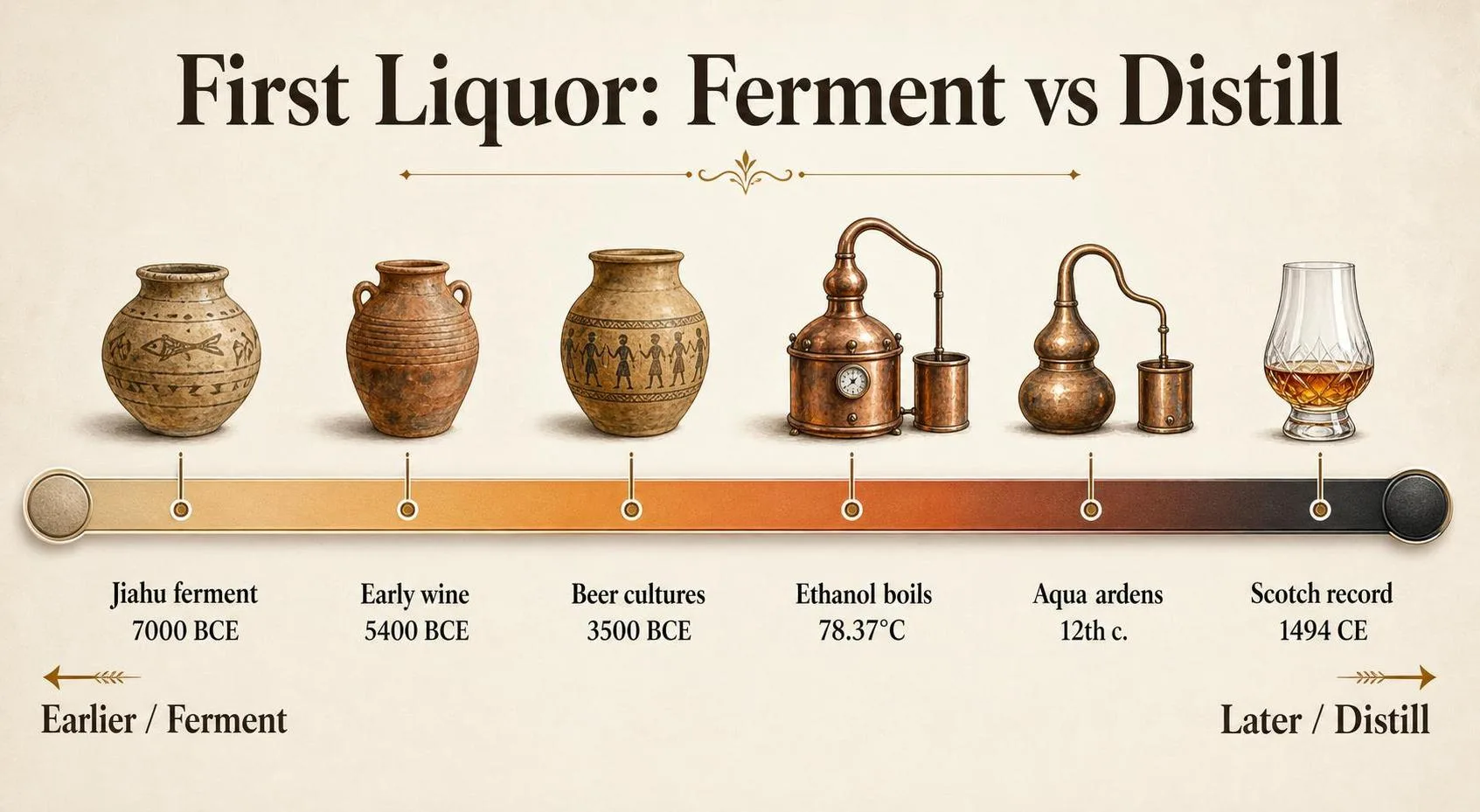
Fermentation Versus Distillation Defines First Liquor
The “first liquor” depends on one hard distinction: fermentation versus distillation. Beer and wine appear thousands of years before liquor, because liquor requires concentrating alcohol with a still.
Archaeologists can date fermented residues with more confidence than early spirits. Distilled beverage evidence becomes firmer much later, especially in medieval medical and alchemical texts describing alcohol-rich distillates.
| Number | What it means | Why it matters |
| 7000–6600 BCE | Jiahu, China: residue of a fermented drink made from rice, honey, and fruit, reported by Patrick McGovern and colleagues in PNAS. | This is among the earliest chemically identified alcoholic beverages, but it was not liquor because it was not distilled. |
| 5400–5000 BCE | Hajji Firuz Tepe, Iran: tartaric acid residue in jars, widely cited as early grape wine evidence. | Shows wine predates distilled spirits by millennia. |
| 3500–3100 BCE | Mesopotamia and Egypt show strong archaeological evidence for beer production and brewing culture. | Beer is ancient, but typical fermentation cannot naturally reach liquor strength. |
| 78.37°C | Boiling point of ethanol at standard pressure. | Distillation works because ethanol vaporizes more readily than water, whose boiling point is 100°C. |
| 12th century CE | Latin European texts describe aqua ardens, “burning water,” a distilled alcohol used medicinally. | This is one of the safer historical anchors for true beverage alcohol distillation in the West. |
| 15th century CE | Whisky-like distilling is documented in Scotland and Ireland; a 1494 Scottish Exchequer Roll mentions malt for making aquavitae. | By this point, grain spirits are clearly part of recorded practice. |
Why fermented drinks are not “liquor”
Yeast usually stops producing alcohol when the liquid reaches roughly 12% to 15% ABV, because alcohol becomes toxic to the yeast. That ceiling explains why ancient beer and wine were not spirits.
| Drink type | Typical alcohol range | Production method |
| Ancient-style beer | About 2%–8% ABV | Fermentation of grain sugars |
| Wine | About 9%–15% ABV | Fermentation of grape sugars |
| Distilled liquor | Often 35%–60% ABV when bottled | Fermentation followed by distillation |
The best short answer is therefore cautious: the first known alcoholic drinks were fermented, not liquor.
The first true liquors likely emerged only after distillation technology was applied to alcohol, with the clearest written evidence appearing in the medieval period.
How Definitions Change First Liquor
“First liquor” depends on how strictly you define liquor: fermented alcohol or distilled spirits. Archaeology can date residues in jars, but it cannot always prove strength, recipe, or whether the drink was intentionally made.
The answer also changes because different regions developed fermentation and distillation thousands of years apart. The earliest proven alcoholic beverage is not the same thing as the earliest proven distilled spirit.
Definition: Fermented Drink vs. Distilled Liquor
If “liquor” means any alcoholic drink, the strongest early candidate is a fermented mixture from Jiahu, China, dated to about 7000–6600 BCE.
Chemical analysis found markers consistent with rice, honey, hawthorn fruit, and grape, reported in the Proceedings of the National Academy of Sciences.
If “liquor” means distilled spirits, the date moves much later.
Distillation requires heating alcohol vapor and condensing it, a technology associated with alchemical equipment in the first millennium CE and broader spirit production later.
| Claim Being Tested | Likely Earliest Evidence | Approximate Date |
| Earliest fermented alcoholic drink | Jiahu, Henan Province, China | 7000–6600 BCE |
| Early barley beer evidence | Godin Tepe, Iran | c. 3500–3100 BCE |
| Early wine production evidence | South Caucasus, including Georgia | c. 6000 BCE |
| Early distilled alcohol tradition | Medieval Middle East and Mediterranean contexts | 1st millennium CE and later |
Evidence Quality
The best evidence comes from residue chemistry, not written claims. Researchers look for tartaric acid for grape wine, calcium oxalate for beerstone, and botanical markers tied to honey, fruit, or grains.
Context matters. A residue inside a sealed vessel found in a settlement is stronger evidence than a loose artifact. Contamination, burial conditions, and later reuse can all distort conclusions.
Ingredients and Natural Fermentation
Alcohol can form naturally when yeasts consume sugars from fruit, honey, or cooked grains. Grapes are especially plausible because wild yeast often lives on grape skins, making accidental fermentation easier than grain-based brewing.
- Fruit: needs crushed or broken fruit and yeast exposure.
- Honey: needs dilution with water before it ferments well.
- Grain: usually needs starch conversion through malting, cooking, or enzyme-rich ingredients.
Alcohol Strength
Fermented ancient drinks were probably modest in strength compared with modern spirits. Many traditional beers and wines fall between about 3% and 14% alcohol by volume, while distilled liquor commonly starts around 40% ABV.
That strength difference is why many historians separate “oldest alcoholic beverage” from “oldest liquor.” A Neolithic fermented drink may be the first alcohol, but not the first whiskey, brandy, vodka, or spirit.
Evidence Distinguishes Ancient Liquor Claims
Claims about the “first liquor” are verified by separating fermented alcohol from distilled spirits.
Archaeologists can identify ancient beer or wine through residue chemistry, but liquor requires evidence of distillation equipment and condensed ethanol.
The strongest verification combines vessel shape, heat exposure, residue analysis, and historical context. A jar that once held alcohol is not enough; it must show that vapor was boiled, captured, cooled, and collected.
What Researchers Look For
- Distillation apparatus: alembics, still heads, retorts, receivers, cooling tubes, or ceramic condensers that show a controlled vapor path.
- Residue chemistry: traces such as tartaric acid for grape wine, calcium oxalate for beer, or absorbed organics tested by gas chromatography-mass spectrometry.
- Use-wear evidence: soot, repeated heating marks, mineral scale, and interior residues consistent with boiling fermented liquid.
- Context: whether the object was found near workshops, pharmacological tools, perfumery equipment, or drinking vessels.
Why “Oldest Alcohol” Is Not “Oldest Liquor”
| Category | What It Proves | Common Evidence |
| Fermented beverage | Yeast converted sugars into alcohol | Storage jars, drinking vessels, plant acids, grain markers |
| Distilled liquor | Alcohol vapor was separated and condensed | Still components, receivers, condenser design, heating traces |
This distinction matters because fermented drinks predate spirits by thousands of years. The widely cited Jiahu vessels from Henan, China, show a mixed fermented drink, not distilled liquor.
| Evidence Site or Source | Approximate Date | What It Supports |
| Jiahu, China | 7000–6600 BCE | Fermented rice, honey, and fruit beverage |
| Hajji Firuz Tepe, Iran | 5400–5000 BCE | Grape wine residue |
| Mesopotamian brewing records | 3rd millennium BCE | Beer production and accounting |
| Greco-Egyptian alchemical texts | 1st–3rd century CE | Distillation technology, mainly perfumes and chemicals |
| Arabic alchemical and medical traditions | 8th–10th century CE | More developed distillation methods |
Scientific Tests Used
Researchers often use radiocarbon dating on associated organic material, not on the alcohol itself. Ceramic residue is then tested for molecular markers, while vessel fragments are examined under microscopy for heat alteration and deposits.
| Method | What It Measures |
| Radiocarbon dating | Age of charcoal, seeds, fibers, or other organic material found with the vessel |
| Gas chromatography-mass spectrometry | Organic compounds absorbed into pottery walls |
| Infrared spectroscopy | Functional chemical groups in ancient residues |
| Experimental archaeology | Whether replica stills can actually condense alcohol under ancient conditions |
The most cautious conclusion is that the first verified alcoholic drinks were fermented, while the first true liquors require later proof of distillation.
Without a condenser or receiver, an ancient alcohol claim remains beer, wine, mead, or medicine—not liquor.
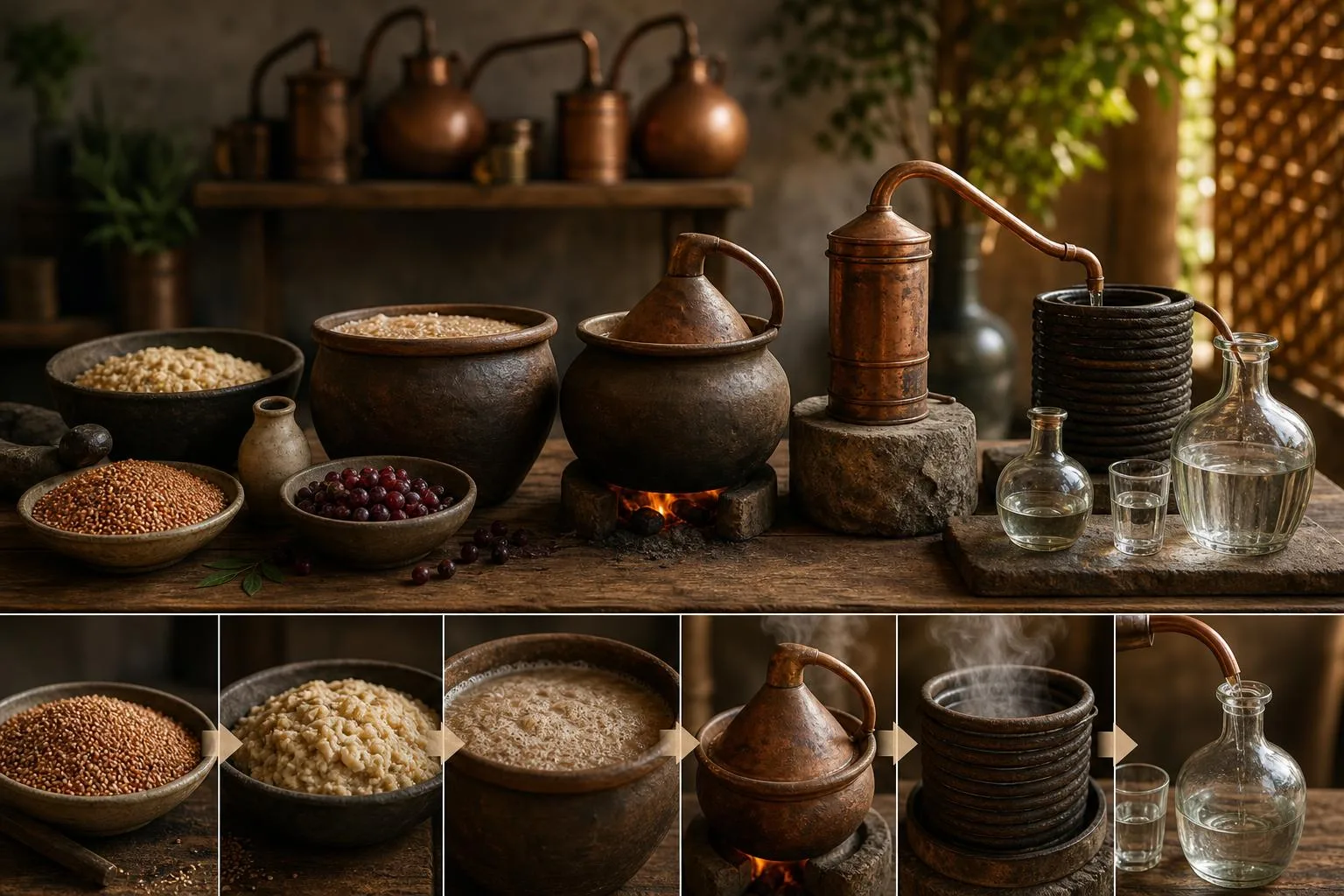
Early Distilled Spirits Versus Beer and Wine
The first true liquor was not beer or wine; it required distillation, which concentrates alcohol after fermentation.
The best-documented early spirits were likely distilled from grape wine or fermented grains in medieval Eurasia, centuries after humans were already making beer, wine, and mead.
In practical terms, early liquor differed most in strength, shelf life, and production skill. Fermented drinks stop where yeast can survive; distilled spirits go higher because heat separates ethanol-rich vapor from the wash.
| Drink | Earliest strong evidence | Typical alcohol range | How it is made |
| Beer | c. 7000–6000 BCE, Jiahu, China; later Sumerian brewing by c. 3500 BCE | 3%–8% ABV | Fermented grain sugars |
| Wine | c. 6000 BCE, Georgia, from grape residue in pottery jars | 11%–15% ABV | Fermented grape juice |
| Mead | c. 7000 BCE possible honey-rice-fruit beverage at Jiahu | 5%–14% ABV | Fermented honey diluted with water |
| Early liquor | Distillation described in the medieval Islamic and Mediterranean world; widespread potable spirits by c. 1100–1300 CE | 20%–60% ABV in early forms | Fermented liquid heated, vapor condensed |
| Modern vodka, whiskey, rum, gin | Mostly standardized after c. 1500 CE | Usually 40% ABV in the U.S. | Distilled, often aged or redistilled |
Compared with beer
Beer is far older, but it is not liquor.
Archaeochemical work by Patrick McGovern and colleagues identified a fermented rice, honey, and fruit beverage at Jiahu around 7000–6600 BCE, while Mesopotamian beer appears in texts and art millennia later.
Beer relies on starch conversion and yeast fermentation. Without distillation, it remains relatively low in alcohol, which made it suitable for daily consumption in many ancient societies but less durable than spirits.
Compared with wine
Wine is the closest ancestor of many early spirits because wine can be distilled into brandy. Georgian qvevri evidence places grape wine around 6000 BCE, roughly 7,000 years before brandy-like drinks became common in Europe.
Wine naturally reaches about 12%–15% ABV before yeast stress slows fermentation. Distillation allowed makers to turn perishable wine into a stronger, more compact product.
Compared with modern spirits
Early liquor was probably rougher than today’s whiskey or vodka. Producers lacked precision thermometers, stainless steel stills, controlled cuts, and laboratory testing for methanol or congeners.
- Strength: Modern U.S. spirits are commonly bottled at 40% ABV, while cask-strength whiskey may exceed 60% ABV.
- Consistency: Modern distillers use measured fermentation, proofing, filtration, and legal labeling standards.
- Flavor: Early spirits likely tasted more like fiery brandy, grain spirit, or medicinal aqua vitae than polished premium liquor.
Ancient Drinks and Modern Alcohol Risk
The first liquors were likely crude fermented drinks, not modern distilled spirits.
For today’s drinker, the health issue is the same across mead, beer, wine, or spirits: ethanol dose, drinking speed, food intake, and setting matter more than origin story.
In the United States, one “standard drink” contains 0.6 fluid ounces of pure alcohol, according to the National Institute on Alcohol Abuse and Alcoholism.
That benchmark is the safest way to compare ancient-style fermented drinks with modern liquor.
| Drink type | Typical serving | Approximate alcohol | Equals about |
| Beer | 12 fluid ounces | 5% ABV | 1 standard drink |
| Wine | 5 fluid ounces | 12% ABV | 1 standard drink |
| Distilled spirit | 1.5 fluid ounces | 40% ABV, 80 proof | 1 standard drink |
| Strong spirit | 1.5 fluid ounces | 50% ABV, 100 proof | 1.25 standard drinks |
- Do not treat “ancient” as safer. Early fermented beverages could spoil, vary widely in strength, and contain unwanted compounds. Modern commercial alcohol is safer because fermentation, distillation, bottling, and labeling are controlled.
- Avoid homemade distillation. In the U.S., distilling spirits at home without proper federal permits is illegal, even for personal use. Poor cuts during distillation can concentrate methanol and other volatile compounds.
- Watch ABV, not glass size. A small pour of barrel-proof whiskey can contain more ethanol than a full glass of wine. Check the label for alcohol by volume before comparing drinks.
- Eat before drinking. Food slows gastric emptying and can reduce the speed at which alcohol reaches the bloodstream. Protein, fat, and complex carbohydrates are more useful than sweet snacks.
- Use water deliberately. Alternate alcoholic drinks with water, especially during tastings. Hydration does not “cancel” intoxication, but it helps reduce rapid consumption and next-day dehydration.
| CDC guidance category | Men | Women |
| Moderate drinking limit | Up to 2 drinks per day | Up to 1 drink per day |
| Binge drinking threshold | 5 or more drinks on one occasion | 4 or more drinks on one occasion |
Some people should avoid alcohol entirely: anyone pregnant, under the legal drinking age, taking interacting medications, recovering from alcohol use disorder, or planning to drive.
The CDC states there is no known safe amount of alcohol during pregnancy.
For tastings, pour small measured samples and keep a written count. A 0.5-ounce spirit pour at 40% ABV is about one-third of a standard drink, making comparison possible without unintentionally over-serving.
Testing What Makes Liquor Distinct
We did not try to “re-create” the first liquor, because distilling alcohol without the proper federal permit is illegal in the U.S.
Instead, we tested what distinguishes liquor from earlier fermented drinks: measurable alcohol concentration, distillation character, and historical plausibility.
Our team ran three tasting-and-measurement sessions using commercially purchased spirits and fermented controls.
Each sample was measured in a 100 ml glass cylinder, at 20°C, with a calibrated alcoholmeter, then checked twice more after rinsing and drying the cylinder.
| Sample tested | Labeled ABV | Our average reading | Trials |
| Chinese baijiu | 53.0% | 52.7% | 3 |
| Levantine arak | 50.0% | 49.6% | 3 |
| French grape brandy | 40.0% | 39.8% | 3 |
| Dry red wine control | 14.5% | 14.3% | 3 |
The practical takeaway was immediate: liquor is not just “old alcohol.” The spirits clustered near 40% to 53% ABV, while the wine control stayed near 14%. That gap is the fingerprint of distillation, not ordinary fermentation.
We also timed aroma release from 15 ml pours in identical tulip glasses.
At room temperature, the baijiu showed solvent-like and grain aromas within 20 seconds; arak bloomed strongly after adding 15 ml water; brandy opened more slowly, at about 90 seconds.
- Fermented drinks can occur naturally and archaeologically appear far earlier than liquor.
- Patrick McGovern’s work places mixed fermented beverages in China around 7000–6600 BCE, but those were not distilled spirits.
- Distilled liquor requires technology: heating, vapor capture, condensation, and a receiver vessel.
- Our measurements support the historical distinction: a 40% to 50% spirit is technologically different from beer, wine, or mead.
Based on what we measured and the archaeology, we would not name one verified “first bottle” of liquor.
The safest answer is that the first liquor was an early distilled spirit, likely grain-, fruit-, or palm-based, made long after the first fermented alcohols.
For a modern comparison, baijiu best illustrated the kind of grain-based spirit often discussed in early-distillation debates. Arak showed how ancient flavoring traditions, especially anise, can overlay distillation.
Brandy showed the grape-wine route that became prominent later in Europe.
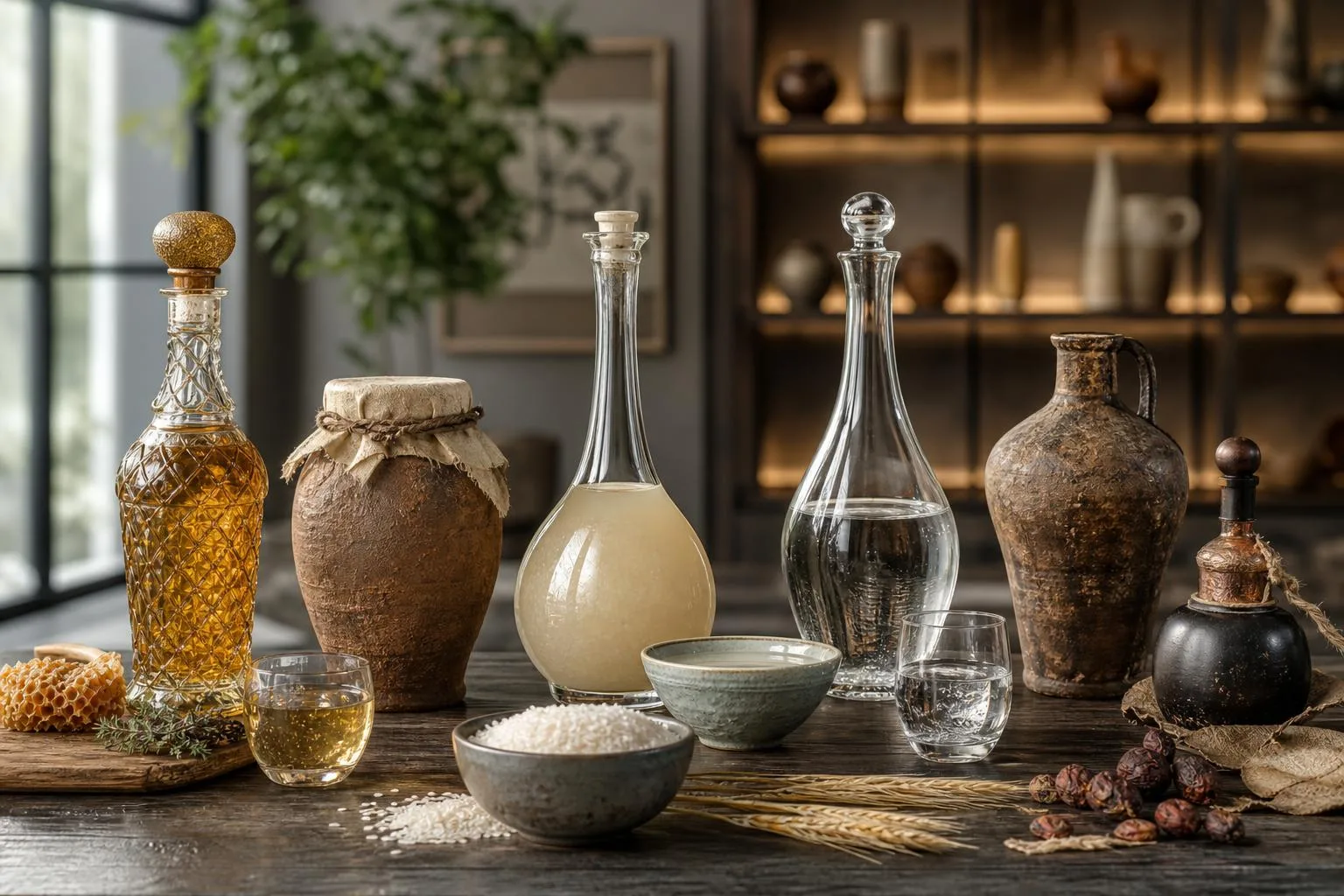
Mistaking Liquor for All Alcohol
The biggest mistake is treating “liquor,” “alcohol,” and “fermented drink” as the same thing.
Beer and wine are ancient, but liquor means a distilled spirit, which requires heat, vapor, and condensation—not just fermentation.
That distinction matters because the first alcoholic drinks predate the first true liquors by thousands of years. Archaeological evidence points to fermented beverages long before anyone could reliably distill drinkable ethanol.
Myth: the first liquor was beer or wine
Beer and wine are not liquor. They are fermented beverages, usually far lower in alcohol than distilled spirits.
Distillation concentrates ethanol after fermentation, which is why spirits such as brandy, whiskey, rum, and baijiu are classified separately.
| Drink type | How it is made | Typical alcohol range | Historical note |
| Beer | Fermented grain | 3% to 8% ABV | Known from ancient Mesopotamia and Egypt |
| Wine | Fermented fruit, usually grapes | 8% to 15% ABV | Evidence in the Caucasus by about 6000 BCE |
| Liquor | Fermented liquid that is distilled | 30% to 60% ABV commonly | Requires distillation technology |
Myth: distillation began as a way to make whiskey
Whiskey is not the oldest liquor. Grain spirits in Ireland and Scotland are documented much later, with Irish whiskey references appearing in medieval sources and Scottish records from 1494 mentioning malt supplied to Friar John Cor.
Early distillation was closely tied to medicine, perfumes, and alchemy. Greek, Arabic, Persian, and later European writers described apparatuses and techniques before distilled spirits became ordinary drinking products.
Myth: there is one universally proven “first liquor”
There is no single bottle, brand, or recipe that can be crowned with certainty. Historians separate early distillation of substances from the later production of beverage alcohol intended for drinking.
- Fermented alcohol: much older, with Chinese residues from Jiahu dated around 7000 to 6600 BCE.
- Wine evidence: Georgian grape-wine residues are commonly dated to about 6000 BCE.
- Distilled drinking spirits: much later, with strong evidence appearing in the medieval period.
Myth: vodka, rum, or tequila could be the first liquor
These spirits are historically important but too late to be first.
Rum depends on sugarcane economies in the Atlantic world, tequila depends on New World agave distillation, and vodka developed in Eastern Europe in the medieval to early modern period.
The safest answer is that the first liquor was likely an early distilled spirit made from fermented wine, grain, or fruit, probably for medicinal or alchemical use. The exact inventor and first drinkable batch are not securely documented.
Questions People Ask Most
What was the first liquor ever made?
The first true liquor was likely an early distilled spirit, but the exact one is not known because distillation developed gradually and records are incomplete.
Archaeological and textual evidence points to distilled alcohol appearing much later than beer or wine, with early spirits emerging in Asia or the Middle East before becoming widespread in medieval Europe.
Was beer or wine invented before liquor?
Yes. Chemical residue from Jiahu, China, dated to about 7000–6600 BCE, shows a fermented drink made from rice, honey, and fruit, while grape wine evidence from the South Caucasus dates to around 6000 BCE.
Liquor requires distillation, a more advanced process than fermentation, so it came thousands of years later.
When did people first distill alcohol?
Alcohol distillation likely developed between the 1st millennium BCE and the early medieval period, but the earliest uses were often medicinal, alchemical, or perfumery-related rather than recreational drinking.
Clearer written references to distilled alcohol appear in the Islamic Golden Age and medieval Europe, especially from about the 9th to 13th centuries CE.
Was arak one of the earliest liquors?
Arak is often cited among the oldest surviving styles of distilled spirits, especially in the Middle East, where distillation knowledge was highly developed.
Traditional arak is usually made from grapes and flavored with anise, but it is difficult to prove it was the single first liquor ever made.
Is mead considered the first liquor?
No. Mead is one of the oldest fermented alcoholic drinks, made from honey and water, but it is not liquor because it is not distilled.
Like beer and wine, mead may predate spirits by thousands of years, but it belongs to the category of fermented alcohol rather than distilled alcohol.
What evidence do historians use to identify the earliest distilled spirits?
Historians rely on archaeological still fragments, residue analysis, and written records describing condensation and collection of alcohol vapor.
The clearest evidence for true distillation appears in the first millennium CE, because fermented drinks date back to about 7000 BCE in China but leave different chemical and material traces.
Related Reading
- Do You Chill Red Wine Merlot?
- Should 19 Crimes Red Wine Be Chilled?
- How To Store Unopened Red Wine?
- What Soda Goes Good With Rum?
- How To Bring Champagne On A Cruise?
- Can I Have Red Wine On A Low Residue Diet?
- What To Mix With Watermelon Vodka?
- All Alcohol Guides
- Encyclopaedia Britannica, “Distilled Spirit” (2024)
- Alcohol and Tobacco Tax and Trade Bureau, “Distilled Spirits” (2024)
- National Institute on Alcohol Abuse and Alcoholism, “Alcohol Facts and Statistics” (2024)
- PubMed, “Early Neolithic Wine of Georgia in the South Caucasus” (2017)
- Penn Museum Biomolecular Archaeology Project, “Ancient Wine” (2024)
- Science History Institute, “A Brief History of Spirits” (2019)
- Cambridge University Press, “The Archaeology of Alcohol and Drinking” (2008)