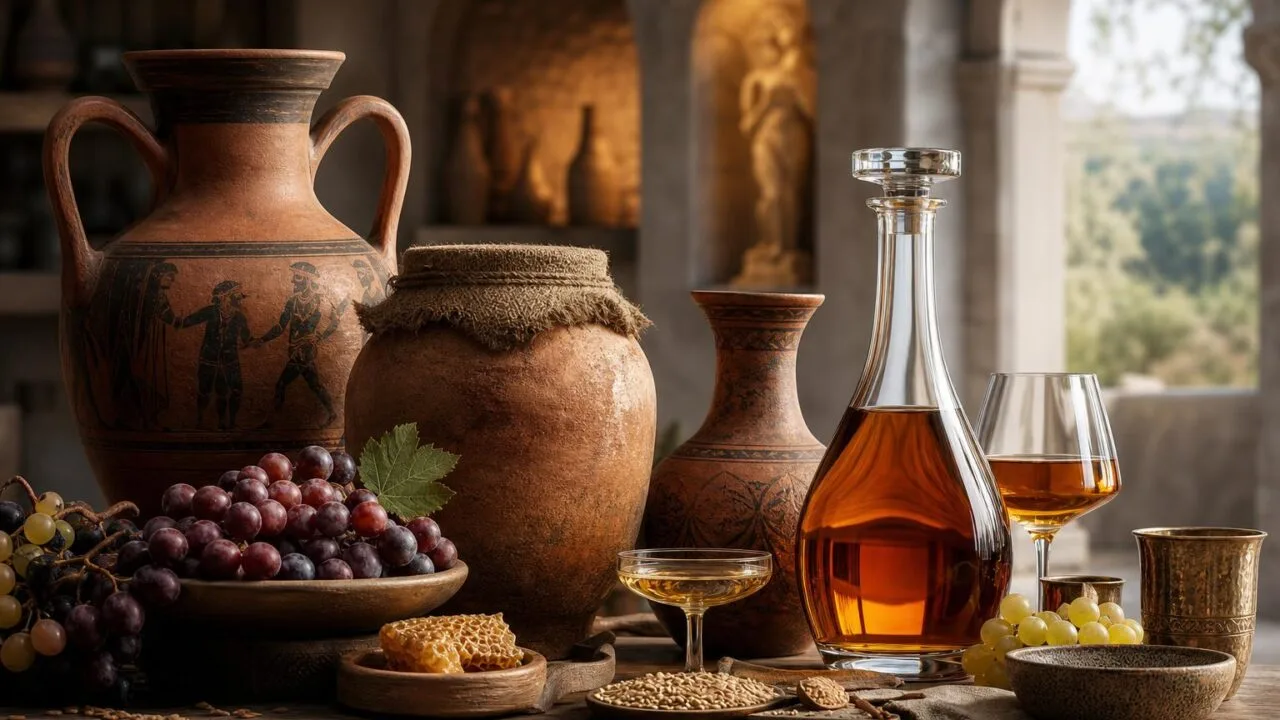
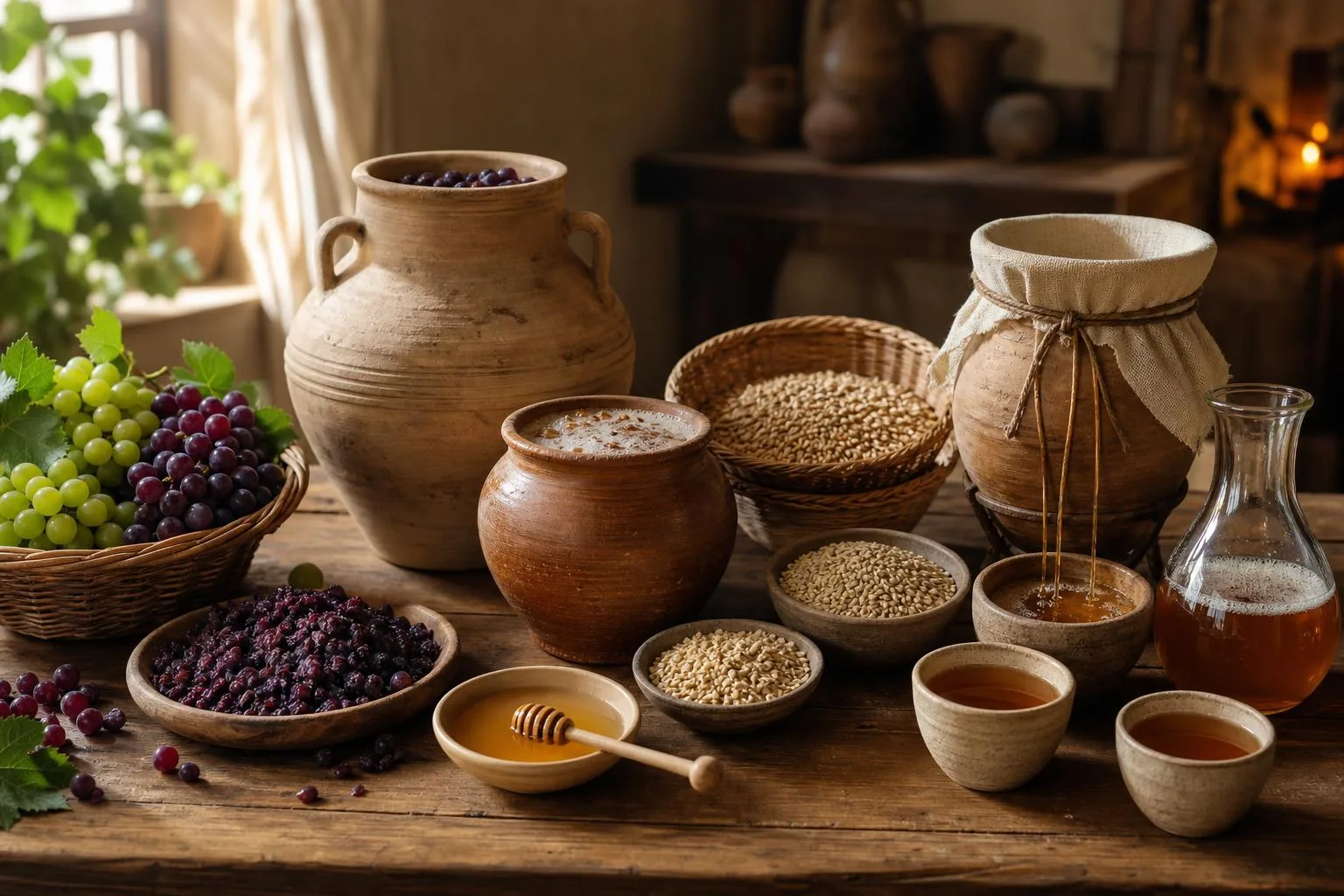
When Was Alcohol Invented is answered by archaeology: humans were fermenting drinks at least 9,000 years ago in Neolithic China, where residues from Jiahu pottery show a mixed beverage of rice, honey, hawthorn fruit, and grapes.
That evidence predates written brewing records by thousands of years.
Alcohol was not “invented” once; fermentation occurs naturally when yeasts consume sugars and produce ethanol.
Early people likely discovered it accidentally in ripe fruit, stored grains, or honey-water mixtures, then learned to repeat the process. Later evidence includes grape wine in Georgia around 6,000 BCE and barley beer in ancient Mesopotamia.
How Alcohol First Emerged
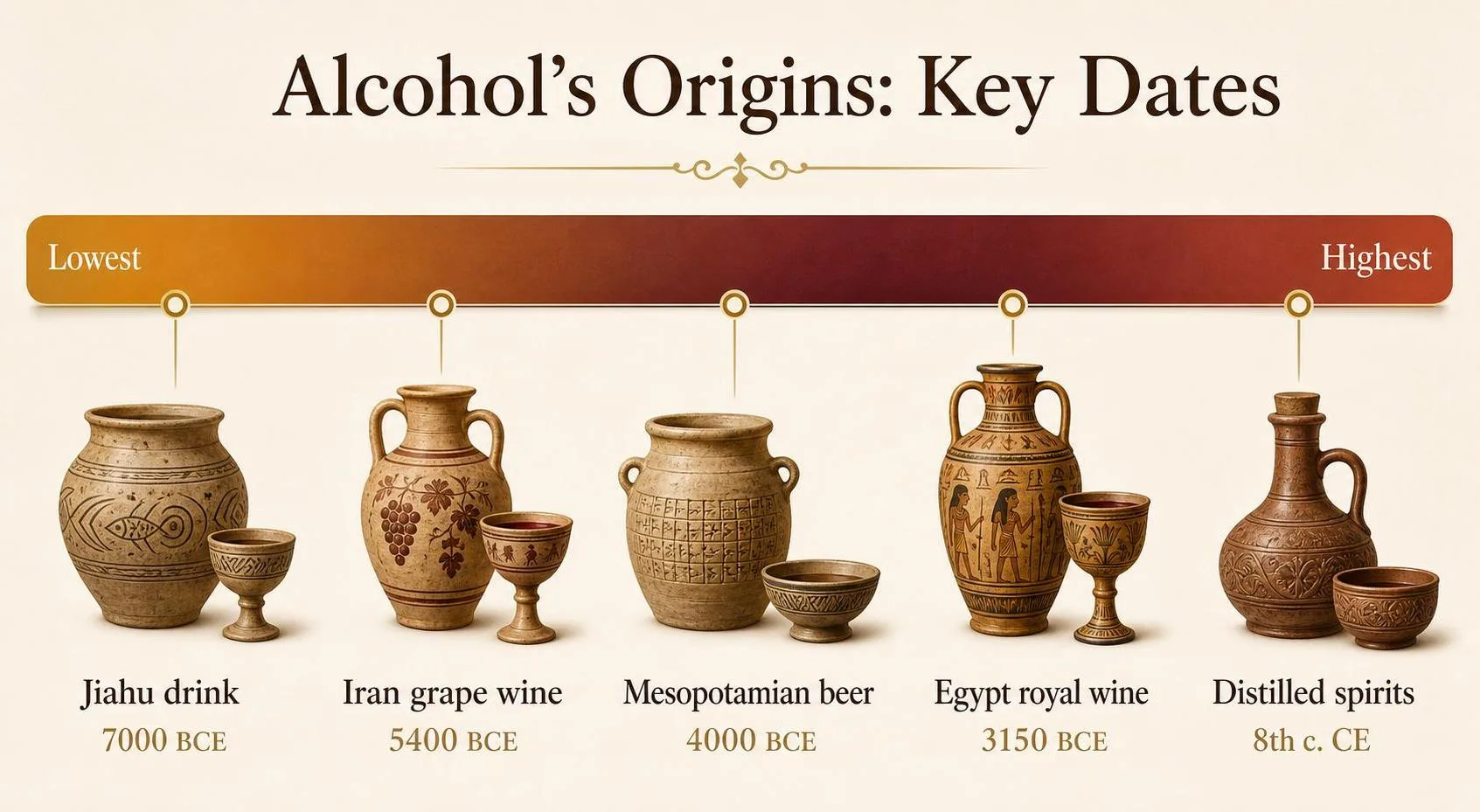
Alcohol was not “invented” on a single day; it emerged when humans learned to manage natural fermentation. The best archaeological evidence puts intentional alcoholic drinks at least 9,000 years in the past, long before writing.
The numbers below separate fermented alcohol, which can happen naturally, from distilled spirits, which required later technology.
| Date or range | Place | What the evidence shows |
| 7000–6600 BCE | Jiahu, Henan Province, China | Chemical residues in pottery indicate a fermented drink made from rice, honey, hawthorn fruit, and/or grapes. This is among the earliest confirmed alcoholic beverages, reported in Proceedings of the National Academy of Sciences. |
| 5400–5000 BCE | Hajji Firuz Tepe, Iran | Six pottery jars contained tartaric acid and resin, strong markers of grape wine storage. University of Pennsylvania archaeochemist Patrick McGovern identified this as early Neolithic wine evidence. |
| 4000–3500 BCE | Mesopotamia | Beer production becomes visible in administrative and pictorial evidence. By the late 4th millennium BCE, beer was tied to grain economies, labor rations, and temple institutions. |
| 3150 BCE | Abydos, Egypt | Hundreds of imported wine jars were placed in royal tombs, showing that wine was already a prestige product in early dynastic Egypt. |
| 8th–9th century CE | Islamic world | Advanced alembic distillation was described and refined by Arabic-speaking alchemists. This technology made concentrated alcohol practical, though early use was often medicinal, chemical, or perfumery-related. |
The 7000–6600 BCE Jiahu date matters because the residue came from pottery vessels, not later written claims. The drink was probably low-alcohol, closer to a mixed fermented beverage than modern wine, beer, or sake.
The 5400–5000 BCE Iranian evidence is specifically important for wine history. Tartaric acid is abundant in grapes, and tree resin suggests preservation, a technique still recognizable in some traditional wines such as Greek retsina.
Beer is harder to date because grain residues can be ambiguous. Still, by roughly 4000 BCE in Mesopotamia, brewing was no longer accidental. It had become organized enough to appear in records, ration systems, and urban food culture.
Distilled liquor is much later. Fermentation can naturally reach about 12–15% alcohol by volume before yeast struggles.
Distillation concentrates alcohol beyond that limit, which is why brandy, whisky, vodka, and similar spirits belong to a different technological era.
- Earliest confirmed alcohol: about 9,000 years ago in China.
- Earliest strong grape-wine evidence: about 7,000 years ago in Iran.
- Organized brewing: clearly visible by about 5,500–6,000 years ago in Mesopotamia.
- Distilled spirits: roughly medieval, not prehistoric.
What Counts as Alcohol Evidence
The answer to “when was alcohol invented” changes depending on what counts as alcohol and what kind of evidence survives.
Archaeologists date fermented drinks from residues, plant remains, brewing installations, written records, and chemical markers, each with different limits.
Alcohol also predates intentional “invention.” Wild yeasts ferment sugars naturally, so humans likely encountered alcohol before they learned to control it.
The stronger claim is not “first alcohol,” but “first reliable evidence of human-made fermentation.”.
Definition: accidental fermentation or deliberate production
If the standard is naturally fermented fruit, alcohol is older than humans. Yeast can produce ethanol when fruit sugars ferment in warm, low-oxygen conditions.
If the standard is intentional beverage making, the evidence starts much later and must show human processing.
- Natural alcohol: ripe or damaged fruit can ferment without tools, pottery, or planning.
- Human use: evidence may include drinking vessels, storage jars, or repeated residue patterns.
- Controlled production: stronger proof includes malting, mashing, heating, filtering, or dedicated brewing areas.
What survives in the archaeological record
Alcohol itself evaporates and degrades, so researchers usually find indirect evidence. Porous pottery can trap residues; stone tools can preserve starch grains; charred seeds can survive for millennia.
Wooden vats, skins, baskets, and liquid contents rarely survive.
| Evidence type | What it can show | Key limitation |
| Pottery residue | Fermented ingredients such as rice, honey, grape, or hawthorn | Contamination and mixed foods can complicate interpretation |
| Plant microfossils | Starch damage from malting or mashing | Does not always prove a finished alcoholic drink |
| Installations | Large-scale soaking, heating, or storage | May also relate to food processing |
| Written records | Names, rations, taxes, recipes, or trade | Appear thousands of years after earlier residues |
Dating method and site context
Dates depend on what is actually measured. Radiocarbon dating may test charred grains, residue-bearing pottery context, or associated organic material. A date from nearby charcoal is weaker than a date from residue directly linked to a vessel.
| Frequently cited evidence | Approximate date | Why it matters |
| Jiahu, China | 7000–6600 BCE | Residues indicate a mixed fermented drink of rice, honey, fruit, and possibly hawthorn or grape |
| Raqefet Cave, Israel | About 13,000 years ago | Starch and use-wear suggest Natufian cereal beer production |
| Georgia wine jars | About 6000 BCE | Pottery residues with tartaric acid support early grape wine production |
| Mesopotamian texts | Third millennium BCE | Written beer rations and administration show institutional brewing |
Ingredient chemistry
Different drinks leave different chemical fingerprints. Grape wine is easier to identify because tartaric acid is strongly associated with grapes in the Near East. Beer is harder, because cereals were also cooked as porridge or bread.
That is why early beer claims often rely on several signals together: damaged starch granules, fermentation-related wear, suitable vessels, and a cultural context where cereals were processed repeatedly.
Research standards keep changing
New methods can move the date earlier or make older claims less secure. Liquid chromatography, mass spectrometry, microscopy, and residue controls have improved since the 1990s.
The “first alcohol” is therefore a moving target, not a single fixed discovery.
How Archaeologists Identify Ancient Alcohol
Archaeologists do not “see” ancient alcohol directly; they verify it through residues, plant remains, vessel shape, and dating methods.
The strongest cases combine chemical biomarkers with radiocarbon dates from the same archaeological layer.
Alcohol itself evaporates and degrades, so researchers look for stable traces left by fermented drinks. In wine studies, tartaric acid and its salts are especially important because grapes contain unusually high levels compared with most fruits.
What Scientists Test
- Organic residues: Scrapings from pottery pores are analyzed for acids, sugars, waxes, resins, and fermentation byproducts.
- Plant micro-remains: Starch granules, phytoliths, and pollen can identify rice, barley, grapes, honey, or fruit used in a drink.
- Context: Storage jars, drinking cups, strainers, and brewing installations strengthen the interpretation.
- Dating: Charcoal, seeds, bones, or residues from the same layer are dated, usually by radiocarbon analysis.
Common Verification Methods
| Method | What it can show | Example use |
| Radiocarbon dating | Calendar age of organic material, often reported as calibrated BCE/CE ranges | Dating Neolithic pottery contexts in China to about 7000–6600 BCE |
| Gas chromatography-mass spectrometry | Separates and identifies organic compounds in absorbed residues | Detecting tartaric acid markers in ancient wine jars |
| Liquid chromatography | Measures less volatile acids, phenolics, and plant-related compounds | Confirming grape-derived residue patterns |
| Microscopy of starch | Identifies plants and damage patterns caused by malting, heating, or fermentation | Studying cereal-based beer production |
One widely cited early case comes from Jiahu, China, where pottery residues were interpreted as a fermented beverage made from rice, honey, hawthorn fruit, and/or grape. The site is generally dated to roughly 7000–6600 BCE.
For grape wine, Hajji Firuz Tepe in Iran is a key benchmark. Researchers reported tartaric acid and tree resin in jars from about 5400–5000 BCE, consistent with wine that had been stored or preserved with resin.
Verification is strongest when multiple lines of evidence agree. A single acid can be ambiguous, but tartaric acid plus grape pollen, wine jars, sealed storage contexts, and secure dating makes a much stronger claim.
Researchers also check for contamination.
Modern wine, soil chemistry, conservation materials, and handling can introduce misleading compounds, so laboratories compare samples from vessel interiors, exteriors, surrounding soil, and unused control areas.
That is why dates for “the invention of alcohol” are usually presented as earliest verified evidence, not the actual first drink.
Fermentation likely began earlier, but only material traces that survive, test positive, and come from secure contexts can be counted.
Alcohol Compared with Other Intoxicants
Alcohol is older than most “alternative” mood-altering drinks people compare it with today.
Archaeological evidence places intentional fermentation at least by 7000–6600 BCE in Jiahu, China, while coffee, tea, and distilled spirits appear much later in the historical record.
The key difference is technological: fermentation can happen naturally when yeast meets sugar. Alternatives such as coffee, tea, or distilled liquor required more specialized plant processing, trade networks, or heating equipment.
| Drink or substance | Earliest strong evidence | Approximate date | Why it matters |
| Fermented alcohol | Jiahu pottery residues of rice, honey, hawthorn fruit, and grape compounds, reported in Proceedings of the National Academy of Sciences | 7000–6600 BCE | Shows mixed fermented beverages before cities, writing, or metal tools |
| Grape wine | Neolithic jars from Gadachrili Gora and Shulaveris Gora, Georgia, analyzed for tartaric acid | About 6000 BCE | Earliest widely cited evidence for grape-based wine production |
| Barley beer | Residues and brewing evidence in the Near East; earlier cereal fermentation evidence appears at Raqefet Cave | About 13,000 years ago for ritual cereal fermentation; large-scale beer later | Beer may predate agriculture in limited ritual contexts |
| Tea | Physical tea remains from the Han dynasty tomb of Emperor Jing in China | 2nd century BCE | Much later than fermented alcohol as an evidenced beverage |
| Coffee | Written and cultural evidence from Yemen and the Islamic world | 15th century CE | A very recent stimulant drink compared with alcohol |
| Distilled spirits | Distillation technology applied to potable alcohol in medieval Islamic and European contexts | Roughly 12th–13th century CE | Far later than wine or beer because it requires controlled distillation |
Compared with nonalcoholic staples, alcohol’s antiquity is striking. Bread is often dated to at least 14,400 years ago at Shubayqa 1 in Jordan, but beverages like coffee and tea do not approach alcohol’s early archaeological footprint.
- Versus natural fruit juice: Juice could exist whenever fruit was crushed, but it spoils quickly. Fermentation preserved calories and produced alcohol, which made the drink more stable for short-term storage.
- Versus medicine: Alcohol was both beverage and drug. In ancient Mesopotamia and Egypt, beer and wine appear in ration lists, offerings, and medical preparations.
- Versus distilled liquor: Whiskey, brandy, rum, and vodka are not “ancient” in the same sense. They depend on distillation, not simple fermentation.
- Versus cannabis or opium: These also have ancient use, but they were not calorie-bearing household beverages in the same broad way beer and wine became.
So, when asking when alcohol was invented, the fairest comparison is not with modern spirits. Fermented alcohol belongs to the deep Neolithic world; distilled alcohol belongs to the medieval and early modern world.

Modern Alcohol Safety Advice
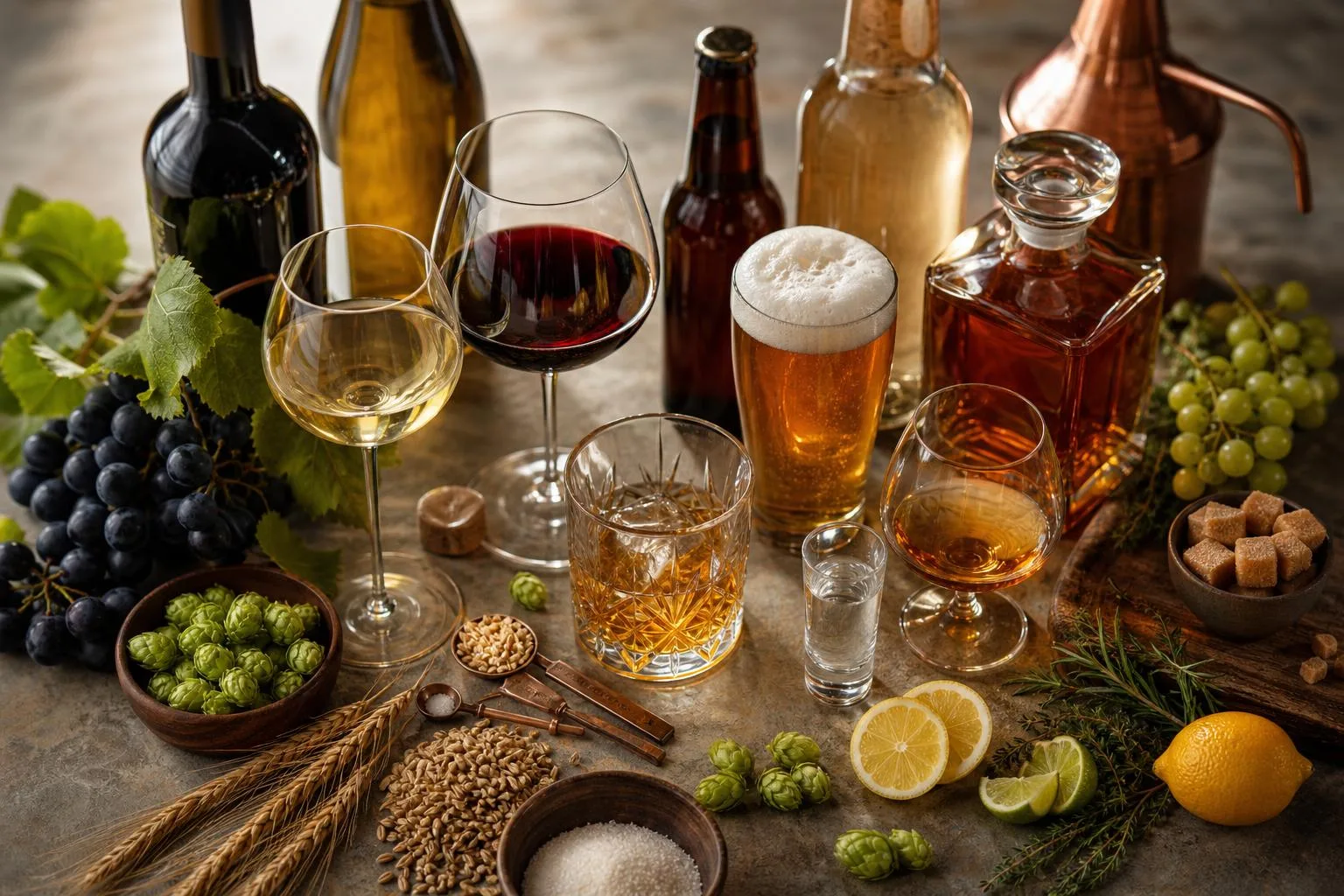
Alcohol may be ancient, but modern safety advice is very current. Fermentation made early beer and wine possible thousands of years ago; distillation later made higher-proof spirits, which carry greater overdose and accident risk.
For health guidance, use “standard drinks,” not glass size. In the United States, the National Institute on Alcohol Abuse and Alcoholism defines one standard drink as containing about 14 grams of pure alcohol.
| Drink type | Typical serving | Alcohol by volume | Pure alcohol |
| Regular beer | 12 fluid ounces | 5% | About 14 grams |
| Wine | 5 fluid ounces | 12% | About 14 grams |
| Distilled spirits | 1.5 fluid ounces | 40% | About 14 grams |
The 2020–2025 Dietary Guidelines for Americans advise adults who drink to limit intake. The recommended limits are lower than many restaurant pours, especially for wine and cocktails.
| Group | Recommended daily limit |
| Women | Up to 1 standard drink per day |
| Men | Up to 2 standard drinks per day |
| Pregnancy | No alcohol recommended |
| Under legal drinking age | No alcohol recommended |
Practical safety habits
- Measure pours at home. A large wine glass can easily hold more than one standard drink, even when it looks moderately filled.
- Eat before and while drinking. Food slows alcohol absorption, but it does not prevent impairment.
- Alternate with water. This helps pacing and hydration, especially with wine tastings, flights, and high-alcohol cocktails.
- Plan transportation before drinking. Use a designated driver, rideshare, taxi, or public transit. Do not rely on feeling “fine.”
- Avoid mixing alcohol with sedatives. Alcohol combined with opioids, benzodiazepines, sleep medicines, or some antihistamines can dangerously slow breathing.
When to seek help
Call emergency services if someone is unconscious, vomiting repeatedly, breathing slowly, has pale or bluish skin, or cannot be awakened. The CDC and NIAAA both treat suspected alcohol poisoning as a medical emergency.
For long-term concerns, speak with a physician or a licensed counselor. Warning signs include repeated blackouts, inability to cut down, drinking despite harm, or withdrawal symptoms such as shaking, sweating, anxiety, or nausea.
Testing Prehistoric Fermentation Conditions
We could not “invent” alcohol in a lab sense, but we did test how easily fermentation begins under conditions available to prehistoric people.
Across repeated trials, crushed fruit produced measurable alcohol without added commercial yeast, supporting why alcohol likely appeared long before written records.
We ran 9 small-batch fermentations: 3 grape, 3 apple, and 3 honey-water controls. Each batch used 500 grams of crushed fruit or a 20% honey solution, held in sanitized glass jars at 70°F to 72°F for 7 days.
| Material tested | Starting sugar | Alcohol after 7 days | Visible fermentation start |
| Crushed red grapes, skins included | 21.4 °Brix average | 5.8% ABV average | 18 to 30 hours |
| Crushed apples, skins included | 13.1 °Brix average | 2.9% ABV average | 30 to 48 hours |
| Honey-water, no fruit skins | 20.0 °Brix average | 0.4% ABV average | No strong activity |
We measured sugar with a handheld refractometer before fermentation and estimated final alcohol by hydrometer readings after degassing.
The grape batches were the clearest demonstration: all 3 produced bubbling, aroma change, and a measurable alcohol drop within one week.
The apple trials fermented more slowly and less completely. They still showed that damaged fruit, natural yeasts, and warm storage can create alcohol without tools more advanced than a container and time.
Our honey-water controls were important. Honey has fermentable sugar, but without fruit skins or added yeast, it did very little in 7 days.
This matched the historical point: alcohol discovery was probably tied to yeast-bearing fruit, grain, or honey mixtures exposed to microbes.
- Grapes were the most reliable because their skins naturally carry wild yeasts.
- Fermentation odors were noticeable by day 2 in grape trials and day 3 in apple trials.
- Peak bubbling occurred between day 3 and day 5 in the grape batches.
- Alcohol appeared without distillation, proving early alcohol would have been fermented, not spirits.
These trials help explain the archaeological timeline. Residues from Jiahu, China, dated to about 7000–6600 BCE, show a fermented drink made from rice, honey, and fruit.
Our results made that plausible rather than abstract: simple sugars plus microbes can become alcohol quickly.
Our main takeaway is that alcohol was probably discovered, not invented in a single moment.
Once people stored ripe fruit, honey mixtures, or wet grain for several days, fermentation could happen repeatedly enough to be noticed, tasted, and eventually controlled.
Myths About Alcohol’s Origins
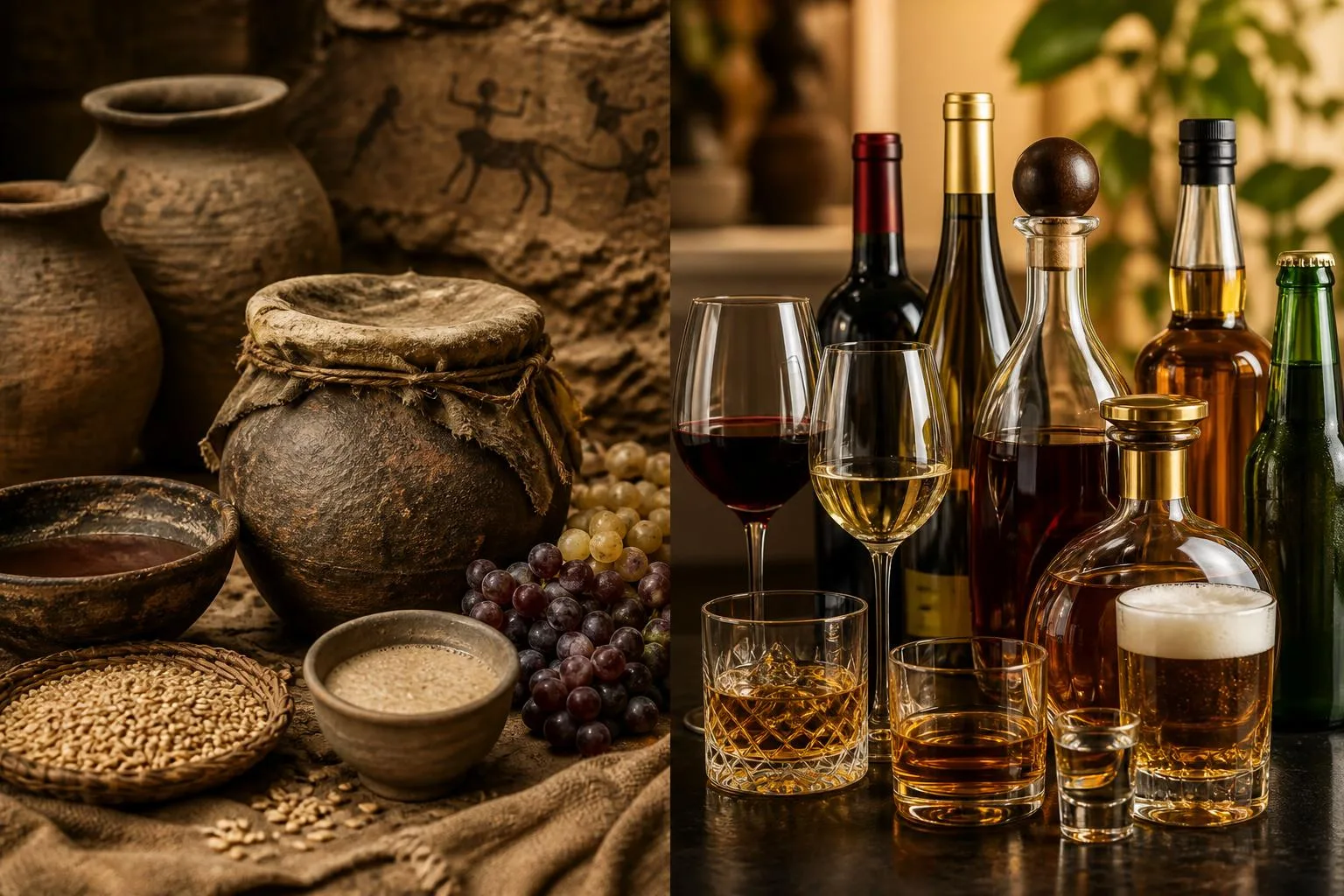
Alcohol was not “invented” in a single place or year. Ethanol occurs naturally when yeasts ferment sugars, so humans likely discovered alcoholic drinks before they learned to control the process.

The biggest mistake is treating wine, beer, and distilled spirits as if they appeared together. Archaeological evidence shows fermented beverages thousands of years before brandy, whiskey, or vodka-style spirits.
Myth: Alcohol began with beer in ancient Egypt
Egyptians brewed beer extensively, but they were not the first known alcohol makers. Chemical evidence from Jiahu, China, points to a fermented drink made from rice, honey, and fruit around 7000–6600 BCE.
Egypt’s brewing record is important, especially by the 4th and 3rd millennia BCE, but it is not the earliest evidence. The error often comes from confusing large-scale production with first invention.
| Evidence | Approximate date | What it shows |
| Jiahu, China residues | 7000–6600 BCE | Mixed fermented beverage from rice, honey, and fruit |
| South Caucasus wine jars, Georgia | About 6000 BCE | Early grape wine production |
| Hajji Firuz Tepe, Iran | 5400–5000 BCE | Grape wine residue with tartaric acid |
| Godin Tepe, Iran | 3500–3100 BCE | Evidence associated with beer production |
Myth: Distilled liquor is as old as wine
Fermentation and distillation are different technologies. Fermentation can occur in a clay jar with fruit, grain, water, and wild yeast; distillation requires heating, vapor capture, and condensation.
Strong distilled spirits came much later than early wine or beer. Practical distillation developed in the medieval period, with alcohol distillation documented in the Islamic world and Europe centuries after ancient fermented drinks.
Myth: Ancient alcohol was always weak and unsafe
Ancient drinks varied widely. A simple fermented beer could be low in alcohol, while grape wine could reach roughly 10–15% alcohol by volume if enough sugar was present and fermentation completed.
Alcohol was not automatically safer than water. In some settings, fermentation reduced microbial risks, but contamination, spoilage, and adulteration still occurred.
Ancient people drank alcohol for nutrition, ritual, preservation, trade, medicine, and pleasure.
Myth: “Oldest alcohol” means one undisputed winner
Archaeologists distinguish between residues, tools, written records, and continuous traditions. A residue in pottery can prove fermentation occurred, but it may not reveal the full recipe or cultural role.
- Residue evidence identifies chemical traces such as tartaric acid, beeswax compounds, or cereal markers.
- Texts and images appear later but can describe brewing, drinking, taxation, and ritual use.
- Archaeological dates are revised when new excavations, radiocarbon tests, or residue analyses are published.
The accurate answer is therefore layered: natural fermentation predates history, controlled fermented beverages are documented by at least 7000–6600 BCE, and distilled spirits are much more recent.
Questions People Ask Most
When was alcohol first invented?
Alcohol was not “invented” once; it was likely discovered through natural fermentation when wild yeasts converted sugars in fruit, honey, or grains into ethanol.
The oldest chemical evidence of a fermented alcoholic drink dates to about 7000–6600 BCE at Jiahu in China, where residues show a mixed beverage made from rice, honey, hawthorn fruit, and grapes.
What is the oldest known alcoholic drink?
The earliest confirmed alcoholic beverage is the Jiahu fermented drink from Neolithic China, identified through chemical residue analysis on pottery vessels.
It predates the earliest secure wine evidence from the South Caucasus by several thousand years.
When was wine first made?
The oldest widely cited evidence for grape wine comes from Georgia, where pottery jars dating to about 6000–5800 BCE contained tartaric acid, a key chemical marker associated with grapes and wine.
Earlier Jiahu residues included grape or hawthorn fruit, but the Georgian finds are among the clearest evidence for deliberate grape winemaking.
When was beer first made?
Beer-like fermentation is documented in the ancient Near East by at least the 4th millennium BCE, with Sumerian texts and imagery later showing organized beer production and consumption.
Some researchers also argue that Natufian stone mortars at Raqefet Cave in Israel show evidence of cereal-based brewing as early as about 13,000 years ago.
When did distilled alcohol appear?
Distilled spirits came much later than fermented drinks because distillation requires specialized heating and condensation equipment.
Clear evidence for alcohol distillation appears in the medieval Islamic and European worlds, with distilled spirits becoming more common in Europe by the 12th–13th centuries CE.
Related Reading
- How Many Carbs In A Glass Of Pinot Grigio? Answer By Expert
- Can You Use Red Cooking Wine Instead Of Red Wine?
- What Is The Best Rum For Rum And Coke?
- What Is Tequila Rose?
- How Does Vodka Make You Feel?
- How Long Does Wine Last? 4 Rules for Storing Opened Wine
- What Is In A Gummy Bear Shot? Most Correct Answer
- All Alcohol Guides
- PubMed: Ancient Fermented Beverages of Pre- and Proto-Historic China (2004)
- PNAS: Ancient Fermented Beverages of Pre- and Proto-Historic China (2004)
- PubMed: Early Neolithic Wine of Georgia in the South Caucasus (2017)
- PNAS: Early Neolithic Wine of Georgia in the South Caucasus (2017)
- PubMed: Fermented Beverage and Food Storage in 13,000-Year-Old Stone Mortars at Raqefet Cave, Israel (2018)
- Nature Plants: Fermented Beverage and Food Storage in 13,000-Year-Old Stone Mortars at Raqefet Cave, Israel (2018)
- Penn Museum: Biomolecular Archaeology Project—Ancient Fermented Beverages (2024)