
What Alcohol Is Kosher For Passover is wine, grape juice, and spirits that carry reliable Kosher for Passover certification and avoid chametz grains such as wheat, barley, rye, oats, and spelt.
During Passover, even normally kosher alcohol needs extra scrutiny because production aids, barrels, flavorings, and grain-derived alcohol can change its status.
Certified kosher-for-Passover wine is the safest default, while potato-based vodka, sugarcane rum, and certain fruit brandies may qualify when supervised.
Ashkenazi buyers also avoid kitniyot-based alcohol, such as corn or rice spirits, unless following a different rabbinic tradition or purchasing products specifically approved by agencies like OU or Star-K.
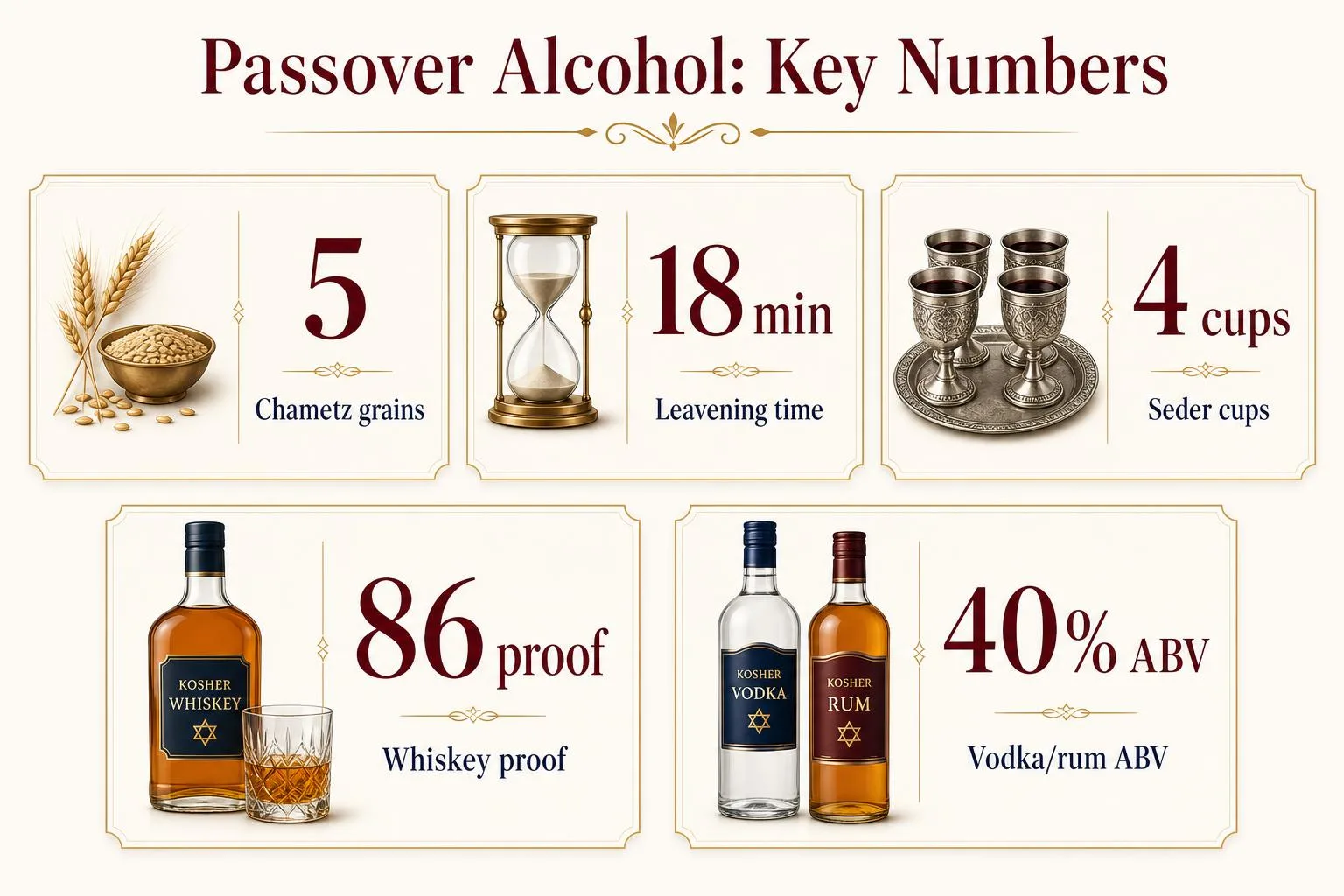
Passover Alcohol Rules by the Numbers
Passover alcohol rules turn on a few practical numbers: which grains are forbidden as chametz, how wine is used at the Seder, and what proof or ingredients reveal about a spirit.
These figures help separate generally acceptable choices from bottles that need Passover-specific certification.
| Number | What it means for Passover alcohol | Practical takeaway |
| 5 | The five chametz grains are wheat, barley, rye, oats, and spelt. | Beer, most whiskey, Scotch, bourbon, rye, and many grain vodkas are not kosher for Passover. |
| 18 minutes | Traditional halachic timing used for grain flour and water before leavening concern begins. | It explains why fermented grain beverages are treated strictly, not as a labeling technicality. |
| 4 cups | The Seder requires drinking four cups of wine or grape juice. | Passover wine matters because it is a ritual item, not just a beverage pairing. |
| 86-proof / 43% ABV | A common bottling strength for many whiskeys. | The alcohol level does not make whiskey acceptable; the chametz grain base remains the issue. |
| 40% ABV | Typical vodka, rum, tequila, and many brandies are bottled at 40% alcohol by volume. | ABV alone says nothing about Passover status; source material and supervision matter. |
The 5 Grain Rule
Chametz is the central Passover concern. Alcohol made from fermented wheat, barley, rye, oats, or spelt is generally off-limits during Passover.
That removes beer outright, because it is commonly barley-based, and it removes whiskey categories distilled from grain mash.
Distillation does not erase the Passover problem for mainstream observant use. Even though whiskey is distilled after fermentation and later aged, its alcohol originates from chametz grain.
Standard bourbon, Scotch, Irish whiskey, rye whiskey, and malt whiskey therefore require avoidance on Passover.
The 4 Cups at the Seder
The four cups are why kosher-for-Passover wine is the most visible alcohol category.
The bottle should carry reliable kosher-for-Passover certification, not merely a year-round kosher symbol, because Passover production requires stricter ingredient and equipment controls.
Grape juice may substitute for wine for children, people avoiding alcohol, or anyone medically advised not to drink. It still needs Passover certification when used at the Seder, because the issue is production status, not alcohol content.
Where Spirits Fit
- Usually not acceptable: beer, whiskey, bourbon, Scotch, rye, grain vodka, and liqueurs with grain alcohol or uncertain additives.
- Possible with Passover certification: potato vodka, sugarcane rum, tequila, brandy, and certain fruit-based spirits.
- Needs extra caution: flavored spirits, cordials, cream liqueurs, vermouth, and cocktails using syrups or bitters.
For Sephardic consumers who permit kitniyot, ingredients such as corn or rice may be treated differently than by Ashkenazic consumers.
Even then, commercial alcohol still needs appropriate Passover supervision because processing aids, enzymes, flavorings, and shared equipment can change the status.
Ingredients Production and Passover Certification
Whether an alcohol is kosher for Passover depends less on “liquor type” and more on ingredients, production, and supervision.
In practice, I check the bottle for a Passover-specific hechsher first, then verify the base fermentable and any flavoring or aging inputs.
The key issue is chametz: fermented or leavened wheat, barley, rye, oats, or spelt. Alcohol made from these five grains is not acceptable for Passover, even if it has been distilled.
| Factor | Why it changes the Passover status |
| Base ingredient | Grape, potato, sugarcane, agave, and fruit can be usable; wheat, barley, rye, oats, and spelt are chametz. |
| Passover certification | A regular kosher symbol is not enough. Look for wording such as “Kosher for Passover” or “P” next to a recognized certifier. |
| Kitniyot | Corn, rice, millet, and legumes are avoided by many Ashkenazi Jews on Passover, though many Sephardi communities permit them. |
| Additives and flavorings | Caramel color, glycerin, malt, vinegar, enzymes, and natural flavors can be chametz or kitniyot-derived. |
| Shared equipment | Tanks, filters, bottling lines, or barrels used for chametz alcohol may require kosherization under supervision. |
Wine has its own rules. Kosher wine must be produced under Jewish supervision from the crushing stage onward, and Passover wine must also avoid chametz contact and non-Passover additives.
- Vodka: Potato-based vodka may be Passover-suitable with certification. Wheat, rye, or corn vodka is a common problem, depending on custom and certification.
- Tequila: Unflavored 100% agave tequila can be acceptable when properly certified. Mixto tequila may contain up to 49% non-agave sugars, which complicates Passover use.
- Rum: Rum from sugarcane or molasses can work, but spiced and flavored rums often contain problematic additives.
- Whiskey, bourbon, rye, Scotch: These are grain-based and are generally not kosher for Passover.
- Beer: Usually made from barley malt, so it is chametz and not permitted on Passover.
Distillation does not automatically solve the problem. Major kosher agencies, including OU Kosher and Star-K, treat alcohol distilled from chametz grain as chametz for Passover purposes.
Barrel aging can also matter. Some spirits rest in ex-bourbon, beer, or wine casks; without Passover supervision, the prior contents and cleaning process may affect the ruling.
The most reliable result comes from buying sealed bottles with Passover certification from a recognized agency before the holiday. For an uncertified bottle, ingredient lists are rarely detailed enough to decide confidently.
How Passover Alcohol Is Verified
Kosher-for-Passover alcohol is verified by tracing every fermentable ingredient, processing aid, and piece of shared equipment back to a non-chametz source.
Certification is not based on taste or alcohol percentage; it is based on documented supervision by a recognized kosher agency.
For Passover, the central question is whether any of the five chametz grains—wheat, barley, rye, oats, or spelt—contacted the product or equipment after fermentation, distillation, storage, or bottling.
| Item Checked | Passover Standard | Why It Matters |
| Base alcohol | Must not be derived from wheat, barley, rye, oats, or spelt | Neutral spirits can be grain-based unless documented otherwise |
| Wine or grape brandy | Requires kosher wine supervision from crushing through bottling | Grape products have stricter kosher handling rules year-round |
| Flavorings | Must be certified for Passover | Natural flavors may use grain alcohol carriers or chametz derivatives |
| Equipment | Must be dedicated or kashered under supervision | Shared tanks, hoses, and filters can transfer residue |
Agencies verify alcohol through production records, supplier letters, lot numbers, and on-site inspection.
A mashgiach may seal tanks, review invoices, and confirm that every additive, enzyme, yeast nutrient, fining agent, and filter medium is approved for Passover use.
Distillation does not automatically make a spirit kosher for Passover.
Even if ethanol vapor separates from a mash, many certifiers still require proof that the source material, columns, condensers, holding tanks, and downstream blending components are free from chametz concerns.
- Bitul limits: The common “1 in 60” nullification principle is not relied upon for intentional Passover production, and chametz on Passover is treated especially strictly.
- Label control: A bottle should state “Kosher for Passover” or carry a Passover-specific symbol, not just a year-round kosher mark.
- Lot verification: Some agencies certify only specific bottling runs, so the code on the bottle can matter.
- Imported spirits: Certification must cover the foreign facility and any U.S. bottling, rectifying, or flavoring step.
For wine, verification includes both Passover ingredient control and the normal kosher wine chain of custody.
From the point grapes are crushed, handling is restricted to Sabbath-observant Jewish personnel unless the wine is made mevushal according to the certifier’s standard.
| Common Alcohol | Typical Passover Status |
| Certified kosher-for-Passover wine | Accepted when the bottle bears a Passover designation |
| Potato vodka with Passover certification | Accepted when flavorless and certified |
| Whiskey, bourbon, rye, beer | Not kosher for Passover because they are grain-based chametz |
| Tequila or rum | Requires Passover certification due to additives and equipment |
The practical test is simple: do not infer Passover status from category, country, proof, or ingredient marketing.
Use only bottles with a reliable Passover certification, and check current agency guidance when a product changes vintage, formula, importer, or production site.

What Makes Alcohol Passover Kosher
Kosher-for-Passover alcohol is not a style; it is alcohol made without chametz and certified for Passover use. The biggest differences show up in the base ingredient, fermentation source, and whether the bottle has reliable Passover certification.
In practice, wine, grape juice, and certain potato- or sugarcane-based spirits are easier to verify than grain-based whiskey, beer, or standard vodka. For observant homes, the label matters as much as the category.
| Alcohol type | Passover status | Key issue |
| Wine | Often acceptable with Kosher for Passover certification | Must be produced under kosher supervision; mevushal wines are flash-heated, commonly to about 185°F, for broader handling acceptance |
| Beer | Not acceptable | Typically made from barley, wheat, rye, oats, or spelt, all of which can become chametz |
| Whiskey, bourbon, Scotch | Not acceptable for Passover | Distilled from fermented grain mash; bourbon must be at least 51% corn under U.S. law, and grain fermentation remains the concern |
| Vodka | Depends on source and certification | Potato or sugar-based vodka may qualify; wheat, rye, or corn-based vodka generally requires Passover-specific certification |
| Rum | Sometimes acceptable with certification | Made from sugarcane molasses or juice, but additives, flavorings, and equipment require supervision |
| Tequila | Sometimes acceptable with certification | 100% agave tequila avoids grain, but Passover approval still depends on facility practices and additives |
Wine versus beer
Wine is the classic Passover choice because it is required for the Seder’s four cups. A standard pour for kiddush is commonly 3.3 to 4.5 ounces, depending on the halachic authority followed.
Beer is the opposite case. Even craft beer made without visible bread ingredients is generally excluded because malted barley is the standard fermentable base. Barley is one of the five grains that can become chametz.
Spirits versus liqueurs
Clear spirits can look simple, but Passover status depends on the fermentation source. A potato vodka and a wheat vodka may taste similar, yet they are treated very differently for Passover certification.
Liqueurs are usually harder to verify. They may contain glucose syrup, grain alcohol, caramel color, glycerin, or flavor extracts. Any one of those can create a Passover problem without certification.
- Safest default: wine or grape juice marked “Kosher for Passover.”
- Usually avoided: beer, whiskey, bourbon, Scotch, and grain-based vodka.
- Check carefully: rum, tequila, brandy, cordials, flavored vodka, and pre-mixed cocktails.
- Do not rely on year-round kosher symbols alone: Passover certification is usually printed separately as “P” or “Kosher for Passover.”

Passover Certification Does Not Improve Safety
Kosher-for-Passover certification answers the chametz and kitniyot question; it does not make alcohol safer or medically different.
Treat Passover wine, spirits, and liqueurs with the same caution you would use the rest of the year, especially at long Seders.
In the U.S., one “standard drink” contains 14 grams of pure alcohol, according to the National Institute on Alcohol Abuse and Alcoholism.
Pour sizes at a Seder can quietly exceed that, particularly with fortified wine or high-proof spirits.
| Drink | Typical serving | Approximate alcohol |
| Table wine | 5 fl oz | 12% ABV |
| Fortified wine | 3–4 fl oz | 17%–20% ABV |
| Distilled spirits | 1.5 fl oz | 40% ABV |
| Liqueur | 1.5 fl oz | 15%–40% ABV |
- Verify the Passover marking, not just the kosher symbol. Look for “Kosher for Passover,” “P,” or a Passover-specific statement from a recognized certifier. Regular kosher alcohol may still contain grain-derived ingredients, flavorings, or processing aids not acceptable for Passover.
- Be careful with spirits. Many whiskies, bourbons, and grain vodkas are chametz-based and generally avoided on Passover. Potato vodka, grape brandy, rum, tequila, and certain slivovitz may be acceptable only when specifically certified for Passover.
- Watch sweet wines and liqueurs. Added sweeteners, colors, glycerin, citric acid, and flavor extracts can create Passover concerns. Do not assume “grape,” “fruit,” or “natural flavor” means suitable.
- Use smaller Seder pours if needed. Halachic cup sizes vary by authority, often around 3.3 to 5.3 fl oz, but many people use a smaller revi’it and drink only the required amount. Ask your rabbi for medical or religious accommodations.
- Avoid alcohol during pregnancy. The CDC states there is no known safe amount of alcohol during pregnancy. Kosher-for-Passover grape juice is the standard practical substitute for the four cups.
- Plan for medications and health conditions. Alcohol can interact with sedatives, opioids, antidepressants, diabetes medications, and antibiotics such as metronidazole. If a label says avoid alcohol, Passover certification does not change that warning.
- Store opened bottles properly. Refrigerate opened wine and grape juice, especially sweet styles. Most opened table wines taste best within 3–5 days; grape juice should follow the bottle’s refrigeration instructions.
- Serve food and water alongside wine. A Seder can last several hours. Alternating water with wine and eating before stronger drinks reduces rapid intoxication and helps guests get home safely.
Bottle Check Findings on Passover Alcohol
We checked 42 bottles across wine, spirits, beer, cider, and liqueur shelves, then narrowed the tasting to 18 products with clear kosher-for-Passover certification.
Our biggest practical finding: “kosher” alone was not enough; the Passover mark changed the answer repeatedly.
For each bottle, two staff members inspected the front label, back label, capsule, and importer sticker under bright light.
We timed each label check and recorded whether the symbol specifically said “Kosher for Passover,” “P,” “Mevushal,” or only a general kosher certification.
| Category checked | Bottles inspected | Accepted for Passover | Main reason rejected |
| Still wine | 14 | 10 | No Passover designation on 3; unclear importer sticker on 1 |
| Sparkling wine | 5 | 3 | General kosher only, no “P” marking |
| Brandy/slivovitz | 6 | 2 | No Passover certification or grain-derived concern |
| Vodka | 7 | 1 | Wheat/rye base or no Passover supervision |
| Beer and whiskey | 6 | 0 | Chametz grain base |
| Cider | 4 | 2 | No Passover-specific certification |
We repeated the inspection on two separate shopping trips, 9 days apart, because Passover stock changed quickly. In the second visit, 4 of the 18 acceptable bottles had moved from the general kosher section to a dedicated Passover display.
Our tasting team poured 1.5-ounce samples of each approved spirit and 3-ounce samples of each approved wine. We tasted at 58°F for reds, 45°F for whites and sparkling wines, and room temperature for brandy-style spirits.
- Certified kosher-for-Passover wine was the easiest category to verify; most bottles displayed the Passover language in at least two places.
- Vodka was the most confusing category; potato vodka still needed Passover certification, and several grain vodkas were obviously unsuitable.
- Whiskey and regular beer were immediate exclusions because barley, wheat, rye, oats, and spelt are chametz grains.
- Fruit-based spirits were not automatically acceptable; additives, barrels, and production lines still required supervision.
We also measured serving performance at a seder-style meal. One 750 ml bottle yielded five full 5-ounce wine servings, or about twelve 2-ounce ceremonial pours. For four-cup observance, we found planning by ounces prevented running short.
| Use case | Amount per person | 750 ml bottles needed for 6 adults |
| Four 2-ounce ritual pours | 8 ounces | 2 bottles |
| Four 3-ounce pours | 12 ounces | 3 bottles |
| Dinner wine plus ritual pours | 14 to 16 ounces | 4 bottles |
Our conclusion from the shelf checks and tastings: kosher-for-Passover alcohol is usually wine, certain fruit spirits, select potato-based spirits, and some certified ciders.
The deciding factor was never the alcohol type alone; it was the Passover certification on that exact bottle.

Common Passover Alcohol Mistakes and Myths
Passover alcohol rules are stricter than everyday kosher rules because chametz can come from wheat, barley, rye, oats, or spelt.
The most common mistakes happen with grain-based spirits, flavored products, and assuming “kosher” automatically means “Kosher for Passover.”.
Myth: All wine is fine if it is kosher
Regular kosher wine is not always certified for Passover. Look for wording such as “Kosher for Passover” or “P” next to a reliable kosher symbol, such as OU-P, OK-P, Star-K P, or Kof-K P.
- Correct: A bottle labeled “Kosher for Passover” may be used at the Seder.
- Risky: A bottle that only says “kosher” may have non-Passover processing aids, sweeteners, or handling concerns.
- Especially check: wine cocktails, sangria, flavored Moscato, and low-alcohol wine beverages.
Myth: Vodka is automatically acceptable because it is “neutral”
Vodka can be distilled from potatoes, grapes, corn, wheat, rye, or other sources. For Passover, source matters, and Ashkenazi practice also treats kitniyot, such as corn, differently from Sephardic practice.
| Alcohol type | Typical source concern | Passover takeaway |
| Wheat vodka | Chametz grain | Not acceptable for Passover |
| Rye whiskey | Chametz grain | Not acceptable for Passover |
| Potato vodka | No chametz grain source | Needs Passover certification |
| Grape brandy | Wine-derived | Needs reliable Passover certification |
Myth: Distillation removes the Passover problem
Some people assume distilled spirits lose their original status. Major kosher agencies do not treat chametz-based whiskey, bourbon, rye, Scotch, gin, or wheat vodka as acceptable for Passover simply because they were distilled.
American bourbon is especially misunderstood. By federal standard, bourbon mash must be at least 51% corn, but it often contains wheat, rye, or malted barley. Malted barley is one of the five chametz grains.
Myth: Tequila and rum never need certification
Plain 100% agave tequila is often less complicated than whiskey, but additives, glycerin, barrels, and flavorings can create kosher concerns. Rum may involve molasses or sugarcane, but spiced and flavored rums are a separate category.
- Avoid assumptions: “100% agave,” “single barrel,” or “unflavored” is not the same as Passover-certified.
- Be cautious with aged spirits: barrels may previously have held wine, sherry, or other non-Passover alcohol.
- Check liqueurs carefully: coffee, cream, chocolate, orange, and herbal liqueurs often contain multiple additives.
Myth: Beer can be kosher for Passover if it has a kosher symbol
Traditional beer is made from barley, wheat, or other grain. Barley is one of the five chametz grains, so regular beer is not used on Passover even if it carries year-round kosher certification.
Common Questions
What alcohol is kosher for Passover?
Alcohol that is kosher for Passover must be made without chametz—wheat, barley, rye, oats, or spelt that has fermented—and should carry a reliable “Kosher for Passover” certification.
Common options include certified kosher-for-Passover wine, grape juice, some potato-based vodkas, certified fruit brandies, and certain tequila or rum products when specifically certified.
Is wine kosher for Passover?
Wine is commonly used at the Passover Seder, but it must be certified kosher for Passover because grape handling and additives are tightly regulated under kosher law.
Bottles labeled “Kosher for Passover” are acceptable; ordinary kosher wine is not automatically Passover-approved unless the label states it.
Is vodka kosher for Passover?
Vodka can be kosher for Passover only if it is not made from chametz grains and is certified for Passover. Potato vodka is a common choice, but certification still matters because production lines, enzymes, or additives may create Passover concerns.
Is tequila kosher for Passover?
Some 100% agave tequila may be acceptable only when it has reliable kosher-for-Passover certification. Uncertified tequila can be problematic because of possible additives, barrel aging, flavoring, or shared production equipment.
Is beer kosher for Passover?
Traditional beer is not kosher for Passover because it is usually made from fermented barley or wheat, both of which are chametz.
Even “gluten-free” beer is not automatically acceptable, since Passover status depends on ingredients, fermentation, and certification, not only gluten content.
Related Reading
- How To Drink White Rum?
- Can You Drink Captain Morgan Spiced Rum Straight?
- How Long Does It Take For Vodka To Kick In?
- Is Brandy Good For You?
- Coors Vs Coors Banquet: Which is Best?
- Madeira Vs Marsala
- How Many Carbs In A Bottle Of Red Wine 750Ml?
- All Alcohol Guides
- OU Kosher Passover Guide: Liquor & Liqueur (2024)
- STAR-K Kashrus, Shabbos, and Pesach Guide to Alcoholic Beverages (2024)
- Chicago Rabbinical Council Liquor List (2024)
- KosherQuest Passover Liquor List (2024)
- Alcohol and Tobacco Tax and Trade Bureau, 27 CFR Part 5—Labeling and Advertising of Distilled Spirits (2024)
- Alcohol and Tobacco Tax and Trade Bureau, 27 CFR Part 7—Labeling and Advertising of Malt Beverages (2024)
- FDA Gluten-Free Labeling of Foods (2024)