Tequila is a sedating alcoholic spirit, so the answer to “Does Tequila Make You Sleepy?” is yes at first: its ethanol slows brain signaling, lowers inhibition, and can make drowsiness arrive faster than it would without alcohol.
That sleepy feeling does not mean better sleep. After the body starts metabolizing tequila, alcohol can fragment sleep, reduce REM sleep, worsen snoring, and trigger early waking, especially after multiple drinks or late-night pours.
Expect stronger effects with larger servings, higher-proof tequila, drinking on an empty stomach, or mixing with fatigue.
If tequila consistently makes you unusually sleepy, causes blackouts, or disrupts sleep, cut back and discuss it with a clinician.
Why Tequila Can Make You Sleepy
Tequila can make you sleepy because its active ingredient is ethanol, a central nervous system depressant.
The sleepy feeling is not unique to agave spirits; it comes from how alcohol changes brain signaling, blood sugar, body temperature, and sleep architecture.
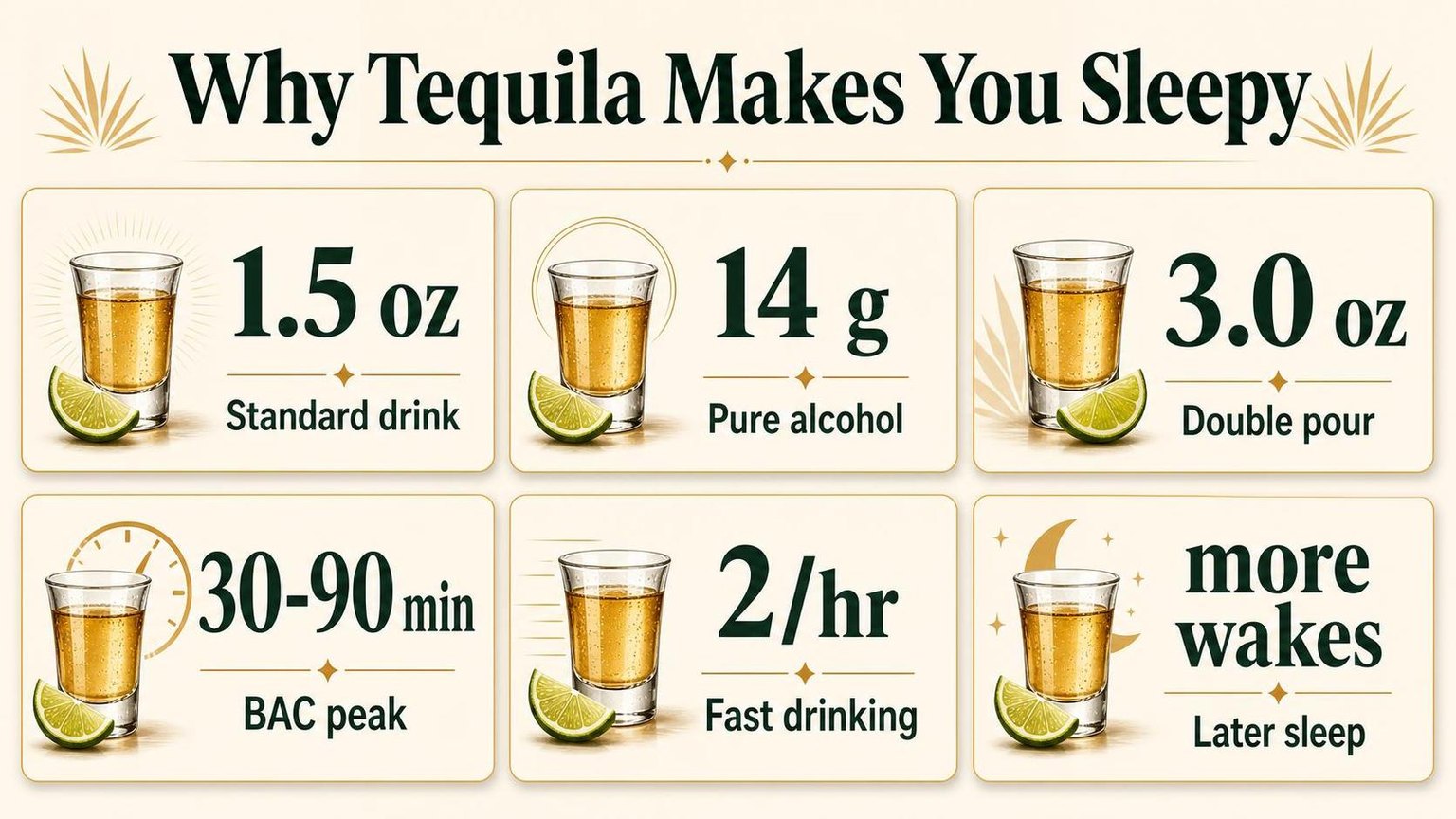
The effect often shows up fastest when tequila is consumed quickly, on an empty stomach, or in larger pours than expected. A standard U.S. drink of 80-proof tequila is 1.5 ounces and contains about 14 grams of pure alcohol.
Alcohol increases inhibitory signaling in the brain, largely through gamma-aminobutyric acid, or GABA, and suppresses excitatory glutamate activity.
That combination slows reaction time, reduces alertness, and creates the heavy, relaxed sensation many people describe as drowsiness.
Tequila can also make you sleepy by changing adenosine activity. Adenosine is a neuromodulator that builds sleep pressure during the day.
Alcohol can intensify that pressure early in the drinking window, which is why some people feel sedated after one or two drinks.
How much tequila you drink matters. In the United States, blood alcohol concentration typically reaches its peak about 30 to 90 minutes after drinking, depending on food intake, body size, sex, and drinking speed.
| Factor | Typical amount | Why it affects sleepiness |
| Standard tequila drink | 1.5 oz at 40% ABV | Delivers 14 g ethanol, enough to produce measurable sedation in some adults |
| Double pour | 3.0 oz at 40% ABV | Delivers 28 g ethanol, doubling depressant exposure |
| Empty stomach | Faster absorption | Raises BAC more quickly, making drowsiness hit sooner |
| Drinking pace | 2 drinks in under 1 hour | Can outpace metabolism, increasing sedation |
Food changes the equation. Drinking tequila with a meal slows gastric emptying and reduces the speed of alcohol absorption.
Without food, alcohol enters the small intestine sooner, where absorption is faster, so sleepiness can feel stronger and arrive earlier.
Blood sugar can contribute. Alcohol temporarily interferes with the liver’s ability to release glucose, especially when you have not eaten.
That can leave some people feeling weak, shaky, or tired, which they may interpret as tequila making them sleepy.
Tequila may also feel sedating because alcohol widens blood vessels near the skin and increases heat loss. You may feel warm at first, but core temperature regulation worsens.
That drop in alertness can resemble bedtime sleepiness, especially in a quiet, dim setting.
The sedative phase does not mean alcohol improves sleep. Alcohol can shorten sleep onset, but it fragments the second half of the night, suppresses REM sleep early, and increases awakenings as the body metabolizes it.
| Alcohol effect on sleep | What happens | Why it matters |
| First 1 to 2 hours | Faster sleep onset | Feels like tequila “helps” sleep |
| Later night | More awakenings | Sleep becomes lighter and less restorative |
| REM sleep | Reduced early in the night | Can worsen sleep quality and next-day fatigue |
| Breathing | Airway relaxation can increase snoring | Can worsen sleep in people with sleep apnea risk |
Individual response varies widely. Women often reach a higher BAC than men after the same amount because of average differences in body water and first-pass metabolism.
Medications, sleep debt, age, and body size can also make one shot feel stimulating for one person and sedating for another.
- Fast drinking raises BAC quickly, which increases drowsiness.
- Mixing tequila with sugary drinks may cause a later energy crash.
- Combining alcohol with antihistamines, benzodiazepines, opioids, or sleep aids can sharply increase sedation.
- Poor sleep the night before makes alcohol’s sedative effect feel stronger.
If tequila makes you sleepy, the main reason is dose and timing, not the spirit itself.
Ethanol depresses brain activity, accelerates early sleep pressure, and then disrupts normal sleep later, producing both immediate drowsiness and next-day fatigue.
Alcohol’s Sedative Effect Versus Sleep Quality
Tequila can make you feel sleepy because alcohol is a central nervous system depressant. It often shortens the time it takes to fall asleep, but that sedative effect is not the same as healthy sleep.
As blood alcohol levels fall overnight, sleep becomes lighter, more fragmented, and less restorative.
Alcohol first enhances inhibitory signaling in the brain, especially through GABA-related pathways, while reducing excitatory activity. That slows reaction time, lowers alertness, and increases drowsiness.
The effect is dose-related, so a larger pour usually causes more sedation than a small serving.
In the U.S., one standard drink contains about 14 grams of pure alcohol. For tequila, that is roughly 1.5 ounces of 80-proof spirit.
A double pour delivers about two standard drinks, which increases both initial sleepiness and the odds of disrupted sleep later.
Research consistently shows a split effect across the night. Alcohol can reduce sleep-onset latency, meaning some people fall asleep faster.
But it also suppresses rapid eye movement sleep early, then produces REM rebound, more awakenings, and lower sleep efficiency as the body metabolizes the alcohol.
| Sleep effect | Early night after drinking | Later night as alcohol wears off |
| Sleep onset | Often faster | No benefit remains |
| REM sleep | Usually reduced | Often rebounds, with vivid dreams |
| Awakenings | May be fewer at first | Usually increase |
| Sleep quality | Feels sedating | Less restorative and more fragmented |
Even moderate amounts matter. Reviews of sleep studies have found that low doses, often defined around less than 0.5 grams of alcohol per kilogram of body weight, can already reduce REM sleep.
Higher doses, above about 0.5 grams per kilogram, more clearly worsen sleep continuity and slow-wave patterns.
For a 70-kilogram adult, 0.5 grams per kilogram equals 35 grams of alcohol. That is about 2.5 standard U.S. drinks. In tequila terms, that is roughly 3.75 ounces of 80-proof tequila, assuming no variation in pour size.
Alcohol also relaxes upper-airway muscles. That can increase snoring and worsen obstructive sleep apnea, especially in people already at risk.
Fragmented breathing means lower oxygen levels, more micro-awakenings, and less refreshing sleep even if total time in bed looks normal.
Its diuretic effect adds another problem. Drinking can increase nighttime urination, which raises the chance of waking up. Spirits mixed with sugary sodas or energy drinks may further disturb sleep through late caffeine intake or blood sugar swings.
- Sleepy after tequila does not mean you will sleep well.
- One standard tequila drink is 1.5 ounces at 80 proof, or 14 grams of alcohol.
- About 2 to 3 drinks is enough to disrupt REM sleep and increase later-night awakenings in many adults.
- People with insomnia, reflux, or sleep apnea usually see worse effects.
The practical difference is simple. Tequila may help induce sleep, but it usually degrades sleep architecture. You may lose less time falling asleep and pay for it with poorer recovery, earlier waking, and next-day fatigue.
Tequila, Blood Sugar, and Nighttime Fatigue
Tequila can make you feel sleepy partly because alcohol disrupts blood sugar control.
The effect is less about tequila being uniquely sedating and more about ethanol lowering the liver’s ability to release glucose while also fragmenting sleep later in the night.
A standard tequila serving contains little or no carbohydrate, but that does not mean it is metabolically neutral. Once alcohol reaches the liver, the body prioritizes breaking down ethanol over maintaining normal glucose output.
That shift matters most at night. If you drank after eating lightly, exercised, or have diabetes, the drop in overnight blood sugar can add to shakiness, sweating, headaches, and a drained, sleepy feeling.
| Item | Typical amount | Why it matters for fatigue |
| Standard tequila shot | 1.5 oz at 40% ABV | Delivers one US standard drink’s worth of alcohol with minimal carbohydrate |
| Pure ethanol in one standard drink | 14 grams | Alcohol metabolism temporarily takes priority over glucose release |
| Calories from one standard drink | About 98 calories | Energy from alcohol does not prevent later blood sugar dips |
| Approximate blood alcohol elimination | About 0.015% BAC per hour | Sedation can fade while sleep disruption and metabolic effects continue |
The liver normally stores glycogen and releases glucose between meals. Alcohol suppresses gluconeogenesis, the process that makes new glucose, because ethanol metabolism raises the liver’s NADH-to-NAD ratio.
That biochemical change is well established in clinical research and explains why alcohol can trigger hypoglycemia.
For most healthy adults, the risk rises with longer drinking sessions, poor food intake, and higher total alcohol dose. The effect is stronger in people using insulin or sulfonylureas, because those drugs already push blood sugar downward.
| Situation | Likely blood sugar effect | Possible nighttime symptom |
| Tequila with a full meal | Slower glucose drop | Less abrupt fatigue, though sleep can still be fragmented |
| Tequila on an empty stomach | Faster alcohol absorption and weaker glucose support | Sleepiness, lightheadedness, earlier rebound waking |
| Several drinks over hours | Greater suppression of liver glucose output | Overnight sweating, early waking, morning exhaustion |
| Alcohol plus diabetes medication | Higher hypoglycemia risk | Confusion, tremor, marked fatigue |
Sleep timing also matters. Alcohol often shortens sleep onset latency, so you may fall asleep faster.
But the American Academy of Sleep Medicine notes that alcohol reduces sleep quality, increases awakenings, and can worsen breathing problems, especially in the second half of the night.
Tequila mixed with sugary soda can create a second problem. The initial sugar surge may briefly mask fatigue, then a later fall in glucose can leave you more tired once alcohol’s stimulating phase wears off.
- Eat protein, fat, and carbohydrate before or with tequila.
- Stop drinking several hours before bed to reduce sleep fragmentation.
- If you have diabetes, monitor glucose and ask your clinician how alcohol interacts with your medication.
- Seek urgent help for confusion, seizures, or inability to wake someone after drinking.
So tequila can make you sleepy, but blood sugar is part of the story, not the whole story. The combined effect of alcohol metabolism, reduced overnight glucose support, and broken sleep is what commonly drives nighttime fatigue.
How Much Tequila Triggers Drowsiness
Tequila can make you sleepy once alcohol starts depressing the central nervous system faster than your body can clear it.
For many adults, that shift begins after 2 to 3 standard drinks in a short period, but body size, sex, food intake, and pace matter as much as the total poured.
In the U.S., one standard drink contains 14 grams of pure alcohol. An 80-proof tequila serving reaches that mark at 1.5 fluid ounces, so “2 drinks” means 3 ounces of 80-proof tequila, not a large mixed drink or an overfilled rocks pour.
| Tequila pour | ABV | Pure alcohol | Standard drinks |
| 1.5 oz shot | 40% | 14 g | 1.0 |
| 2.0 oz pour | 40% | 18.7 g | 1.33 |
| 3.0 oz double | 40% | 28 g | 2.0 |
| 1.5 oz shot | 50% | 17.5 g | 1.25 |
Drowsiness often appears around the same point that coordination worsens and reaction time slows.
That commonly starts near a blood alcohol concentration of 0.05% to 0.08%, although sleepiness can show up earlier if you are tired, dehydrated, taking sedating medications, or drinking on an empty stomach.
Alcohol is usually eliminated at about 0.015% BAC per hour. That is why sleepiness builds when drinks stack faster than clearance.
Two shots in 30 minutes can feel very different from two shots across two hours, even though the total alcohol is identical.
| Body weight | Approximate drinks in 2 hours linked with noticeable drowsiness | Why |
| 120 lb | 2 to 3 standard drinks | BAC rises faster at lower body mass |
| 160 lb | 3 to 4 standard drinks | More dilution, but impairment still builds |
| 200 lb | 4 to 5 standard drinks | Drowsiness may take longer, not disappear |
These ranges are estimates, not guarantees.
Sex assigned at birth changes the effect because women, on average, reach a higher BAC than men after the same amount of alcohol, partly due to lower total body water and differences in first-pass metabolism.
Food changes the threshold. A meal with fat, protein, and fiber can slow gastric emptying and reduce the speed of alcohol absorption. The same 3-ounce tequila pour may produce less sudden sleepiness after dinner than it does before eating.
- Sleep debt lowers the amount needed to feel sedated.
- Sugary mixers can hide intoxication, then leave you feeling heavy and tired later.
- Higher-proof tequila reaches the same sleepy effect with less volume.
- Mixing tequila with cannabis, antihistamines, benzodiazepines, or opioids sharply increases sedation risk.
If tequila is making you sleepy after one drink, the cause is often timing, fatigue, medication, or an oversized pour.
If drowsiness shows up after 2 to 4 standard drinks, that falls within a common physiologic range for alcohol’s sedating phase.
Safer Ways to Drink at Night
Tequila can feel sedating at night because alcohol slows brain activity, lowers body temperature slightly, and fragments sleep later in the night.
Safer drinking means limiting dose, slowing absorption, and avoiding combinations that raise impairment after dark.
Start with a clear cap before the first pour. For most healthy adults, low-risk drinking means no more than 1 standard drink per day for women and 2 for men, with less on any single night reducing acute impairment.
| Drink | Serving | Approx. ABV | Standard drinks (US) |
| Tequila, straight | 1.5 oz | 40% | 1.0 |
| Tequila, doubleshot | 3 oz | 40% | 2.0 |
| Margarita, typical restaurant pour | 6 to 8 oz | Varies | About 1.3 to 2.0 |
In the US, one standard drink contains about 14 grams of pure alcohol. A 1.5-ounce shot of 80-proof tequila equals one standard drink, but many cocktails contain more than one shot and count faster than people expect.
Space drinks by time, not mood. The liver typically clears about one standard drink per hour, though the rate varies by body size, sex, food intake, medications, and genetics.
Drinking faster raises blood alcohol concentration before your body can catch up.
- Set a maximum of 1 drink in the first hour, then no more than 1 each following hour.
- Stop at least 3 hours before bed if sleep quality matters.
- Alternate each alcoholic drink with 8 to 16 ounces of water.
Eat before and during drinking. Food, especially meals with protein, fat, and fiber, slows gastric emptying and delays alcohol absorption.
That does not make you sober, but it can reduce rapid spikes that lead to drowsiness, poor judgment, and nausea.
| Safer choice | Why it helps at night | Practical target |
| Drink with food | Slows absorption | Full meal or substantial snack before first drink |
| Use smaller pours | Reduces accidental overconsumption | Measure 1.5 oz tequila |
| Lower-sugar mixers | Avoids heavy, fast-drinking cocktails | Soda water, lime, ice |
| Earlier cutoff | Improves REM and reduces sleep disruption | Last drink 3 hours before sleep |
Avoid mixing tequila with sedatives. Alcohol combined with benzodiazepines, opioids, sleep medications, or antihistamines can sharply increase sedation, breathing risk, falls, and blackouts.
The National Institute on Alcohol Abuse and Alcoholism warns these combinations can be dangerous even at moderate doses.
Energy drinks are not a fix. Caffeine can make you feel less sleepy while leaving coordination and reaction time impaired.
That mismatch can increase risky decisions, including driving when you are still over the legal limit or too impaired to drive safely.
Choose your setting carefully. Night drinking is safer when you stay in one place, keep your phone charged, share your location with a trusted person, and plan a ride home before the first drink.
Do not rely on “feeling fine” as a safety test.
Stop drinking and get medical help fast for vomiting repeatedly, slow or irregular breathing, confusion, seizures, blue lips, or inability to wake someone. Sleepiness after tequila can be normal. Unresponsiveness is an emergency.
Questions People Ask Most
Does tequila itself make you sleepy?
Tequila does not contain a sedative unique to agave spirits. Sleepiness usually comes from ethanol, which slows central nervous system activity, reduces alertness, and can make people feel drowsy as blood alcohol concentration rises.
Why do some people feel tired faster with tequila than with other alcohol?
The main drivers are serving size, drinking speed, and what the tequila is mixed with.
A 1.5-ounce shot of 80-proof tequila contains about 14 grams of pure alcohol, and multiple shots taken quickly can raise blood alcohol concentration faster than sipping wine or beer.
Can tequila help you fall asleep?
Alcohol can shorten the time it takes to fall asleep, so tequila may make some people feel ready for bed sooner.
That effect is misleading because alcohol commonly fragments sleep later in the night and reduces overall sleep quality, especially in the second half of sleep.
Does tequila cause better sleep than whiskey, vodka, or wine?
No strong evidence shows tequila produces better sleep than other standard 80-proof spirits when the alcohol dose is the same.
Sleep effects depend more on total ethanol consumed, timing before bed, and mixers like sugar or caffeine than on whether the drink is tequila or another liquor.
Why does tequila sometimes make people sleepy and restless at the same time?
Alcohol can create a split effect: early sedation followed by lighter, more disrupted sleep as the body metabolizes it.
If tequila is mixed with energy drinks, cola, or sweet mixers, the caffeine or sugar can add stimulation while the alcohol still impairs coordination and promotes fatigue.
Does the type of tequila, such as blanco, reposado, or añejo, change how sleepy you feel?
The style matters less than proof and portion size.
A standard pour of blanco, reposado, or añejo at the same alcohol by volume will usually affect sleepiness similarly, though higher-proof pours or larger restaurant servings can intensify drowsiness.
How can you reduce sleepiness after drinking tequila?
Drink less, drink slower, and avoid taking shots back-to-back because rapid intake increases impairment and fatigue.
Eating before drinking, alternating with water, and stopping several hours before bed can reduce the sleepy crash and lower the chance of poor overnight sleep.
Related Reading
- Does Tequila Have Sulfites?
- Biggest Bottle of Tequila
- How Many Calories Does a Shot of Tequila Have?
- What Can You Mix Tequila With Soda? The Complete 2026 Guide to Tequila + Soda Mixers
- What Is Kirkland Tequila Silver Comparable To?
- Does Tequila Have Gluten?
- Lowest Calorie Tequila – With Easy-to-Find Ingredients
- Brown Casamigos Review – What You Need to Know?
- What Is Tequila Made From?
- All Alcohol Guides
- National Institute on Alcohol Abuse and Alcoholism (2021)
- Sleep Foundation (2023)
- Centers for Disease Control and Prevention (2024)
- National Health Service (2022)
- National Institute on Alcohol Abuse and Alcoholism (2021)
- Harvard Medical School Division of Sleep Medicine (n.d.)
- PubMed (2013)
- Stanford Medicine (n.d.)
- Mayo Clinic (2023)