How Long Does It Take to Make Tequila? is 7 to 12 years from planting blue Weber agave to bottling most aged tequila, with the plant-growing stage taking the vast majority of that time.
Agave usually matures for 6 to 8 years before harvest, then cooking, crushing, fermentation, distillation, and bottling can take days to weeks. Aging adds 2 months for reposado, at least 1 year for añejo, and at least 3 years for extra añejo.
This guide breaks down each production step, the legal aging categories, and why climate, agave maturity, fermentation choices, barrel type, and distillery workflow change the final timeline.
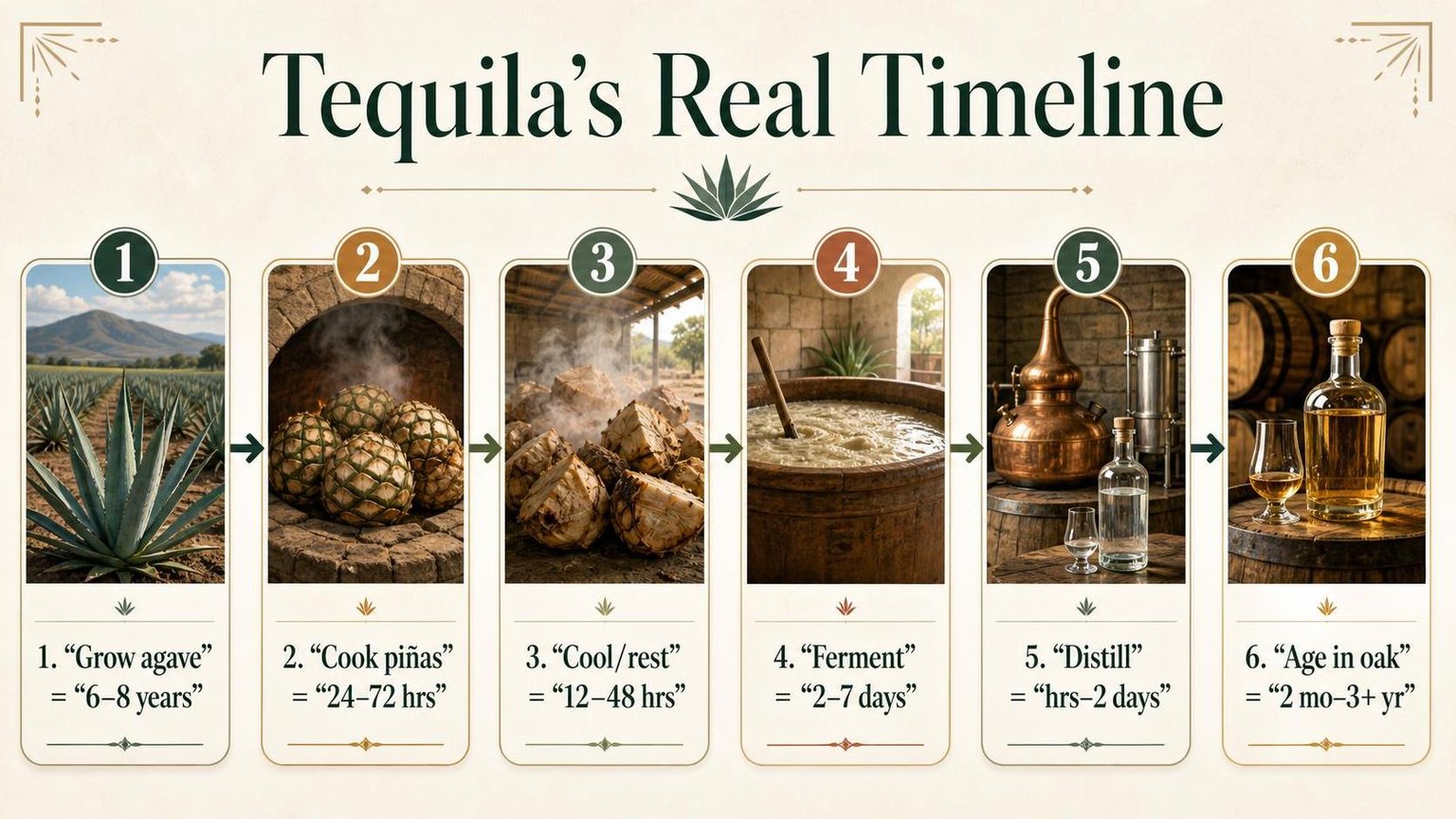
Tequila Takes Years, Not Days
Tequila is not a quick spirit. The liquid can move through a distillery in days, but the raw material takes years to grow, and that agricultural clock controls the real timeline.
Every bottle starts with Blue Weber agave, the only agave permitted for tequila under Mexican regulation.
In the Lowlands and Highlands of Jalisco, that agave usually needs about 6 to 8 years to reach harvest, and some producers wait longer for sugar development.
The longest stage is field growth. Agave is a slow, perennial succulent, not a grain crop planted and harvested in one season. Jimadores cut the leaves away and harvest the heart, or piña, only after the plant has stored enough fermentable sugars.
| Stage | Typical time | Why it matters |
| Blue Weber agave growth | 6 to 8 years | Sugars accumulate in the piña before harvest |
| Cooking | 24 to 72 hours | Heat converts inulin-rich carbohydrates into fermentable sugars |
| Resting after cooking | 12 to 48 hours | Piñas cool before milling |
| Fermentation | 2 to 7 days | Yeast turns sugars into alcohol |
| Distillation | Several hours to 2 days | Most tequila is distilled twice |
| Aging for reposado | 2 months to under 1 year | Required by tequila standards |
| Aging for añejo | 1 to 3 years | Required by tequila standards |
| Aging for extra añejo | More than 3 years | Required by tequila standards |
Cooking is faster than growing, but it still takes time. Traditional brick ovens, called hornos, often roast agave for one to three days.
Autoclaves can shorten that stage, while diffuser-based systems can move even faster, though production style varies by distillery.
Fermentation is measured in days, not minutes. A short fermentation may finish in about 48 hours, while slower fermentations can run close to a week, depending on yeast, temperature, sugar concentration, and whether fibers remain in the tank.
Distillation does not erase the years invested in the plant. Tequila is commonly distilled twice in pot or column setups, producing a blanco that can be bottled soon after distillation or rested briefly in stainless steel before release.
If the producer makes aged tequila, the clock extends again. By law, reposado must spend at least 2 months in oak, añejo at least 1 year, and extra añejo more than 3 years.
Those categories add maturation time after the agricultural and distilling work is done.
- Blanco can be ready for bottling shortly after distillation, but its agave still took years to grow.
- Reposado adds a minimum 2-month oak rest.
- Añejo adds at least 12 months in oak.
- Extra añejo adds more than 36 months in oak.
The practical answer is simple. Fast tequila production after harvest may take days or weeks, but from planting agave to finished bottle, tequila usually represents at least 6 to 8 years, and aged expressions can push that timeline past a decade.
Agave Growth Sets the Timeline
Tequila takes years to make because the plant takes years to mature. The legally required raw material is Blue Weber agave, and that agave usually needs far longer in the field than the rest of production needs in the distillery.
Fermentation, distillation, and even barrel aging are short compared with cultivation. The biggest clock starts when an agave pup is planted and ends when the piña has enough stored sugar to justify harvest.
Blue Weber agave is a succulent, not a cactus, and it stores carbohydrates in its heart as it grows. Those carbohydrates are the future fermentable sugars for tequila, so producers cannot rush the plant without affecting yield and flavor.
In practice, most tequila agave is harvested at about 6 to 8 years old. Some fields are cut earlier in warmer, lower areas, while slower-growing highland plants can stay in the ground closer to 8 to 10 years.
That range exists because growth depends on altitude, rainfall, soil, temperature, disease pressure, and farming goals. A producer balancing sugar yield, field losses, and market demand may not harvest every plot at exactly the same age.
| Factor | Typical effect on maturity timeline |
| Lowland conditions | Often around 6 to 7 years |
| Highland conditions | Often around 7 to 10 years |
| Early harvest | Less time, but lower sugar development risk |
| Later harvest | More sugar potential, but more weather and disease risk |
Growers watch for maturity through plant size, leaf structure, and sugar concentration in the piña.
They also look for the plant’s reproductive stage, because agave sends up a tall flower stalk called a quiote when it is biologically ready to reproduce.
In tequila agriculture, jimadores usually cut that quiote before full flowering.
Removing it redirects the plant’s energy back into the core, helping preserve sugar concentration for spirit production instead of letting those reserves go into seed formation.
Harvest itself is manual and skilled. A jimador trims off the spiny leaves with a coa, leaving the dense heart, or piña, which commonly weighs from roughly 50 to more than 150 pounds depending on age, site, and farming practices.
Those weights matter because more mature piñas generally mean more extractable sugars per plant.
Still, larger is not automatically better; overlong field time can expose agave to rot, pests, and theft, all of which raise cost and reduce usable harvest.
Tequila’s denomination of origin limits where Blue Weber agave can be grown for tequila production.
Most comes from Jalisco, with approved municipalities in Guanajuato, Michoacán, Nayarit, and Tamaulipas also permitted under Mexican regulations.
That legal geography matters because not every climate matures agave at the same pace. A producer working in Los Altos de Jalisco may wait longer than a producer in the valley, even when both are making 100% agave tequila.
- Planting to harvest usually takes the majority of tequila’s total production time.
- Most commercial timelines center on roughly 6 to 8 years in the field.
- Regional climate and harvest strategy can push that closer to 10 years.
- The distillery stage is measured in days or months; agave growth is measured in years.
That is why the true answer to tequila’s timeline starts in the field. Before ovens, fermentation tanks, or stills matter, the agave must spend years building the sugars that make tequila possible.
From Harvest to Fermentation
Tequila does not start in a still. It starts in the field, where Blue Weber agave must reach enough sugar maturity to justify cutting.
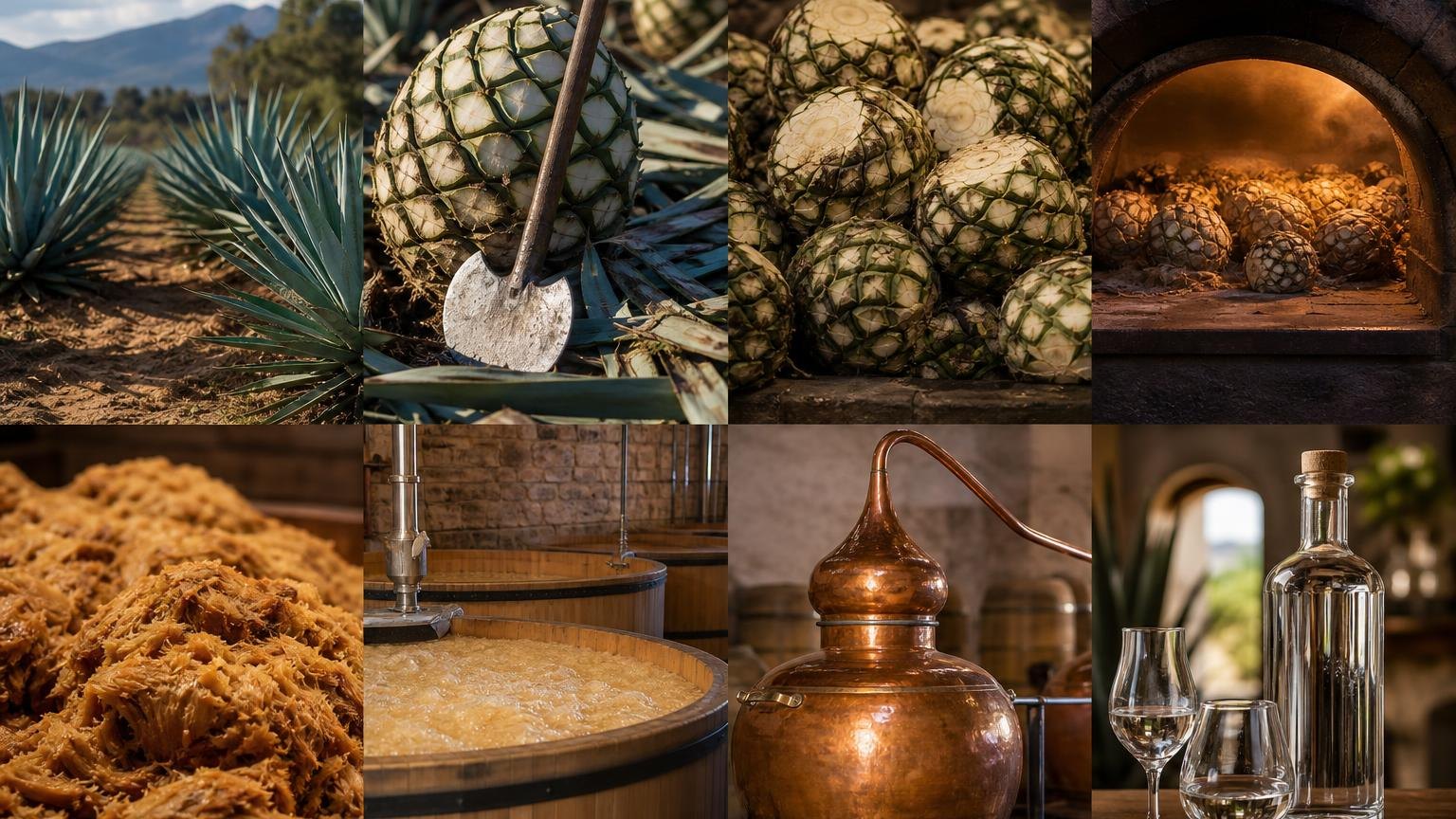
From harvest to the start of fermentation, most distilleries need about 2 to 7 days, depending on cooking method, equipment, and scale.
The longest part of this stage happens before the jimador swings the coa.
Blue Weber agave used for tequila usually matures in about 6 to 8 years in Los Altos and the Tequila Valley, though some plants are harvested earlier or later based on sugar content, disease pressure, and weather.
At harvest, the jimador removes the leaves and keeps the piña, the agave heart that will be cooked. A mature piña commonly weighs 50 to 150 pounds.
Large plants can exceed that, but oversized piñas are not always preferred because fiber, handling, and cooking consistency matter.
Producers look for ripeness because the agave’s stored carbohydrates, mainly inulin-type fructans, must later be converted into fermentable sugars. Harvest timing affects efficiency. Under-ripe agave gives lower sugar yield.
Overripe or damaged agave can bring spoilage risk and less predictable flavor.
Once cut, piñas are usually transported to the distillery the same day or within 24 hours. Fresh handling matters because cut agave can dry out, oxidize, and begin microbial activity.
Distilleries trying to preserve a clean cooked-agave profile do not want long delays in the yard.
Cooking is the real time driver between harvest and fermentation. Traditional brick ovens, called hornos, work slowly and gently. Autoclaves use pressure and shorten the timeline.
Diffusers, where permitted in tequila production, extract sugars differently and can reduce this phase even further.
| Step | Typical time | Why it varies |
| Harvest in field | 1 day | Field size, labor, weather, distance to distillery |
| Post-harvest transport | Same day to 24 hours | Road time, queue at the plant, harvest volume |
| Cooking in hornos | 24 to 48 hours | Piña size, oven loading, target caramelization |
| Cooking in autoclaves | 6 to 12 hours | Pressure, temperature, cut size, plant protocol |
| Cooling after cooking | 8 to 24 hours | Safety, extraction schedule, flavor goals |
| Milling and juice extraction | 4 to 12 hours | Tahona vs roller mill, batch size, water use |
In hornos, heat hydrolyzes inulin into simpler sugars, mainly fructose, that yeast can ferment later. Slow cooking can also build roasted, sweet, earthy aromas.
Many traditional producers cool the cooked agave overnight because milling agave that is too hot is harder and less safe.
After cooking, the agave is shredded or crushed. Common systems include roller mills and the tahona, a heavy stone wheel. Roller mills are faster and common in larger operations.
Tahona milling is slower and often leaves more fiber in the must, affecting texture and aroma.
Water is added during extraction to wash sugars from the cooked fiber. The resulting liquid, often called mosto, may be fermented with or without some agave fiber, depending on house style.
Fiber can add complexity, but it also changes tank behavior and heat management.
Fermentation begins only after the distillery has enough sugar-rich mosto in tanks and the temperature is in a workable range for yeast.
In practical terms, a traditional horno-based producer may need 3 to 5 days from cutting agave to pitching yeast. A pressure-cooked system can often begin within 2 to 3 days.
- Field maturity takes years, but the harvest-to-fermentation window is usually measured in days.
- Cooking method has the biggest effect on time.
- Fast processing protects sugar yield and limits unwanted microbial activity.
Distillation and Resting Time
After cooked agave is fermented, tequila moves into distillation, then sometimes into barrels or tanks for resting. This stage can take less than a day for unaged tequila, or years for extra-aged styles.
The exact timeline depends on production choices and the legal aging category.
Most tequila is distilled twice in Mexico, and that second distillation is what typically brings the spirit to its final clean, concentrated profile.
Some producers use copper pot stills, some use stainless steel stills with copper components, and a few distill three times for a lighter texture.
Distillation itself is fast compared with growing agave. A single run may take only a few hours, but total production time includes loading the still, heating, separating heads and tails, and preparing the spirit for proofing or barreling.
| Production step | Typical time | Why it matters |
| First distillation | 2 to 4 hours | Separates alcohol from the fermented mosto and creates ordinario |
| Second distillation | 3 to 5 hours | Refines flavor, raises proof, and defines the final tequila character |
| Proofing and settling before bottling | 1 to 3 days | Allows dilution water to integrate and the spirit to stabilize |
Time varies by still size and method. Small copper pot stills often run slower, while larger column-assisted systems can move more efficiently. Producers also decide how tightly to cut the heads and tails, which affects both flavor and yield.
If the tequila will be bottled as blanco, resting may be minimal. Under Mexican rules, blanco tequila can be bottled right after distillation or rested for up to 2 months in stainless steel or neutral containers before bottling.
Reposado, añejo, and extra añejo require longer aging, and those timelines are defined by the Norma Oficial Mexicana and the CRT category standards.
Barrel type, fill level, warehouse temperature, and evaporation all influence the final pace of development.
| Tequila category | Minimum resting or aging time | Container requirement |
| Blanco | 0 to 2 months resting | Stainless steel or neutral containers |
| Reposado | At least 2 months | Oak containers |
| Añejo | At least 1 year | Oak barrels no larger than 600 liters |
| Extra añejo | More than 3 years | Oak barrels no larger than 600 liters |
In practice, many reposados rest 4 to 11 months, and many añejos age 12 to 24 months. Extra añejos commonly spend 36 to 60 months in oak, though some go longer.
Longer aging adds vanilla, caramel, spice, and oak tannin, but it can mute cooked agave character.
Evaporation also matters. In warm tequila regions such as Jalisco, annual angel’s share losses can be around 3% to 7%, sometimes higher depending on warehouse conditions.
That loss pushes producers to balance time in barrel against volume, cost, and freshness.
So, from distillation to bottle, blanco may be finished within days, while reposado needs at least 2 months, añejo at least 12 months, and extra añejo more than 36 months. Distillation is the short part.
Resting and aging create the biggest differences in total production time.
Aging Rules by Tequila Type
Tequila’s aging clock starts after distillation, and Mexican law sets the minimum time and vessel rules for each category.
Those rules matter because a bottle labeled reposado, añejo, or extra añejo must meet specific aging thresholds under the Norma Oficial Mexicana for tequila.
The core categories are blanco, joven, reposado, añejo, and extra añejo. The legal differences are mostly about minimum time in wood and, for older styles, barrel size limits.
| Tequila type | Minimum aging time | Wood requirement | Barrel size limit |
| Blanco / Silver | 0 months; if aged, less than 2 months | Oak or encino allowed if briefly rested | No specific limit stated for this short aging period |
| Joven / Gold | No minimum | Usually unaged tequila or a blend; may include additives allowed by the standard | Not defined by an aging minimum |
| Reposado | Minimum 2 months | Oak or encino casks or vats | No 600-liter cap stated for reposado |
| Añejo | Minimum 1 year | Oak or encino barrels | Maximum 600 liters |
| Extra Añejo | Minimum 3 years | Oak or encino barrels | Maximum 600 liters |
Blanco is the fastest legal style to release. It can go straight from still to bottle, or it can rest briefly in oak or encino for less than two months and still remain blanco.
Joven has no mandatory aging period. In practice, it is often a blend of blanco with reposado, añejo, or extra añejo tequila, though the category can also include permitted coloring, flavoring, glycerin, or oak extract.
Reposado means “rested,” but the legal floor is short: two months. Producers often age it longer than the minimum, yet once the spirit reaches two months in oak or encino, it can be labeled reposado.
Añejo requires a more meaningful wait. The spirit must spend at least one full year in oak or encino barrels, and each barrel cannot exceed 600 liters, a rule intended to keep wood contact more concentrated than in giant tanks.
Extra añejo is the longest-aged standard category. It must remain in oak or encino barrels for at least three years, again with the same 600-liter maximum barrel size.
These categories apply whether the tequila is labeled “100% agave” or made as tequila under the broader category that can include other sugars before fermentation. Aging rules do not change based on that distinction.
One common point of confusion is cristalino. Cristalino is not a separate official aging class; it is usually an aged tequila, commonly añejo or extra añejo, filtered to remove color after barrel maturation.
- Minimum legal aging does not equal typical producer aging.
- Oak and encino are the recognized woods in the legal definitions.
- The 600-liter barrel cap applies to añejo and extra añejo, not reposado.
- Blanco and joven can reach market far faster than wood-aged categories.
For production timing, these rules mean aging can add nothing, two months, one year, or three years before bottling. The label tells you the legal minimum the producer had to wait.
Questions Readers Ask
How long does it take agave to grow before tequila can be made?
Blue Weber agave, the only agave allowed for tequila, usually needs about 6 to 8 years to reach harvest maturity in Jalisco and other authorized regions.
In cooler highland sites or under drought stress, some plants take closer to 10 years because sugar accumulation in the piña develops more slowly.
How long does the actual tequila production process take after harvest?
Once agave is harvested, production typically takes several days for blanco tequila and much longer for aged styles.
Cooking often runs 6 to 12 hours in autoclaves or up to 24 to 48 hours in traditional brick ovens, fermentation usually takes 2 to 5 days, and distillation is commonly completed within 1 day.
Does tequila have to be aged before it can be sold?
No. Blanco tequila can be bottled shortly after distillation, or after a short resting period in stainless steel or neutral vessels, so it can reach market far faster than aged categories.
How much extra time do reposado, añejo, and extra añejo add?
Mexican rules set minimum aging periods for these categories: reposado must age at least 2 months in oak, añejo at least 1 year, and extra añejo at least 3 years.
That aging time is added after distillation, so an extra añejo represents years of cellar time on top of the agave’s years in the field.
Why does tequila take longer to make than many other spirits?
The biggest reason is agriculture, not distillation. Grain for whiskey or vodka can be grown in a single season, but tequila depends on agave that stores sugars over many years before the piña is mature enough to harvest.
Can producers speed up tequila production?
They can shorten some cellar steps with faster cooking systems, controlled fermentation, and bottling blanco without barrel aging, but they cannot eliminate the agave growth cycle.
Tequila must still come from mature Blue Weber agave grown in the authorized denomination of origin, so the timeline is anchored by years in the field.
Related Reading
- What Is The Tequila On Queen Of The South?
- Does Tequila Burn Fat?
- What Is Horseshoe Tequila? Get the Answer
- What Is Delion Drink – Basic Information You Must Know
- Is Tequila Good For Weight Loss?
- Does Tequila Help with a Cold?
- All Alcohol Guides
- Consejo Regulador del Tequila (2023)
- Tequila Regulatory Council / Consejo Regulador del Tequila (2023)
- Diario Oficial de la Federación, Gobierno de México (2012)
- Government of Mexico, Secretaría de Economía (2012)
- U.S. Alcohol and Tobacco Tax and Trade Bureau (2024)
- U.S. National Library of Medicine, PubMed (2014)
- University of California Agriculture and Natural Resources (2000)
- College of Agriculture and Life Sciences, University of Arizona (2023)
- Encyclopaedia Britannica (2024)
- Smithsonian Magazine (2018)