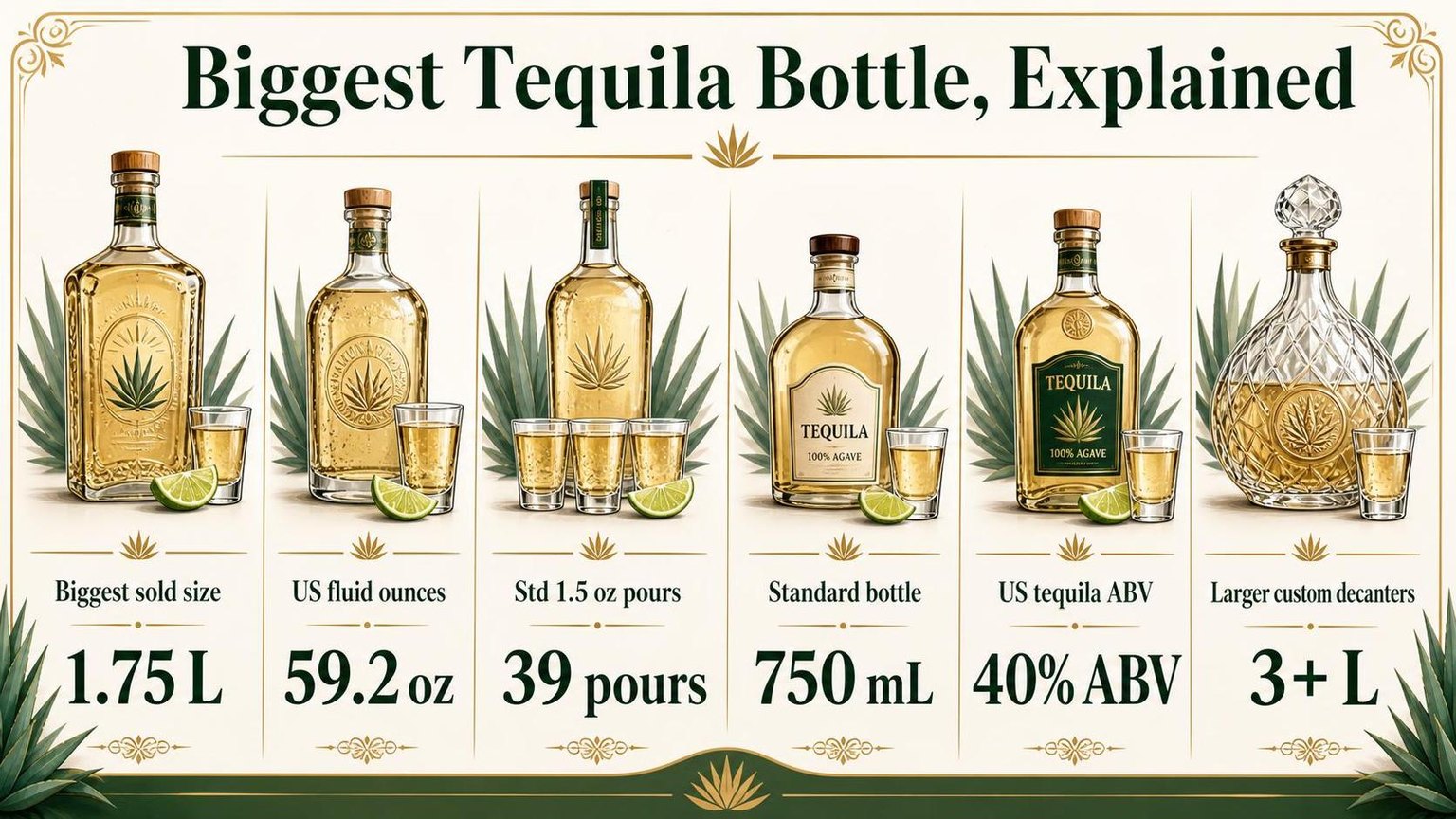
The biggest bottle of tequila is typically a 3-liter large-format bottle for retail sale, while 1.75 liters is the largest common U.S. shelf size. Bigger one-off display bottles exist, but they are not normal consumer packaging.
Tequila bottle size matters because alcohol content stays near 40% ABV, but pour count changes fast: a 750 ml bottle gives about 16 standard 1.5-ounce pours, 1.75 liters gives about 39, and 3 liters gives about 67.
This guide separates everyday handles, magnums, collectible oversized bottles, and record-style display pieces so “biggest” means the right thing: buyable, legal to ship, practical to store, and useful for a bar, event, or collection.
The Biggest Tequila Bottle Ever Made
There is no single, universally maintained record for the biggest tequila bottle ever made. Brands have built one-off exhibition bottles, but the largest size with consistent retail and hospitality relevance is the 1.75-liter “handle.”.
That matters because tequila is a regulated Mexican spirit, and bottle sizes sold in normal trade are easier to verify than promotional showpieces.
For buyers, bars, and collectors, the 1.75-liter format is the largest tequila bottle most people can actually source.
A 1.75-liter bottle holds 59.2 US fluid ounces. At a standard 1.5-ounce pour, that equals about 39 servings, making it more than double a regular 750-milliliter bottle.
| Format | Volume | US fluid ounces | Approx. 1.5 oz pours |
| Mini | 50 mL | 1.7 oz | 1 |
| Half bottle | 375 mL | 12.7 oz | 8 |
| Standard | 750 mL | 25.4 oz | 16 |
| Liter | 1,000 mL | 33.8 oz | 22 |
| Handle | 1,750 mL | 59.2 oz | 39 |
In practical terms, the 1.75-liter bottle is the biggest tequila bottle that has broad market meaning. It appears in large-format bar service, warehouse retail, and duty-free channels more often than any oversized tequila above one liter.
Tequila itself must be produced in Mexico under the Denomination of Origin rules, primarily from Blue Weber agave. Bottlings are commonly released at 35% to 40% ABV for many markets, with 40% ABV remaining the standard for the US.
Some premium houses also issue large celebratory decanters in 3 liters or larger. Those bottles are real, but they are limited, expensive, and inconsistent across brands, so they do not function as a stable “biggest bottle” benchmark.
That is why responsible comparisons separate three categories: standard retail sizes, large-format commercial releases, and custom display bottles. Only the first two categories are easy to verify by volume, distribution, and labeling.
- If you mean biggest widely sold tequila bottle, the answer is usually 1.75 liters.
- If you mean biggest custom-made tequila vessel, sizes can exceed retail formats by a large margin.
- If you need bottle value per pour, divide bottle price by roughly 39 pours for a 1.75-liter bottle.
So the clean answer is this: the biggest tequila bottle with dependable real-world availability is the 1.75-liter handle.
While “the biggest ever made” remains a moving target because exhibition bottles are not standardized or consistently documented.
Official Records and Verification Standards
For a “biggest bottle of tequila” claim, the key issue is verification, not marketing.
A bottle can look enormous in photos, but official recognition depends on measured capacity, documented tequila classification, and evidence that the vessel is a true bottle rather than a display prop.
Guinness World Records is the best-known benchmark for oversized container claims.
Its process typically requires independent measurement, dated photography and video, witness statements, and proof that the object meets the category definition from manufacture through final presentation.
Measurement starts with capacity. For spirits, capacity is normally stated in liters or milliliters, and any record claim should identify whether the stated figure is nominal capacity, filled volume, or total vessel volume.
| Metric | Verification standard |
| Declared capacity | Stated in liters or milliliters on supporting documents |
| Measured dimensions | Height, widest diameter, and opening measured independently |
| Empty vs. filled weight | Recorded to show the vessel can contain the declared volume |
| Contents | Confirmed as tequila, not a neutral spirit or decorative liquid |
For tequila specifically, the liquid must comply with Mexican legal standards.
Tequila is a protected designation of origin tied to production in approved regions and made from at least 51% blue agave sugars, with 100% agave tequila labeled accordingly.
Certification matters because an oversized vessel can still fail as “tequila” if the contents are uncertified.
The Consejo Regulador del Tequila, known as CRT, oversees compliance, traceability, and labeling for tequila produced under Mexican law.
In the United States, any public-facing bottle claim also intersects with labeling rules.
Alcohol and Tobacco Tax and Trade Bureau, or TTB, standards govern imported distilled spirits labeling, including class designation, alcohol content, and net contents statements.
| Authority | Primary role |
| Guinness World Records | Record adjudication and evidence review |
| CRT | Tequila certification, origin, and production compliance |
| TTB | US labeling and net contents compliance for spirits sold or imported |
A credible claim should also address bottle construction. Record reviewers may ask whether the container was blown as one bottle, assembled from multiple sections, or reinforced with a frame that makes it more sculpture than functional packaging.
Evidence should be contemporaneous and redundant.
Strong submissions include calibrated measuring tools, a written engineer or surveyor report, serial-numbered photos, uninterrupted video of measurement, and signed statements from at least two independent witnesses.
- State the exact capacity in liters.
- Identify the tequila class and alcohol by volume.
- Provide CRT-backed product documentation.
- Show independent measurements of height and diameter.
- Document filling, sealing, and public display dates.
Without that chain of proof, “largest tequila bottle” remains a publicity claim. With it, the claim becomes auditable, comparable across brands, and eligible for formal recognition instead of relying on spectacle alone.
How Many Shots It Holds
A bottle’s shot count depends on two numbers: total liquid volume and your pour size. In the US, a standard shot is 1.5 ounces, so even a giant tequila bottle can be converted precisely.
If “biggest bottle of tequila” means the oversized display formats sold for parties and back bars, a 6-liter bottle holds about 135 standard shots. A rarer 9-liter bottle reaches about 203 shots, and a 15-liter bottle reaches about 338.
The math is fixed. One liter equals 33.814 US fluid ounces. Divide total ounces by 1.5 ounces per shot to get the number of standard US shots.
| Bottle size | Total ounces | 1.5 oz shots |
| 750 mL | 25.36 oz | 16.9 shots |
| 1 liter | 33.81 oz | 22.5 shots |
| 1.75 liters | 59.17 oz | 39.4 shots |
| 3 liters | 101.44 oz | 67.6 shots |
| 6 liters | 202.88 oz | 135.3 shots |
| 9 liters | 304.33 oz | 202.9 shots |
| 15 liters | 507.21 oz | 338.1 shots |
Most real-world pours are not perfectly measured. Bartenders often round down, overpour slightly, or serve tequila neat in tasting portions smaller than 1.5 ounces. That changes the practical count fast.
| Bottle size | 1 oz pours | 1.5 oz pours | 2 oz pours |
| 6 liters | 202.9 pours | 135.3 shots | 101.4 pours |
| 9 liters | 304.3 pours | 202.9 shots | 152.2 pours |
| 15 liters | 507.2 pours | 338.1 shots | 253.6 pours |
That range matters when planning a wedding, club table, or large tasting. A 6-liter tequila bottle can cover about 100 generous two-ounce pours. The same bottle stretches past 200 one-ounce tasting pours.
Alcohol by volume does not change the shot count. A 40% ABV blanco and a 38% ABV reposado in the same bottle size still yield the same number of ounces. ABV changes strength per shot, not the number of shots.
For quick planning, use 17 shots for a 750 mL bottle and multiply from there. Eight standard 750 mL bottles equal 6 liters, which is why a 6-liter format lands at roughly 135 shots.
- 6 liters: about 135 standard US shots
- 9 liters: about 203 standard US shots
- 15 liters: about 338 standard US shots
Cost, Weight, and Display Logistics
An oversized tequila bottle costs more than the liquid alone.
Once a bottle moves past 1.75 liters, buyers pay for heavier glass or ceramic, higher freight charges, and the simple fact that large-format tequila is produced in far smaller numbers than standard 750 mL bottles.
Weight is the first practical limit. At 40% ABV, the tequila itself weighs about 0.95 kilograms per liter, so a true large-format bottle becomes a lifting and storage problem before it becomes a pouring problem.
The table below shows what that means in real handling terms. Liquid weight is approximate and excludes the bottle, stopper, wood case, or ceramic housing.
| Bottle size | Equivalent 750 mL bottles | Approx. 1.5 oz pours | Approx. liquid weight |
| 750 mL | 1 | 16 | 0.71 kg |
| 1.75 L | 2.33 | 39 | 1.66 kg |
| 3 L | 4 | 67 | 2.84 kg |
| 6 L | 8 | 135 | 5.69 kg |
| 9 L | 12 | 203 | 8.53 kg |
That 9-liter figure matters because it is about the largest format most consumers will realistically see in tequila.
Add heavy luxury packaging, and total weight can move well past 12 kilograms, especially with thick glass, ceramic bodies, and presentation cases.
Price follows the same pattern. A large-format bottle rarely sells at a simple per-liter discount. Premium tequila often carries a packaging premium, and collectible formats can price above the liquid’s straight multiple.
| If a 750 mL bottle costs | Pure 9 L liquid multiple | Large-format price at 15% premium | Large-format price at 30% premium |
| $100 | $1,200 | $1,380 | $1,560 |
| $250 | $3,000 | $3,450 | $3,900 |
| $500 | $6,000 | $6,900 | $7,800 |
Display logistics matter as much as price. A filled 6- to 9-liter bottle should sit on a low, stable shelf with full support under the base. Hanging part of the base over a shelf edge increases break risk.
- Store it away from direct sunlight. UV and heat accelerate aroma loss and color change.
- Keep it upright. Tequila closures are not designed for prolonged side storage.
- Measure shelf depth and vertical clearance before delivery. Decorative stoppers can add several inches.
- Plan a two-person lift once total package weight exceeds about 11 kilograms.
For bars and collectors, the biggest tequila bottle is usually a display-first purchase. Budget for shipping, crate disposal, shelf reinforcement, and controlled pouring, not only the spirit inside.
Largest Tequila Bottles You Can Buy
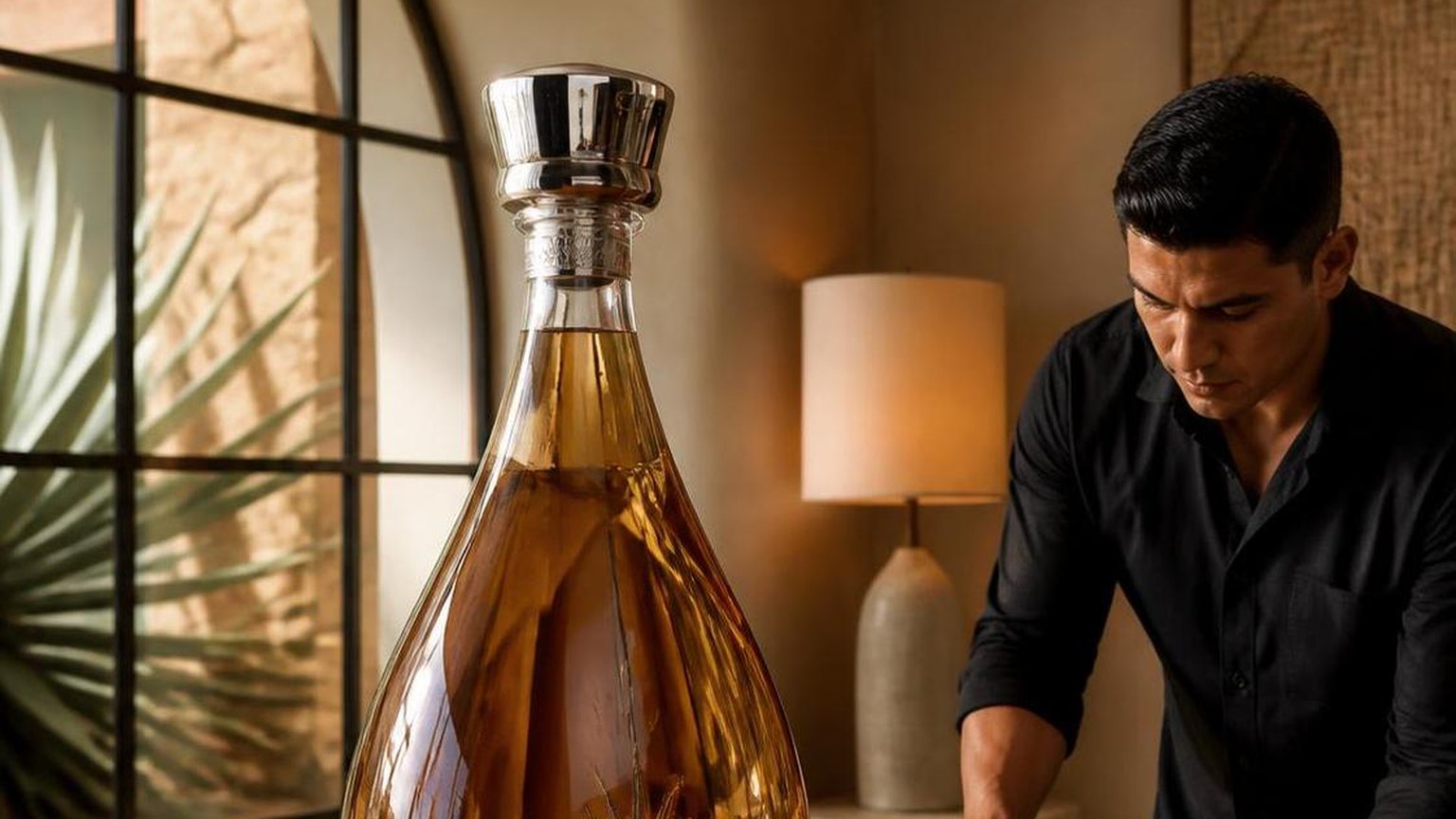
The biggest tequila bottles sold to consumers are usually limited large-format releases from luxury houses, not everyday bar stock.
In the U.S. market, the practical ceiling is often a display-focused bottle that appears through specialty retailers, auction houses, or direct brand allocation.
For most buyers, “largest” means moving beyond the standard bottle into oversized formats built for gifting, events, and collecting.
The key differences are bottle volume, weight, pour count, and whether the producer actually releases the format for retail sale.
| Brand / Expression | Largest commonly documented format sold to consumers | Volume | Approx. standard-bottle equivalent | Approx. shots at 1.5 oz each | Notes |
| Clase Azul Reposado | Large-format ceramic decanter | 6 liters | 8 standard 750 mL bottles | About 135 shots | One of the best-known ultra-large tequila formats in U.S. retail and collector channels. |
| Jose Cuervo Reserva de la Familia Extra Añejo | Large-format release | 3 liters | 4 standard 750 mL bottles | About 68 shots | Available intermittently through premium retailers; format is less common than the standard release. |
| Don Julio 1942 | Large-format bottle | 1.75 liters | About 2.3 standard 750 mL bottles | About 39 shots | Large by regular retail standards, but smaller than collector-grade giant formats. |
| Patrón Silver | Large-format bottle | 1.75 liters | About 2.3 standard 750 mL bottles | About 39 shots | Common in U.S. liquor stores; useful for parties, not a true trophy-size bottle. |
| Cazadores Blanco or Reposado | Handle format | 1.75 liters | About 2.3 standard 750 mL bottles | About 39 shots | Represents the upper end of widely distributed everyday tequila packaging. |
Among bottles an ordinary buyer can realistically find, Clase Azul Reposado in the six-liter format is the standout.
It is massive, highly recognizable, and packaged in the brand’s hand-painted ceramic decanter, which makes it function as display piece as much as spirits bottle.
The next tier down is the three-liter class.
Jose Cuervo Reserva de la Familia has appeared in that size, but availability is irregular and market pricing varies sharply because the format is treated as a prestige item rather than a standard shelf product.
Most large tequila bottles sold in regular U.S. retail stop at one-point-seven-five liters. That size is big for service, but it is not the biggest bottle of tequila you can buy. It is the biggest size you can buy consistently.
- Choose six liters for a true statement bottle.
- Choose three liters for premium gifting with better storage and pouring.
- Choose one-point-seven-five liters for the easiest restock and lowest risk.
Before buying, confirm fill level, closure condition, and current importer labeling. Large-format tequila moves slowly, so bottle age in the retail channel matters more than with fast-turning standard sizes.
Collectors Value and Brand Examples
Collector value in oversized tequila bottles comes from three factors: scarcity, presentation, and fill size.
Volume alone does not guarantee appreciation, because most tequila buyers still drink the liquid and compare the price against standard 750 mL bottles.
Large-format tequila is less standardized than large-format Champagne.
In the U.S. market, 1.75-liter bottles are the most common oversized format, while 3-liter and larger bottlings appear far less often and are usually tied to display pieces, special releases, or nightclub service.
| Format | Volume | 750 mL equivalent | Collector takeaway |
| Standard bottle | 750 mL | 1 bottle | Baseline for pricing and drinkability |
| Large format | 1.75 L | 2.33 bottles | Most common oversized tequila sold at retail |
| Display large format | 3 L | 4 bottles | Noticeably scarcer; stronger bar-display appeal |
| Very large format | 6 L | 8 bottles | Rare in tequila; usually novelty or event-driven |
For collectors, the strongest premium usually sits in the package, not the math of the fill.
A 3-liter bottle uses four times the liquid of a 750 mL bottle, but the market often prices it above a simple four-bottle equivalent because storage, breakage risk, and lower production runs raise costs.
Brands collectors watch
- Don Julio 1942: One of the best-known prestige tequilas in U.S. restaurants and clubs. Large formats, especially 1.75 L, attract buyers because the brand already carries a luxury identity and strong gift recognition.
- Patrón Silver and Patrón Añejo: Patrón has long been visible in large-format retail. A 1.75 L bottle is not rare by itself, but sealed older-label versions can interest brand completists.
- Clase Azul Reposado: Collectors often pay for the ceramic decanter as much as the tequila. Oversized formats matter here because the handmade presentation is central to value.
- Jose Cuervo Reserva de la Familia: Annual box-art changes create a different collector dynamic. Size matters less than release year, condition, and whether the original carton is present.
What actually adds value
| Factor | Why it matters |
| Original seal | Opened bottles lose most collector appeal |
| Box or presentation case | Missing packaging usually lowers resale interest |
| Discontinued packaging | Older label designs can outperform current stock |
| Low-output format | 3 L and 6 L bottles are harder to replace |
| Storage condition | Heat, light, and seepage reduce confidence and value |
If the goal is resale, buy the bottle that combines a recognized brand, an uncommon format, and complete packaging.
If the goal is display, the “biggest bottle of tequila” usually wins attention only when the brand already has prestige behind it.
Questions Readers Ask
What is the biggest bottle of tequila sold to consumers?
The largest standard consumer format commonly sold is the 6-liter bottle, equal to eight 750 mL bottles. Brands such as Patrón and Clase Azul have released 6L large-format tequilas for collectors, events, and bottle service.
How many shots are in a 6-liter tequila bottle?
A 6-liter bottle holds 6,000 mL. Using a standard US 1.5-ounce shot, that yields about 135 shots, because 1.5 ounces is roughly 44.36 mL.
Are tequila bottles larger than 6 liters officially standardized?
No major industry-wide bottle size above 6 liters is broadly standardized for tequila retail in the way magnums and larger formats are for wine.
Larger display bottles can exist as custom, promotional, or venue-only pieces, but they are not common shelf formats.
Why are the biggest tequila bottles so expensive?
The price rises from more than liquid volume alone. Large-format tequila adds heavy glass, specialty packaging, lower production runs, and higher shipping costs, and premium brands often reserve these bottles for aged expressions or luxury releases.
Does tequila age differently in a giant bottle after purchase?
No, tequila does not continue barrel-aging in glass once bottled. A very large bottle can preserve quality well if stored upright, away from light and heat, but repeated opening introduces oxygen and can slowly dull aroma over time.
What is the largest tequila bottle ever produced as a promotional or display piece?
In 2012, a 5,280-gallon (approximately 20,000-liter) bottle of tequila was displayed in Jalisco, Mexico, earning a Guinness World Record.
These oversized promotional bottles are not commercially sold and serve as marketing spectacles for distilleries showcasing their brand at festivals and trade events.
Can you bring a large-format tequila bottle through U.S. customs when traveling from Mexico?
U.S. Customs and Border Protection allows travelers over 21 to bring back one liter duty-free. Larger bottles are permitted but subject to federal and state excise taxes plus duties on the volume exceeding one liter.
Airlines may also restrict oversized or heavy bottles in checked luggage.
Which tequila brands currently offer bottles in the 3-liter size or larger?
Brands including Patrón, Don Julio, and José Cuervo have released 1.75-liter formats widely, while select premium labels like Clase Azul and DeLeón have produced 3-liter and occasional 6-liter editions.
These large formats are typically limited-run offerings sold through specialty retailers and duty-free shops.
Related Reading
- Reposado Vs Anejo – What Is The Difference Between Them?
- Can Tequila Freeze?
- Does Tequila Have Sulfites?
- Lowest Calorie Tequila – With Easy-to-Find Ingredients
- What Is Tequila Made From?
- What Tequila Does Trader Joe’S Sell?
- What To Mix With Jose Cuervo?
- All Alcohol Guides
- Alcohol and Tobacco Tax and Trade Bureau (2024)
- Electronic Code of Federal Regulations, 27 CFR § 5.203 (2024)
- Diario Oficial de la Federación, NOM-006-SCFI-2012 Bebidas alcohólicas–Tequila–Especificaciones (2012)
- Patrón Tequila, Patrón Silver (2024)
- Jose Cuervo, Tradicional Plata (2024)
- Tequila, 1800 Silver (2024)
- Don Julio, Blanco Tequila (2024)