black owned tequila brands are tequila labels founded, owned, or led by Black entrepreneurs in a spirits category long dominated by Mexican heritage producers and major conglomerates.
Notable names include Anteel Tequila, Lobos 1707, Ego Tequila, Tequila with Friends, and LS Cream Liqueur’s tequila-based line.
This guide focuses on who owns the brands, where the tequila is made, what styles they sell, and how to verify authenticity through NOM numbers, production details, and transparent sourcing.
Use it to choose bottles that support Black founders while still meeting tequila’s legal and quality standards.
What Black Owned Tequila Means
“Black owned tequila” means the brand is owned, co-owned, or majority controlled by Black founders, investors, or operators, not merely endorsed by them.
In spirits, that distinction matters because celebrity marketing can be visible while equity, governance, and profit participation remain limited or undisclosed.
Ownership in alcohol is layered. A tequila brand may control recipe development, sourcing, packaging, and distribution while contracting production to a licensed Mexican distillery.
That still counts as brand ownership if the Black founder or ownership group holds the company equity and decision-making authority.
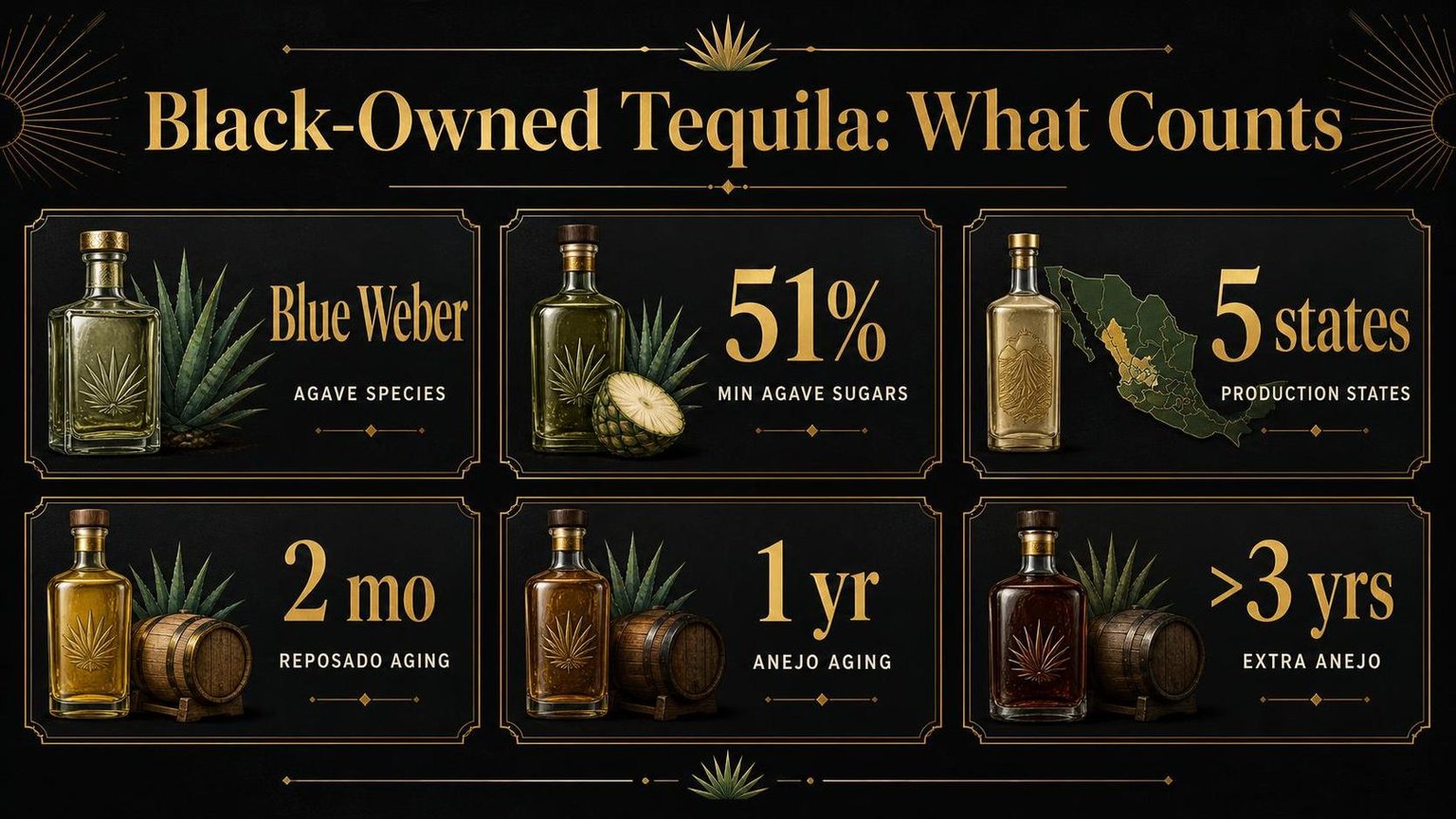
Tequila itself is tightly regulated. By Mexican law, tequila must be produced in Mexico from blue Weber agave and can only be made in Jalisco and limited municipalities in Guanajuato, Michoacán, Nayarit, and Tamaulipas.
| Requirement | Rule |
| Agave species | Blue Weber agave only |
| Tequila category | At least 51% agave sugars |
| 100% agave tequila | All fermentable sugars from agave |
| Authorized production area | 5 Mexican states, with Jalisco dominant |
That legal framework explains why many Black-owned tequila brands do not “own the distillery.” Building a distillery in Jalisco requires land, water access, ovens, tanks, bottling infrastructure, regulatory approvals, and export logistics.
New brands commonly begin through contract production at an existing NOM-certified facility.
NOM matters. Every tequila bottle should show a Norma Oficial Mexicana distillery number, identifying where it was made.
For consumers, NOM verification helps separate actual tequila brands from vague lifestyle labels and gives a direct way to check production transparency.
“Black owned” also does not guarantee one production style. Some brands bottle blanco only, while others release reposado or añejo.
Under tequila rules, reposado is aged at least 2 months in oak, añejo at least 1 year, and extra añejo more than 3 years.
| Style | Minimum aging |
| Blanco | Unaged or aged less than 2 months |
| Reposado | 2 months |
| Añejo | 1 year |
| Extra añejo | More than 3 years |
For readers, the practical definition is simple.
A Black-owned tequila brand should have identifiable Black ownership, transparent leadership, and a real operating role in the business, whether that role covers blending, branding, sales, or long-term strategic control.
- Check the founder and ownership disclosures, not only celebrity association.
- Look for a NOM number to confirm legal tequila production.
- Verify whether the bottle is tequila or another agave spirit.
- Separate minority endorsement deals from majority or controlling ownership.
That standard keeps the term meaningful.
It recognizes Black entrepreneurship in a category rooted in Mexican agriculture and regulation, while giving buyers a factual way to evaluate who owns the brand, who makes the spirit, and how the business actually operates.
Verified Black Owned Tequila Brands
The verified list is short. That reflects the market: many spirits tied to Black founders are whiskey, cognac, or celebrity-backed tequila partnerships rather than clearly Black-owned tequila companies.
The safest approach is to separate fully Black-founded brands from Black co-owned tequila labels. That keeps the category accurate and avoids counting endorsement deals as ownership.
| Brand | Ownership status | What is verified | Core facts |
| Anteel Tequila | Black-founded, family-owned | Founded by Nayana Ferguson and Don Ferguson | Launched in 2018; product line includes Blanco, Reposado, and Coconut Lime Blanco; bottled at 40% ABV |
| Gran Coramino Tequila | Black co-owned | Co-founded by Kevin Hart with Juan Domingo Beckmann | Launched in 2022; debuted with Cristalino Reposado and Añejo; tequila is made in Jalisco, Mexico |
Anteel Tequila is the clearest inclusion. The brand identifies itself as a Black-owned tequila company founded by Nayana Ferguson and Don Ferguson, a husband-and-wife team, and it launched commercially in 2018.
Anteel matters because ownership and operating control are central to its identity, not a licensing arrangement. Its lineup has included Blanco, Reposado, and a Coconut Lime Blanco, all sold at the standard 40% ABV for tequila in the US market.
Gran Coramino Tequila belongs in the conversation, but with a qualifier.
Kevin Hart is a verified co-founder and owner, yet the brand is not solely Black-owned because it was built with tequila executive Juan Domingo Beckmann and Proximo-linked infrastructure.
That distinction matters for readers searching “Black owned tequila brands.” Gran Coramino is accurately described as Black co-owned or Black co-founded, not exclusively Black-owned.
Its launch year was 2022. The first releases were Cristalino Reposado and Añejo, and the production base is in Jalisco, the legally protected home region for tequila.
How to vet ownership claims
- Check whether the founder has equity, not only a marketing role.
- Look for the words founded by, owner, or co-founder in company materials and trade coverage.
- Separate tequila from agave spirits broadly; mezcal and sotol are different categories.
- Treat celebrity association alone as insufficient evidence of ownership.
If accuracy is the goal, Anteel is the strongest fully Black-founded tequila brand to cite. Gran Coramino is a credible second entry when labeled precisely as Black co-owned.
Brand Founders and Ownership Details
Ownership claims in tequila are often looser than the facts. The cleanest standard is this: identify the named founder, the launch year, and whether the brand publicly states sole ownership, co-ownership, or only an investment relationship.
That matters because celebrity marketing can obscure control. A Black founder or investor can be central to a brand’s story without holding 100% ownership, and private tequila companies rarely publish exact equity splits.
| Brand | Launch year | Named founders | Public ownership description |
| Anteel Tequila | 2018 | Nayana Ferguson and Donnette Ferguson | Black woman-owned, privately held |
| Gran Coramino Tequila | 2022 | Kevin Hart and Juan Domingo Beckmann | Co-founded, privately held; percentages not public |
Anteel Tequila is the clearest example in this category. Sisters Nayana Ferguson and Donnette Ferguson founded the brand in 2018, and the company publicly positions itself as Black woman-owned.
The founders are the operating faces of the business, not passive endorsers. Anteel’s production is based in Jalisco, Mexico, while the ownership story remains tied to the Ferguson sisters rather than a large public parent company.
Because Anteel is privately held, outside investors and cap-table percentages are not broadly disclosed.
Still, the available public record consistently identifies the founders themselves as the owners, which makes the brand easier to classify than many celebrity-backed labels.
Gran Coramino requires more precision. The brand launched in 2022 and was co-founded by comedian Kevin Hart and tequila producer Juan Domingo Beckmann, an 11th-generation member of the Beckmann family associated with Jose Cuervo.
Hart is not merely a spokesperson. He is a named co-founder, and that gives him a stronger ownership link than a standard endorsement deal.
But the company does not publish exact percentages, so describing Gran Coramino as solely Black-owned would overstate what is publicly documented.
For readers evaluating “Black-owned tequila brands,” that distinction is the practical test. Anteel fits the most direct founder-ownership definition, while Gran Coramino fits more accurately under Black co-founded tequila.
- Founder-led and Black woman-owned: Anteel Tequila.
- Black co-founded with shared ownership: Gran Coramino Tequila.
- Not enough public data for exact equity claims: most private tequila brands, including celebrity-led launches.
If ownership status is the deciding factor, check for three facts before buying: named founders, launch year, and whether the brand states ownership or only partnership. That avoids confusing marketing visibility with actual control.
Tequila Styles Each Brand Offers
Black-owned and Black co-founded tequila labels do not all follow the same lineup. Some stay with classic categories, while others lean into flavored tequila or modern sub-styles like cristalino to stand out in a crowded premium market.
The easiest way to compare them is by counting actual tequila expressions, not marketing names. That shows whether a brand is built for broad bar use, sipping, or a narrower flavor-driven niche.
| Brand | Tequila expressions commonly marketed | Count |
| Anteel Tequila | Blanco; Coconut Lime Blanco; Pecan Shortbread | 3 |
| Gran Coramino | Cristalino Reposado; Añejo | 2 |
| Lobos 1707 | Joven; Reposado; Extra Añejo | 3 |
Anteel Tequila has one of the most distinctive style mixes in this space. Its range starts with a standard blanco, then moves into flavored tequila, including Coconut Lime Blanco and Pecan Shortbread.
That matters for use. Blanco fits margaritas and highballs, while the flavored bottles are built more for dessert cocktails, chilled pours, and consumers who want tequila without the sharper agave edge.
Gran Coramino, co-founded by Kevin Hart, keeps a tighter portfolio. The brand centers on two aged expressions: Cristalino Reposado and Añejo.
Cristalino is an aged tequila that is filtered back to a clearer appearance. In practice, that gives Gran Coramino a softer visual profile than standard reposado while still keeping oak influence from barrel aging.
The añejo gives the lineup a more traditional sipping option. Under Mexican tequila regulations, añejo must be aged at least 1 year, while reposado must be aged at least 2 months and less than 12 months.
Lobos 1707, associated with LeBron James as an investor and partner, offers the broadest classic tequila ladder of the three. Its tequila line includes Joven, Reposado, and Extra Añejo.
Joven is useful because it gives the brand an entry point between blanco brightness and oak-aged depth. Reposado covers the mainstream premium cocktail slot, and Extra Añejo targets slower sipping.
Extra Añejo is the longest-aged legal category in tequila. By rule, it must spend more than 3 years in oak, making it the most barrel-driven style on this list.
- Choose Anteel for flavored tequila and lower-formality drinking occasions.
- Choose Gran Coramino for a small, polished aged-tequila lineup.
- Choose Lobos 1707 for the widest spread of classic tequila aging styles.
Where to Buy These Tequilas
Black-owned tequila brands are easiest to find through three channels: the brand’s own store locator, national alcohol e-commerce platforms, and large specialty chains.
Start with the producer’s website, because spirits availability changes by state, retailer, and distribution contract.
For most shoppers, online search should be brand first, retailer second. That cuts down wasted time, because a tequila can be listed nationally but unavailable for delivery to your ZIP code.
Brand websites are usually the most accurate source for current distribution.
Anteel Tequila, for example, sells through its own site and directs buyers to retail partners; Gran Coramino also uses a store locator and links to online merchants where legal.
National marketplaces matter when local shelves are thin. ReserveBar regularly carries premium tequila brands in the 750 mL format, while Instacart and Total Wine can surface same-day or in-store inventory depending on your market.
Big-box chains help when you want predictable pricing and easier returns.
Total Wine & More has more than 250 stores across the United States, which makes it one of the most useful search points for newer tequila labels that have entered wider distribution.
Independent bottle shops are often better for limited runs and founder-led brands. Many stores will special-order a case if their distributor already carries the label, and a standard case for 750 mL spirits is commonly 6 or 12 bottles.
| Buying channel | Best use | What to verify |
| Brand website | Most accurate locator and official releases | Shipping states, bottle size, release timing |
| ReserveBar | Premium online ordering | ZIP-code eligibility, delivery fees, gift packaging |
| Total Wine & More | Broad chain inventory and store pickup | Nearest store stock, shelf price, vintage or expression |
| Instacart retailer network | Fast local delivery | Substitution policy, service fees, store source |
| Independent bottle shops | Special orders and harder-to-find labels | Distributor access, case minimum, arrival date |
Check bottle details before you pay. Most tequila is sold in 750 mL, but some retailers mix 50 mL minis, 375 mL half-bottles, and 1 L formats into the same search results, which makes price comparisons misleading.
For gifting or event buying, ask whether the store has enough inventory from the same expression. A blanco, reposado, and añejo from one brand can carry very different prices and may not be stocked together.
- Use the store locator on each brand’s site first.
- Search by exact expression name, not only the brand.
- Confirm 750 mL size before comparing prices.
- Ask independent shops about special orders by the case.
- Check your state’s spirits shipping rules at checkout.
If a bottle is unavailable online, call strong tequila markets first: New York, California, Texas, Florida, and Illinois.
Those states tend to have denser distributor networks, more specialty retailers, and better odds of finding emerging Black-owned tequila brands.
How to Support Black Owned Brands
Support starts with purchase, but the most useful help is repeat demand that retailers and bars can measure.
For Black-owned tequila brands, one bottle sale matters; one requested reorder matters more because buyers track velocity, case movement, and pour-through.
Focus on actions that move product through the U.S. three-tier system: supplier, distributor, retailer.
That system usually prevents most stores and bars from buying direct from a brand, so your request often needs to reach a buyer who can place a distributor order.
| Action | Concrete number | Why it helps |
| Buy a full bottle at retail | 1 standard spirits case = 12 bottles x 750 mL = 9 liters | One sold case is a clean reorder signal for the retailer and distributor. |
| Order pours at a bar | A standard U.S. shot is 1.5 oz; a 750 mL bottle yields about 16 full shots | Steady pour-through tells the bar the brand earns back-bar space. |
| Ask a store to stock it | Give the exact SKU, expression, and bottle size in 30 seconds | Specific requests are easier for buyers to place than vague “Can you get this?” questions. |
| Leave a verified review | Write 50-100 words with tasting notes and where you bought it | Detailed reviews improve search visibility and reduce hesitation for first-time buyers. |
When you shop, ask for the exact expression, not only the brand name.
Tequila is sold across blanco, reposado, añejo, and sometimes extra añejo; the wrong expression can create a false “out of stock” result or lead a retailer to order the wrong SKU.
At bars, order the tequila neat first or in a simple serve like a Ranch Water. That gives the staff and nearby guests a clear reference point, and it keeps the brand visible instead of burying it in a long cocktail build.
Use your receipt as leverage. If a store says the bottle does not move, show that you bought one and ask whether they can commit to one 9-liter case on the next distributor drop. That is a practical, low-friction ask.
- Call ahead and ask for the buyer’s name, then make the request once, clearly.
- Post the shelf photo, bottle size, and price so others can buy the same item.
- Tag the retailer, bar, distributor, and brand in one post to connect demand with supply.
- Bring the bottle to group occasions where 6-10 people can taste it and remember the name.
If you run events, list the brand on the menu, not only “tequila.” Menu text creates searchable proof of placement, and repeated placements help small brands show traction when they pitch new accounts and distributor partners.
Questions People Ask Most
What are some established Black-owned tequila brands in the U.S. market?
Notable examples include Tequila with Friends, founded by a Black-owned team and launched with Blanco, Reposado, and Añejo expressions, and Anteel Tequila, a Black woman-owned brand known for both traditional tequila and infused releases.
These brands are part of a small but growing segment in a category still dominated by large multinational producers and celebrity-backed labels.
Is tequila always made in Mexico, even when the brand is Black-owned?
Yes. Under Mexican law and denomination-of-origin rules, tequila must be produced in designated regions of Mexico, primarily Jalisco, from Blue Weber agave.
A Black-owned tequila brand typically owns the company, recipe direction, and brand identity, while production happens at a licensed Mexican distillery identified by a NOM number on the bottle.
How can buyers verify that a Black-owned tequila brand is producing legitimate tequila?
Check the label for “100% de agave” if you want tequila made entirely from Blue Weber agave, and look for the NOM number, which identifies the certified distillery.
Also confirm the category—Blanco, Reposado, or Añejo—because Mexican regulations require minimum aging periods, including at least 2 months for Reposado and at least 1 year for Añejo.
Are Black-owned tequila brands usually additive-free?
Not automatically.
Some emphasize traditional production and additive-free positioning, but many tequila labels do not independently certify that claim, so buyers should review the producer’s disclosures and third-party reporting before assuming anything.
In tequila, ownership and production style are separate questions.
What should restaurants or retailers consider before adding a Black-owned tequila brand?
Start with supply consistency, pricing tier, and style fit: a crisp Blanco works for cocktails, while a richer Reposado or Añejo supports premium pours.
Then verify distributor coverage, case availability, and whether the brand has on-premise support such as staff training, tasting materials, or founder events, because those factors often determine sell-through more than the ownership story alone.
Most Black-owned tequila brands position in the $30–$60 range for blanco and reposado expressions, competing directly in the premium segment.
Brands like Lobos 1707 and DeLeón price higher, entering the ultra-premium tier above $70, reflecting aged expressions and luxury brand positioning strategies.
Do Black-owned tequila brands own their own distilleries in Mexico?
The majority contract production through established NOM-certified distilleries in Jalisco, which is standard industry practice—roughly 80% of all tequila brands use contract distillation.
Founders typically control the recipe, agave sourcing specifications, and blending decisions while partnering with experienced Mexican distillers for production.
Related Reading
- Does Tequila Have Sulfites?
- How Many Calories In A Shot Of Tequila? Find Out Now
- How Many Calories Does a Shot of Tequila Have?
- Does Tequila Help with a Cold?
- Is Tequila A Depressant? The Most Accurate Answer
- What Is the Difference Between Vodka and Tequila?
- Can You Mix Vodka & Tequila? The Answer You Must Know
- All Alcohol Guides
- Anteel Tequila (2024)
- Gran Coramino Tequila (2024)
- Tequila With Friends (2024)
- Jon Basil Tequila (2024)
- Alcohol and Tobacco Tax and Trade Bureau, Beverage Alcohol Manual: Distilled Spirits, Chapter 4 — Tequila (2024)
- National Institute on Alcohol Abuse and Alcoholism, Alcohol Facts and Statistics (2024)
- National Center for Biotechnology Information, Agave tequilana Weber: A Review of Its Nutritional and Functional Properties (2018)