Cognac is pronounced “KON-yak”—the answer to “How Is Cognac Pronounced?” The first syllable rhymes with “con,” while the second sounds like “yak.” The emphasis falls on “KON,” not.
The final syllable.
This pronunciation applies to the French brandy and the Cognac region in southwestern France.
English speakers sometimes say “KON-yack,” adding a stronger final consonant than French pronunciation requires. In French, the ending is lighter, closer to “yak,” and the word flows as two syllables.
Knowing the pronunciation helps when ordering a VS, VSOP, or XO Cognac, discussing producers such as Hennessy or Rémy Martin, or visiting the region.
This guide explains the sound clearly and shows how to use “Cognac” naturally in conversation.
How to Pronounce Cognac Correctly
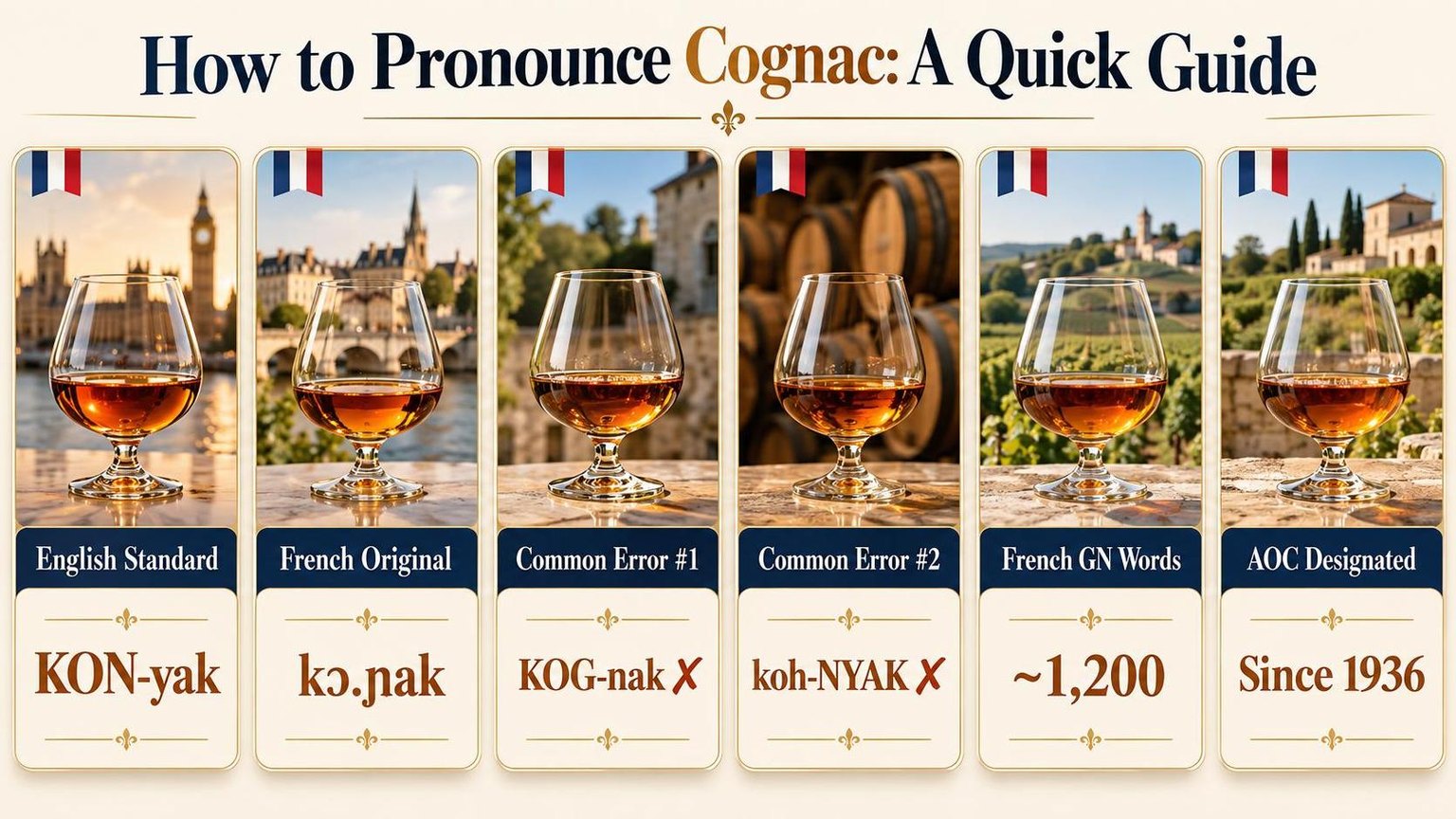
The standard English pronunciation of Cognac is KON-yak (IPA: /ˈkɒn.jæk/), with three syllables compressed into what sounds like two. The original French pronunciation is kɔ.ɲak, featuring a palatal nasal consonant absent from English phonology.
Breaking Down the Syllables
The word derives from the town of Cognac in the Charente department of southwestern France, officially designated as the spirit’s appellation d’origine contrôlée since 1936.
| Element | French Pronunciation | English Pronunciation |
| First syllable “Co-“ | Short /kɔ/ (open “o”) | /kɒn/ (as in “con”) |
| Middle “-gn-“ | Palatal nasal /ɲ/ (like “ñ” in Spanish) | Approximated as /nj/ (“ny”) |
| Final “-ac” | /ak/ (crisp, short “a”) | /æk/ (as in “yak”) |
| Stress | Final syllable (kɔ.ɲAK) | First syllable (KON-yak) |
Common Mispronunciations to Avoid
Several persistent errors circulate among English speakers. Avoiding these marks a knowledgeable drinker and professional.
- “KOG-nak” — Pronouncing the “g” as a hard /ɡ/ is the most frequent mistake. The French “gn” digraph always produces a single nasal sound, never a hard “g.”
- “koh-NYAK” — Overemphasizing the French nasality while adding a long “o” creates an exaggerated, hypercorrect version neither authentically French nor standard English.
- “KON-yik” — Reducing the final vowel to a schwa or short “i” loses the decisive /ak/ ending present in both languages.
- “kuh-NYAK” — Unstressing the first vowel to a schwa misplaces emphasis and distorts the word’s recognizable shape.
Context Matters: Formal vs. Casual Settings
In English-speaking wine bars and restaurants across the United States, KON-yak is universally understood and accepted. The Bureau National Interprofessionnel du Cognac (BNIC) itself uses this anglicized form in English-language communications.
When speaking French or ordering in a French establishment, shifting toward kɔ.ɲak with stress on the final syllable shows cultural awareness without affectation.
Why the “GN” Confuses English Speakers
English lacks the palatal nasal /ɲ/ as a native phoneme. French uses it in approximately 1,200 common words, including “champagne” (/ʃɑ̃.paɲ/), “Bourgogne” (/buʁ.ɡɔɲ/), and “Boulogne” (/bu.lɔɲ/).
Italian shares this sound — spelled “gn” in words like “gnocchi” and “lasagna.” Spanish spells it “ñ.” English speakers instinctively approximate it as /nj/.
Which is close enough to be clearly understood.
Quick Reference
| Setting | Recommended Pronunciation | Phonetic Guide |
| American bar or restaurant | KON-yak | /ˈkɒn.jæk/ |
| French restaurant or sommelier | koh-NYAK (closer to French) | /kɔ.ɲak/ |
| Casual conversation | KON-yak | /ˈkɒn.jæk/ |
Mastering the pronunciation takes seconds. The confidence it conveys when ordering a V.S.O.P. or X.O. at the bar lasts far longer.
The French Pronunciation of Cognac
In French, Cognac is pronounced /kɔ.ɲak/ — three distinct sounds compressed into two syllables. The word derives from the town of Cognac in the Charente department, where distillers have produced the spirit since the 16th century.
The pronunciation breaks down into two syllables: ko-NYAK. The stress falls lightly on the second syllable, though French generally distributes stress more evenly than English.
Sound-by-Sound Breakdown
| IPA Symbol | Sound | English Approximation | Position |
| /k/ | Voiceless velar stop | “k” in “kite” | Initial consonant |
| /ɔ/ | Open-mid back rounded vowel | Between “aw” and short “o” | First vowel |
| /ɲ/ | Palatal nasal | “ny” in “canyon” | Middle consonant cluster |
| /a/ | Open front unvoweled vowel | “a” in “father” | Second vowel |
| /k/ | Voiceless velar stop | “k” in “kite” | Final consonant |
The Critical “gn” Sound
The French digraph “gn” produces the palatal nasal /ɲ/, not two separate sounds. This same phoneme appears in words like champignon, Bourgogne, and Avignon.
English lacks this exact sound as a single consonant.
The closest equivalent is the “ny” combination in “canyon” or the “ni” in “onion.” Place the middle of your tongue against the hard palate while releasing air through the nose.
The Final “c” Is Pronounced
Unlike many French words where final consonants are silent, the terminal “c” in Cognac is fully articulated.
This follows a pattern seen in other place-derived French words ending in “-ac,” such as Armagnac (/aʁ.ma.ɲak/) and Bergerac.
The Charente-region dialect historically preserved these final consonants more consistently than Parisian French, which influenced the standard pronunciation.
Common Mispronunciations to Avoid
- “KON-yak” — Nasalizing the first vowel is incorrect. The “o” in Cognac is oral, not nasal. There is no /n/ sound before the “gn.”
- “KOG-nak” — Separating the “g” and “n” into distinct sounds ignores the French digraph rule entirely.
- “ko-NYAK” with a hard American “a” — The French /a/ is more open and central than the flat American vowel in “back.”
- Silent final “c” — Dropping the /k/ at the end produces a word that no French speaker would recognize.
Regional Nuance
Residents of Cognac itself — a town of roughly 19,000 people in southwestern France — pronounce the first vowel slightly more open than standard Parisian speakers.
The Bureau National Interprofessionnel du Cognac (BNIC), the spirit’s governing body since 1946, uses the standard /kɔ.ɲak/ in all official communications.
Practicing with the phrase “un verre de cognac” (a glass of cognac) helps anchor the pronunciation in natural speech rhythm. The word flows as a single crisp unit: two syllables, five phonemes, no silent letters.
Cognac Versus Common English Mispronunciations
The word “cognac” triggers at least four distinct mispronunciations among English speakers.
Understanding exactly where each version diverges from the accepted pronunciation helps eliminate errors and builds confidence when ordering at a bar or discussing spirits.
The Correct Pronunciation
In standard American English, cognac is pronounced KON-yak (IPA: /ˈkɒn.jæk/). The stress falls on the first syllable. The “gn” produces a palatal nasal /ɲ/, approximated in English as a “ny” sound.
In French, the origin language, it is pronounced kɔ.ɲak — two syllables with a nasalized first vowel and no final consonant stress. Most English dictionaries, including Merriam-Webster, accept the anglicized three-syllable rendering.
Common Mispronunciations Compared
| Pronunciation | IPA | Error Type | Frequency |
| KON-yak (correct) | /ˈkɒn.jæk/ | None | Standard |
| KOG-nak | /ˈkɒɡ.næk/ | Hard “g” inserted; “gn” split into two consonants | Very common |
| ko-NYAK | /koʊˈnjæk/ | Stress shifted to second syllable | Common |
| KON-ee-ak | /ˈkɒn.i.æk/ | Extra syllable added; word stretched to three beats | Occasional |
| KON-yak with silent “c” | /ˈkɒn.jæ/ | Final “c” dropped entirely | Occasional |
Why the “Gn” Causes Problems
English uses “gn” as two separate sounds in words like “ignite” (/ɪɡˈnaɪt/) and as a silent “g” in words like “gnat” (/næt/).
Neither pattern matches French, where “gn” consistently represents the single palatal nasal /ɲ/.
This mismatch explains the most widespread error: pronouncing cognac as KOG-nak. Speakers default to English phonetic rules and split the cluster into a hard /ɡ/ followed by /n/.
Regional Variations in English
- American English: KON-yak with a short “o” and a hard final “k” is the dominant accepted form across major dictionaries including Merriam-Webster and Oxford Advanced Learner’s.
- British English: Often rendered as KON-yak with a slightly rounded “o” closer to the French vowel. Cambridge Dictionary lists /ˈkɒn.jæk/ as the primary British transcription.
- Australian English: Tends to mirror British pronunciation but occasionally elongates the first vowel to KOHN-yak.
Quick Self-Check
Say “canyon” aloud. The “ny” in the middle of canyon is the same consonant cluster needed in cognac. Replace “ca-” with “ko-” and add “-ak” at the end: KON-yak.
If the word coming out of your mouth rhymes with “fog rack,” you are inserting a hard “g.” If it rhymes with “Don Juan,” you are too close to a Spanish phonetic pattern.
The target rhyme is “bon voyage” — French-origin, soft nasal, no hard stop in the middle.
Breaking Down the Cognac Sounds
The word “Cognac” contains three distinct phonetic segments that combine into a two-syllable word. Understanding each sound individually makes the full pronunciation accessible, even for speakers with no French language background.
The Three Phonetic Segments
| Segment | Letters | IPA Symbol | English Approximation |
| 1 | Co- | /kɔ/ | “Koh” — rhymes with “go” but rounder |
| 2 | -gn- | /ɲ/ | Like the “ny” in “canyon” |
| 3 | -ac | /ak/ | “Ahk” — short, crisp “a” as in “father” |
Segment 1: The “Ko” Opening
The initial “Co-” uses a rounded back vowel, transcribed as /kɔ/ in the International Phonetic Alphabet. English speakers often flatten this into “kahn,” which misses the rounded lip position French requires.
Place your lips in a slight “O” shape while producing the vowel. The sound sits between the English “oh” and “aw,” closer to the vowel in the British English pronunciation of “lot.”.
Segment 2: The French “gn” Consonant
This is the sound most English speakers struggle with. The French “gn” digraph represents a palatal nasal consonant /ɲ/, which does not exist as a standard English phoneme.
The /ɲ/ sound appears in over 4,200 French words, including “champagne,” “Bourgogne,” and “mignon.” English borrowed all three words and largely preserved this sound.
- Tongue position: Press the middle of your tongue flat against the hard palate — not the tip, which stays behind the lower teeth
- Airflow: Direct air through the nasal passage, not the mouth
- Duration: Hold the contact briefly — roughly 80–120 milliseconds in natural French speech
- Practice word: Say “lasagna” slowly — the “gn” in the middle uses the identical articulation
Segment 3: The Final “-ac”
The closing syllable uses an open front vowel /a/ followed by a hard /k/. Unlike many French words, the final consonant in “Cognac” is fully pronounced — not silent.
This distinguishes Cognac from words like “blanc” or “franc,” where the final “c” is mute. Linguists attribute the pronounced final consonant to Cognac’s Occitan and Saintongeais dialect roots.
Putting It Together
The full IPA transcription is /kɔ.ɲak/. Stress falls lightly on the second syllable, consistent with standard French prosody, which typically emphasizes the final syllable of a word or phrase.
Spoken at natural speed, the word takes approximately 0.4–0.6 seconds to articulate. Resist inserting a vowel between the “gn” and “ac” — there is no third syllable. Two syllables only: KON-yak.

How French Speakers Say Cognac
French speakers pronounce Cognac as kɔ.ɲak in the International Phonetic Alphabet, rendering it roughly as “koh-NYAK.” The word carries two syllables with stress on the second,.
Following standard French prosodic patterns for words ending in a consonant cluster.
The critical sound distinguishing French from English pronunciation is the palatal nasal /ɲ/. This consonant does not exist natively in English.
The /ɲ/ sound is produced with the tongue blade pressed flat against the hard palate, simultaneously releasing air through the nasal cavity. It appears in French words like champignon, montagne, and Bourgogne.
Breaking Down Each Syllable
| Syllable | IPA | Approximate Sound | Duration (ms) |
| First: Co- | /kɔ/ | “koh” with an open-mid back rounded vowel | ~120–150 |
| Second: -gnac | /ɲak/ | “nyak” with palatal nasal onset | ~180–220 |
The first vowel /ɔ/ sits between English “oh” and “aw.” It is more open than the English /oʊ/ diphthong and does not glide upward.
The final /k/ is released crisply. French speakers do not aspirate it with a puff of air the way American English speakers typically do with word-final plosives.
Common Errors Non-French Speakers Make
- Substituting /n.j/ for /ɲ/: English speakers often say “kon-yak” with two distinct consonants instead of the single palatal nasal, adding an extra syllable and producing three beats instead of two.
- Nasalizing the first vowel: Some speakers incorrectly treat “Co-” like the French nasal vowel /ɔ̃/ found in bon. The “o” in Cognac is oral, not nasal.
- Dropping the final /k/: Anglophone speakers sometimes trail off with “koh-NYAH,” but the terminal /k/ is always articulated in standard French.
- Stressing the first syllable: English tends toward initial stress. French lexical stress falls predictably on the final syllable of an isolated word.
Regional Variation Within France
Residents of the Cognac delimited appellation area in Charente and Charente-Maritime departments sometimes soften the /k/ ending slightly. This reflects broader Poitevin-Saintongeais substrate influences in western France.
Parisian speakers and formal broadcast French (le français standard) maintain the full /kɔ.ɲak/ with no reduction. The Dictionnaire de la prononciation française by Léon Warnant confirms this two-syllable rendering.
The Bureau National Interprofessionnel du Cognac (BNIC), the official trade body governing Cognac production since 1946, uses this standard pronunciation in all French-language communications and media.
Practicing the sound “montagne” (/mɔ̃.taɲ/) isolates the /ɲ/ in a familiar context.
Once that palatal nasal feels natural, transferring it to “Cognac” becomes straightforward — simply attach /ak/ immediately after the /ɲ/ without inserting a vowel.
Common Questions
How Is Cognac Pronounced?
Cognac is pronounced KON-yak (/ˈkɒn.jæk/) in English, with stress on the first syllable and a soft “y” sound replacing the French nasal “gn.” In French, the native pronunciation is closer to koh-NYAK (/kɔ.ɲak/),.
Where the “gn” produces a palatal nasal consonant identical to the “gn” in Italian “gnocchi.” The word refers exclusively to brandy distilled in the Cognac AOC region of southwestern France.
Designated by the Bureau National Interprofessionnel du Cognac (BNIC) since 1946.
Frequently Asked Questions
Why do English and French speakers pronounce Cognac differently?
English lacks the palatal nasal /ɲ/ phoneme that French uses for the “gn” combination.
English speakers naturally substitute the closest available sounds — a hard /n/ followed by a /j/ glide — producing “KON-yak” instead of the French “koh-NYAK.” This is a standard phonological adaptation.
The same process that turns “champagne” into “sham-PAIN” in English.
Is it wrong to pronounce Cognac with a hard “g” sound?
Pronouncing it as “KOG-nak” with an audible hard /g/ is incorrect in both English and French. The “gn” in French functions as a single consonant unit (a digraph), never separating into distinct /g/ and /n/ sounds.
Merriam-Webster, Oxford, and Cambridge dictionaries all transcribe the English pronunciation without any /g/ phoneme.
How do you pronounce specific Cognac brands like Hennessy, Rémy Martin, and Courvoisier?
Hennessy is pronounced HEN-uh-see, named after Irish officer Richard Hennessy who founded the house in 1765.
Rémy Martin is reh-MEE mar-TAN in French, though English speakers often say “REH-mee MAR-tin.” Courvoisier is koor-VWAH-zee-ay, with four syllables and stress on the third.
Does the pronunciation change when referring to the town versus the spirit?
No. The town of Cognac in the Charente département and the spirit share identical pronunciation in both French and English.
The town has approximately 19,000 residents and gave its name to the brandy through the 1936 Appellation d’Origine Contrôlée designation, which legally restricts use of the name to spirits produced within the defined region.
How do you pronounce Cognac age designations like VS, VSOP, and XO?
These are spoken as individual letters or their full English forms: V-S (Very Special, minimum 2 years aged), V-S-O-P (Very Superior Old Pale, minimum 4 years), and X-O (Extra Old,.
Minimum 10 years as of a 2018 BNIC regulation change from the previous 6-year minimum).
The designation “hors d’âge” is pronounced or-DAHZH.
What is the correct pronunciation of “eau-de-vie,” the term for the base spirit in Cognac?
“Eau-de-vie” is pronounced oh-duh-VEE, literally meaning “water of life” in French.
Cognac requires double distillation of eau-de-vie made from at least 90% Ugni Blanc, Folle Blanche, or Colombard grapes in traditional copper pot stills called alembics (ah-LOM-bik).
How do you pronounce the six Cognac crus (growing regions)?
The six official crus are: Grande Champagne (grahnd shahm-PAN-yuh), Petite Champagne (puh-TEET shahm-PAN-yuh), Borderies (bor-duh-REE), Fins Bois (fan BWAH), Bons Bois (bon BWAH), and Bois Ordinaires (bwah zor-dee-NAIR).
Grande and Petite Champagne are the most prized, producing the eaux-de-vie used in “Fine Champagne” Cognac blends.
Is “Cognac” ever pronounced differently in other languages like Spanish, German, or Japanese?
Spanish speakers typically say coh-NYAK, closely mirroring the French original because Spanish shares the /ɲ/ sound (as in “ñ”). German speakers say KON-yak, similar to English.
In Japanese, it is rendered as コニャック (ko-nyak-ku), adding a final vowel consistent with Japanese phonotactic rules. Across all languages, the “gn” is treated as a nasal or glide — never as a hard /g/.
Related Reading
- Is Cognac An After-Dinner Drink?
- Does Cognac Go Bad?
- Martell Vs Cognac: What Is The Difference Between Them?
- How Do You Pronounce Cognac?
- What Does Hennessy Taste Like? (2026 Cognac Flavor Guide)
- Cavasia Cognac Review – Basic Information You Must Know
- What Does Xo Mean in Cognac?
- All Alcohol Guides
- Bureau National Interprofessionnel du Cognac (BNIC) (2024)
- Merriam-Webster Dictionary – "Cognac" Entry (2024)
- Cambridge Dictionary – "Cognac" Pronunciation (2024)
- TTB – Alcohol and Tobacco Tax and Trade Bureau, U.S. Department of the Treasury – Standards of Identity for Distilled Spirits, 27 CFR Part 5 (2023)
- U.S. Patent and Trademark Office (USPTO) – Cognac Geographical Indication Certification Mark (2024)
- Yale University Library – French Language Pronunciation Guides & Resources (2024)
- National Center for Biotechnology Information (NCBI/PubMed) – "Chemical Composition and Sensory Characteristics of Cognac" (2020)