
Does Cognac Go Bad? is answered by one concrete fact: unopened Cognac stays safe indefinitely when sealed, while opened Cognac gradually loses aroma and flavor after oxygen enters the bottle.
Its 40% ABV makes spoilage from microbes unlikely, but evaporation, oxidation, heat, and light can flatten the spirit.
This guide explains how long Cognac lasts, what changes after opening, how to spot a damaged bottle, and the storage habits that protect fruit, oak, rancio, and texture. Use it before saving, gifting, or pouring an old bottle.
Does Cognac Go Bad Unopened
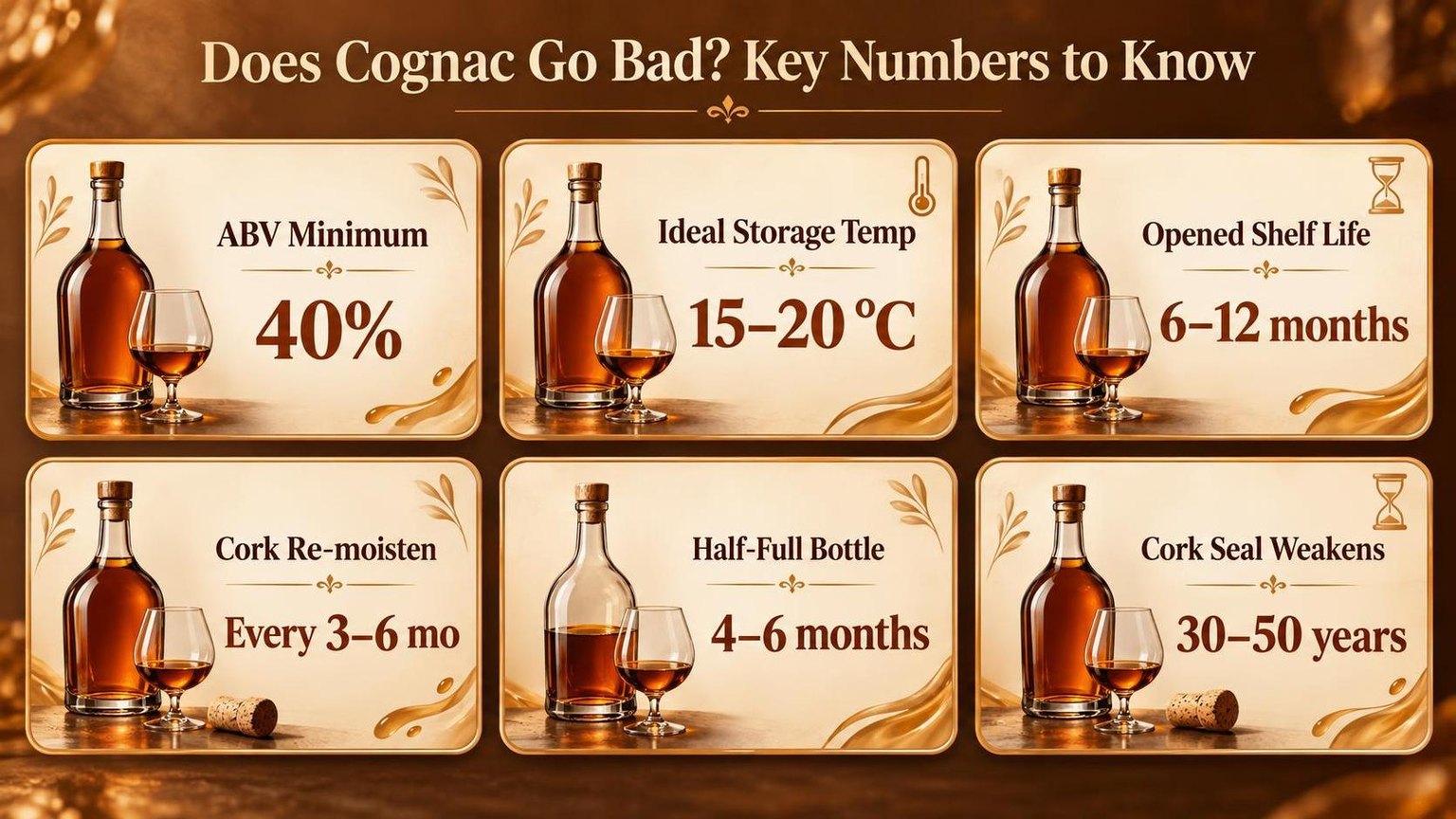
Unopened Cognac stored properly remains safe to drink indefinitely. The 40% ABV minimum (most range 40–60% ABV) prevents microbial growth, making spoilage virtually impossible inside a sealed bottle.
Cognac is a distilled spirit, not wine. Once bottled, it stops aging entirely. A VS Cognac bottled in 1980 tastes the same today as it did then — assuming correct storage.
What “Going Bad” Actually Means for Sealed Cognac
Cognac doesn’t spoil like perishable food. The real risks are environmental degradation, not biological decay. Three factors determine whether an unopened bottle maintains its original character.
| Factor | Safe Range | Risk If Exceeded |
| Temperature | 15–20 °C (59–68 °F) | Evaporation through cork, flavor flattening |
| Light exposure | Dark or minimal UV | Photodegradation of esters and tannins |
| Bottle position | Upright | Cork erosion from prolonged alcohol contact |
Why Upright Storage Matters
Unlike wine corks, spirit corks degrade when in constant contact with high-proof alcohol. Storing Cognac on its side can dissolve cork material within months, contaminating the liquid with off-flavors and particles.
Natural cork closures dry out over decades. Periodically tilting the bottle briefly — once every 3–6 months — moistens the cork without sustained contact.
Does the Seal Weaken Over Time?
Cork shrinkage causes the most common issue with very old unopened bottles.
After 30–50 years, micro-gaps can allow slow oxidation and evaporation, a phenomenon called the “angel’s share” in barrel aging but undesirable in bottles.
Wax-sealed or synthetic-sealed bottles resist this problem far longer. Many prestige Cognacs — Rémy Martin Louis XIII, Hennessy Paradis — use glass stoppers with tight gaskets specifically to prevent long-term seal failure.
Bottom Line for Collectors
- An unopened bottle stored upright in a cool, dark place will not spoil — ever.
- Flavor degradation requires decades of poor storage, not mere time.
- No expiration date exists for sealed Cognac under French or EU labeling regulations.
- Bottles older than 50 years should be inspected for fill-level drop before purchase.
How Long Open Cognac Lasts
An opened bottle of Cognac remains drinkable for 6 to 12 months when stored properly, though flavor degradation begins within weeks of breaking the seal.
The high alcohol content (40% ABV minimum by law) prevents spoilage but cannot stop oxidation from dulling the spirit’s aromatic complexity.
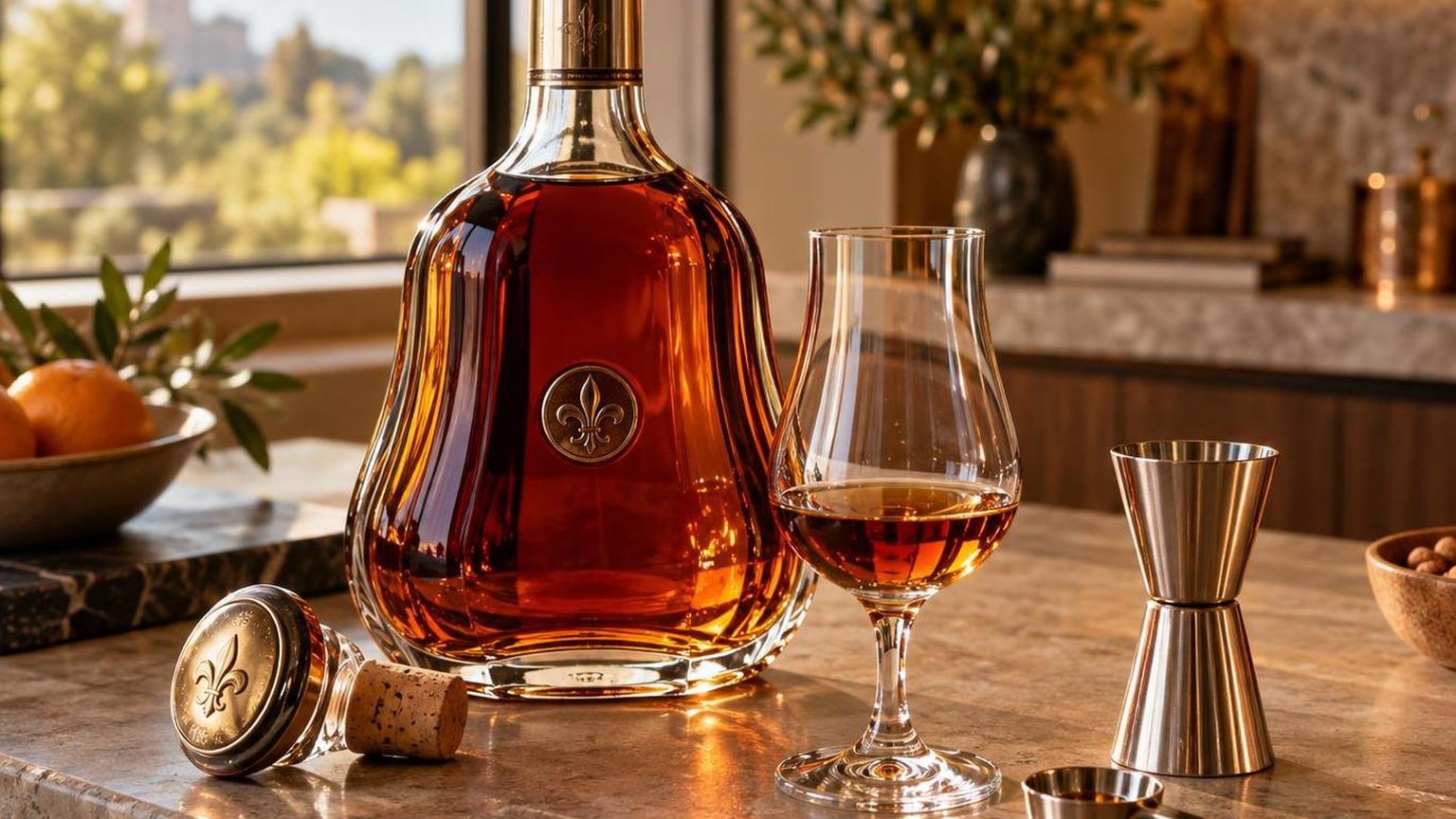
Oxidation is the primary enemy. Each time you open the bottle, fresh oxygen enters and reacts with volatile esters and aldehydes responsible for Cognac’s bouquet.
| Bottle Fill Level | Estimated Quality Window | Reason |
| ¾ full or more | 8–12 months | Minimal headspace limits oxygen exposure |
| ½ full | 4–6 months | Moderate headspace accelerates oxidation |
| ¼ full or less | 1–3 months | Large air-to-liquid ratio rapidly degrades aromatics |
The fill level matters more than any other single factor. A nearly empty bottle of Rémy Martin VSOP will lose its signature vanilla and dried-fruit notes far faster than a mostly full one.
What Changes After Opening
- Weeks 1–4: Negligible change detectable by most drinkers; some tasters note slight “opening up” of flavors similar to wine breathing.
- Months 2–6: Top notes—floral, citrus, spice—begin flattening. The spirit tastes simpler and less vibrant on the nose.
- Months 6–12: Noticeable dullness across the palate. Older XO and hors d’âge expressions lose the layered complexity that justified their price.
- Beyond 12 months: Safe to drink but qualitatively diminished. Aromas become muted and the finish shortens considerably.
Factors That Accelerate Decline
Heat above 20°C (68°F) speeds evaporation of ethanol and aromatic compounds through the cork. Direct sunlight catalyzes chemical reactions that further degrade flavor.
A loose or dried-out cork allows continuous air exchange, effectively shortening the quality window by half. Synthetic closures and screw caps maintain a tighter seal.
Cognac will not become unsafe to consume regardless of how long the bottle sits open. The 40%+ ABV inhibits bacterial and fungal growth entirely.
The question is never safety—it is whether the spirit still delivers the experience its classification promises.
Signs Cognac Has Gone Bad
Cognac rarely spoils in a way that makes it unsafe, but it absolutely degrades. Oxidation, heat exposure, and light damage alter its chemistry, stripping away the esters and aldehydes that define its character.
Recognizing deterioration early prevents you from serving a diminished spirit.
Visual Changes
Hold the bottle against a white background. Degraded Cognac often appears noticeably lighter or develops a dull, muddy hue compared to its original amber-to-mahogany tone.
- Cloudiness or haze — indicates contamination or temperature damage to dissolved compounds
- Floating particles or sediment — cork disintegration or oxidation byproducts settling at the bottom
- Color fading — UV light breaks down tannins extracted during barrel aging, reducing depth by 20–40% in severely light-damaged bottles
Aroma Red Flags
Cognac’s bouquet relies on roughly 300 volatile compounds. When these degrade, the nose shifts dramatically and unmistakably.
- Nail polish remover or sharp solvent smell — excess ethyl acetate from oxidation
- Flat, cardboard-like aroma — loss of fruity esters and floral aldehydes
- Musty or wet-cork scent — potential TCA contamination (cork taint), detectable at concentrations as low as 2 parts per trillion
Taste Indicators
A small sip confirms what your eyes and nose suspect. Deteriorated Cognac tastes harsh, hollow, or chemically off-balance.
| Indicator | Healthy Cognac | Degraded Cognac |
| Finish length | 8–15 seconds of warmth | Short, abrupt, under 3 seconds |
| Sweetness balance | Subtle dried fruit, vanilla | Flat or bitter with no fruit |
| Alcohol integration | Smooth at 40% ABV | Burning, ethanol-forward bite |
| Mouthfeel | Round, slightly viscous | Thin, watery texture |
The Half-Bottle Rule
A bottle less than half full contains enough oxygen to noticeably degrade Cognac within 6–8 months. At one-quarter full, deterioration accelerates to 2–3 months.
If your bottle has sat at that level for longer, evaluate it using the criteria above before pouring for guests.
Why Cognac Changes After Opening
Cognac doesn’t spoil like milk or wine, but it undergoes measurable chemical changes once the seal breaks.
Oxygen exposure triggers oxidation reactions that alter flavor compounds, while ethanol evaporation shifts the spirit’s balance over months and years.
Oxidation: The Primary Catalyst
When you open a bottle, oxygen contacts the liquid surface. This initiates oxidation of esters and aldehydes — the volatile compounds responsible for Cognac’s fruit, floral, and spice notes.
Polyphenols extracted during oak aging are particularly susceptible. These compounds oxidize and polymerize, muting the tannic structure and shifting flavor toward flatness over time.
Ethanol Evaporation
Cognac is bottled at 40% ABV minimum (per AOC regulations). After opening, ethanol evaporates faster than water because its vapor pressure is roughly 3× higher at room temperature.
This gradual ABV drop reduces the spirit’s ability to carry aromatic molecules to your nose, diminishing perceived complexity even before flavor compounds themselves degrade.
Headspace Effect
The air-to-liquid ratio in the bottle determines oxidation speed. A nearly full bottle changes slowly; a quarter-full bottle deteriorates noticeably within 6–8 months.
| Bottle Fill Level | Estimated Stability Window | Oxidation Risk |
| 75–100% full | 2–3 years | Low |
| 50–75% full | 1–2 years | Moderate |
| 25–50% full | 6–12 months | High |
| Below 25% full | 3–6 months | Very high |
Contributing Factors
- Temperature fluctuations: Storage above 20°C (68°F) accelerates both oxidation and evaporation rates by roughly 2× per 10°C increase (Arrhenius principle).
- Light exposure: UV radiation breaks down terpenes and phenolic compounds, causing stale or cardboard-like off-notes.
- Cork degradation: Natural cork dries out in upright storage, losing its seal integrity and allowing increased air exchange over time.
None of these changes make Cognac unsafe to drink. They reduce aromatic intensity, soften flavor definition, and ultimately leave the spirit tasting dull compared to its freshly opened state.
Best Storage Conditions for Cognac
Cognac demands stable, controlled conditions to preserve its complex aromatic profile. Unlike wine, an opened or unopened bottle requires specific environmental parameters that, when maintained, keep the spirit drinkable for decades.
Temperature and Humidity
Store cognac between 15°C and 20°C (59°F–68°F). Fluctuations above 25°C accelerate oxidation and evaporation—the same “angel’s share” effect that costs producers roughly 2% of barrel volume annually during aging.
Maintain relative humidity between 50% and 70%. Excessively dry air degrades natural corks, allowing oxygen ingress. Excessively damp conditions promote mold on labels and closures.
Key Storage Factors at a Glance
| Factor | Optimal Range | Risk if Ignored |
| Temperature | 15–20°C (59–68°F) | Flavor degradation, evaporation |
| Humidity | 50–70% | Cork drying or mold growth |
| Light exposure | Zero direct sunlight | UV breaks down tannins and esters |
| Bottle position | Upright | High-proof spirit (40%+ ABV) erodes cork |
| Vibration | Minimal | Disrupts sediment in older bottlings |
Upright, Not on Its Side
Always store cognac bottles upright. At 40% ABV or higher, prolonged cork contact dissolves the cork material, introducing off-flavors and compromising the seal. This is the opposite of wine storage protocol.
Light and Location
UV radiation degrades aromatic compounds—particularly esters responsible for fruity and floral notes. A closed cabinet, cellar, or dark pantry is ideal. Avoid kitchen counters near stoves or windows.
After Opening
- Reseal tightly after every pour to limit oxygen exposure.
- Consume within 6–8 months once the bottle is less than half full; the increased headspace accelerates oxidation.
- Transfer remaining cognac to a smaller glass bottle to reduce air volume if long-term storage is planned.
- Never store with a speed pourer attached—it allows constant air exchange.
A full, sealed bottle stored under these conditions retains its original character essentially unchanged for 50+ years. The spirit does not mature further in glass, but proper storage prevents deterioration.
Can Old Cognac Make You Sick
Cognac’s 40% ABV minimum makes it inhospitable to pathogenic bacteria, so properly stored old Cognac won’t cause food poisoning.
The real risks come from oxidation-related quality loss and, in rare cases, contaminated bottles with compromised seals.
Why High-Proof Spirits Resist Spoilage
Ethanol at concentrations above 20% ABV kills most foodborne pathogens, including E. coli, Salmonella, and Listeria. Cognac ranges from 40–60% ABV, well above that antimicrobial threshold.
No documented case exists of bacterial food poisoning from commercially bottled, sealed Cognac—regardless of age. The WHO confirms distilled spirits at 40%+ ABV are self-preserving.
What Can Actually Go Wrong
Degraded Cognac won’t poison you, but it can taste unpleasant enough to cause mild gastrointestinal discomfort, particularly if heavily oxidized compounds irritate the stomach lining.
| Condition | Health Risk | Likelihood |
| Sealed bottle, proper storage | None | Indefinitely safe |
| Opened bottle, 1–2 years | None; minor flavor loss | Very common |
| Opened bottle, 5+ years, half-empty | Excessive acetaldehyde; possible headache/nausea | Moderate |
| Cracked seal or cork disintegration | Mold contamination; off-flavors | Rare |
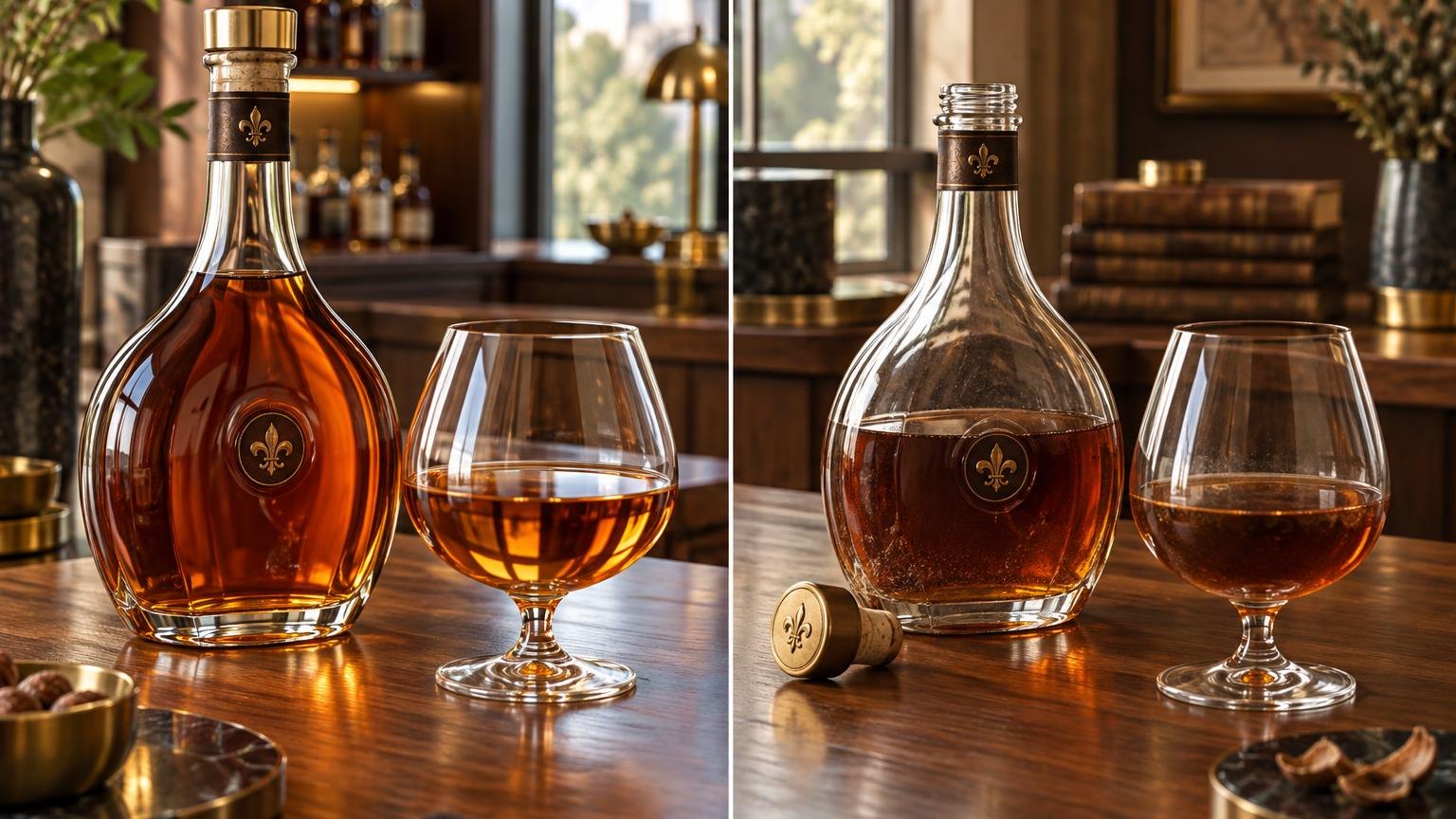
| Decanted into lead crystal for months | Lead leaching; toxic at 15+ µg/dL blood level | Rare but documented |
The Lead Crystal Warning
Storing Cognac in lead crystal decanters is genuinely dangerous.
A 1991 study in The Lancet found brandy stored in lead crystal for 5 days leached lead concentrations up to 5,331 µg/L—far exceeding the EPA’s 15 µg/L action level for drinking water.
Long-term lead exposure causes neurological damage, kidney dysfunction, and elevated blood pressure. Transfer Cognac to glass decanters or keep it in the original bottle.
Signs to Discard Old Cognac
- Visible mold or floating particles not attributable to natural sediment
- Strong vinegar or nail-polish-remover smell indicating acetic acid or ethyl acetate dominance
- Cork has fully crumbled, allowing prolonged air and debris contact
- Liquid stored in lead crystal for more than 24 hours
Old Cognac is almost never a health hazard. The spirit itself remains microbiologically stable for decades. Storage vessel and seal integrity matter far more than the date on the bottle.
When to Replace Opened Cognac
Opened Cognac doesn’t spoil like milk or wine, but oxidation steadily degrades its aromatic complexity. The timeline depends on fill level, storage conditions, and bottle closure quality.
Oxygen is the primary enemy. Each time you pour, the headspace in the bottle increases, accelerating oxidation of volatile esters and aldehydes that define Cognac’s character.
Replacement Timeline by Bottle Fill Level
| Fill Level | Expected Quality Window | Primary Risk |
| ¾ full or more | 8–12 months | Slow oxidation; minimal flavor loss |
| ½ full | 4–6 months | Noticeable dulling of fruit and floral notes |
| ¼ full or less | 1–3 months | Rapid oxidation; flat, harsh, or cardboard-like taste |
These estimates assume storage at 15–20 °C in an upright position, away from direct sunlight, with the original cork or cap properly sealed.
Signs It’s Time to Replace
- Muted nose: The raisin, vanilla, and dried-fruit aromas that characterize VS, VSOP, or XO expressions become faint or absent.
- Flat palate: The mid-palate warmth and layered finish shorten noticeably, replaced by a one-dimensional alcohol burn.
- Off aromas: Acetaldehyde buildup can introduce stale, cardboard, or nail-polish-like odors.
- Color shift: Prolonged oxidation may slightly darken the spirit, though this change is subtle in already amber-hued Cognac.
Cognac’s 40% ABV minimum (set by the Bureau National Interprofessionnel du Cognac) prevents bacterial spoilage. Drinking oxidized Cognac is safe — just unpleasant.
How to Extend the Window
Transfer remaining Cognac into a smaller glass bottle to minimize headspace. A 375 ml half-bottle works well when your 750 ml bottle drops below half.
Private-preserve argon gas sprays displace oxygen inside the bottle. A 2–3 second burst before resealing can extend quality life by roughly 30–50%, according to spirits storage trials.
Never store Cognac on its side. The high-proof spirit degrades natural cork, introducing off-flavors and risking seal failure — the opposite of wine storage protocol.
Questions People Ask Most
Does an unopened bottle of Cognac expire?
No. Cognac is distilled to 40% ABV minimum and bottled at a stable proof that prevents microbial growth indefinitely.
An unopened bottle stored upright in a cool, dark place at 15–20 °C will taste virtually identical decades after purchase—spirit does not age further once it leaves the barrel.
How long does Cognac last after opening?
An opened bottle retains its intended flavor profile for roughly 6–12 months if kept tightly sealed and stored away from heat and light.
After that window, oxidation gradually flattens the aromatic esters—particularly the fruity and floral top notes—though the liquid remains safe to drink.
Can Cognac make you sick if it’s been open too long?
No. The 40%+ alcohol content prevents pathogenic bacteria and mold from colonizing the liquid. An old, oxidized Cognac may taste dull or slightly acetic, but it poses no food-safety risk.
If the bottle has a compromised seal and visible foreign matter, discard it as a precaution.
How can you tell if a Cognac has degraded in quality?
Check for three indicators: a noticeably flat or vinegar-like aroma replacing the expected rancio and dried-fruit notes, a paler color suggesting prolonged light exposure, or a thin, watery mouthfeel where richness once existed.
A VS that once smelled of fresh grape and vanilla but now smells like cardboard has oxidized past its prime.
Does storing Cognac on its side—like wine—damage it?
Yes. Prolonged contact between 40% ABV spirit and a natural cork degrades the cork material, causing it to crumble and leach off-flavors into the Cognac. The Bureau National Interprofessionnel du Cognac (BNIC) recommends storing bottles upright.
If you must store long-term, re-seal with a glass stopper or parafilm the cork.
Is a 50-year-old bottle of Cognac better than a fresh one?
Not inherently. Unlike wine, Cognac does not evolve in the bottle; its age statement (VS at minimum 2 years, VSOP at 4, XO at 10) reflects only time spent in oak casks before bottling.
A Rémy Martin XO bottled in 1975 and stored properly tastes the same as when it was sealed—no additional complexity develops in glass.
Related Reading
- How To Drink Hennessy? 12 Powerful Tips for the Ultimate Cognac Experience
- What Is The Most Expensive Cognac?
- What Goes Good With Cognac?
- Is Cognac An After-Dinner Drink?
- Martell Vs Cognac: What Is The Difference Between Them?
- What Are The Best Cognac Brands?
- Cavasia Cognac Review – Basic Information You Must Know
- What Does Hennessy Taste Like? (2026 Cognac Flavor Guide)
- Does Hennessy Freeze?
- All Alcohol Guides
- U.S. Food & Drug Administration — Labeling of Distilled Spirits (2024)
- U.S. TTB — Beverage Alcohol Manual: Brandy (2023)
- National Institute on Alcohol Abuse and Alcoholism — Alcohol's Effects on Health (2023)
- USDA FoodData Central — Brandy Nutrient Profile (2024)
- PubMed — Oxidative Changes in Spirits During Storage (2007)
- Bureau National Interprofessionnel du Cognac (BNIC) — How Cognac Is Made (2024)
- MasterClass — Does Liquor Go Bad? Shelf Life of Spirits (2022)
- Wine Spectator — How to Store Spirits (2021)
- University of California Davis — Distilled Spirits Technology (2023)





