Cognac is pronounced “KON-yak” (IPA: /ˈkɒn.jæk/), with stress on the first syllable and a soft “gn” that produces a “ny” sound rooted in French phonology.
Most English speakers drop the nasal French vowel, and that simplified three-syllable rendering is accepted worldwide.
The word derives from the town of Cognac in southwestern France’s Charente department, where this double-distilled grape brandy has been produced since the 16th century.
Native French speakers nasalize the final vowel — closer to “koh-NYAHK” — but either pronunciation is understood in wine bars and restaurants globally.
The Correct French Pronunciation of Cognac
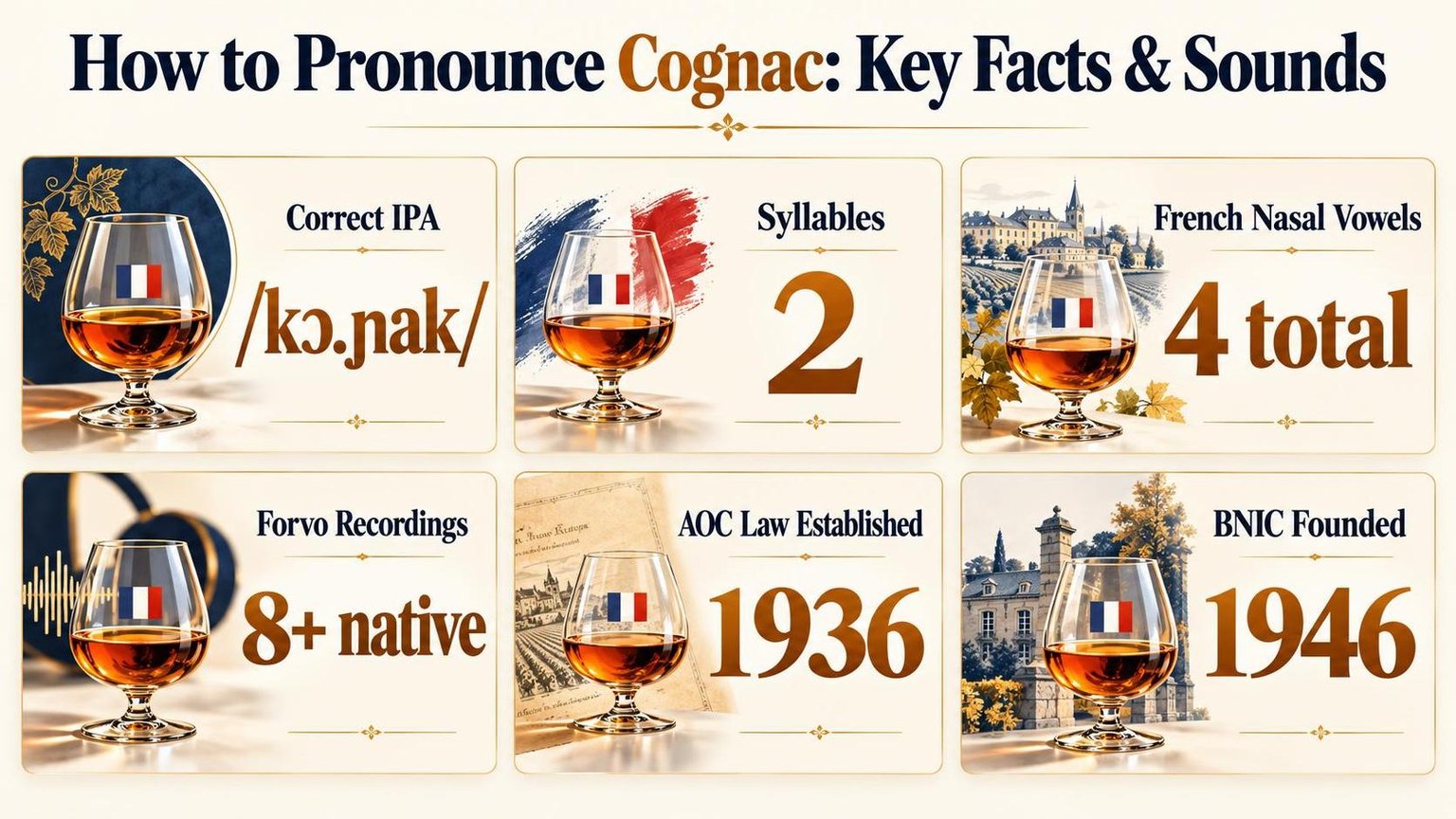
The French pronunciation of Cognac is “koh-NYAK” (IPA: /kɔ.ɲak/), with three distinct elements that differ sharply from English speech habits. The word has two syllables, not three, and the stress falls on the second syllable.

Breaking Down Each Sound
The first syllable “co” uses the open-o vowel /ɔ/, produced with rounded lips and a lower jaw position than the English “oh.” Think of the vowel in the French word corps.
The critical middle consonant is /ɲ/, the palatal nasal. This sound does not exist as a standalone phoneme in standard American English. Your tongue’s blade presses against the hard palate, not the alveolar ridge.
The final syllable “-ac” rhymes with the English word “rock,” not “ack.” The vowel is a clear, bright /a/, and the terminal /k/ is crisp and unaspirated.
Common Mispronunciations to Avoid
| Mispronunciation | IPA | Error |
| “KON-yak” | /kɒn.jæk/ | Nasalizes the first vowel; splits /ɲ/ into /n.j/ |
| “COG-nack” | /kɒɡ.næk/ | Pronounces the silent “g”; uses hard /ɡ/ |
| “koh-NYACK” | /koʊ.njæk/ | Uses English diphthong /oʊ/ instead of pure /ɔ/ |
| “koh-nyak” (flat stress) | /ko.njak/ | No stress distinction between syllables |
The “gn” Combination in French
In French orthography, “gn” consistently represents the palatal nasal /ɲ/. The “g” is never pronounced separately. This rule applies across the entire language without exception.
Other French words using this identical “gn” = /ɲ/ pattern include champagne (/ʃɑ̃.paɲ/), Bourgogne (/buʁ.ɡɔɲ/), and Charlemagne (/ʃaʁ.lə.maɲ/).
Regional French Variations
Residents of the Cognac commune in Charente, southwestern France, population roughly 19,000, pronounce the word with a slightly more open final /a/ than Parisians.
The local Poitevin-Saintongeais dialect historically influenced vowel quality in the region.
In Parisian French, speakers sometimes reduce the first vowel slightly, producing a faster, almost clipped delivery. Both regional variants maintain the /ɲ/ consonant identically.
Practical Tips for English Speakers
- Practice by saying “canyon” — the “ny” sound in the middle approximates French /ɲ/.
- Drop any nasal quality from the first vowel. Cognac contains zero nasal vowels despite appearances.
- Keep the final “k” short and dry, without the puff of air English adds to initial and stressed /k/ sounds.
- Record yourself and compare against pronunciation databases like Forvo, which hosts over 8 verified native French recordings of the word.
The Bureau National Interprofessionnel du Cognac (BNIC), governing body of the appellation since 1946, uses the standard French pronunciation in all official communications.
Adopting this pronunciation signals respect for the spirit’s protected designation of origin, established under French AOC law in 1936.
Why English Speakers Mispronounce Cognac
English speakers routinely mangle “Cognac” because French nasal vowels, silent consonants, and stress patterns have no direct equivalents in English phonology.
The result is a predictable set of errors rooted in how the English language processes borrowed words.
The Nasal Vowel Problem
French has four nasal vowels: /ɑ̃/, /ɛ̃/, /ɔ̃/, and /œ̃/. English has zero.
The final syllable of Cognac uses /ak/ in French, but the first syllable’s /kɔ/ often shifts because English speakers instinctively add a hard “g” sound that doesn’t exist in the French pronunciation.
Common English Mispronunciations vs. Correct French
| Mispronunciation | IPA | Error Type |
| “KOG-nack” | /ˈkɒɡ.næk/ | Hard “g” inserted, anglicized vowels |
| “KON-yak” | /ˈkɒn.jæk/ | Nasalized first vowel but added “y” glide |
| “ko-NYACK” | /koʊˈnjæk/ | Stress shifted to second syllable |
| Correct French | /kɔ.ɲak/ | No hard “g,” palatal nasal /ɲ/, stress on final syllable |
The Silent Letter Instinct
English borrows roughly 29% of its vocabulary from French, according to linguist Joseph M. Williams’ research. Yet English speakers habitually pronounce letters that French leaves silent or softened.
In “Cognac,” the “g” is not articulated as a separate plosive.
It combines with “n” to form /ɲ/—a palatal nasal consonant similar to the “ny” in the Italian word “gnocchi” or the Spanish “señor.”.
Stress Pattern Conflict
English typically front-loads stress on the first syllable of two-syllable words—approximately 90% of English nouns follow this pattern, per research published in the Journal of Memory and Language.
French does the opposite, placing stress on the final syllable.
This means English speakers say COG-nac while French speakers say co-GNAC. The stress difference alone changes the perceived vowel quality of both syllables.
Historical Anglicization Patterns
Cognac is far from the only French word mangled in English. The pattern is consistent across beverage terminology:
- Champagne: English adds a hard final syllable; French uses /ʃɑ̃.paɲ/
- Bordeaux: English often over-pronounces the “x”; French drops it entirely
- Pinot: English frequently sounds the “t”; French keeps it silent
- Sommelier: English adds a final “ay”; the French ending is /je/
The Merriam-Webster dictionary now lists /ˈkōn-ˌyak/ as the accepted American English pronunciation—an anglicized compromise that approximates the French without requiring mastery of /ɲ/.
Understanding these phonological gaps doesn’t just help with “Cognac.” It provides a framework for correctly approaching every French wine and spirits term you’ll encounter at the bar or in a tasting room.
Breaking Down the Syllables and Sounds
Cognac contains two syllables in both French and English pronunciation, but each language treats those syllables differently.
Understanding the exact phonetic components eliminates guesswork and builds genuine confidence when ordering at a bar or restaurant.
The Two Syllables Compared
| Element | French Original | Standard American English | Common Mispronunciation |
| Syllable 1 | kɔ (“koh”) | kɔn (“kawn”) | “cog” |
| Syllable 2 | ɲak (“nyak”) | jæk (“yak”) | “nack” |
| Full IPA | /kɔ.ɲak/ | /ˈkɒn.jæk/ | /ˈkɒɡ.næk/ |
| Stress | Second syllable | First syllable | First syllable |
First Syllable: “KON” vs. “KO”
In American English, the first syllable is pronounced “KAWN” with a nasalized vowel landing close to the “o” in “on.” The consonant is a hard /k/, never a soft “s” sound.
In French, the first syllable is shorter — a clipped “koh” where the nasal quality is subtler. The vowel sits further back in the mouth compared to the English version.
Second Syllable: The Critical “NY” Sound
The French second syllable contains a palatal nasal consonant, written /ɲ/ in the International Phonetic Alphabet. This sound exists in Italian (“gnocchi”) and Spanish (“señor”) but has no native English equivalent.
English speakers substitute /j/ (a “y” sound), producing “yak.” This approximation is universally accepted in English-speaking countries and appears in both Merriam-Webster and Oxford dictionaries.
The final consonant is always a hard /k/. Pronouncing it as a soft “ch” or dropping it entirely are the two most frequent errors among first-time speakers.
Stress Pattern Differences
French places rhythmic emphasis on the second syllable: koh-NYAK. English shifts primary stress to the first syllable: KAWN-yak. Neither pattern is wrong — each follows its language’s prosodic rules.
Vowel Quality Breakdown
| Vowel Position | French Sound | English Sound | Closest Reference Word |
| First vowel | Open-mid back rounded /ɔ/ | Open back rounded /ɒ/ | “caught” (American) |
| Second vowel | Open front unrounded /a/ | Near-open front /æ/ | “cat” |
Three Errors to Avoid
- “COG-nack” — hard “g” before the “n” breaks the syllable incorrectly and adds a sound that does not exist in the French original.
- “CON-yak” with a long “oh” — stretching the first vowel into “CONE-yak” misplaces the vowel quality entirely.
- Silent final “c” — unlike some French words, the terminal /k/ in cognac is always pronounced in both languages.
The Comité Interprofessionnel du Cognac (BNIC), the appellation’s governing body established in 1946, uses the French pronunciation /kɔ.ɲak/ in all official communications.
For English speakers, “KAWN-yak” with two clean syllables remains the standard accepted form.
Regional Variations in Pronouncing Cognac
The word “Cognac” originated in the Charente department of southwestern France, yet its pronunciation shifts dramatically across languages and regions.
At least six major language groups produce distinct phonetic renderings, each shaped by native vowel systems and consonant rules.
French Pronunciation: The Standard
In France, Cognac is pronounced /kɔ.ɲak/ — three syllables with a nasal “o,” a palatal “ny” sound, and a hard final “k.” The town’s 18,700 residents universally use this rendering.
The “gn” in French functions as a single palatal nasal consonant, identical to the sound in “champagne” or “agneau.” English speakers frequently miss this detail.
English-Language Variations
American and British English diverge noticeably. The dominant American pronunciation is /ˈkɒn.jæk/, stressing the first syllable with a short “o” and anglicized “yak” ending.
British English typically renders it /ˈkɒn.jæk/ as well, but often with a rounder “o” closer to the French original. Some British speakers drop the final “k” entirely, producing “KON-yah.”.
| Region/Language | IPA Transcription | Approximate Sound |
| France (standard) | /kɔ.ɲak/ | koh-NYAK |
| American English | /ˈkɒn.jæk/ | KON-yak |
| British English | /ˈkɒn.jæk/ | KON-yak (rounder “o”) |
| German | /ˈkɔn.jak/ | KON-yahk |
| Spanish | /koɲˈak/ | koh-NYAHK |
| Mandarin Chinese | /gān yì/ | gahn-yee (干邑) |
| Japanese | /koɲakku/ | koh-nyah-koo (コニャック) |
Key Phonetic Differences by Region
- Stress placement: French stresses the final syllable; English and German stress the first. Spanish places stress on the last syllable, aligning closer to French.
- The “gn” cluster: French, Spanish, Italian, and Japanese all preserve the palatal nasal /ɲ/. English and German substitute a simpler /nj/ sequence.
- Final consonant: The hard terminal “k” survives in most languages but gets softened or dropped in casual British English and some Australian English dialects.
- Vowel quality: Mandarin Chinese completely restructures the word into two characters — 干邑 (gān yì) — abandoning the original vowel pattern entirely. China consumed over 31 million bottles of Cognac in 2022, making this rendering commercially significant.
Which Pronunciation Is Correct?
The Bureau National Interprofessionnel du Cognac (BNIC), the official regulatory body governing the appellation since 1946, uses the French pronunciation in all formal communications.
However, no governing body polices spoken pronunciation abroad. Using your native language’s adaptation is standard practice in the global spirits industry.
Sommeliers and spirits professionals in the United States typically use the anglicized “KON-yak” in service settings.
Switching to the French /kɔ.ɲak/ signals familiarity with the spirit’s 400-year Charentais heritage without sounding affected.

Pronouncing Famous Cognac House Names
Cognac house names trip up even seasoned wine professionals because they blend French, English, and Irish origins. Mastering these pronunciations signals credibility when ordering at a bar or presenting bottles to guests.
The Big Four Houses
Four houses control roughly 90% of global Cognac sales. Each name carries distinct pronunciation rules tied to its founder’s nationality.
| House | Pronunciation | Founded | Origin of Name |
| Hennessy | HEN-eh-see | 1765 | Irish (Richard Hennessy) |
| Rémy Martin | REH-mee mar-TAN | 1724 | French |
| Martell | mar-TELL | 1715 | English (Jean Martell from Jersey) |
| Courvoisier | koor-VWAH-zee-ay | 1828 | French |
Hennessy commands about 40% of all Cognac sales worldwide. Despite its Irish roots, the brand operates entirely from the town of Cognac in the Charente department.
Prestigious and Boutique Houses
Beyond the Big Four, smaller houses produce critically acclaimed Cognacs. Their names often prove harder to pronounce because they use older French spellings.
| House | Pronunciation | Key Detail |
| Hine | HYNE (rhymes with “wine”) | Founded 1763, English origin |
| Delamain | deh-lah-MAN | Founded 1824, Grande Champagne only |
| Frapin | frah-PAN | Family estate since 1270 |
| Camus | kah-MOO | Founded 1863, largest family-owned house |
| Pierre Ferrand | pee-AIR feh-RAHN | Revived in 1989 |
| Hardy | ar-DEE | Founded 1863, silent “H” |
| Gautier | go-tee-AY | Founded 1755 |
Common Mistakes to Avoid
- Courvoisier: Never say “KUR-voh-see-er.” The French diphthong “oi” produces a “wah” sound, making it koor-VWAH-zee-ay.
- Rémy Martin: The final “n” in “Martin” is nasalized, not fully pronounced. Say mar-TAN, not mar-TIN.
- Camus: The final “s” is silent in French. Say kah-MOO, not kah-MUSS. Albert Camus the novelist shares the same pronunciation.
- Hardy: French drops the “H” entirely and stresses the second syllable: ar-DEE, not HAR-dee.
- Martell: Stress falls on the second syllable in French. Say mar-TELL, not MAR-tull.
A Practical Tip
When uncertain, default to French pronunciation rules: stress the final syllable, nasalize terminal “n” sounds, and silence trailing consonants like “s” and “x.”.
The Cognac appellation spans six designated crus across the Charente and Charente-Maritime departments. Every house sources from these same 75,000+ hectares, but each name reflects centuries of individual heritage worth pronouncing correctly.

Common Questions
How do you pronounce Cognac in English?
In American English, Cognac is pronounced KON-yak (IPA: /ˈkɒn.jæk/), with stress on the first syllable and a soft “y” sound replacing the French nasal.
British English follows a similar pattern but often renders the first vowel closer to “KON-yak” (/ˈkɒn.jæk/) with a shorter, rounder “o.” Both are universally accepted in wine bars and restaurants across the English-speaking world.
What is the correct French pronunciation of Cognac?
Native French speakers say koh-NYAK (IPA: /kɔ.ɲak/), with a nasal “o,” a palatal “gn” sound identical to the “gn” in “champignon,” and stress falling on the second syllable.
The final “c” is fully pronounced, unlike many French words where trailing consonants are silent.
Attempting the French pronunciation when ordering at a high-end establishment signals familiarity with the spirit’s origin in the Charente department of southwestern France.
Is it wrong to pronounce the “g” separately in Cognac?
Pronouncing it as “KOG-nac” with a hard “g” is the single most common mispronunciation and is considered incorrect in both English and French.
The “gn” in Cognac functions as a single consonant cluster producing a “ny” sound.
The same phoneme found in Italian words like “gnocchi” and the Spanish “ñ.” Separating the “g” from the “n” immediately marks the speaker as unfamiliar with the term.
Does Cognac rhyme with any common English words?
The closest rhyme in everyday English is “yon” + “yak”—the first syllable sounds like “kon” (rhyming with “on”).
And the second syllable rhymes with “yak.” Some speakers also compare it to the name “Konya” (the Turkish city) with a hard “k” ending.
Using these reference words helps anchor the pronunciation for first-time speakers.
How do you pronounce specific Cognac brands like Hennessy, Rémy Martin, and Courvoisier?
Hennessy is straightforward: HEN-eh-see, three syllables with stress on the first. Rémy Martin follows French rules: reh-MEE mar-TAN,.
with a nasal final syllable—not “martin” as in the English name. Courvoisier is koor-VWAH-zee-ay (IPA: /kuʁ.vwa.zje/), four syllables,.
With stress on the third—mispronouncing it as “kur-VOY-see-er” is a frequent error among English speakers.
Are the Cognac classifications VS, VSOP, and XO pronounced as letters or words?
All three are spoken as individual letters: V-S (Very Special, minimum 2 years aged), V-S-O-P (Very Superior Old Pale, minimum 4 years), and X-O (Extra Old, minimum 10 years as of the Bureau National Interprofessionnel du Cognac’s 2018 regulation).
They are never blended into single words—no one says “vee-sop” or “zoh.” Spelling them out is standard practice from Cognac houses to sommelier certification exams.
Why is Cognac capitalized, and does capitalization affect pronunciation?
Cognac is capitalized because it is an Appellation d’Origine Contrôlée (AOC), legally tied to the delimited Cognac region surrounding the town of Cognac in Charente,.
France—only brandies distilled there from approved grape varieties (primarily Ugni Blanc) may use the name.
Capitalization has no effect on pronunciation but signals a protected geographic designation, similar to Champagne or Burgundy.
Writing it lowercase (“cognac”) to refer generically to brandy is technically incorrect under EU Regulation No 110/2008 on spirit drinks.
Related Guides
- Does Hennessy Freeze?
- Is Cognac An After-Dinner Drink?
- Is Hennessy Whiskey?
- Cavasia Cognac Review – Basic Information You Must Know
- How To Drink Hennessy? 12 Powerful Tips for the Ultimate Cognac Experience
- All Alcohol Guides
- Merriam-Webster Dictionary – "Cognac" Entry (2024)
- Cambridge Dictionary – "Cognac" Pronunciation (2024)
- Bureau National Interprofessionnel du Cognac (BNIC) – Official Cognac Website (2024)
- Oxford English Dictionary – "Cognac" (2024)
- TTB – Alcohol and Tobacco Tax and Trade Bureau, U.S. Department of the Treasury – Standards of Identity for Distilled Spirits, 27 CFR 5.22 (2023)
- Cornell Law Institute – 27 CFR § 5.22 The Standards of Identity (2024)
- Yale Grammatical Diversity Project – French Loanwords in English (2024)
- National Institutes of Health / PubMed – "Chemical Composition and Sensory Properties of Cognac" (2020)
- Encyclopædia Britannica – "Cognac" (2024)
- Institut National de l'Origine et de la Qualité (INAO) – Cognac AOC Specifications (2024)