- The
- How Long Opened Champagne Lasts
- Opened Champagne deteriorates rapidly compared to still wine because dissolved CO₂ escapes the moment the cork is removed. Storage method and wine style determine whether you have hours or days before the wine becomes flat and oxidized.
General Shelf Life After Opening
The following table summarizes realistic timelines for opened Champagne stored under proper refrigeration at 37–45 °F (3–7 °C).
| Storage Method | Non-Vintage Champagne | Vintage / Prestige Cuvée |
| No stopper, refrigerated | 4–6 hours | 6–12 hours |
| Hermetic Champagne stopper, refrigerated | 1–3 days | 3–5 days |
| Left at room temperature, no stopper | 1–2 hours | 2–4 hours |
Why Vintage Champagne Lasts Longer
Vintage and prestige cuvées like Dom Pérignon or Krug Grande Cuvée undergo longer aging on lees—often 5–10 years versus the 15-month minimum for non-vintage.
Extended lees contact creates a more complex, autolytic structure that resists oxidation slightly longer after opening.
The Role of CO₂ Pressure
A freshly disgorged bottle of Champagne contains approximately 5–6 atmospheres of pressure (roughly 75–90 psi). Once the cork is removed, pressure drops immediately.
Within the first hour, an uncovered bottle can lose up to 40% of its dissolved CO₂.
A sealed Champagne stopper slows this loss dramatically. Studies from the Centre Interprofessionnel des Vins de Champagne (CIVC) confirm that a proper stopper retains meaningful effervescence for up to 48 hours under refrigeration.
Signs Your Opened Champagne Has Gone Bad
- Flat texture: No visible bubbles rising in the glass, mousse absent on the palate.
- Dulled aroma: Fresh citrus and brioche notes replaced by a stale, cardboard-like smell.
- Darkened color: Pale gold shifting toward deeper amber indicates oxidation.
- Sour or vinegary taste: Acetic acid formation signals the wine is past drinkable condition.
Maximizing Freshness
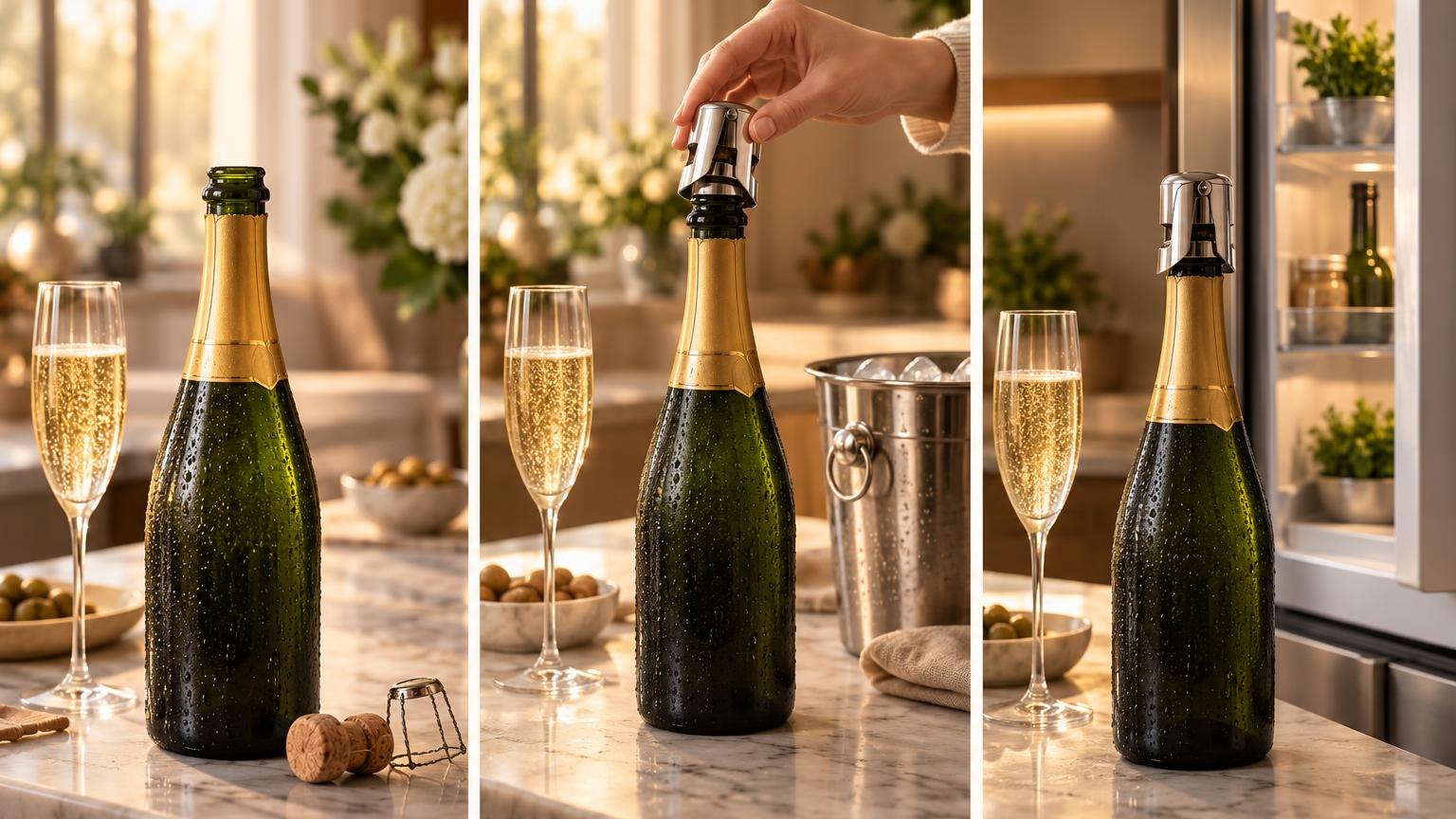
Always use a Champagne-specific stopper with a clamp mechanism—standard wine stoppers cannot withstand residual carbonation pressure. Invest in a quality stopper; reliable options cost $8–$15 and pay for themselves quickly.
Store the resealed bottle upright in the coldest part of your refrigerator. Cold temperatures (below 45 °F) slow CO₂ release and reduce oxidation rates. Keeping the bottle upright minimizes the surface area exposed to air inside the neck.
Avoid the common myth of placing a silver spoon in the bottle neck.
Controlled tests, including a widely cited 1994 study by Stanford chemist Richard Zare, found zero measurable difference in carbonation retention between the spoon method and leaving the bottle completely open.
For best results, drink opened Champagne within 24 hours. After 3 days, even properly sealed bottles lose most of their effervescence and aromatic vibrancy.
Opened Champagne Storage Time by Type
Not all Champagne loses its fizz at the same rate. The style, sugar content, and carbonation level directly determine how long an opened bottle remains drinkable. Here’s what to expect from each major category.
Storage Duration by Champagne Style
| Champagne Type | Refrigerated Shelf Life (Opened) | Key Factor |
| Non-Vintage Brut | 1–3 days | Lower pressure (~5 atm) depletes CO₂ quickly |
| Vintage Brut | 3–5 days | Complex structure holds flavor longer |
| Blanc de Blancs | 2–3 days | Delicate Chardonnay oxidizes faster |
| Blanc de Noirs | 3–4 days | Fuller body from Pinot Noir/Meunier resists breakdown |
| Rosé Champagne | 1–3 days | Skin-contact phenolics fade rapidly once exposed to air |
| Demi-Sec / Doux | 3–5 days | Residual sugar (33–50+ g/L) acts as a natural preservative |
| Prestige Cuvée | 3–5 days | Extended lees aging (6–10+ years) builds structural resilience |
Why Sweeter Styles Last Longer
Champagnes with higher dosage retain drinkability longer after opening. A Demi-Sec contains 32–50 g/L of residual sugar, which slows oxidative degradation compared to a Brut’s under-12 g/L.
Extra Brut and Zero Dosage bottlings (0–6 g/L residual sugar) are the most vulnerable. Expect noticeable flatness within 24 hours, even with a Champagne stopper.
The Role of Bottle Size
Larger formats preserve carbonation longer because the ratio of liquid volume to headspace air shifts favorably. A magnum (1.5 L) can hold fizz an extra 1–2 days beyond a standard 750 mL bottle.
Half bottles (375 mL) lose pressure fastest. Their small liquid volume means proportionally more CO₂ escapes into the headspace immediately upon opening.
Aged vs. Young Champagne
Recently disgorged Champagne with high initial pressure (~6 atmospheres) maintains carbonation better in the first 24 hours. Older bottles that have naturally lost some pressure during cellaring go flat sooner.
However, aged Champagne often develops autolytic flavors—brioche, hazelnut, honey—that remain enjoyable even after effervescence fades. Some collectors deliberately drink day-old vintage Champagne still for these qualities.
Practical Tips for Each Type
- Non-Vintage Brut: Drink within 24 hours for optimal sparkle; usable up to 3 days for cooking or mixing.
- Vintage and Prestige Cuvée: Seal with a hermetic Champagne stopper and store at 4–7 °C; sample daily to track evolution.
- Demi-Sec: The most forgiving style—still pleasant at day 4 or 5 when properly sealed and refrigerated.
- Zero Dosage: Consume the entire bottle at opening whenever possible; this style deteriorates the fastest.
Regardless of type, temperature is non-negotiable. Every opened Champagne must return to refrigeration immediately.
Warmth accelerates CO₂ loss exponentially—a bottle left at room temperature (20 °C) loses carbonation roughly twice as fast as one stored at 4 °C.
Why Champagne Loses Its Bubbles
Champagne holds approximately 49 million bubbles per bottle, sustained by roughly 5–6 atmospheres of CO₂ pressure—three times the pressure in a car tire.
Once the cork is removed, that dissolved carbon dioxide begins escaping immediately, and the clock starts ticking on freshness.
The Science of CO₂ Escape
Carbon dioxide dissolves in wine under pressure during secondary fermentation inside the bottle. A sealed 750 ml bottle contains about 5 liters of dissolved CO₂ at standard temperature and pressure.
Removing the cork eliminates the seal maintaining those 5–6 atmospheres. Dissolved CO₂ rapidly reaches equilibrium with atmospheric pressure (1 atmosphere), forcing gas out of solution as bubbles.
Research from the University of Reims Champagne-Ardenne measured that a freshly poured flute releases approximately 1 million bubbles before going flat. Each bubble nucleates at imperfections in the glass surface.
Rate of Pressure Loss After Opening
The rate at which Champagne loses carbonation depends on temperature, storage method, and whether a stopper is used. Below is a comparison of internal bottle pressure over time under different conditions.
| Time After Opening | With Hermetic Stopper (4°C) | Without Stopper (4°C) | Without Stopper (20°C) |
| 0 hours | 5–6 atm | 5–6 atm | 5–6 atm |
| 1 hour | ~4.5 atm | ~3 atm | ~2 atm |
| 4 hours | ~4 atm | ~1.5 atm | ~1 atm |
| 24 hours | ~3 atm | ~1 atm | <0.5 atm |
| 48 hours | ~2 atm | <0.5 atm | Flat |
Key Factors Accelerating Bubble Loss
- Temperature: CO₂ solubility drops as temperature rises. Champagne at 18°C loses carbonation roughly twice as fast as Champagne stored at 4°C.
- Surface area exposed: Pouring into a wide coupe glass releases CO₂ 2–3 times faster than a narrow flute, due to the larger liquid-air interface.
- Agitation: Swirling or moving the bottle creates additional nucleation sites, accelerating gas release significantly.
- Volume remaining: A half-empty bottle has more headspace, meaning more room for CO₂ to occupy above the liquid, which speeds depressurization.
Oxidation Compounds the Problem
Beyond carbonation loss, oxygen exposure triggers chemical changes. Polyphenols in the wine oxidize, dulling the bright, toasty aromas characteristic of fresh Champagne.
Gérard Liger-Belair, a physicist at the University of Reims, found that aromatic compounds in the headspace decrease by approximately 70% within 24 hours of opening without a stopper.
This oxidation also shifts the flavor profile toward bitterness and flatness, compounding the textural loss from diminished effervescence.
Both processes—CO₂ escape and oxidation—work together to degrade quality rapidly once the bottle is open.
Best Stoppers for Open Champagne
A proper Champagne stopper preserves carbonation 3–5 times longer than makeshift methods like plastic wrap or a spoon wedged in the neck.
The right seal maintains internal pressure at roughly 2–3 atmospheres, compared to the 5–6 atmospheres in an unopened bottle.
Types of Champagne Stoppers Compared
Not all stoppers perform equally. Pressure retention, ease of use, and price vary significantly across designs.
| Stopper Type | Pressure Retained After 24 Hours | Effective Duration | Typical Price (USD) |
| Hermetic lever-lock (e.g., Le Creuset, Westmark) | ~70–80% | 3–5 days | $10–$20 |
| Spring-clamp stopper (e.g., Kloveo, Moet-style) | ~60–70% | 2–4 days | $7–$15 |
| Silicone push-in stopper | ~40–50% | 1–2 days | $3–$8 |
| Original cork forced back in | ~20–30% | 12–24 hours | Free |
| Spoon-in-the-neck method | ~0% (no seal formed) | No measurable benefit | Free |
Top-Performing Stoppers
Hermetic lever-lock stoppers outperform every other category. They clamp onto the bottle lip and compress a food-grade silicone gasket against the opening, creating an airtight seal rated for pressures up to 6 bars.
- Le Creuset Champagne Crown Cap — Stainless steel body, fits standard 750 mL bottles with an 18 mm internal bore. Retails around $15.
- Westmark “Monopol” Champagne Stopper — Chrome-plated with a swing-top lever. Independent testing by German consumer group Stiftung Warentest rated it among the top sparkling wine closures.
- Kloveo Champagne Stopper — Patented spring-loaded design that adapts to slight variations in bottle-lip diameter. Averages 4.6 out of 5 stars across 10,000+ Amazon reviews.
What to Avoid
Flat wine vacuum pumps (e.g., Vacu Vin) are designed to remove air from still wine. They do the opposite of what sparkling wine needs—they actively extract dissolved CO₂, accelerating flatness.
Novelty stoppers with loose-fitting plastic caps rarely maintain more than 1 atmosphere of pressure. They may prevent spills but do almost nothing for carbonation.
Usage Tips for Maximum Retention
- Chill the bottle to 4–7 °C (39–45 °F) before sealing. Cold liquid holds dissolved CO₂ more effectively than warm liquid—solubility increases roughly 30% between 20 °C and 5 °C.
- Seal immediately after pouring. Every 10 minutes of open exposure drops internal pressure by an estimated 0.3–0.5 atmospheres.
- Store upright. A vertical position minimizes the surface area of wine exposed to the headspace gas, slowing CO₂ escape.
- Replace silicone gaskets annually. Compressed gaskets lose elasticity after approximately 100 uses or 12 months, reducing seal integrity by up to 40%.
Investing $10–$20 in a quality hermetic stopper is the single most effective step to preserve opened Champagne beyond one evening.
Signs Opened Champagne Has Spoiled
Opened Champagne deteriorates through oxidation, microbial activity, and CO₂ loss. Recognizing spoilage early prevents serving flat, off-tasting wine. The indicators fall into four sensory categories: visual, aromatic, taste, and textural.
Visual Indicators
Fresh Champagne displays a pale gold to light straw color. Spoiled bottles shift toward deeper amber or brownish-gold hues, signaling advanced oxidation. This color change can begin within 24–48 hours of opening without proper storage.
Cloudiness or haze in a previously clear pour indicates microbial contamination. Sediment floating near the surface—distinct from harmless tartrate crystals—suggests bacterial or yeast activity that has progressed beyond recovery.
Aromatic Red Flags
The nose reveals spoilage fastest. Fresh Champagne presents citrus, brioche, and green apple notes. Degraded bottles produce unmistakable off-aromas that intensify the longer the wine sits exposed.
- Vinegar or acetic acid smell: Acetobacter bacteria convert ethanol to acetic acid when oxygen exposure exceeds 24–48 hours at room temperature.
- Wet cardboard or musty odor: Indicates oxidation has broken down aromatic compounds, particularly aldehydes.
- Bruised apple or sherry-like notes: Acetaldehyde buildup from oxidation, detectable at concentrations above 100–125 mg/L.
- Sulfur or rotten egg smell: Hydrogen sulfide formation from residual yeast compounds degrading, noticeable at just 1–2 µg/L.
Taste and Texture Changes
Spoiled Champagne tastes sharply acidic, bitter, or flat. The balanced acidity of fresh Champagne (typically pH 3.0–3.1) shifts as volatile acidity rises above the acceptable threshold of 0.98 g/L acetic acid equivalent.
| Quality Marker | Fresh (Day 0) | Declining (Day 1–2) | Spoiled (Day 3+) |
| Bubble persistence | Steady, fine streams | Fewer, larger bubbles | No visible effervescence |
| CO₂ pressure (atm) | 5–6 | 2–3 | Below 1 |
| Flavor profile | Crisp, balanced fruit | Muted, slightly flat | Sour, bitter, cardboard |
| Mouthfeel | Creamy, lively | Soft, less prickle | Thin, watery, flat |
When to Discard
Champagne stored under a hermetic stopper in a refrigerator at 4–7°C remains drinkable for 3–5 days. Without a stopper, expect significant quality loss within 12–24 hours.
If two or more spoilage signs appear simultaneously—flat texture plus off-aromas, for example—discard the bottle. Spoiled Champagne poses no serious health risk, but the drinking experience offers nothing worth saving.
Trust your senses before any timeline. A bottle stored poorly for one day can taste worse than a well-sealed bottle at day four. Temperature control and airtight closure matter more than counting hours alone.
Questions Readers Ask
How long does opened Champagne last in the refrigerator?
Opened Champagne retains acceptable carbonation and flavor for 1–3 days when sealed with a hermetic Champagne stopper and stored at 4–7 °C (39–45 °F).
Non-vintage cuvées lose fizz faster than vintage Champagnes because their lower pressure (around 5 atmospheres vs. 6 at disgorgement) dissipates more quickly once the cage and cork are removed.
After 3 days, the wine is still safe to drink but will taste flat and oxidized.
Can you re-cork Champagne with the original cork?
No. A Champagne cork expands by roughly 30% within minutes of removal, making reinsertion impossible without damaging the bottle’s lip.
Use a purpose-built Champagne stopper with a clamp mechanism—stainless-steel versions from brands like Le Creuset or Kloveo create a near-airtight seal rated to hold up to 2 bars of residual pressure.
A makeshift seal with plastic wrap and a rubber band allows CO₂ to escape rapidly and is not recommended.
Does a silver spoon in the bottle keep Champagne fizzy?
No.
A widely cited 1994 study by Stanford Research Institute–affiliated scientist Harold McGee, and a 2005 replication by Interprofessional Committee of Champagne Wine (CIVC).
Both found zero measurable difference in CO₂ retention between bottles with a dangling spoon and those left open.
The myth likely persists because small-volume leftover Champagne in a cold refrigerator retains carbonation reasonably well on its own for several hours regardless of the spoon.
How can you tell if opened Champagne has gone bad?
Three reliable indicators: the absence of visible bead (continuous bubble streams) when poured, a vinegar-like or wet-cardboard aroma from acetic acid formation and oxidation, and a dull yellow-brown tint replacing the original pale gold or straw color.
If the wine smells yeasty-stale rather than fresh-bready, acetaldehyde levels have risen past the sensory threshold of approximately 100 mg/L, confirming excessive oxidation.
Does the type of Champagne affect how long it stays fresh after opening?
Yes. Vintage and prestige cuvées (e.g., Dom Pérignon, Krug Grande Cuvée) have greater extract, higher acidity, and more complex phenolic structures that buffer oxidation, often staying enjoyable for 3–5 days under a proper stopper.
Blanc de Blancs made from 100% Chardonnay oxidizes faster than Blanc de Noirs due to lower phenolic content. Demi-sec Champagne (33–50 g/L residual sugar) resists flavor degradation slightly longer because sugar masks oxidative notes.
Can you freeze leftover Champagne to preserve it?
Freezing is not recommended for later drinking because ice crystal formation at −5 °C (23 °F) ruptures dissolved CO₂ pockets, resulting in a completely flat wine upon thawing.
The liquid also expands roughly 9% when frozen, risking bottle breakage.
However, pouring leftover Champagne into ice-cube trays is a practical way to preserve it for cooking—frozen Champagne cubes work well in pan sauces, risottos, and beurre blanc for up to 3 months.
Is opened flat Champagne safe to drink?
Flat Champagne is safe to consume as long as it has been refrigerated and shows no mold or extreme vinegar smell.
Wine’s ethanol content (12–12.5% ABV for most Champagne) and low pH of 2.9–3.3 prevent pathogenic bacterial growth.
Flat Champagne can be repurposed in vinaigrettes, cocktail mixers, or as a poaching liquid for fruit—Julia Child’s classic pears poached in Champagne specifically calls for leftover flat bubbly.
Does a Champagne preservation system like Coravin work on sparkling wine?
Standard Coravin systems designed for still wine cannot be used on Champagne because the needle-through-cork method cannot withstand internal bottle pressure of 5–6 atmospheres.
Coravin released the Sparkling™ system in 2022, which uses a proprietary stopper and CO₂ cartridge to maintain up to 90% carbonation for approximately 2–4 weeks.
At roughly $100 USD plus $10 per replacement cartridge, it is the most effective consumer-grade option for extending opened Champagne’s life well beyond the typical 1–3 day window.
- How Long to Chill Champagne in Fridge?
- Best Champagne in Costco: The Ultimate 2026 Guide to Affordable Luxury
- What to Mix with Champagne Besides Orange Juice
- Dom Perignon Vs Cristal: The Easiest Way to Distinguish
- Difference Between Brut and Extra Dry Champagne
- How To Book Champagne Bar Eiffel Tower? – 12 Proven Tips for a Perfect Parisian Experience
- What Percentage Alcohol Is Champagne?
- All Alcohol Guides
- U.S. Food & Drug Administration – Food Storage Guidelines (2024)
- USDA FoodKeeper App – Wine Storage Data (2023)
- National Institutes of Health – Ethanol Oxidation and Wine Spoilage (2017)
- University of California Davis – Department of Viticulture & Enology (2022)
- Cornell University – Wine Chemistry and Oxidation (2021)
- Comité Champagne – Official Champagne Bureau Storage Recommendations (2024)
- The Wine Institute – Wine Storage and Handling Guidelines (2023)
- Decanter Magazine – How Long Does Champagne Last Once Opened? (2023)
- Wine Spectator – Storing Open Bottles of Sparkling Wine (2022)
- Journal of Agricultural and Food Chemistry – CO₂ Loss Kinetics in Sparkling Wine (2019)