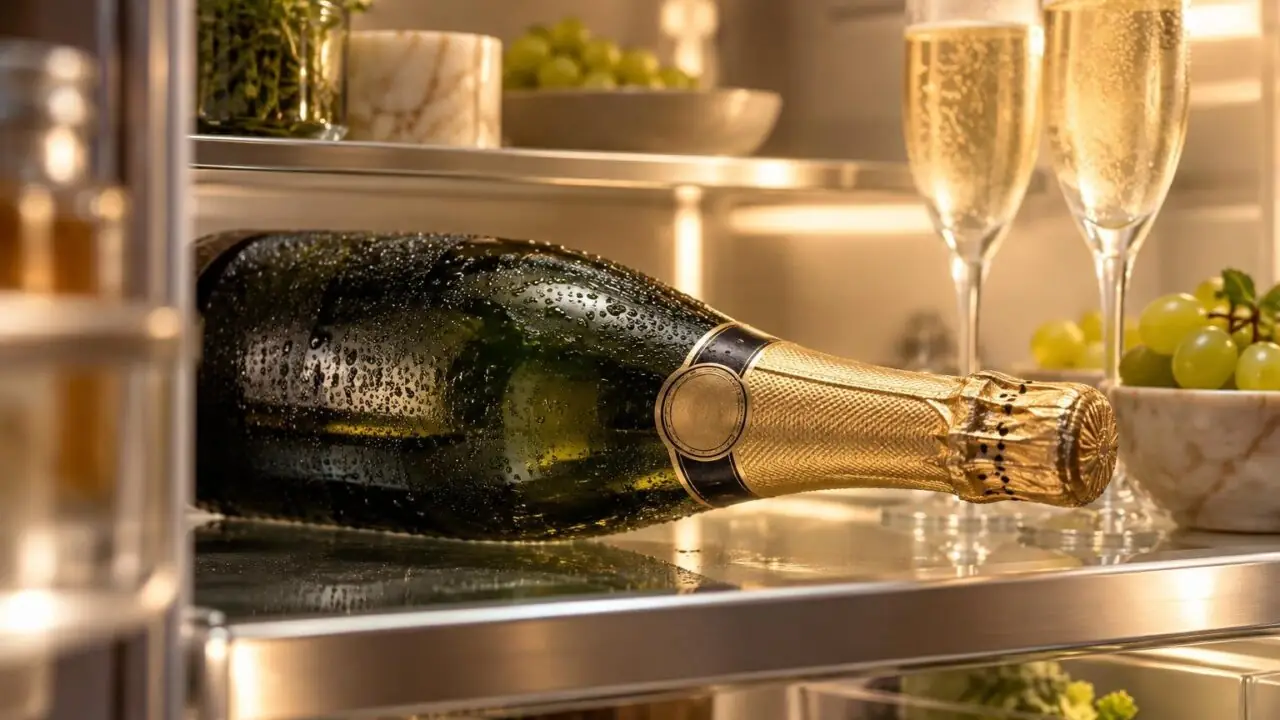
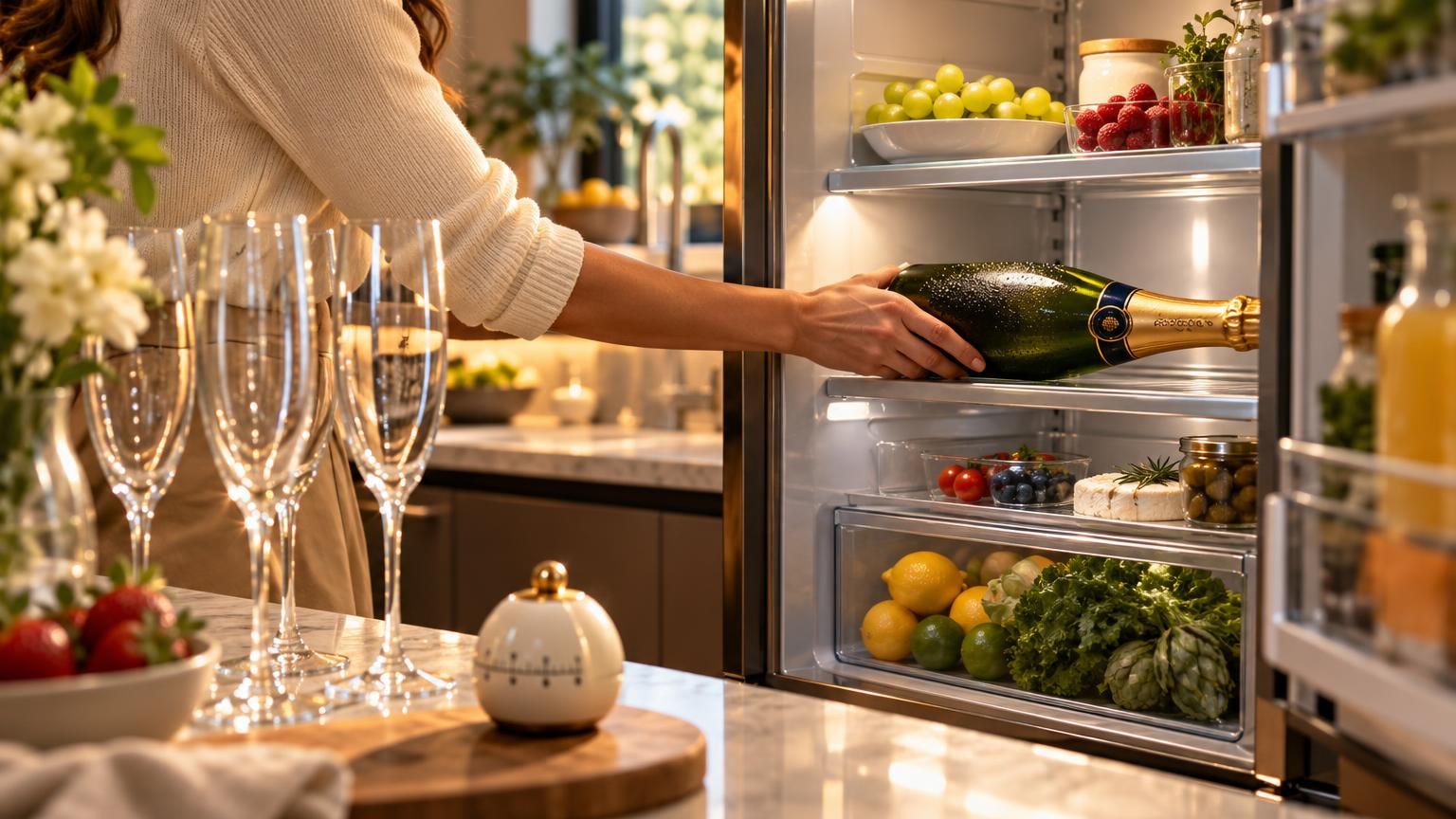
How Long to Chill Champagne in Fridge is approximately 3 hours for a standard 750-milliliter bottle placed on its side at 38–40°F.
That timing cools the wine thoroughly without relying on ice, but the starting temperature, bottle size, and refrigerator load can change the result. A bottle stored at room temperature may need longer; one already chilled needs less.
This guide compares refrigerator chilling with faster ice-bath methods, explains why the freezer can damage Champagne, and identifies the serving temperature that best preserves bubbles and aroma.
Use a timer, keep the bottle away from the refrigerator door, and check its temperature before opening. The same approach works for vintage, nonvintage, rosé, and large-format bottles, with adjusted chilling times.
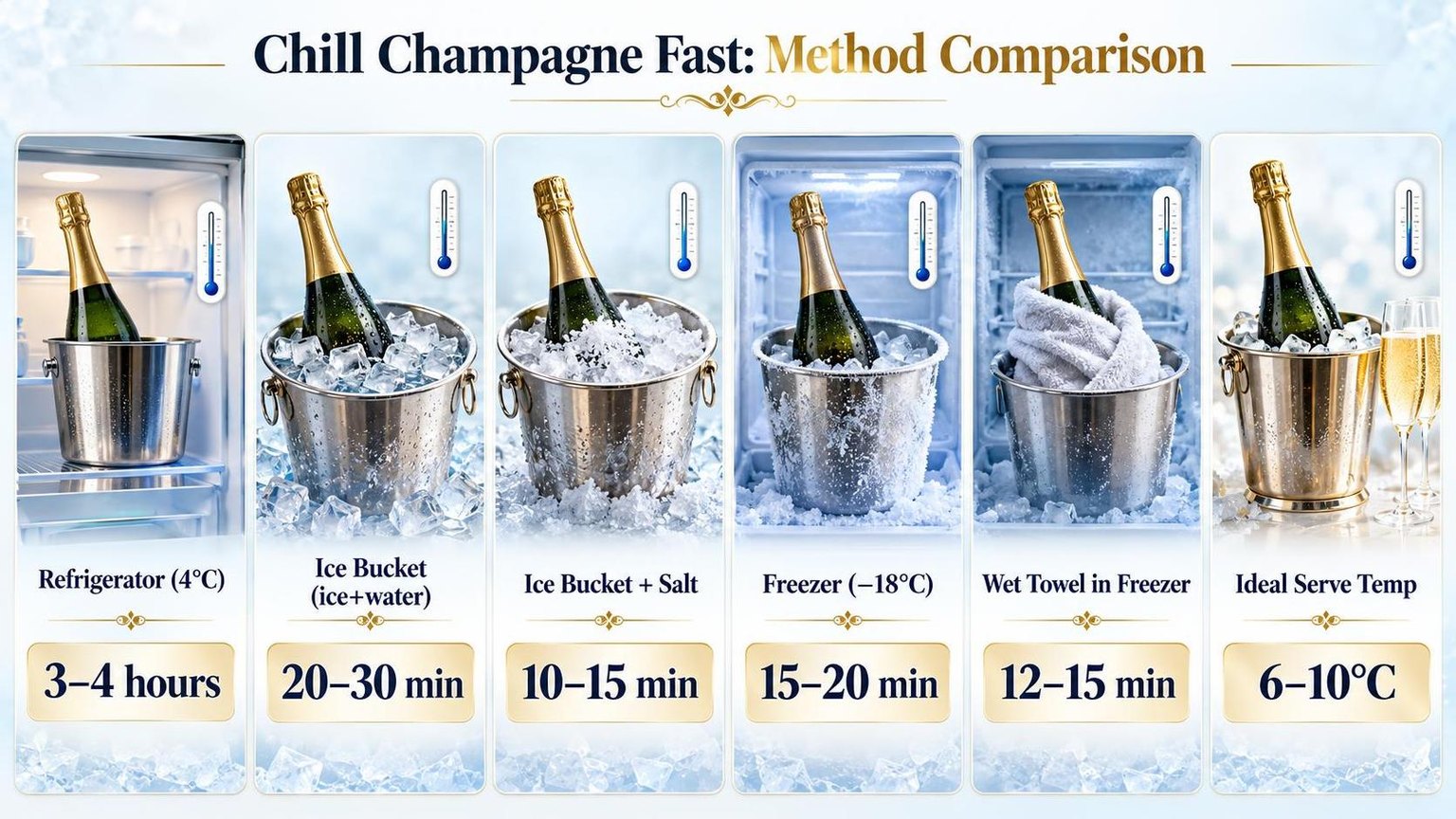
How Long Champagne Takes to Chill
Champagne’s ideal serving temperature falls between 6°C and 10°C (43–50°F), depending on style. Reaching that range from room temperature requires patience—or the right technique.
Each chilling method delivers dramatically different results.
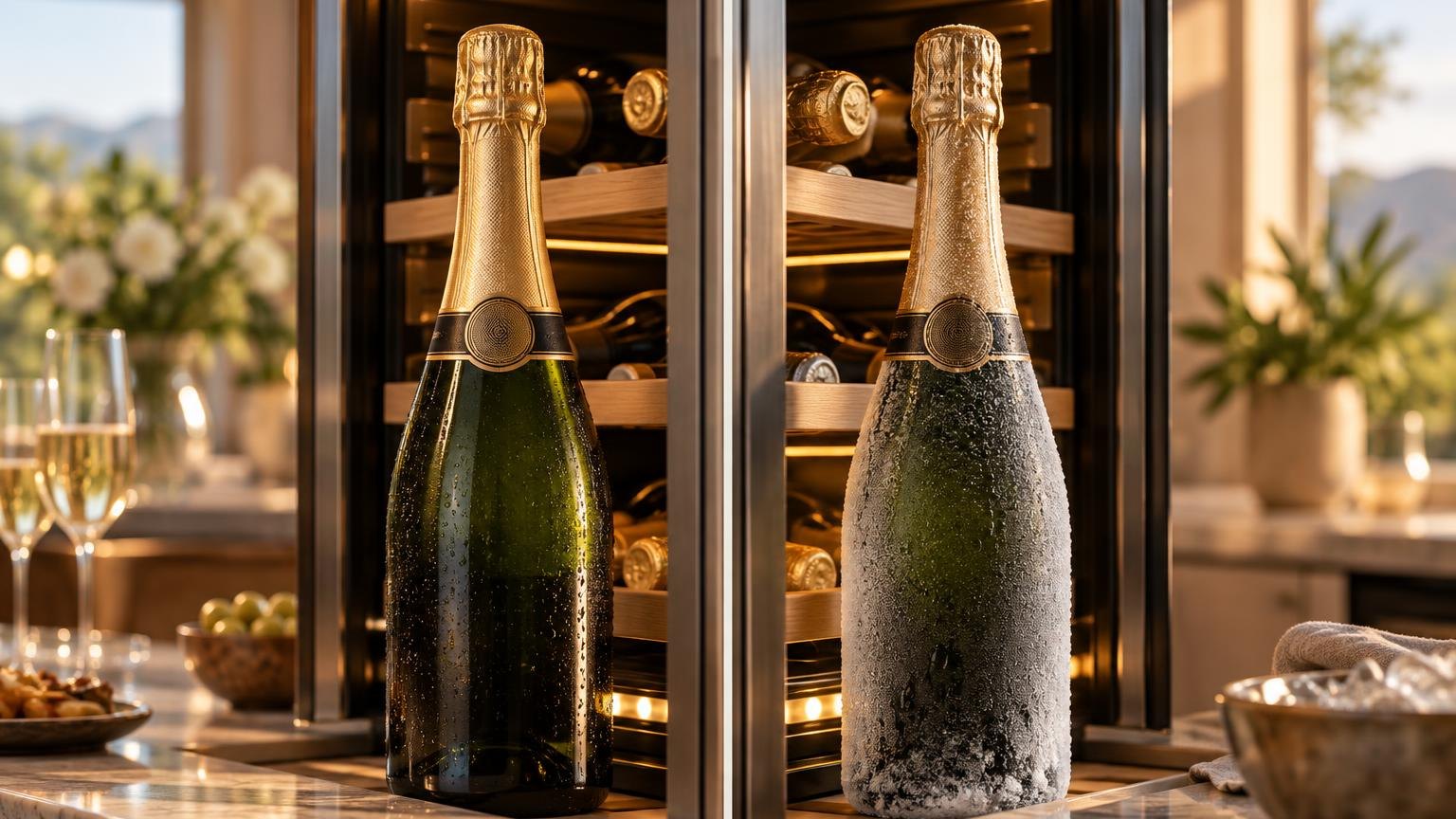
A standard 750 ml bottle stored at 20°C (68°F) room temperature needs approximately 3 to 4 hours in a refrigerator set to 4°C (39°F). Vintage and prestige cuvées benefit from the higher end of the serving range.
| Method | Time to Reach 8°C (46°F) | Best For |
| Refrigerator (4°C / 39°F) | 3–4 hours | Planned ahead, gentle chilling |
| Ice bucket (ice + water) | 20–30 minutes | Quick chill before service |
| Ice bucket + salt | 10–15 minutes | Fastest reliable method |
| Freezer (−18°C / 0°F) | 15–20 minutes | Emergency only; set a timer |
| Wet towel in freezer | 12–15 minutes | Fast hack, requires monitoring |
Refrigerator Chilling Details
Place the bottle upright on a middle shelf where airflow is consistent. The door shelf experiences temperature fluctuations of 2–5°C every time you open the fridge, slowing the process.
If the bottle starts at a cooler ambient temperature—say 15°C (59°F)—fridge time drops to roughly 2 to 2.5 hours. Conversely, a bottle stored in a warm car at 30°C (86°F) may need a full 5 hours.
Why the Ice Bucket Wins on Speed
Water conducts thermal energy approximately 25 times faster than air. An ice-water bath surrounds the entire bottle surface, transferring heat far more efficiently than cold refrigerator air circulating around it.
Fill the bucket with roughly 50% ice and 50% cold water. The bottle should be submerged up to the neck. Adding 2–3 tablespoons of salt lowers the water’s freezing point to about −6°C (21°F), accelerating chilling significantly.
Freezer Warnings
Champagne contains 5–6 atmospheres of pressure—roughly three times that of a car tire. If forgotten in a freezer, the liquid expands as it freezes, and the cork can eject violently or the glass can crack.
Never leave Champagne in a freezer longer than 30 minutes. Set a phone timer the moment you place the bottle inside. Wrapping the bottle in a damp paper towel speeds freezer chilling by increasing surface contact with cold air.
Serving Temperature by Style
| Champagne Style | Ideal Serving Temperature |
| Non-vintage Brut | 6–8°C (43–46°F) |
| Vintage / Prestige Cuvée | 8–10°C (46–50°F) |
| Rosé Champagne | 7–9°C (45–48°F) |
| Demi-Sec / Sweet | 6–7°C (43–45°F) |
Over-chilling below 4°C (39°F) mutes aromas and flattens the palate. A bottle served too cold will warm in the glass within 3–4 minutes, but those first impressions matter for tasting.
For consistent results, keep a dedicated bottle thermometer. Clip-on liquid crystal models cost under $10 and read through the glass within seconds.
Best Fridge Temperature for Champagne
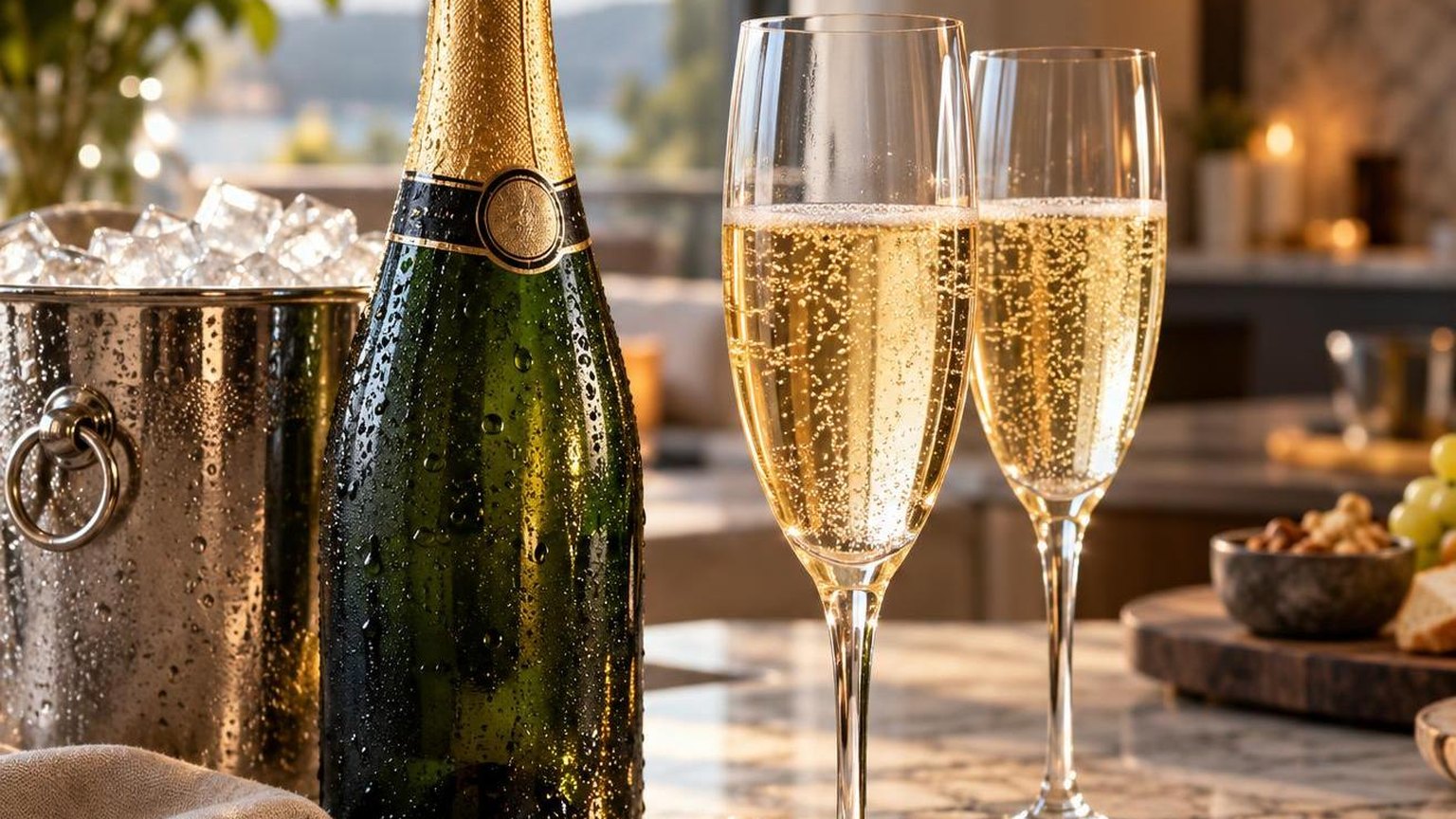
The ideal serving temperature for Champagne falls between 8°C and 10°C (46°F–50°F).
Most household refrigerators operate at 3°C to 4°C (37°F–39°F), which is colder than optimal serving temperature but perfect for chilling Champagne to the right range quickly.
Serving Temperature by Champagne Style
Different Champagne styles reach their aromatic peak at slightly different temperatures. Younger, non-vintage bottles benefit from cooler serving, while aged and vintage cuvées reveal more complexity with a degree or two of warmth.
| Champagne Style | Ideal Serving Temp (°C) | Ideal Serving Temp (°F) |
| Non-Vintage Brut | 8°C – 10°C | 46°F – 50°F |
| Vintage / Prestige Cuvée | 10°C – 12°C | 50°F – 54°F |
| Rosé Champagne | 8°C – 10°C | 46°F – 50°F |
| Demi-Sec (Sweet) | 6°C – 8°C | 43°F – 46°F |
| Blanc de Blancs | 8°C – 10°C | 46°F – 50°F |
Why Standard Fridge Temperature Works
A refrigerator set to 3°C–4°C chills Champagne below serving temperature. This deliberate over-chilling accounts for the 2°C–3°C rise that occurs within minutes of pouring into a glass at room temperature.
The Comité Champagne — the official trade body for the Champagne appellation — recommends removing the bottle from the fridge and letting it rest 2–3 minutes before pouring to reach the sweet spot.
What Happens at the Wrong Temperature
Temperature directly affects CO₂ release, aroma perception, and mouthfeel. Serving too cold or too warm degrades the drinking experience in measurable ways.
- Below 6°C (43°F): Aromas become muted. The tongue’s taste receptors are less sensitive at low temperatures, suppressing fruit and brioche notes. Carbonation feels aggressive and prickly.
- Above 12°C (54°F): CO₂ escapes rapidly, producing excessive foam and a flat texture within minutes. Alcohol becomes more perceptible, creating a harsh, unbalanced impression.
- Above 15°C (59°F): The wine loses its refreshing quality entirely. Volatile acidity and alcohol dominate the nose. Pressure inside the bottle increases, raising the risk of a forceful cork release.
Fridge Placement Matters
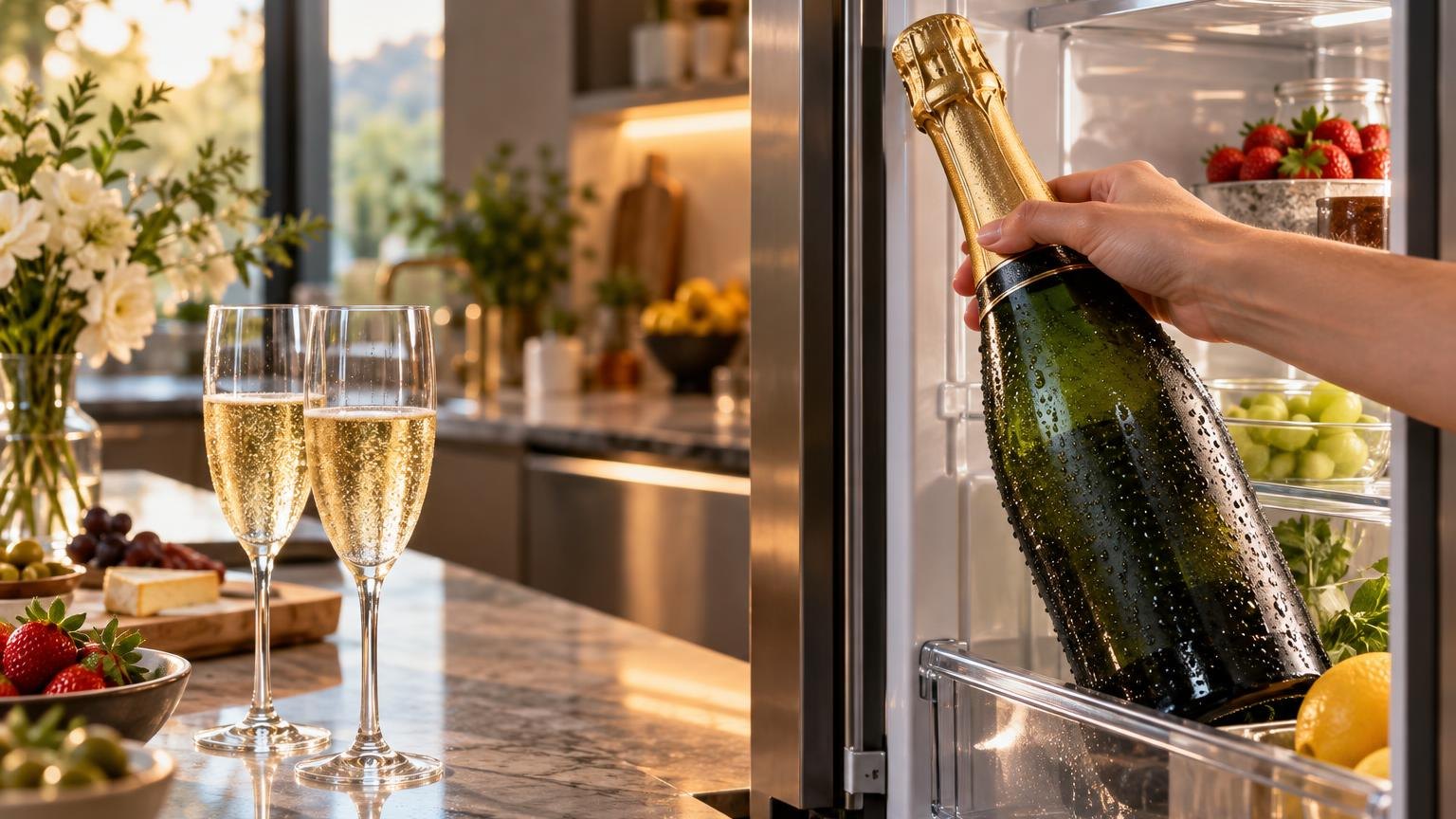
Place Champagne in the coldest zone of your refrigerator — typically the bottom shelf near the back wall. Door shelves fluctuate 2°C–5°C every time the door opens, making them the least stable location.
If your fridge has a dedicated beverage or wine compartment adjustable to 8°C–10°C, store Champagne there for ready-to-serve convenience.
Otherwise, the main compartment at 3°C–4°C with a brief rest before pouring remains the most reliable approach for consistent results every time.
Chilling Champagne From Room Temperature
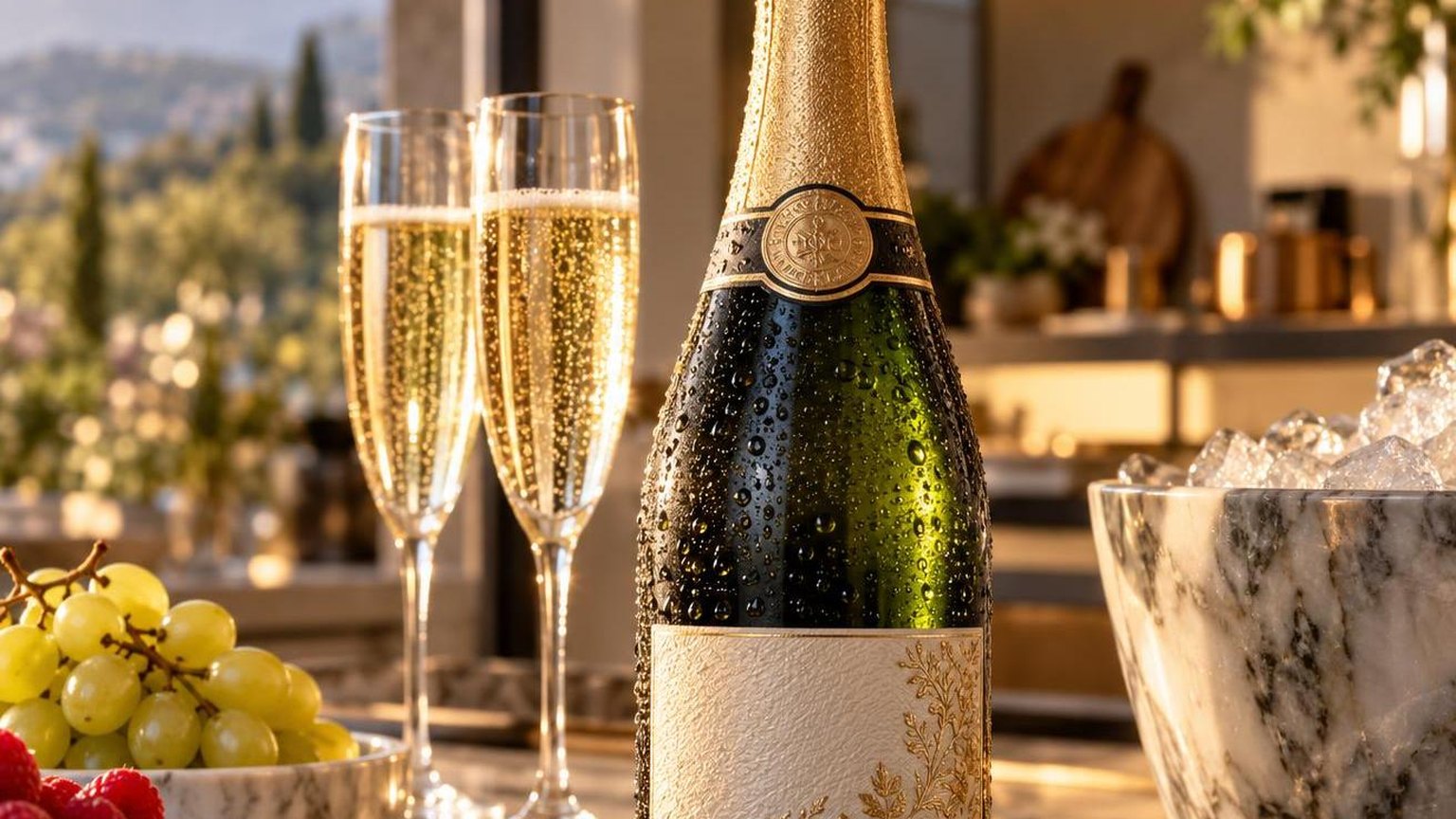
Room temperature champagne—typically 68–72°F (20–22°C)—needs to drop roughly 25–30°F to reach the ideal serving range of 43–48°F (6–9°C).
A standard refrigerator set to 37–40°F (3–4°C) accomplishes this in approximately 3 to 4 hours.
The timeline depends on bottle size, starting temperature, and refrigerator efficiency. A 750 ml bottle at 70°F placed in a 38°F fridge reaches 47°F in about 3 hours and 43°F closer to 3.5–4 hours.
Estimated Chill Times by Bottle Size
| Bottle Size | Starting Temp | Time to 47°F (8°C) | Time to 43°F (6°C) |
| 375 ml (Half Bottle) | 70°F (21°C) | ~2 hours | ~2.5 hours |
| 750 ml (Standard) | 70°F (21°C) | ~3 hours | ~3.5–4 hours |
| 1.5 L (Magnum) | 70°F (21°C) | ~4.5 hours | ~5–5.5 hours |
These estimates assume the bottle is placed upright in the main compartment—not in a door shelf, where temperatures fluctuate 5–10°F more with each opening.
Why Position and Placement Matter
Laying the bottle on its side increases the surface area of liquid contacting the cold glass wall, potentially shaving 15–20 minutes off chill time versus standing upright.
Place the bottle in the coldest zone of your fridge, usually the back of the lowest shelf. Avoid the door compartment entirely; repeated opening exposes the bottle to warm air surges.
Faster Alternatives When Time Is Short
- Ice-water bath: Submerge the bottle in a bucket filled with equal parts ice and cold water plus 2–3 tablespoons of salt. This chills a 750 ml bottle from 70°F to 43°F in 20–25 minutes—roughly 10× faster than the fridge alone.
- Freezer method: A 750 ml bottle reaches serving temperature in about 25–30 minutes in a standard freezer at 0°F (−18°C). Set a timer; champagne freezes near 15°F (−9°C), and a forgotten bottle can explode under 6 atmospheres of internal pressure.
- Wet towel wrap: Wrapping the bottle in a damp paper towel before placing it in the freezer accelerates evaporative cooling, cutting time to roughly 15–20 minutes.
Signs Your Champagne Is Properly Chilled
Touch the bottle’s neck—it should feel distinctly cold, not just cool. Condensation forming evenly across the glass surface indicates the wine has reached approximately 45–48°F.
An instant-read thermometer inserted after pouring provides the most reliable reading. Champagne served at 43–48°F delivers tighter, more persistent bubbles and cleaner acidity than wine poured even 5°F warmer.
Planning ahead eliminates all guesswork. Place your champagne in the refrigerator 4 hours before serving and it will land squarely in the optimal range—no rushing, no risk of freezing.
How to Chill Champagne Faster
A standard refrigerator takes 3–4 hours to chill Champagne to the ideal 45–48°F (7–9°C) serving temperature.
When time is short, several proven methods cut that window dramatically without compromising the wine’s quality or carbonation.
Ice-Water Bath: The Gold Standard
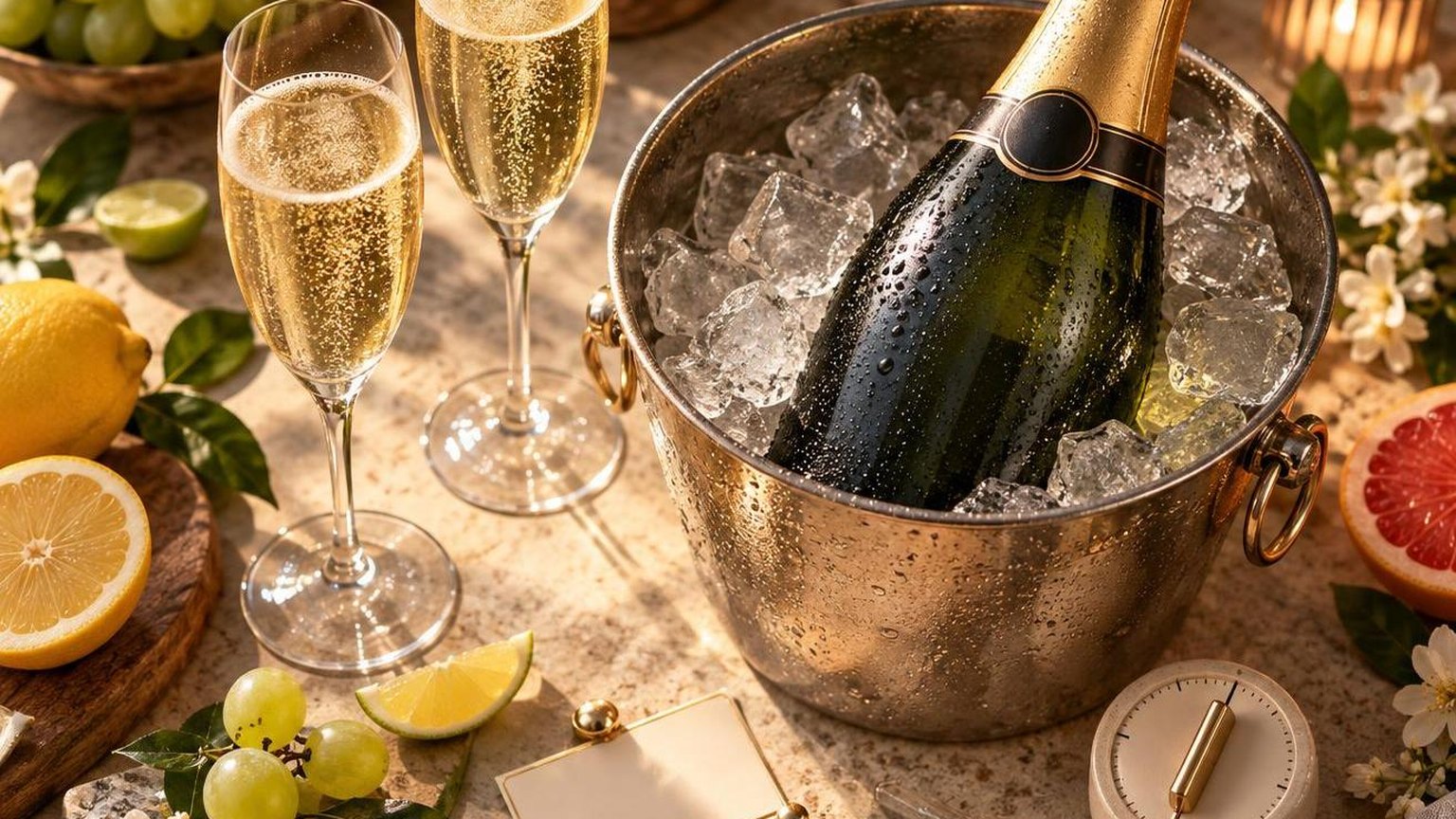
Submerge the bottle in a bucket filled with equal parts ice and cold water. This method chills a room-temperature bottle to serving temperature in 20–30 minutes—roughly 8× faster than a refrigerator alone.
Water is the key ingredient. Ice alone creates air pockets that insulate the glass. Water fills those gaps and conducts thermal energy 25× more efficiently than air, maintaining full contact with the bottle surface.
Add 2–3 tablespoons of kosher salt to lower the water’s freezing point by approximately 5–6°F, accelerating heat transfer. A salted ice bath can reach proper serving temperature in as little as 15 minutes.
Wet Towel–Freezer Method
Wrap the bottle in a damp kitchen towel and place it in the freezer. Evaporative cooling plus direct cold contact brings the temperature down in roughly 15–20 minutes. Set a timer—never leave Champagne in the freezer beyond 30 minutes.
Frozen Champagne expands and can crack the bottle or push the cork out violently. At approximately 15°F (−9°C), the liquid begins to freeze, risking shattered glass and wasted wine.
Method Comparison
| Method | Time to 45–48°F | Risk Level |
| Refrigerator (35–38°F) | 3–4 hours | None |
| Ice-water bath | 20–30 minutes | None |
| Salted ice-water bath | 15 minutes | None |
| Damp towel in freezer | 15–20 minutes | Moderate (if forgotten) |
| Freezer alone | 25–40 minutes | High (breakage) |
What to Avoid
- Chilling in the freezer overnight. A 750 mL bottle under 6 atmospheres of pressure becomes a genuine safety hazard when frozen.
- Adding ice cubes directly to the glass. Dilution destroys the carefully calibrated dosage and flattens carbonation within minutes.
- Rapid temperature swings. Moving a bottle from a hot car trunk (potentially 130°F+) straight into a salted ice bath can stress the glass. Let it rest at room temperature for 10 minutes first.
Maintaining Temperature at the Table
Once chilled, Champagne warms approximately 2°F per minute in a 72°F room. Return the bottle to an ice bucket between pours. A vacuum-insulated wine chiller sleeve holds temperature for up to 2 hours without ice.
Proper chilling preserves the fine, persistent bead that distinguishes quality Champagne. Serving even 5°F too warm releases CO₂ too quickly, producing aggressive mousse and muting delicate aromas of brioche and citrus.
When Champagne Is Cold Enough
Champagne reaches its ideal serving temperature between 45°F and 50°F (7–10°C). Below that range, cold numbs the palate and suppresses aromatic complexity. Above it, the wine loses effervescence faster and alcohol dominates the finish.
Target Temperatures by Champagne Style
Different styles of Champagne perform best at slightly different temperatures. The Comité Champagne provides specific guidance based on the wine’s age and complexity.
| Champagne Style | Ideal Temp °F | Ideal Temp °C | Fridge Time from 70°F |
| Non-vintage Brut | 45–47°F | 7–8°C | 3–3.5 hours |
| Rosé Champagne | 46–50°F | 8–10°C | 2.5–3 hours |
| Blanc de Blancs | 46–48°F | 8–9°C | 3–3.5 hours |
| Vintage / Prestige Cuvée | 50–54°F | 10–12°C | 2–2.5 hours |
| Demi-Sec (sweet) | 43–46°F | 6–8°C | 3.5–4 hours |
Vintage and prestige cuvées like Dom Pérignon or Krug Grande Cuvée benefit from a warmer pour. Extra temperature lets their developed secondary aromas—brioche, toasted almond, honey—express fully.
How to Check the Temperature
An instant-read kitchen thermometer inserted into a poured glass gives a reading within 3–5 seconds. This is the most reliable method short of an infrared thermometer aimed at the bottle surface.
Without a thermometer, use the touch test. Hold the bottle by the neck for 5 seconds. If the glass feels distinctly cold but not painfully so, it is near 47–50°F. A bottle that stings the palm is likely below 40°F—too cold.
Signs Champagne Is Properly Chilled
- Condensation forms evenly on the bottle within 10 seconds of leaving the fridge.
- Bubbles in the glass are fine and persistent, rising in steady streams rather than erupting in large clusters.
- The first sip reveals citrus and mineral notes before toasty or yeasty depth emerges as the wine warms 2–3°F in the glass.
- The mousse (foam) feels creamy, not aggressive, on the tongue.
What Happens Outside the Range
Champagne served below 40°F (4°C) loses approximately 60% of its aromatic volatiles, according to research published in the Proceedings of the National Academy of Sciences (2012). Flavors flatten, and CO₂ release slows dramatically.
Champagne above 54°F (12°C) releases CO₂ too rapidly. Internal pressure—normally around 5–6 atmospheres at proper temperature—pushes gas out faster in warm conditions.
The result is an aggressive, foamy pour and a flat glass within minutes.
A well-chilled bottle holds its effervescence for 15–20 minutes in the glass. A warm bottle may go flat in under 8 minutes. Keeping the bottle in an ice bucket between pours maintains temperature within a 2°F drift over 30 minutes.
Questions Readers Ask
How long does it take to chill Champagne in a standard refrigerator?
A full 750 ml bottle of Champagne needs approximately 3 to 4 hours in a refrigerator set to 35–38 °F (2–3 °C) to reach the ideal serving temperature of 47–50 °F (8–10 °C).
Starting from room temperature around 70 °F (21 °C), the thick glass of a Champagne bottle insulates the wine and slows cooling compared to still-wine bottles.
Placing the bottle in the coldest part of the fridge—typically the back of the lowest shelf—can shave off roughly 20–30 minutes.
Can I chill Champagne faster using an ice bucket instead of the fridge?
An ice-water bath (half ice, half cold water, plus a tablespoon of salt) chills a bottle of Champagne to serving temperature in just 15 to 20 minutes, roughly 10 times faster than a refrigerator.
The water makes full contact with the glass surface, transferring heat far more efficiently than cold air circulating in a fridge. The Comité Champagne recommends this method for quick, even chilling without risking the wine.
Is it safe to put Champagne in the freezer for rapid chilling?
You can place Champagne in the freezer for a quick chill of about 15 to 20 minutes, but never exceed 30 minutes.
Champagne freezes at approximately 15 °F (−9 °C), and because the bottle holds roughly 6 atmospheres of pressure, a frozen bottle can explode, causing serious injury and damage. Set a timer every time you use this method.
What is the ideal serving temperature for Champagne?
Most Champagne houses, including Krug and Moët & Chandon, recommend serving non-vintage Champagne at 47–50 °F (8–10 °C) and vintage or prestige cuvées slightly warmer at 50–54 °F (10–12 °C).
Serving too cold—below 43 °F (6 °C)—mutes the aromas and flavor complexity. A wine thermometer inserted into the neck after pouring is the most reliable way to verify the temperature.
Can I store Champagne in the fridge long-term before serving?
Storing Champagne in a standard refrigerator for more than 3 to 4 days is generally discouraged because the low humidity (typically around 30–40%) can dry out the cork, allowing air ingress that degrades the wine.
Vibration from the compressor motor also disturbs the sediment over time.
For long-term storage, keep bottles horizontally in a dark cellar or wine fridge at 50–55 °F (10–13 °C) with 70% humidity, and transfer to the regular fridge only 3–4 hours before serving.
Does bottle size affect how long Champagne takes to chill?
Bottle size has a significant impact: a 375 ml half-bottle reaches serving temperature in roughly 2 to 2.5 hours in the fridge, while a 1.5-liter magnum requires 5 to 6 hours due to its greater thermal mass.
A 3-liter Jeroboam can take 7 hours or more. For larger formats, an oversized ice bucket with the ice-water-salt method remains the most practical approach, cutting chill time to approximately 30–40 minutes for a magnum.
How long does Champagne stay cold once removed from the fridge?
An opened bottle of Champagne warms by roughly 2 °F per 5 minutes at a 70 °F room temperature, meaning it exits the ideal drinking range within about 15 to 20 minutes on a countertop.
Using an insulated wine cooler sleeve maintains temperature for up to 2 hours without ice.
Alternatively, return the bottle to an ice bucket between pours—this keeps the Champagne within the 47–50 °F sweet spot throughout an entire meal service.
Related Reading
- Brut Vs Extra Dry Champagne: The Easiest Way to Distinguish
- How To Box Chocolate Covered Strawberries And Champagne? The Ultimate Elegant Gift Guide (Step-by-Step Tutorial)
- Best Champagne in Costco: The Ultimate 2026 Guide to Affordable Luxury
- How Many Calories Are in a Glass of Sparkling Wine?
- How Many Ounces Champagne Flute?
- How Long Does Moet Champagne Last Unopened? – A Real-World, Experience-Based Guide to Shelf Life, Storage, and Quality (2026 Update)
- How Many Calories In A Bottle Of Champagne 750Ml? The Surprising Truth You Need to Know (Complete Guide)
- All Alcohol Guides
- USDA Food Safety and Inspection Service – Refrigerator & Freezer Storage Chart (2023)
- FDA – Are You Storing Food Safely? (2023)
- University of California, Davis – Viticulture & Enology: Wine Storage and Service Temperatures (2022)
- National Center for Biotechnology Information / PubMed – Effect of Temperature on Carbon Dioxide Solubility and Bubble Nucleation in Champagne (2009)
- Cornell University, College of Agriculture – Wine Serving Temperature Guidelines (2021)
- Comité Champagne / CIVC – Official Champagne Bureau: How to Serve Champagne (2024)
- The Wine Institute – Wine Storage and Serving Best Practices (2023)