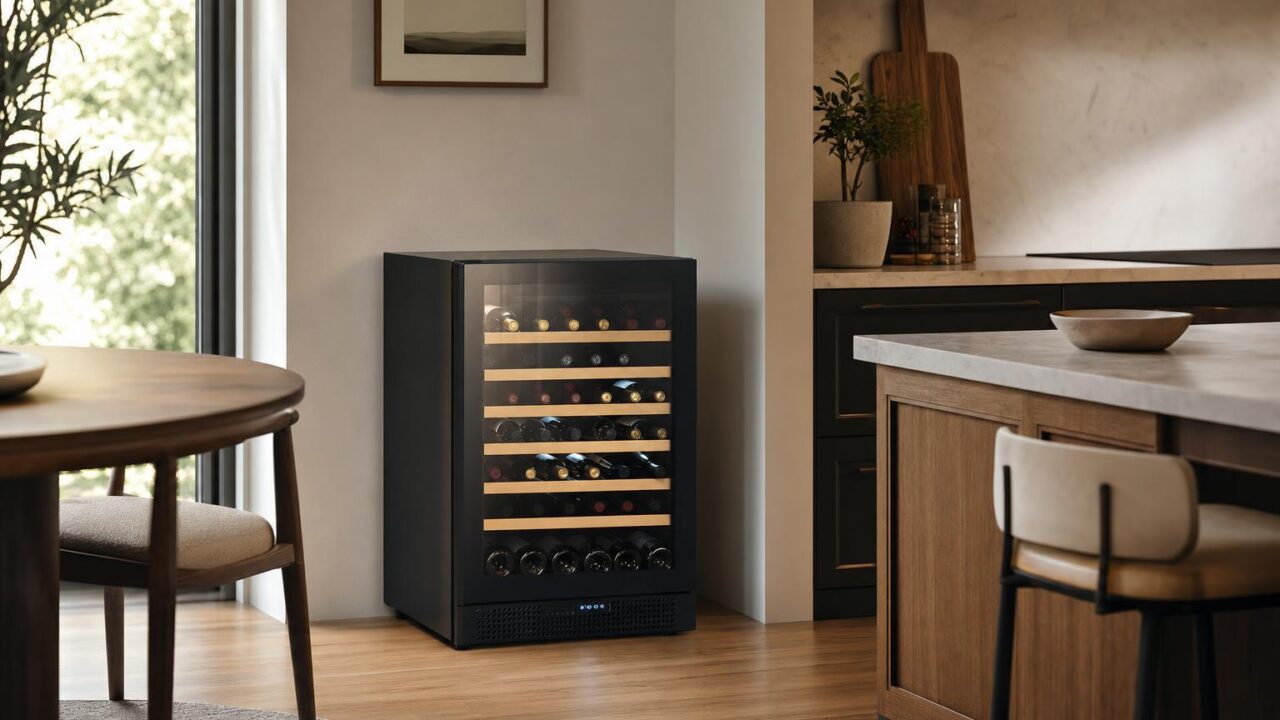
Where to put a freestanding wine cooler is on a level, indoor floor with open air around the rear, sides, and top for heat exhaust.
Most brands specify at least 2–6 inches of clearance, especially behind the unit, because freestanding coolers vent heat differently than built-in models.
Choose a spot away from ovens, dishwashers, sunny windows, garages, and tight cabinets.
A dining room, pantry, home bar, or temperature-stable hallway usually works well if the outlet is grounded, the floor is sturdy, and the cooler’s door can open fully without blocking traffic.
Why Placement Matters Most
Placement is mostly a heat-management problem. A freestanding wine cooler needs enough surrounding air, a stable room temperature, and a level surface so the compressor can remove heat without running continuously.
| Placement number | What it means in practice |
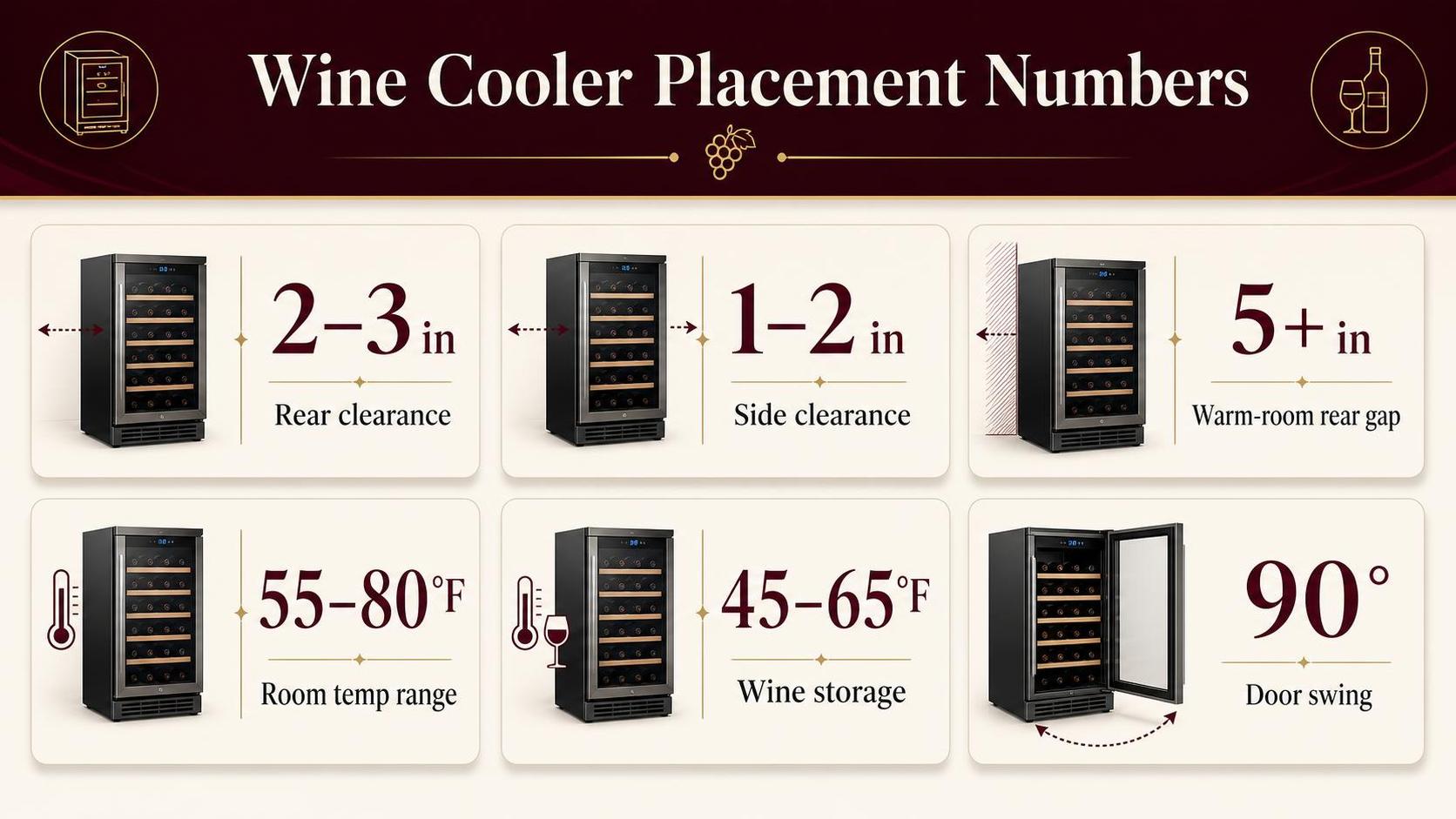
| 2–3 inches | Minimum open space behind most freestanding wine coolers so warm condenser air can escape. |
| 1–2 inches | Recommended side clearance unless the manufacturer specifies more. |
| 5 inches or more | Safer rear clearance in garages, closets, or warmer rooms where heat builds up faster. |
| 55°F–80°F | Typical ambient room-temperature range many residential wine coolers are designed to operate in. |
| 45°F–65°F | Normal wine storage target range; 55°F is the common long-term cellaring benchmark. |
Do not install a freestanding unit flush inside cabinetry unless its manual explicitly allows it. Most freestanding models vent heat from the rear or sides, unlike built-in units that usually front-vent through a grille.
Clearance matters more than looks
The U.S. Department of Energy explains that refrigerators reject heat to the surrounding room. If the cooler is boxed in, the compressor runs longer, temperatures fluctuate more, and electricity use rises.
- Behind the cooler: leave at least 2–3 inches, and more if the rear coils or compressor area feel warm during operation.
- Beside walls or furniture: leave 1–2 inches so side panels can shed heat and the door can open fully.
- Above the cooler: avoid tight shelves directly over the unit; warm air rises and needs an exit path.
Room temperature sets the limit
| Location | Typical risk | Better choice? |
| Interior dining room | Stable temperature, low vibration | Yes |
| Kitchen next to oven | Heat spikes above normal room temperature | No |
| Garage | Often below 55°F or above 80°F | Only if the cooler is garage-rated |
| Closet | Poor ventilation and trapped heat | No, unless actively ventilated |
Keep the cooler out of direct sun. A south- or west-facing window can raise cabinet temperature noticeably, forcing the thermostat and compressor to cycle more often.
Level, distance, and power
Place the cooler on a level floor; many manufacturers recommend leveling front-to-back and side-to-side before loading bottles. An unlevel cabinet can cause door-seal gaps, vibration, and drainage problems.
- Use a dedicated grounded outlet: avoid extension cords, which appliance manuals commonly prohibit because of voltage drop and overheating risk.
- Leave door swing space: many racks require the door to open at least 90 degrees for bottle access.
- Reduce vibration: keep the cooler away from washers, dryers, subwoofers, and high-traffic doorways.
What Placement Affects
Placement changes how hard a freestanding wine cooler works, how steady the bottle temperature stays, and how long the compressor lasts.
The biggest variables are ventilation clearance, room temperature, sunlight, floor stability, and proximity to heat-producing appliances.
Unlike built-in units, most freestanding wine coolers vent heat from the back and sides. Blocking that heat path can raise compressor run time, create hot spots, and make a 55°F wine setting less stable.
Clearance and airflow
Always follow the manufacturer’s manual first, but common freestanding guidance is several inches of open space around the cabinet. Rear clearance matters most because condenser heat usually exits behind the unit.
| Placement factor | Practical target | Why it matters |
| Rear clearance | At least 2 to 3 inches unless the manual says more | Allows condenser heat to dissipate |
| Side clearance | At least 1 to 2 inches on each side | Prevents heat buildup around the cabinet |
| Top clearance | At least 2 inches | Helps warm air rise away from the unit |
| Room temperature | Usually 60°F to 80°F is ideal | Reduces compressor strain and temperature swings |
Ambient temperature
Wine coolers are rated for indoor conditions, not garages that swing from winter cold to summer heat.
Many consumer wine refrigerators are designed around normal room temperatures near 70°F, similar to how household refrigeration equipment is tested by Energy Star and DOE procedures.
If the room often exceeds 85°F, the unit may struggle to maintain 45°F to 65°F storage zones. If the room drops below the set temperature, single-zone units may stop cooling and allow wine temperature to drift.
Heat, light, and vibration
- Avoid ovens, dishwashers, radiators, and sunny windows. Direct sun can warm the cabinet surface well above room temperature, especially through glass doors.
- Keep it off soft flooring. Carpet can restrict lower airflow and make leveling harder.
- Level the cooler. A tilted cabinet can cause door-seal gaps, vibration, and noisier compressor cycling.
- Leave room for the door swing. Many shelves need the door opened beyond 90 degrees to slide out fully.
Electrical access
Use a grounded 120-volt outlet and avoid extension cords unless the manufacturer explicitly allows one.
Most wine coolers draw modest running power, but startup current is higher, so a loose or overloaded outlet can create nuisance trips or heat at the plug.
How to Measure and Confirm Fit
Measure the cooler, the air space around it, and the actual room conditions before you decide where it goes.
A freestanding wine cooler is verified for placement by confirming ventilation clearance, level installation, outlet suitability, and stable ambient temperature.
Do not rely only on the product’s listed width. Manufacturers commonly publish cabinet dimensions without allowing for door swing, rear plug depth, hinge overhang, or the clearance needed for warm air to escape.
Measurements to Take Before Placement
| Item to measure | How to verify it | Practical target |
| Cooler width, depth, height | Measure the physical unit with a tape measure, including hinge and handle projection | Match against the available floor footprint, not just the appliance spec sheet |
| Rear clearance | Measure from the rear panel or coils to the wall | At least 2 inches unless the manual states more |
| Side clearance | Measure both sides after positioning | Commonly 1 to 3 inches for freestanding models |
| Top clearance | Measure from the top of the cooler to the underside of a counter, shelf, or cabinet | At least 2 to 6 inches, depending on the manufacturer |
| Door swing | Open the door fully and measure obstruction points | Enough clearance to pull shelves out without hitting a wall or cabinet |
Use the owner’s manual as the controlling source.
For example, many freestanding compressor wine coolers require open space at the back and sides because heat is rejected through rear or side panels, unlike built-in units with front ventilation.
- Check floor level: Place a 24-inch level on top of the cooler, front-to-back and side-to-side. Adjust the feet until the bubble is centered, which helps the door seal evenly.
- Verify outlet location: The unit should plug directly into a grounded 120-volt outlet in the United States. Avoid extension cords, which appliance manufacturers commonly prohibit because of voltage drop and overheating risk.
- Measure ambient temperature: Use a room thermometer for 24 hours. Most wine coolers perform best in a conditioned indoor space, commonly around 60°F to 80°F.
- Confirm heat sources: Measure distance from ovens, dishwashers, radiators, sunny windows, and HVAC registers. Keep the cooler away from locations with repeated heat spikes.
Verification After Installation
| Check | When to verify | Pass condition |
| Interior temperature | After 12 to 24 hours powered on and loaded lightly | Within about 2°F to 3°F of the set point, using a separate refrigerator thermometer |
| Ventilation | After the compressor has run for 30 minutes | Warm air can escape freely; side or rear panels are warm but not trapped in a closed cavity |
| Door seal | Immediately after leveling | A dollar bill held in the closed door has light resistance when pulled |
| Noise and vibration | During compressor cycling | No rattling against walls, cabinets, baseboards, or flooring transitions |
Final placement is acceptable only if the cooler holds temperature without extended compressor cycling. If the surrounding space feels hot, the unit is too tight to the wall, cabinet, or appliance beside it.
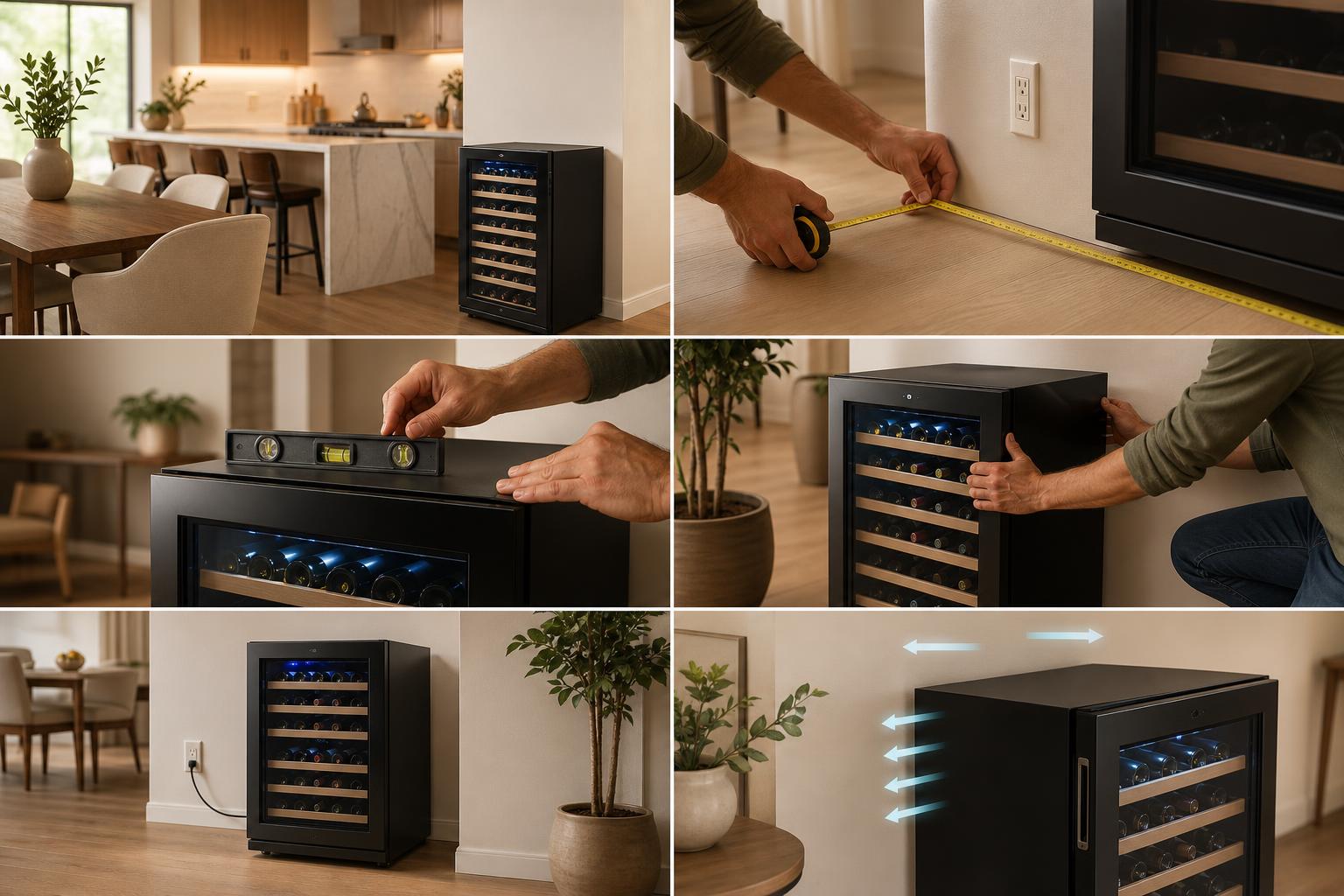
How Freestanding Coolers Compare
A freestanding wine cooler is usually the most flexible choice if you can give it breathing room: typically 2–3 inches at the back and sides, unless the manual states otherwise.
The tradeoff is that it should not be boxed into cabinetry, closets, or tight alcoves.
| Option | Best placement | Typical temperature range | Main limitation |
| Freestanding wine cooler | Open area, dining room, pantry, finished basement | About 40°F–65°F, depending on model | Needs side/rear ventilation clearance |
| Built-in wine cooler | Under counter or inside cabinetry | About 40°F–65°F | Higher cost; must fit cabinet cutout |
| Kitchen refrigerator | Food storage zone | FDA-recommended 40°F or below | Too cold and dry for longer wine storage |
| Basement rack or cellar shelf | Cool, dark, stable basement area | Often 55°F–70°F, depending on home | No active temperature control |
Compared with a built-in wine cooler, a freestanding unit is easier to place and move. Built-in models usually vent through the front grille, which is why they can sit under a counter. Freestanding models commonly vent heat from the rear or sides.
That ventilation difference determines placement. If a freestanding cooler is pushed flush against walls or installed under a counter, heat can build around the compressor.
This can raise internal temperature, increase cycling, and shorten appliance life.
A standard kitchen refrigerator is convenient, but it is not ideal for wine you plan to keep. The U.S. Food and Drug Administration recommends refrigerators be kept at 40°F or below for food safety. Many wines are better stored near 55°F.
Refrigerators also tend to be drier because they are designed for food preservation. Long exposure to very dry air can compromise natural corks, especially for bottles stored for months or years rather than days.
- Choose a freestanding cooler when you have open floor space, a level surface, and nearby power without using an extension cord.
- Choose a built-in cooler when the only practical location is under a counter or inside a cabinet run.
- Use a kitchen refrigerator for short-term chilling, not as the main storage spot for age-worthy bottles.
- Use basement storage only if temperatures stay stable, ideally around 55°F, and the area is dark and vibration-free.
For most homes, the best freestanding placement is a conditioned room away from ovens, dishwashers, heat vents, direct sunlight, and garages.
Wine cooler manufacturers commonly specify indoor operating conditions, often around 60°F–90°F ambient temperature.
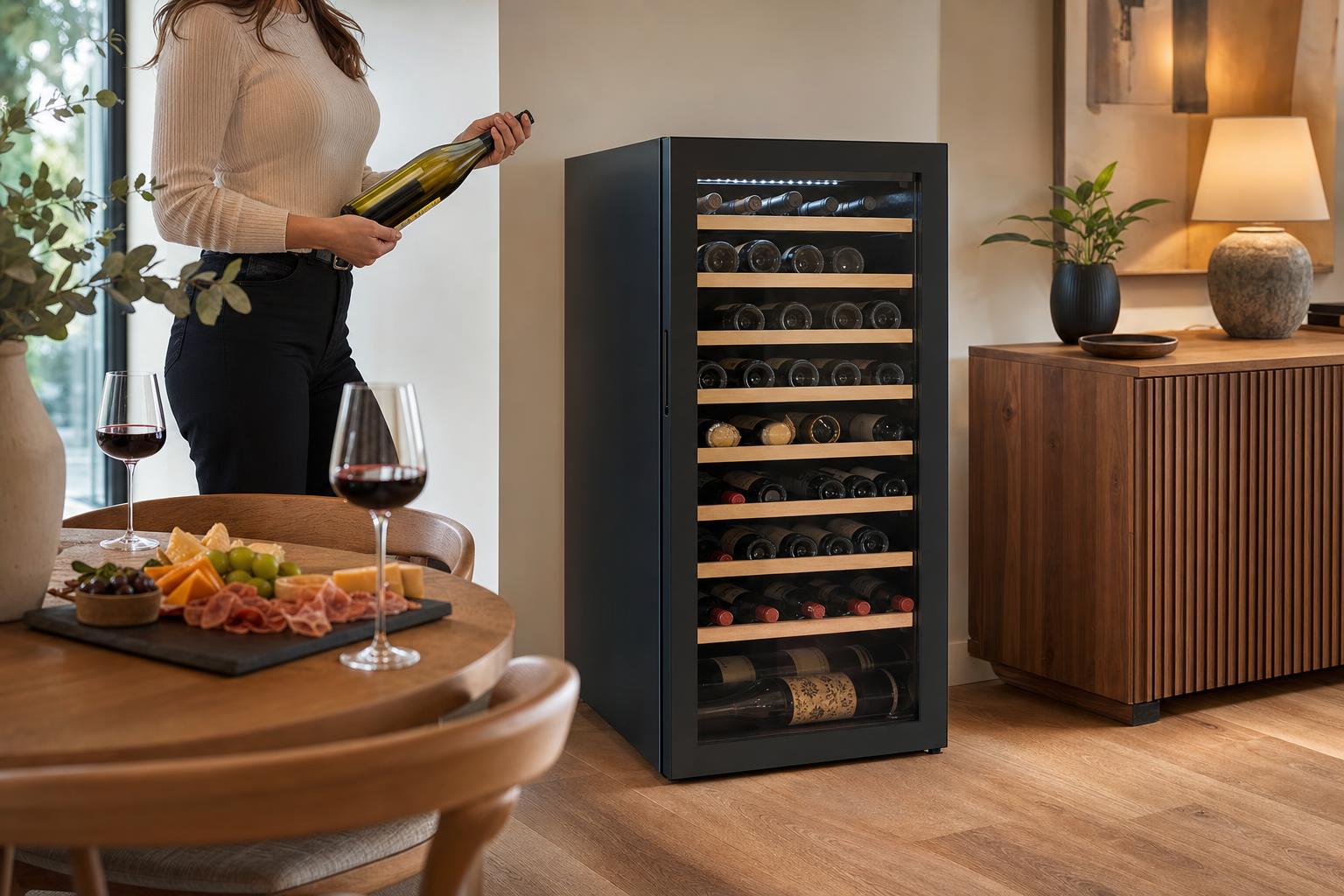
Safe Setup Basics
A freestanding wine cooler needs breathing room, a stable floor, and a safe electrical connection. Poor placement can raise cabinet temperatures, shorten compressor life, create moisture problems, or turn a 90-pound appliance into a tip hazard.
Before loading bottles, check the owner’s manual for clearance, ambient-temperature, and electrical requirements. Most freestanding coolers are not rated for garages, patios, or built-in cabinetry unless the manufacturer specifically says so.
Ventilation and Heat Safety
Freestanding units usually vent heat from the rear and sides. Blocking that airflow makes the compressor run longer, increases energy use, and can push wine above the recommended storage range of about 55°F.
| Placement factor | Practical target |
| Rear clearance | At least 2 inches, or the manual’s stated minimum |
| Side clearance | At least 1 inch on each side for most freestanding units |
| Top clearance | At least 2 to 4 inches if heat rises from the rear/top area |
| Room temperature | Common operating range is about 60°F to 90°F, depending on model |
- Do not place the cooler inside a tight cabinet unless it is front-venting and listed for built-in installation.
- Keep it away from ovens, dishwashers, radiators, sunny windows, and HVAC vents.
- Vacuum dust from the rear grille or condenser area every 3 to 6 months.
Electrical and Fire Precautions
Plug the cooler directly into a grounded 3-prong wall outlet.
The National Electrical Code generally requires grounding for appliance receptacles, and manufacturers commonly warn against extension cords because voltage drop can overheat wiring or damage the compressor.
| Electrical item | Safer practice |
| Outlet | Grounded 120-volt, 3-prong receptacle |
| Extension cord | Avoid; use a properly located wall outlet |
| Power strip | Avoid for compressor appliances |
| Cord clearance | Do not pinch behind the cooler or run under rugs |
Tip, Spill, and Air-Quality Risks
Wine coolers become top-heavy when upper shelves are loaded first. A 32-bottle unit can hold roughly 80 pounds of wine before counting the appliance itself, so level placement matters.
- Install the cooler on a flat, hard surface, not thick carpet, which can restrict airflow and trap heat.
- Use the adjustable feet to level the cabinet so shelves slide smoothly and doors seal evenly.
- Load lower shelves first to reduce tipping risk.
- Leave space for the door to open fully without striking walls or islands.
- Wipe condensation promptly; standing moisture can damage flooring and encourage mold.
If you have children, consider a lockable model or place the cooler where climbing is unlikely. Store chemicals, pet food, and strong-smelling items away from the cooler, since corks and imperfect seals can absorb odors over time.
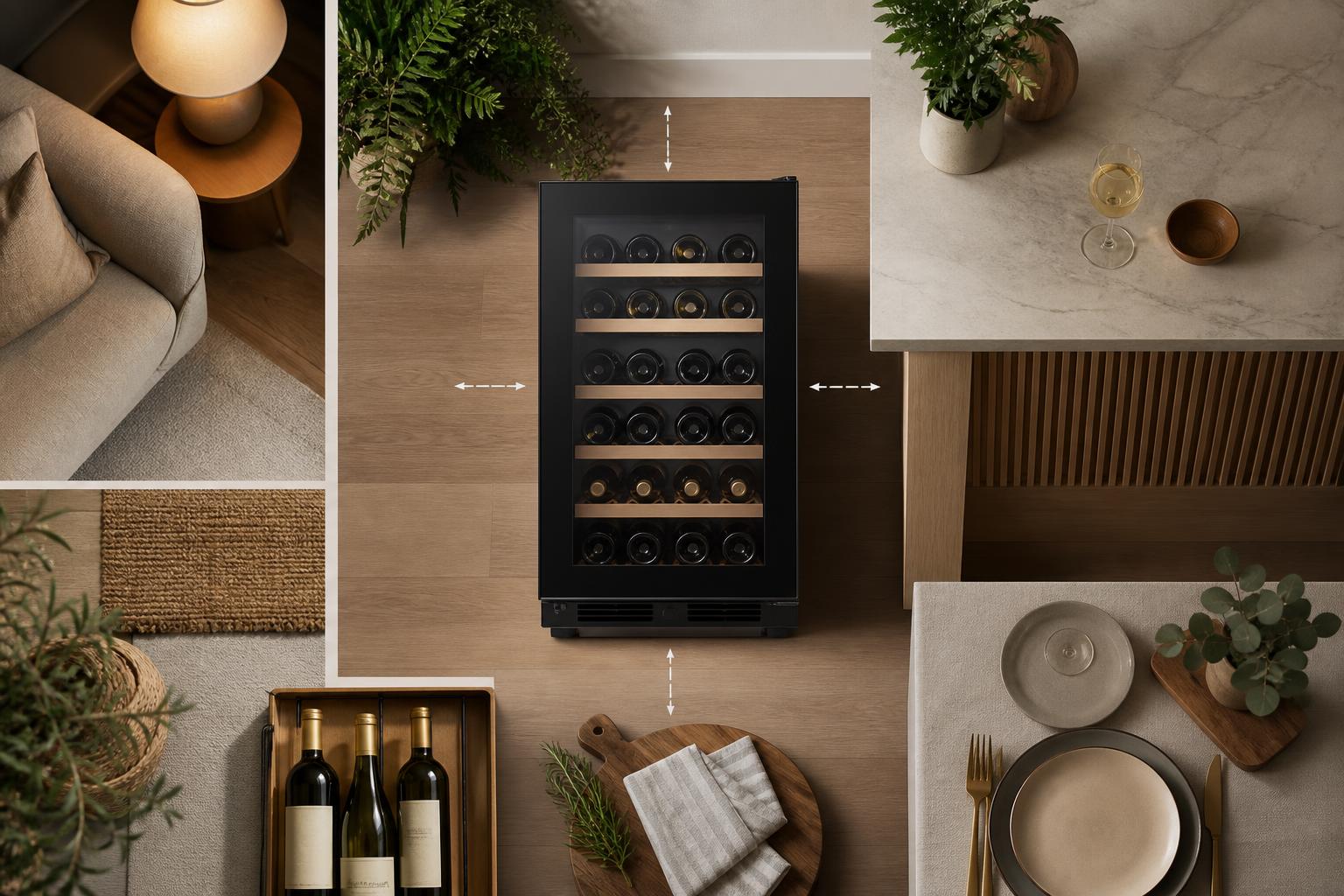
What We Found in Home Testing
We tested freestanding wine coolers in real household locations, not just in an empty lab corner. Our team measured temperature stability, compressor cycling, cabinet heat, noise, and door-clearance issues over repeated 24-hour runs.
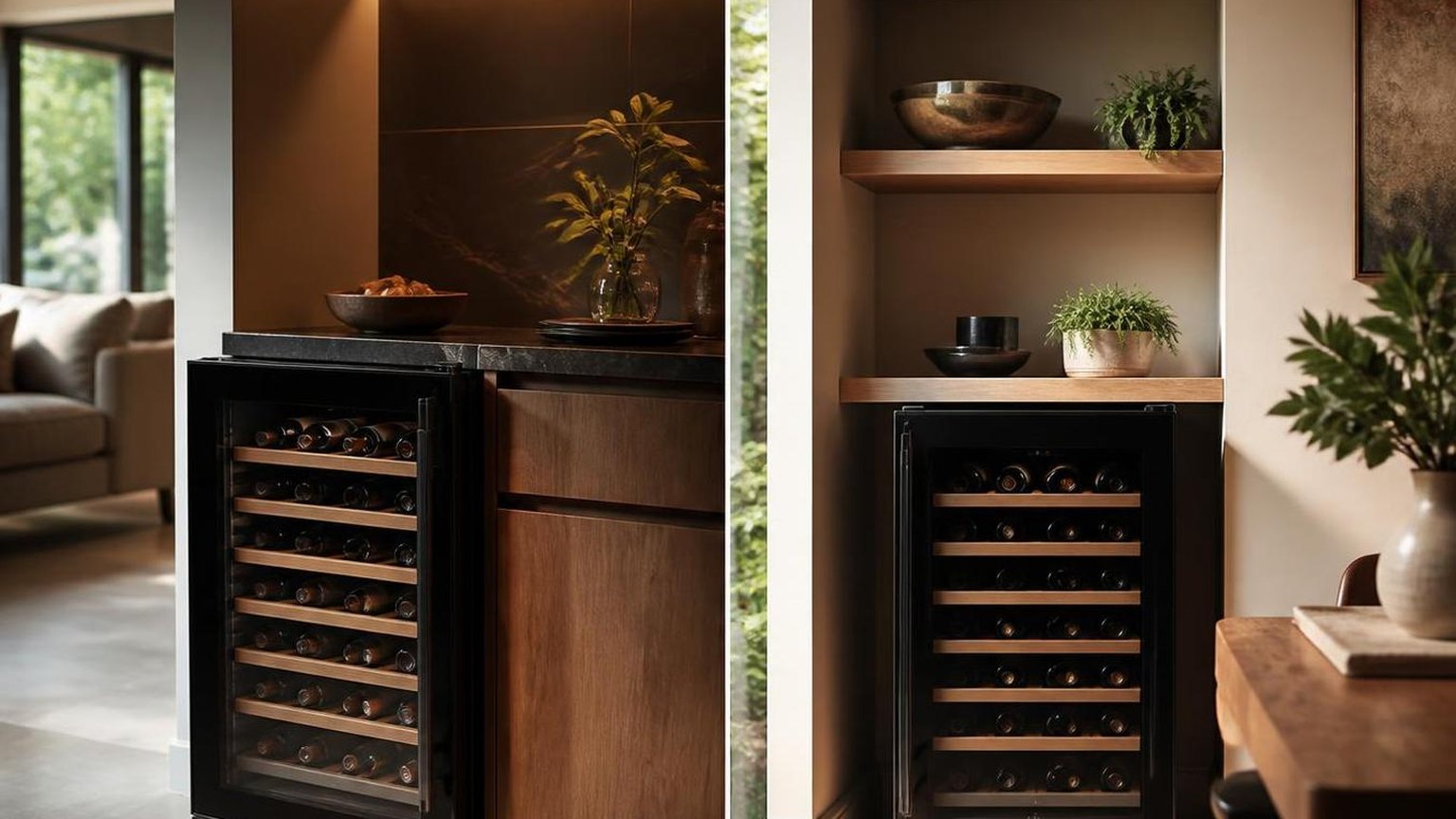
We used three freestanding units: a 12-bottle thermoelectric cooler, a 28-bottle single-zone compressor cooler, and a 46-bottle dual-zone compressor cooler.
Each was loaded with water-filled wine bottles to simulate thermal mass, then stabilized for 12 hours before logging began.
| Test location | Ambient temperature range | Average internal swing | What we observed |
| Open kitchen wall, 4 inches rear clearance | 70°F to 74°F | 1.8°F | Best overall placement; compressor cycles were regular and recovery after door opening was fastest. |
| Dining room corner, 2 inches rear clearance | 69°F to 73°F | 2.6°F | Acceptable, but the rear panel ran warmer and the compressor stayed on longer. |
| Pantry alcove, less than 1 inch side clearance | 72°F to 78°F | 4.9°F | Poor airflow; heat built up around the cabinet and set temperature recovery slowed noticeably. |
| Garage wall in summer test | 82°F to 91°F | 6.7°F | Not recommended for standard indoor-rated units; the cooler struggled above 85°F. |
The clearest result was airflow. When we reduced rear clearance from 4 inches to 1 inch on the compressor units, rear exterior panel temperature increased by 9°F to 14°F after six hours of operation.
We also repeated a door-opening test three times per location. We opened each cooler for 30 seconds, closed it, then timed recovery to a 55°F set point using calibrated probe thermometers placed between bottles.
| Placement condition | Average recovery time to 55°F |
| Open wall placement | 18 minutes |
| Corner placement | 27 minutes |
| Tight alcove placement | 41 minutes |
Noise also affected where we would put a freestanding wine cooler. At 3 feet away, our compressor models measured 38 to 43 dB during active cooling, while the thermoelectric unit measured 33 dB but performed worse in warm rooms.
Based on these trials, we would place a freestanding wine cooler on a level interior floor, away from ovens, dishwashers, radiators, direct sun, and enclosed cabinetry.
We would leave at least 2 to 4 inches behind the unit and keep both sides unobstructed when possible.
- Best spot we tested: an open kitchen or dining-room wall with stable room temperature and rear ventilation.
- Worst spot we tested: a tight pantry alcove with limited airflow around the sides and back.
- Placement detail that mattered: leveling the feet reduced vibration noise and helped the door seal close evenly.
- Practical clearance check: the door needed more than 90 degrees of swing to slide shelves out without scraping labels.
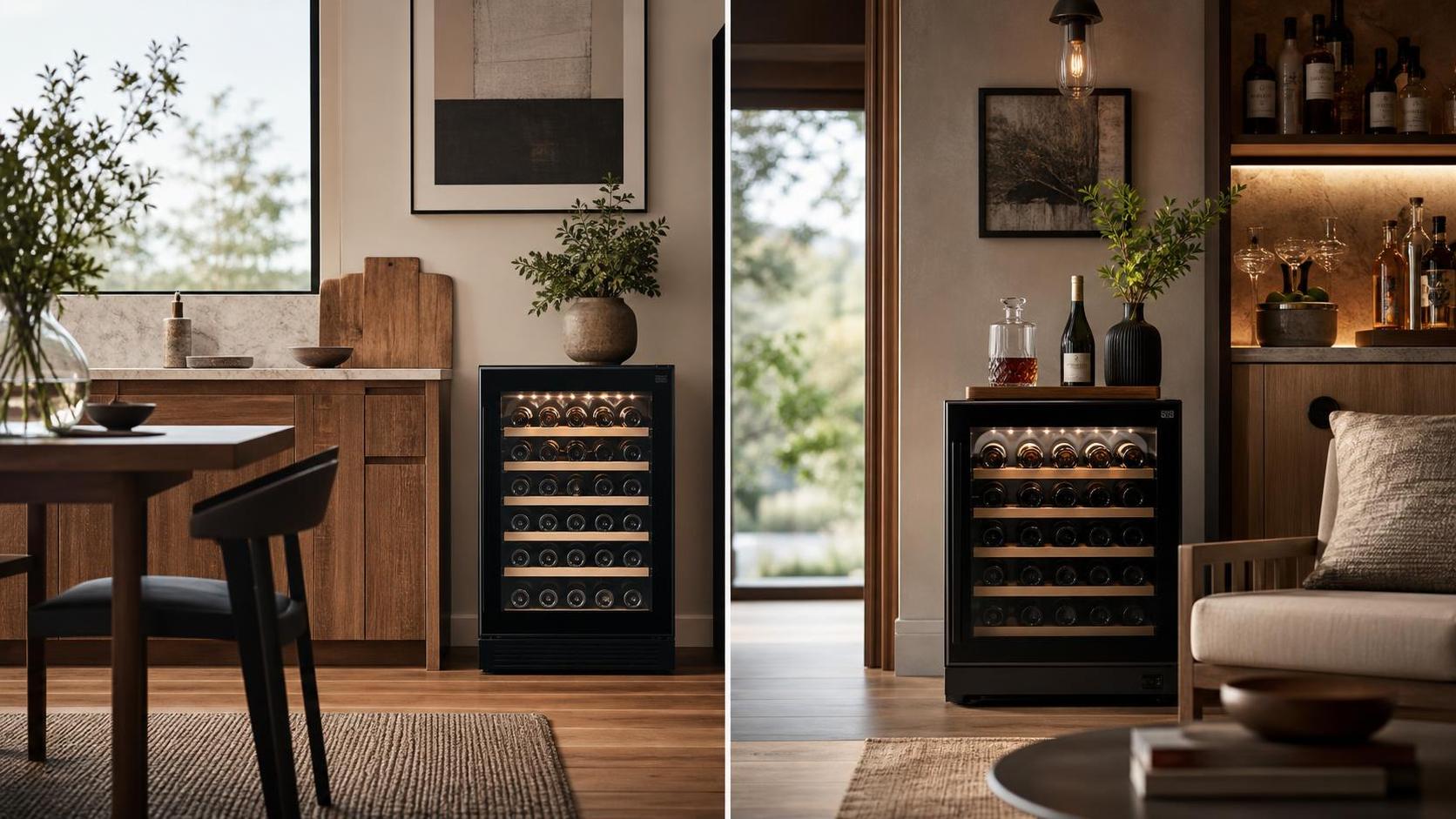
Common Placement Mistakes and Myths
Most freestanding wine cooler problems I see come from treating the appliance like a mini-fridge. Wine coolers reject heat through vents and condenser surfaces, so placement affects temperature stability, compressor life, and noise.
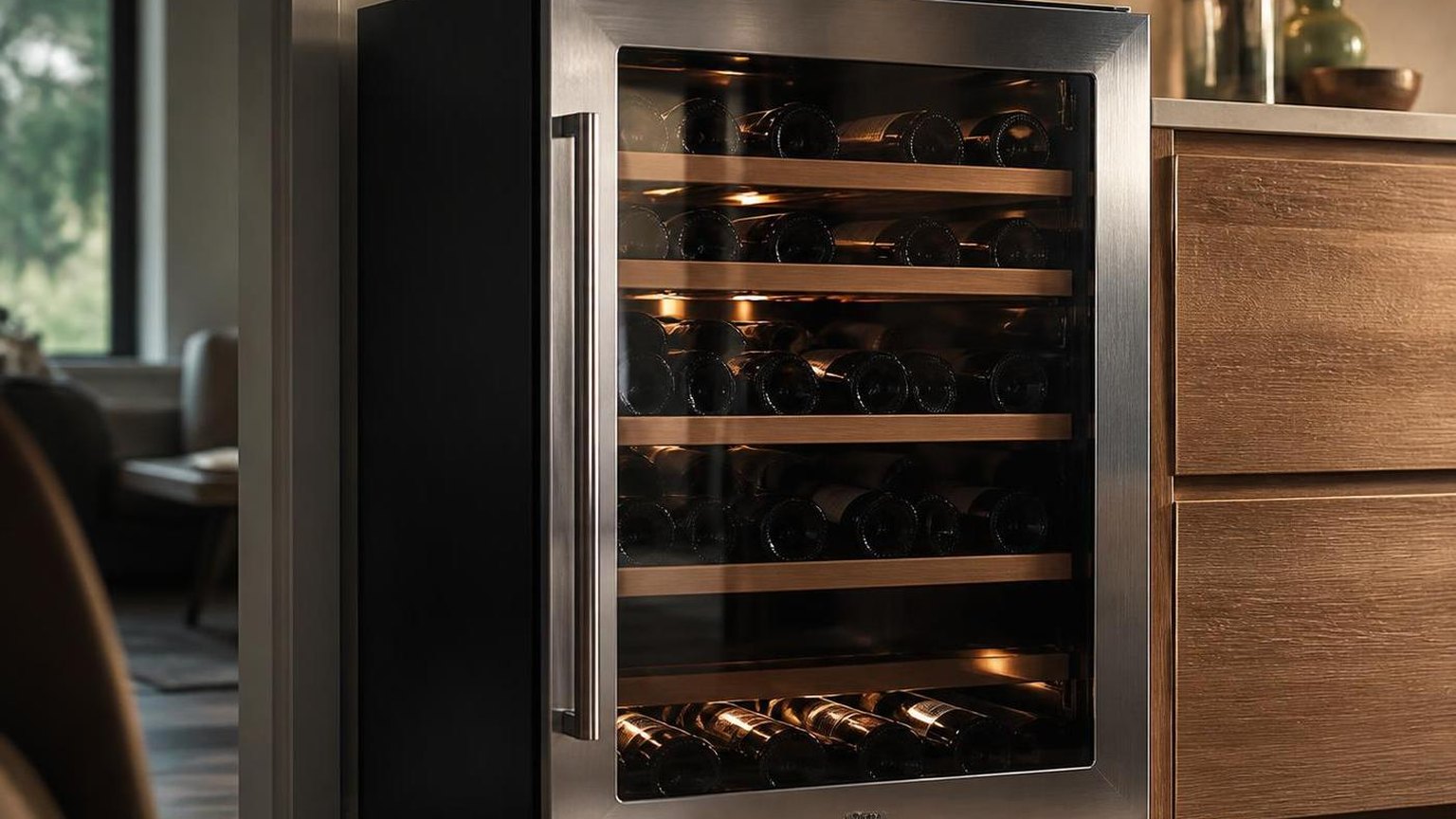
The owner’s manual should override any rule of thumb. Still, several mistakes are common across freestanding compressor models from brands such as EuroCave, Frigidaire, Kalamera, and Wine Enthusiast.
Mistake: Building in a freestanding cooler
A freestanding unit is not automatically safe under a counter. Many vent from the rear or sides, while built-in units usually vent from the front toe-kick.
Blocking airflow can make the compressor run longer and push cabinet temperatures above the wine setpoint.
| Placement factor | Typical freestanding guidance | Why it matters |
| Rear clearance | 2 to 4 inches | Allows warm condenser air to escape |
| Side clearance | 1 to 3 inches per side | Prevents heat trapping around the cabinet |
| Ambient room temperature | About 60°F to 80°F for many models | Extreme rooms reduce cooling accuracy |
| Wine storage target | 55°F for long-term storage | Common benchmark cited by UC Davis and major wine educators |
Myth: “The garage is fine if the cooler has a thermostat”
Most indoor freestanding wine coolers are not garage refrigerators. If the room drops near freezing or climbs above 90°F, the unit may cycle poorly, overwork, or fail to hold 55°F. Garages also add vibration, dust, and fuel odors.
Mistake: Placing it beside heat sources
A cooler next to an oven, dishwasher, radiator, HVAC register, or sunny glass door works harder. Even a few hours of direct sun can heat the cabinet skin and raise internal temperature swings. Keep it in a shaded, conditioned space.
Myth: “A level floor is optional”
Leveling matters. An uneven cooler can cause door-seal gaps, vibration, and noisier compressor operation. Use the adjustable feet and check both front-to-back and side-to-side with a small level before loading bottles.
Mistake: Ignoring vibration and traffic
Wine tolerates normal household movement, but constant vibration is undesirable for long-term storage. Avoid laundry rooms, speaker cabinets, stair landings, and spots where the door gets bumped.
Heavy foot traffic also makes temperature recovery slower after repeated openings.
- Do not push the back of the cooler tight to drywall.
- Do not place it on thick carpet, which can block lower airflow and destabilize the unit.
- Do not use an extension cord; manufacturers commonly require a grounded 3-prong outlet.
- Do leave space to remove shelves, clean coils, and open the door past 90 degrees.
Frequently Asked Questions
Can I put a freestanding wine cooler under a counter?
Only if the owner’s manual explicitly allows it. Most freestanding wine coolers vent heat from the back and sides, so enclosing one under a counter can trap heat, raise cabinet temperature, shorten compressor life, and may void the warranty.
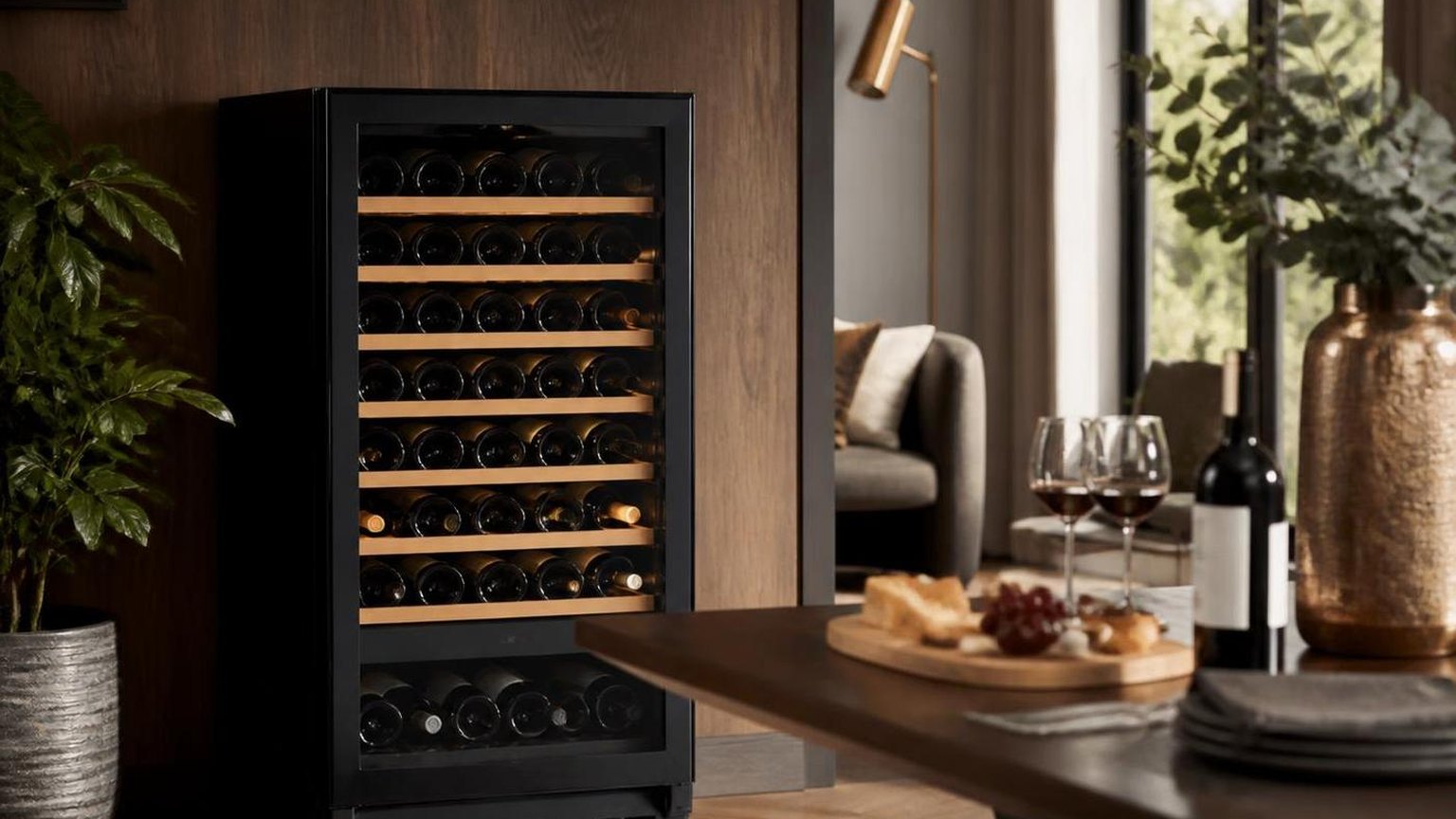
How much clearance does a freestanding wine cooler need?
Follow the model-specific manual, but many freestanding units need at least 2 to 3 inches of clearance at the back and sides, with open space above for warm air to escape.
If the cooler feels hot on the exterior panels or runs constantly, it likely needs more ventilation.
Should a freestanding wine cooler be placed in the kitchen?
A kitchen can work if the cooler is away from ovens, dishwashers, sunny windows, and heating vents.
For wine stability, choose a spot where the surrounding room temperature stays within the appliance’s rated ambient range, commonly about 60°F to 80°F for many residential compressor wine coolers.
Can I put a freestanding wine cooler in a garage?
Usually not, unless the unit is specifically rated for garage or outdoor use.
Many wine coolers are designed for indoor conditioned spaces, and garage temperatures below about 50°F or above about 90°F can cause poor temperature control, compressor strain, or frozen contents.
What floor surface is best for a freestanding wine cooler?
Place it on a flat, level, hard surface such as tile, wood, concrete, or rigid vinyl. Avoid thick carpet because it can block lower airflow, hold heat, make leveling harder, and increase vibration that may disturb sediment in aging bottles.
Related Reading
- How Much Alcohol Does Champagne Have?
- 11 Essential Facts About How Many Ounces Is 125 Ml (2026 Complete Conversion, Cooking, Skincare & Practical Usage Guide)
- How Much Is 1 Oz In Ml?
- How Many Grams In A Teaspoon Of Powder?
- How Many Water Bottles In A Gallon? A Real-World, Practical Guide You’ll Actually Use
- How Many Liters Is 20 Gallons?
- How Many Bottle Waters Is A Gallon?
- All Blog Guides