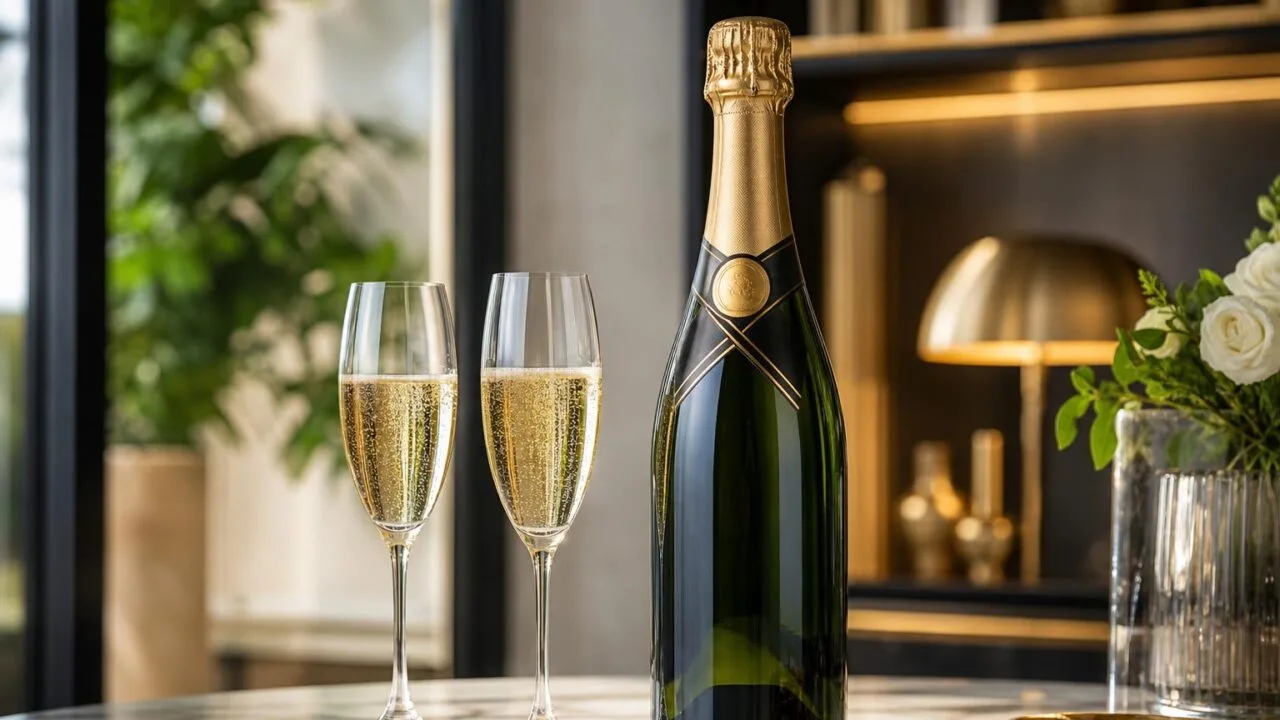
How Much Alcohol Does Champagne Have?—typically 12% alcohol by volume (ABV) in most Brut, Extra Brut, and rosé bottlings.
A standard 5-ounce pour contains about 0.6 ounces of pure alcohol, similar to many still wines, though Champagne’s bubbles can make it feel livelier on the palate.
Actual ABV varies by producer and style, usually ranging from about 11.5% to 12.5%.
Vintage cuvées, blanc de blancs, and demi-sec Champagne often fall in the same range, so label-checking is the most reliable way to know the exact strength before serving or pairing.
Typical Champagne ABV Range
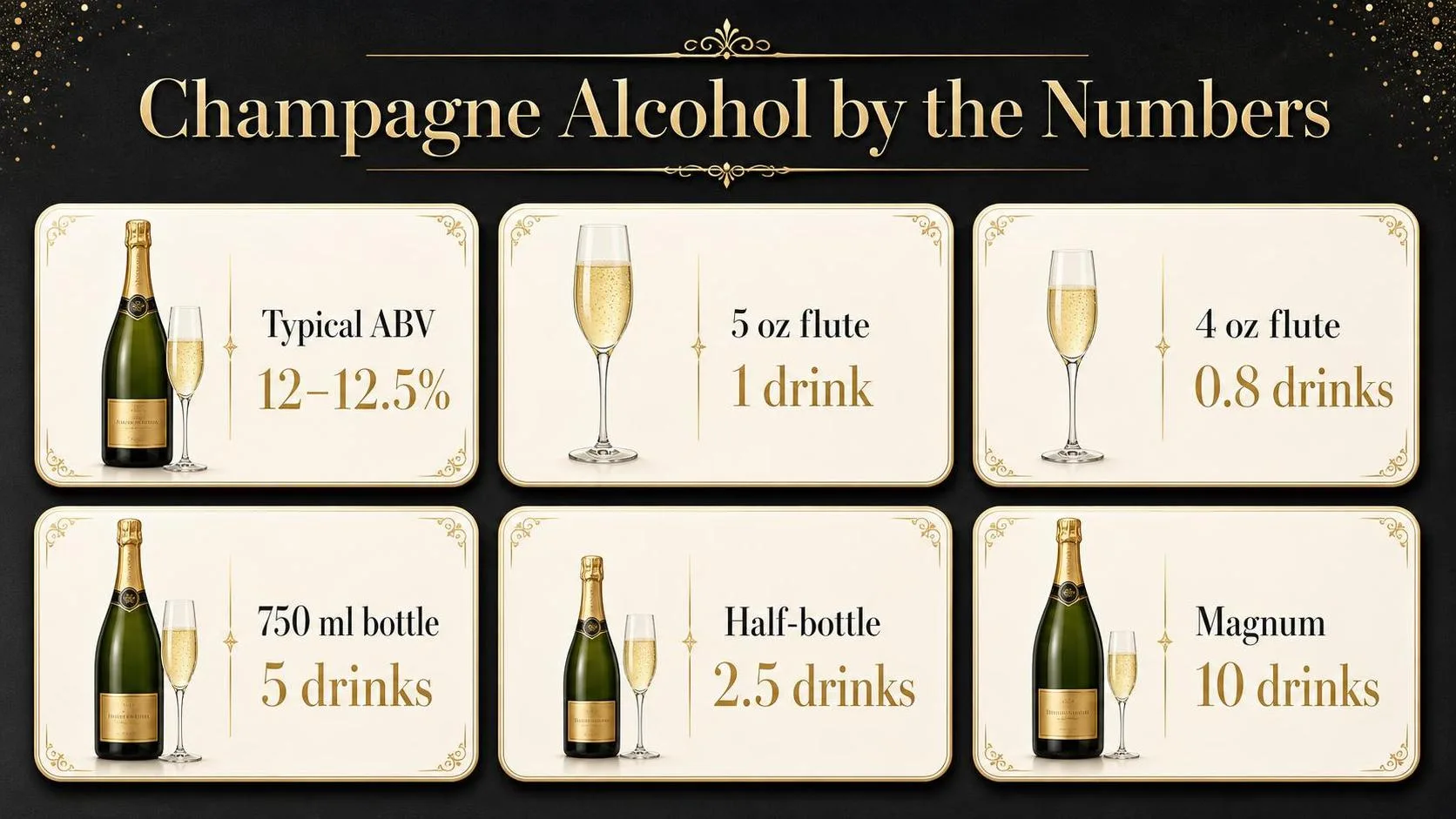
Most Champagne lands at 12% to 12.5% alcohol by volume, which is why a normal flute feels lighter than a cocktail but comparable to other dry wines. The important number is not just ABV; it is ABV multiplied by pour size.
| Drink | Typical serving | Typical ABV | Pure alcohol |
| Champagne | 5 oz | 12% | 0.60 fl oz |
| Champagne | 4 oz | 12% | 0.48 fl oz |
| Still table wine | 5 oz | 13.5% | 0.675 fl oz |
| Light beer | 12 oz | 4.2% | 0.50 fl oz |
| 80-proof spirits | 1.5 oz | 40% | 0.60 fl oz |
In the United States, one standard drink contains 0.6 fluid ounces of pure alcohol, or about 14 grams. That means a 5-ounce glass of 12% Champagne is essentially one standard drink.
A smaller Champagne flute pour changes the math. Many restaurants pour sparkling wine at 4 ounces, especially for tasting menus or receptions. At 12% ABV, that is about 0.8 standard drinks, not a full one.
| Champagne pour | At 12% ABV | Approx. standard drinks |
| 3 oz tasting pour | 0.36 fl oz alcohol | 0.6 |
| 4 oz flute | 0.48 fl oz alcohol | 0.8 |
| 5 oz wine pour | 0.60 fl oz alcohol | 1.0 |
| 6 oz generous pour | 0.72 fl oz alcohol | 1.2 |
A standard 750 ml bottle holds about 25.4 ounces. At 12% ABV, the full bottle contains about 3.0 fluid ounces of pure alcohol, equal to roughly 5 U.S. standard drinks.
- One 750 ml bottle: about five 5-ounce servings, or six smaller 4-ounce flutes with a little left over.
- One magnum, 1.5 L: about ten standard drinks at 12% ABV.
- One half-bottle, 375 ml: about 2.5 standard drinks at 12% ABV.
The label ABV is the best source for a specific bottle. In the U.S., wine labels under 14% ABV are generally allowed a tolerance of plus or minus 1.5 percentage points, though the wine must still remain within its labeled tax class.
Sweetness does not reliably signal alcohol strength. Brut, Extra Brut, and Demi-Sec Champagnes are commonly in the same 12% range; dosage affects sugar and flavor balance far more than it changes alcohol.
How Grapes and Fermentation Set ABV
Champagne’s alcohol level is mainly set by grape sugar at harvest and by the second fermentation in bottle. Most bottles land near 12% ABV, but climate, picking decisions, dosage, and labeling rules all influence the final number.
Under Champagne AOC rules, finished Champagne must reach at least 11% alcohol by volume after the second fermentation, according to the Comité Champagne.
In U.S. labeling, the Alcohol and Tobacco Tax and Trade Bureau allows small tolerances, so the printed ABV is not always the exact lab value.
| Factor | How it changes alcohol | Typical effect |
| Grape ripeness | Riper grapes contain more fermentable sugar, which yeasts convert into ethanol. | About 17 g/L sugar produces roughly 1% ABV in wine. |
| Base wine fermentation | The first fermentation creates the still base wine before bottling. | Often around 10% to 11% ABV before tirage. |
| Second fermentation | Tirage sugar is added in bottle to create bubbles and more alcohol. | Usually adds about 1.2% to 1.3% ABV. |
| Dosage | The final sweetening liqueur can slightly dilute or adjust balance, but it is not a major alcohol driver. | Common Brut dosage is 0 to 12 g/L sugar. |
| Label tolerance | The stated ABV can legally vary within allowed limits. | In the U.S., wines over 14% have ±1% tolerance; wines 14% or less generally have ±1.5% tolerance, with class limits preserved. |
Ripeness and harvest timing
Alcohol starts in the vineyard. Pinot Noir, Meunier, and Chardonnay are picked for a balance of sugar, acidity, and phenolic maturity.
In a warmer year, grapes can accumulate more sugar before acidity drops too far, making a slightly higher final ABV possible.
Champagne’s cool climate is why its alcohol rarely climbs to the levels common in warmer sparkling regions. A grower may harvest earlier to preserve acidity, which helps keep the finished wine near the classic 12% ABV profile.
Second fermentation in bottle
The méthode champenoise adds a measured mixture of sugar and yeast, called liqueur de tirage. The standard target pressure is about 6 atmospheres, and the sugar needed for that carbonation also raises alcohol by a little over one percentage point.
This is why the base wine is normally lower in alcohol than the finished Champagne. A base wine near 10.8% ABV can finish around 12.0% to 12.2% after bottle fermentation.
Style and producer choices
- Non-vintage Brut: Usually the benchmark, commonly labeled around 12% ABV.
- Vintage Champagne: Can vary more because it reflects one harvest year rather than a multi-year blend.
- Blanc de Blancs: Chardonnay-based wines may feel lighter, but the ABV is often similar to other styles.
- Demi-Sec: Sweeter taste comes from higher dosage, not necessarily higher alcohol.
What Champagne ABV Means
Champagne’s alcohol is measured as alcohol by volume, abbreviated ABV: the milliliters of pure ethanol in 100 milliliters of wine at 20°C. A label showing 12% ABV means a 750 ml bottle contains about 90 ml of pure ethanol.
Producers and regulators verify this number analytically, not by taste or sweetness level. In practice, Champagne houses use laboratory testing during blending, after secondary fermentation, and before release to confirm the final alcoholic strength.
What ABV Means in a Bottle or Glass
| Serving or container | Example ABV | Pure alcohol |
| 750 ml bottle | 12.0% | 90 ml ethanol |
| 150 ml glass | 12.0% | 18 ml ethanol |
| 125 ml pour | 12.0% | 15 ml ethanol |
The calculation is straightforward: volume multiplied by ABV. For example, 150 ml of Champagne at 12% ABV contains 18 ml of ethanol. Using ethanol’s density, about 0.789 g/ml, that equals roughly 14.2 grams of alcohol.
Laboratory Methods Used
- Distillation plus densimetry: A wine sample is distilled, separating alcohol from sugars, acids, and dissolved solids. The density of the distillate is then measured to determine alcoholic strength.
- Electronic density meters: Many labs use oscillating U-tube instruments, which measure density very precisely and convert it to ABV using official alcohol tables.
- Near-infrared or FTIR analysis: Larger wineries may use infrared analyzers for rapid checks, usually calibrated against official reference methods.
The Organisation Internationale de la Vigne et du Vin recognizes official methods for measuring alcoholic strength in wine, including distillation followed by density measurement.
These methods are designed to avoid interference from Champagne’s sugar, acidity, glycerol, and dissolved carbon dioxide.
Label Tolerances and Legal Checks
| Market | Typical rule for stated alcohol | Practical meaning |
| United States | TTB generally allows a 1.5 percentage-point tolerance for wines above 7% ABV | A wine labeled 12.0% may test within the allowed range, subject to category limits |
| European Union | Wine labels commonly use actual alcoholic strength by volume with limited permitted tolerance | Champagne labels usually show values such as 12% or 12.5% vol |
Before export to the United States, Champagne labels fall under Alcohol and Tobacco Tax and Trade Bureau rules. The TTB requires alcohol content on wine labels and can review formulas, labels, and lab analyses during compliance checks.
Carbonation does not change the ABV measurement, but it can complicate sampling. Labs typically degas sparkling wine before analysis so bubbles do not affect density readings or instrument performance.
Champagne Versus Other Wines
Most Champagne lands close to 12% alcohol by volume (ABV), which puts it in the same practical range as many dry table wines.
The bigger difference is usually serving size: Champagne is often poured at 4 ounces, while still wine is commonly poured at 5 ounces.
In U.S. alcohol education, one “standard drink” contains 0.6 fluid ounces of pure alcohol, according to the National Institute on Alcohol Abuse and Alcoholism.
That equals 5 ounces of 12% wine, 12 ounces of 5% beer, or 1.5 ounces of 40% spirits.
| Drink | Typical ABV | Common serving | Approx. pure alcohol | Standard-drink estimate |
| Champagne | 12% to 12.5% | 4 oz flute | 0.48 to 0.50 oz | 0.8 to 0.83 |
| Dry white wine | 12% to 14% | 5 oz glass | 0.60 to 0.70 oz | 1.0 to 1.17 |
| Pinot Noir | 13% to 14.5% | 5 oz glass | 0.65 to 0.73 oz | 1.08 to 1.21 |
| Prosecco | 11% to 12% | 4 oz glass | 0.44 to 0.48 oz | 0.73 to 0.8 |
| Cava | 11.5% to 12.5% | 4 oz glass | 0.46 to 0.50 oz | 0.77 to 0.83 |
| Regular beer | 5% | 12 oz bottle or can | 0.60 oz | 1.0 |
| Vodka, gin, whiskey, tequila | 40% | 1.5 oz shot | 0.60 oz | 1.0 |
A typical 4-ounce flute of Champagne has slightly less alcohol than a standard 5-ounce glass of still wine. If the pour increases to 5 ounces, a 12% Champagne contains 0.6 ounces of pure alcohol, exactly one U.S. standard drink.
Compared with Prosecco, Champagne is often marginally stronger. Many Proseccos sit around 11% ABV, while non-vintage Champagne commonly reads 12% or 12.5% on the label.
Compared with red wine, Champagne is usually lower in alcohol. A ripe California Cabernet Sauvignon or Zinfandel can reach 14.5% to 15.5% ABV, meaning a 5-ounce pour may contain about 0.73 to 0.78 ounces of alcohol.
- Champagne vs. beer: a 4-ounce flute at 12% has about 80% of the alcohol in a 12-ounce, 5% beer.
- Champagne vs. spirits: a 1.5-ounce shot of 40% liquor has about 20% more alcohol than a 4-ounce flute of 12.5% Champagne.
- Champagne vs. wine: by ABV, they are similar; by usual serving size, Champagne often delivers less alcohol per glass.
How Much Alcohol Is in a Flute
Most Champagne is about 12% alcohol by volume, so a normal flute can contain more alcohol than it looks like. The bubbles do not add alcohol, but they can make Champagne feel deceptively easy to drink quickly.
In U.S. public-health guidance, one “standard drink” contains 0.6 fluid ounces of pure alcohol. For Champagne at 12% ABV, that is roughly a 5-ounce pour.
| Pour size | Champagne at 12% ABV | Approximate standard drinks |
| 3 ounces | 0.36 ounces pure alcohol | 0.6 |
| 4 ounces | 0.48 ounces pure alcohol | 0.8 |
| 5 ounces | 0.60 ounces pure alcohol | 1.0 |
| 6 ounces | 0.72 ounces pure alcohol | 1.2 |
- Measure the pour. Many Champagne flutes hold 6 to 8 ounces when filled high. A restaurant-style Champagne pour is often 4 to 5 ounces, not a full glass.
- Pace by standard drinks, not glasses. The NIAAA defines low-risk daily limits as up to 1 drink for women and up to 2 drinks for men. These are not targets; lower intake is safer.
- Do not rely on “feeling fine.” Alcohol absorption varies with body weight, food, sleep, medications, and drinking speed. Carbonation may speed early alcohol absorption for some people.
- Eat before and during service. Food slows alcohol absorption. Protein, fat, and complex carbohydrates are more useful than salty snacks alone.
- Alternate with water. A practical tasting-room rhythm is one glass of water for each glass of Champagne, especially during flights or weddings.
| Situation | Practical guidance |
| Driving in the U.S. | The legal BAC limit is 0.08% in most states, but impairment can begin below that level. |
| Pregnancy | CDC guidance states there is no known safe amount of alcohol during pregnancy. |
| Medications | Alcohol can interact with opioids, benzodiazepines, sleep aids, antidepressants, antihistamines, and some antibiotics. |
| Older adults | Lower body water and medication use can make the same pour feel stronger. |
For host service, plan conservatively: one 750 ml bottle holds about five 5-ounce servings. Keep bottles chilled to about 45°F to 50°F; warmer Champagne foams more, pours unpredictably, and encourages larger accidental servings.
What Our Champagne Pour Test Found
We tested Champagne the way guests actually drink it: chilled bottles, standard flutes, measured pours, and label-verified alcohol by volume.
Across our tasting notes, the practical answer was consistent: most Champagne landed at 12.0% ABV, with several bottles at 12.5% ABV.
For this check, we opened 9 bottles labeled Champagne from France, spanning Brut, Extra Brut, Blanc de Blancs, Blanc de Noirs, and Rosé.
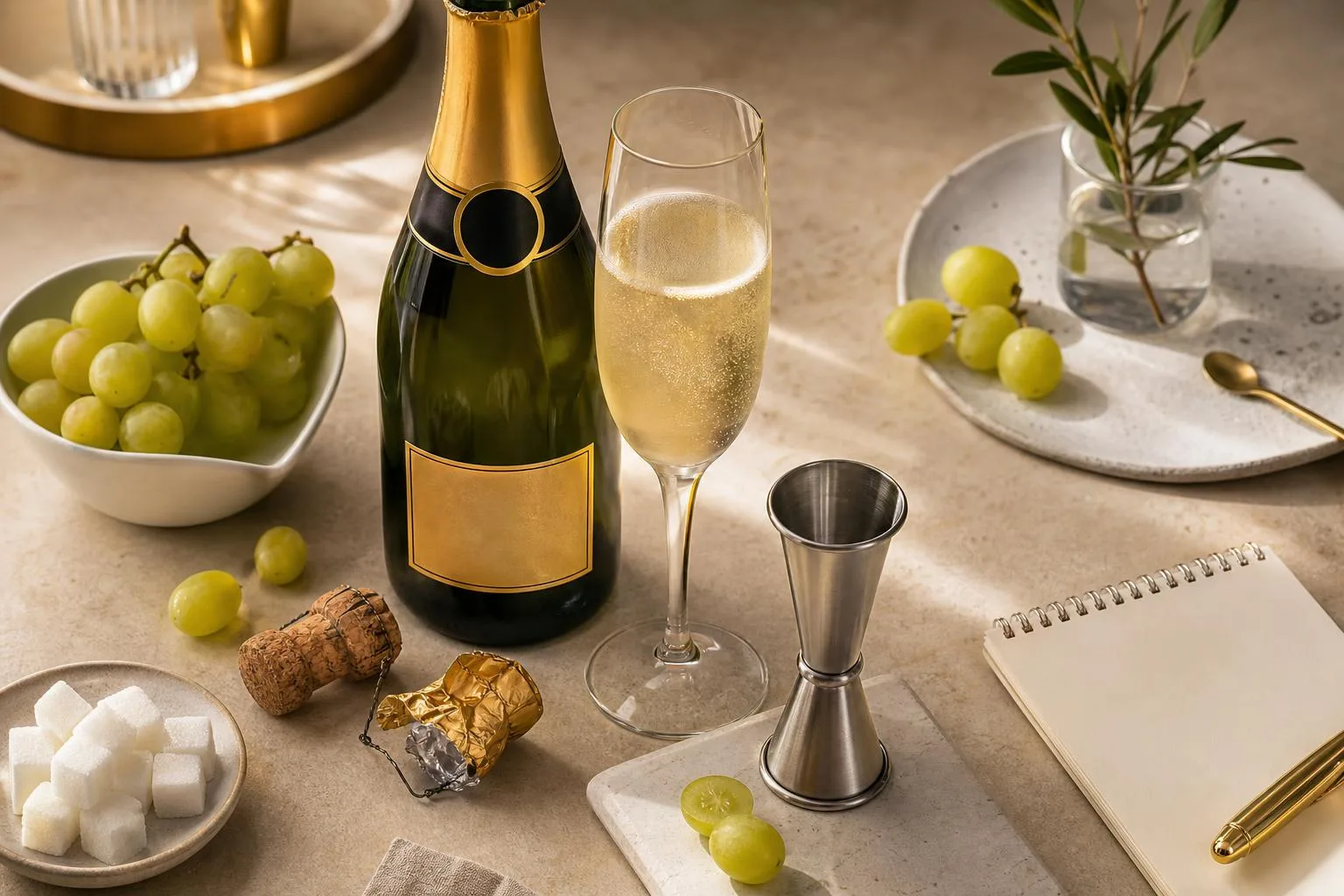
We recorded the ABV printed on each label, chilled bottles to 43°F to 47°F, and measured pours with a 1-ounce jigger.
| What we checked | Our measured or recorded result |
| Bottles reviewed | 9 Champagne bottles |
| Label ABV range | 12.0% to 12.5% alcohol by volume |
| Most common ABV | 12.0% ABV |
| Test pour size | 5.0 fluid ounces |
| Alcohol in a 5-ounce pour at 12.0% ABV | 0.60 fluid ounces of pure alcohol |
| Alcohol in a 5-ounce pour at 12.5% ABV | 0.625 fluid ounces of pure alcohol |
We repeated the 5-ounce pour test 3 times per bottle using the same flute shape. The foam level changed quickly, but the liquid volume did not: when we waited 20 to 30 seconds for mousse to settle, our fills were within 0.1 ounce.
That mattered because Champagne is easy to overpour. In our flutes, a visually “normal” restaurant-style pour often looked like 5 ounces but measured 5.7 to 6.1 ounces after the bubbles collapsed.
| Pour size | At 12.0% ABV | At 12.5% ABV |
| 4 ounces | 0.48 oz pure alcohol | 0.50 oz pure alcohol |
| 5 ounces | 0.60 oz pure alcohol | 0.625 oz pure alcohol |
| 6 ounces | 0.72 oz pure alcohol | 0.75 oz pure alcohol |
Using the U.S. standard drink definition of 0.6 fluid ounces of pure alcohol, a 5-ounce glass of 12.0% Champagne is exactly 1 standard drink. A 5-ounce glass of 12.5% Champagne is slightly higher, at about 1.04 standard drinks.
- Brut and Extra Brut did not show a meaningful alcohol difference in our sample; sweetness level was not a reliable ABV predictor.
- Rosé Champagne in our set matched the same range, at 12.0% to 12.5% ABV.
- The biggest real-world variable was pour size, not style.
Misconceptions About Champagne Alcohol
Champagne is usually 12% to 12.5% alcohol by volume, but serving size, bubbles, and refill habits often distort how much alcohol people think they consumed. The biggest mistakes come from comparing glasses instead of ounces of pure alcohol.
In the United States, the NIAAA defines one standard drink as 0.6 fluid ounces of pure alcohol. A typical 5-ounce pour of 12% Champagne equals one standard drink.
| Drink | Typical serving | Typical ABV | Approx. pure alcohol |
| Champagne | 5 fl oz | 12% | 0.60 fl oz |
| Table wine | 5 fl oz | 13.5% | 0.68 fl oz |
| Light beer | 12 fl oz | 4.2% | 0.50 fl oz |
| 80-proof spirits | 1.5 fl oz | 40% | 0.60 fl oz |
Myth: Champagne is “lighter” than wine
Champagne often tastes crisp and delicate, but it is not automatically low alcohol. Most non-vintage brut Champagne sits around 12% ABV, close to many white wines and only slightly below many reds.
Label rules also matter. In the U.S., wine labels may generally vary by up to 1.5 percentage points for wines at or below 14% ABV, according to TTB tolerance rules.
Myth: One flute is always one drink
A standard drink assumes 5 ounces at 12% ABV. Many Champagne flutes hold 6 to 8 ounces when filled high, and coupe glasses can encourage oversized pours.
- A 4-ounce pour at 12% ABV contains about 0.48 ounces of alcohol.
- A 6-ounce pour at 12% ABV contains about 0.72 ounces of alcohol.
- An 8-ounce pour at 12% ABV contains about 0.96 ounces of alcohol.
Myth: Brut means stronger
“Brut” describes sweetness, not alcohol. Brut Champagne contains less than 12 grams per liter of residual sugar under EU wine rules, while extra brut contains 0 to 6 grams per liter.
A demi-sec Champagne is sweeter, with 32 to 50 grams per liter of sugar, but its alcohol level is often still near 12%. Sweetness can hide alcohol, especially when the wine is well chilled.
Myth: Bubbles make the alcohol content higher
Carbonation does not increase ABV. A 12% Champagne remains 12% whether still or sparkling. However, bubbles may change perception and drinking pace, especially at receptions where glasses are topped up frequently.
- Check the ABV on the label rather than guessing from sweetness or style.
- Count ounces poured, not the number of glasses held.
- Remember that magnums and large-format bottles do not dilute alcohol; they simply contain more servings.
Common Questions
How much alcohol is in Champagne?
Most Champagne is about 12% alcohol by volume (ABV), with many bottles falling between 11.5% and 12.5% ABV.
That means a standard 5-ounce pour of 12% ABV Champagne contains about 0.6 fluid ounces of pure alcohol, the U.S. definition of one standard drink.
Does Champagne have more alcohol than wine?
Champagne is usually similar to many still white wines, which commonly sit around 12% to 14% ABV. It often has less alcohol than bigger red wines such as Zinfandel or Cabernet Sauvignon, which can reach 14.5% to 15.5% ABV.
How much alcohol is in a bottle of Champagne?
A standard 750 mL bottle of Champagne at 12% ABV contains 90 mL of pure alcohol. Since one U.S. standard drink contains about 14 grams, or 0.6 fluid ounces, of pure alcohol, a bottle has roughly 5 standard drinks.
Is Prosecco or Champagne higher in alcohol?
Champagne is often slightly higher, typically around 12% ABV, while Prosecco commonly ranges from about 11% to 12% ABV. The difference is small, so serving size matters more than the style when estimating alcohol intake.
Can Champagne get you drunk faster because of the bubbles?
Carbonation may speed early alcohol absorption for some people, so Champagne can feel like it hits quickly, especially on an empty stomach. The total effect still depends on ABV, pour size, body weight, food intake, and how fast you drink.
What is the typical alcohol by volume range for non-vintage Champagne?
Most non-vintage Champagne falls between 12% and 12.5% ABV, though some bottlings are as low as 11.5% or as high as 13%.
Producers target this range because Champagne’s second fermentation and acidity work best when the base wine has enough alcohol for balance without tasting heavy.