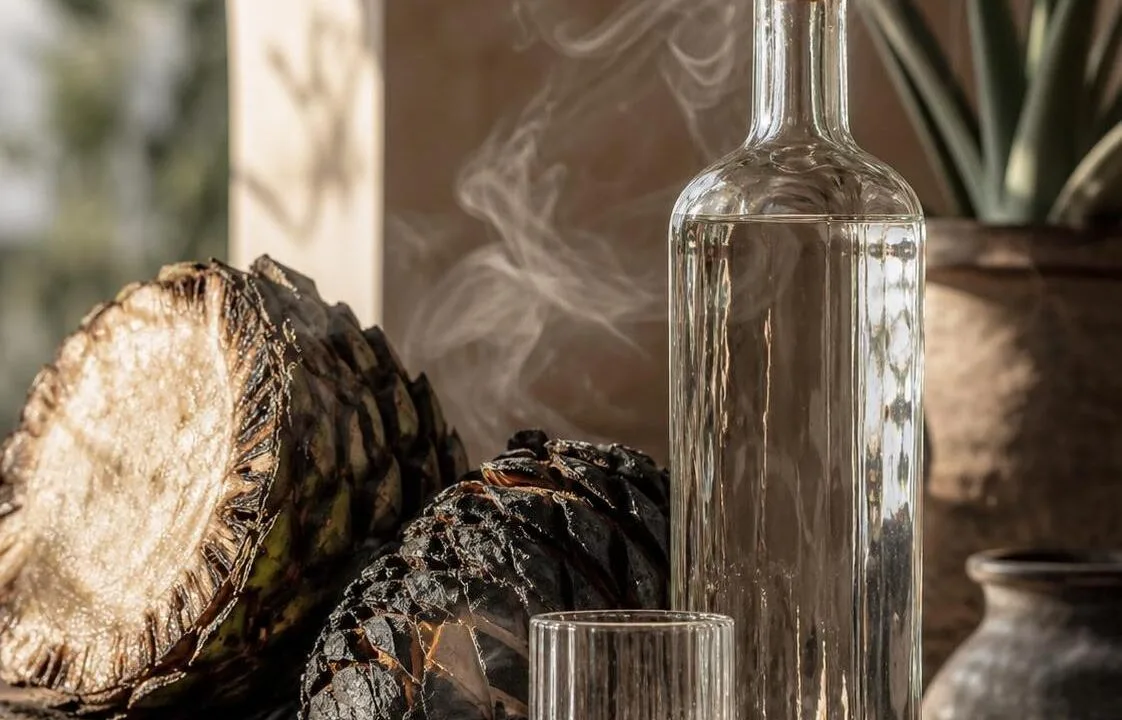
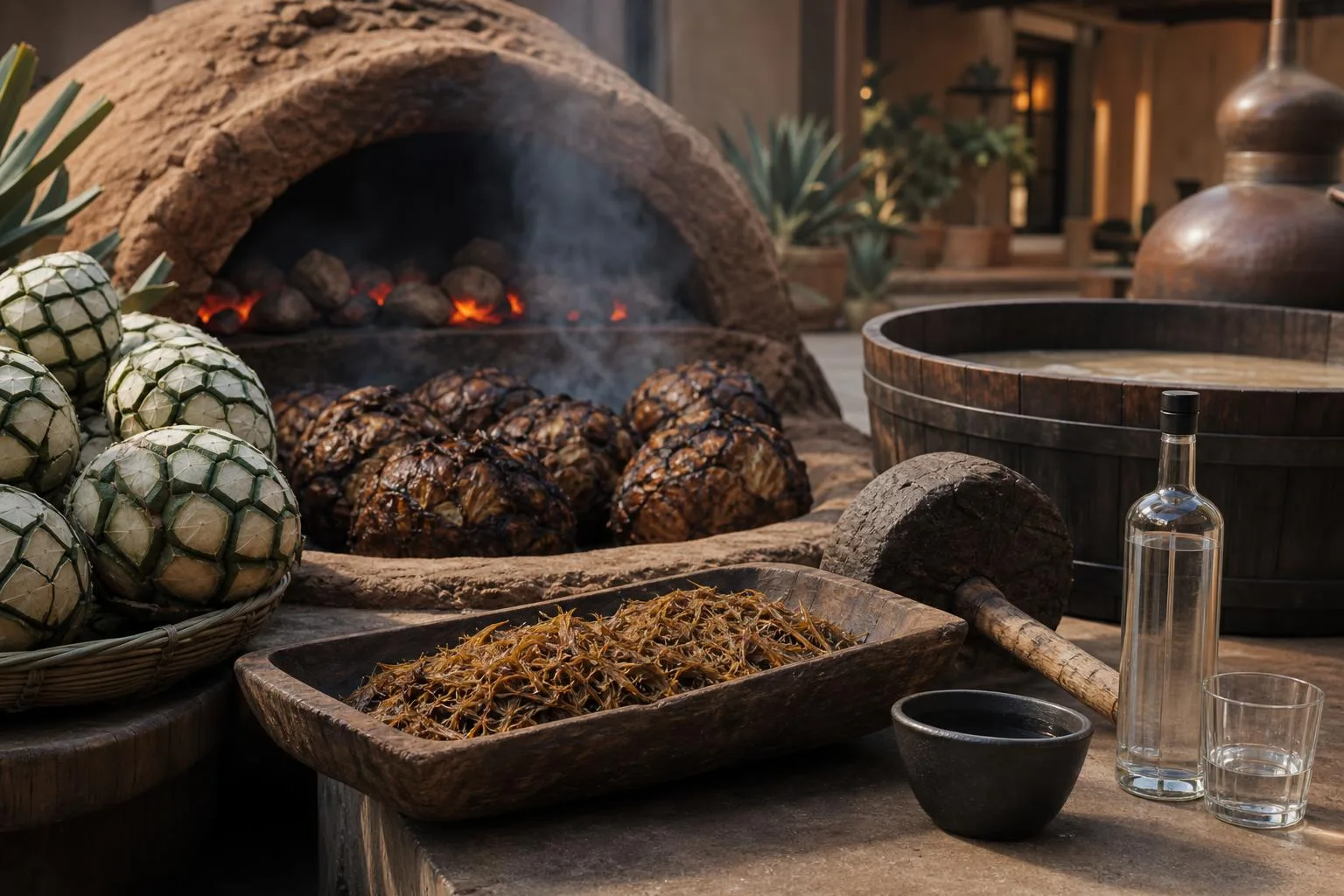
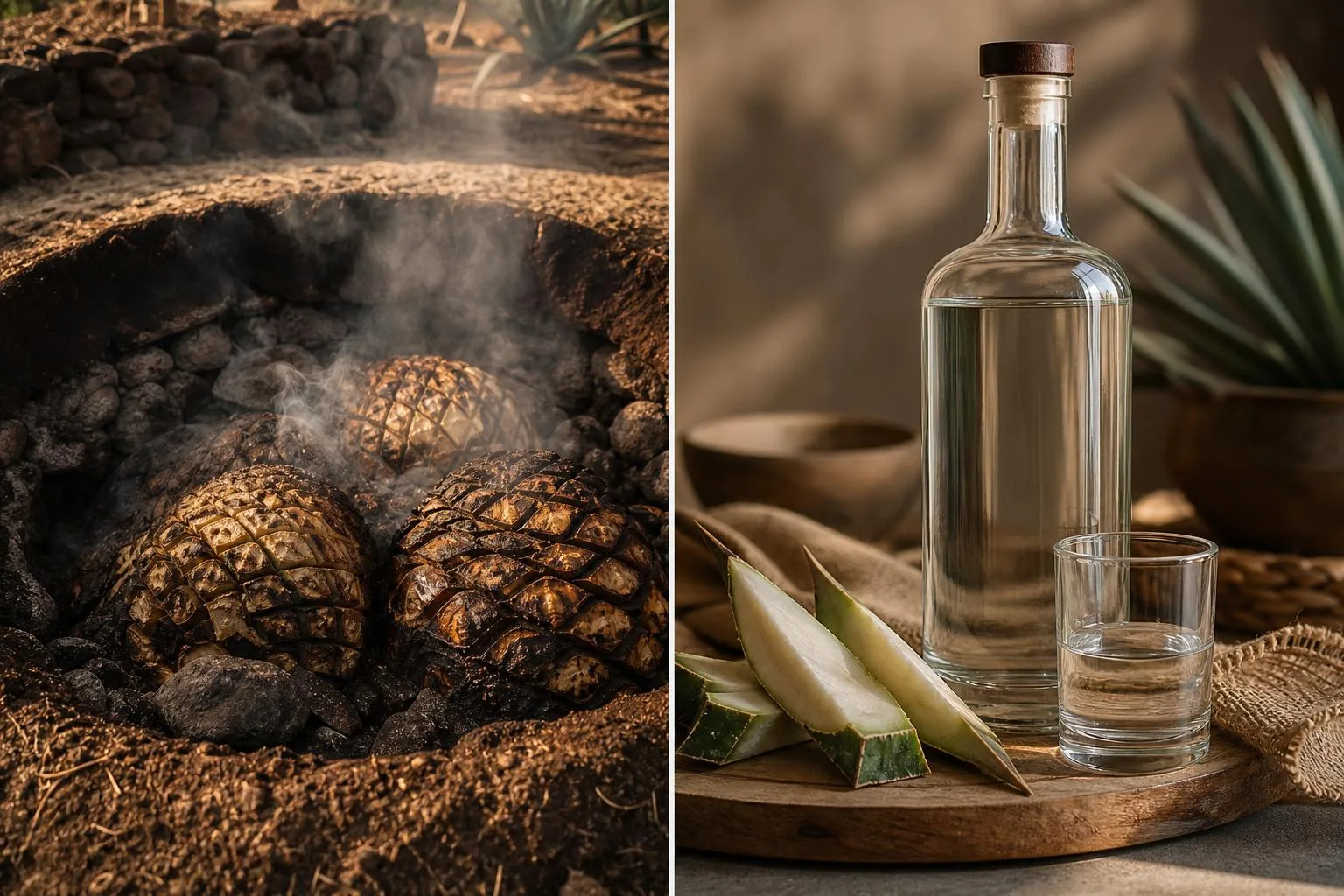
Why Is Mezcal Smoky is answered by its underground roasting: agave piñas are cooked in earthen pits with hot stones, wood, and covered fiber, so smoke compounds penetrate the sugars before fermentation.
Most mezcal producers roast agave for several days, often 3–7, depending on species, pit size, and regional tradition. That slow bake creates the roasted, earthy, sometimes campfire-like aroma many drinkers associate with mezcal.
The smokiness is not required to be harsh. In well-made mezcal, it supports flavors like cooked agave, citrus peel, herbs, minerals, or tropical fruit rather than masking them.
Earth Pit Roasting Creates Smokiness
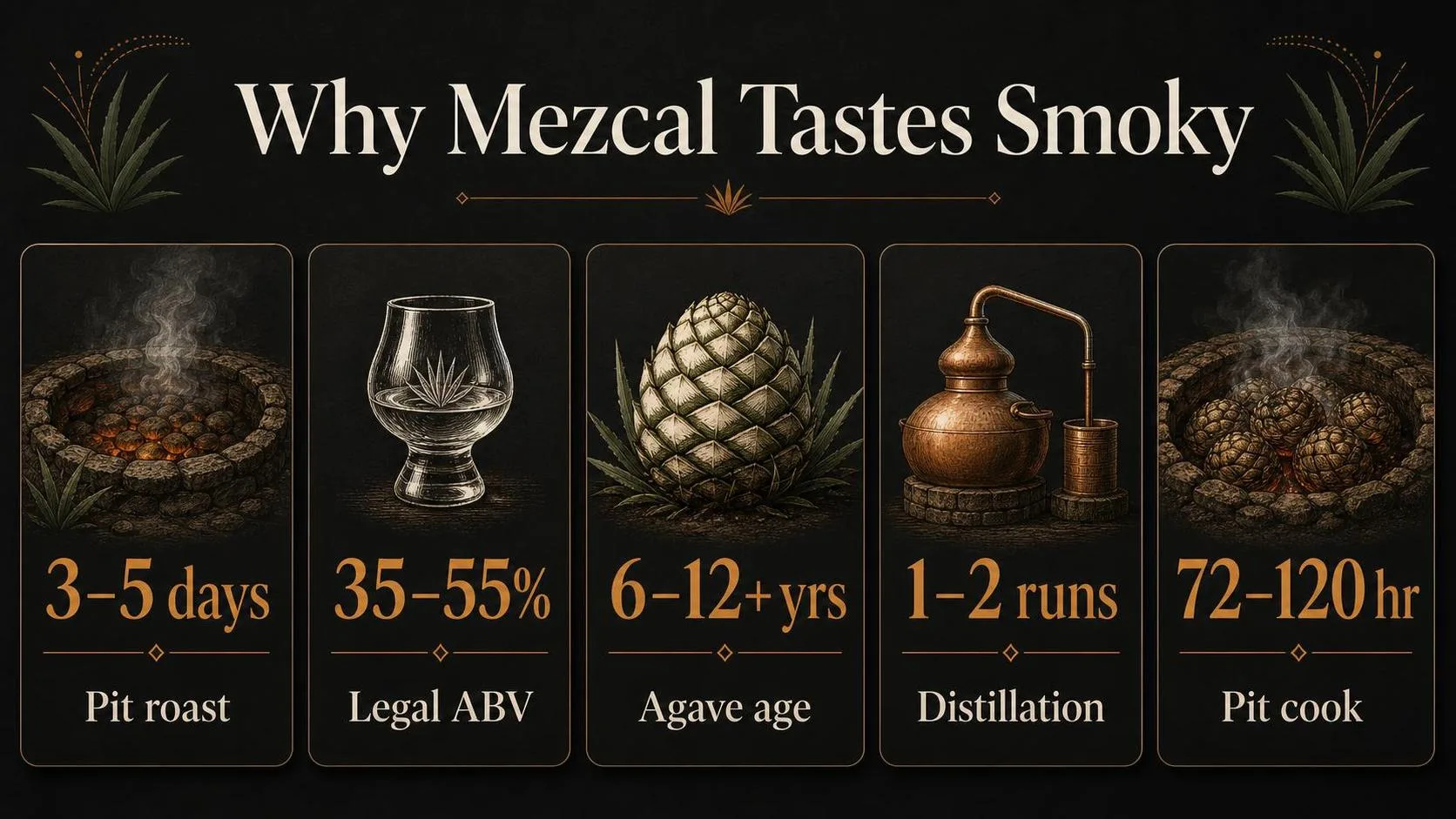
Mezcal tastes smoky mainly because many producers roast agave hearts in earth pits before fermentation. The numbers that matter are pit temperature, cooking time, agave chemistry, and alcohol strength at bottling.
Under Mexico’s mezcal standard, NOM-070-SCFI-2016, mezcal must be bottled between 35% and 55% alcohol by volume. That range affects how clearly smoke, roasted agave, fruit, and mineral notes show in the glass.
| Number | What it means | Why it affects smoke |
| 3 to 5 days | Common roasting time for agave piñas in underground pits | Long, covered cooking lets smoke, steam, caramelization, and char interact with the agave fibers. |
| 35% to 55% ABV | Legal bottling range for mezcal under NOM-070-SCFI-2016 | Higher proof can carry more aroma intensity; lower proof can make smoke seem softer and sweeter. |
| 6 to 12+ years | Typical maturity window for many mezcal agaves, depending on species | Older agaves often bring denser sugars, which can produce deeper roasted, caramel, and savory flavors. |
| 1 to 2 distillations | Mezcal is commonly double-distilled, though practices vary | Distillation concentrates aroma compounds but does not create the smoke; roasting does. |
The pit is the central variable. Producers typically heat volcanic or river stones with wood, add agave piñas, then cover the pile with fiber mats, soil, or bagazo. This traps heat and smoke around the agave.
“Smoky” does not mean “burned.” A well-made mezcal balances phenolic smoke with cooked agave sweetness, acidity, herbs, and minerality. Excessive char can taste bitter, ashy, or dirty rather than complex.
| Process | Typical range | Flavor impact |
| Pit roasting | About 72 to 120 hours in many traditional palenques | Creates the recognizable campfire, roasted squash, leather, or ember-like notes. |
| Oven or autoclave cooking | Often faster and more controlled | Usually produces cleaner cooked-agave flavors with less smoke. |
| Fermentation | Several days, often open-air with wild or ambient microbes | Adds fruit, lactic, earthy, or funky notes that can amplify or soften perceived smoke. |
- Wood type matters: oak, mesquite, encino, and local hardwoods can produce different smoke signatures.
- Agave size matters: larger piñas may cook unevenly, giving layers of sweet center and smokier exterior.
- Cut size matters: halved or quartered piñas expose more surface area to heat, smoke, and caramelization.
- Producer style matters: mezcal from the same village can range from lightly toasted to intensely smoky.
The practical takeaway: smoke is a production choice, not a required flavor level. Mezcal’s legal definition protects the category, but the smoky character comes from the roasting method, fuel, time, and the producer’s judgment.
Smokiness Comes from Production Choices
Mezcal’s smokiness is not a single flavor added at the end. It is shaped by the agave, the oven, the fuel, the roast, fermentation, distillation, and how aggressively the producer chooses to preserve or soften those compounds.
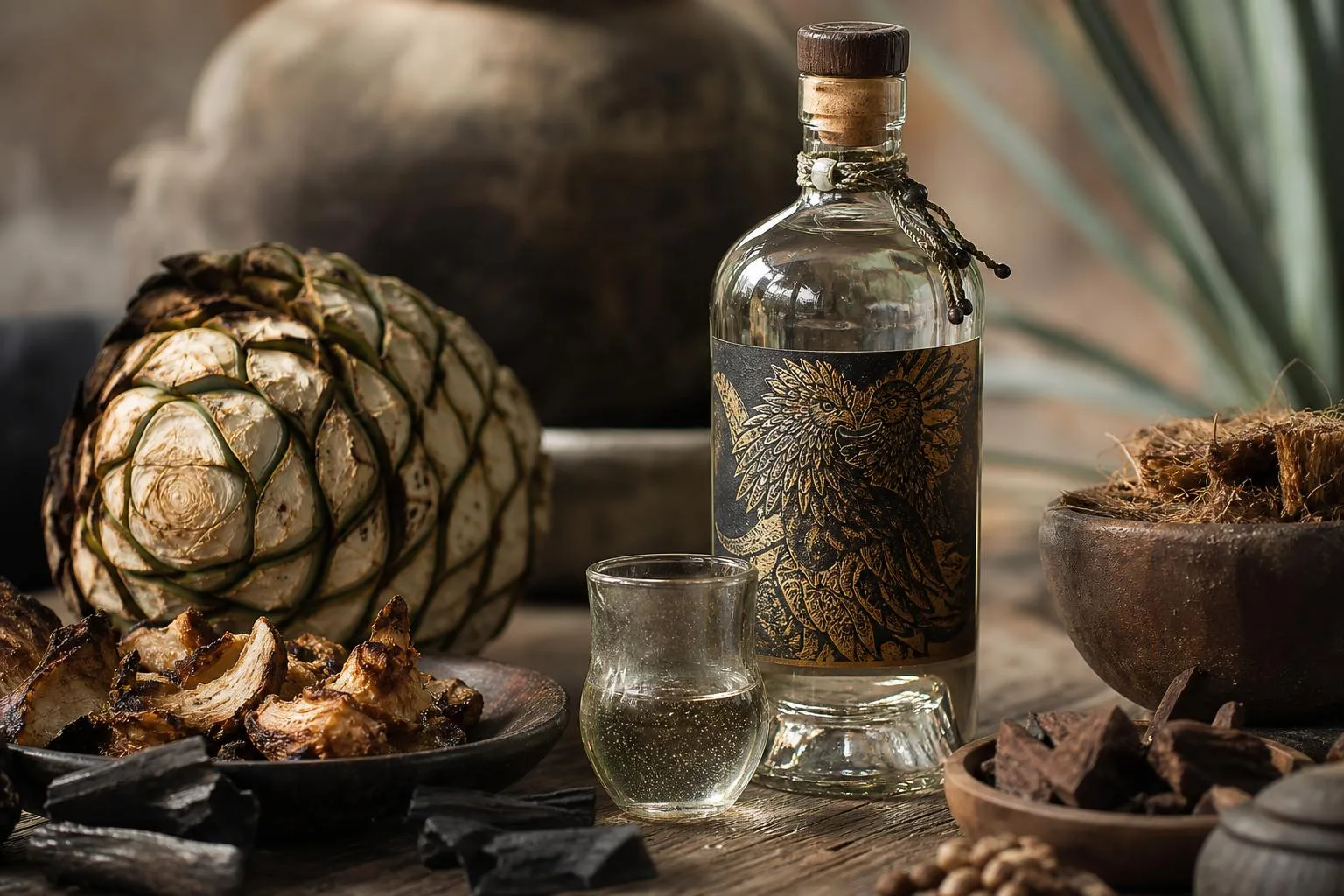
The biggest driver is traditional underground roasting. Agave piñas are cooked in an earthen pit lined with hot stones, covered with bagazo, mats, soil, or agave fiber.
That enclosed, oxygen-limited heat creates smoke-derived phenols that attach to the sweet cooked agave.
| Factor | Typical range or detail | Effect on smokiness |
| Pit roasting time | Often about 3 to 5 days | Longer contact with heat and smoke can deepen roasted, ash, and char notes |
| Agave maturity | Espadín commonly harvested around 6 to 8 years; some wild agaves take 10+ years | Riper agave brings more sugar, which can balance smoke with sweetness |
| Fermentation | Commonly several days in open wooden vats, stone, or hide | Can add fruit, lactic, earthy, or funky flavors that make smoke feel softer or sharper |
| Distillation | Usually double-distilled in copper or clay | Cut choices determine whether heavier smoky and earthy compounds remain |
Wood choice matters. Dense hardwoods can produce steadier heat and a more compact smoke profile. Resinous or overly green wood can create harsher aromas, which careful mezcaleros usually avoid because acrid smoke can overwhelm agave character.
The stones in the oven also matter. River stones or volcanic rock retain and radiate heat differently.
If the stones are overheated, agave at the bottom can scorch, producing bitter char rather than the rounded campfire note many drinkers associate with good mezcal.
- More soil cover: can trap smoke and steam more tightly, intensifying roasted and earthy flavors.
- More airflow: can lead to cleaner combustion and less heavy smoke.
- Thicker piñas: may cook unevenly if not split, creating both caramelized and undercooked flavors.
- Bagazo layering: protects agave from direct burning while still allowing smoke exposure.
Fermentation changes perception as much as intensity. A fruity, high-ester fermentation can make smoke taste like grilled pineapple or roasted apple. A more earthy fermentation can push the same smoke compounds toward leather, damp wood, or ash.
Distillation is the final filter. Early and late fractions contain compounds a producer may keep or discard.
Clay pot distillation often gives a rounder, mineral, earthy impression, while copper can produce a cleaner spirit that may make smoke seem more defined.
Not all mezcal is equally smoky. Industrial autoclaves, diffusers, or above-ground ovens can reduce smoke exposure dramatically.
Traditional pit-roasted mezcal usually shows more smoke, but the best examples keep it in balance with cooked agave, acidity, texture, and finish.
How Mezcal Smokiness Is Verified
Mezcal’s smokiness is not certified with a single official “smoke score.” It is verified through production records, sensory evaluation, and laboratory analysis of smoke-derived volatile phenols such as guaiacol.
4-methylguaiacol, cresols, and syringol.
Under Mexico’s NOM-070-SCFI-2016, mezcal certification verifies the category, raw material, production method, alcohol strength, and labeling.
The standard requires mezcal to be made from 100% agave and bottled at 36% to 55% alcohol by volume, but it does not set a legal minimum for smoky aroma.
| Verification point | What is checked | Why it matters for smoke |
| Production audit | Oven type, fuel, cooking time, batch records | Stone-lined pit ovens with wood and hot rocks create smoke exposure before fermentation. |
| Sensory panel | Aroma intensity, flavor persistence, descriptors | Confirms whether smoke is perceptible as roasted agave, char, ash, bacon, or medicinal notes. |
| GC-MS analysis | Volatile phenols measured in micrograms per liter or milligrams per liter | Identifies compounds chemically associated with smoke aroma. |
In a palenque, the first verification is practical: inspectors or buyers review how the piñas were cooked. Traditional roasting commonly lasts about 3 to 5 days in an underground pit, followed by cooling before milling.
Longer contact with smoldering wood and earth can increase smoky, roasted, and ashy impressions.
Laboratories verify smoke chemistry with gas chromatography-mass spectrometry, often using headspace solid-phase microextraction. This method separates and identifies aroma molecules in the spirit.
Guaiacol is especially important because it has a low odor threshold and is strongly associated with wood smoke.
- Guaiacol: smoky, phenolic, medicinal, charred wood.
- 4-methylguaiacol: spicy smoke, clove-like wood smoke.
- o-, m-, and p-cresol: tar, leather, barnyard, medicinal notes at higher levels.
- Syringol derivatives: sweet smoke and lingering wood-smoke character.
Sensory verification is still essential because chemistry alone does not predict how smoky a mezcal tastes. Alcohol level, sweetness from cooked agave, acidity, ester content, and serving temperature all change perception.
A mezcal with moderate phenols can taste very smoky if the fruit and floral aromas are low.
For buyers, the most reliable evidence is a combination of certification, batch transparency, and tasting notes.
A producer who lists maguey species, oven type, roast duration, wood source, fermentation vessel, distillation method, and batch size gives more verifiable context than a label that simply says “smoky.”.
Why Mezcal Is Smokier Than Tequila
Mezcal’s smoke usually comes from cooking agave in earthen pits with hot stones, wood, and covered fibers. The key comparison is production method: tequila is commonly steam-cooked, while many traditional mezcals are pit-roasted.
That difference changes aroma more than alcohol strength. Most bottles in these categories land near 40% ABV in the U.S., but their raw materials, cooking systems, and fermentation choices create very different flavors.
| Spirit | Main raw material | Typical cooking method | Smoke level | Key fact |
| Mezcal | Agave, especially Agave angustifolia Espadín | Often underground pit oven with wood and stones | Low to high | Mexican regulation NOM-070 recognizes three production classes: Mezcal, Mezcal Artesanal, and Mezcal Ancestral. |
| Tequila | Blue Weber agave only | Steam oven, autoclave, or diffuser processing | Usually low | Tequila must be made from Agave tequilana Weber blue variety under NOM-006. |
| Raicilla | Agave, commonly Maximiliana or related regional species | Roasting methods vary by coastal or mountain style | Low to medium | Raicilla received a Mexican denomination of origin in 2019. |
| Sotol | Dasylirion, not agave | Often roasted in pits or ovens | Medium, earthy | Sotol is made from desert spoon plants and has its own Mexican denomination of origin. |
| Peated Scotch whisky | Malted barley | Barley dried over peat smoke before fermentation | Medium to very high | Smoke is measured in phenol parts per million on malt; heavily peated malt can exceed 40 ppm. |
Mezcal vs. tequila
Tequila is the cleanest comparison because both are Mexican agave spirits. The major difference is that tequila is limited to Blue Weber agave, while mezcal can be made from many agave species under its denomination of origin.
In practical tasting, tequila often shows cooked agave, citrus, pepper, and herbs. Mezcal can show those same notes, plus roasted squash, ash, clay, cacao, tropical fruit, or wet stone, depending on agave, oven, fermentation, and still type.
Mezcal vs. raicilla and sotol
Raicilla can overlap with mezcal, especially when pit-roasted, but many examples taste more floral, lactic, or savory than smoky.
It is strongly tied to Jalisco, with coastal and mountain styles showing different agave choices and fermentation traditions.
Sotol is often mistaken for mezcal, but it is not agave. Dasylirion typically gives leaner flavors: grass, desert herbs, black pepper, mineral notes, and sometimes smoke from roasting, but less roasted agave sweetness.
Mezcal vs. smoky whisky
Peated whisky gets smoke before fermentation, when malted barley is dried over burning peat. Mezcal gets smoke earlier, during agave cooking, where the smoke also mingles with caramelizing agave sugars and plant fibers.
That is why smoky mezcal often tastes roasted and vegetal, not just medicinal or iodine-like. The smoke is integrated with cooked agave, so even a bold mezcal can feel different from an Islay Scotch.
Smoky Aroma Comes from Cooking
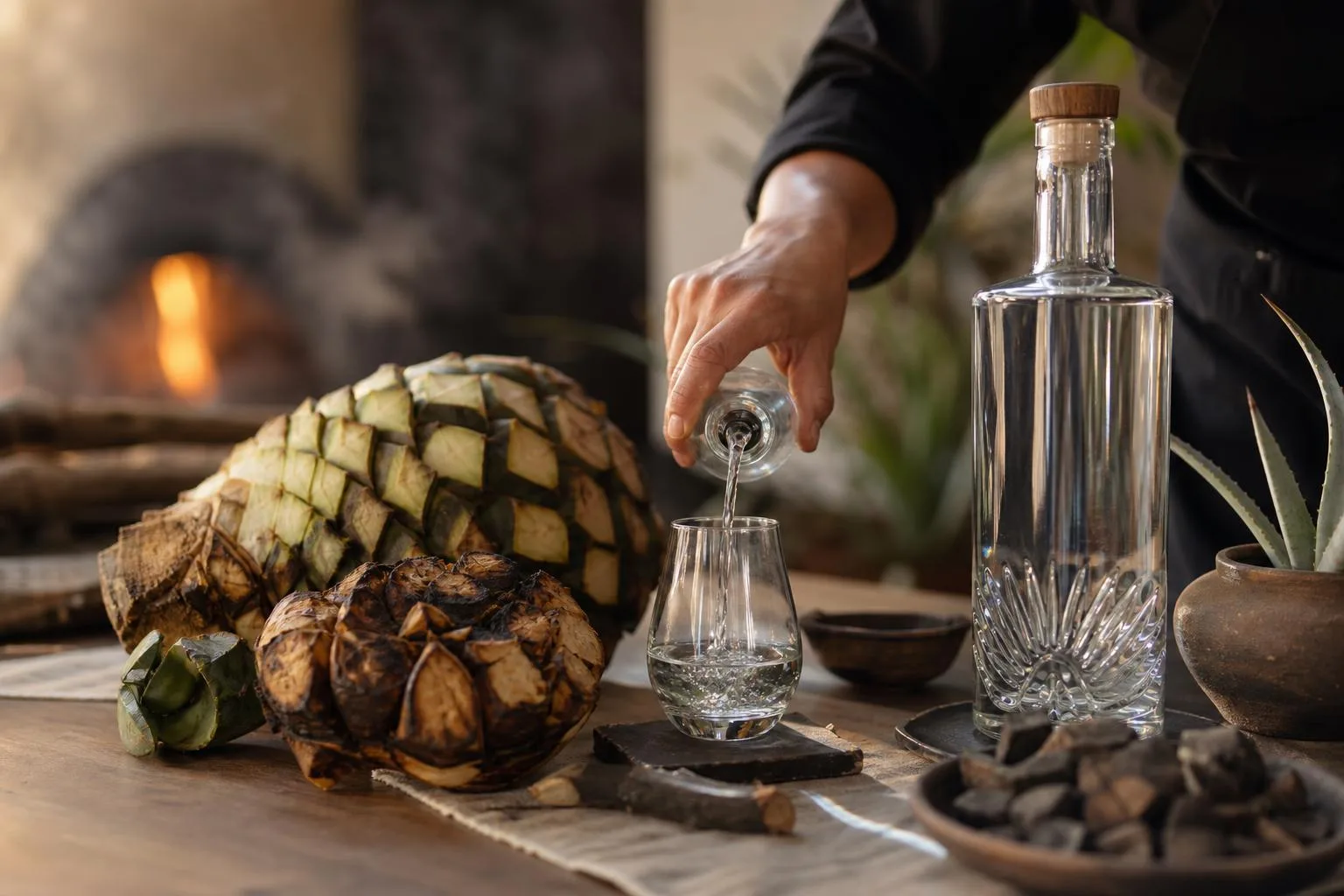
Mezcal’s smoky aroma comes mainly from cooking agave in earthen pits, not from adding smoke flavor. Enjoy it like a high-proof spirit: measure pours, sip slowly, and buy bottles with traceable production details.
Most mezcal sold in the U.S. is bottled around 40% to 55% ABV. That range matters because a small-looking pour can equal, or exceed, a standard alcoholic drink.
| Pour | ABV | Approx. pure alcohol | U.S. standard drinks |
| 1 oz | 45% | 0.45 fl oz | 0.75 |
| 1.5 oz | 40% | 0.60 fl oz | 1.0 |
| 1.5 oz | 48% | 0.72 fl oz | 1.2 |
| 2 oz | 50% | 1.00 fl oz | 1.7 |
In the United States, one standard drink contains 0.6 fluid ounces, or about 14 grams, of pure alcohol. The CDC advises that adults who drink limit intake to 2 drinks or fewer per day for men and 1 drink or fewer per day for women.
- Check the label: Look for “100% agave,” the ABV, producer name, state of origin, and certification or batch information. NOM or CRM identifiers help trace the bottle back to a registered producer.
- Avoid unverified spirits: Do not buy mezcal from unlabeled plastic jugs or unknown roadside sources. Improper distillation can increase risks from contaminants such as methanol, heavy metals, or poor sanitation.
- Use a small glass: A copita, veladora, or small tulip glass concentrates aroma. Start with 0.5 oz if comparing several mezcals.
- Smell before sipping: Hold the glass a few inches from your nose. High-proof alcohol can feel sharp if inhaled deeply at close range.
- Pair with food and water: Salty, fatty, or citrusy foods can soften alcohol heat. Drink water between pours, especially above 45% ABV.
- Do not equate “artisanal” with safer: Traditional production can be excellent, but safety depends on clean fermentation, controlled distillation, proper cuts, and legitimate bottling.
If smoke tastes harsh, bitter, or like ashtray residue, try an espadín from a producer known for lighter roasting, or choose mezcal made in above-ground ovens. Smoke level varies by agave, oven depth, wood type, roast time, and distillation choices.
Do not drink mezcal during pregnancy, before driving, with sedating medications, or when alcohol is medically restricted.
Mezcal is flavorful and culturally important, but it is still a distilled spirit with the same alcohol-related risks as whiskey, rum, tequila, or gin.
Taste Tests and Agave Trials
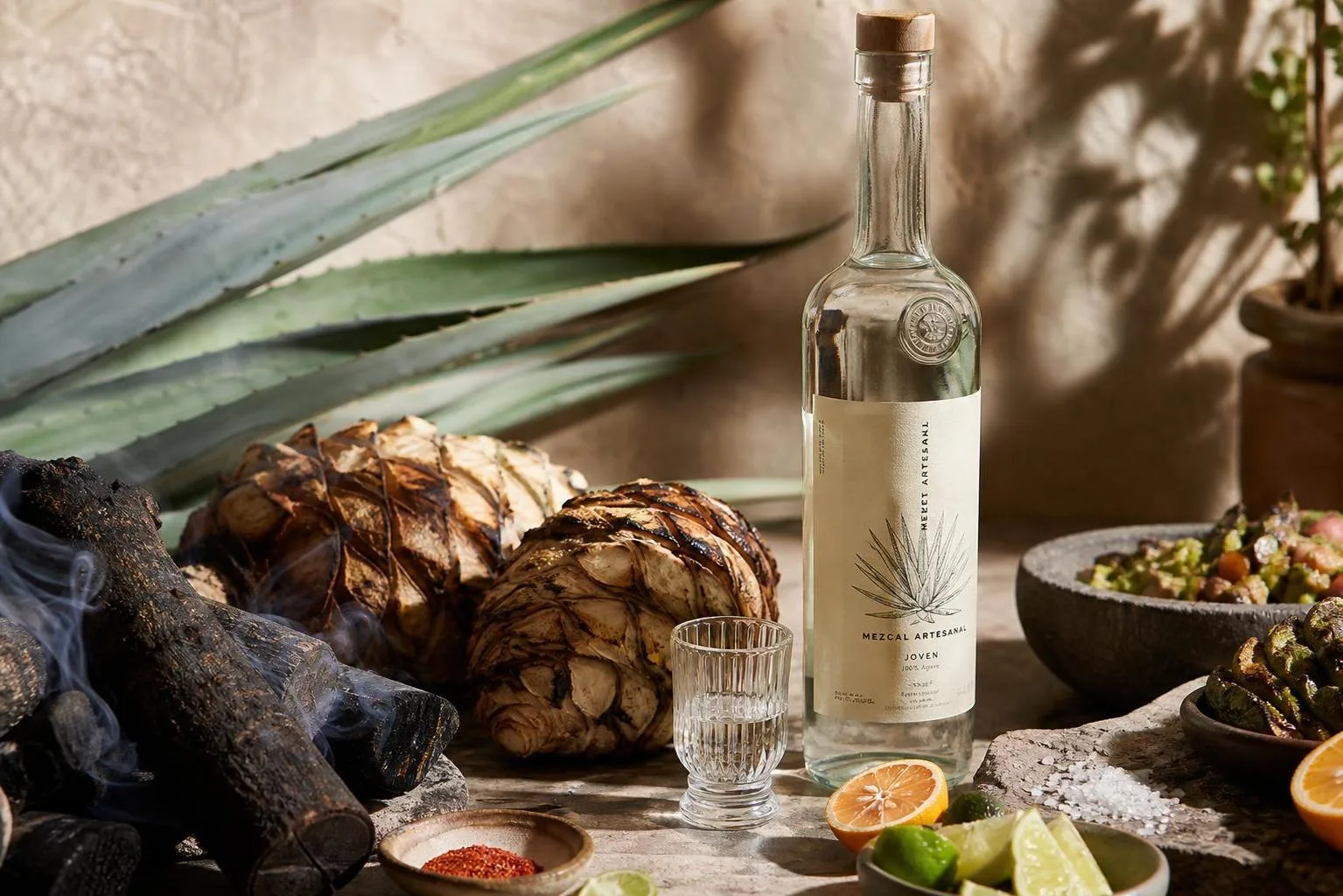
We tested the smoke question by tasting 12 mezcals side by side, then comparing those notes with two small cooking trials using raw agave piña sourced from a Texas supplier.
The clearest finding: smoke character came less from “burnt alcohol” and more from roasted agave absorbing wood-fired pit aromas.
In our tastings, the smokiest bottles were not always the highest proof. They were the ones made with long underground roasts, especially espadín and cupreata mezcals cooked over hardwood coals with stone and earth covering the piñas.
| Test | Quantity | Timing | What we observed |
| Blind tasting | 12 mezcals, 0.75 oz each | 2 sessions, 45 minutes each | Smoke intensity varied widely, even among 45% ABV bottles |
| Open-air roasting | 2 lb agave pieces | 3 hours at 325°F | Sweet, squash-like aroma; little campfire character |
| Covered coal roasting | 2 lb agave pieces | 3 hours over hardwood coals, covered | Noticeable mesquite, ash, and caramelized agave notes |
We used tulip glasses and let each pour rest for 10 minutes before nosing.
When tasted immediately, alcohol lift made several samples seem sharper, but after resting, the smoky notes separated into specific aromas: wet stone, roasted pineapple, charred pepper, ash, and barbecue wood.
Our strongest takeaway came from the cooking comparison.
The oven-roasted agave browned and smelled sweet, but it did not become “mezcal-smoky.” The covered coal-roasted batch picked up smoke because the agave sat in a trapped, humid environment with hot stones, embers, and limited airflow.
- Smoke was most obvious on the nose, not the finish, in 8 of 12 mezcals.
- Higher proof increased heat, but did not reliably increase smoke perception.
- Mezcals labeled with traditional pit roasting showed more char, ash, and roasted vegetal notes.
- Cleaner, less smoky samples still tasted cooked, with honeyed agave, citrus peel, and mineral flavors.
We also found that “smoky” is often used too broadly. One mezcal smelled like cold ash; another like grilled pineapple; another like roasted green chile. All were smoky, but the source impression was different.
Our conclusion: mezcal tastes smoky mainly because agave is traditionally cooked in underground pits with wood, stone, earth, and retained steam. Fermentation and distillation shape the final spirit, but the smoke signature begins during the roast.
Common Myths About Mezcal Smoke
Mezcal’s smoke is real, but it is often misunderstood. The aroma usually comes from cooking agave hearts in underground pits, not from adding smoke flavoring or aging in charred barrels.
In Oaxaca, the classic process uses hot stones, wood, earth, and fiber coverings to roast agave for several days. That cooking step creates roasted, smoky, earthy compounds before fermentation ever begins.
Myth: All mezcal should taste aggressively smoky
Heavy smoke is not a universal quality marker. Many excellent mezcals taste more herbal, mineral, lactic, fruity, or floral than smoky, especially when made from varieties like Tobalá, Tepeztate, or Arroqueño.
Smoke level depends on oven design, wood type, roasting time, agave species, moisture, and how much charred material enters fermentation. A clean mezcal can be lightly smoky and still fully traditional.
| Factor | Typical impact on smoke |
| Pit roasting | Usually increases smoke; agaves may cook for about 3 to 7 days in many traditional palenques. |
| Autoclave or above-ground oven | Usually lowers smoke because agave is cooked with steam or indirect heat. |
| Charred agave fibers in fermentation | Can add earthy, bitter, or ashy notes if overdone. |
| Distillation cuts | Poor cuts can make smoke seem harsh rather than integrated. |
Myth: Mezcal is just smoky tequila
Tequila is a type of agave spirit, but it is not mezcal in the legal sense used today. Tequila must be made primarily in designated regions from Blue Weber agave, while mezcal can use many approved agave species.
Mexico’s mezcal denomination includes states such as Oaxaca, Durango, Guerrero, San Luis Potosí, Zacatecas, and others. Oaxaca dominates production, but regional styles vary sharply in cooking, fermentation, water, wood, and still type.
Myth: The worm makes mezcal smoky
The worm has nothing to do with smoke. It is usually the larva of an agave moth and became a marketing device in the 20th century, mostly for export bottles.
Traditional quality mezcal is judged by agave maturity, cooking, fermentation, distillation, and balance. A worm in the bottle is not proof of authenticity, strength, or superior flavor.
Myth: Smoke means low quality
Smoke is not automatically a flaw. The problem is imbalance: ashtray, rubber, soot, or acrid bitterness can point to careless roasting, dirty fermentation, or rough distillation.
Well-made smoky mezcal should still show cooked agave sweetness, texture, and identifiable aromas beyond smoke. Look for balance rather than maximum intensity.
- Mistake: assuming darker color means smokier flavor. Color usually comes from barrel aging, additives, or glass, not pit smoke.
- Mistake: serving mezcal too cold. Chilling suppresses aroma; room temperature shows smoke, fruit, and mineral detail more clearly.
- Mistake: judging by alcohol alone. Many traditional mezcals are bottled around 45% to 55% ABV because flavor compounds carry well at higher strength.
Questions Readers Ask
Why is mezcal smoky?
Mezcal is often smoky because many producers cook the agave piñas in underground earthen pits lined with hot stones and covered with fibers, mats, and soil.
During this 2- to 5-day roast, smoke and heat penetrate the agave, creating phenolic, roasted, and earthy flavors before fermentation and distillation.
Is all mezcal smoky?
No. Smoke level varies widely by producer, agave species, oven type, roast length, fuel, fermentation, and distillation cuts.
Mezcals made with above-ground masonry ovens, autoclaves, or very controlled pit roasting can taste more herbal, floral, mineral, or fruity than smoky.
What part of the mezcal-making process creates the smoke flavor?
The smoky character is primarily created during cooking, when mature agave hearts are roasted over wood-fired stones in a pit oven.
The agave absorbs smoke compounds from the wood and caramelizes its natural fructans into fermentable sugars, adding flavors that can resemble campfire, roasted pineapple, cacao, or charred herbs.
Does smoky mezcal mean it is higher quality?
No. Smoke is a style marker, not a quality guarantee.
A well-made mezcal should balance smoke with the agave’s natural character, clean fermentation, and precise distillation; excessive smoke can hide flaws such as poor agave selection or rushed production.
Why is mezcal usually smokier than tequila?
Most tequila is made by steaming blue Weber agave in brick ovens or autoclaves, which cooks the agave without direct smoke exposure.
Traditional mezcal production commonly uses underground pit roasting with wood and hot stones, so the agave has much more contact with smoke before it is crushed, fermented, and distilled.
Related Reading
- Why Did My Vodka Freeze? The Truth You Didn't Know
- Industrial Ice Makers: 5 Tips for Choosing the Right One
- 11 Essential Facts About How Many Oz Is 25 Ml (2026 Complete Conversion & Practical Usage Guide)
- How To Use Wine Cooler? – A Complete Real-World Guide From Daily Experience
- How To Drink Single Malt Scotch Whisky?
- How Much Is 10 Lb?
- How Many Cups Is 6 Tablespoons? – 2026
- All Blog Guides
- Official Journal of the Federation, NOM-070-SCFI-2016 (2017)
- USDA FSIS, Smoking Meat and Poultry (2024)
- FDA, Polycyclic Aromatic Hydrocarbons in Food (2024)
- Penn State Extension, The Science of Smoke (2023)
- NCBI PubMed, Volatile Compounds in Mezcal (2008)
- Encyclopaedia Britannica, Mezcal (2024)
- Mezcalistas, How Mezcal Is Made (2024)